
October 23, 2026 • 13 min read
Gartner Magic Quadrant for CCaaS 2026: What You Need to Know

Director of Content & Market Research
October 23, 2026

The report comes at a time of great change for the space.
Now, buyers care more about how well their CCaaS solution fits within the broader enterprise ecosystem, its data architecture, and governance models.
Meanwhile, the emphasis on interaction management, routing, and standalone AI solutions is dwindling as much of that has become commoditized.
Given this upheaval, many may have anticipated a greater shake-up of the Magic Quadrant.
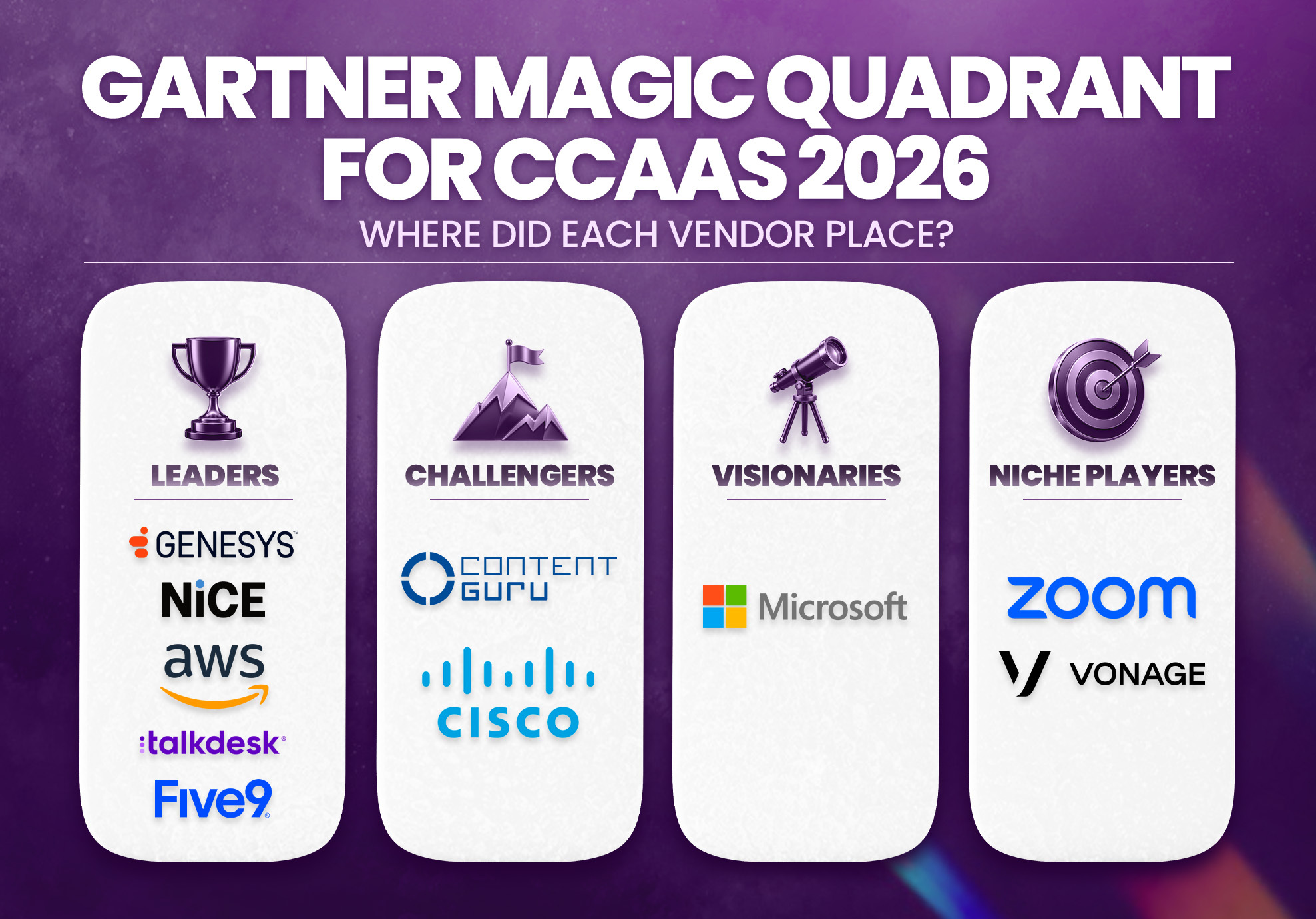
Yet, the results are eerily similar to previous years, with Microsoft the only new entrant since 2025 and Cisco the only mover (from Niche Player to Challenger).
Ultimately, this may reflect how effectively leading players are adapting to a changing market and intensifying competition.
How Does Gartner Define CCaaS ?
Essentially, Gartner defines a CCaaS solution as a suite of cloud-based applications that enables the effective management of multichannel customer interactions from both the customer and employee perspectives.
Mandatory features include cloud-hosted application access, global voice and data connectivity, digital routing, workforce engagement management (WEM) tooling, and prepackaged agent, supervisor, and reporting applications.
Although the report explores additional optional features, Gartner’s overall CCaaS definition remains unchanged, word for word, from the previous report.
Some may interpret that as the analyst holding its breath, waiting for a clearer picture of where the market is headed, now that vendors are evolving their visions and innovating faster.
How Did the CCaaS Providers Perform? (And Who Missed Out?)
Gartner named the same five Magic Quadrant leaders as in 2025: Genesys, NiCE, AWS, Talkdesk, and Five9.
Cisco joins Content Guru in the Challenger quadrant, having previously placed in the Niche Player group.
Meanwhile, Microsoft makes its debut in the study as the only “Visionary.”
Finally, Zoom and Vonage hold their places in the Niche Player quadrant.
Yet, the market is much more than these ten players, with Gartner listing 8x8, Dialpad, Odigo, RingCentral, Salesforce, and Sprinklr as honorable mentions.
Elsewhere, others were unfortunate to miss out altogether. Nextiva is perhaps the most obvious omission, supporting thousands of businesses' contact center operations, from Hynudai to DHL.
Additional examples include:
- Zendesk: It’s extending many of its 160,000+ strong customer base to CCaaS, unifying CRM, CCaaS, WEM, and conversational AI in one environment.
- UJET: Its chief differentiator is using context from customers’ mobile devices to streamline and personalize their experience.
- Puzzel: Like Odigo, Puzzel is big in Europe, where its sovereign cloud offerings are widely deployed.
- Twilio: Its Flex solution is now often embedded inside third-party systems of record, making it a popular choice among systems integrators (SIs).
Given this, buyers should also consider providers outside the report’s remit. That said, the study is a helpful guide to many of the market’s biggest players’ strengths and cautions.
Gartner Magic Quadrant Leaders
Leaders in the Magic Quadrant scored above average in its aggregated criteria for both their “Ability to Execute” and “Completeness of Vision.” Gartner’s 2026 Leaders are:
Genesys
Genesys draws plaudits for its “easy on-premises-to-cloud migration,” “agent orchestration enablement,” and “large, complex deployments.”
That migration piece is a long-time strength, with its Ignite Program including pilots, playbooks, and AI trials that validate value before commitment. Genesys also avoids double-charging for customers migrating from Engage to Cloud CX.
Yet, orchestration is its big drive. While rival vendors are now building toward this, it has been Genesys’s big push for years. Most recently, it announced four new orchestration solutions to understand intent, preserve memory across resources, and move interactions forward.
However, one word Gartner surprisingly omits is “ecosystem.” Genesys goes beyond integrating with other systems, partnering with the likes of Adobe, ServiceNow, and Sierra and innovating alongside them.
In doing so, it helps expand the contact center’s role within the enterprise, and this advantage will likely prove significant as agent-to-agent innovation evolves.
NiCE
Gartner lists NiCE's core strengths as “leading conversational AI platform,” “human agent guidance,” and “large, global account support.”
The conversational AI platform comes from Cognigy, which NiCE quickly embedded into its CXone solution, taking interaction data, spinning up customer-facing AI agent prototypes, and projecting ROI before implementation. Via Cognigy, brands can also configure AI agents via coding agents, like Codex or Cursor, accelerating deployments.
Other key strengths Gartner may not have had the space to acknowledge include its WEM portfolio and mature sovereign cloud.
NiCE is one of only two CCaaS vendors, alongside Cisco, to announce a hybrid WEM solution for both human and AI agents across intents. That’s innovative. Meanwhile, NiCE IEX remains a market-leading workforce management (WFM) solution that brands can integrate, offering capabilities that rival CCaaS platforms cannot match.
On the sovereign cloud, it has a mature solution across the EU, UK, and Australia, alongside a proven support system grounded in over three years of complex deployments. This strength won NiCE a deal worth over $600 million with HMRC, the UK tax authority, early this year.
AWS
AWS wins credit for its “customizable solutions,” “global scalability,” and “AWS AI portfolio.”
Gartner highlights customer satisfaction with Lex, the chatbot builder included in its AI portfolio. Yet, this will soon be the past for many customers. After all, AWS seems to be shifting this out and replacing it with a new Agentic CX designer and Live Sync capability.
That Live Sync capability stems from its April 2026 NLX acquisition and paves the way for AI-led voice experiences that sync with the customer's smartphone, enabling contact centers to overlay digital elements over voice conversations. That’s true multimodal CX.
Elsewhere, the research firm doesn’t mention Amazon Connect Customer’s fully consumption-based pricing model as a strength. Instead, it’s considered a caution, as it can make pricing unpredictable.
Nevertheless, many consider it an advantage rather than a drawback. After all, there are no upfront commitments, capacity constraints, licences, or tokens to manage. Brands simply pay for what they use. As the future of seat-based pricing remains uncertain, this offers a practical alternative.
Talkdesk
The Magic Quadrant study lists “unified customer data,” “account managers,” and “preconfigured industry-specific AI solutions” as Talkdesk’s lead strengths.
Its industry-specific clouds have long been touted as a differentiator and still are, comprising sector-specific integrations, workflows, and AI models.
The clouds can also include unique capabilities. Take its financial services contact center as an example. It features a Talkdesk for Financial Services solution that gives branch workers the same pre-conversation context and guidance tools that contact center teams use.
Talkdesk has also seen considerable success with its customer experience automation (CXA) portfolio, which enables it to layer its latest AI innovations onto legacy environments without requiring teams to migrate.
Crucially, this approach has allowed Talkdesk to influence organizations’ CX strategies and build relationships with brands that may eventually migrate. This positions Talkdesk as a natural partner when they do.
Five9
Five9 gains commendation from Gartner for its “broad market fit,” “outbound engagement,” and “support services.”
Such outbound engagement capabilities include its Advanced Campaign Manager, which includes coordinated outbound campaigns, AI-driven targeting and timing, no-code compliance, and more.
These tools come at a timely moment, as outbound contact centers regain momentum. With more mature data strategies, service teams can detect issues in real time and proactively reach out to resolve them, adding a personal touch as AI takes on more inbound interactions.
Beyond Gartner’s listed strengths, Five9 benefits from its close relationship with Google. It is the only CCaaS provider in the evaluation hosted on Google Cloud and available through its marketplace, a partnership that helped it secure a $100 million financial services deal earlier this year.
Finally, the vendor’s “humantic” vision is compelling. This involves taking insights from top-performing human agents to benchmark and guide AI agent performance.
Gartner Magic Quadrant Challengers
Challengers in Gartner’s Magic Quadrant scored above average on aggregated “Ability to Execute” criteria, but below average on “Completeness of Vision.” Gartner’s 2026 Challengers are:
Content Guru
Gartner identifies Content Guru’s core strengths in “large, complex deployments,” “high service availability,” and “large language model (LLM) flexibility.”
These strengths echo the industry perception of Content Guru as Mr. Dependable, meeting enterprises where they are and pulling together messy ecosystems of legacy, home-cooked, and cloud innovations into a modern, agile environment.
However, Gartner omits that this environment doesn’t need to be a public cloud. Content Guru also offers a mature sovereign cloud proposition, proven across Europe and the UK, Australia, and - most uniquely - the US.
As a result, it’s a popular pick in highly-regulated industries, like the public sector, where it has secured the much-coveted FedRAMP Class D (High) Authorization.
Finally, Content Guru’s built-in customer data platform captures conversation data and critical context, while synchronizing updates across enterprise systems. As brands rethink the contact center’s role in the broader business ecosystem and how to leverage its data more effectively, this is a powerful differentiator.
Cisco
Cisco wins praise in the 2026 Magic Quadrant for its “integrated communication platforms,” “advanced AI security measures,” and “global solutions.”
The vendor brings CCaaS, UCaaS, and CPaaS together in its Webex suite to deliver this integrated communications platform. This gives Webex Contact Center customers access to advanced proactive customer service capabilities, swarming, and insights into how employees across the business collaborate to resolve customer issues.
Cisco’s advanced AI security measures highlight its ability to draw on its broader portfolio to strengthen its CCaaS offering. Gartner specifically highlights AI Defense, which enables teams to build sophisticated, custom AI guardrails using natural-language instructions alone.
An example that’s not in the study is how Cisco has embedded ThousandEyes into its platform, ensuring observability into the performance of specific contact center applications and networks.
Finally, Cisco’s rapid innovation in 2026 is also worth mentioning. That includes announcements around hybrid human-agent WEM, real-time translation, and - most recently - Dialog, which delivers more business context to customer-facing agents.
Gartner Magic Quadrant Visionaries
Visionaries in Gartner’s Magic Quadrant scored below average on aggregated “Ability to Execute” criteria, but above average on “Completeness of Vision.” Gartner’s 2026 Visionaries are:
Microsoft
This year’s new entrant draws praise for its “integrated CX platforms,” “Microsoft AI ecosystem,” and “global sales network.”
Its integrated CX platform strength reflects how tightly Dynamics 365 Contact Center connects with Microsoft’s customer service CRM, Dynamics 365 Customer Service, and its UCaaS solution, Microsoft Teams.
On the latter, enabling enterprises to use the same voice channel for customer, employee, and partner conversations can simplify migrations. Gartner also highlights how the integration supports “contractual simplicity.”
However, the big benefit is that organizations can consolidate their CX ecosystem around the solutions they already use. With so many businesses effectively being “Microsoft shops,” this is a key advantage.
Gartner offers limited detail on what sets Microsoft’s AI ecosystem apart. However, Microsoft does embed native AI agents across its platform, supporting not only self-service but also quality assurance, knowledge management, and administration. Some of these are now available for enterprises to layer on top of legacy platforms, through Microsoft Contact Center Intelligence (CCI).
Gartner Magic Quadrant Niche Players
Niche Players in the Magic Quadrant scored below average for both their “Ability to Execute” and “Completeness of Vision.” Gartner’s 2026 Niche Players are:
Zoom
Zoom won plaudits for its “bundled AI pricing,” “tight UCaaS integration,” and “simplified setup and administration.”
On pricing, Gartner commends Zoom’s inclusion of AI tools in its per-seat model, rather than charging additional usage-based fees. At Zoomtopia 2026, Zoom built on this further.
Now, it follows a “spend-based pricing model”, with one annual commitment covering the Zoom CX portfolio and no separate line items between products. Alongside Zoom Contact Center and WEM, that portfolio also includes Zoom Virtual Agent (ZVA).
At Zoomtopia, Zoom also enhanced its QA solution to track conversations across human and AI agents, as well as front- and back-office teams, giving organizations an end-to-end view of where service experiences break down. It also offers AI roleplays based on conversations where agents struggled, which is a capability unique among vendors in this evaluation.
Then, Zoom made significant updates to CX Insights, which combines operational and conversational data, analyzes it, and proactively recommends customer and employee experience improvements.
However, the report’s timing may be unfortunate for Zoom, as Gartner conducted the research before these and several other significant announcements.
Vonage
Gartner gives Vonage credit for its “strong network security features,” “tight UCaaS and CPaaS integration,” and “Salesforce Service Cloud integration.”
These security capabilities stem from Ericsson, Vonage’s parent company. Its APIs leverage network-level data to detect fraud, such as SIM swaps, adding a silent layer of authentication.
As AI deepfakes undermine traditional contact center identity verification methods, including voice biometrics, this capability is increasingly valuable.
More broadly, Vonage’s CPaaS strength enables contact centers to connect with other systems, replicate complex legacy configurations, and support advanced proactive workflows.
Gartner also acknowledges Vonage’s high ratings on Salesforce AppExchange. Beyond this, its Intelligence Workspace provides a single pane of glass across multiple CRM instances, offering another notable advantage.
CCaaS Trends Recognized In the Magic Quadrant
The 2026 Gartner Magic Quadrant points toward many major CCaaS trends. Here’s a closer look at four of the most significant.
1. Agentic AI Deployments Are Dragging Along
The first round of generative AI (GenAI) innovations proved relatively straightforward, with use cases like intent analysis and auto-summaries not requiring contact centers to reconsider their operating models.
Agentic AI is proving much more complex, requiring contact centers to rethink data structures, governance models, and employee workflows. Meanwhile, the ROI, compared to something like an auto-summary, is not so clear-cut.
Ultimately, these concerns show up in Gartner’s vendor cautions, where even its market leaders are dinged for AI deployments that run longer than anticipated.
2. The Demand for Assistive AI Is Rising
As agentic AI projects stall, Gartner states that contact centers are seeking a “balanced approach to AI-infused CCaaS transformation,” with more turning to assistive AI.
In itself, the evolution of contact center Agent Assist is fascinating. Now, it auto-drafts replies, pulls context from previous customer conversations, and guides reps through resolution flows. It’s not just chucking up knowledge articles anymore.
The next iteration of this technology is also exciting, as it may not only recommend next best steps, but offer to perform them across systems. However, this will once again lead contact centers into the currently murky waters of agentic AI.
3. CCaaS Providers Face Rising Competition
Gartner notes growing competition from CRM providers, which are expanding into the contact center market and positioning their desktops as the primary interface for customer service.
Alongside Microsoft, Salesforce and Zendesk are further examples of this trend, with both launching CCaaS solutions over the last 18 months.
However, it’s not only CRM providers. UCaaS and CPaaS providers are also stepping into the space and looking to win business. Meanwhile, conversational AI vendors may also make a similar move, with Crescendo recently throwing its hat into the ring.
Why? Because while their solutions can deliver value fast, the underlying infrastructure sets a ceiling on how successful a conversational AI deployment can be.
4. The Race to a Sovereign Cloud Is On
Demand for CCaaS is still rising, with Gartner predicting CCaaS will account for more than half of agent licenses globally by the end of the year.
Nevertheless, Gartner highlights the “geopolitical complexities” of buying from US suppliers, prompting many vendors to expand their sovereign cloud offerings.
That’s especially the case in Europe, where Genesys released such an offering earlier this year. Meanwhile, the research firm also tags Cisco and Odigo as possible sovereign cloud options.
Yet, NiCE and Content Guru also deserve a shout-out here for their mature sovereign cloud propositions inside and beyond the continent.
Interestingly, many of these same trends cropped up in ISG’s latest contact center study. Unpack those findings by reading its 2026 Contact Center Buyers Guide.