
October 21, 2026 • 5 min read
Microsoft Announces an AI Agent Suite to Modernize Legacy Contact Centers

Director of Content & Market Research
October 21, 2026
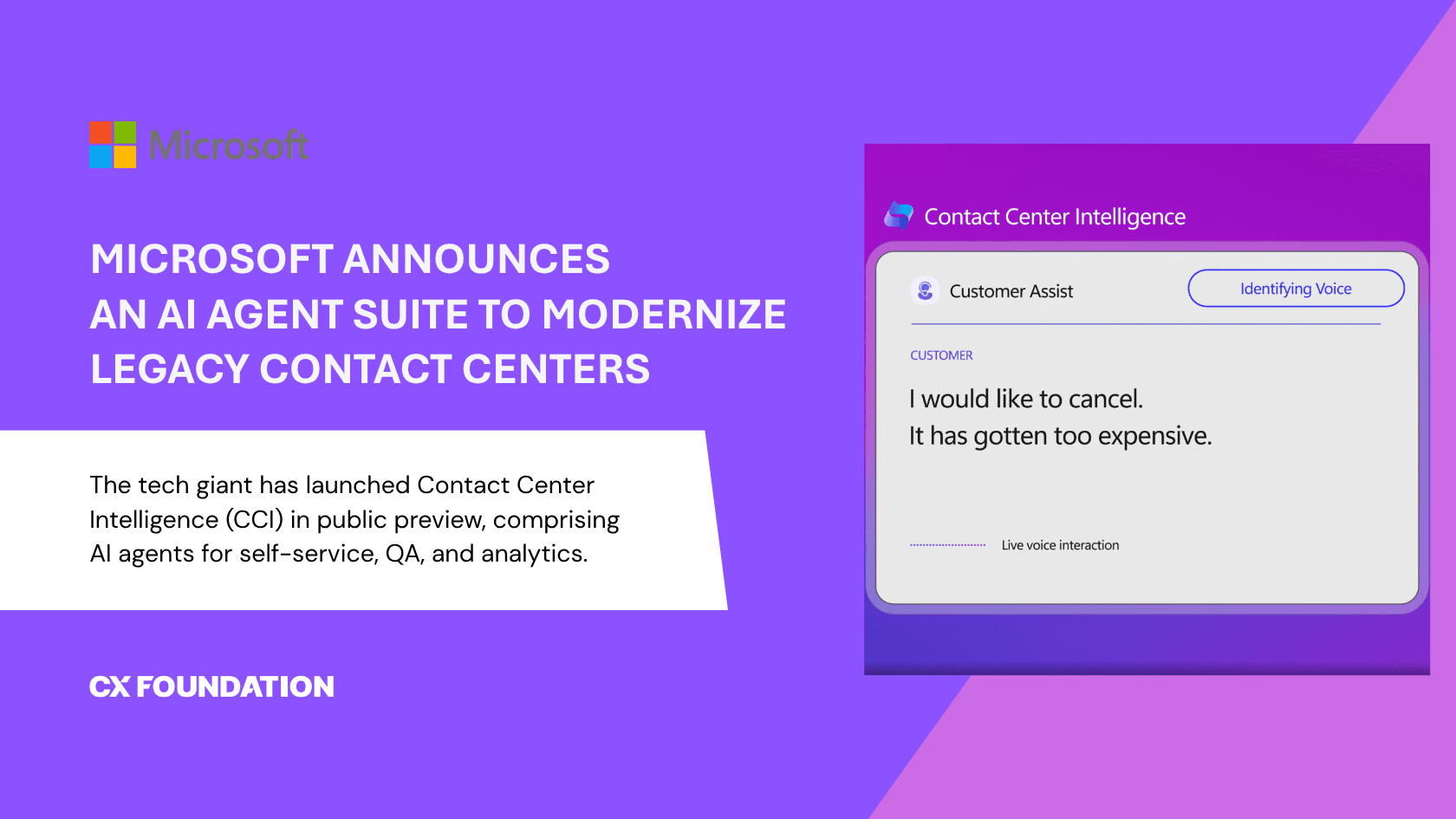
Microsoft has launched Contact Center Intelligence (CCI) in public preview.
Essentially, Microsoft CCI is a standalone AI agent suite that businesses can layer on top of their existing contact center platforms.
The suite adds AI agents for self-service, quality assurance, and analytics, all initially launched as part of the Microsoft Dynamics 365 Contact Center.
Now, the tech giant is extending these agents to third-party environments through an open connector, allowing customers to access its latest contact center AI innovations without a time-consuming migration.
“A full platform migration is often expensive, disruptive, and difficult to justify. Microsoft Contact Center Intelligence gives organizations another option. It allows them to bring Microsoft’s AI capabilities into their existing contact center environment, helping them modernize customer and agent experiences without a rip-and-replace project.”

Other vendors, such as NiCE, Talkdesk, UJET, and Zoom, have taken a similar approach, spinning out AI solutions from their core platforms to deliver value on top of on-premise and rival CCaaS environments.
Microsoft’s differentiator is in the context it can deliver to these agents.
CCI grounds agents in data from Microsoft IQ (the company’s enterprise intelligence layer) and, through 1,700 connectors, taps into often-disconnected contact center insights, CRM data, and knowledge content.
The tech giant also promises a new “customer conversation harness” to ensure its self-service agent (the Customer Assist Agent) learns from other contact center interactions.
Ultimately, this means that AI agents can leverage more context, better understand customers, and act accordingly.
What’s Included within Microsoft CCI?
Essentially, Microsoft CCI is built around three core agents, each powered by the contact centers ÁI models of choice:
- The Customer Assist Agent autonomously resolves customer issues across channels. Thanks to a new designer, the agent follows agentic or, where specified, deterministic workflows. When it isn’t sure of a resolution, or when the customer requests it, the agent escalates to a human, passing over the context of the interaction so far. Contact centers can monitor the agent via Microsoft’s Multimodal Agent Score (MAS) to ensure quality before deployment.
- The Quality Assurance Agent evaluates both AI and human interactions against quality, compliance, and brand standards, pulling intelligence from every interaction.
- The Service Operations Agent (coming soon) helps to validate and monitor systems and processes across the current contact center environment.
As noted previously, these agents are also grounded in Microsoft IQ plus intelligence drawn from over 1,700 connectors.
Additional features include voice biometric authentication and agent governance through Agent 365, available through Microsoft’s 365 E7 license.
However, Microsoft isn’t done there, promising that additional AI agents for coaching and agent assist are on the roadmap.
All agents are priced on a consumption basis through Copilot Credits.
Why Should Contact Centers Care About Microsoft CCI?
The big benefit is that organizations can access AI without an expensive, disruptive platform migration. That drives faster time to value.
Thomas Jefferson University is one early adopter that experienced this benefit.
“We began the preview in September, and just six weeks later, we are preparing to go live. That speed gives us a faster path to measurable value.”

Yet, there are also other possible benefits.
Consider how the Quality Assurance Agent pulls conversational intelligence from every interaction. This allows contact centers to more accurately track outcomes such as resolution, sentiment, and satisfaction.
This intelligence also gives brands greater visibility into failure demand, helping them make more informed decisions about customer-facing AI deployments while identifying opportunities to improve processes both within and beyond the contact center.
The Broader Trend
91% of customer service leaders are under pressure to implement AI, according to Gartner.
As pressure to deploy AI grows, CX and IT leaders increasingly prioritize quick wins by layering AI onto legacy infrastructures rather than undertaking broader platform transformations.
That’s helping many standalone conversational AI vendors win significant business.
Consider Decagon, Retell AI, and Sierra. 18 months ago, these brands (and others) stood on the CX periphery. Now, they’re major players with booming valuations.
For example, Decagon was valued at $1.5 billion in June 2025. Seven months later, its valuation reached $4.5 billion.
Taking stock of this, and Talkdesk’s success with a similar strategy over the past two years, other contact center players are spinning out AI offerings.
In doing so, they’re hoping to give contact centers quick AI wins, build relationships, and then work with them to evolve the underlying architecture.
"This also goes beyond a future migration pitch. The supplier connecting customer context, automation and service workflows can start shaping the customer’s CX strategy while the incumbent still holds the platform contract."

Microsoft likely has a similar objective. However, its motivations may extend beyond just CX.
After all, if it can pull more customer conversations from legacy environments, it can combine those with conversations happening on Microsoft Teams between employees and with partners.
By centralizing this data, Microsoft can enrich Microsoft IQ, its enterprise intelligence layer, with the context needed to inform AI agents and Copilots across the organization. That’s an exciting possibility for many companies that are essentially Microsoft shops.