September 24, 2026 • 40 min read
16 Contact Center Solutions for Financial Services & How They Differentiate

Director of Content & Market Research
September 24, 2026
The way enterprises procure contact center solutions is changing.
Buyers used to focus narrowly on capabilities like IVRs, routing engines, and agent desktops, which once lived in a self-contained ecosystem, walled off from the rest of the enterprise.
Today, the contact center fits into a larger customer experience ecosystem, supporting new deployment models, data architectures, and cross-system workflows.
The result is a far more multidimensional buying decision.
At the same time, overall market coverage remains broad and rarely touches the specifics most buyers care about.
This overview of the contact center space narrows the lens, taking a single, specific vantage point: that of a financial services buyer.
What Do Financial Services Buyers Look for in a Contact Center Solution?
Every organization has its own contact center requirements. Still, financial institutions typically place significant emphasis on architectural, capability, and strategy elements such as:
- Security and governance that go beyond a checkbox. Buyers are grilling vendors on the specifics: Does AI development leak PII to third parties? Are attachments scanned for malware? Is data encrypted between internal services, not just at the perimeter? Can the vendor see live conversations without permission? Do they hold direct PCI DSS certification, or are they riding on their cloud provider's?
- Flexible deployment options. Legacy on-premises systems like Avaya, Cisco, and Genesys have long dominated in financial services. Some may still wish to keep elements of their contact centers on-premise or move to a sovereign cloud to ensure data residency and compliance with evolving regional regulations. As such, flexible deployment models can be seen as a significant advantage.
- One data foundation. In a cloud contact center solution, buyers want a cloud-native architecture, built on APIs and microservices, that seamlessly integrates core banking, insurance, and other systems into a single, consistent view of customer data.
- New-age authentication mechanisms. Traditional authentication tools like voice biometrics are increasingly vulnerable to new threats such as AI-generated deepfakes. As a result, financial services providers are placing growing value on more resilient mechanisms that are harder to spoof, such as network-based fraud monitoring and biometrics drawn directly from the customer's smartphone.
- Outbound as a customer experience differentiator. A bank account is a commodity; it’s a number, a card, a place a paycheck lands. What breaks the sameness is proactive, opted-in outreach that anticipates needs before customers ask. As such, outbound is having a renaissance, and predictive analytics is the next lever.
- Agent Assist for customer education. Financial decisions are high-stakes and often unfamiliar territory for customers. Agent Assist has become table stakes for supporting customer education. The vendors pulling ahead here are linking Agent Assist to quality assurance, giving institutions visibility into how it's actually used and where it's falling short.
- Proof the vendor is playing the long game. Financial institutions pick contact center partners for the decade, not the quarter, so roadmap transparency and long-term vision matter as much as today's feature set.
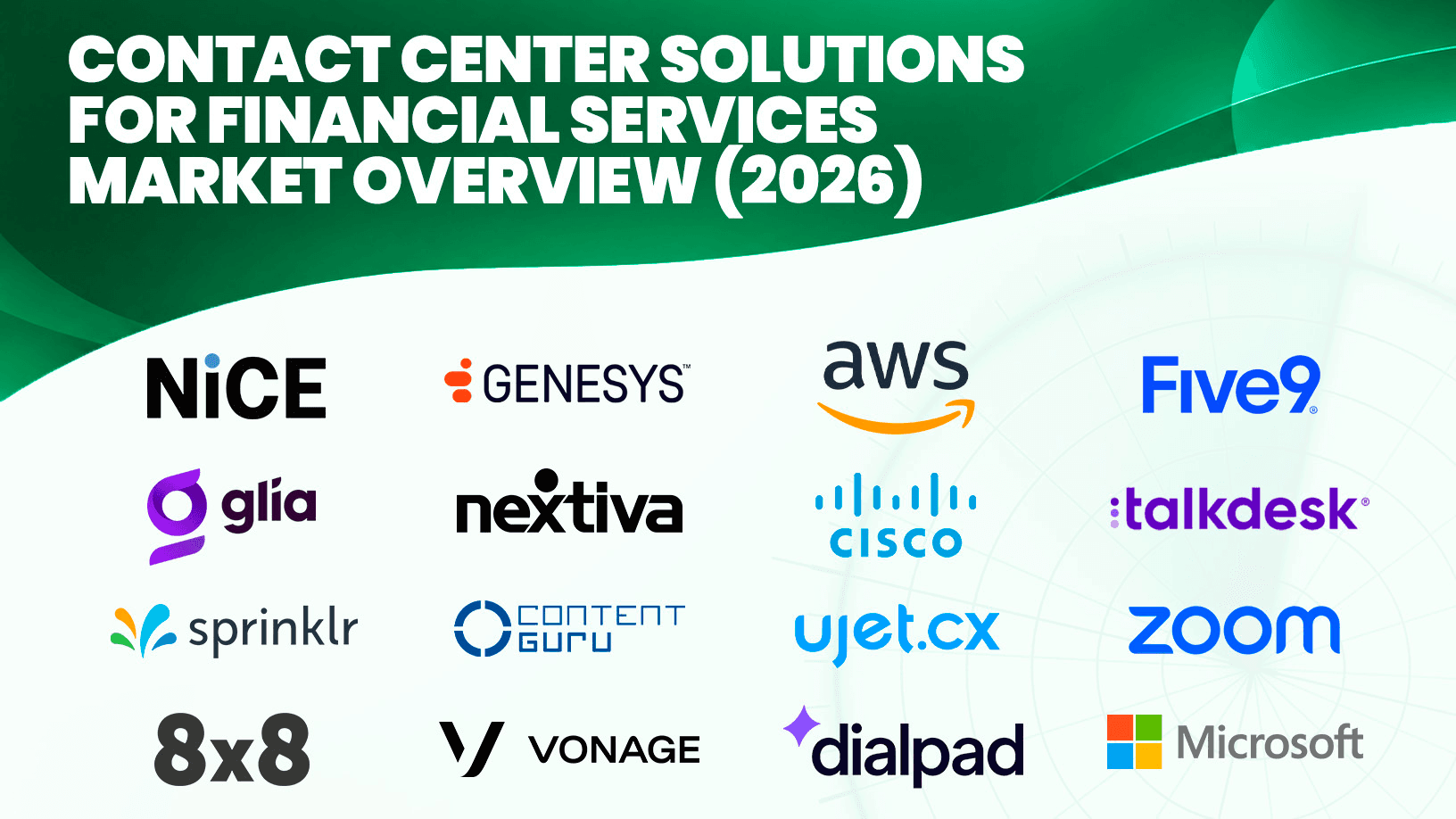
16 Contact Center Solutions for Financial Services
Below are 16 of the most prominent contact center solution providers serving financial institutions, with an overview of what sets each apart, through the lens of what typically matters most to buyers in the sector.
1. NiCE
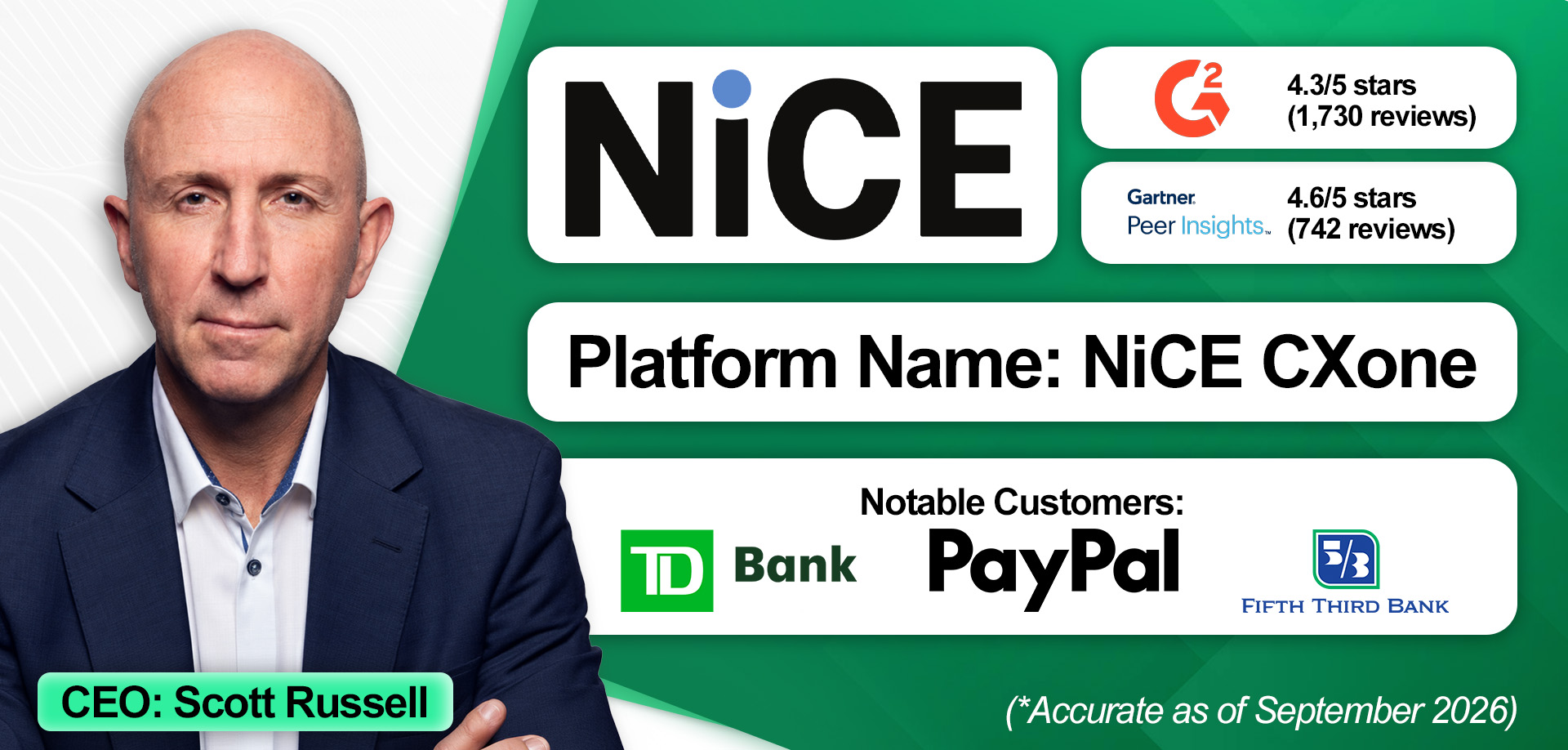
More financial institutions, especially in Europe, are evaluating sovereign cloud contact center deployments to ensure local data residency, data protection, and geopolitical resilience. That trend is working in NiCE's favor.
Indeed, the company has run a sovereign cloud across the continent (and beyond) for over three years, building specialized support teams, security and network operations, billing processes, and a level of localization that most competitors are only now starting to develop.
Its 2025 Cognigy acquisition also gives NiCE specialized, customer-facing AI Agents for Banking and Finance. These are available - alongside its workforce engagement management (WEM) and Copilot solutions - within CXone and as part of the NiCE Engagement Hub.
Interestingly, the Engagement Hub lets companies layer these solutions onto their existing contact center infrastructure, delivering quick value from NiCE AI before committing to a broader CXone transformation. This approach is resonating given how complex and patchwork many legacy financial services environments are.
Elsewhere, NiCE is well-regarded for its WEM solutions, having recently launched a single platform to manage both human and AI agents, a differentiating capability built for the hybrid contact center workforce of tomorrow.
Its workforce management (WFM) offering also goes deeper than competitors', with advanced capabilities including the option to let companies extend scheduling across both contact center agents and branch workers, supporting financial institutions in spreading customer contacts across virtual and physical locations.
“While others are saying the sovereign cloud is "coming soon," we operate in some of the most complex environments… We know how it works, we know how to build it, and we know how to scale it.”

Standout Features
- Sovereign Cloud: NiCE is experienced in sovereign cloud contact center deployments, with specialized support teams, guidance, and operations. Most rivals are just starting to build what NiCE already runs.
- NiCE Engagement Hub: Banks can layer AI agents, assistants, and WEM onto legacy systems and see value fast, no rip-and-replace required. For an industry built on patchwork infrastructure, that's a compelling entry point for a broader contact center transformation.
- Workforce Management: NiCE is a pioneer in WFM solutions and has extended its offering to support AI and human agents on one platform, tracking how the evolving use of customer-facing AI changes the contact center demand profile and scheduling requirements.
How Much Does It Cost?
NiCE CXone is available in five suites: Omnichannel, Essential, Core, Complete, and Ultimate. These cost $110, $135, $169, and $209 per agent, per month, respectively. The Ultimate suite also includes a $0.25 per session charge. Learn more about NiCE CXone pricing here.
2. Genesys
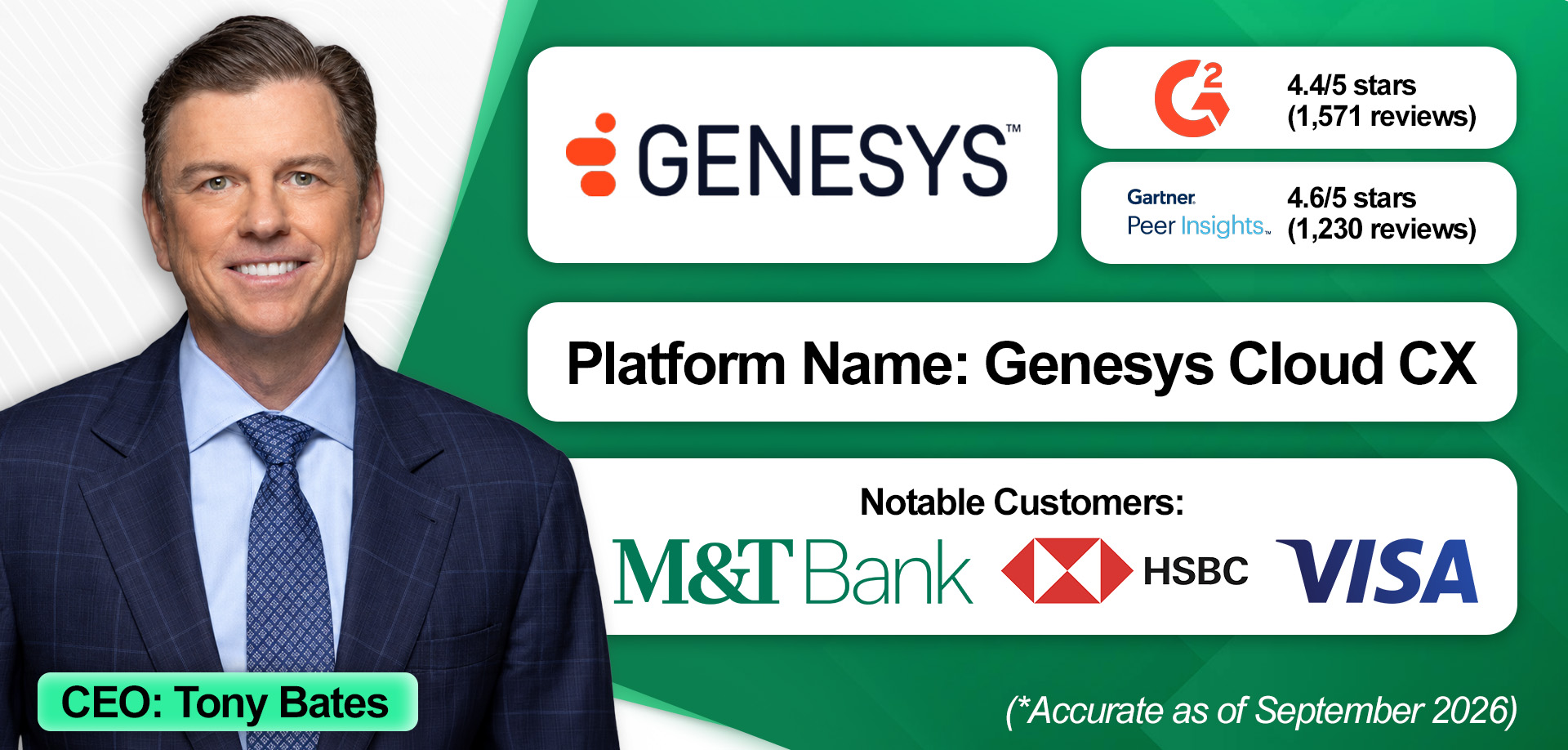
Genesys stands out for its close ecosystem partnerships, first through unified CCaaS-CRM solutions with players like Salesforce and ServiceNow, and then by actively partnering with these companies to orchestrate agentic resolution flows that cross into their platforms.
The vendor has referenceable customers, like Visa, doing this today, which sets it apart from most competitors.
Its partner ecosystem also extends beyond the typical contact center footprint, with strong relationships with broader CX vendors like Adobe, focused on democratizing customer insights and translating them into action elsewhere in the business.
Beyond the ecosystem, Genesys's biggest push is journey orchestration, coordinating resolutions across channels, agents, and systems. Its Genesys Cloud Associate capability supports this by pulling in subject matter experts (SMEs) from across the organization. That's especially powerful in financial services, where firms can tap physical branch workers as part of the resolution flow.
Its Copilot strategy is similarly advanced. Rather than just recommending actions, it can perform them directly. Today, that capability is limited to Supervisor and Admin Copilot, but the roadmap points toward extending it to the Agent Copilot as well.
Across the platform, Genesys also provides detailed model cards documenting what data is used, where it's sourced, how models are trained, and which AI approach - agentic, generative, or predictive - applies to a given capability. That transparency helps build the trust financial institutions require.
“We're playing in a different ball game… Genesys is a strategic platform, not just a contact center solution."

Standout Features
- Partner Ecosystem: Genesys offers deep integrations with major platforms like Salesforce and ServiceNow, while partnering with them to enable agentic resolution flows that extend beyond the contact center. That's proven with referenceable customers like Visa. Relationships with broader CX vendors, such as Adobe, also help democratize customer insights across the business.
- Journey Orchestration: The vendor's primary focus is coordinating resolutions across channels, agents, and systems, using differentiative capabilities like Genesys Cloud Associate to pull in experts org-wide, including physical branch workers, which is a key advantage for financial institutions.
- Contact Center Copilots: Genesys goes beyond recommending actions to actually performing them, currently live in Supervisor and Admin Copilot, with plans to extend this to Agent Assist.
How Much Does It Cost?
Genesys offers its contact center solution in four packages: Cloud CX 1, 2, 3, and 4, with each adding extra capabilities. These cost $75, $115, $155, and $240 per user, per month, respectively, when billed annually. Some advanced AI features are sold as additional tokens. Discover more about Genesys Cloud CX pricing here.
3. AWS
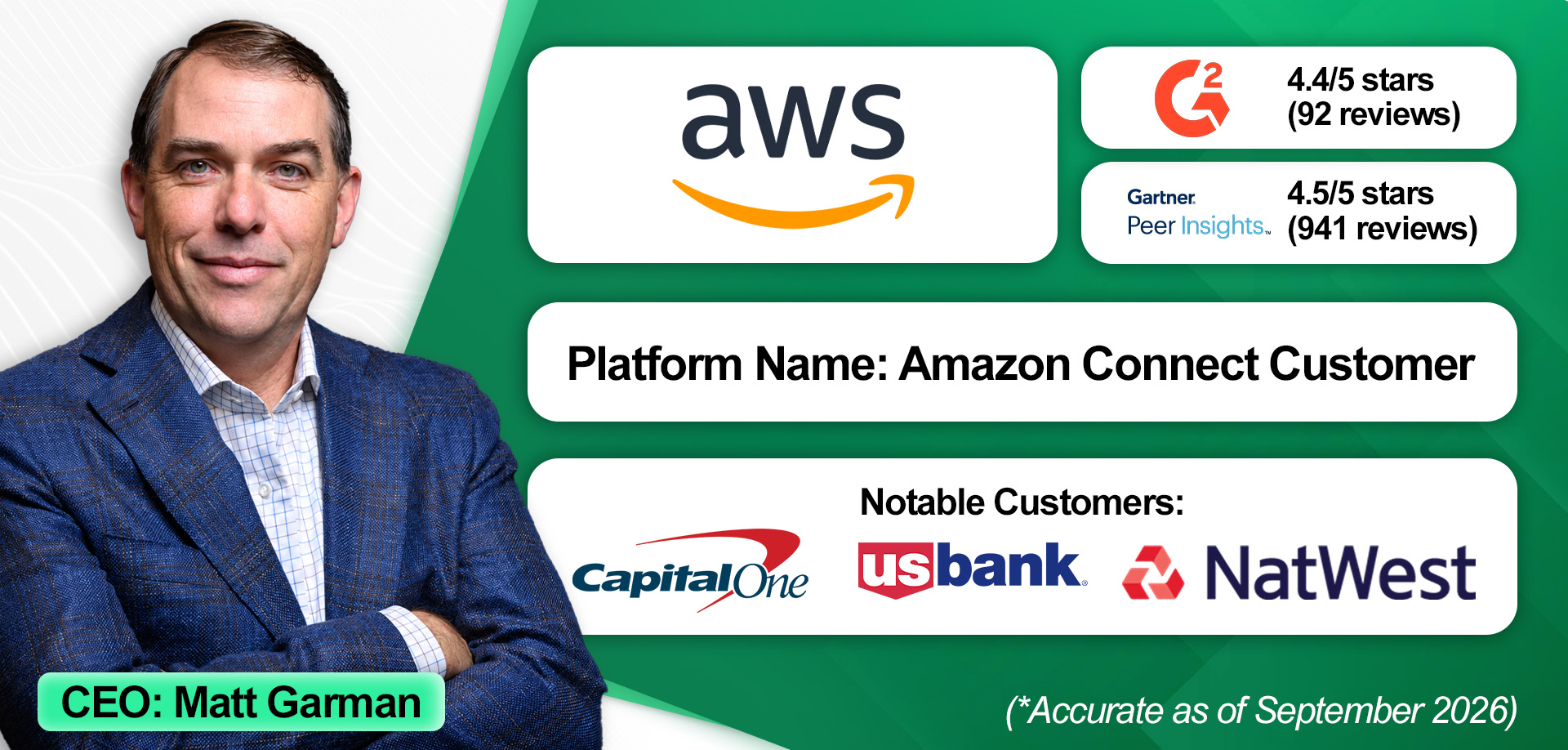
At the heart of Amazon Connect Customer are Customer Profiles, which pull data from the CRM and various third-party applications to build a single, continually updating view of the customer. This supports human and AI agents alike as they resolve inbound service queries.
Built on top of these profiles, AWS's Predictive Insights capability monitors customer data to flag signals that a customer may need extra support, is at risk of churning, or is ready for a cross-sell or upsell. These signals can then drive outbound support or success outreach that strengthens the relationship.
Amazon Connect Customer's voice AI agents are another standout, particularly a feature called Live Sync, which synchronizes the voice agent with the customer's smartphone screen. This lets financial services companies build AI-led voice experiences with interactive digital elements.
For example, during a new checking account signup, a bank could walk a customer through an on-screen comparison of two subscription options, along with terms and conditions to review and accept, all guided by the AI voice agent.
Pricing is another differentiator, as AWS bundles everything, from voice to WEM, into a single per-minute rate, regardless of whether a human or AI agent handles the interaction.
As financial services teams increase their use of AI, this model offers cost stability as the human/AI mix shifts, builds "psychological safety" through predictable spending, and reduces administrative overhead by consolidating multiple contracts into one.
"We made a huge investment in the last couple of years to bring out... customer profile capabilities that allow you to pull out data from across the silos of the enterprise, bring it into one place, and make it actionable.”

Standout Features
- Predictive Insights: This tool analyzes a customer’s behaviors and interaction history to improve live call guidance and enable proactive outbound engagements, led by a human or AI agent, whenever an opportunity arises to strengthen the customer relationship.
- Voice AI Agents: Thanks to its April 2026 NLX acquisition, brands using Amazon Connect Customer can synchronize voice interactions with a customer's smartphone screen, creating a multimodal experience where voice guides them through a digital journey. This opens new ways to resolve cases that go beyond traditional voice-only or digital-only support.
- Pricing Model: AWS offers a single bundled consumption rate per minute, regardless of whether a human agent, AI agent, or a mix of both handles the conversation. This folds in the costs of separate contact center solutions that competitors price separately, leaving telecom cost as the only variable.
How Much Does It Cost?
Amazon Connect Customer uses a consumption-based pricing model where everything, including its WEM and conversational analytics solutions, is billed per minute. Dive deeper into AWS’s contact center pricing here.
4. Five9
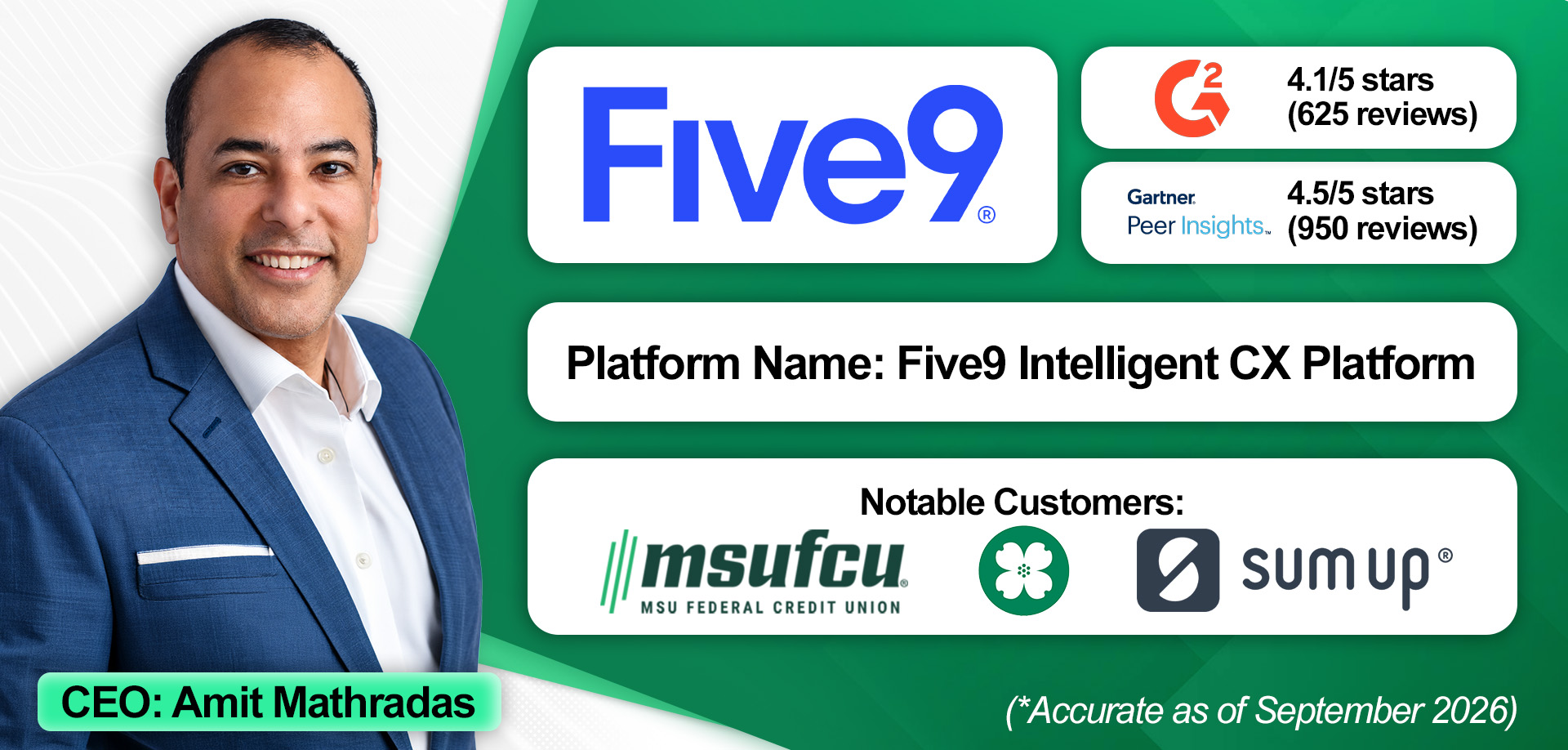
At first, Five9 Fusion referred only to a specific type of integration, where Five9 teamed up with the likes of Salesforce and ServiceNow to deliver a unified CCaaS-CRM offering.
Now, Fusion encapsulates its entire partner program, signaling that it's not just integrating solutions but working more expansively across the enterprise, connecting workflows and ensuring its solutions fit more neatly into the enterprise stack.
Its Google Cloud partnership, announced early in 2026, exemplifies this. It includes a joint go-to-market motion that, in Q2 2026, resulted in a large Fortune 100 financial services win worth approximately $100 million in total contract value (TCV).
Regarding its core platform, recent innovation has been driven by a "humanistic" focus: observing how a contact center's best human agents work and extracting that intelligence to make AI-led experiences effective.
Crucially, this isn't just about getting the customer off the phone quickly. Instead, Five9 aims to isolate the desired outcome for a specific customer and dynamically orchestrate experiences around that.
While this represents the future, many financial services customers also work with Five9 for its referenceability, serving global banks and credit unions while navigating a dense regulatory landscape (TCPA, UDAP, PCI, Gramm-Leach-Bliley, Reg E, etc.).
"We don't think about connecting you to a human in the lowest-cost manner possible. We're beginning to understand the value of specific customers, and figuring out how to maximize by adapting the conversations we have with them."

Standout Features
- Mature Partner Ecosystem: Fusion now refers to Five9's entire partner program, which connects workflows end-to-end across enterprise systems as the vendor works closely alongside adjacent partners. Its Google partnership is a prime example. In the summer of 2026, it helped win a major Fortune 100 financial services account.
- "Humantic" AI Vision: Five9 benchmarks its AI against data from top-performing human agents, setting a real-world standard for it to meet. In doing so, it looks at the specific outcomes each scenario calls for, teaching the AI which outcome matters when and guiding its behavior accordingly.
- Deep Financial Services Base: Five9 has a deep history in serving global banks and credit unions, with a platform built to handle the sector's dense regulatory requirements and high referenceability.
How Much Does It Cost?
Five9 comes in five bundles: Digital, Core, Plus, Pro, and Enterprise. Digital and Core cost $119 and $159 per seat, per month, respectively. The remaining three are only available with a custom quote. Learn more about Five9’s contact center packages here.
5. Glia
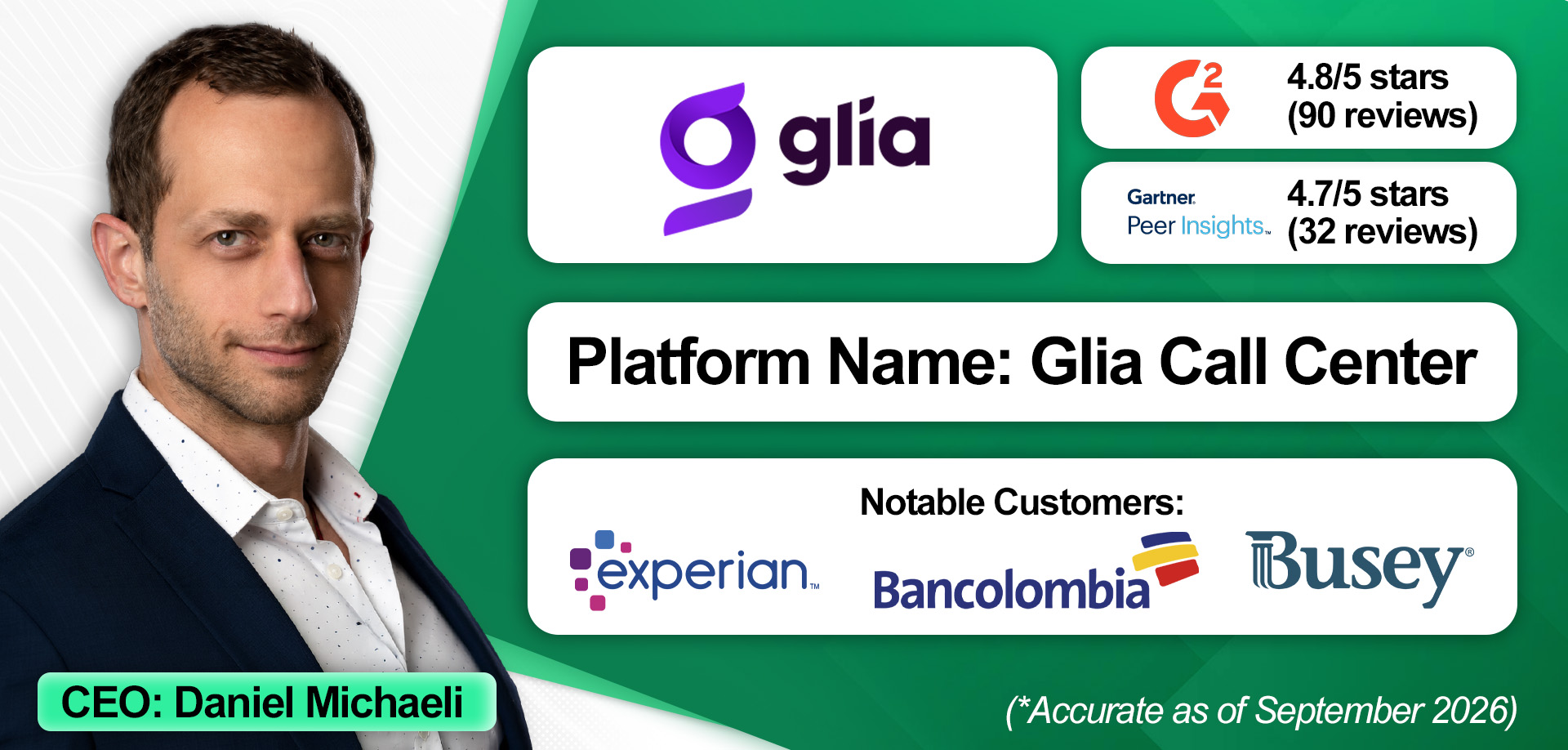
Outside financial services, Glia may be the least-known provider on this list. Within the sector, however, it's one of the biggest, with 700+ banking and credit union customers alone.
Its success hinges on platform architecture. Glia positions itself as a system of intelligence and action that sits above the banking technology stack, pulling in structured data from core systems alongside unstructured data from customer interactions. From there, it processes everything through LLMs trained specifically for banking, guiding both AI- and human-led customer conversations.
The new "Response Modes for Glia Bankers" tool builds on this, letting banks and credit unions control how much flexibility and creativity AI responses have on a topic-by-topic basis.
That same capability also reflects Glia's strong governance posture. Elsewhere, this shows up in how all platform data, at rest or in transit, is encrypted, and in how access is limited to a small, auditable set of people, even on the administrative side.
Still, customer experience remains Glia’s biggest differentiator. Before negotiation, it sends a team of three to five employees to the prospect’s contact center, observing how it operates. Afterward, it projects the impact of AI, both customer- and internal-facing AI, whether that’s for agents, the quality team, planners, or whoever it may be. That projection informs pricing, guides deployments, and predicts ROI.
Seven months later, Glia runs the study again and then annually thereafter, ensuring continuous innovation and that it’s driving value against where the customer started.
“Everyone at Glia gets full banking training equivalent to a three-month internship, so they know exactly what it takes to make a bank or credit union successful.”

Standout Features
- Platform Architecture: Glia sits above the banking technology stack, connecting structured system data with unstructured interaction data and translating it through LLMs trained specifically for banking, which gives Glia a deeper understanding of financial-services terminology, intents, and interactions.
- Customer Experience: The vendor shadows the contact center, builds a detailed baseline of how the operation works, and projects AI impact. Critically, it then repeats the ROI study throughout the customer relationship, creating a continuous before-and-after measurement of value, rather than a one-time business case.
- Industry Expertise: Glia brings deep industry expertise, with every employee receiving substantial, sector-specific training. The company also publishes a weekly podcast featuring banking leaders, giving customers valuable insights while keeping the entire team informed on the latest industry trends.
How Much Does It Cost?
Glia’s pricing model is unique. After an initial assessment of an organization’s contact center, it shares a fixed price. Upon signature, the customer may leverage as much of the platform - including features, AI, and integrations - as they like. The price point won’t change. Learn more about Glia’s Priceless Pricing model here.
6. Nextiva
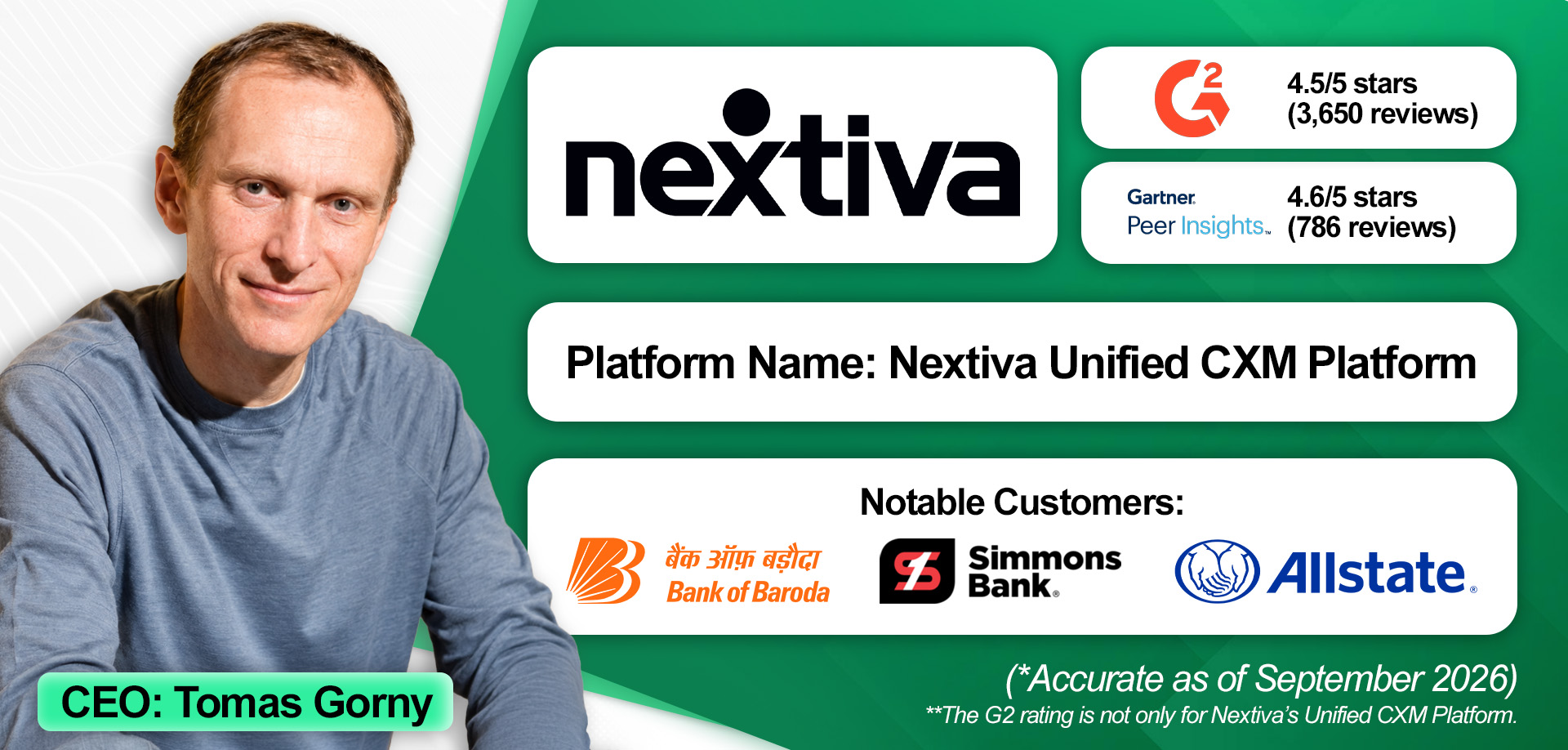
Nextiva was headless before Salesforce made it cool, decoupling its contact center logic from the core interface and letting developers build mobile and desktop apps on top of its platform.
As a result, brands can build their own interfaces and tap into specific platform capabilities remotely, with every capability accessible via API or webhook, making it a strong fit for organizations with deep customization needs.
On the architecture side, Nextiva also runs a native data layer that curates structured and unstructured data together, from both systems of record and live conversations. This means brands don't need to orchestrate real-time actions, such as next-best-action recommendations, by stitching together multiple separate systems and lookups.
That same philosophy of taking the operational burden off customers carries through to Nextiva's internal support resources, which include a financial services playbook covering 150+ real-world scenarios, each mapped to customer types, step-by-step processes, and the relevant legal and regulatory requirements.
Working through this playbook helps ensure deployments stay compliant, rather than automating processes that shouldn't be automated, with Nextiva engaging in regular customer follow-ups and offering hands-on support.
Finally, Nextiva offers mature outbound capabilities, including "quarterback mode", a hybrid dialing model where a human curates and releases numbers into a predictive queue, keeping campaigns effective while avoiding robo-dialing risk.
“You can decompose every capability of the platform down to an API call... We say there's an API for that or a webhook for that. And we even have a mobile and a desktop SDK that allows people at the very highest level to evoke the use of our platform like a puppeteer from their own applications.”

Standout Features
- Platform Architecture: Nextiva offers a single, API-accessible cloud communications foundation with a native data layer that unifies structured and unstructured data, enabling real-time action at the moment of interaction without multiple system lookups.
- Financial Services Playbooks: The vendor provides a proprietary guide covering 150+ real-world scenarios with mapped customer types, workflows, and regulatory requirements, backed by independent PCI certification and enterprise-scale references like Bank of Baroda.
- Mature Outbound Capabilities: Alongside proactive capabilities and outbound automation, Nextiva offers mature features like "Quarterback mode" for predictive queue dialing, paired with native state-by-state recording compliance and PII redaction.
How Much Does It Cost?
Nextiva offers three product bundles: Core, Engage, and Scale. When purchased annually, these cost $15, $25, and $75 per user, per month, respectively. Its AI receptionist, XBert, is available as an add-on.
7. Cisco
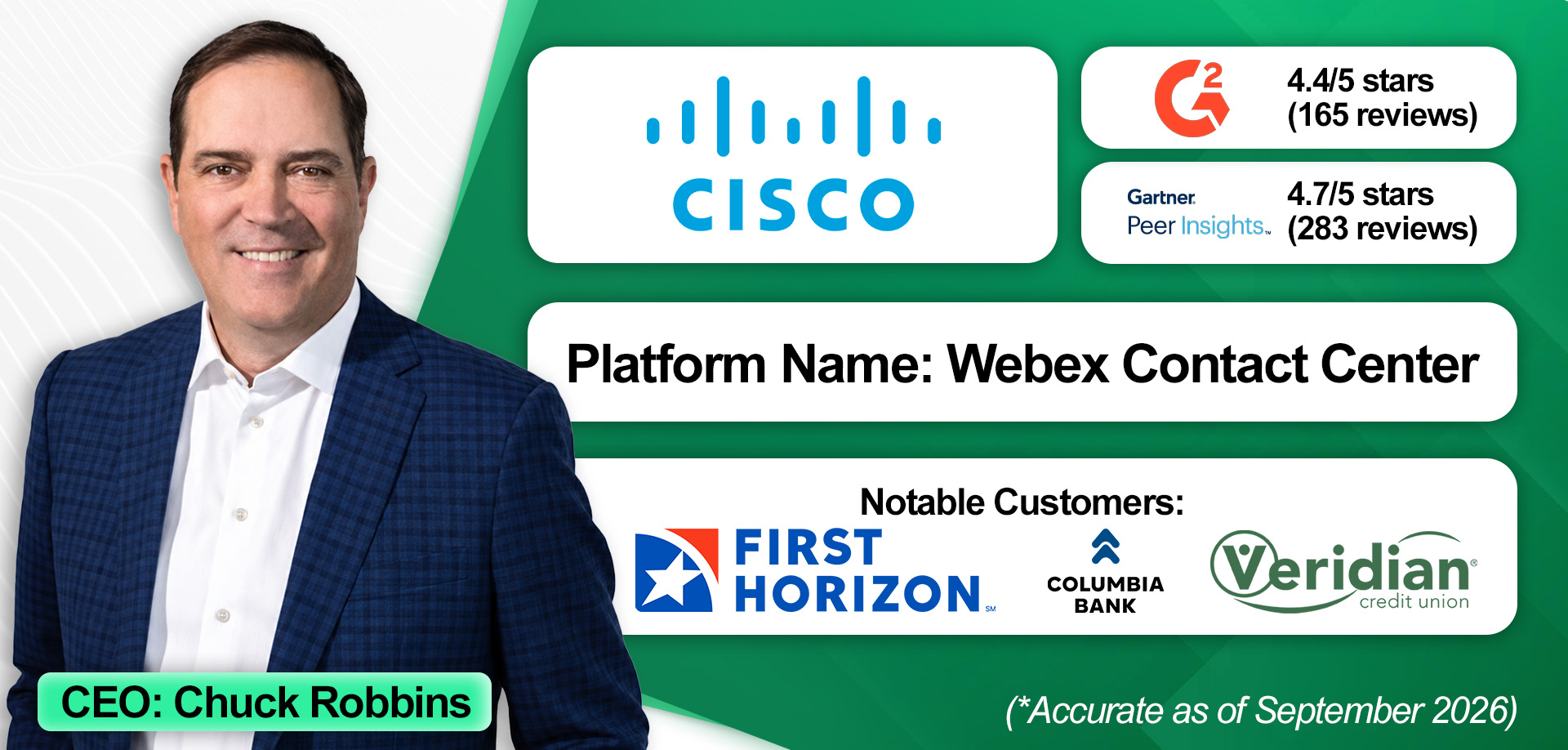
Cisco is the only listed provider offering the complete set of contact center deployment options: cloud, on-premise, or hybrid.
Like others, it's bringing its cloud AI capabilities to on-premise contact centers. However, it's also building AI features to run on-premise directly, so customers aren't forced into the cloud just to keep innovating.
Financial institutions that do move to the cloud can still keep their on-premise environment as a backup, giving them robust failover and greater platform resilience.
Beyond deployment flexibility, Cisco stands out as a full-time security and observability company, with both capabilities natively embedded across its contact center portfolio. Its AI Defence solution is a strong example. This generates custom guardrails from any policy a customer states or uploads, running a multi-turn, multi-step process to identify allowed and disallowed behaviors that are then enforced at runtime for the AI agent.
Cisco also offers UCaaS and CPaaS solutions built on a shared Webex platform, an architecture with real advantages in financial services. CPaaS enables proactive communication workflows driven by signals from across the enterprise, while branch staff using UCaaS can handle external conversations, transfer queries, and pull in customer context.
Finally, Cisco has invested heavily in a mature WEM offering that supports human and AI agents on a single platform, a capability only NiCE currently matches.
“What's really been unique for us with WEM is that, because we're building it post the proliferation of AI, we have been able to build it from the ground up, focusing on supporting that hybrid workforce."

Standout Features
- Flexible Deployment Options: Cisco is the only listed provider offering cloud, on-premise, or hybrid deployment, giving financial institutions the freedom to deploy where it fits and the ability to fail over between environments.
- AI Security & Observability: As a full-time security and observability company, Cisco embeds differentiative capabilities natively across its CX stack. AI Defense, which auto-builds and enforces custom guardrails from customer policies, is a prime example.
- CCaaS-UCaaS-CPaaS: Cisco's shared Webex platform ties CCaaS, UCaaS, and CPaaS together. That unified environment brings several advantages, including the ability to capture not only customer conversations, but the internal conversations around customer cases. Of the other listed solutions, only 8x8 and Vonage can also offer this.
How Much Does It Cost?
Cisco prices Webex Contact Center per agent seat, with two tiers: a Standard Agent runs $85 per month, while a Premium Agent costs $135 per month. These rates apply only to named agents, and concurrent seats will cost more. Optional add-ons include Agent Assist, Webex Calling integration, and CPaaS. Get Cisco's full pricing breakdown here.
8. Talkdesk
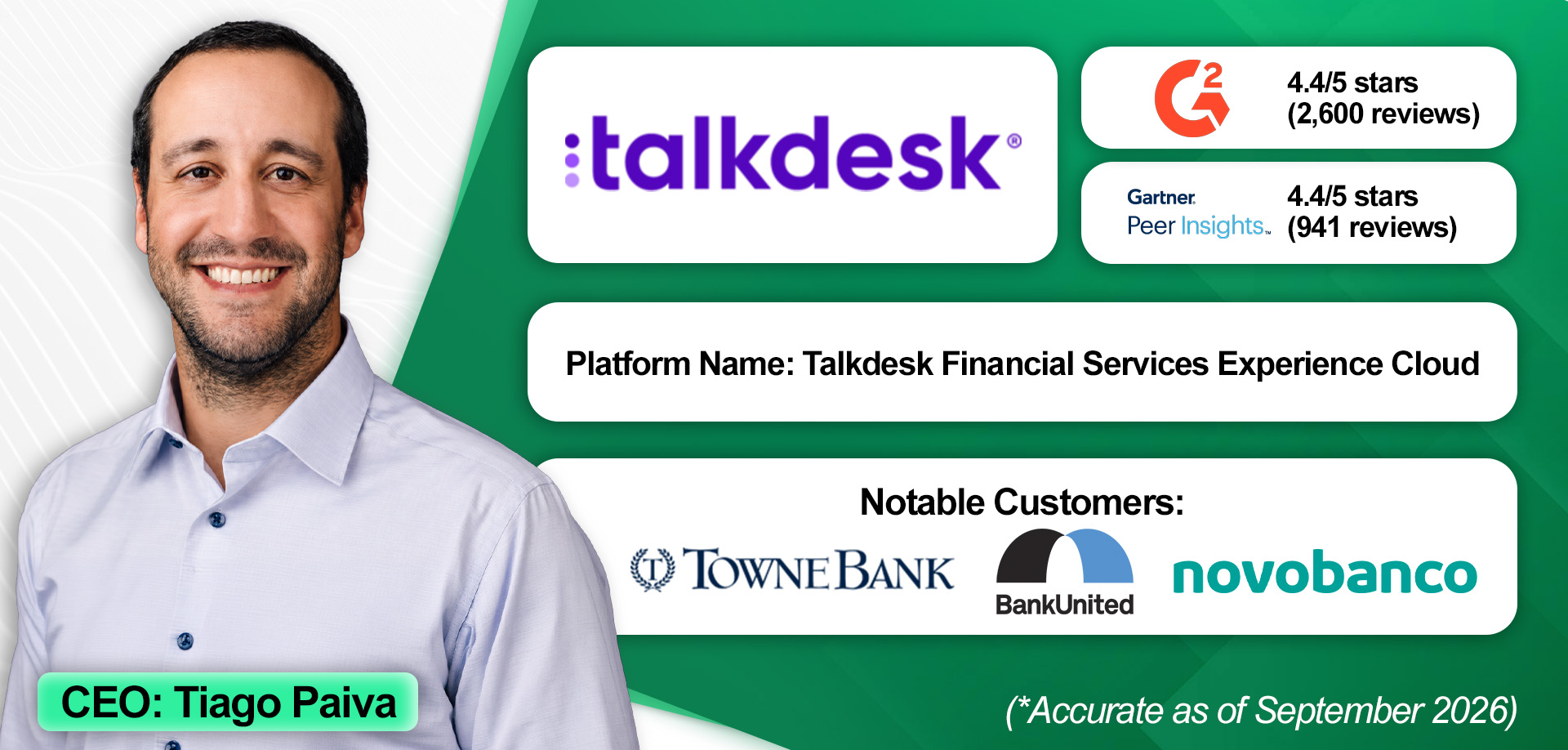
Talkdesk has a long history of delivering verticalized contact center solutions or, as it calls them, Industry Experience Clouds.
One is the Talkdesk Financial Services Experience Cloud, which brings together pre-trained AI models, integrations, and workflows built specifically for the sector.
Yet, Talkdesk also makes many of the AI elements within its platform available on a standalone basis. This lets contact centers keep their existing infrastructure while layering AI agents, copilots, analytics, and more on top. Over time, financial institutions can gradually build Talkdesk deeper into their core architecture.
Along the way, they can also tap into Talkdesk's Data Cloud, which pulls together fragmented data from branch systems, mobile apps, and contact centers into one real-time source of truth, closing the "data gap" that causes institutional amnesia.
The new Talkdesk for Financial Services solution, part of the Financial Services Experiences Cloud, also helps to close the gap between virtual and physical branches.
It gives bankers in physical locations the same pre-conversation context, AI guidance, and next-best actions on screen as a contact center agent would receive, so they don’t start a conversation from a blank piece of paper. Bankers can also update the system of record, capturing richer context from these in-person conversations.
Standout Features
- Verticalized AI: Talkdesk pre-packages integrations and workflows for the financial services sector, and pre-trains its AI models for it too. For example, transcription engines are tuned to understand industry jargon, improving accuracy.
- Customer Experience Automation Approach: At first, the vendor often lays AI over legacy contact center environments. From there, it supports organizations in their broader contact center transformations.
- Talkdesk for Financial Services: This unique solution democratizes contact center capabilities for physical branch workers, supporting better-informed in-person conversations while allowing the organization to capture broader customer context.
How Much Does It Cost?
The Talkdesk Financial Services Experience Cloud costs $225 per user, per month. However, it also offers three lighter packages for its Talkdesk CX Cloud. These are: Digital Essentials, Voice Essentials, and Elite, costing $85, $105, and $165 per user, per month, respectively. Visit Talkdesk’s pricing webpage to learn more.
9. Sprinklr
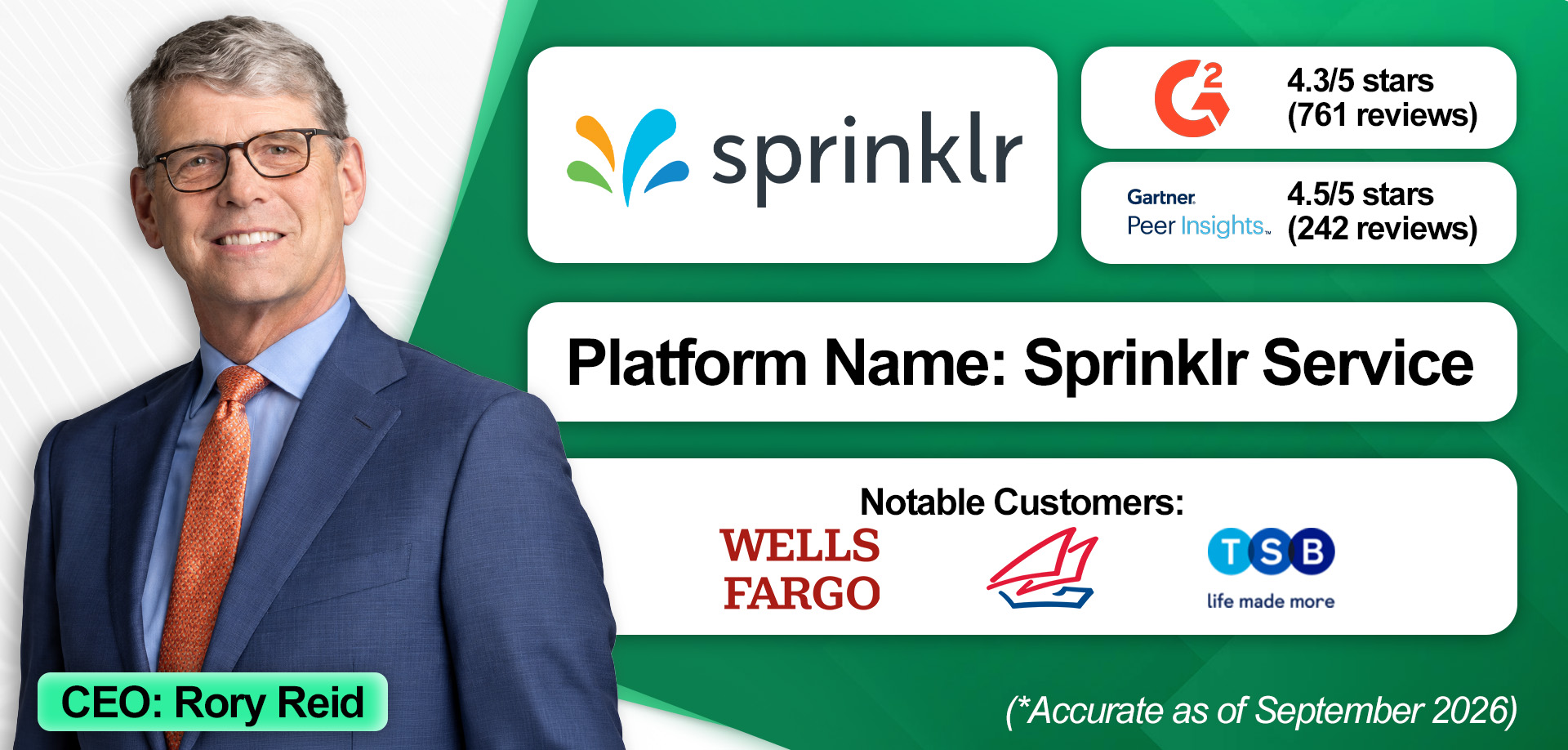
Sprinklr built a platform around the conversation, not around a channel.
So, for instance, a customer may interact with a voice agent, then go through live chat, and after post a comment on Reddit. Often, those are siloed conversations because they sit on different technology stacks. To Sprinklr, those are just tags on the same conversation.
As such, it can monitor a customer conversation as it flows across channels, capturing that context, and enabling a deeper understanding of each customer’s journey.
Sprinklr can then apply its Voice of the Customer (VoC) technology to analyze all that context, understand when a customer is unhappy, and create an outbound case in Sprinklr Service to help save the relationship.
In financial services, where customer relationships face increasing commoditization, these mature, outbound capabilities are a differentiator.
Lastly, Sprinklr Service and its VoC solution, Sprinklr Surveys, fit into a broader Unified Customer Experience Management (Unified CXM) vision. This aims to consolidate data and help traditionally siloed CX teams manage experiences together.
Given this, Sprinklr is often the choice of contact center buyers who understand that customer experience is much more than a synonym for customer service.
"We didn't build a platform around channels; we built it around conversations."

Standout Features
- Channeless Architecture: By unifying every customer conversation - across contact center and social channels - into a single, real-time thread rather than siloed logs, Sprinklr gives the contact center a clearer view of how conversations flow across channels and surfaces more customer journey context.
- CCaaS-VoC Unification: Sprinklr offers mature CCaaS and VoC solutions. Its VoC system translates customer feedback from the contact center and other sources into insights and actionable tasks to improve those experiences. Customer support teams can then engage with customers via Sprinklr Service, perform those tasks, and play a new role in customer experiences.
- Unified CXM Vision: Sprinklr Service and Surveys are part of a broader Unified CXM portfolio that connects insights across CX teams, aligns them on outcomes, and appeals to buyers who see CX as more than just customer service.
How Much Does It Cost?
Sprinklr Service uses custom, quote-based pricing based on headcount, interaction volumes, and selected modules. Contact the Sprinklr sales team for a quote here.
10. Content Guru
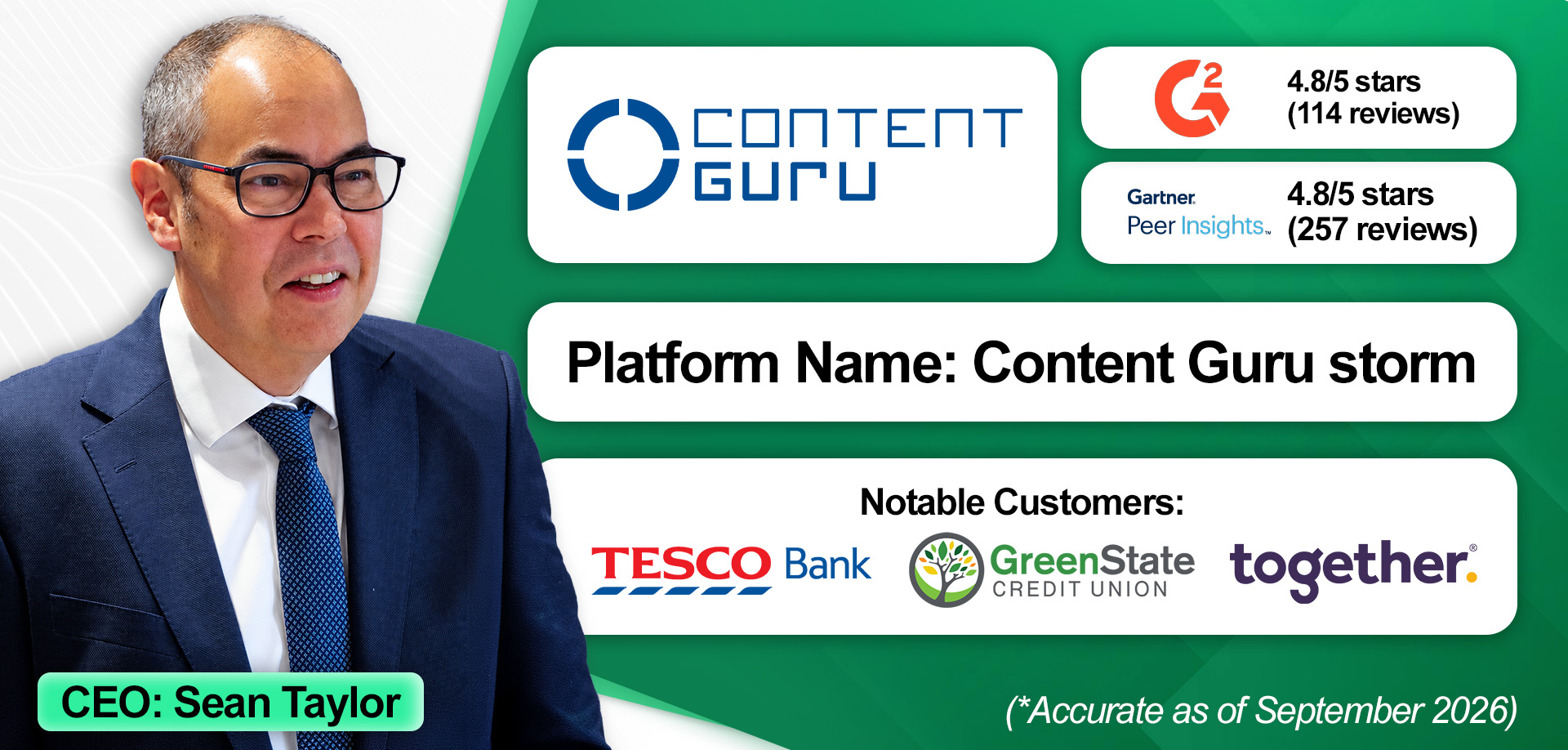
Content Guru has a Customer Knowledge System (CKS) at the heart of its storm CCaaS platform, essentially functioning as a customer data platform (CDP).
Critically, the CKS captures context from customer conversations and pushes relevant updates to legacy systems, ensuring systems of record don’t fall out of sync. That’s particularly valuable for financial institutions that still rely heavily on legacy infrastructure.
The CKS also sits across systems of record, surfacing the most relevant data and knowledge for each user through a Copilot. This guidance is based on the context, the customer they’re interacting with, and their skill set. So, for instance, an experienced agent may receive less context than a new agent.
By working across these systems, Content Guru presents its platform as an orchestration layer between modern, AI-led customer support and legacy environments.
Content Guru can also provide sovereign cloud deployments across the EU, UK, Australia, and US, with in-region data processing, data residency, and data-center sovereignty.
Within these private, sovereign environments, customers can apply their chosen LLM to specific AI use cases, including different models for different languages. The core business logic remains locked in, enabling more flexible and capable private-cloud deployments.
“In banking and financial services, there’s lots of legacy and modern, cloud and on-prem, home-baked and off-the-shelf solutions. Pulling it all together into one coherent story is what we're really good at. That's our USP.”\

Standout Features
- Legacy Transformation Support: Content Guru's CKS acts as an "orchestration layer" between modern, AI-led customer support and legacy environments, managing how data and context flow between them. This lets financial institutions modernize without replacing or rapidly overhauling core systems.
- Context-Aware Agent Assist: The provider assembles the information for every interaction based on the customer, journey, interaction context, agent skills, support information, and knowledge, going beyond a standardized CRM view to deliver personalized agent guidance.
- Sovereign Cloud Deployments: Content Guru’s sovereign deployments extend across the EU, UK, Australia, and US with in-region processing, residency, and data-center sovereignty, while allowing institutions to use their preferred LLMs - including different models by language - for specific AI use cases.
How Much Does It Cost?
Content Guru storm LITE is available from $70 and $22 for voice and digital agents, respectively. Its full-featured platform runs on a similar seat-based model. However, the vendor only provides quotes after a consultation. Request a consultation with Content Guru here.
11. UJET
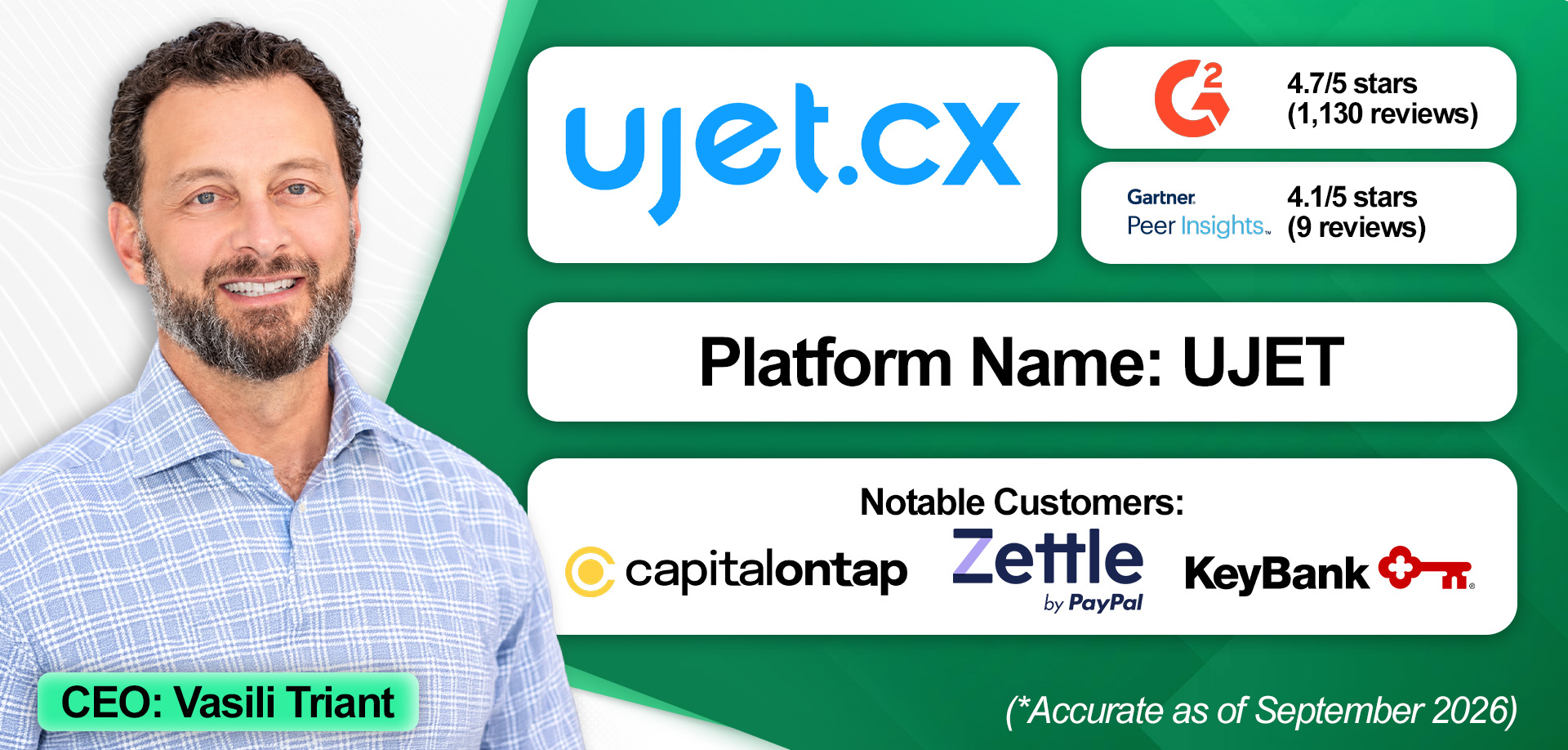
UJET became a global player in contact center solutions by seizing untapped opportunities to pull context from the customer's mobile device and personalize their experience, and this focus still sets the provider apart.
Its Mobile SDK authenticates customers using the PIN, passcode, or biometric method (Fingerprint or Face ID) already set up on their smartphone. This streamlines authentication in a way that's especially valuable in financial services, where the process can otherwise be cumbersome.
Governance is another differentiator. UJET pioneered embedded contact centers, letting service reps work entirely within their existing system of record. From there, UJET automates case creation and transcription, storing all data and PII in one secure system, reinforcing a robust governance posture.
Platform reliability is a further strength. UJET runs simultaneously across the U.S. East and U.S. West regions, providing geographic redundancy against regional outages or natural disasters. That redundancy spans communications, storage, and compute, while a diverse telco network reroutes traffic immediately if one provider goes down.
Finally, UJET's AI analytics platform, Spiral, is especially compelling in financial services, where legacy on-premises systems have long dominated. Spiral layers over these platforms to unify customer conversations and feedback, consolidate reporting, and surface root-cause analysis.
Increasingly, UJET leads customer engagements with Spiral, using it to build a tailored playbook for next-generation contact center transformation.
“Instead of having your CCaaS information here, QM here, WFM here, CRM over here, with some of the data overlapping, some competing with each other, and some entirely redundant, you have it all together with UJET. That’s played very well for us in financial services.”

Standout Features
- Customer Authentication: UJET leverages the SmartActions capability within its Mobile SDK to authenticate customers through the existing device security mechanics on their smartphones, adding a robust, relatively frictionless authentication layer to the contact center.
- Platform Governance: The solution lets service reps work directly within their system of record while consolidating CCaaS, QM, WFM, and CRM data. This centralized storage of data and PII reduces fragmented, redundant systems and creates a consistent source of truth across the contact center.
- Legacy Transformation Support: UJET’s Spiral platform layers on top of legacy environments, consolidates contact center conversations and broader customer feedback - including calls, chats, email, NPS/CSAT, social media, and reviews - to autonomously identify the root causes of customer issues and steer legacy transformation projects.
How Much Does It Cost?
UJET sells its contact center solutions in four core packages: Basic, Digital, Pro, and Enterprise. These cost $65, $69, $99, and $120, respectively. Advanced AI solutions, including Spiral, are available as add-ons. Learn more about UJET’s pricing model here.
12. Zoom
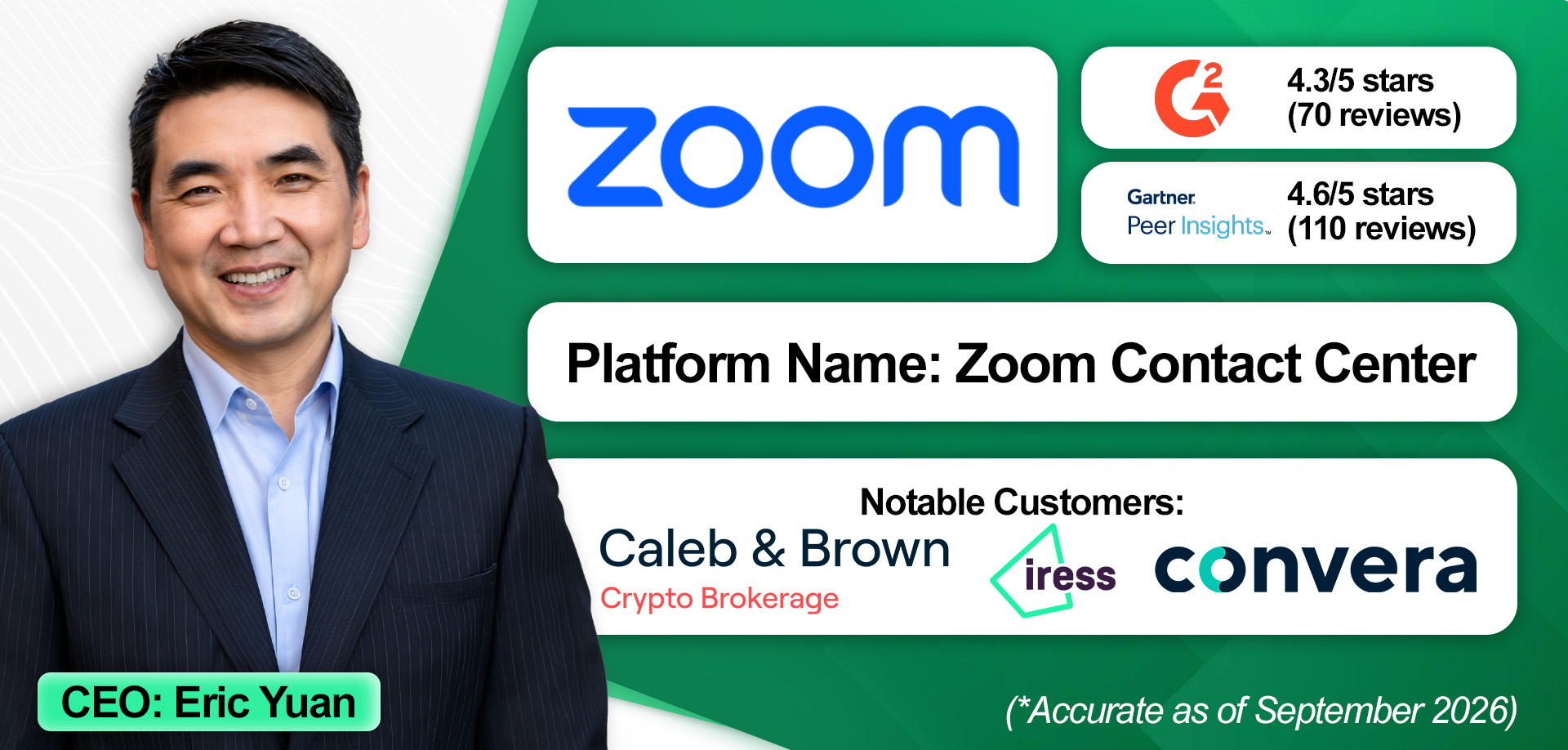
The Zoom Contact Center comprises mature conversational AI and intelligence offerings.
Its conversational AI offering, Zoom Virtual Agent, is often sold as a standalone solution, layered over complex, legacy environments, as are common in financial services. From there, Zoom makes its pitch: why not use us for the underlying contact center platform too? It's a tactic that's winning business.
Then there’s Zoom's conversational intelligence solution: Zoom CX Insights. Yet, it goes beyond conversation intelligence, functioning as a broader intelligence layer that connects interaction transcripts, operational data, and metrics.
Users can then ask questions of their data through a natural language interface, like: "What's driving this demand peak?" Or: "Who on this team needs the most help right now?" Even people outside the contact center can tap into it, asking things like "What are customers saying about our competitors?" And: "What's the feedback on our latest app update?"
Together, these two capabilities underpin Zoom's greatest strength: platform breadth, with other useful tools like its employee experience solution, WorkVivo. This helps build cultural cohesion between support teams across physical and virtual branches.
In financial services specifically, Zoom has brought on customer support and CX leaders with experience at banks ranging from HSBC to Lloyds Bank. This adds to its market credibility and enables the vendor to deliver a more consultative, journey-first approach.
“We’re not chucking a POC at everyone. We have people, experienced in the sector, who unpack your customer journeys, your requirements, and will work alongside you.”

Standout Features
- Platform Breadth: Zoom’s has a broad platform that comprises mature CCaaS, UCaaS, WEM, conversational AI, employee experience, and other solutions, with a roadmap where these tools bleed into one another and inspire differentiated innovation.
- Intelligence Layer: CX Insights acts as an intelligence layer across Zoom Contact Center, letting leaders across the business query customer conversations, operational data, and metrics. It also helps surface recommendations to improve specific outcomes.
- Consultative Vendor Experience: Zoom has hired experienced CX leaders from across the financial services space and has them work alongside customers, mapping customer journeys as part of a more hands-on vendor experience.
How Much Does It Cost?
The Zoom Contact Center is available in three packages: Essentials, Premium, and Elite. These cost $69, $99, and $149 per user, per month, when billed annually. Full details on what each bundle includes are available on the Zoom Contact Center pricing page.
13. 8x8
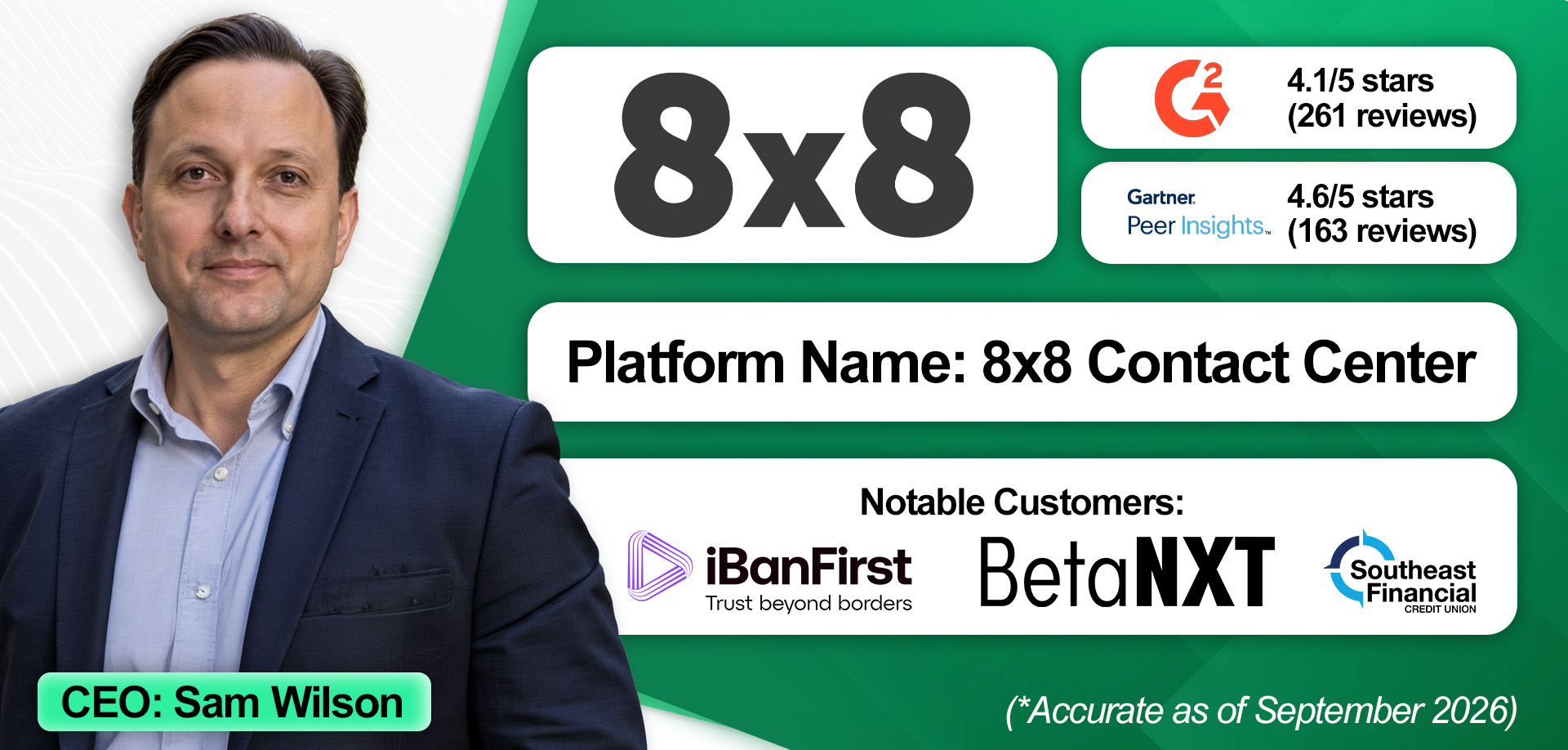
8x8 offers a single platform spanning UCaaS, CCaaS, and CPaaS. That combination often plays particularly well in financial services. After all, many financial institutions operate dispersed support organizations, with numerous branches. These branches can use 8x8 Work for internal communications while leveraging lightweight contact center capabilities through 8x8 Engage for additional inbound and outbound services.
Meanwhile, the primary support organization can operate from the 8x8 Contact Center, routing specific contacts to branches while maintaining the full context of all internal and external interactions regarding a customer case on a single platform.
Financial institutions can then use 8x8 Pulse to surface insights across these conversations, combining them with telemetry, CRM data, and financial context from across the organization. Users can prompt the system in natural language to learn more about customer cases, with references back to the source conversations.
Those users might be case workers, but they can also span sales and marketing, risk management, corporate strategy, and beyond.
Finally, the single-platform advantage also extends to 8x8’s advanced CPaaS capabilities. These are valuable for institutions looking to deliver more proactive experiences, taking signals from enterprise systems and orchestrating complex outbound communications.
Such experiences may happen on RCS, with 8x8 able to send messages with an official brand name, logo, and verified sender status. This gives customers confidence that messages genuinely come from their financial institution, strengthening trust and reducing the risk of customers calling to ask: “Is this really you?”
“We have one platform, with one SLA, where all your conversations live in one place for greater context into customer experiences for the entire business.”

Standout Features
- A Single Communications Environment: 8x8 unifies branch and primary support operations on one UCaaS-CCaaS platform, enabling financial institutions to flexibly route customer interactions to branches while preserving conversation context across the organization. That context includes the internal conversations happening around each customer case.
- Conversational Intelligence: The provider turns customer and business conversations into actionable intelligence by connecting communications with CRM, telemetry, and financial data, with governed, traceable answers that surface customer sentiment, competitive signals, product feedback, and more.
- CPaaS Infrastructure: 8x8 runs sophisticated, event-driven outbound communication workflows from various enterprise systems, including branded and verified RCS messaging that strengthens customer trust and reduces uncertainty around whether communications are legitimate.
How Much Does It Cost?
The 8x8 Contact Center and 8x8 Engage come as part of seat-based subscriptions. Pricing for both is available by contacting 8x8 directly. Request a quote from 8x8 here.
14. Vonage
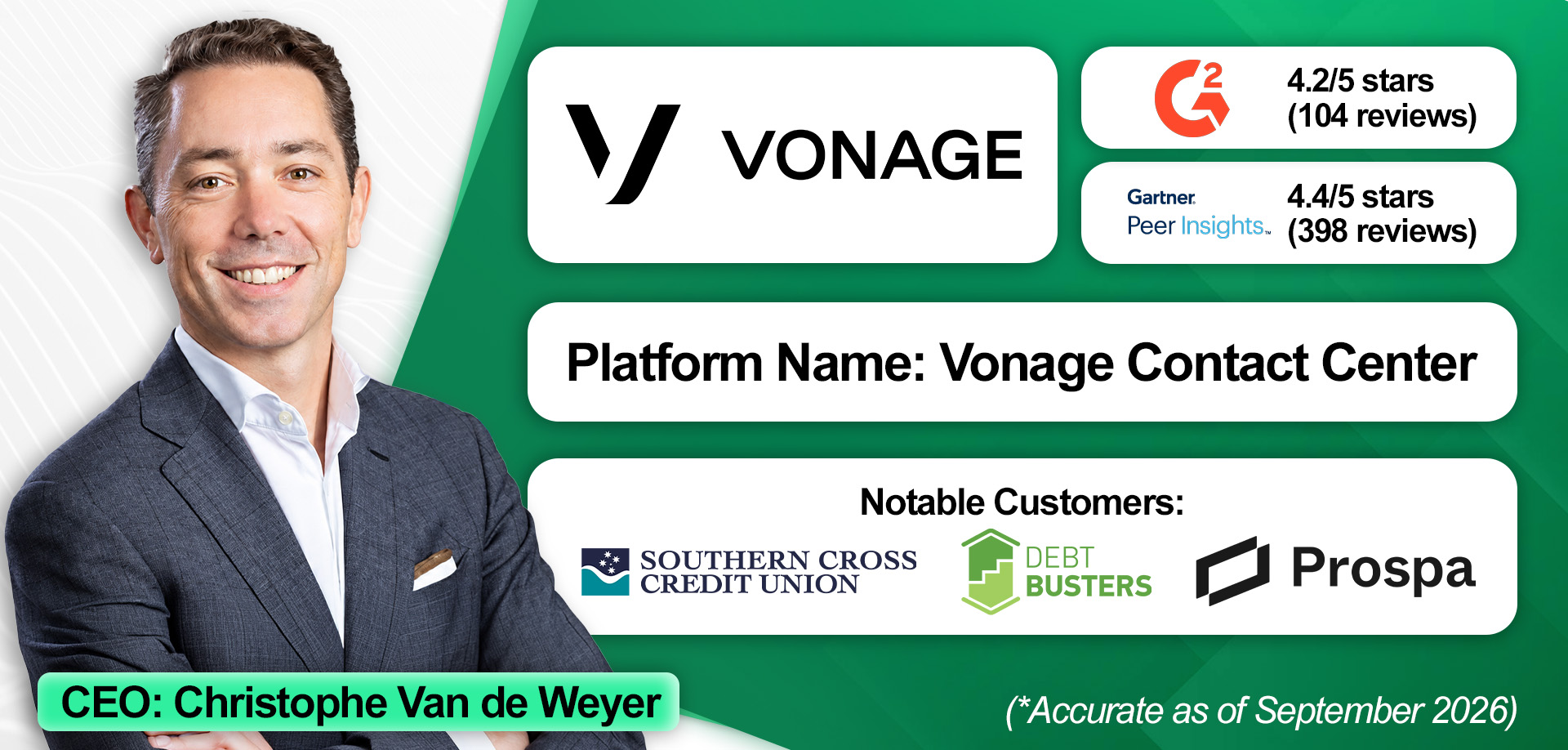
Vonage can pull signals from the underlying telecom network, enabling silent authentication behind the scenes rather than relying on customers to manually verify themselves. This replaces clunky ID&V methods like one-time passwords (OTPs).
The vendor is also working on combining network data with other data sources to build risk scores that support smarter, more automated decisions. For example, intelligently routing calls based on the likelihood that a caller is fraudulent. These are potentially powerful security and compliance tools for the financial services market.
Vonage also stands out for its dual deployment model, supporting contact center implementations both inside the CRM and outside it via a standalone product. It's particularly widely used inside Salesforce, where it's rated the number one contact center partner on AgentExchange.
When implemented inside Salesforce, agents never see Vonage branding. The solution runs natively within Salesforce while tapping into Vonage's communication and channel APIs, plus its advanced authentication mechanisms, behind the scenes. It also now streams audio directly into Agentforce Voice for brands building voice agents within Salesforce.
Outside Salesforce, financial institutions running multiple CRM interfaces simultaneously may choose Vonage for its Intelligent Workspace that acts as a "single pane of glass" for agents working across systems.
Finally, Vonage's unified CCaaS-UCaaS-CPaaS proposition brings additional benefits, including swarming, advanced proactive support tooling, and pricing discounts for brands that adopt all three solutions together.
“We’ve had customers pulling up to 13 CRM instances into the Intelligent Workspace, which becomes the single pane of glass for agents that many have long promised, but we deliver.”

Standout Features
- Silent Customer Authentication: Vonage uses network-level data (e.g., detecting SIM swaps) to enable silent, behind-the-scenes authentication that replaces OTPs, improving authentication success rates and reducing fraud risk while removing friction for the customer.
- Dual Deployment Model: The vendor supports both natively embedded CCaaS inside the CRM and a standalone CCaaS, with the latter including an Intelligent Workspace that connects numerous CRMs into a single pane of glass. This allows Vonage to serve enterprises regardless of how they want to deploy.
- CCaaS-UCaaS-CPaaS: Vonage combines UCaaS and CCaaS through presence sync, swarming, and shared minutes, while its CPaaS layer gives direct access to underlying network APIs, powering new fraud-prevention capabilities. CPaaS also supports mature proactive customer service workflows.
How Much Does It Cost?
The Vonage Contact Center is available on a per-seat subscription across two core packages, Priority and Premium, with optional add-ons available. Pricing isn't publicly disclosed for either tier; prospective customers should contact Vonage directly for a quote. Contact the Vonage sales team here.
15. Dialpad
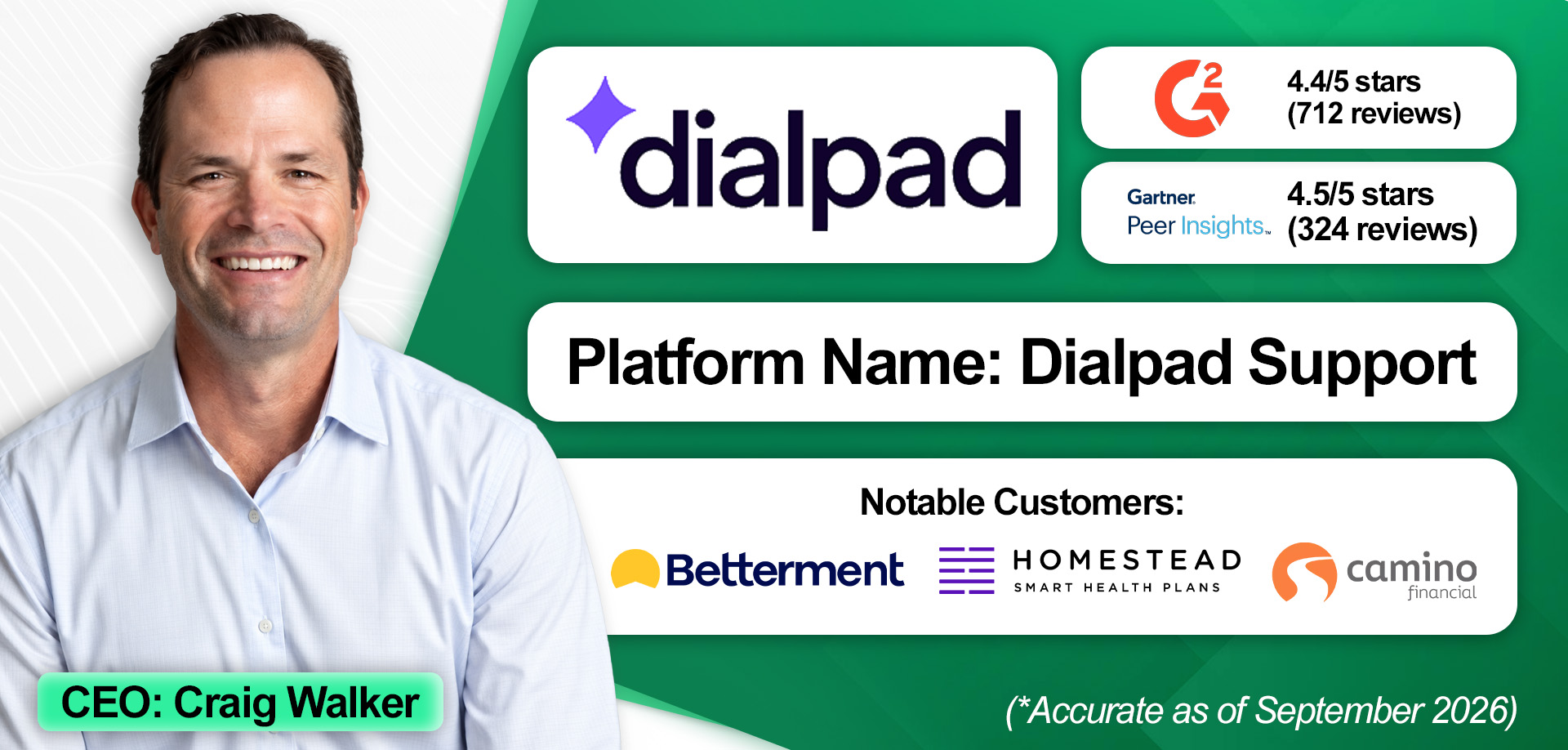
Dialpad extracts context from previous contact center conversations and, when agents appear to be struggling in real time, offers live guidance through its AI Live Coach, drawing on that all-important historical intelligence.
That example exemplifies Dialpad's focus on leveraging intelligence to dynamically adjust live user and customer experiences, which is a focus that remains central to its roadmap.
Indeed, the vendor is also building a solution that takes real-time intelligence about emerging issues, like problems with a banking app, and dynamically updates its AI agents to handle them appropriately. So, once the AI agents are updated, new callers get routed straight to an AI that already knows about the issue.
Dialpad is also building a specialized AI model for financial services and customer profiles directly into its platform. Eventually, each customer will have a persistent profile, formatted for LLMs rather than a traditional CRM, that carries conversational context forward between interactions. As a result, human and AI agents alike won't be limited to whatever's stored in CRM fields.
Yet, Dialpad isn't limiting this intelligence to its own platform. Its integrations with Gemini Enterprise and Glean mean the information inside customer conversations can feed into the broader enterprise knowledge layer.
Finally, the vendor fully rebuilt its outbound proposition last year, with automatic voicemail detection, pickup detection, and - more recently - agentic calling. As a result, the system is able to proactively make outbound calls, complete tasks like appointment reminders and pre-appointment forms, and hand off with context to a live agent when needed.
“Dialpad owns the underlying communications platform, the real-time conversation intelligence, the contact center, the AI agents, and - increasingly - the orchestration between them. That gives us a continuous loop where every conversation creates intelligence that can make the next interaction better.”

Standout Features
- Use of Real-Time Intelligence: Dialpad goes beyond identifying "what the customer is calling about" to tailor live agent guidance and coaching dynamically. Its roadmap includes leveraging real-time intelligence to auto-configure AI agents that resolve emerging contact center issues as they arise.
- Google and Glean Partnerships: Built on its Google Voice heritage, Dialpad was first to support Google's Agent-to-Agent (A2A) protocol with Gemini Enterprise, letting users query Gemini directly about call center activity. The vendor’s Glean integration extends customer conversation intelligence to personnel outside the contact center, feeding the broader enterprise knowledge layer.
- Reimagined Outbound Proposition: Dialpad’s new outbound proposition includes automatic voicemail and pickup detection, with agentic calling coming soon. Critically, missed inbound calls and outbound follow-ups log to the same Salesforce record/customer journey, with automatic mobile-to-Salesforce sync, which is key for financial services teams working on the go.
How Much Does It Cost?
Dialpad Support comes in three bundles: Essentials, Advanced, and Premium. These cost $80, $115, and $150 per user, per month. Visit Dialpad’s website for full details on what each package includes.
16. Microsoft
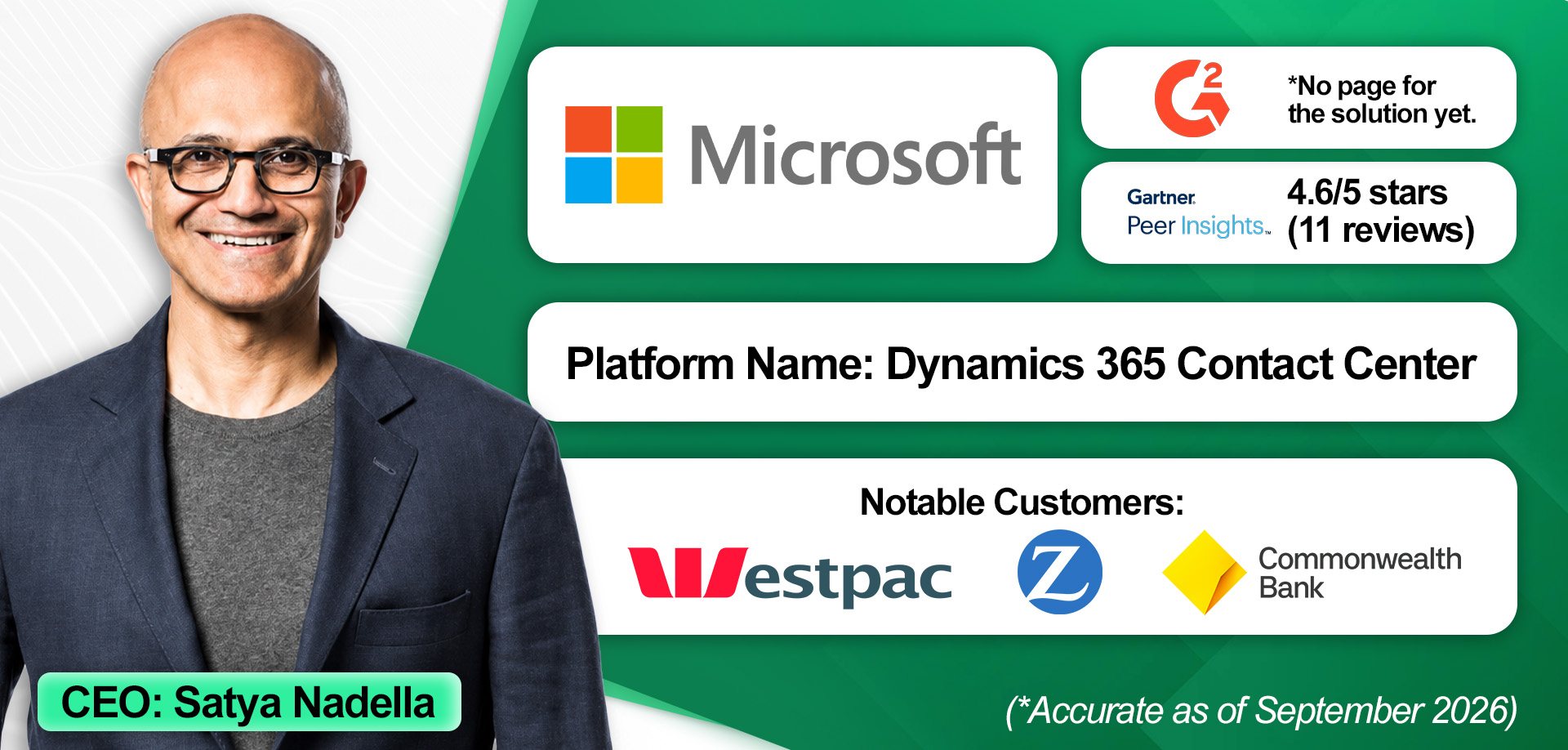
Many enterprises are essentially "Microsoft shops," partnering with the tech giant across business applications, data stores, communications, and more.
Critically, this makes the Dynamics 365 Contact Center an obvious choice for many brands, and Microsoft understands this, integrating the solution closely with the broader enterprise portfolio.
For example, the platform offers swarming for Teams, helping financial services companies pull branch employees and other staff into resolving customer contacts. It also shares a voice channel with Teams, which simplifies billing.
This deep integration extends further. The CCaaS solution wraps around Dynamics 365 for Customer Service to consolidate support environments, uses Power BI dashboards natively for reporting, and runs on Copilot as the platform's native assistant.
Copilot in particular gives Microsoft an opening to connect AI agents across the enterprise, letting human agents automate specific tasks across systems on-command.
Finally, Microsoft has invested heavily in embedding AI agents natively, including a Service Operations Agent that helps admins configure the platform. This reflects a broader recognition that the deployment experience is fast becoming part of the product experience itself.
Standout Features
- Microsoft Ecosystem: The solution's native ties to Teams (including swarming and a shared voice channel), Dynamics 365 Customer Service, Power BI, and Copilot as the built-in assistant. This lets many financial services firms consolidate around tools they already use.
- Copilot Opportunity: As Copilot has become a studio for building and connecting AI agents, Microsoft's messaging around the Dynamics 365 Contact Center as a Copilot-first solution gains traction. After all, brands can connect the native Copilot to AI agents elsewhere in the business and streamline live agent workflows. Currently, this would take significant work. But there seems to be a long-term opportunity here.
- Coordinated, Native AI Agents: Five embedded agents handle tasks from platform configuration to quality scoring and coaching, with some working together. For instance, a Customer Intent Agent tracks emerging contact reasons and informs the Customer Knowledge Management Agent that spins up new knowledge content. That's a potentially powerful cycle.
How Much Does It Cost?
When billed annually, the Microsoft Dynamics 365 Contact Center is available from $110 per user, per month. Voice- and digital-only editions cost $95 per user, per month. Organizations may also have to pay for Copilot Credits. Find out more about Microsoft’s CCaaS pricing here.
More Contact Center Solutions Financial Services Buyers May Consider
Beyond the providers listed above, many other vendors offer contact center solutions worth noting.
Salesforce and Zendesk are two big names, both differentiating by positioning their contact center as an extension of their customer support CRM. That said, both are still early in their CCaaS journeys.
Indeed, Zendesk only recently crossed the 100-customer milestone for its CCaaS offering, while Salesforce's Service Cloud Contact Center only began its global rollout in Fall 2026. Still, these are two names worth watching.
RingCentral is another big name, though it chiefly sells the RingCentral Contact Center to enterprises, which is a white-labeled version of NICE CXone, closely integrated with its UCaaS platform, RingEX.
Tata Communications and Odigo are also prominent players, often chosen by organizations that want professional services bundled into their deployment, thanks to close ties with Tata Consultancy Services and Capgemini, respectively.
Tata Communications further stands out for its specialist voice AI capabilities, its own network infrastructure (which boosts reliability), and its ability to unify CCaaS, CPaaS, and UCaaS in a single offering.
Among more niche players, 3CLogic embeds a contact center directly inside a brand's system of record, focusing on connecting service workflows and data with the broader ecosystem.
Notably, it’s proving an especially popular offering with brands running ServiceNow Customer Service Management (CSM).
Finally, conversational AI provider Crescendo recently made headlines with a contact center solution run "end-to-end" by AI agents. How this differentiated product gets adopted will be fascinating to watch.
A Final Observation
The days of choosing a contact center primarily for its ability to manage interactions efficiently and at scale are over.
Today, organizations must first define the contact center's broader role within the enterprise ecosystem and then work backwards to determine the right deployment, data, and labor model.
That means the buying journey shouldn't start here, and it shouldn't start with another analyst report either. It should start with a diverse committee diagnosing the current operation and what needs fixing right away, then asking: where do we need to be in 18 months?
From there, IT specifications will reflect the organization's own specific requirements, context that's essential once market research begins. After all, a "top" vendor isn't necessarily the best fit, and that holds as true in financial services as in any other vertical.