
October 20, 2026 • 13 min read
Zoom Debuts a Unified Context Layer to Transform Customer and Employee Experiences

Director of Content & Market Research
October 20, 2026
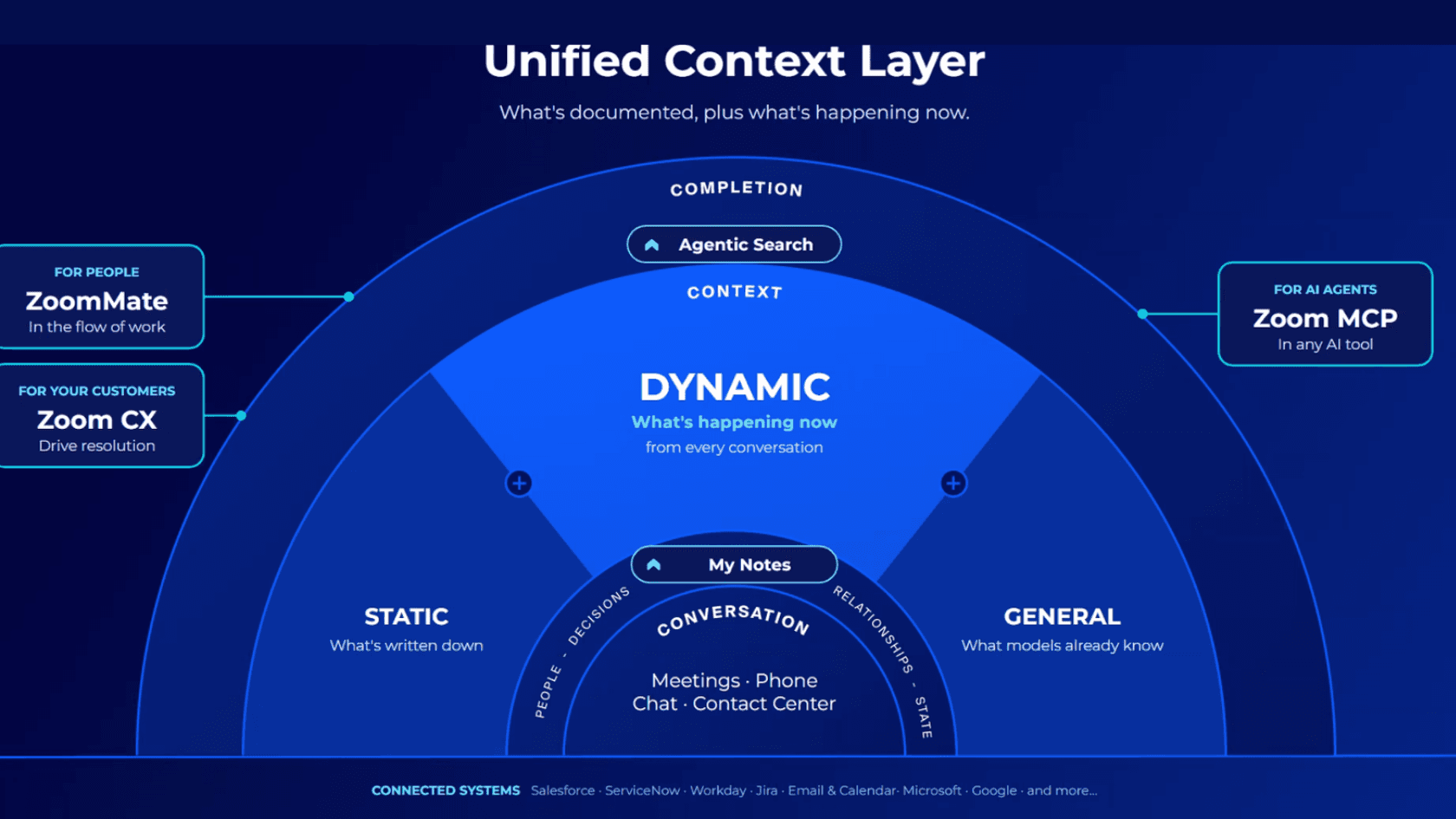
Zoom has launched a unified context layer spanning its portfolio as its headline announcement from Zoomtopia 2026.
The premise is that most valuable information within a business never makes it into a document, knowledge base, or CRM field.
Instead, it lives in the conversations between employees, customers, and partners.
Consider decisions made in meetings, customer insights shared on calls, and details buried in chat threads. All too often, these never make it into a system of record.
The unified context layer captures all this, piecing together context from documents, files, and connectors; general company knowledge from web searches; and dynamic context.
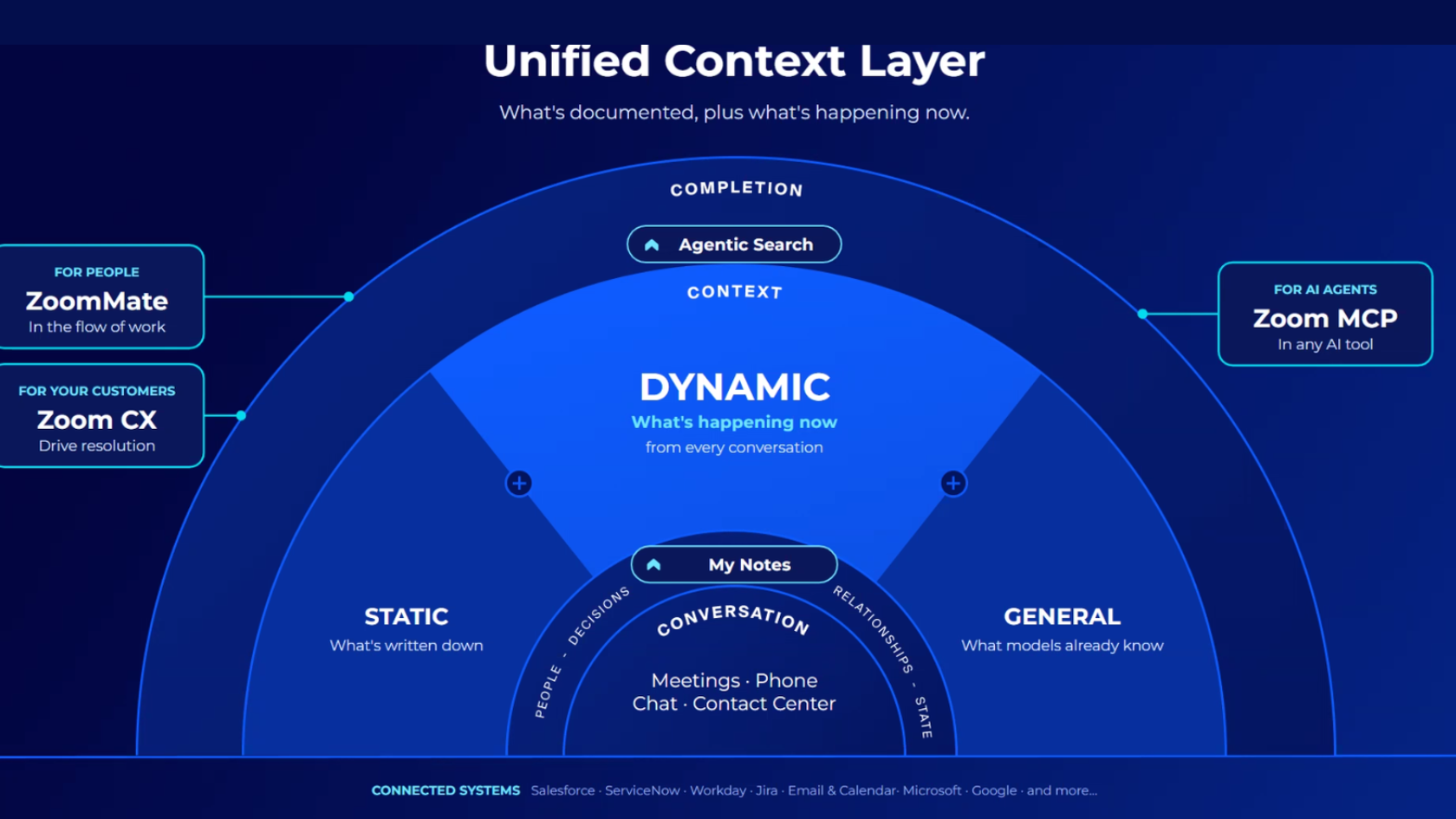
That dynamic context from customer conversations is Zoom’s secret sauce. It tracks what’s happening in interactions across the business and follows them until completion.
In doing so, it builds a graph of how people connect, what they discuss, and the decisions they make, understanding how the business operates.
That graph updates continuously, serving employees through agentic search and AI agents, turning context into action.
“In practice, your AI agents don’t need to sift through mountains of documents and transcripts every time you ask a simple question, because the context layer has already synthesized and distilled that information.”

Zoom is uniquely positioned to deliver this context layer, with first-party data from meetings, phone, team chat, contact center, revenue intelligence, and events, while also integrating with third-party systems of record such as Salesforce, ServiceNow, Workday, and Jira.
Every interaction across those touchpoints feeds the context layer.
Consider a partner calling in to enquire about the shipping date for a product. A system that only searches static files, like a project plan, won’t have the full picture. One that might have detected someone in the morning’s meeting saying they weren’t sure if they could meet the deadline can flag that hesitation.
That example highlights the benefit of a living, breathing context layer.
Zoom Extends Its Context Layer with Customer Profiles
Zoom aims to track every conversation happening on its platform to completion, accumulating intelligence that informs its unified context layer.
However, regarding CX specifically, it’s also considering cases to completion.
So, rather than treating customer interactions as isolated tickets, Zoom aims to connect them into one continuous customer story.
To do so, the enterprise communications giant is introducing a new Customer Profiles solution as part of its expanded Customer Directory.
Customer Profiles combine conversational context, CRM data, engagement history, and linked cases into a unified customer view that updates as customers engage with the business.
Both human agents working across the Zoom Contact Center or Phone and Zoom Virtual Agents can consult Customer Profile when interacting with customers, informing their responses. Zoom AI Expert Assist can also surface helpful information from a profile for live reps mid-conversation.
However, with this additional context, brands can not only better inform human and AI agents; they can also reimagine customer experiences.
An Example of How Customer Profiles Transform Customer Cases
Consider an online travel agency. Its Customer Profile might show a “Diamond Member” recently searched for hotels in Barcelona next January, previously booked a two-room suite for their husband and kids, and had complained about a noisy room near the ice machine.
With this insight, instead of sending out a generic campaign to Diamond members, the travel agency can send a message stating: “We noticed you’re looking at Barcelona. As a Diamond member, here’s a 15% discount. We also have a family suite away from the ice machine, with a welcome package for your kids.”
“By combining Zoom’s unstructured, conversational data and case data in this way, organizations can move from personalization to true individualization.”

Zoom Is Not Replacing the CRM Layer; It’s Building on It
Zoom isn’t looking to replace the CRM with Customer Profiles. Instead, it connects multiple systems of record, enriches them with conversational data, and brings that context together to make it actionable.
Contact center agents, whether human or AI, still need to work across other systems to resolve cases. That hasn’t changed, but Zoom is now making the process easier with its new Source Hub.
Essentially, this allows agents to view, create, and update cases in a third-party system from their desktop, so they don’t have to swivel between systems as they resolve customer queries.
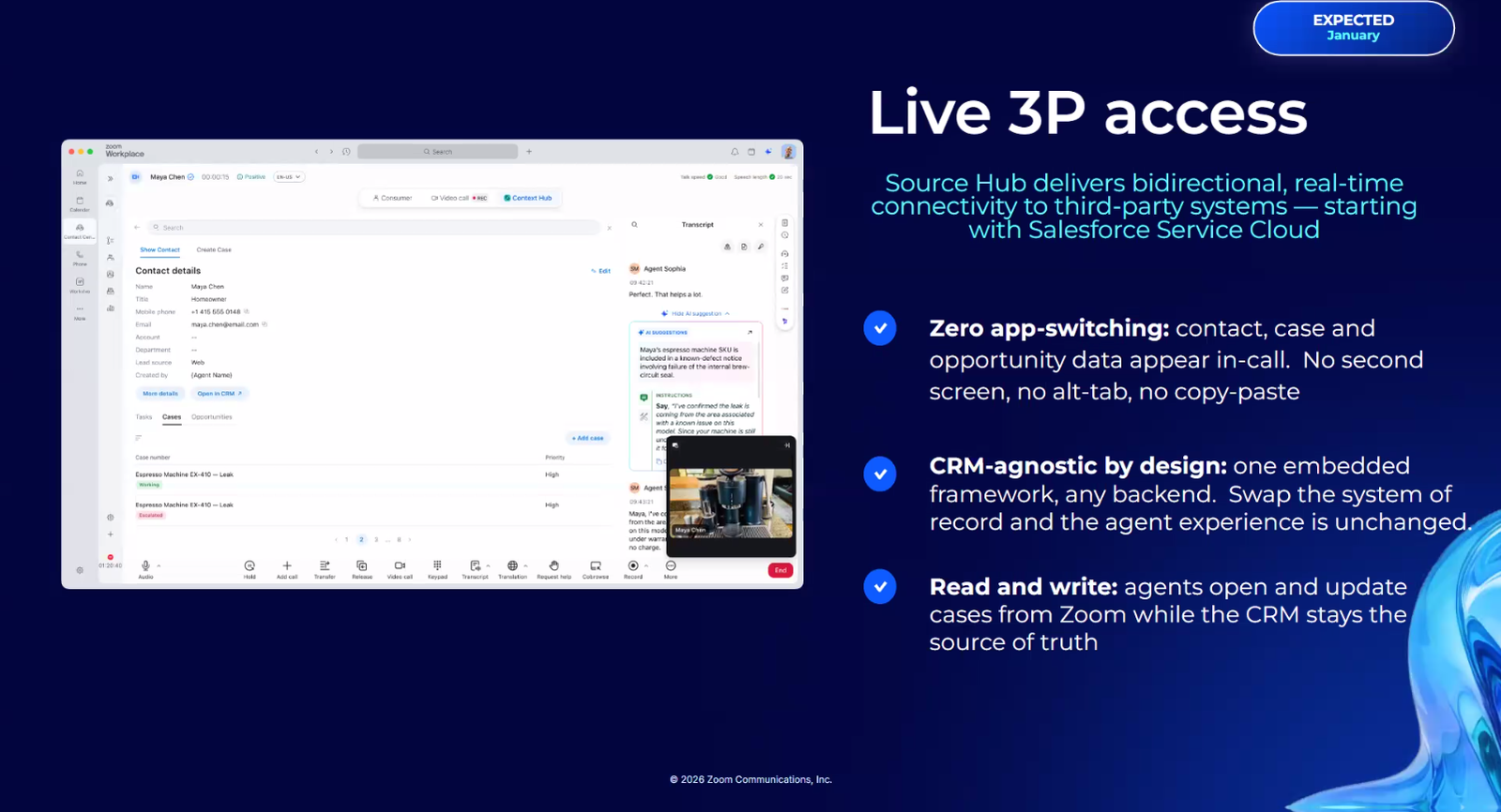
“Agents go here for knowledge, here for system-of-record data, here for inventory, here for open tickets. They have to go to a lot of places to do their job. So the premise that you should work in my application because that’s where all your work is done is flawed out of the gate. The right thesis is that agents shouldn’t have to toggle.”
When the Source Hub is generally available in early 2027, it will initially only support Salesforce. However, many additional integrations are in the pipeline.
Zoom Captures More Customer Context with Virtual Agent Kiosks
While Zoom captures customer context across channels and systems of record for its Customer Profiles, in-person customer conversations still fly under the radar.
With the new Zoom Virtual Agent (ZVA) kiosks, that may not be the case much longer.
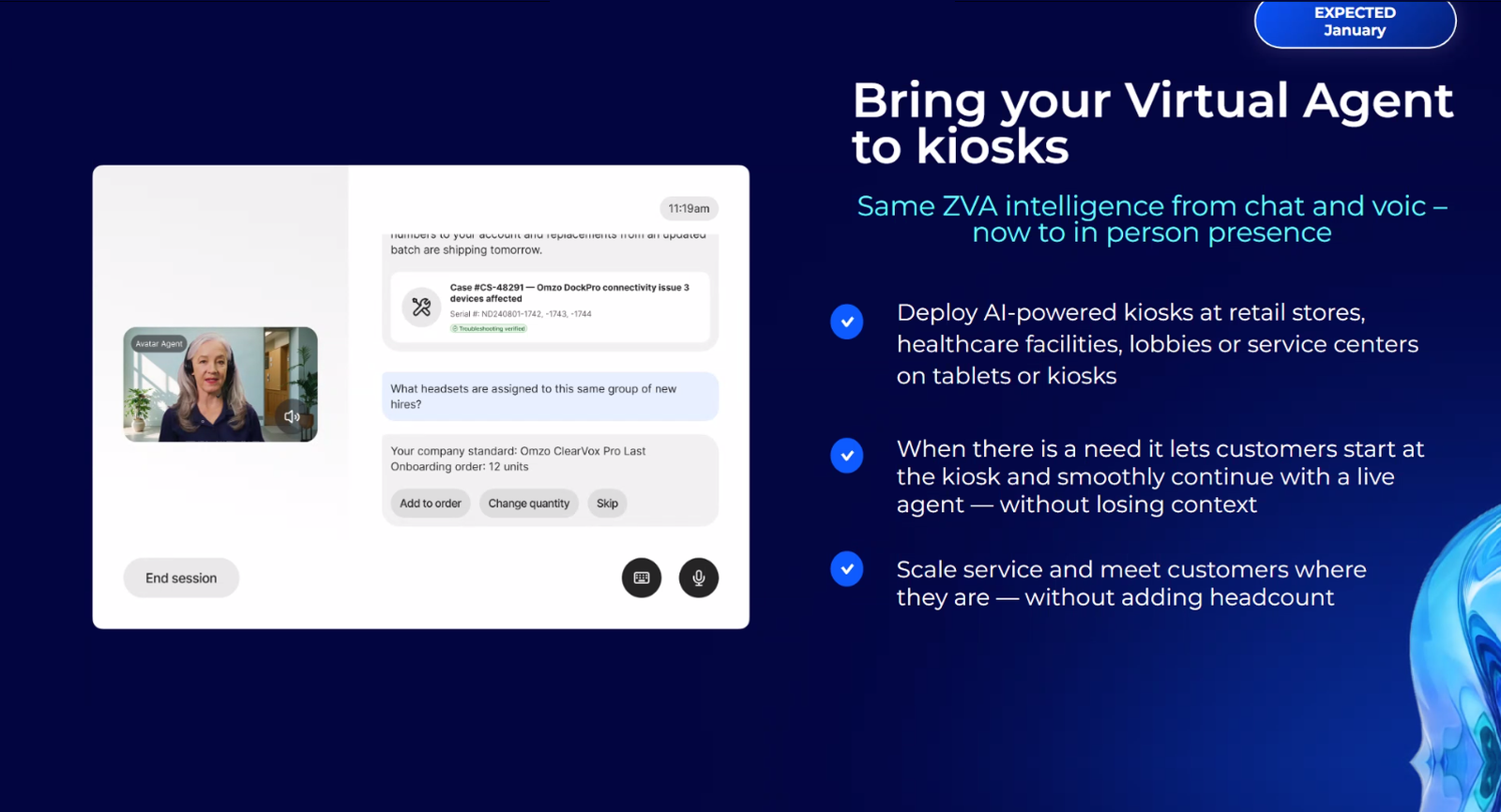
These physical kiosks can be deployed in branches, stores, clinics, and other locations, allowing customers to get support from a virtual agent instead of a human associate.
Customers can log in, enabling Zoom to capture the interaction and add it to their profile, building a richer picture of their needs and preferences.
The benefits extend to customers too...
“Think of the moments a customer needs help in the real world but can’t find a person to ask a question in a retail aisle, or update insurance information at a doctor’s office. Now you can show up anywhere your customer is standing: no line, no wait, no tracking someone down.”

An Example of Zoom’s Virtual Agent Kiosks in Action
Consider an electronics store. A customer walks in ready to buy a television but has questions. If the store associate is busy, they may leave, and a sale goes begging.
With the ZVA Kiosk, customers can compare televisions by showing the kiosk photos of different options and asking for pros and cons.
The kiosk answers their questions, recommends accessories, and escalates to a remote support agent if required, improving the customer experience and saving potentially lost revenue.
But there’s another benefit: insight. That’s not only added insight into the customer journey, but new insights into what people come into stores to buy, what they ask, what they compare, and what they can’t find.
This additional conversational data can then inform product displays, inventories, and promotions.
“We’re not just helping customers make better decisions and preventing lost sales. We’re giving brands visibility into what customers actually want, right at the moment of purchase.”
Additional Zoom CX Announcements
Alongside the unified context layer, Customer Profiles, and ZVA Kiosk, Zoom made four other major updates to its Zoom CX portfolio, as outlined below.
1. Zoom CX Insights Pivots from Reporting to Action
CX Insights is the Zoom Contact Center’s analytics layer, combining conversational and operational data. Users can query this data through a natural language interface, unlocking new insights.
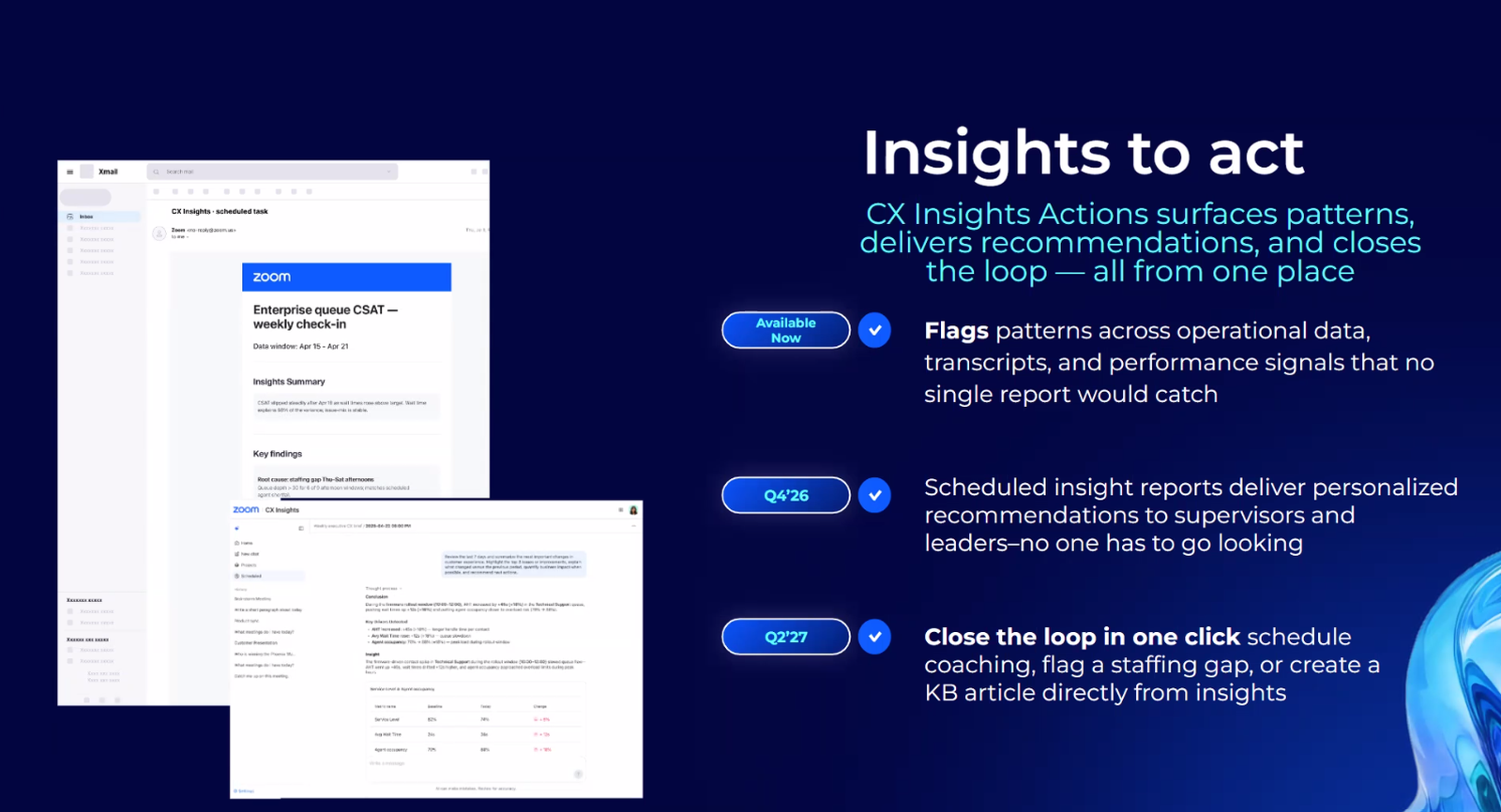
Now, Zoom is enabling one-click actions through that interface. These include scheduling coaching sessions, flagging staffing gaps, creating knowledge base articles, and delivering personalized recommendations.
“We’re also introducing executive briefs, where one click turns any CX Insights report into a polished, presentation-ready brief with key findings, trend context, and recommended actions, so you can share insights beyond the contact center in a form other leaders can consume.”
2. The Zoom Customer Workflow Orchestrator Is Now Generally Available
Zoom’s Customer Workflow Orchestrator lets support leaders define what happens after a customer contact ends. AI evaluates the interaction to determine which follow-up actions to trigger, such as sending a confirmation email.
Actions don’t have to happen immediately. The orchestrator can wait for external events before proceeding.
For example, if a customer is waiting for a refund on a returned item, it can send a notification once the package arrives at the warehouse, reassuring the customer without requiring another support interaction.
3. Zoom Expands QA to Monitor the Entire Conversation, Adds AI Roleplays
Customer service often involves AI agents and human teams working across front- and back-office operations.
Zoom can now score these cases as a single interaction, giving contact centers a broader view of where customer experiences break down and extending Quality Management (QM) beyond individual agent performance to the processes themselves.
Additionally, QM now includes AI roleplays, allowing human reps to practice difficult conversations through simulations. These exercises can help accelerate proficiency and prepare teams for new queries, such as those arising from a product launch or marketing campaign.
4. Zoom Announces a New Pricing Model for Its CX Solutions
Zoom CX is introducing a spend-based model that replaces separate product commitments with one annual spending pool covering agents, seats, applications, and AI capabilities.
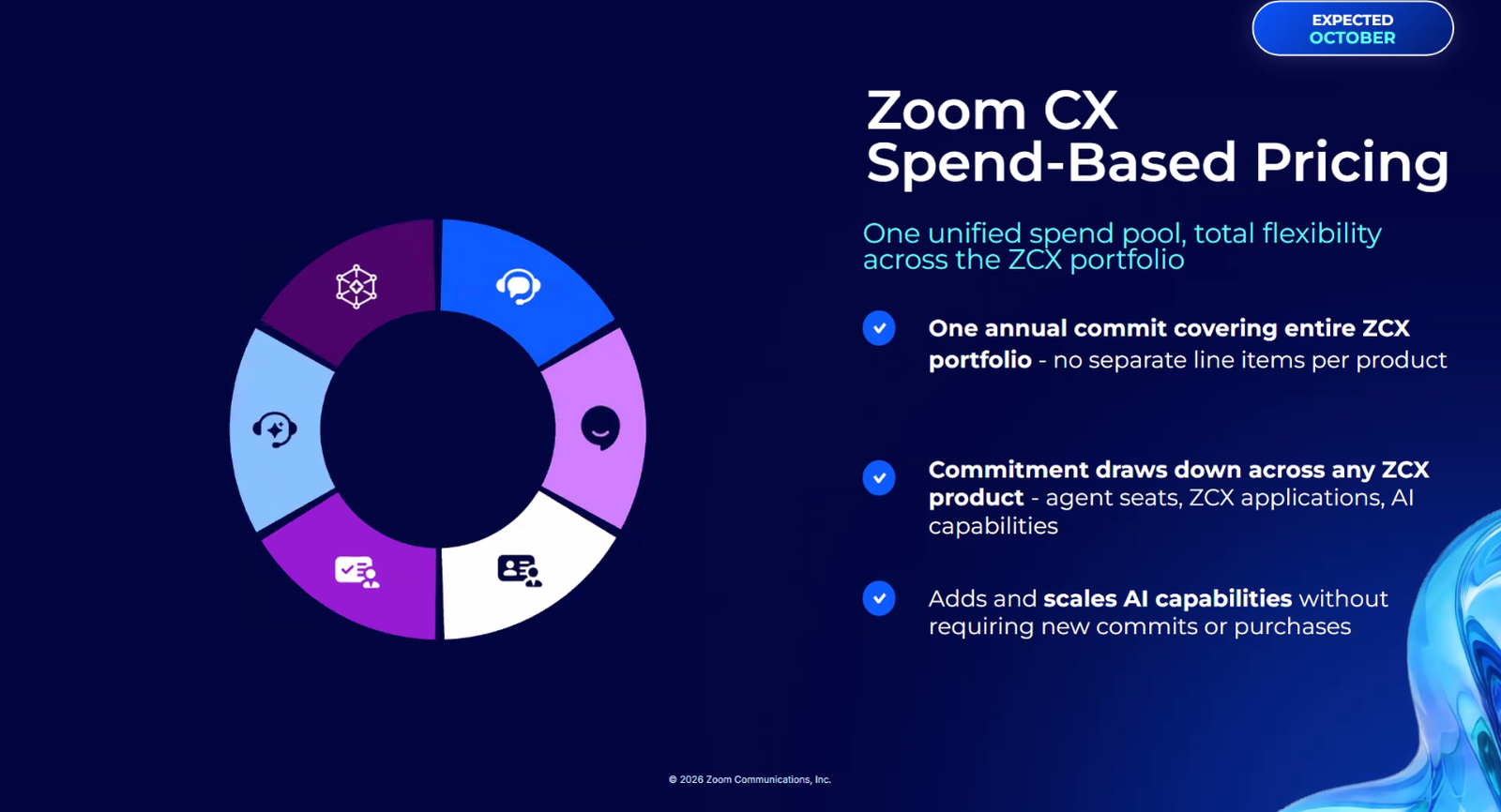
“Customers can add and scale AI without product-specific purchases and make changes without reviewing their contract.”
What’s Next for Zoom CX?
“My goal, from day one at Zoom, was never to become the 30th CCaaS vendor,” said Morrissey. “The market is changing too fast for that to be your true north.”
Instead, Zoom wants to help customers unearth new customer context to reimagine and individualize customer experiences, not just handle tickets.
The universal context layer and Customer Profiles provide that context.
Yet, beyond CX, Zoom can draw on its broader portfolio to differentiate itself from traditional CCaaS providers. It’s already doing so, having introduced interview roleplays for HR teams through BrightHire; it now offers similar AI simulations to help sales reps practice.
There are further opportunities, too. For instance, insights from contact center conversations could reveal where customers drop off, feeding that intelligence into Zoom Revenue Accelerator (ZRA), its revenue intelligence solution. Such cross-portfolio integrations could create a more distinctive offering.
With capabilities spanning collaboration and employee experience, Zoom has considerable scope for further innovation.
7 More Announcements from Zoomtopia 2026
Beyond the unified context layer and CX updates, Zoom made several other major announcements at Zoomtopia 2026. Below is a roundup of the remaining news.
1. Zoom Evolves Its Meeting Experience
Zoom is making meetings more natural and productive with AI-powered improvements to voice clarity, real-time translation in the speaker’s own voice, subtle camera-position correction, and 60 fps screen sharing. A private live meeting agent can also provide instant answers and speaking tips.
Then, there are two additional innovations to help employees act after meetings:
- My Notes Workflows: Automatically send meeting summaries to Zoom Chat, Salesforce, and other destinations using pre-built templates or natural-language instructions, without manually building workflows.
- Zoom AI Agent Teams: Assign specialized agents to work on different parts of a project in parallel, coordinate their tasks, and consolidate their results into a single output.
2. Zoom Also Refreshes Its Chat Experience
Zoom Chat is becoming a shared workspace for employees and AI agents.
Agents can join the conversation; fetch intelligence from across meetings, notes, chats, documents, and connected applications; and work alongside the team.
Instead of searching each store separately, users get synthesized answers from the universal context layer, and agents get the understanding they need without sifting through everything every time.
A new thread inbox also helps to aggregate replies across conversations, an activity page surfaces mentions, reactions, and events, and Zoom has reduced notification noise.
3. Zoom Goes Headless
Zoom is opening its capabilities beyond its own interface through MCP servers, APIs, and pre-built integrations with AI assistants such as Claude, Codex, Copilot, Gemini, and Muse.
As a result, developers and agents can schedule meetings, search content, transcribe, and manage Zoom systems without opening Zoom itself.
In this sense, Zoom has become headless.
An admin MCP server and unified search-and-ask API further extend conversational access to Zoom data and controls.
4. Zoom Innovates to Improve the Physical Office
Zoom is improving shared devices and workplace collaboration. Bring Your Own Zoom lets employees access their personal meetings, calendars, and contacts on shared devices via a QR code, with personal data removed at sign-out.
Zoom Signage is a new offering for managing office screens, with rule-based scheduling by location, so organizations can manage every screen in your office from one place.
Finally, enhanced interoperability with Microsoft Teams Rooms adds features such as HDMI sharing, dual displays, 1080p video, and participant rosters. So, whether a Zoom Room is joining Teams or a Teams Room is joining Zoom, the vendor promises an excellent experience.
5. Zoom Adds New AI Governance Capabilities
Zoom is expanding controls over how AI accesses and uses company information.
Sensitivity labels can restrict AI agents from reading classified content, while custom guardrails prevent sensitive information from appearing in AI responses.
Centralized administration provides oversight and shutdown controls for AI agents.
Additional measures include deepfake detection, verified-human badges through partners, and expanded compliance archiving for My Notes and Zoom Canvas.
6. Zoom Events Goes Agentic
Zoom Events is turning live events into ongoing content and business opportunities.
Content Studio repurposes recordings into multilingual clips, posts, and images, with editing based on text changes rather than traditional video timelines.
AI can also automate event setup, registration, pages, and reminders, while conversational analytics help hosts assess engagement and create reports.
7. Zoom Onboards Common Room to Boost its Revenue Accelerator
Finally, Zoom Revenue Accelerator is adding AI-driven prospecting, lead enrichment, opportunity prioritization, and automated outreach that can continue until meetings are booked.
These capabilities come from its $250 million acquisition of Common Room.
In addition, Zoom has added an Agentic Workflow Builder that lets sales teams create workflows triggered by CRM events or deal signals. So, for example, they may set up an alert for a manager when a deal is at risk. The first version is planned for October.