September 22, 2026 • 6 min read
NiCE Cognigy Steps Toward Self-Configuring AI Agents

Director of Content & Market Research
September 22, 2026
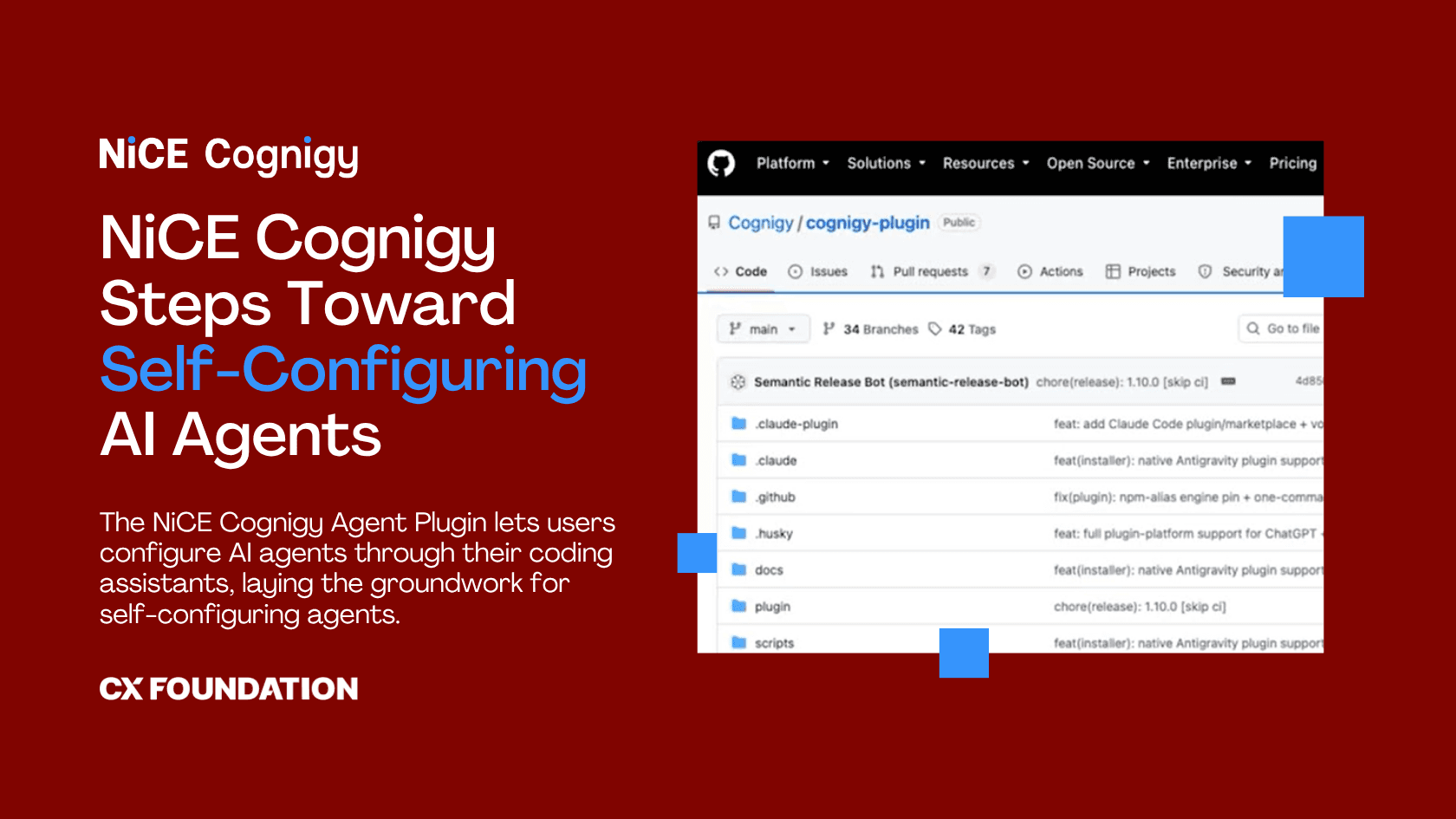
Last month, NiCE Cognigy announced Agentic Building for CX AI.
At the heart of the announcement was the NiCE Cognigy Agent Plugin, a solution that brings a new kind of user to the NiCE Cognigy platform: coding agents.
Traditionally, conversational AI platforms like NiCE Cognigy have served two types of users: developers, who build API connectivity and functions, and business users, who design the conversational flows.
However, the NiCE Cognigy Agent Plugin also enables coding agents to act directly within the platform, following natural language instructions.
As a result, CX and IT teams can build, tweak, and optimize AI agents - with personas, goals, and guardrails - by only interacting with their coding agents. They won’t need to interact directly with the platform.
“This doesn't remove the canvas, the flow editor, or any of the management tools in the platform. It's simply a third participant that supercharges how fast and how efficiently developers and business users can build AI agents.”

Currently, that participant could be Claude Code, Codex, Cursor, Antigravity, or VS Code. Yet, as NiCE Cognigy’s solution is built on the Agentic Plugin Standard, it will support an increasing number of coding agents over time.
As more CX and IT teams leverage this capability, their agents will start to configure other AI agents, ushering in a future of self-configuring agents.
How Does the NiCE Cognigy Agent Plugin Work?
Cognigy’s Agent Plug-in comprises two MCP servers, predefined skills, and sub-agents.
The first MCP server connects to the Cognigy platform. Meanwhile, the second connects to its documentation, ensuring agents access its latest documentation and API specifications.
Next come the skills that teach the coding agent how to interact with Cognigy. These include the skills to build agents, adapt agents, add knowledge, configure WebRTC, and more.
Finally, the sub-agents. These include a sub-agent that runs through a voice go-live checklist, another that completes an audit of another agent, and - as a final example - one that helps structure the knowledge base.
When all of these work together, users can create AI agents, flows, and job nodes with commands to their coding agents and attachments like PowerPoint presentations, PDFs, URLs, or conversation transcripts. They may only need an agent job description.
They can then test the agent, optimize it, and tweak its persona all through conversation.
From there, users can deploy their agents on voice or chat with a command. They can also build and implement xApps, which are multimodal web and mobile apps, where Cognigy blends modalities - i.e., text, multimedia, voice, etc. - within one interaction.
NiCE Cognigy Beckons Self-Configuring AI Agents
Conventionally, brands build conversational AI applications with a human who learns how to connect knowledge, reconfigure integrations, establish guardrails, configure prompts, and more.
Ultimately, it has required specialist expertise, and - partly due to this - industry disruptors like Bland and Sierra have made headway by forward-deploying engineers.
In effect, they’ve recognized that small enterprises and the midmarket struggle to scale their pilots and make them work at scale.
Nevertheless, while forward-deployed engineers are an excellent short-term solution, they’ll leave, environments will change, and organizations will eventually need to fend for themselves.
That’s why innovations like Cognigy Agent Plugin are exciting. What was once a complex configuration is replaced by instructions to a third-party agent.
As a result, one agent essentially configures another.
Still, a human with specialist knowledge should review the configuration. That human oversight and validation remain critical.
However, the direction is exciting. After all, additional agents may track the customer-facing agent’s interactions over time before testing and recommending changes - approved via the coding agent.
If this happens, NiCE Cognigy could one day bring a self-configuring, conversational AI platform to market.
Similar Announcements That Underscore the Trend
Perhaps the obvious point of comparison for the NiCE Cognigy Agent Plugin is Salesforce’s Headless 360 announcement, when Salesforce exposed its platform capabilities, workflows, and data to third-party natural language interfaces.
At Dreamforce 2026, Salesforce evolved this story with AIforce, which preconnected MCP servers and preconfigured skills so that users could interact with these capabilities from Claude, Slack, and Agentforce Coworker.
Yet, so far, Salesforce customers can only take actions across its ecosystem; they cannot redefine the ecosystem itself. That’s perhaps its next step.
As such, two better examples are Typewise and Crescendo.
Typewise is an AI agent platform for customer experience teams. It recently launched Nova as an “AI operator”.
When leveraging the “AI operator”, a user explains - in natural language - the optimal resolution path to an on-platform assistant. The solution then defines the customer journey, maps out workflows across connected systems, and configures the agents.
From there, it drafts governance processes and tests agents against a contact center’s past conversations. It also monitors post-deployment success factors, investigates performance drops, and systemically recommends workflow reconfigurations.
As a result, it aims to bring that self-configuration loop, albeit not through a third-party assistant.
Then, there’s Crescendo, which released a CX Platform run “end-to-end” by specialized agents, continuously learning from customer conversations to automatically adapt workforce plans, knowledge content, and performance evaluations. Essentially, it becomes a more autonomous contact center.
These are exciting examples, and - as NiCE Cognigy is clearly thinking along the lines of self-configuration - the longer-term ramifications for NiCE software as a whole are exciting.
What Does This Say About the Future of Customer Experience Software?
The “SaaSpocalypse” is no longer the talk of the tech town.
While some had lauded the prospect of vibe-coding bespoke software - often as a CRM alternative - maintenance costs, integration complexities, and shallow capabilities have diffused that conversation.
Yet, consider the future of agents living inside of software platforms, learning from customer conversations and continually adapting the customer support environment by reconfiguring routing rules, agent schedules, customer-facing agents, and more.
That’s a powerful vision for the future contact center.
So, while software may not be on the chopping block in the near future, self-configuring agents could eventually lead to self-configuring software.
Of course, that future remains up for debate. Yet, one idea has crystallized, especially from the NiCE and Typewise examples: AI agents are increasingly becoming part of the initial configuration and deployment experience, not just the product experience.