Updated on September 15, 2026 • 12 min read
Dreamforce 2026: The Top Announcements, Inc. AIforce, Koa, & New Partnerships

Director of Content & Market Research
September 15, 2026
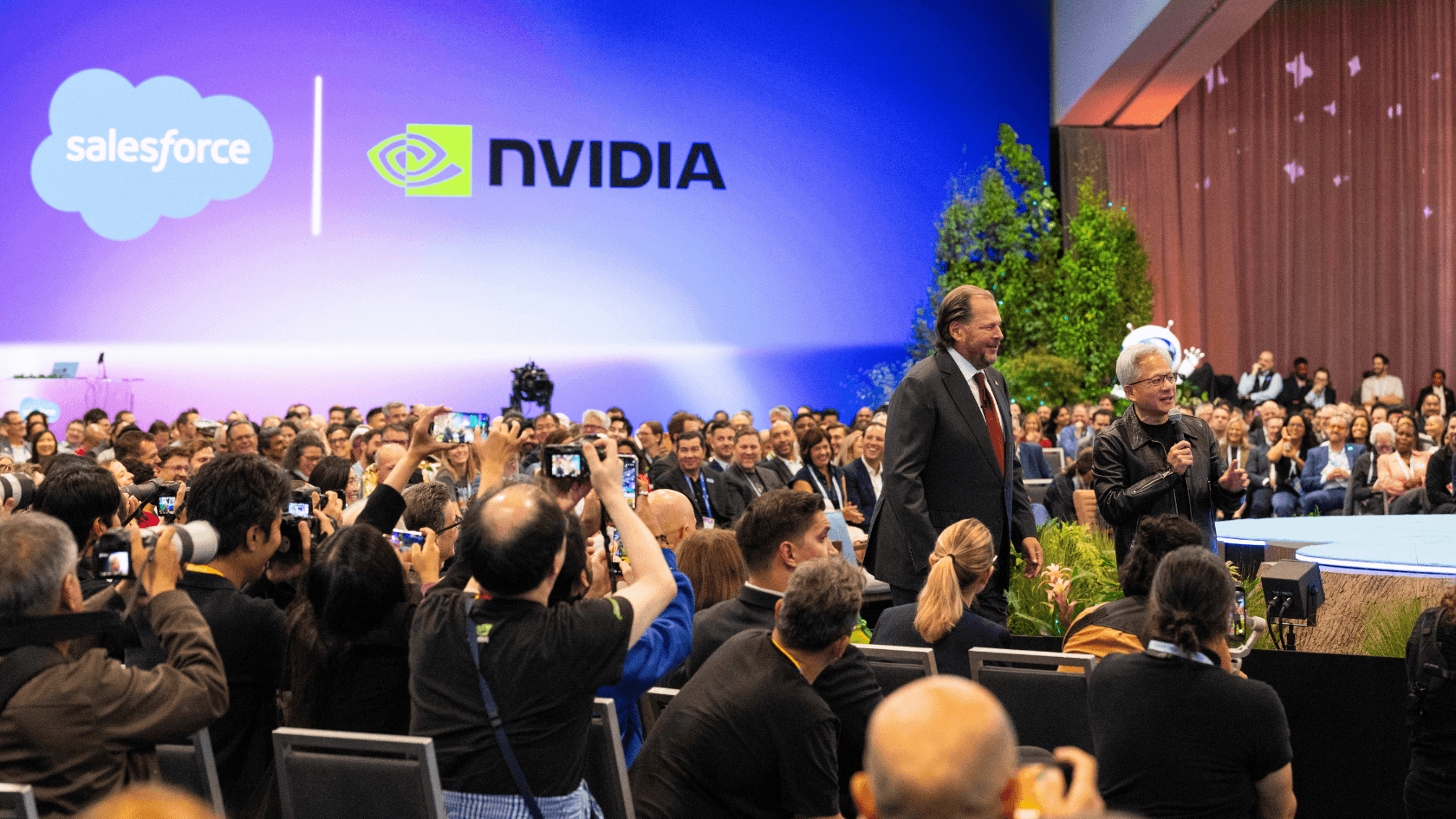
Some 43,000 people have descended on San Francisco for Dreamforce 2026, Salesforce’s flagship annual event.
However, a lot has changed at Salesforce in the 12 months since the last Dreamforce.
First came Slackbot, billed as an agentic front door to the Salesforce ecosystem, giving users a way to prompt AI agents to complete tasks across Salesforce applications on their behalf.
Then came Headless 360, which opened Salesforce capabilities and workflows to third-party agentic interfaces, followed by the launch of Agentforce Contact Center.
At the same time, Salesforce has been on an acquisition spree, moving to buy Fin, m3ter, Contentful, Momentum, and Cimulate.
Dreamforce 2026 is where those moves start to come together into a single, coherent vision for Salesforce. Here are the biggest announcements from the event so far.
1. AIforce Evolves Salesforce’s Headless Story
Salesforce is a platform where organizations encode how their customer experience operations run, with data, metadata, workflows, permissions, and so forth. It is not defined by its UI.
That’s where the Headless 360 came in. Essentially, it exposed Salesforce capabilities via MCP servers, giving people a way to start wiring Salesforce up to agentic interfaces.
In doing so, Salesforce aimed to help customers “break free” of a shared user interface where every organization and employee uses an adaptation of the same screen.
Yet, it stumbled across two core issues:
- It takes a technical person to manually wire up raw MCP servers and APIs just for one person’s Salesforce environment, let alone thousands of people’s workspaces.
- AI must reason about which API and MCP server to use, and users have to guide those decisions by manually creating skills. That’s tricky, and not every individual can write their own skills.
For Salesforce, the conclusion was that teams need a curated library of "skills" and ready-to-install products to start going headless. Enter AIforce.
“AIforce is a step above (Headless 360). We've taken those things (raw MCP servers, APIs, etc.) and productized them into packaged solutions within your org that you can just turn on.”

Those packaged solutions include Claudeforce, Slackforce, and Agentforce Coworker…
2. Salesforce Introduces Claudeforce & Slackforce
As teased above, Claudeforce, Slackforce, and Agentforce Coworker are the three pre-configured agentic interfaces that currently make up Salesforce's new AIforce initiative.
Claudeforce is a plug-in that brings Salesforce to Claude.
As such, Salesforce customers can interact with the Salesforce platform through Claude, without building custom skills or relying on Claude to reason from scratch about which MCP servers or APIs to call.
For instance, a user may ask Claude something like: "Give me an update across my deals," and the AI Assistant pulls from Salesforce data. They may then ask Claude to take specific actions on those deals, in Sales Cloud, without entering the app.
Over time, Claude Cowork users may also build entirely new custom interfaces/apps on top of Salesforce data just through natural-language instructions, according to Rohan Kumar, President & CPO of Salesforce.
"As an individual user (of Claude Cowork), you can build - just through instructions, no code - an entirely new interface for how you and your team want to work with Salesforce.”

Claudeforce functions similarly to Slackforce.
Slackforce is essentially Slackbot, with a significant new addition: Slack Surfaces.
Slack Surfaces lets Slackbot generate rich, interactive applications directly inside Slack, as Marc Benioff, CEO of Salesforce, teased on X last week.
Finally, there is Agentforce Coworker. First announced in May 2026, it provides an agentic interface for organizations pinning their future on Salesforce’s conventional Lightning Interface, but still wanting an agentic experience layered on top of it.
3. Claudeforce Goes Into an Open Beta
Salesforce teased Claudeforce in late August, with Salesforce and Anthropic both running it internally as "customer zero," with approximately 4,000 daily active users.
The offering is now available in an Open Beta.
Salesforce customers can sign up for the Open Beta via AppExchange, installing it into their Claude Enterprise account.
The solution is also available via Claude's Enterprise Marketplace.
There, Scott White, Head of Enterprise Products at Anthropic, promises built-in security, governance, and zero data retention.
“Claude only sees what the person is allowed to see. Users authenticate with their own credentials, and Claude only has access to the data they should have access to."

From there, the promise is that Claudeforce can scale to thousands of employees at once via a single admin install, rather than one technical person configuring it individually for each user.
4. Salesforce Shows Off Its New Enterprise AI Harness
As the announcements above suggest, Salesforce envisions a world where users never log into one of its apps. Instead, they express the action they wish to take into an agentic interface. From there, the agents and models orchestrate to make it happen.
Yet, while these models may be intelligent, they don’t know anything about a specific organization, its customers, products, interactions, or how it functions. That limits their power.
Given this, Salesforce believes these models need a “harness” that offers them the business-specific understanding and control they need to operate inside an enterprise.
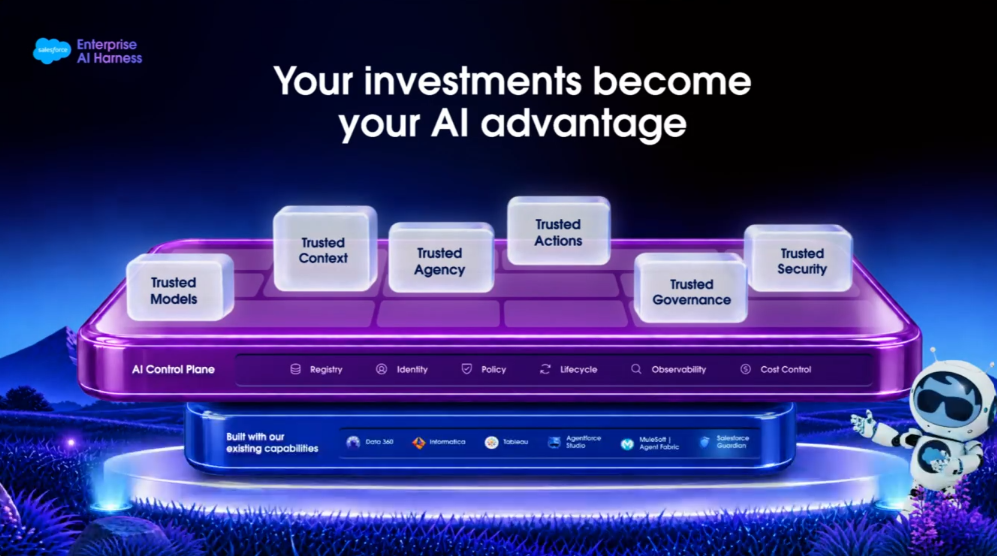
Against that backdrop, Salesforce has announced the Enterprise AI Harness to supply that missing context, memory, and governance.
The Enterprise AI Harness promises to consolidate six Salesforce products:
- Informatica discovers, catalogs, and curates data assets across an enterprise's messy landscape of lakehouses, warehouses, and SaaS apps. This is step one: getting data "AI-ready."
- Data 360 turns that curated data into actual context (e.g., understanding who a customer is and their relationship history when they call in). It also includes a "zero-copy" capability to synthesize data across systems that Informatica has discovered.
- Tableau builds the business semantic layer, defining what terms like "revenue" or "ARR" actually mean for a specific business, and sharing that definition consistently across all agents.
- Salesforce Guardian (formerly Einstein Trust Layer) is the next evolution of the Salesforce Trust Layer. It handles security and governance, adding new agent identity capabilities to constrain agents beyond the user’s permissions and taking data protection to the enterprise level.
- MuleSoft (Agent Fabric) manages the "digital workforce" via a single registry, tracking performance, monitoring costs, and governing agents at scale.
- Agentforce Studio allows brands to build AI-led experiences on the Enterprise Harness.
“Today, these are separate products with these capabilities, and we're working to greatly simplify this into a universal, single, composable platform,” said Kumar.
“Six capabilities [are] coming together as an AI Control Plane, helping every customer bring the Harness to life simply.”
5. NVIDIA Helps Salesforce Deliver a CRM-Specific AI Model: Koa
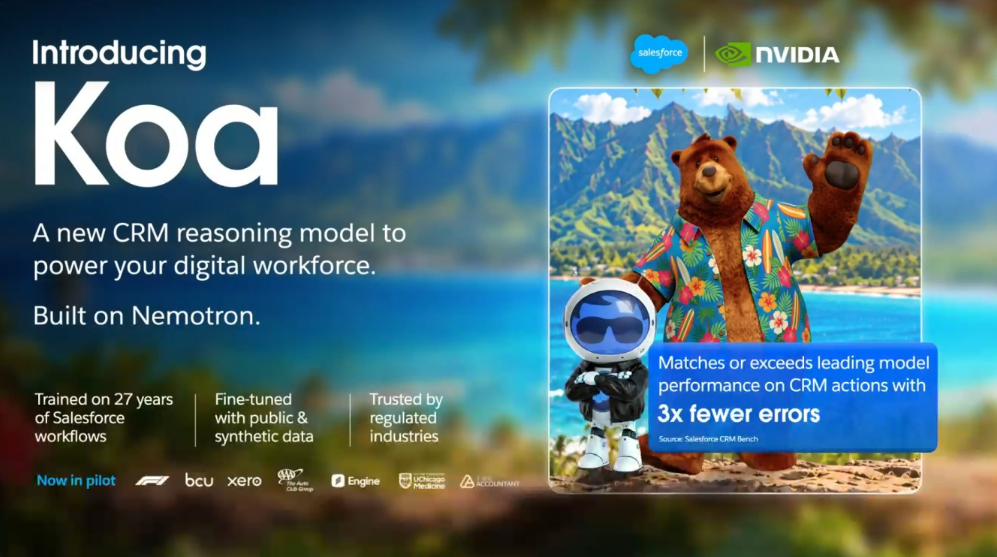
Salesforce has built a new CRM-specific AI model called ‘Koa’.
Koa was developed - without leveraging customer data - on top of NVIDIA’s Nemotron model family, with Salesforce specializing a general frontier model for CRM-related work.
In other words, it's tailored for sales, service, and marketing tasks.
Already, Koa "matches or exceeds leading model performance on CRM actions with 3x fewer errors," according to Salesforce.
Yet, Kumar suggests the solution is still in its “early innings”, with 1-800Accountant, Formula 1, and UChicago Medicine now piloting the model.
Over time, it will become one option within the broader model layer that sits on top of the Enterprise AI harness.
No customer data was used to train Koa, while Salesforce emphasizes that the product is still in its “early innings” and not yet mature.
6. Salesforce Introduces a New “Family” of Agents on Top of Agentforce
Shortly before Dreamforce 2026 kicked off, Salesforce announced a portfolio of seven “job-ready” agents for common use cases organizations have deployed across its platform.
The vendor has embedded the agents across its CRM platform, which businesses can configure themselves, without IT involvement. They include:
- Casey - Formerly Help Agent, Casey resolves customer queries across voice and digital channels, leveraging existing Salesforce knowledge, cases, workflows, permissions, and data.
- Fin - Like Help Agent, Fin - an agent that stems from Salesforce’s acquisition of Fin AI - resolves customer queries. Yet, it also lays over third-party solutions. As such, it creates a single conversational AI solution for organizations using multiple CRM systems.
- Paige - Paige resolves employee queries, both HR- and IT-related, across Slack, custom portals, and connected agentic interfaces.
- Carter - Carter is a shopping assistant that engages with a brand’s customers, helping them discover, compare, and purchase products and services in natural language.
- Hunter - From research to customer outreach, Hunter builds a pipeline, engages leads, moves deals forward, prepares a forecast, and more, automatically learning and adjusting to the sales motion.
- Marshall - Users can have a conversation with Marshall, and he builds a supply-chain/finance process (steps, forms, and system connections), runs it, and assigns specialized back-office agents to execute each step.
- Piper - Piper engages, qualifies, and converts inbound leads for B2B sales teams, working across their websites and inboxes.
Organizations can leverage all of these agents now, except Hunter, which is in pilot and expected to become generally available in November 2026.
As these agents become available, they underscore a significant departure in Salesforce’s Agentforce strategy. Now, it’s embedding more pre-configured agents, instead of encouraging all customers to build them.
That highlights a fundamental truth: building agents is hard.
“When you hand customers a platform and say, 'Build an agent,' there's a lot of inherent friction in getting started,” admitted Stokes. “[So,] for common use cases… We now have out-of-the-box agents that sit on top of the Agentforce platform.”
“Business users themselves can implement and configure them without having to go back and forth with IT to do these kinds of complex implementations.”
7. Salesforce Announces a New, Multi-Dimensional Partnership with Google Cloud
Salesforce has strengthened its partnership with Google, covering cloud infrastructure, agentic workflows, and more.
Starting with infrastructure, Salesforce's Hyperforce platform will soon run natively on Google Cloud infrastructure, with general availability slated for November 2026 in North America.
Next, Salesforce has connected its headless architecture to Google's Gemini Enterprise, allowing enterprises to surface Salesforce data and capabilities "directly within Gemini Enterprise." That means capabilities like pipeline checks, account summaries, and case triage are now available to any agentic workflow built within Gemini Enterprise - as is Tableau analytics, via Tableau MCP.
“Gemini Enterprise brings Google’s most advanced AI together with a company’s data, applications, and everyday workflows in one platform. By bringing Salesforce - where critical customer and business processes already live - into Gemini Enterprise, customers can build trusted agents that reason across their business context and securely take action."

Meanwhile, Gemini's models are available inside Agentforce, specifically on the back end of Agentforce Prompt Builder and Reasoning Engine.
The partnership also extends to commerce. Commerce Cloud merchants can now let shoppers discover and check out products directly within Google Search (including AI Mode), using the Universal Commerce Protocol (UCP) for checkout.
Finally, the two companies will expand their Data 360 and BigQuery integration, including Zero Copy data, to more regions later this fall.
8. The Saleforce-AWS Partnership Also Levels Up
Alongside Google Cloud, Salesforce has deepened its partnership with its other major cloud partner: AWS, with AI agents once again taking center stage.
First, the companies announced new integrations bringing Salesforce data, context, and actions directly into Amazon Quick (AWS's AI assistant for work). This might be a preview of "Quickforce" as the next addition to the AIforce lineup...
At the same time, AWS's frontier agents are also coming to Slack, letting employees work with AWS DevOps, Security, FinOps, and Partner Central Agents right from the Slack interface.
On the model side, Agentforce customers now have access to Amazon Bedrock's full range of frontier models. These include Anthropic and NVIDIA, with OpenAI models coming soon.
Beyond AI and models, Salesforce's Data 360 zero-copy capability now extends to more AWS products, while Informatica is expanding general availability of its MCP servers, now accessible from both Amazon Bedrock AgentCore and Amazon Quick.
However, perhaps most interesting from a CX standpoint is that AWS and Salesforce have unveiled a new approach for secure agent-to-agent communication between Amazon Connect Customer and Agentforce Voice, which will go live this Fall.
This approach means that if, for example, a customer's call starts with an AI agent on Amazon Connect but requires something only an Agentforce agent can handle, like pulling account history, the two agents can now hand off or collaborate live, in voice. That's a compelling glimpse of multi-agent orchestration in action.
9. “Agentforce” Gets Dropped from Salesforce CRM Application Names
While Salesforce hasn’t yet made a formal announcement around the names of its CRM applications, it seems to have reverted to calling them by their pre-Dreamforce-2025 names.
During a preview of Dreamforce 2026, it mentioned Service Cloud, not Agentforce Service, for instance. Moreover, on its website, all apps now go by their previous names again.
So, Agentforce Sales is now Sales Cloud again. Agentforce Marketing is now Marketing Cloud again. And so forth.
One possible motivation is that Salesforce may have lost name recognition in previously making the pivot. Another may be confusion around what exactly "Agentforce" is, if not just a platform for building and testing AI agents.
Whatever the case, expect an explanation here, as the Dreamforce keynote gets underway…
CX Foundation will update this article as additional news from Dreamforce 2026 comes to light.