September 14, 2026 • 9 min read
ISG Contact Centers Buyers Guide 2026: Top Takeaways

Director of Content & Market Research
September 14, 2026
For its 2026 Contact Centers Buyers Guide, ISG tore up its previous evaluation framework and rebuilt it from the ground up.
Why? Because the market, and what buyers are looking for, has changed so quickly.
The obvious culprit is AI. AI hasn't just been added to the contact center stack; it has been wired into the fundamentals.
Yet, those fundamentals are different in themselves.
After all, the contact center used to have one mandate: handle interactions at scale as efficiently as possible.
That mandate hasn’t gone away. But it’s no longer the full story.
Now, contact center platforms are expected to play with the broader customer experience ecosystem, support new workflows, and turn insights into actions that can be applied far beyond the interaction itself.
That’s just the start, and ISG wanted to compare 27 of the most prominent contact center providers to see how their platforms are evolving with the needs of the modern buyer.
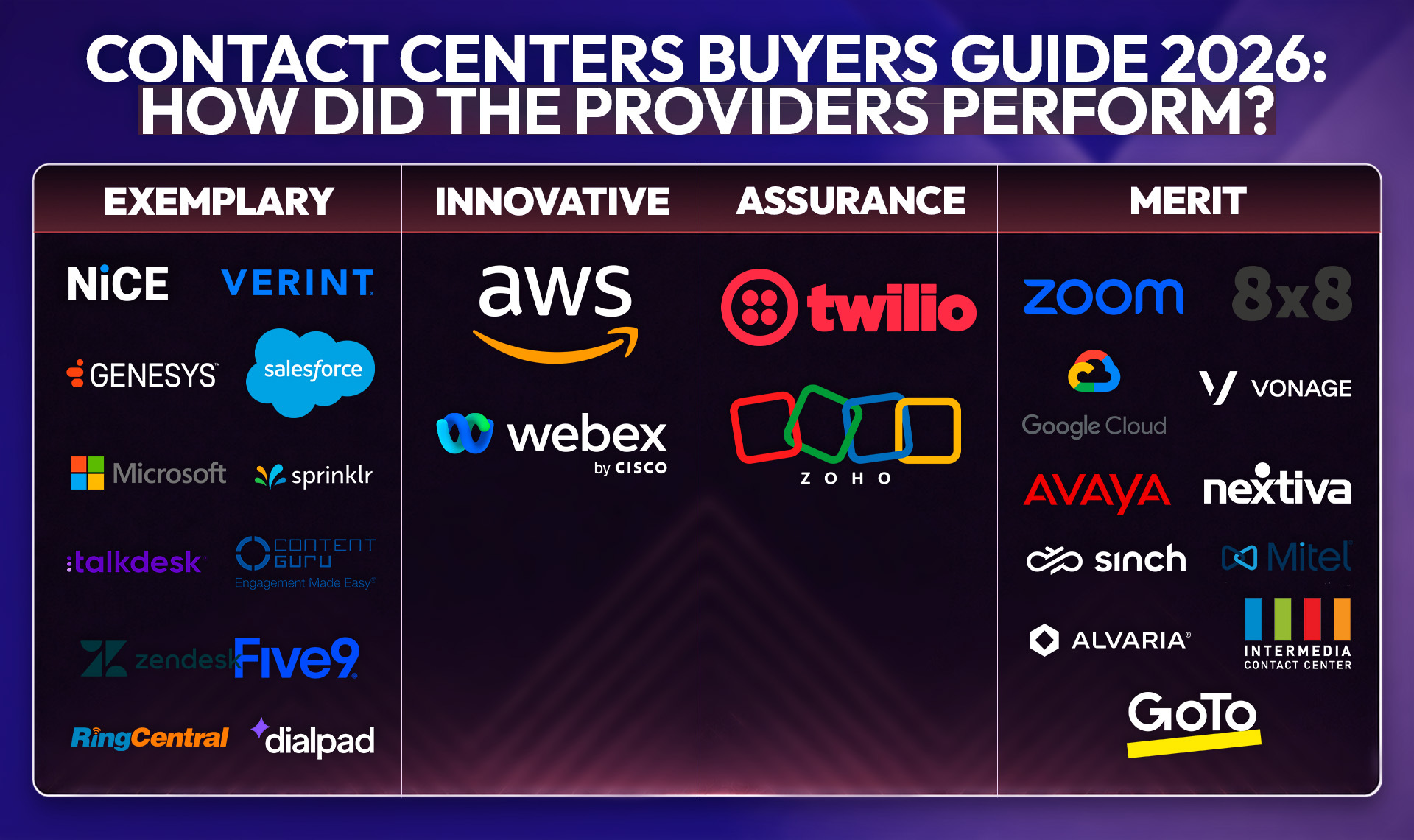
In doing so, it named 11 “exemplary” vendors, as showcased below.
ISG’s “Exemplary” Contact Center Providers in 2026
In 2026, ISG listed NiCE, Verint, Genesys, Salesforce, Microsoft, Sprinklr, Talkdesk, Content Guru, Five9, Zendesk, RingCentral, and Dialpad as its 11 “exemplary” contact center providers.
The research firm did so by evaluating each across three key criteria:
- Customer Experience (20%): ISG gathered and validated customer feedback, while investigating total cost of ownership (TCO) and return on investment (ROI) realization. (NiCE, Salesforce, and Verint led here).
- Product Capability (50%): ISG assessed 89 function points across 12 areas, including interaction management, routing, workforce engagement management (WEM), self-service, knowledge management, analytics, and AI/automation. (NiCE, Verint, and Genesys led here).
- Product Platform (30%): ISG evaluated each offering’s adaptability, manageability, reliability, and usability, considering ecosystem, governance, security, and ease of use. (NiCE, Salesforce, and Genesys led here)
The matrix below shows how the 16 remaining evaluated providers fared.
Yet, while the study examines individual provider performance in much greater depth, it also highlights several broader trends in contact center technology, explored below.
7 Top Takeaways from ISG Contact Centers Buyers Guide 2026
From shifting buyer priorities to how they’re transforming contact center capabilties, ISG’s Buyers Guide offers valuable insights into the current state of the space.
Here are seven key takeaways, along with insights from lead author Keith Dawson, Director of Research for Customer Experience at ISG.
1. Contact Center Buyer Confusion Is High
For a long time, contact center buyers largely chose among variations of an established operating model: with an ACD, IVR, agent desktop, and so forth.
Yet, the technology landscape is now far more capable, modular, configurable, and heterogeneous.
Suddenly, contact centers have many more possible ways to organize their work.
While that may be exciting, it opens up a new can of worms.
After all, the hard part is no longer deciding which technology to buy. It is figuring out the contact center’s future role within the organization.
Buyers must then work backward to not only determine which technology, but which labor model, data architecture, governance model, and overall operating structure will get them there.
That is where the "AI pressure" trope comes in. Executives may indeed say: "We need to put AI everywhere." But underneath that is buyer confusion, according to Dawson.
Why? Because buyers now face more choices, configurations, and interdependencies than ever before, making the decision inherently multidimensional.
As a result, many brands are layering over conversational AI point solutions, then stepping back to consider how the underlying platform must evolve to maximize their value.
NiCE, Talkdesk, and Zoom are all taking advantage of this trend, layering AI point solutions over competitive environments, and then making the case for a wider-scale AI transformation.
2. Agentic AI Mania Hasn’t Taken Hold of the Contact Center (Yet!)
The take-up of agentic AI has proven much slower than the mass adoption of generative AI solutions brought to market three years ago.
Why? Because the first flush of AI tools was demonstrably useful. AI summarizations, suggested responses, automated QA… For many, these are essentially no-brainers and don't require contact centers to rip up their operating models.
Now, AI hype centers around AI agents automating more complex workflows. The success of these agents hinges on connecting complex data sources, having multiple teams collaborate around new workflows, and understanding new governance models.
Ultimately, it's significantly more complicated. Not just from a technology point of view, but from a corporate culture, managerial, and work-organization point of view.
“You now have to get more people dancing to the same tune, and that's harder to do.”

So, while many may have implemented a front-end AI agent that automates standard processes, such as booking appointments and making transactions, unlocking the full potential of such agents will likely prove a slow burn.
3. Contact Center Workforce Engagement Management (Finally) Advances
AI has sparked broader discussion about the future workforce, prompting contact centers to rethink how they will organize their workforce over time.
Given this, workforce engagement management (WEM) innovation is accelerating furiously.
Take NiCE and Cisco. Both have fundamentally rearchitected their workforce management (WFM) platforms to manage both human and customer-facing AI agents.
Meanwhile, quality assurance (QA) has advanced from “we’ll monitor 100% of your contacts” to taking QA data and building individualized coaching plans - and even customized AI role-play simulations - for agents.
Agent Assist is another example. It initially came to market as an agent guidance tool, sharing next-best actions and surfacing knowledge content. Now, it takes notes, summarizes interactions, drafts auto-replies, and more.
Some vendors, like Genesys and Zoom, are even touting a future where Agent Assist won’t just suggest a next-best action, but will offer to perform it on their behalf.
These pockets of contact center technology had laid dormant for several years. Now, they’re evolving at a frenetic pace.
4. The Contact Center as a Profit Center Narrative Returns, But It’s Different Now
For decades, the contact center was deliberately kept “over there,” with a primary purpose of protecting the business from the incursion of customers.
Essentially, many brands were trying to minimize the cost impact of having customers.
That’s no longer entirely true. Businesses are starting to look at the contact center’s cost structure and its potential from a different perspective.
Increasingly, they’re considering the contact center as a potential “profit center,” but not in the traditional sense of asking whether it can generate revenue directly.
Instead, the opportunity lies in taking contact center intelligence and applying it more deliberately to the promotions, outreach, and customer-management strategies being developed across the broader business.
The focus, in other words, is no longer solely on the interaction itself. It’s on what the organization can learn from those interactions, and how that intelligence can create value far beyond the contact center.
5. Contact Center Insights Start to Turn Into Actions
Like “build a profit center,” “turn insight into action” is an aging contact center slogan.
Yet, historically, the onus has always been on the contact center team to derive those actions.
After all, analytics tools were traditionally about retrospective understanding: What just happened, and what did we just do?
Now, a more flexible, modern form of analytics is emerging. It’s not just “real-time”, but proactively suggesting insights for how to improve customer outcomes during a conversation.
Take real-time sentiment analytics. It was often used to tell live agents how a customer was feeling during an interaction (not very helpful!). Now, if a customer becomes unhappy with something the agent just said, some solutions can offer guidance on how to course-correct, drawing on lessons from previous interactions.
Moreover, many contact center vendors have built a data layer across their platforms, with some adding a natural-language interface that makes it easier to surface and query connected data. That includes WEM data, campaign data, and telemetry, alongside conversational intelligence.
Interestingly, other department leaders can also use this interface and understand what customers are saying about particular products, campaigns, and competitors, democratizing contact center insights. That’s powerful.
6. Legacy Telephony Experience Is No Longer a Necessity
Hyperscalers, including Amazon, Microsoft, and (to a lesser extent) Google, account for an increasingly large portion of the contact center market.
As these companies have many other solutions that make them far more money than contact centers, they have taken their time and iterated on their offerings.
“In the process of iterating, they’ve basically iterated away the core telephony functions of most CCaaS products,” noted Dawson.
“It’s now possible to operate a contact center using a CRM front end, on top of an underlying hyperscaler’s routing infrastructure.”
Critically, that changes the low end of the market, creeping up into the middle, where the bells and whistles of enterprise CCaaS aren’t necessary. Instead, businesses can build a contact center at any other point within the enterprise stack.
Still, would that be an unusual way to outfit a contact center? Today, yes. But it’s possible, and it changes the cost equation for many.
7. The Resurgence of Outbound Contact Centers
While telemarketing, predictive dialing, and do-not-call lists may seem like relics of the past, outbound - as a whole - is not.
Indeed, many contact centers now see outbound as a strong complement to inbound queries, not only because bringing service to customers can save costs, but also because it fosters more personal, intimate relationships.
Another factor could be workforce restructuring. As AI reduces inbound contacts, some brands may redeploy human agents into new roles focused on personalized outreach that complements the broader customer experience.
Over time, AI agents may own more of the outbound channel, too, not only notifying customers of an issue, but collaborating across channels to resolve it. That’s when proactive service becomes pre-emptive.
Nevertheless, the human touch remains crucial in customer relationship-building.
For more, check out CX Foundation's earlier coverage of ISG's 2026 Buyers Guide for Customer Experience Management (CXM), unpacked here.