
May 5, 2026 • 9 min read
ISG Customer Experience Management Buyers Guide 2026: Top Takeaways

Director of Content & Market Research
May 5, 2026
For many years, the term “customer experience” was often used as a synonym for customer service.
However, customer experience is something much bigger, with every part of the enterprise influencing it: service, sales, marketing, commerce, and beyond.
Recognizing this, siloes between departments are shrinking, with more cross-functional teams considering how to analyze, orchestrate, and manage customer journeys together.
That requires a much broader capability than contact center as a service (CCaaS) or customer relationship management (CRM).
Indeed, customer experience management (CXM) also incorporates other technologies, such as data and analytics, journey orchestration, and workflow automation.
All these solutions come together to support customer interactions, understand the full context around the customer relationship, and, ultimately, leverage that context to drive favorable customer outcomes.
Yet, there’s no universal CXM solution, only overlapping offerings converging on similar capabilities.
Given this, ISG delivers a report that considers the full scope of CXM, investigating everyone from Adobe to Genesys.
How Did ISG Evaluate CXM Providers?
First, ISG started with a definition, describing CXM software as “an applications suite built on a common platform that enables an interdepartmental view of customer activity and provides mechanisms for controlling and optimizing that activity.”
Importantly, it also supports managing customer journeys, understanding customer behavior, and coordinating communication across multiple channels.
After giving this definition, ISG breaks down some of the key capabilities expected of a CXM provider. Alongside interaction management, these include:
- Resource and knowledge management
- Customer journey management and orchestration
- Workflow automation
- Analytics and insight
All providers included in ISG’s analysis offer at least three of these four capabilities. They must also have at least $100 million in annual or projected revenue, support at least 50 customers across two or more continents, and have made a major software release in the past 12 months.
These requirements trimmed the field to 27 vendors, across which ISG applied its Value Index Methodology, which assesses each provider on their product and customer experience.
Product experience considers product capability, manageability, usability, reliability, and adaptability. Meanwhile, customer experience focuses on vendor validation and Total Cost of Ownership (TCO) and ROI.
Those that score above-average on both product and customer experience are considered “Exemplary”, and this year, 12 CXM vendors earned that status.
Which Tech Providers Lead the CXM Market in 2026?
ISG’s group of 12 “Exemplary” CXM software providers is led by Salesforce, NiCE, and Oracle.
Salesforce has pulled its Customer 360 apps into a shared planning model, supported by Data 360. This model allows customers to measure outcomes such as customer lifetime value (CLV), churn risk, and expansion potential more holistically as they deploy Agentforce agents that complete cross-application workflows.
Meanwhile, NiCE has invested heavily in journey orchestration and acquired conversational AI giant Cognigy. Recently, it also released an innovation that analyzes service interactions, auto-identifies where AI agents will have the biggest impact, and prioritizes use cases based on ROI projections. From there, it automatically generates agents with guardrails, which contact centers can adapt, implement, and manage. That’s powerful.
Lastly, Oracle unites CRM, ERP, and supply chain data within its Fusion Suite, enabling complex cross-office workflows, without tricky integration work. For instance, an Oracle Fusion customer can utilize real-time ERP data to inform a customer exactly when a product will arrive, almost at an out-of-the-box level. That’s high-value work, without the expected complexity.
The other 27 evaluated vendors are showcased in the image below, which outlines how ISG ranked them.
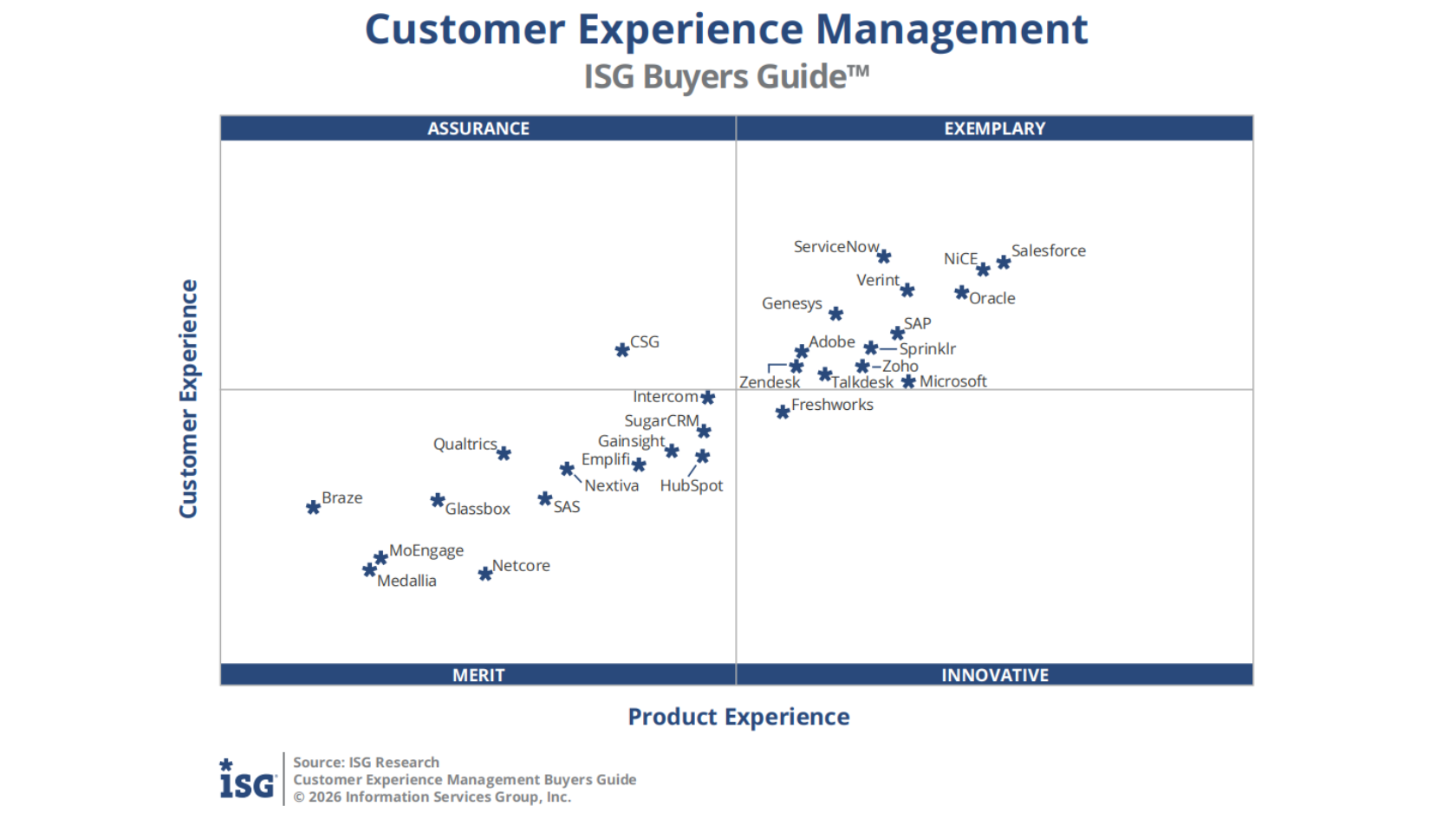
ServiceNow also scored well, especially in customer experience. Its chief differentiator stems from its understanding of how enterprise work gets done and the processes shift between the CRM and other enterprise systems. This enables the provider to pull in significant data from across the enterprise, enabling a data-rich view of the customer experience.
Other “Exemplary” vendors include Verint, SAP, Sprinklr, and Genesys, as they were in the report’s 2025 edition.
7 Top Takeaways from the ISG Customer Experience Management Buyers Guide 2026
Beyond the vendor analysis, ISG Buyer Guides also investigates key trends impacting the broader marketplace.
Recognizing this, CX Foundation contacted the research firm to interview lead author Keith Dawson, Director of Research for Customer Experience at ISG.
From their conversation and the report itself, here are seven key takeaways on how the CXM space is evolving.
1. Operational CXM Maturity Varies Significantly
Customer experience management is an independent evolution outside of the AI evolution.
It marks a shift from only managing interactions to managing the context around those interactions and the outcomes they drive.
Yet, different organizations are at different stages of that journey. Some still equate a “journey” with a single call or chat. Others understand the broader context.
Meanwhile, a smaller group is adopting an enterprise-wide CXM approach, focused on ownership and orchestration of outcomes.
However, that group is in the minority, and ISG emphasizes the increasing demand on CXM providers to guide companies more closely, supporting them in this transition.
2. Journey Orchestration & Analytics Solutions Are Advancing Quickly
CXM orientates customer interactions around measurable business outcomes, i.e., revenue, loyalty, and profitability.
Journey orchestration and analytics solutions help to connect interactions to outcomes, and now the biggest CXM players are investing heavily here.
Just consider CRM providers. They have long offered solutions that essentially acted as systems of record, tracking what happened during a customer conversation.
Over the past decade, they have focused on turning interaction data into actions via capabilities such as next-best-step recommendations.
Yet, now the onus is on coordinating data, interactions, and processes to drive actions that elicit specific outcomes.
“We’re moving from systems of record and systems of engagement toward systems of orchestration.”

While data quality and operational maturity remain big blockers, the ISG Buyers Guide appears to frame this as the future.
3. Brands Are Building Contact Centers at Different Points in the Stack
Orchestration solutions help design journeys around customer outcomes. Then, CX and IT teams compose those experiences.
The old CCaaS model of starting with a foundational ACD system and building outward is not compatible with this approach.
As such, many companies are taking alternative approaches to configure a cloud contact center.
For instance, a company building on AWS might enable voice interactions through services like Nova Sonic to establish a makeshift contact center on top of a CRM.
Alternatively, they may embed a formalized contact center offering into the CRM or helpdesk, with Talkdesk and Twilio now offering such CCaaS solutions.
These options emphasize that enterprises are no longer dependent on traditional vendors for the “interaction machine.”
“Traditional interaction mechanics are becoming commoditized. The value is increasingly in what happens downstream: analytics, orchestration, and business outcomes.”
As the mechanics have become commoditized, more enterprise technology players are entering the CCaaS space, with Salesforce the latest example. Meanwhile, CCaaS providers are expanding their offerings to not only support interactions but drive outcomes.
Thanks to these trends, vendors such as Adobe, NICE, and Sprinklr now overlap significantly despite very different origin stories.
4. The CXM Technologies That “Stick” Are Changing
As contact centers mould their tech stacks around customer experience, rather than just interaction management, new technologies enter their orbit.
For instance, the contact center begins to work in concert with broader enterprise solutions, including ERP, finance, product systems, and more.
That growing ecosystem begs the question: where is the new “sticky” layer?
Traditionally, certain contact center components were very sticky. Workforce management (WFM) systems, for example, often follow managers from company to company. That stickiness drove vendor success.
But today, the stack is more flexible and influenced by broader enterprise stakeholders. Given this, the “sticky layer” is changing.
“It may emerge in data platforms like CRM, CDP (customer data platform), or analytics, especially as those systems are used across multiple departments,” said Dawson.
However, buyers must maintain caution. After all, if they base their entire customer experience ecosystem around a platform like Salesforce, they are at the mercy of price hikes or strategic changes that could prove expensive in the long run.
5. IT Becomes the Hub of CX Decision Making
Buying groups for CX technologies are expanding. IT, in particular, has become central. That’s largely due to AI, as everything now needs to be validated for security, compliance, and integration.
Now, this trend has even extended beyond the realms of marketing, sales, and commerce and into the contact center.
Ten years ago, many would have considered that impossible. After all, enterprise IT leaders often avoided the contact center at all costs, with telephony and numbers being tricky and on-premise environments being locked down.
However, in 2026, IT often takes the lead role on all buying decisions relating to CXM, increasingly acting as the hub of customer experience decision-making.
While doing so, they often closely consult marketing leaders, because the technologies first developed for them - i.e., analytics, journey orchestration, proactive engagement - have fast become essential to CX at a higher level.
6. Pricing Remains an Industry-Wide Problem
As enterprises orchestrate and connect CX workflows, many are starting to utilize AI agents, which reason, adapt, and take action.
While this represents an exciting technological revolution - even from the generative AI revolution three years ago - it challenges traditional cost structures.
Indeed, as customer experience teams start to leverage these AI agents, often embedded into CXM software, their cost model changes and becomes much less predictable.
That unpredictability is a long-term concern, as agent-to-agent workflows require significantly more computing resources, and it’s not clear how those costs will be passed along. Will they be absorbed by platform providers or passed down to customers?
“Buyers today have a reasonable understanding of pricing for current AI use cases like agent assist or quality management. But once you introduce complex, cross-functional workflows, pricing becomes much harder to forecast.”
Ultimately, that’s an issue that extends across the enterprise technology space. It’s not just a CX problem.
7. Buying Behaviors Split Across the Enterprise & Midmarket
Large enterprises tend to adopt broad platforms tied to existing systems, like Oracle or SAP. Midmarket organizations are more likely to adopt targeted, use-case-driven solutions from niche vendors that tackle specific problems.
For instance, a midmarket business might utilize a disruptive conversational AI provider, a standalone orchestration tool, or a niche workforce engagement management (WEM) product.
Meanwhile, enterprise buyers tend to favor: broad platforms that integrate tightly with existing systems, fewer providers to reduce complexity and risk, and vendors that span multiple functions. It’s a less flexible but more cohesive strategy.
Recognizing this as an accelerating trend, CXM vendors more often prioritize one type of organization over the other.
For more analyst insights in the state of CX technology, unpack CX Foundation’s coverage of the Forrester Wave for Conversational AI Platforms, Customer Service 2026.