October 7, 2026 • 7 min read
Cisco Debuts the New-Look Webex AI Agent Platform, with Dialog and AI Agent 360

Director of Content & Market Research
October 7, 2026
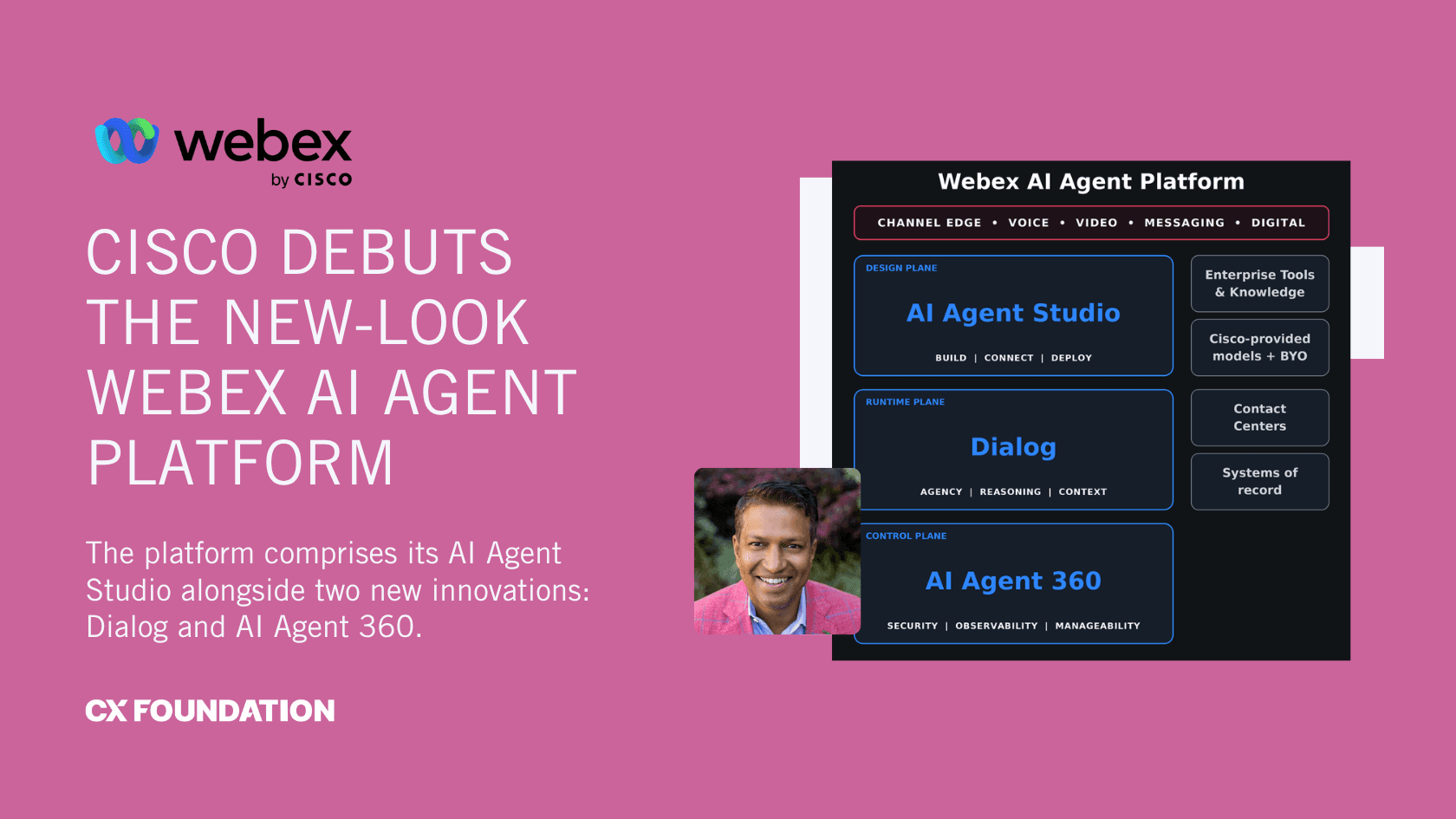
Cisco has unveiled the new-look Webex AI Agent platform at Webex ONE 2026 in Austin, Texas.
The goal is to help organizations deliver customer-facing AI agents that not only resolve issues but also become “customer relationship managers.”
To deliver on this aim, the platform centers on the AI Agent Studio, where brands can continue to build, connect, and deploy agents.
However, the platform will soon comprise two additional solutions: Dialog and AI Agent 360.
Essentially, both sit beneath the AI Agent Studio, with Dialog providing “an agentic harness” and AI Agent 360 acting as the control plane.
The agentic harness supports AI agents with additional context to dynamically adjust how they resolve a specific customer's issue.
Meanwhile, AI Agent 360 governs end-to-end resolution flows, not just the conversation.
What Exactly Does Dialog Do?
Consider how most organizations deliver customer-facing AI agents. Typically, they are deployed to resolve specific types of customer contacts, with each interaction treated as a moment in time.
Yet, for the customer, the interaction is just one of many engagements that form a continuous relationship.
Without an understanding of that relationship, AI agents may reach a resolution, but it might not necessarily be the resolution that delivers the best lon-term outcome for that customer or the business.
Dialog aims to challenge this reality. Cisco introduces it as “an agentic harness transforming AI agents into high-impact relationship managers.”
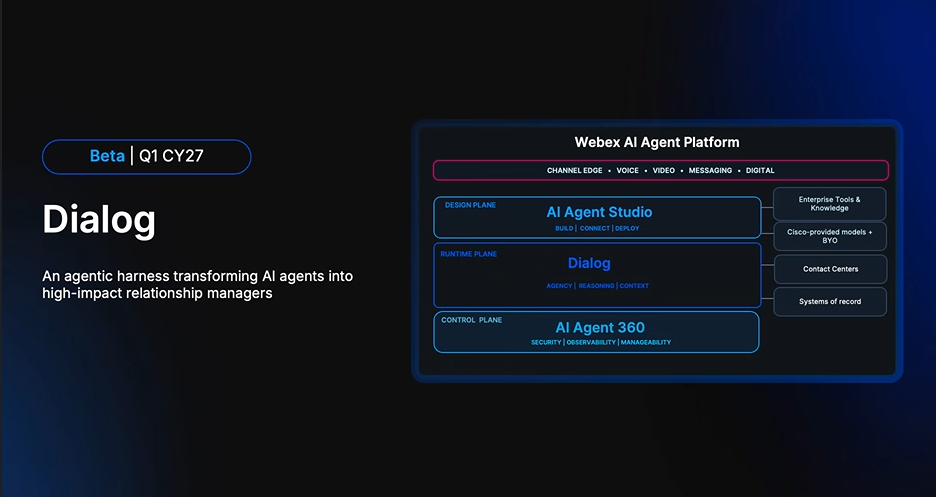
In simpler terms, think of Dialog as a context engine that centralizes and reasons over enterprise knowledge, Webex CX data, and system of record data.
With this harness, AI agents go beyond pulling data from the CRM to understand each customer in context, enabling more dynamic, individualized experiences.
“Bringing this together creates something very unique, which I'll call the relationship cortex. With it, the system can reason through journeys and show real agency, within the constraints of policy and procedure.”

With the AI Agent Studio and Dialog together, Cisco believes it can help brands build AI agents that act as “relationship managers”, striving to deliver across four key areas:
- Long-horizon agent execution: The agent can understand the customer's intent, map the resolution path, and distribute work across people, other agents, and other systems to resolve the issue. Even after the initial contact, it keeps working until it delivers the customer outcome.
- Relationship context: The agent treats each customer uniquely based on history, context, and lifetime value.
- A self-learning loop: The system keeps learning from every interaction, understanding the impact of its actions to guide future decisions.
- Onboarding: The agent follows rules, policies, procedures, incentives, and exceptions as a human agent would, with a closely monitored onboarding process to ensure effective guardrails.
Nevertheless, a critical element is missing: ongoing control, security, and observability, and that’s where AI Agent 360 comes into play.
The Role of AI Agent 360 (with Splunk Observability)
As AI agents begin to tap into other enterprise systems to complete complex resolution flows, the security and governance conversation has expanded significantly.
It’s no longer about monitoring a conversation but the entire execution chain.
As Muthukrishnan summarized: “The opportunity surface went up 10x, but the threat surface went up 100x.”
Cisco is in a unique position to deliver here, thanks to its broader portfolio, which includes Splunk.
Now, it has delivered AI Agent 360, embedded into the Webex AI Agent platform to observe the entire lifecycle and not just the conversational parts.
Critically, it helps to unify agent telemetry with enterprise data, dashboard agent health, and deliver actionable insights into escalation patterns and operation inefficiencies.
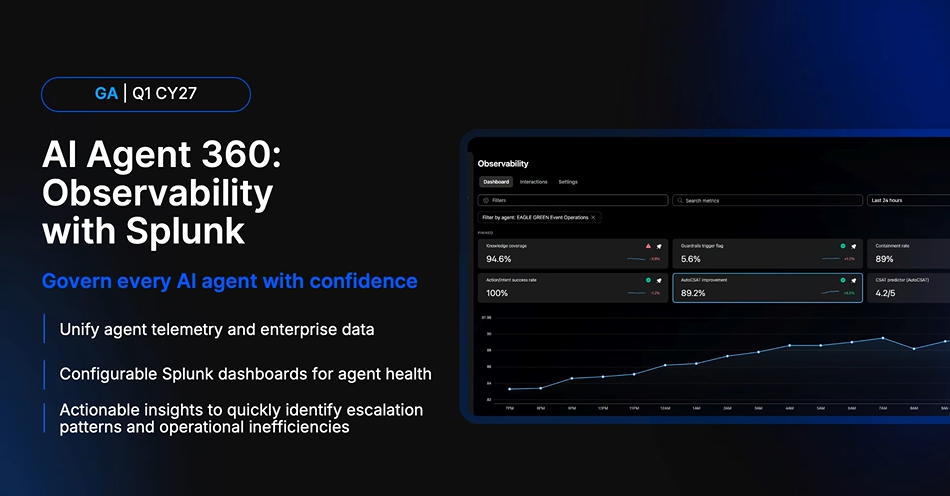
This builds on the security and governance capabilities already available in AI Agent Studio, including Cisco AI Defense, which lets users create custom guardrails for AI agents using natural-language instructions alone.
Cisco Expands the Webex CX Ecosystem with NVIDIA, Google Cloud, & AWS
Alongside the new-look Webex AI Agent platform, Cisco has expanded the ecosystem around it by strengthening partnerships with NVIDIA, Google Cloud, & AWS.
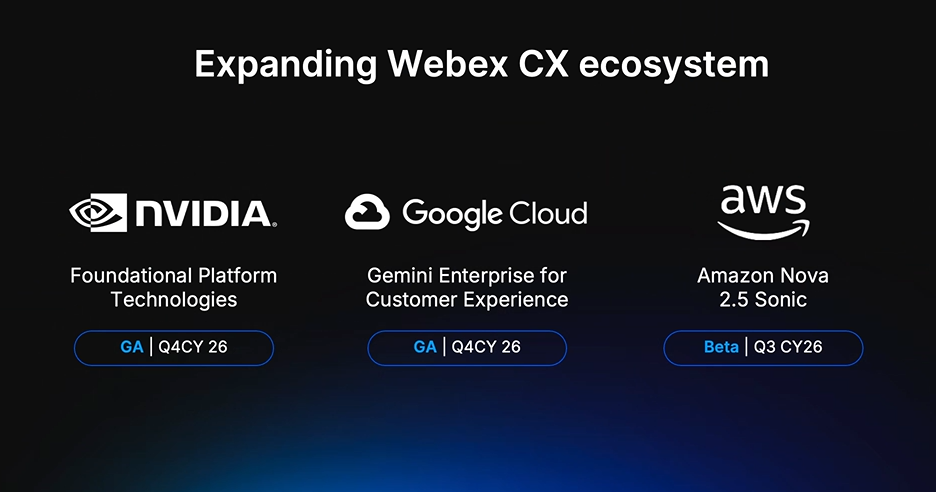
Cisco’s partnership with NVIDIA will allow Webex to leverage NVIDIA’s Parakeet family of models to power its voice AI engine across multiple languages. Meanwhile, NVIDIA Nemotron will help brands bring their own virtual agents onto the Webex AI Agent platform.
Similarly, new support for Gemini Enterprise for Customer Experience allows AI agents built there to run on the Webex AI Agent platform, supported by Dialog and AI Agent 360.
Lastly, Amazon Nova Sonic 2.5 is now available in beta within the Webex AI Agent platform, continuing Webex’s evolution of its speech models.
More News from Webex ONE
Cisco organized its Webex ONE announcements around four pillars, with the Webex CX announcements aligned to the fourth: AI that builds lasting customer relationships.
The other three pillars are:
- Intelligent workplace experiences
- Rooms that sense, reason, and act
- AI-native work experiences
Here is a summary of the remaining announcements from Cisco’s latest collaboration event, organized around each of these three pillars.
1. Intelligent Workplace Experiences
Cisco Webex’s vision for intelligent workplace experiences is to connect people, spaces, devices, and data to improve the workplace by giving those who design and operate it the intelligence to make smarter decisions.
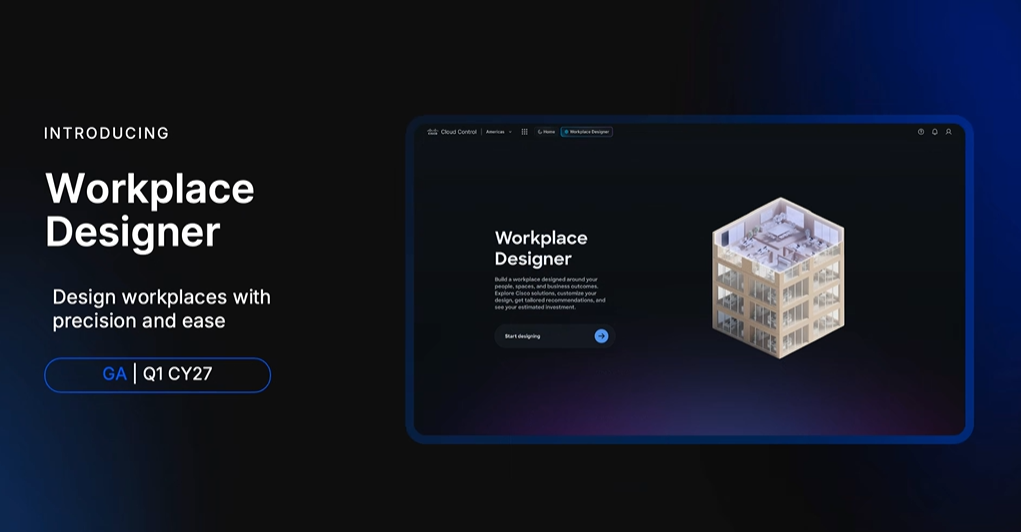
The new Workplace Designer is how Cisco aims to bring this vision to life. It takes real-world insights from Cisco’s infrastructure and devices to inform better designs and deployments.
Workplace Insights & Experience Designer further that journey once the workplace is in use, providing visibility into how spaces are performing and the experiences they deliver, so organizations can continuously optimize utilization, connectivity, and employee experience.
Together with Cisco Cloud Control, which adds cross-domain visibility across networking, security, collaboration, and data center, these capabilities turn workplace data into actionable intelligence, helping businesses make better decisions about space, cost, operations, and employee experience.
For example, these types of decisions could include redesigning a floor plan, adding Wi-Fi capacity where connectivity is low, reconfiguring meeting rooms, or determining how to accommodate more people in existing space.
2. Rooms That Can Sense and Act
Cisco is ushering in an era of meeting rooms that understand what’s happening and autonomously adapt the environment to deliver the right experience.
The new Cisco Ceiling Speaker Pro is a key step in that mission, working with cameras, microphones, and other IP peripherals to create an intelligent audio system. With AI at the edge, the system understands where voices come from and intelligently delivers them where they are needed, helping everyone to hear clearly.
With embedded intelligence, spatially aware voice lift, and AV-over-IP connectivity, it effectively makes the room itself part of the experience.
The Speaker forms a crucial part of Cisco RoomOS 27 vision for bringing context to every workplace interaction.
In practice, RoomOS 27 can dynamically tune noise removal based on whether one person or a group is speaking, prioritizing the right voices in real time, while giving IT greater visibility and control over room performance.
3. AI-Native Work Experiences
Webex is bringing new AI agents into the Webex experience, running more tasks autonomously on behalf of Webex Suite users, while pulling in people when their input or approval is necessary.
Already, Webex includes the Note Taker, AI Receptionist, Scheduler, and Polling Agent, all generally available, with the Translator moving to general availability next month.
Now, Webex is adding two new agents. The first is an AI Coach, starting in Vidcast, which provides feedback on presentation pacing, tone, and filler words, with a path toward coaching across meetings and calls.
The second is a Personal Agent for Webex Calling that can act on a user’s behalf, using their context to handle calls while they remain in a meeting.
Together, Cisco believes these agents signal that Webex is moving toward becoming an “agentic harness for people and AI collaboration”, bringing together Cisco-built, third-party, and custom agents, connectors, and skills to help people get more work done.
This shift aligns with a broader enterprise communications technology trend: collaboration solutions are becoming the operational center point for partnering with AI agents to get work done across the organization.