July 22, 2026 • 33 min read
11 Enterprise Communications Solutions & Their Differentiators in 2026

Director of Content & Market Research
July 22, 2026
Historically, enterprise communications have been siloed across applications.
Employee and partner conversations sat inside a unified communications as a service (UCaaS) platform. Meanwhile, customer conversations happened within a separate contact center as a service (CCaaS) solution.
At the enterprise level, these platforms have had distinct buying groups, keeping the two types of interaction isolated from one another.
However, that could be starting to change.
As CCaaS buying committees evolve, new stakeholders are coming on board, ones who recognize the value of unifying conversations within an all-encompassing enterprise communications solution.
What Is an Enterprise Communications Solution?
An enterprise communications solution refers to any tool that supports conversations with employees, partners, and customers.
As noted, these tools have traditionally lived within broader UCaaS and CCaaS platforms. Nevertheless, these two platforms are now converging in three distinct ways:
- Customer communication modules within UCaaS solutions: Many UCaaS providers are embedding lightweight customer communication modules within their solutions, typically aimed at smaller businesses that then don’t need to implement a separate CCaaS solution.
- UCaaS tools within CCaaS platforms: Some CCaaS providers are adding lightweight UC tools that push conversations from the core CCaaS environment to subject matter experts (SMEs) across the business.
- Integrated UCaaS-CCaaS platforms: Many UCaaS providers have built and integrated a first-party CCaaS solution, delivering an all-encompassing enterprise communication solution.
Each form of convergence brings its own benefits, but the third approach goes furthest. It gives enterprises a single environment for all communications. That offers several potential advantages.
Why Choose an All-Encompassing Enterprise Communications Solution?
As businesses explore integrated UCaaS-CCaaS platforms, they uncover several key benefits. These include:
- Back Office Support: Unified UCaaS-CCaaS solutions enable organizations to route customer interactions to the employee best equipped to help. Front-end AI agents, or "AI receptionists," can direct queries to back-office teams from the outset, while human support reps can seamlessly transfer conversations to available colleagues as needed.
- Customer Swarming: A unified communications platform creates channels from the agent desktop to SMEs (inside and outside the contact center), enabling them to collaborate on customer cases. No separate application is required.
- Shared Customer Insights: When teams collaborate on a separate UC platform to resolve customer issues, brands lose visibility into how those issues actually get resolved. A unified UCaaS-CCaaS solution keeps these interactions together, giving brands a complete view of the customer's resolution journey.
- Unified Workforce Engagement Management (WEM): A unified WEM solution lets organizations measure how often and effectively back-office employees engage with customers, insights that support better resource allocation and extended performance evaluations to safeguard customer experience.
- Technology Consolidation: Pairing UCaaS and CCaaS with a single provider can consolidate communication channels, simplify vendor management, and reduce IT overhead.
11 Enterprise Communications Solutions
The first nine providers offer unified UCaaS-CCaaS solutions, with 8x8, Microsoft, and RingCentral also building lightweight contact center capabilities natively into their UC solutions.
Genesys and NICE round out the list. While neither offers deep UCaaS capabilities, both offer fascinating strategies for combining CCaaS with foundational UCaaS capabilities to enhance customer experiences.
Below is an analysis of the differentiation each provider offers in UCaaS, CCaaS, and as an all-encompassing enterprise communications solution.
1. Cisco
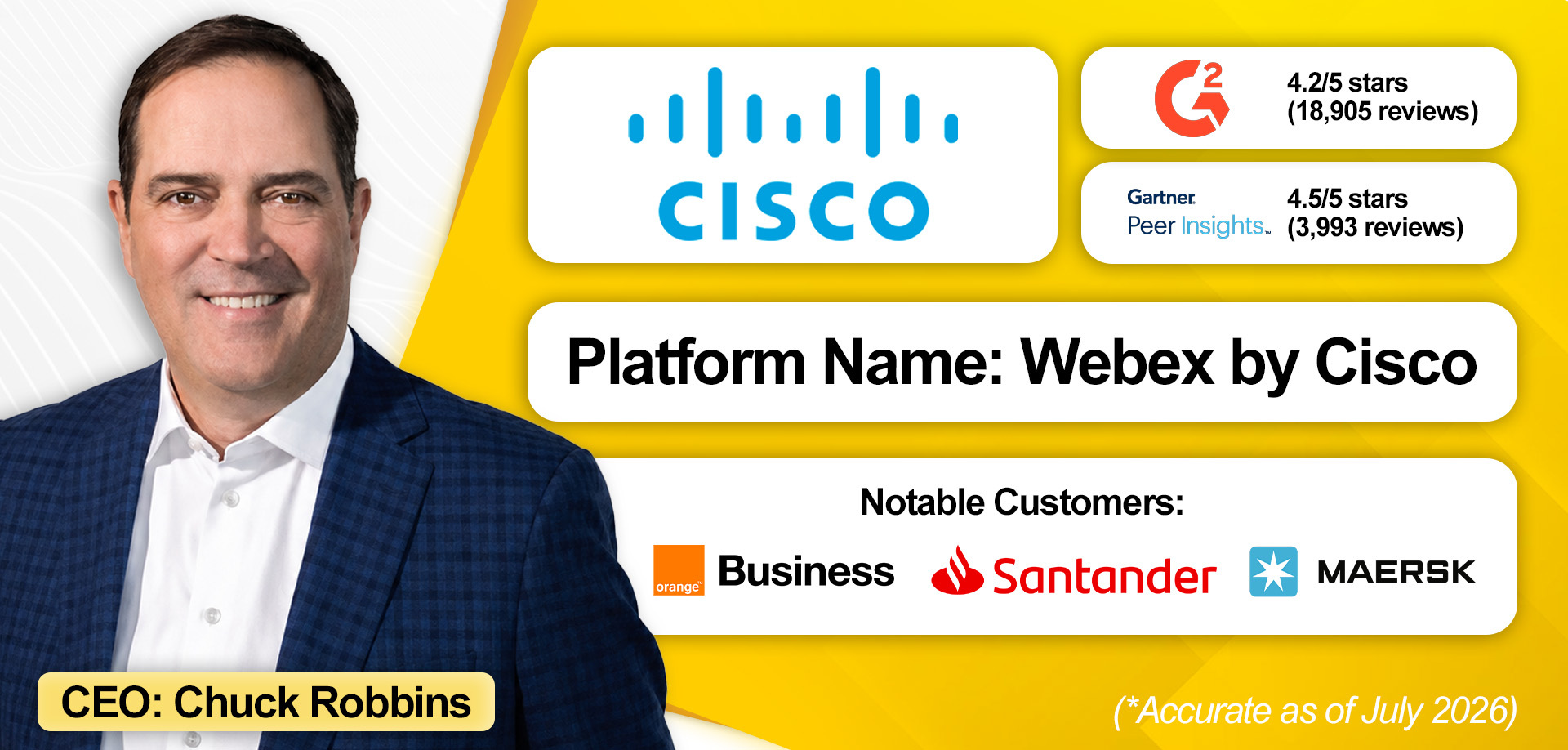
Cisco supports all three deployment models for unified communications and contact center: on-premise, cloud, and hybrid. That flexibility, combined with financial stability, is a significant differentiator in the enterprise, especially given recent bankruptcies at Avaya and Mitel.
That same flexibility also supports a more resilient communications architecture. Recent outages across hyperscalers and cloud services have reminded organizations how critical business continuity is, and many contact centers now want hybrid failover strategies, cloud backed by on-premises or on-premises backed by cloud. Cisco makes this possible.
The tech giant also offers a robust CPaaS solution as part of its Webex platform, enabling brands to replicate complex, custom configurations in the cloud, embed communications across enterprise systems, and support proactive service workflows.
Elsewhere, security and observability are also becoming increasingly critical differentiators, especially as AI agents come to the fore. After all, if a customer-facing AI agent makes a mistake, the AI isn't accountable; the organization that built and deployed it is. Without strong governance, AI becomes a liability rather than an asset. Cisco addresses this through AI Defense capabilities built into its AI Agent Studio, which enable custom guardrails that secure customer service experiences.
Building on these longstanding platform strengths, recent innovations include a WEM solution designed for a hybrid workforce of AI and human agents. The solution tracks and monitors how AI agents affect demand and performance relative to human agents and other staff members fielding customer calls across the enterprise.
Finally, Cisco has reached general availability for unified reporting across Contact Center and Webex Calling, letting organizations follow interactions seamlessly as they move between calling and the contact center.
"The great differentiator for Cisco is that we are a full-time security company, we're a full-time observability company, and we're taking those capabilities and natively embedding them in our communications stack."

Standout Features
- Flexible Deployment Options: Cisco offers cloud, on-premises, and hybrid deployment models, enabling large enterprises with diverse needs to avoid a one-size-fits-all approach. This flexibility matters more given renewed data sovereignty concerns, and it also gives on-premises customers access to many of the same AI capabilities available in the cloud. Lastly, it supports resilience, enabling failover strategies.
- Security & Observability: As AI agents grow more autonomous, Cisco embeds tools from its its billion-dollar security and observability businesses across its enterprise communications platform. For example, AI Agent Studio integrates AI Defense, which auto-generates custom guardrails from customer policies/documents and enforces runtime policies to protect both prompts and outputs.
- Robust CPaaS Offering: Cisco unifies UCaaS, CCaaS, and CPaaS - each recognized in their respective Gartner Magic Quadrant - on a single platform. This lets customers manage all three together, unify customer journeys, and maintain shared context across interactions.
How Much Does It Cost?
Webex Meet and Call costs $22.50 per user, per month when billed annually. Pricing for Webex Contact Center and Webex Enterprise (which includes UCaaS, CCaaS, and CPaaS) is only available upon request. Learn more about Cisco’s pricing for Webex here.
2. Zoom
Zoom is positioning its UCaaS offering as the first application an employee opens each day and the operational center point of the business. Its AI Companion, framed as the natural-language interface for completing tasks across the Zoom ecosystem, plays a key part in this vision, and as MCP becomes enterprise-secure, it will fulfil jobs across the organization.
This UC vision is advanced, with Slack perhaps the only provider to match its maturity.
Zoom is also aiming to own more of the enterprise stack, acquiring adjacent technologies such as Workvivo for employee experience and Common Room for revenue intelligence. The latter is particularly exciting, as it lets Zoom, through its Revenue Accelerator and CX Insights, analyze customer conversations across sales and support, unlocking a more complete view of the customer experience.
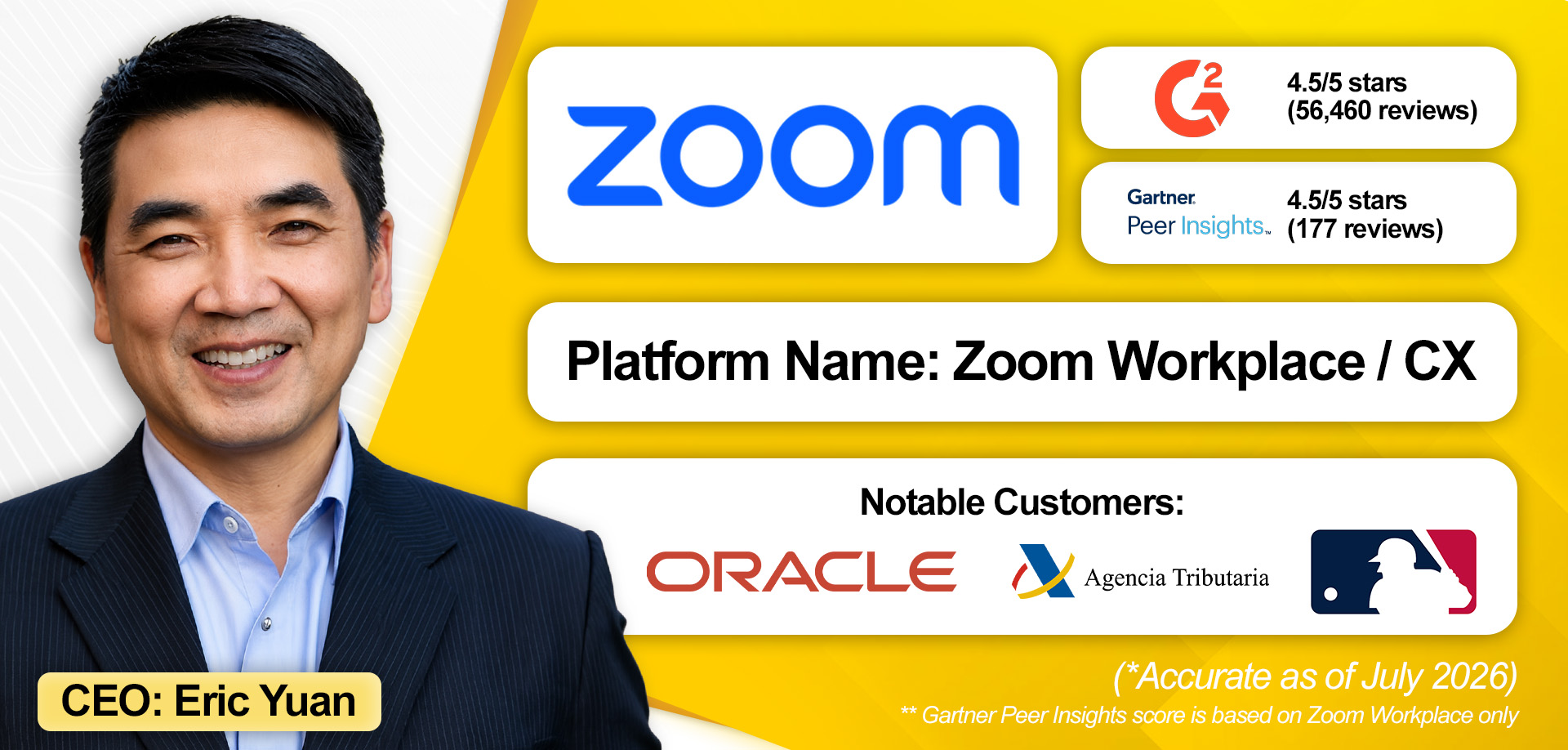
On the contact center side, Zoom has moved quickly, winning enterprise customers such as Agencia Tributaria, Major League Baseball (MLB), and Oracle. Zoom Virtual Agent, meanwhile, is more mature than the self-service solutions touted by most rival enterprise communications vendors.
Its Agent Architect announcement exemplifies this, offering a prompt-based way to build customer-facing agents in seconds while integrating with back-end systems like Salesforce and ServiceNow. There's also an Agent Performance Suite, so brands can test agents, evaluate their performance, and optimize.
Finally, back on the UC front, Zoom's expansion into docs, email, sheets, and notes has puzzled some observers. But the goal is to address how work becomes fragmented across scattered channels, making it difficult to track decisions and outcomes. Its "conversations to completion" strategy ties these pieces together so insights don't get lost.
“If you look at Meetings, Webinars, Events, and Workvivo, you'll see innovation happening across each of these areas. Those innovations don't stay isolated; they often bleed over and enhance other parts of the platform as well.”

Standout Features
- Platform Strategy: Zoom aims to be the daily operational hub for organizations, with AI Companion as the natural-language interface for fulfilling tasks across its ecosystem. As MCP becomes enterprise-secure, this reach will expand further.
- UCaaS Expansion: By adding docs, email, sheets, and notes to its stack, Zoom unifies scattered work, enabling cross-channel search (chat, email, docs, meetings) and lets AI draw on a user's entire body of work, not just siloed tools.
- Zoom Virtual Agent: Agent Architect lets users build AI bots via simple prompts (tone, voice, integrations) instead of manual step-by-step setup. Agent Performance Suite measures and improves outcomes pre- and post-deployment. AI agents are managed like human agents (scored and coached) and can learn from human handoffs to reduce future transfers across the enterprise.
How Much Does It Cost?
Zoom Workspace is available in four packages: Basic, Pro, Business, and Enterprise. When billed annually, the first three cost $0, $14.16, and $18.33. The Enterprise offering comes at a price customized to requirements. The Zoom Contact Center comes in three bundles, Essentials ($69), Premium ($99), and Elite ($149), also billed annually. Discover more about Zoom’s pricing here.
3. Microsoft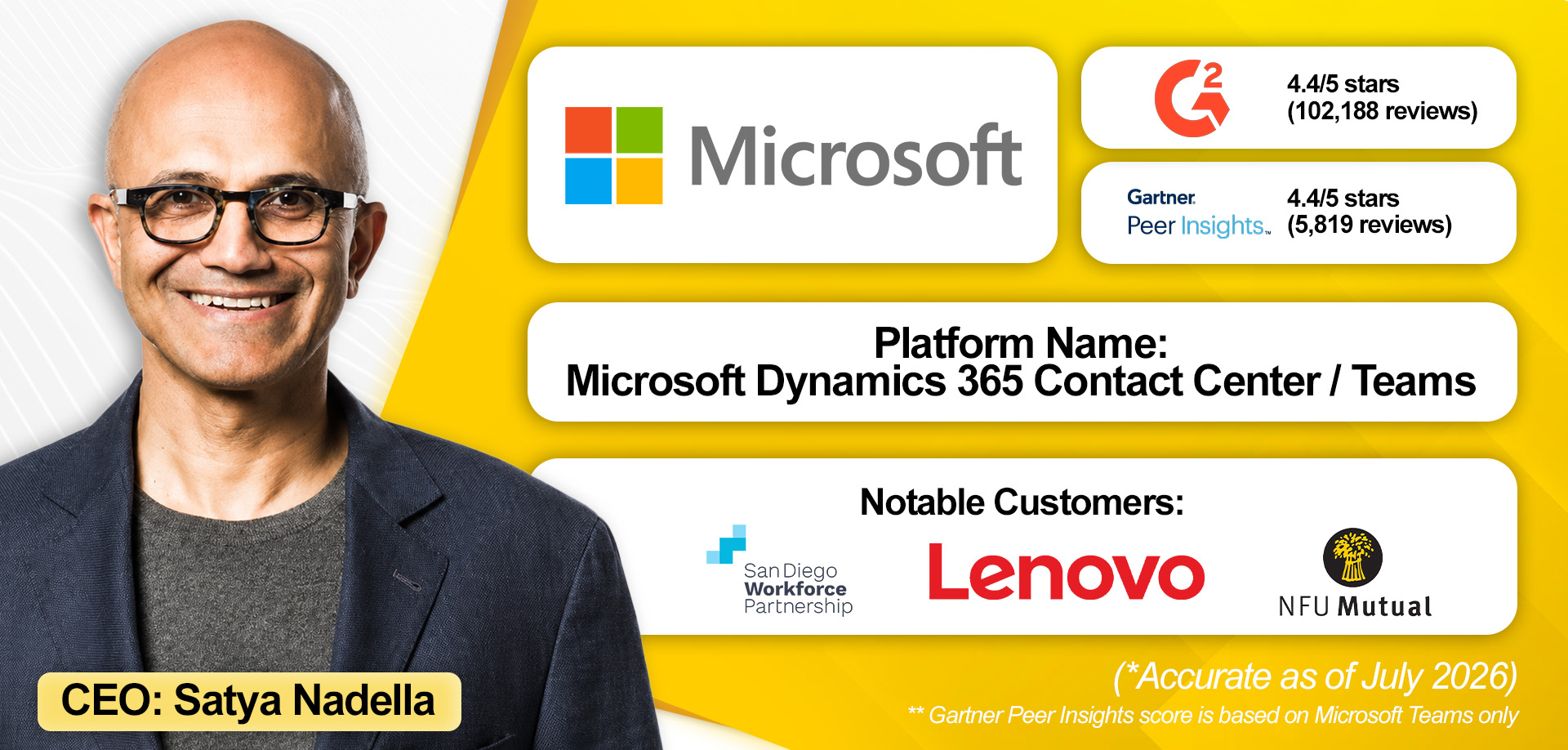
Microsoft Teams is the most widely deployed enterprise UCaaS platform, with 320+ million monthly active users (MAUs), driven by its broader enterprise presence and comparatively low total cost of ownership (TCO).
The tech giant supports SMBs looking to run a lightweight contact center on the platform, offering a Queues App, Teams Phone, and a live chat module. Brands can also transfer calls with context of prior conversations via Copilot.
Yet, recent UCaaS enhancements have centered on AI agents. Channel Agent, for example, works within Teams channels to flag deadlines, summarize conversations, and answer questions using channel history. Brands can go further still with the Microsoft 365 Agents SDK, building custom agents and extending their actions beyond Teams via an MCP Server.
Switching to CCaaS, Microsoft offers a standalone solution: Dynamics 365 Contact Center. Like Teams, its voice platform runs on Azure Communications Services (ACS), allowing existing Microsoft Teams customers to accelerate CCaaS deployments. They may also benefit through streamlined billing.
Microsoft has also integrated its UCaaS and CCaaS solutions, enabling reps to collaborate with external experts on customer cases without switching applications. Features such as swarming and presence sync, along with broader portfolio integrations like Power BI reporting, provide additional competitive advantages.
Finally, Microsoft runs a certification program for third-party CCaaS integrations, with Microsoft Teams Contact Centers emerging as a rapidly evolving CX technology category in its own right.
Standout Features
- Broader Portfolio Tie-In: The tech giant’s CCaaS solution wraps around the Dynamics 365 for Customer Service CRM, pulling in additional context to create a unified UCaaS-CCaaS-CRM offering. Power BI integrates closely with both the CCaaS and UCaaS solutions, helping businesses democratize customer intelligence.
- Microsoft Teams Contact Center Integrations: Microsoft runs a certification program for specialist CCaaS providers to build on its platform. Under the latest "Unify" model, certified solutions run on the same underlying voice platform as Teams (aka. ACS). Certified brands include AudioCodes, Landis Technologies, and CONTACTCENTER4ALL, among six others.
- Microsoft Teams Queues App: Through the Queues app, organizations using Microsoft Teams can create queues that route incoming customer contacts to employees, who can engage via voice and chat without leaving the UC solution. Supervisors gain visibility into interactions and can use whisper and barge controls to support reps in real time, effectively turning Teams into a contact center solution for small businesses.
How Much Does It Cost?
For UCaaS, Microsoft's most basic enterprise plan, "Microsoft Teams Enterprise," starts at $8.55 per user, per month. Teams is also bundled into broader Microsoft 365 licenses: the E3 plan runs $39 per user, per month, while E5 runs $60. For CCaaS, Dynamics 365 Contact Center costs $110 per user, per month, with a free trial available. All prices are the costs when billed annually. Learn more about Microsoft Teams pricing here.
4. RingCentral
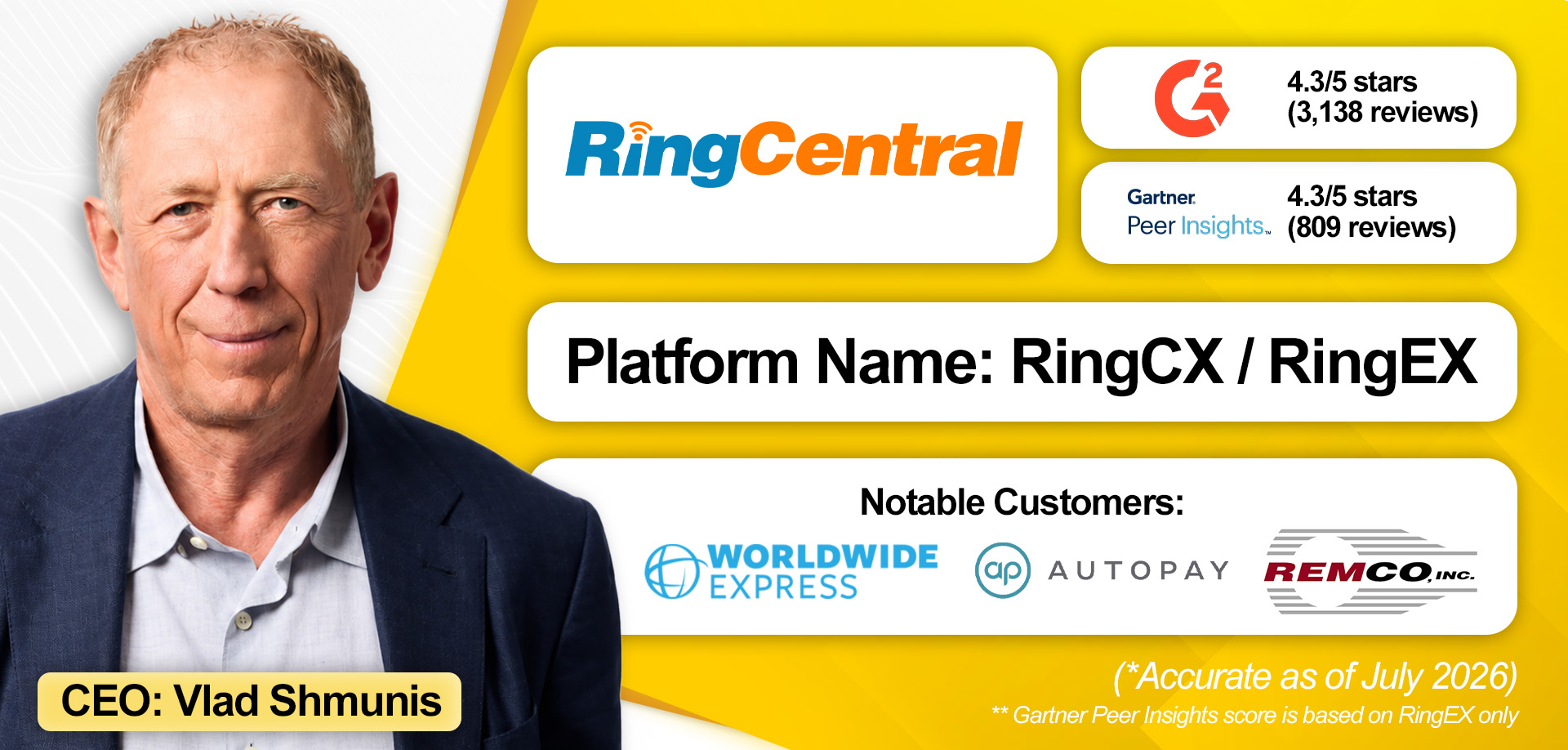 In 2024, RingCentral launched AI Receptionist (AIR), which thousands of organizations now use as a first point of contact for customers, resolving issues directly or routing interactions across the business.
AIR can route contacts to specialists using a dedicated CCaaS solution or to users of its UCaaS platform, RingEX, who have access to its Customer Engagement Bundle (CEB). CEB extends RingEX with contact center capabilities, enabling users to manage voice and digital customer communications.
With queue management, real-time reporting, and a shared SMS inbox, CEB also allows SMBs to build a lite contact center directly within their RingEX environment.
Brands can further extend CEB with AI Virtual Assistant (AVA) and AI Conversation Expert (ACE), solutions that support agents during live calls and deliver post-interaction analytics, respectively.
Midmarket brands with deeper CCaaS needs can instead turn to RingCX, which integrates closely with RingEX and offers unified reporting, analytics, and WEM, the latter strengthened by the company's September 2025 acquisition of CommunityWFM.
For enterprise-scale requirements, RingCentral Contact Center rounds out the portfolio. Essentially, it’s a white-labelled version of NiCE CXone, integrated more tightly with RingEX. By offering this, RingCentral can offer tailored, all-encompassing communications solutions to SMBs, the midmarket, and enterprises.
Still, even as RingCentral expands into CCaaS, its core strength remains in UCaaS. Here it offers feature-rich telephony, seamless call transfers to mobile devices, and 500+ preconfigured integrations spanning industries, enabling highly customized deployments.
Standout Features
- Contact Center Options: RingCentral's customer communications options scale with needs, from its SMB-focused CEB offering to its enterprise-grade Contact Center. This approach lets brands start with simpler solutions and expand as their requirements grow.
- AI Receptionist: Many RingEX customers have adopted AIR for its simplicity, with small businesses often using it to manage contact surges during peak periods. Available as both a standalone offering and as part of a RingEX bundle, AIR combines ease of deployment with a fit-for-purpose design that differentiates it from competing solutions.
- Core UCaaS Functionality: RingEX offers intuitive, feature-rich telephony, with seamless call transfer to mobile devices, a deep integration portfolio for customized deployments, and a simplified admin experience with advanced controls across global locations.
How Much Does It Cost?
RingEX is available in three packages - Core, Advanced, and Ultra - priced at $20, $25, and $35 per user, per month when billed annually. RingCX follows a similar three-tier structure, with Standard, Professional, and Elite bundles costing $65, $95, and $145, respectively, on an annual billing basis. Pricing for RingCentral Contact Center, by contrast, is not publicly disclosed. Unpack RingCentral’s complete pricing strategy here.
5. Nextiva
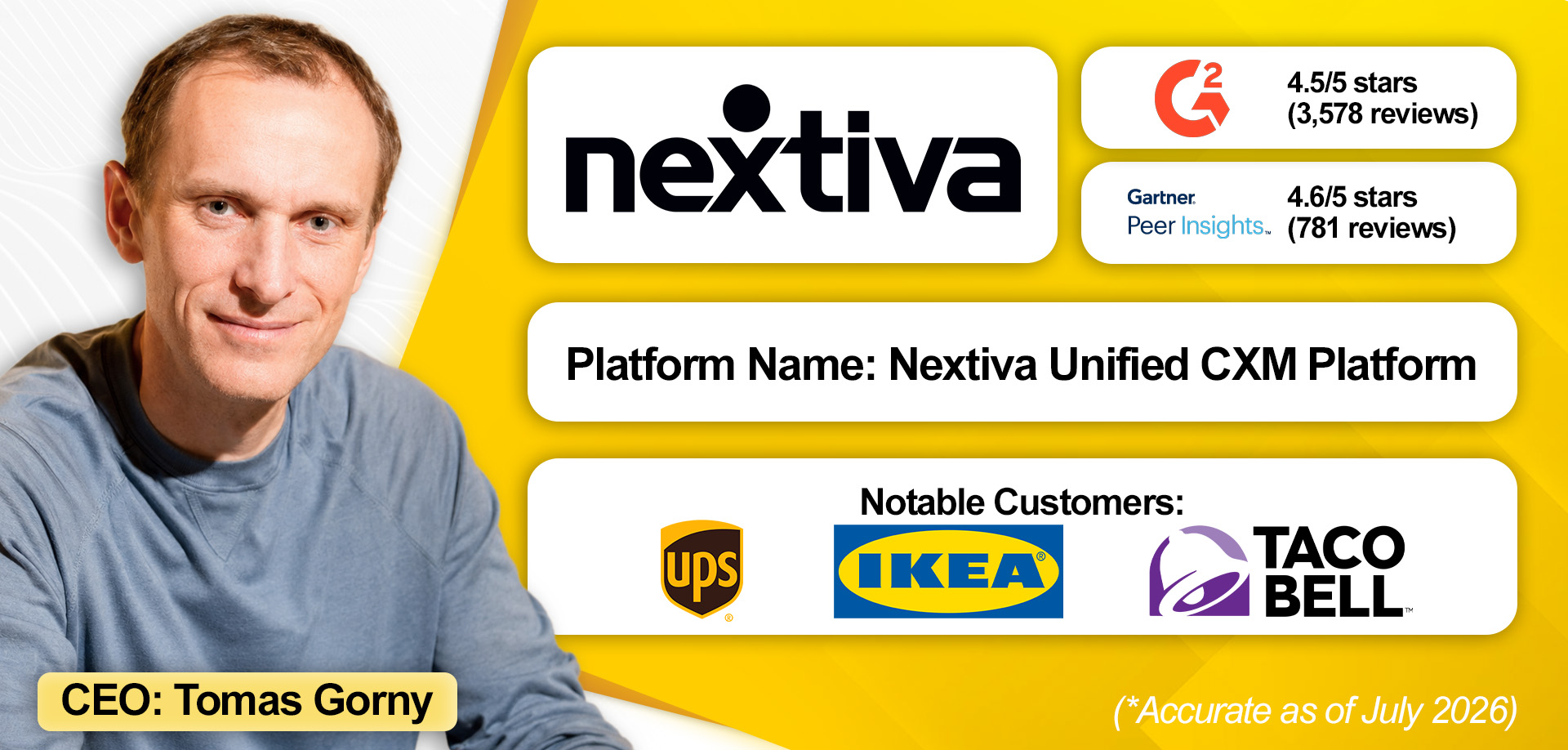
Nextiva has close to 100,000 small businesses on its unified platform, a scale it attributes to more than 20 years of focus on a segment many competitors have overlooked.
These businesses typically don't have the means to pay for additional IT staff, so Nextiva designs its innovations to be an easy lift. Consider AI. It identifies use cases well-suited to automation or analytics as an entry point, then makes them available out-of-the-box.
That same philosophy shapes how Nextiva builds AI agents or "AI Employees," as it calls them. Its analytics agent, NextIQ, is a good example. It communicates directly with a Google BigQuery agent via agent-to-agent (A2A) protocols, dynamically assembling real-time dashboards and reports. This showcases how Nextiva takes tricky IT specifications, like agent-to-agent configuration, and pieces them together for customers.
Also, this example highlights Nextiva's deep integration with Google Cloud and its broader portfolio. Each customer gets their own Google Cloud project, complete with a dedicated BigQuery database for analytics, Google Cloud Storage for unstructured data like recordings and files, and access to Vertex AI.
As a result, organizations get full data separation, which is beneficial for compliance, security (each tenant's data is completely isolated), and for AI, since Nextiva uses Google's models rather than sending customer data to any open LLM. In effect, Nextiva has made enterprise-grade architecture accessible to smaller businesses.
That said, Nextiva also serves enterprise customers with thousands of seats, typically those that have scaled alongside the provider. Like their smaller counterparts, these customers benefit from Nextiva's ownership of its own voice, SMS, and video infrastructure, which supports reliable service levels and voice AI applications.
“It's not easy to make things very simple and work out of the box. That’s our focus. We even build agents that allow you to provision and manage the entire system… The whole configuration of our system now is agentic.”

Standout Features
- Small Business Focus: Nextiva has made a long-term commitment to the small business segment many competitors have overlooked. Since these businesses typically can't support dedicated IT staff, Nextiva has built a fundamentally different service model, one validated by enterprise customers who've grown with the platform and stayed.
- Data Management & Compliance: The provider solves one of the hardest challenges in contact center technology, data management and separation, by giving every customer their own Google Cloud project, including a dedicated BigQuery database, Cloud Storage, and Vertex AI access.
- AI Employees: Nextiva is preconfiguring "AI Employees" that work within its platform and beyond. Indeed, it’s solving issues around agent-to-agent (A2A) communication for its customers, building Employees like NextIQ, an analytics agent, that talks directly to a Google BigQuery agent to dynamically assemble real-time dashboards and reports.
How Much Does It Cost?
Nextiva’s small business offerings start at $15 per user, per month. Its enterprise portfolio includes three packages: Essential, Professional, and Premium. Essential costs $75 per user, per month, while the remaining tiers are priced based on enterprise requirements. Discover more about Nextiva’s pricing strategy here.
6. Dialpad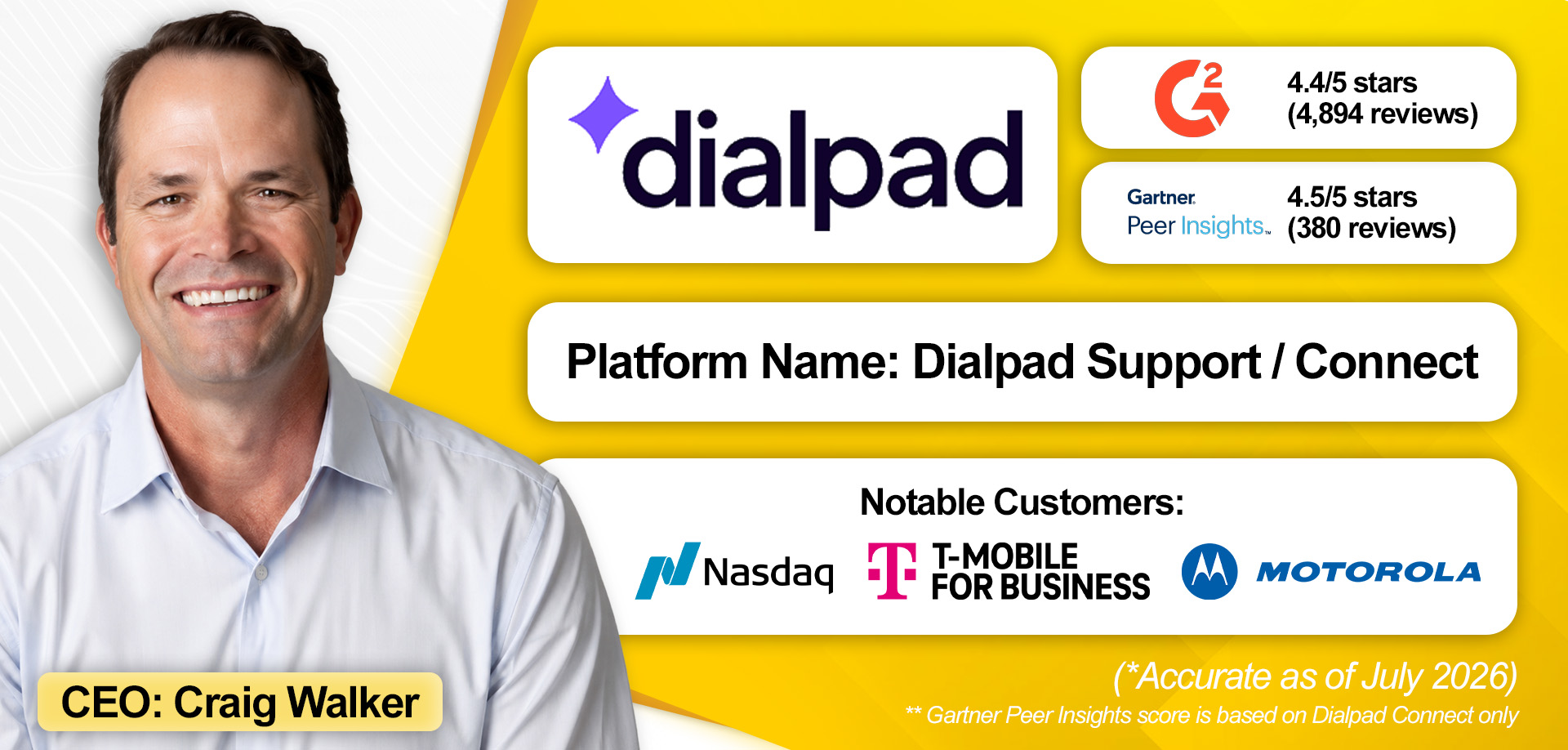
Dialpad has built one platform where all customer conversation data lives in one place and is queryable across the business. As a result, employees - with the appropriate permissions - can ask questions about a customer, even if the answer was never uploaded to a CRM.
That capability helps democratize insight across the business, and so does Dialpad's AI CSAT Score. It infers CSAT scores from customer interactions and lets users, wherever they sit in the organization, question what's driving satisfaction rates up or down. That insight can be especially useful to sales, marketing, product development, and various other departments.
Dialpad also strives to deliver role-specific, actionable intelligence to users across the enterprise. Rather than presenting 20 dashboards and leaving users to figure out what matters, it aims to surface what deserves their attention right now.
In the contact center specifically, Dialpad offers several advanced AI capabilities, including Real-Time Assist and Skills Mining. With Real-Time Assist, the AI detects when a human agent is likely to need help and only intervenes at that point, avoiding unnecessary, tiresome pop-ups.
Skills Mining, meanwhile, mines the last 30 days of customer calls to show contact center leaders what their calls are about, how they break down, and what percentage could realistically be automated.
Dialpad also owns a range of proprietary AI models, which it often uses in place of large language models (LLMs) where performance is flat or better. This helps lower token spend and conserve customer costs.
Finally, Dialpad has a mature WFM solution that's evolving to manage both human and AI agents. It embeds enterprise-grade capabilities, incorporates fairness controls into its scheduling logic, and accounts for new types of human work, such as AI training.
“We've always had a long-standing tradition of innovation, but from the get-go, we thought of Dialpad as one platform and that philosophy is hugely important for us.”

Standout Features
- Customer Intelligence: Dialpad captures insights beyond traditional CRM fields and democratizes that intelligence across the business. This helps subject matter experts (SMEs) resolve customer cases while equipping sales, marketing, and back-office teams with actionable customer insights.
- AI Strategy: With Google alumni charting its AI course, Dialpad delivers powerful AI capabilities like Real-Time Assist and Skills Mining, while also surfacing actionable intelligence tailored to different types of employees, both human and AI.
- First-Party AI Models: Many end users worry about AI costs rising with usage or LLM providers increasing prices over time. Dialpad’s first-party AI models help mitigate these risks while safeguarding performance.
How Much Does It Cost?
Dialpad Connect is offered in two packages: Standard and Pro, which cost $15 and $25 per user, per month, respectively. Meanwhile, Dialpad Support is available in three bundles: Essentials, Advanced, and Premium, priced at $80, $115, and $150 per user, per month, respectively. Dialpad’s full pricing breakdown is available here.
7. 8x8
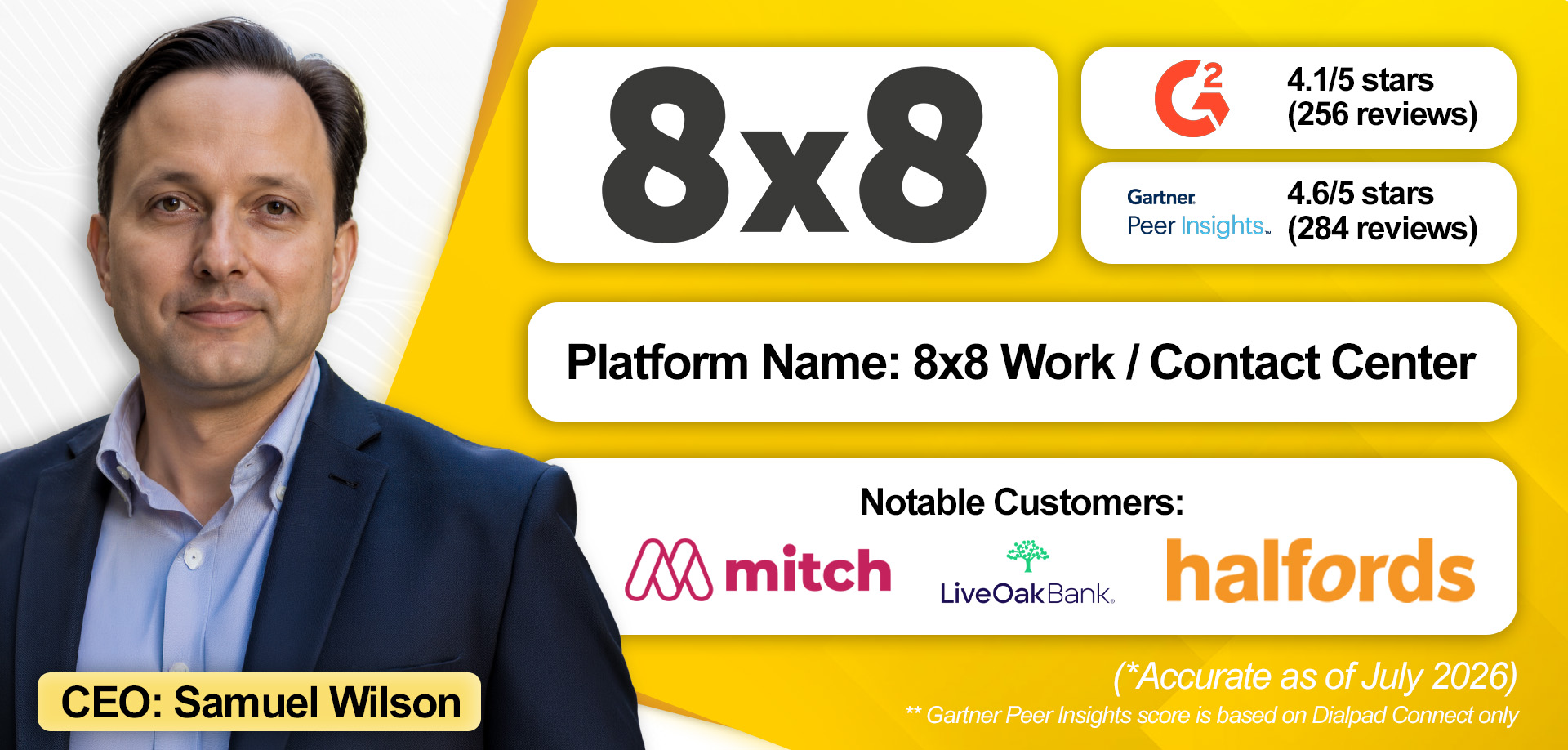
8x8 demonstrated market thought leadership by releasing Engage in early 2024, a lightweight add-on to 8x8 Work that lets back-office workers communicate with customers without requiring an additional contact center license.
Others have since followed suit, but 8x8's offering has continued to mature, with the vendor offering smart routing, Agent Assist, and a unified workspace that captures customer context as contacts transfer across the business.
8x8 Pulse builds on this further. It draws context from conversations happening across the business and data from the CRM to capture the full "pulse" of the customer, turning it into what 8x8 calls "actionable intelligence" for each customer's support needs.
The enterprise communications provider is also a popular pick among businesses running on Microsoft Teams. Like several competitors, it offers a certified Microsoft Teams Contact Center, but it goes further with 8x8 Voice, which handles public calls directly inside Teams without on-premise hardware or additional desktop apps.
Another differentiator is in how 8x8 works closely with customers to identify the solutions that best fit their needs.
Rather than handing customers tools, 8x8 aims to build integrated, end-to-end solutions that solve specific business problems. As AI accelerates software development and reduces the value of individual features, 8x8’s differentiation increasingly lies in integration, simplicity, and measurable outcomes.
Lastly, the company has a strong footprint in the midmarket and SMB segments, particularly in the US and UK, where customers frequently cite platform simplicity, intuitiveness, and ease of use as key strengths. For large enterprise CCaaS requirements, it partners with NiCE.
“Today, you get an overall product that is as good in each individual technology (as the standalone providers), and, in some cases, better. And you can get it from a single vendor on a single platform, with a single analytics solution and a single data foundation."

Standout Features
- Embedded Contact Center Capabilities: 8x8 was first to market with a solution, Engage, that delivers a lightweight, coordinated contact center experience within 8x8 Work, while its broader CCaaS portfolio remains mature and well aligned with midmarket needs.
- Customer-Focused Strategy: The vendor prioritizes business outcomes over selling individual product categories or standalone tools. Rather than leaving customers to piece together solutions, 8x8 delivers integrated, end-to-end platforms tailored to specific business requirements.
- Microsoft Teams Specialization: 8x8 is a strong choice for Teams-based organizations, offering a certified Microsoft Teams Contact Center and 8x8 Voice for Microsoft Teams, backed by deep experience within the ecosystem.
How Much Does It Cost?
8x8 Work and 8x8 Contact Center are primarily priced on a per-user basis, but the company is transitioning to a hybrid pricing model that also factors in AI and digital channel consumption. 8x8 does not publicly disclose detailed pricing. Instead, buyers must contact the company directly for a custom quote. Learn more about 8x8’s pricing here.
8. Vonage
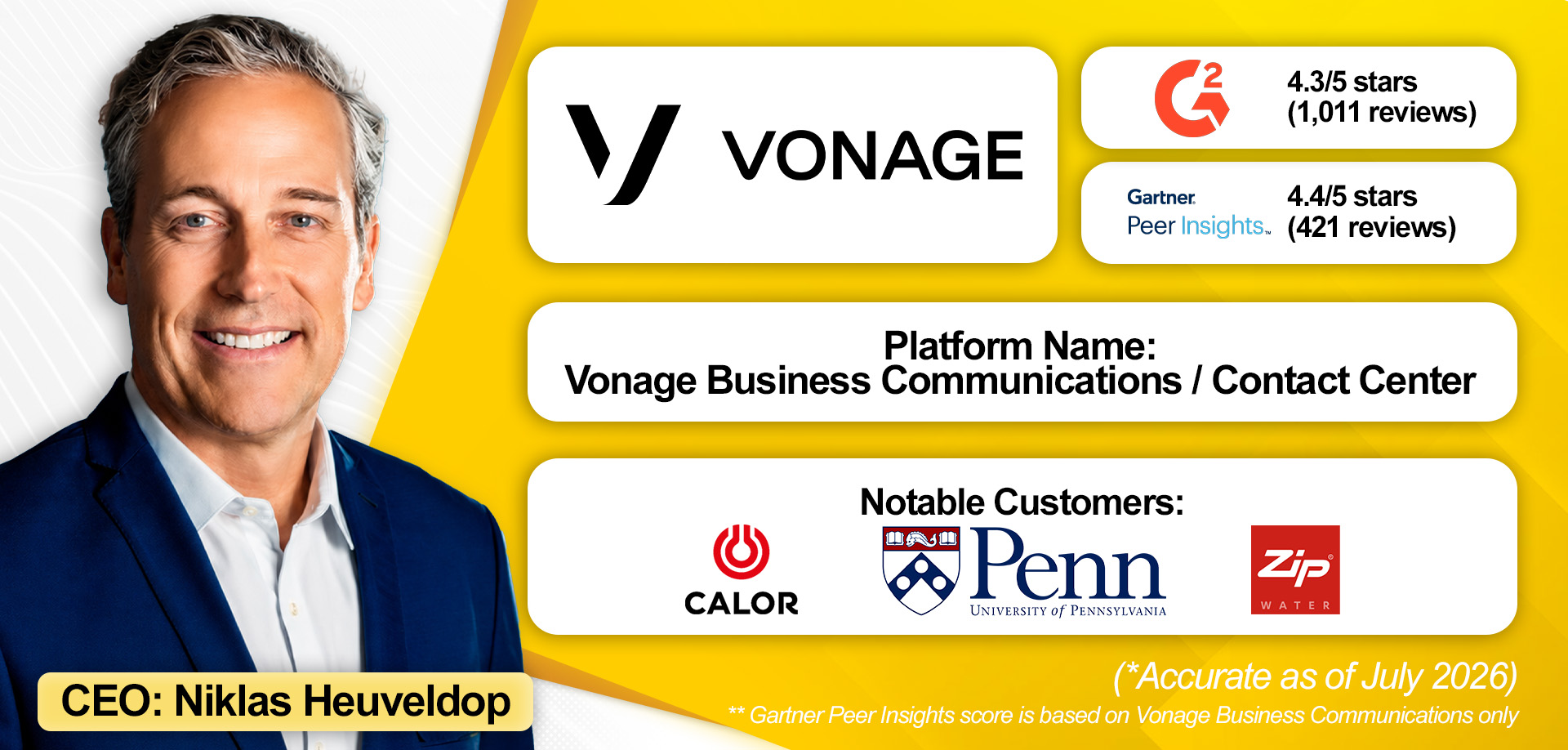
Vonage is the number one rated vendor for CCaaS on the Salesforce AgentExchange (formerly AppExchange), embedding call controls, digital channels, and - uniquely - Network APIs into Agentforce Service. As such, it’s an often-touted solution for businesses looking to build a customer engagement center on Salesforce.
Yet, it also has a standalone CCaaS solution outside the CRM, featuring an ‘Intelligent Workspace’. It’s designed to layer across various CRM instances, consolidating the user experience, so agents aren’t continuously dipping in and out of different solutions.
Back to Network APIs that pull data from the network. These bolster both its UCaaS and CCaaS offerings. For starters, they allow companies to monitor whether remote teams are experiencing continuous internet connection issues. Meanwhile, in customer communications, Vonage can pull network data, such as whether someone has swapped the SIM in their phone, helping businesses improve their customer authentication practices.
In terms of UCaaS + CCaaS specifically, Vonage offers the expected features from presence sync to shared contact directory, with unified reporting to come. It also gives combined customers free minutes between front and back office if they buy both. That can save businesses significant sums of money.
Additionally, it offers a certified Microsoft Teams contact center integration and was recently listed in the Microsoft Teams Admin Center for Operator Connect.
Finally, as Vonage is an Ericsson company, it can collaborate with many communications service providers (CSPs) worldwide. These relationships support high uptime and CX assurance initiatives. Yet, they're also supporting growth. For instance, Bharti Airtel, a massive Indian operator, has reskinned its UCaaS solution to run there. Expect that distribution channel to expand further.
“We have direct access to the underlying APIs, creating strong commercial value that we can pass on to our customers through new innovation. That allows us to move aggressively and differentiate our offering.”

Standout Features
- CRM-Focused CCaaS Design: Vonage Premier for Salesforce Voice is the highest-rated CCaaS application in Salesforce AgentExchange. Meanwhile, its Intelligent Workspace works across multiple CRM instances, enabling a consolidated user experience.
- Network APIs & Intelligence: Of all vendors considered, Vonage arguably has the strongest CPaaS portfolio. Part of that is its Network APIs that pull network intelligence to validate employee and customer experiences, while supporting improved contact center identification and verification (ID&V).
- Roadmap: Vonage plans to build on its CPaaS portfolio and Ericsson relationships to deliver differentiated innovations in areas such as quality of service and fraud prevention, capabilities that are increasingly important as organizations face evolving security threats.
How Much Does It Cost?
On its own, Vonage Business Communications comes in three packages: Mobile, Premium, and Advanced. Billed annually, these cost $13.99, $20.99, and $27.99, respectively. Vonage does not disclose its CCaaS pricing, but stresses that UCaaS is available as an add-on. Full Vonage pricing information is available here.
9. Tata Communications
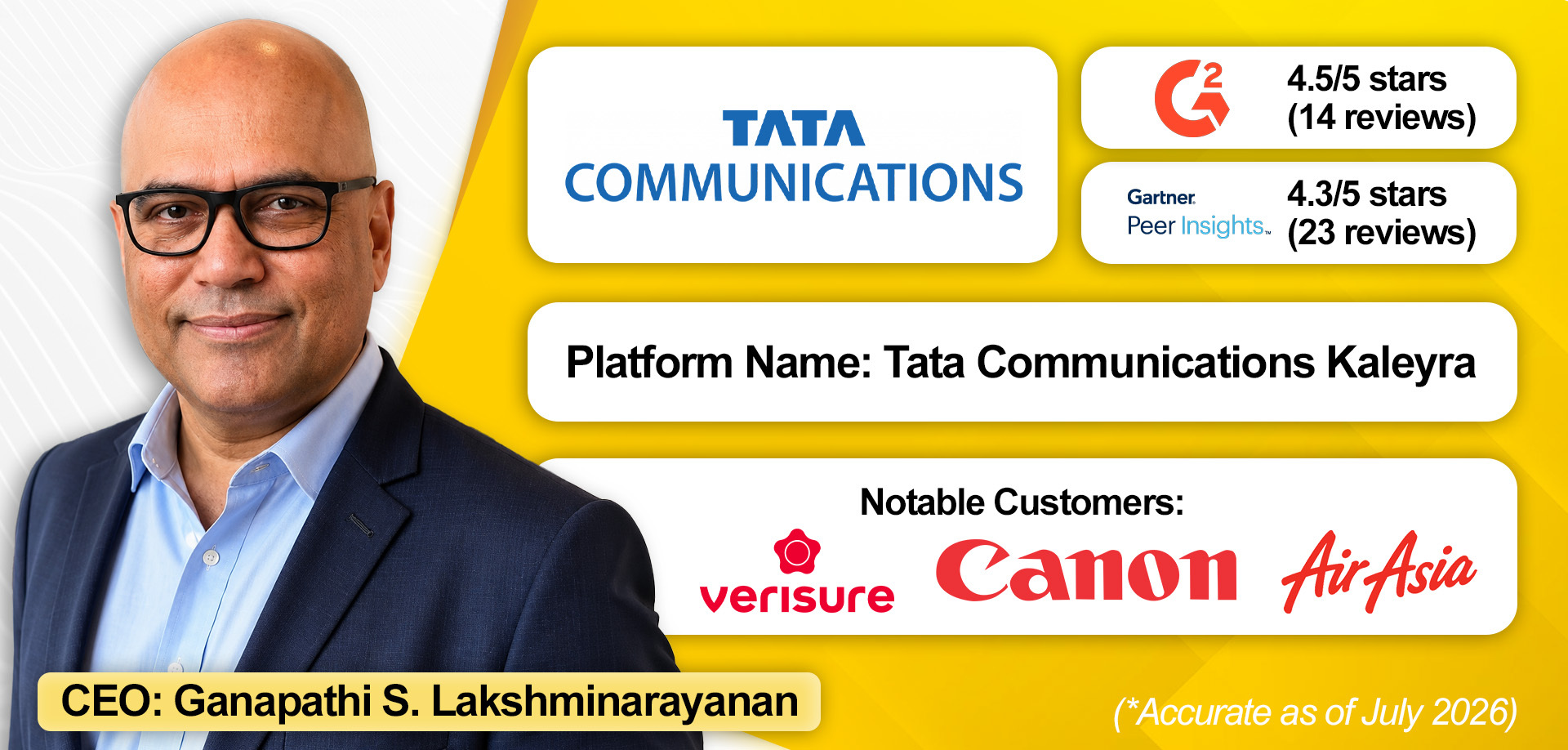
Tata Communications is one of the largest enterprise communications providers in APAC, but maintains a global presence with its Kaleyra platform.
Kaleyra runs an "interaction fabric" across the vendor's CCaaS and UCaaS solutions. This treats customer and employee interactions as part of one coherent system, with unified data, analytics, and services.
Notably, this fabric also extends across third-party communications solutions, which aligns Tata Communications with the needs of many large-scale organizations.
After all, such organizations typically manage employee and customer conversations across a plethora of tools. These enterprises can then leverage Kaleyra to slowly unify that fragmentation.
The vendor also benefits from a robust CPaaS portfolio, comprising Network APIs that it has woven across the Kaleyra platform to detect anomalies in voice and SMS traffic, bolstering the provider’s overall security posture.
Tata also leverages its advanced CPaaS capabilities to orchestrate conversations across systems. In doing so, it essentially lays out a framework for AI agents to handle complex customer engagements.
Standout Features
- Unified Architecture: Tata Communications combines employee and customer conversations within a unified data architecture, tracking interactions beyond first- and third-party UCaaS and CCaaS to include chats, meetings, and emails. This richer conversational context lays the foundation for more mature analytics and AI agents that aren't limited to fragmented data sources.
- Experience Orchestration: The provider has established a programmable orchestration layer across its solution, allowing organizations to coordinate complex interactions, apply AI, and enforce policy, all while meeting rising regulatory expectations around traceability and oversight.
- Security & Fraud Prevention: Tata Communications’ Network APIs monitor voice and SMS traffic for anomalies, flagging - or even auto-pausing - suspicious activity until a human verifies it. This built-in capability supports a complex, multi-layered security strategy without adding friction to the customer experience.
How Much Does It Cost?
Tata Communications doesn't publicly disclose pricing for Kaleyra CCaaS, UCaaS, or the platform as a whole. Instead, brands must schedule a consultation to receive a custom quote. Talk to the Tata sales team here.
10. Genesys
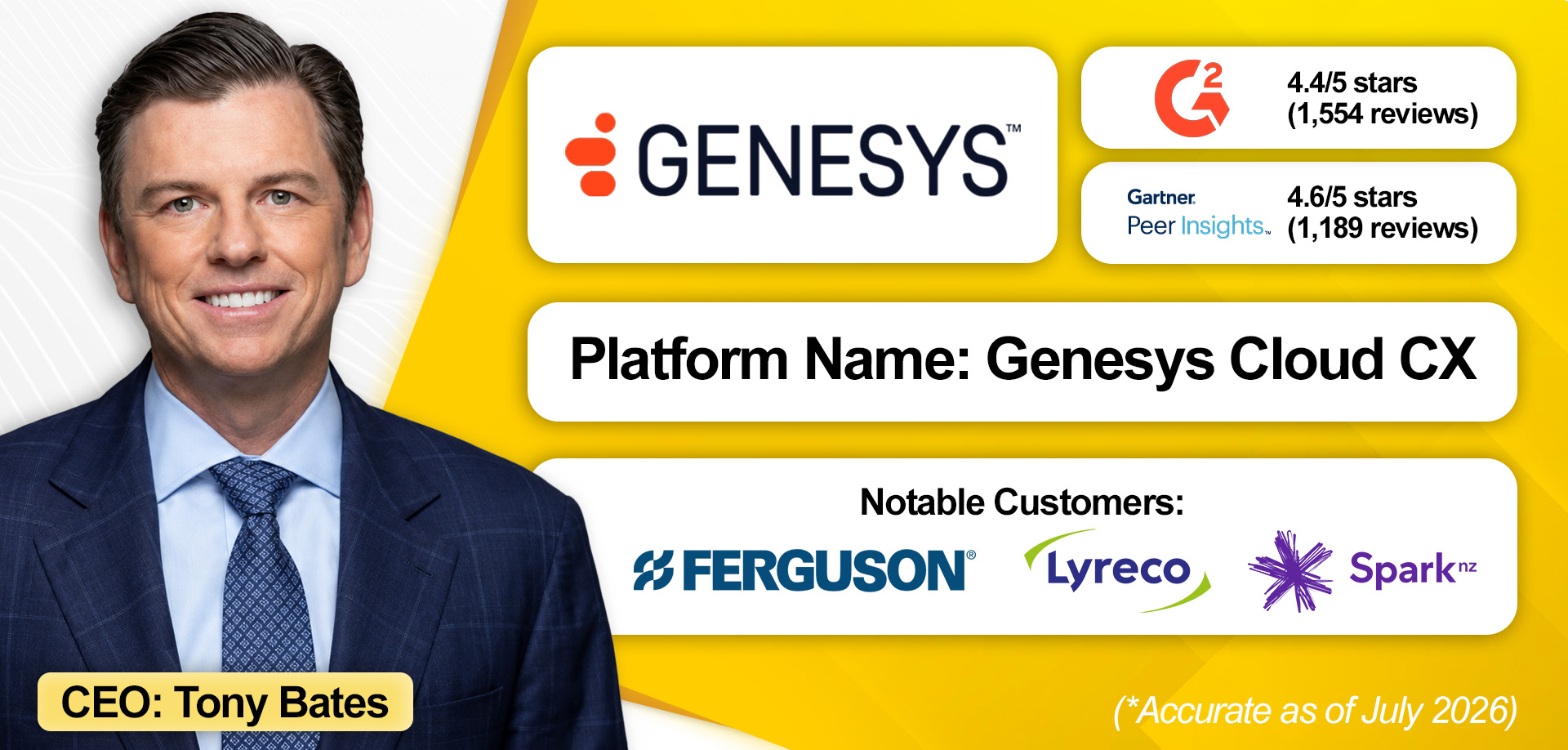 Genesys offers a UCaaS solution, “Genesys Cloud Communicate”, though it sometimes calls it a "business telephony product", which is a deliberate choice, since UCaaS is often understood as something much broader. The product was integrated with its CCaaS solution to enable escalations of customer contacts to experts beyond the confines of the contact center.
In enabling this, Genesys serves CX-focused customers with basic UC needs without forcing them to bring in a separate UC vendor. At the same time, it offers mature integrations with Microsoft Teams and Zoom Phone. These underscore the company's core strength: ecosystem integration and depth.
Yet, in the world of converged enterprise communications, perhaps the provider’s most significant solution is its Genesys Cloud Associate, which distributes customer contacts across the enterprise and different UCaaS platforms.
So, for example, it could route a call to a sales rep on Zoom, a finance manager on Slack, or a branch manager on Teams as needed, orchestrating experiences that tap cross-enterprise knowledge wherever it lives. That’s a critical capability given that global enterprises, especially those with multiple subsidiaries, rarely run on a single UCaaS platform.
Genesys also offers a strong workforce management (WFM) solution that extends into the back office, ensuring the right expertise is available to handle customer contacts throughout the day. Meanwhile, its deep relationships with Salesforce and ServiceNow, now expanding to support AI agent-to-agent communication across their platforms, reinforce its broader positioning: orchestrating experiences across CCaaS, UCaaS, and beyond.
“Typically, enterprises don't use a UC platform; they use UC platforms. So how do you manage that, make sure you have context, and orchestrate across the organization? That's where we focus a lot of effort.”

Standout Features
- Genesys Cloud Associate: Nowadays, Genesys rarely refers to itself as a CCaaS platform. Instead, it's an “AI orchestration platform.” The Genesys Cloud Associate allows it to orchestrate resolution journeys that span the business, crossing first- and third-party UCaaS solutions.
- Ecosystem & Integrations: With 600+ pre-configured integrations, Genesys outpaces much of the CCaaS market. The provider’s ecosystem includes deep integrations with Microsoft Teams and Zoom. It has also fostered close partnerships with Salesforce and ServiceNow that, in some cases, enable cross-platform agent-to-agent resolution journeys.
- Workforce Management: Genesys allows brands to co-ordinate back- and front-office tasks through work automation and workforce management, ensuring companies have the resources available to resolve customer contacts when they pass beyond the boundaries of a contact center.
How Much Does It Cost?
Genesys offers its CCaaS platform in four bundles: Genesys Cloud 1, 2, 3, and 4. These cost $75, $115, $155, and $240, respectively. Genesys Cloud Communicate is part of every package. Find out more about Genesys’s pricing here.
11. NiCE
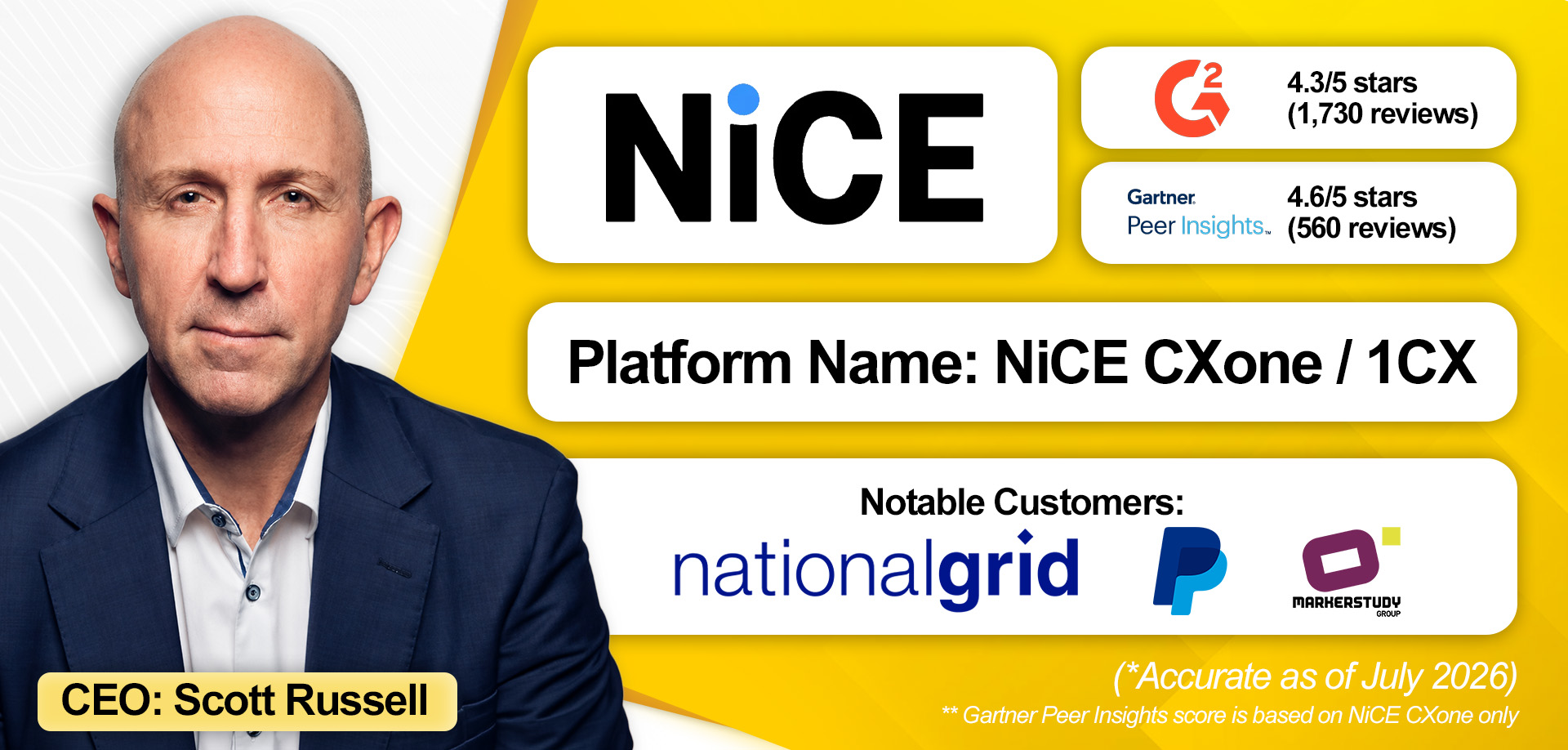
In 2024, NiCE caused a stir by launching NiCE 1CX, a UCaaS offering priced at just $5 per month. However, a closer look reveals it's a white-labelled version of the 3CX UCaaS suite, available only to existing users of its CCaaS platform, NiCE CXone.
So, if it's not trying to disrupt the UCaaS market, why launch NiCE 1CX?
The answer is that NiCE is using UCaaS as an extension of CXone. It enables brands to route customer interactions to back-office users who handle occasional customer queries at a much lower cost than provisioning them a full CXone license. At the same time, it preserves conversational context as interactions move beyond the contact center.
Viewed this way, NiCE 1CX is less a standalone UCaaS competitor to Microsoft, Slack, or Zoom and more an extension of its CCaaS platform.
Instead, NiCE's differentiation remains rooted in CXone, with strengths including Cognigy AI agents, a mature sovereign cloud offering, and Engagement Hub, which enables on-premises contact centers to access its latest AI capabilities.
Addtionally, NiCE stands out with its hybrid WFM solution. It forecasts customer demand and helps organizations coordinate both human and AI resources, extending workforce planning into the back office so subject matter experts are available when customer interactions require their support.
Standout Features
- Low Price Point: Previously, businesses would have to provision a new CCaaS license for external users to engage with customers. NiCE offers a more cost-effective solution while keeping all customer interactions on its platform for improved customer intelligence.
- Workforce Management: NICE is a recognized leader in contact center WFM, with a solution that helps brands account for back-office support and ensure appropriate staffing levels across the business to support customer service teams.
- Cognigy AI: In 2025, NiCE acquired conversational AI leader Cognigy, transforming its self-service proposition. But Cognigy's AI agents extend beyond the contact center. Indeed, they can be deployed across the enterprise to augment third-party systems and fulfill sales, marketing, and commerce tasks. As such, they can add value not only to NiCE CCaaS, but also to third-party UCaaS solutions.
How Much Does It Cost?
NiCE 1CX costs $5 per user, per month and is available as an add-on to a NiCE CXone bundle, of which there are five: Omnichannel, Essential, Core, Complete, and Ultimate. These cost $110, $135, $169, $209, and $249 per user, per month, respectively. The latter also has a $0.25 per-session charge on top. Get more information on NiCE’s pricing here.
Other Notable Enterprise Communications Solutions
Many big names with UCaaS solutions are expanding into CCaaS. Consider Salesforce. It owns Slack and recently announced the Agentforce Contact Center. As it pushes further into CCaaS, expect these solutions to collide.
Google is another big name player in the UCaaS space, offering Google Workspace. It provides a CCaaS offering via Gemini Enterprise for Customer Experience, based on UJET’s differentiative contact center platform. While the company has siloed these offerings, there is significant potential to bridge the technologies.
Elsewhere, Talkdesk, like NiCE and Genesys, is a prominent CCaaS provider with a UCaaS solution. Similar to Genesys, this is essentially business telephony. However, it fits a use case for businesses aiming to transfer customer contacts across the business.
Additionally, there are other enterprise communications solution providers that bridge the worlds of CCaaS and UCaaS. GoTo, Intermedia, Dstiny, Sangoma, and Enreach are prime examples, which excel across specific regions and market segments.
Lastly, for those enterprises that aim to stay on-premise or would prefer a hybrid deployment, Avaya and Mitel are still options in the space, alongside Cisco.
5 Trends Reshaping the Enterprise Communications Market
As the enterprise communications market converges, many trends rise to the fore, shaping how providers innovate and go to market. Here are five excellent examples.
1. CPaaS Converges with UCaaS and CCaaS
Many providers of unified UCaaS-CCaaS solutions also include CPaaS in their offerings. Vonage, Cisco, Tata Communications, and 8x8 are notably strong here.
These CPaaS solutions not only inject new communication channels into enterprise systems but also support complex integrations and journey orchestration strategies.
Perhaps most interesting, however, is how Vonage and Tata Communications are using CPaaS to strengthen security. By weaving Network APIs across their platforms, both are adding another layer of fraud prevention while bolstering user and customer authentication.
2. Providers Focus Less on Seat Counts and More on Wallet Share
Simply selling more UCaaS seats is no longer the primary growth lever for many enterprise communications providers. Instead, the real growth engine now is by expanding into adjacent categories.
CCaaS is part of that. But providers are also going deeper into conversational AI, WEM, and conversational intelligence.
Vendors with large existing collaboration or telephony footprints are best positioned, because they can attach these new capabilities onto that base rather than starting from zero in each new deal.
3. Unified Analytics & Reporting Becomes Table Stakes
A key benefit of a unified enterprise communications solution is its ability to capture employee interactions around customer conversations. This visibility helps organizations identify the extra steps employees take to resolve issues and uncover friction points in the resolution journey.
Moreover, by extending analytics to back-office interactions, organizations can understand how experts resolve specific queries and train AI agents to automate them over time.
Alternatively, they can use these insights to help frontline reps resolve issues without involving the back office in the first instance.
Given this value, more providers are extending their conversational intelligence capabilities, with 8x8, Cisco, and Dialpad key examples here.
4. Workforce Management Extends Into the Back Office
When UCaaS providers first expanded into CCaaS, their WFM capabilities were relatively lightweight. However, these solutions are rapidly maturing, with providers such as Cisco, Dialpad, and RingCentral now offering sophisticated WFM functionality.
These capabilities help organizations route, prioritize, and track back-office work related to customer contacts, improving forecasting and resource allocation to support customer service teams.
5. Regional and Channel Strategy Remains Crucial in Enterprise Communications
In UCaaS especially, growth for many vendors is tied less to product innovation and more to geographic reach, channel partnerships, and segment focus. Even strong products can plateau without the right go-to-market and regional execution.
For instance, Vonage pulled back slightly from the channel and shifted to investing in customer experience and CPaaS post-acquisition, slowing short-term growth.
Ultimately, this shows that pursuing "the future" can come at the cost of business momentum, even if Vonage’s play might pay off in the longer run.
The Future of the Enterprise Communications Market
Across the enterprise communications space, there is a large segment of regional specialists, such as Wildix, Dstny, Enreach, alongside other segment-driven players that win through pricing, channel, and industry focus. These include NFON, Ooma, and Sangoma.
However, the analyzed providers have the broadest appeal, and may gain market traction as the contact center becomes more closely integrated with the organization’s broader tech stack.
As this trend kicks into gear, these providers will increasingly treat AI as a connective tissue, not a bolt-on feature, across UCaaS, CCaaS, and - increasingly - CPaaS.
This approach will further distinguish them from pure-play CCaaS providers, which still win most enterprise contact center deals today.
Indeed, as CCaaS becomes more commoditized, the ability to unify capabilities and extract new value - whether in better orchestration, automation, or insight - is becoming a key differentiator.