June 2, 2026 • 6 min read
Cisco Announces a Unified WEM Suite to Manage Human and AI Contact Center Agents

Director of Content & Market Research
June 2, 2026
Cisco has launched a unified Workforce Engagement Management (WEM) suite, delivering a single platform for managing human and AI agents within the Webex Contact Center.
The suite includes workforce management (WFM) and quality management (QM) systems, alongside performance management, AI assistance, and onboarding solutions.
Its launch at Cisco Live 2026 in Las Vegas aligns with Cisco’s ambition to deliver a “truly agentic” contact center.
Vinod Muthukrishnan, VP/GM of Webex Customer Experience at Cisco, reflected on this ambition.
“AI cannot reach its full potential when it is bolted onto systems that were built for another era. What we've been building is different. We're not adding AI to the contact center; we're rebuilding the contact center around AI, with orchestration, context, and interoperability as foundational infrastructure, not an afterthought."

Its approach in re-architecting WEM exemplifies this, especially through its new-look WFM and QM solutions.
One WFM Solution to Manage Human and AI Agents
As human and AI agents begin to share the workload, WFM teams must carefully monitor how demand splits across the hybrid team while tracking AI escalations to accurately forecast staffing requirements.
At the same time, human agent responsibilities are expanding, handling new tasks from AI coaching to customer success initiatives. That means scheduling must support more activities.
Additionally, WFM leaders must navigate new real-time planning considerations, monitoring emerging drivers of fluctuating demand, such as AI updates and availability issues.
Cisco puts forward a WFM solution to meet these new challenges and better serve the modern resource planner, with its revamped offering set for controlled availability before October 2026.
One QM Solution to Manage Human and AI Agents
Cisco has introduced a single solution for monitoring human and AI agent performance across all contact center conversations, which will become generally available by the close of this quarter.
Such a solution will tell service leaders where AI and human agents typically perform best across particular intents and inform their automation and routing strategy.
Leaders may also use the solution to model the behaviors of their best human agents, use that intelligence to steer AI agents, close the performance gap, and safeguard critical customer outcomes.
Cisco’s Consolidated WEM Platform
WFM and QM sit alongside three further solutions within Cisco's WEM portfolio: Performance Management, AI-Powered Assist, and the soon-to-be-released AI-Powered Onboarding solution, each designed with interoperability in mind.
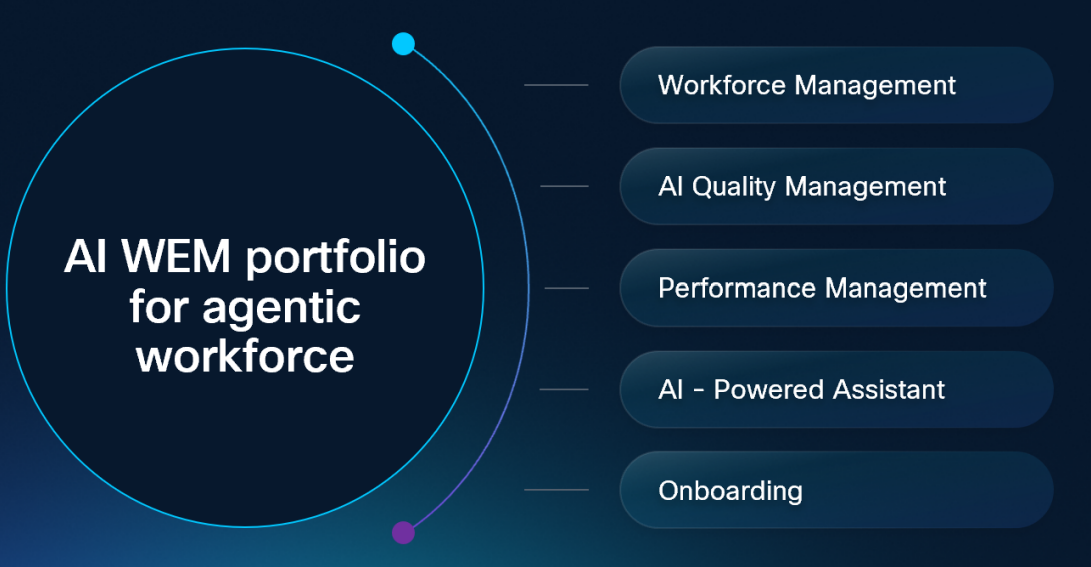
Performance Management gives service teams tools for individual and team measurement, benchmarking, and gamification. It also monitors real-time performance and workload data, prompting supervisors to make timely wellbeing check-ins with agents.
AI-Powered Assist delivers real-time support to human agents during live conversations, surfacing knowledge suggestions and recommending actions. What makes it particularly notable is that QM analysts and supervisors can track how agents interact with the tool, enabling them to monitor and improve human-AI collaboration over time and to dial back unnecessary prompts for experienced reps who no longer need them.
Both Performance Management and AI-Powered Assist are available now.
Coming soon is AI-Powered Onboarding. This is an AI agent that simulates real-world customer interactions to accelerate time to proficiency. Yet, it can also help experienced reps by addressing known performance issues and preparing them for new conversation types, such as those tied to a product launch.
AI-Powered Onboarding demonstrates the suite’s interoperability, using QM data to tailor simulations to each rep's specific development needs.
Cisco sees interoperability as a key pillar of its vision for the contact center of tomorrow, leveraging connections across its WEM suite and broader contact center ecosystem to drive innovation.
Cisco’s Vision for the Contact Center of Tomorrow
In most organizations, contact center technology has evolved faster than the work design around it.
As a result, leaders are left with islands of automation layered onto schedules, metrics, and workflows designed for a world where every interaction was human and every decision was local.
That gap shows up as burnout, inconsistent experiences, and leaders flying blind.
According to Justin Robbins, Founder & Principal Analyst at Metric Sherpa, this is what Cisco wants to change.
“What Cisco is signaling here is a shift from ‘add more AI’ to ‘redesign the operating system’ for customer work. If you treat AI agents, human agents, quality, security, and performance as one system with a shared control plane, you’re not just modernizing the stack; you’re redesigning how work gets done.”

“For enterprises that care about both experience and accountability, that is where the real opportunity sits,” he concludes.
Meet Cisco’s New AI Concierge
Also launching at Cisco Live 2026 is AI Concierge, a pre-configured AI agent that acts as an extensible front door to the Webex Contact Center.
The solution dynamically evaluates customer context, including intent, sentiment, and interaction history, alongside a memory of how the brand has previously resolved similar interactions.
From there, it coordinates behind the scenes, pulling from the knowledge base, connecting with other AI agents, and tapping enterprise systems simultaneously.
When escalation is necessary, AI Concierge draws on QM data to identify the best-placed human agent and completes a warm transfer to the channel most likely to drive a positive outcome.
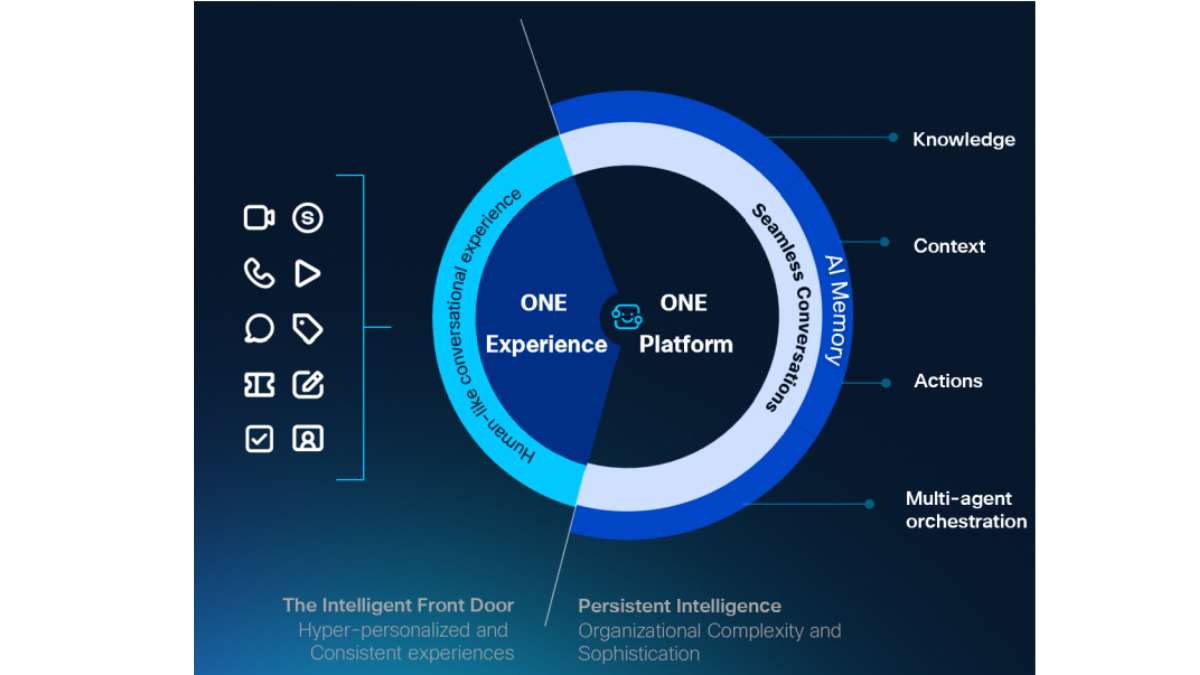
Notably, it can also route contacts beyond the conventional contact center to subject matter experts (SMEs) across the broader Webex platform.
Lastly, businesses can configure their concierge through the AI Agent Studio, plugging into brand content, workflows, and tone guidelines.
More Webex CX Announcements
Already, Cisco’s CCaaS customers can build AI agents for self-service. Yet, the vendor is now expanding access to the AI Agent Studio across the Webex portfolio.
As a result, enterprises using Webex as a unified communications platform can deploy multi-modal AI agents across both internal and external use cases.
For example, IT and HR teams can automate employee requests ranging from hardware provisioning to time-off management.
In making this capability more broadly available, Cisco helps standardize enterprise service management (ESM), avoiding unnecessary technology duplication across the business.
To help businesses manage these agents, Cisco has introduced AI Agent 360, a combined observability, security, and management solution that lets teams build, test, monitor, and improve agents in real time, all from one place.
This is an example of how Cisco is leveraging its broad portfolio to deliver differentiative capabilities to its Webex Contact Center customers.
Cisco is also extending its reach in two further directions. First, geographically, with its CCaaS platform launching in India last month, bringing the solution to one of the world's largest enterprise markets.
Second, to on-premises customers, with the Webex AI Agent now generally available alongside a Universal Harness, which is a single connector that handles all the technical plumbing, including APIs, SDKs, and authentication, removing the need for complex infrastructure setup.
While commending Cisco for rearchitecting its CCaaS platform, Zeus Kerravala, Principal Analyst at ZK Research, also views these moves as significant.
“Expanding localized data infrastructure into critical, high-scale markets like India and delivering advanced AI capabilities to on-premises environments demonstrates a pragmatic commitment to meeting enterprises exactly where they are, regardless of their deployment model or regulatory boundaries."