
March 25, 2026 • 5 min read
Cisco Lays Out Its Framework for a “Truly Agentic” Contact Center

Director of Content & Market Research
March 25, 2026
The cloud contact center market continues to become more crowded every year.
Still, there are the stalwarts: NiCE, Genesys, Five9, and (of course) Cisco.
Yet, CRM players are now pushing into the space. For example, Salesforce entered earlier this month, while Microsoft (through Dynamics) and Zendesk have also added CCaaS to their platforms.
Then, there are hyperscalers such as AWS and Google, CPaaS players like Twilio and Infobip, and UCaaS giants including RingCentral and Zoom.
From all angles, global technology providers are converging on the market.
Still, Cisco is expanding its CCaaS business, securing several recent megadeals. Its 2025 win with Maersk, spanning 120 countries, is an excellent example.
The tech giant’s deep on-premise base facilitates much of its growth. That remains an advantage with 60% of enterprises not yet moving their contact centers to the cloud, per estimates from NiCE.
However, this on-premise base isn’t enough. Understanding this, Cisco has evolved its CCaaS strategy as it strives to stay at the forefront of a bustling market.
Cisco’s Evolving Contact Center Strategy
Last year, Gartner named Cisco one of only two “customers’ choice” CCaaS vendors, citing verified customer reviews.
Its analysis hints that differentiators - such as its CCaaS-CPaaS-UCaaS approach, broad employee experience portfolio, and security and observability posture - are resonating.
Now, Cisco hopes to take these strengths and the Webex Contact Center into the agentic era.
Vinod Muthukrishnan, VP & GM of Webex Customer Experience at Cisco, underscored how his team plans to do this in an interview with CX Foundation, sharing a framework for the “truly agentic platform” Cisco is building toward. Here’s a closer look.
Cisco’s Framework for an Agentic Customer Experience Platform
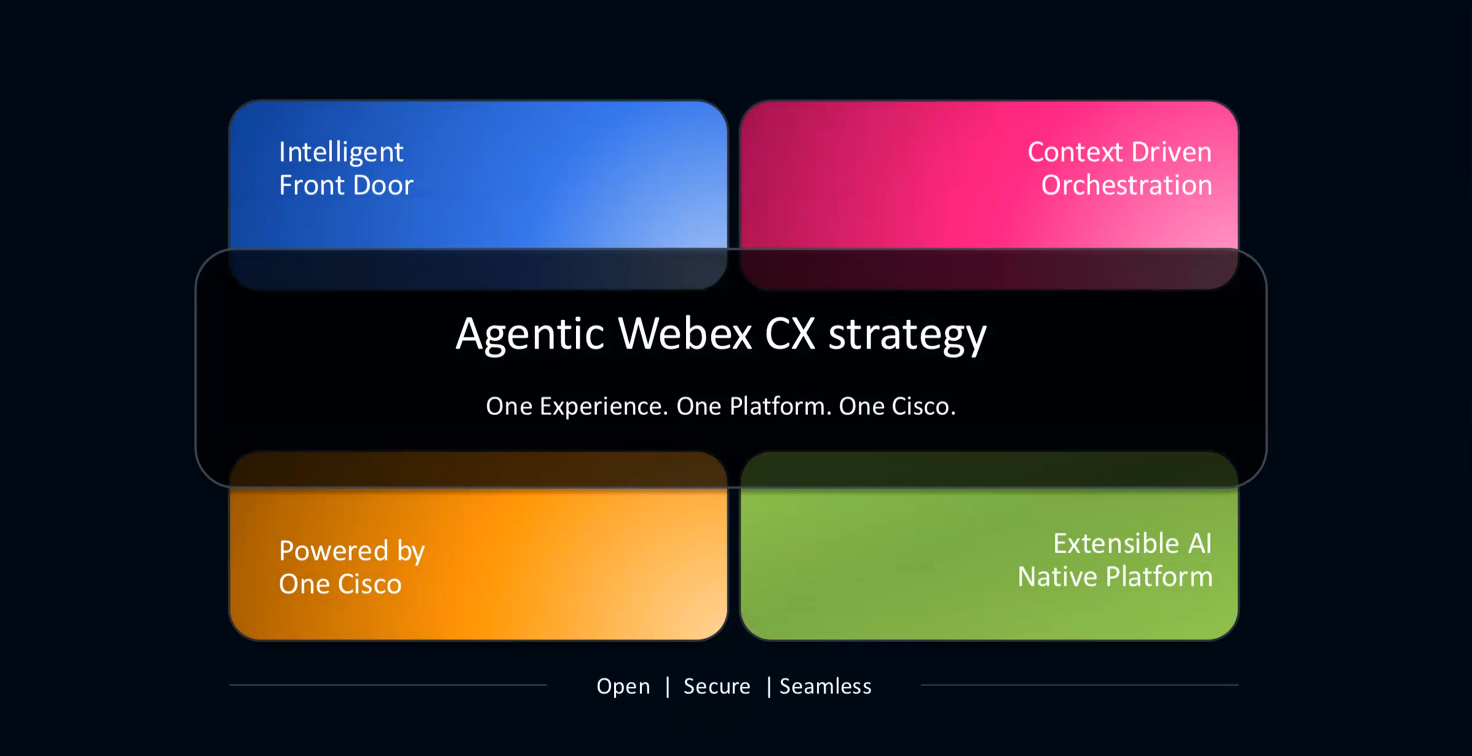
Cisco’s framework for an agentic customer experience platform has four pillars, as the following image showcases.
1. The Intelligent Front Door
The agentic CX platform begins with an AI agent or “concierge” that dynamically evaluates customer context, intent, sentiment, and interaction history alongside workforce engagement management (WEM) data to intelligently match each request to the best-suited agent, whether human or AI.
The concierge may also consider specific goals, whether it's customer satisfaction, conversion rate, or another critical CX or EX outcome.
From there, the agentic CX platform pulls in context pertinent to the customer’s intent, supporting a continuous, persistent experience.
That’s opening the front door to a customer who is already there. However, Cisco also brings the front door to them.
How? By utilizing the CPaaS elements within its CCaaS suite to track signals across the systems that suggest the customer is experiencing an issue and triggering a proactive support experience.
This ability for Cisco to utilize CPaaS as an infrastructure for AI agents to pre-emptively resolve issues, often before the customer realizes, may prove a key differentiator moving forward.
2. Context-Driven Orchestration
Cisco strives to take real-time context and dynamically influence service experiences.
That involves extracting insights into how customers feel, what they prefer, and what matters to them in that moment to drive next best actions and guide interventions.
So, instead of an agent following a single, idealized way to resolve each query, the agentic contact center suggests other approaches to individualize the experience.
As Muthukrishnan put it, Cisco hopes to take living context and feed it into an engine for orchestration, dynamically shaping interactions.
“We believe context is the new architectural control point. As agents interact and pass information between each other, maintaining and leveraging context becomes critical. That’s why we’re investing heavily in a unified context and memory layer; it enables smarter orchestration and better outcomes.”

3. Powered by One Cisco
Cisco is actively pulling elements from its broader ecosystem to support contact centers in safeguarding, monitoring, and optimizing their AI agents.
For instance, AI Defense safeguards its embedded agents, Splunk delivers observability and insight, while ThousandEyes offers network visibility.
In making these tools more readily accessible, Cisco becomes one vendor that monitors, secures, and runs AI workloads together, enabling the agentic contact center.
4. Extensible, AI-Native Platform
The Webex Contact Center is already cloud-native, driving fast innovation. Meanwhile, its CPaaS elements add extensibility.
However, the agentic CX platform must also be interoperable with third-party ecosystems, enabling AI agents that run between customer service and other departments.
For example, if marketing wants to send in an agent that picks out positive themes customers express in conversations, they should be able to do so. Cisco is building toward this future.
Still, this is new territory, and the underlying agent-to-agent protocols are maturing. Nevertheless, progress is fast. Most systems now support MCP servers, so integration becomes increasingly feasible.
“We’re not fully at scale yet for widespread multi-agent orchestration across platforms, but we’re moving quickly in that direction. I’d be surprised if we’re not seeing it broadly deployed very soon.”
Cisco Shows Us the Bigger Picture
After moving into CCaaS late, Cisco is now a vendor that can compete for the biggest deals in the space with a rapidly maturing platform.
Recently announced innovations, such as workforce management for blended human-AI teams and real-time voice translation, underscore its ability to lead and not follow market direction.
Yet, for sustained success in an increasingly competitive space, Cisco will need to lean more on its broader portfolio for differentiation and strong IT relationships.
The latter is particularly crucial. After all, contact center buying decisions are increasingly IT-led.
Cisco’s vision for a more extensible, agentic platform with baked-in security and observability will resonate with this emerging stakeholder.
However, its framework may strike a chord more broadly, with many competitors struggling to affirm compelling differentiators as more of the CCaaS stack becomes commoditized.
The same “we can do AI” messaging won’t work anymore. Cisco understands that and is presenting something that’s much bigger, yet still credible.