
November 11, 2026 • 10 min read
Gartner Magic Quadrant for the CRM Customer Engagement Center 2026: Top Takeaways

Director of Content & Market Research
November 11, 2026
CRM solutions have evolved beyond being “systems of record” that primarily served as a source of truth, documenting what has already happened.
Today, they’re “systems of action” that embed AI, trigger workflows, automate repetitive tasks, freeing users to focus on higher-value work.
Next, they’ll become “systems of outcomes”, monitoring key business and customer outcomes, recommending actions to improve them, and even offering to perform those actions.
That appears to be the direction for the CRM market as a whole.
Yet, in its series of Magic Quadrant reports, Gartner evaluates individual CRM solutions across commerce, marketing, sales, and customer service.
The research firm’s CRM Customer Engagement Center (CEC) study focuses on the latter.
In 2026, Gartner evaluated ten of the most prominent CRM CEC providers, shedding more insight into how their solutions are evolving alongside the broader CRM space.
Below are seven top takeaways inspired by the report's findings, after a quick review of Gartner’s market leaders.
Who Are Gartner’s CRM Market Leaders in 2026?
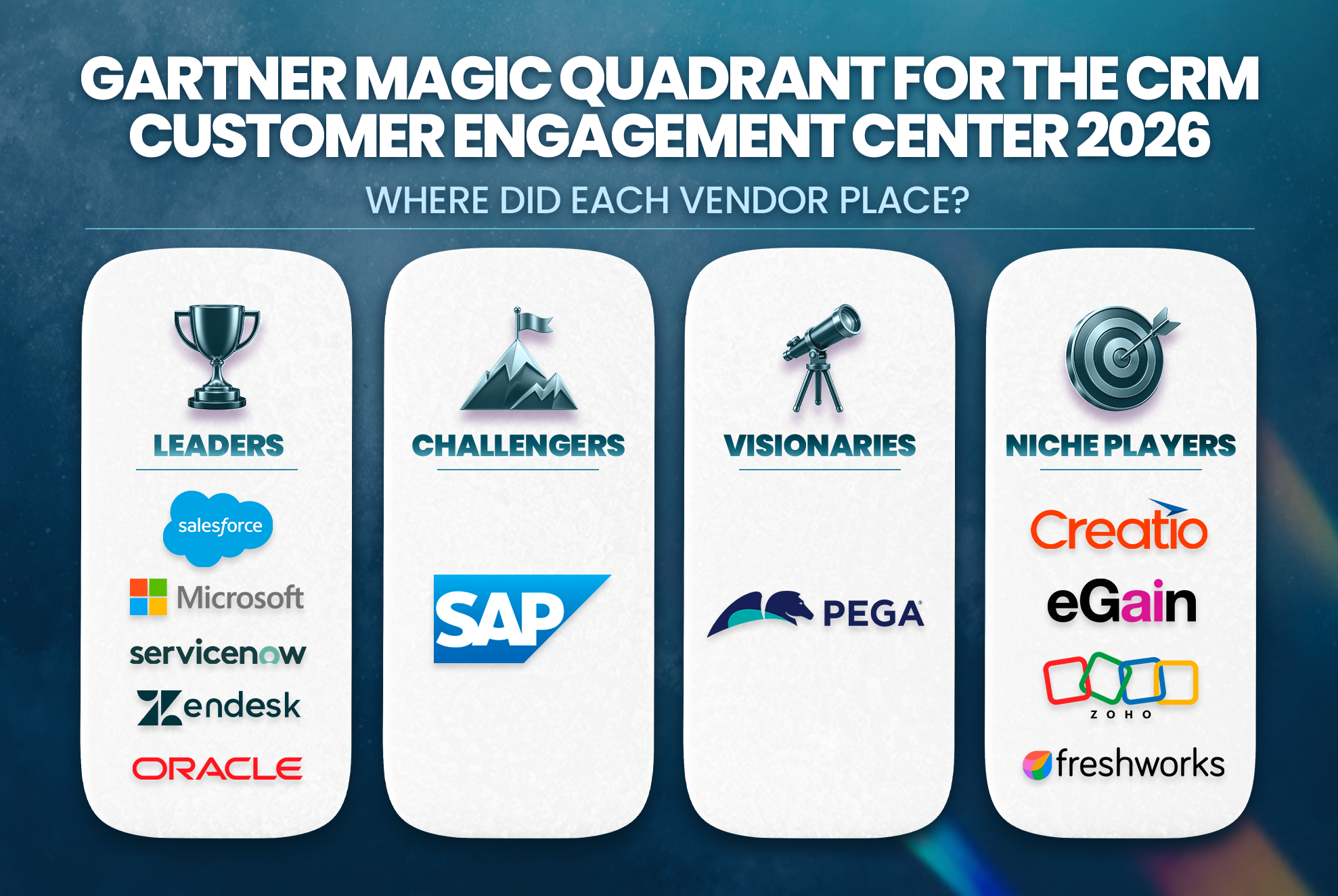
Gartner named Salesforce, Microsoft, ServiceNow, Zendesk, and Oracle as its 2026 market leaders in CRM CEC.
Salesforce earned plaudits for how its Service Cloud solution integrates data, workflows, and AI agents within a “unified multi-tenant architecture.” Its “global partner strategy” and “industry strategy” also impressed.
Microsoft received praise for how its Dynamics 365 Customer Service offering fits into its broader portfolio, including Azure, Power, and Teams, which can be beneficial for the many organizations that are essentially Microsoft shops. Its “global execution capacity” and “innovation capacity” are further strengths.
ServiceNow’s secret sauce is how it connects into back-end systems. This enables a more data-rich, action-oriented CRM experience. Gartner recognized this alongside its “complex case orchestration” and “enterprise operating capacity” strengths.
Zendesk wins Gartner’s approval for its “AI transformation story,” which combines customer-facing AI agents, contact center workforce management (WFM), quality assurance (QA), copilots, and more on one platform geared toward resolution. The vendor’s “unified service engagement” and “market execution” strengths also draw commendation.
Finally, Oracle gains kudos for delivering its CRM on one unified platform with its ERP solution and other enterprise applications. That helps brands consolidate experience and operational data, while it has preconfigured AI agents that run workflows between these solutions. Gartner also commends Oracle for its “partner ecosystem” and cloud deployment options.
Alongside its leaders, Gartner evaluated five other vendors and grouped them into three additional categories, as the image below illustrates.
7 Top Takeaways from the Gartner Magic Quadrant for the CRM Customer Engagement Center 2026
A quick scan of the Gartner Magic Quadrant report won’t raise any eyebrows.
Not only are all the vendors unchanged from the 2025 edition, but they also remain in exactly the same categories. Even its definition for the CRM CEC is a straight copy-and-paste.
However, dig into the vendor profiles and statistics Gartner provides, and several significant trends about where this market is moving rise to the fore.
The seven top takeaways below get to the heart of the trends.
1. CRM Growth Is Set to Accelerate, But the Space Is Competitive
Gartner forecasts that end-user spending across the global CRM customer service and support software market will accelerate from $57.2 billion in 2026 to $84.2 billion by 2029.
ServiceNow appears well set to drive this forward. In 2025, it led the space in its revenue growth, which jumped 29.3% year-over-year (YoY). Zoho and Microsoft also impressed with 22.6% and 20.2% growth, respectively.
However, according to Gartner’s Market Share Analysis: CRM Customer Service and Support, Worldwide, 2025, Salesforce still leads in overall market share, ahead of Oracle.
Nevertheless, the market remains fragmented. Combine the earnings of the market’s ten leading providers, and they only account for 50.8% of overall revenue.
Ultimately, that highlights how competitive this space is and how providers beyond those included in the Magic Quadrant can win significant market share, so long as they have compelling differentiation…
2. Gartner Spotlights Four Areas of Differentiation Between Providers
In its Market Overview, Gartner isolated four key areas of differentiation among CRM CEC vendors. These are:
- "Comprehensive customer platform": Salesforce is perhaps the best example here, expanding into Contact Center as a Service (CCaaS) and Workforce Engagement Management (WEM) in 2026. Meanwhile, it continues to extend its portfolio through acquisitions, making 11 this calendar year alone. The most relevant for customer service include its rollups of conversational AI giant Fin AI and conversational intelligence stalwart Cresta, while Salesforce also expands its sales and marketing CRM solutions through M&A.
- "Workflow- and decisioning-oriented platforms": ServiceNow and Pegasystems stand out here with a focus on coordinating processes between humans and AI, departments, and systems, from their CRM solutions across other enterprise systems, whether first- or third-party. They offer a stark departure from traditional, ticket-oriented models.
- "Enterprise operational backbones": Think of Oracle and SAP. They win business by tying their CRM and ERP solutions, bringing experience and operational applications and data together. That architecture can enable a more data-rich CRM experience while supporting AI agents that automate workflows across these applications, with less tricky integration work required.
- "Service- or knowledge-centered platforms": Zendesk differentiates here. It aims to become the center point for all service activity, with a mature, phased approach to helping teams layer in AI, which Gartner commends. Similarly, this is eGain’s core differentiation. However, it focuses more on the knowledge side and is best known for its knowledge management system, not its CRM.
CRM CEC buyers may consider these four areas of differentiation as they think through which solution best fits their operating model and enterprise architecture.
Yet, overall, much of the latest innovation across the space follows a standard trajectory, taking CRM CEC systems away from managing tickets and toward “resolution orchestration,” as Gartner terms it.
3. Specialization vs. Breadth Becomes a Key Trade-Off
Gartner’s analysis shows that almost every vendor has a caution that is essentially the flipside of one of its core strengths.
Take platform-centric players like Microsoft, Oracle, Salesforce, SAP, and ServiceNow. They receive credit for how they take context from their wider suite. But that advantage shrinks or disappears outside their broader install base.
Maybe the clearest examples are Oracle and SAP. Their ERP backbone is what drives differentiation as they can unify customer context and action it across their wider platform.
Gartner sees this as a strength, but then warns buyers that both providers prioritize their broader install base over customers purchasing their CRM solutions as standalone products.
However, one is impossible without the other, as the vendors trade breadth for specialization.
The trade-off extends to specific industries.
For instance, Pegasystems has found success in targeting highly-regulated industries while ServiceNow is winning business in asset- and fulfillment-heavy industries. Yet, wary of being pigeon-holed, both still focus most of their marketing efforts on a more generalist audience.
Some have gone all-in on specific industries, like SugarAI in manufacturing. While that offers differentiation, it misses out on broader industry coverage and placements in influential reports like the Magic Quadrant. As such, it’s a fine balance.
4. Complex Pricing and Packaging Becomes a Big Buyer Concern
By 2029, Gartner predicts that almost 10% of CRM spending will be dedicated to “agentic AI- and GenAI-enabled platforms”.
As AI accounts for more spending, CRM providers are layering new consumption- and outcome-based pricing models over traditional licenses.
That has added a degree of unpredictability to end-user costs, with Gartner citing “production economics” as an ongoing challenge.
Meanwhile, it dings several vendors for their pricing and packaging, including market leaders.
Criticisms include Salesforce and Microsoft requiring customers to coordinate multiple pieces of their AI architecture, ServiceNow’s rising costs as deployments scale, and Pegasystems failing to publish standardized pricing.
Conversely, Gartner’s Niche Players flip this into a strength, with Freshworks earning plaudits for its lower operating complexity and Creatio for its licensing flexibility.
Interestingly, this could highlight how smaller, specialist vendors see simplified economics as a deal winner, instead of going pound-for-pound on the latest AI innovations.
5. CRM Expands Into New Remits of Customer Experience Software
The “CEC” category of CRM is increasingly expanding into new areas. Gartner spotlights CCaaS, WEM, and enterprise workflow automation as key examples.
CCaaS is perhaps most noteworthy. Since 2024, Microsoft, Salesforce, and Zendesk have entered the market after partnering with CCaaS providers on joint go-to-market strategies over many years.
The promise is one primary interface for customer service, with consolidated data and streamlined vendor management.
However, ServiceNow has taken a different approach. Rather than moving in this direction, it has deepened its ties with major CCaaS providers, strengthening partnerships with the likes of NiCE and Genesys over the past 18 months.
Ultimately, that may have opened up the channel and strengthened its revenue growth. After all, it led the market on this metric in 2025.
Nevertheless, Gartner cautioned that a lack of “advanced voice and telephony can require third-party contact center integrations.” That note suggests that pushing into CCaaS is now becoming an expectation, not an exception.
6. Approaches to AI Agents Pivot Across the Space
In early 2025, agent builders were all the rage, with CRM providers promising to help customers automate bespoke workflows using AI agents.
However, since then, the narrative has shifted toward embedding pre-configured agents directly into CRM environments that take on more generalized tasks.
The swing reflects growing recognition that enterprises need more than tools to build enterprise-grade agents themselves. They also need support in ensuring agents can access reliable data, follow business rules, and deliver tangible value.
However, the vision for AI agents running end-to-end CRM workflows hasn’t changed. The approach is just maturing.
Gartner’s analysis shows that vendors are developing innovations to preserve customer context, manage agent-to-agent communication, and ensure appropriate testing and observability.
On the last point, the research firm also stresses how they must now interoperate with broader governance systems to ensure auditability and financial controls.
7. The CRM UI Is Starting to Evolve
Conventionally, CRM buyers purchased a UI with capabilities and data spread across different tabs, profiles, and fields. That’s where most organizations still are today.
However, Gartner notes that: “Vendors are exposing CRM objects, workflows and actions through APIs, MCP servers, and agent-to-agent interfaces.”
Why does this matter? Because it allows brands to bring their own UI to the CRM platform.
Salesforce kickstarted this trend with its Headless 360 launch in April 2026.
At Dreamforce 2026, it went further with Claudeforce and Slackforce, enabling users to pull context from its CRM and take actions across it via natural language commands to Claude and Slackbot, respectively. AIforce also helps embed Salesforce CRM within other natural language interfaces across the business.
Zendesk and Microsoft have also followed a similar path, with the former launching Zendesk Bridge as part of its new Outcome AI Platform.
Microsoft’s grand ambition is a little different. It aims to funnel enterprise context, including CRM context, into Microsoft IQ and allow employees to interact with it via Copilot.
Nevertheless, the overarching trend is that organizations can now access their CRM in a new way, which may help service teams switch between fewer applications as they complete customer service work.
That’s it for the top takeaways from this report. But Gartner also released its 2026 CCaaS Magic Quadrant last month. Get the rundown here.