April 16, 2026 • 5 min read
Salesforce TDX 2026: 5 Major Announcements

Director of Content & Market Research
April 16, 2026
Salesforce TDX is the tech giant’s annual developer conference.
The event brings together people building on Salesforce, showcasing the company’s latest innovations, tools, and capabilities.
“There has never been a more important time for this conference,” said Patrick Stokes, President & CMO of Salesforce, opening up TDX 2026.
“The way we build software 18 months ago is different from 12 months ago, different from six months ago, and even different from yesterday. It is changing that quickly.”

As this suggests, Salesforce had several major announcements to share at TDX 2026. Here are the five biggest headlines.
1. Salesforce Debuts Headless 360
Salesforce Headless 360 is the standout announcement from TDX 2026.
Essentially, it separates Salesforce’s capabilities from its traditional user interface, enabling programmatic access via APIs, MCP tools, and CLI commands.
This means IT teams are no longer tied to Salesforce’s default UI. Instead, they - and their coding agents - can call what they need from across the Salesforce ecosystem, when they need it.
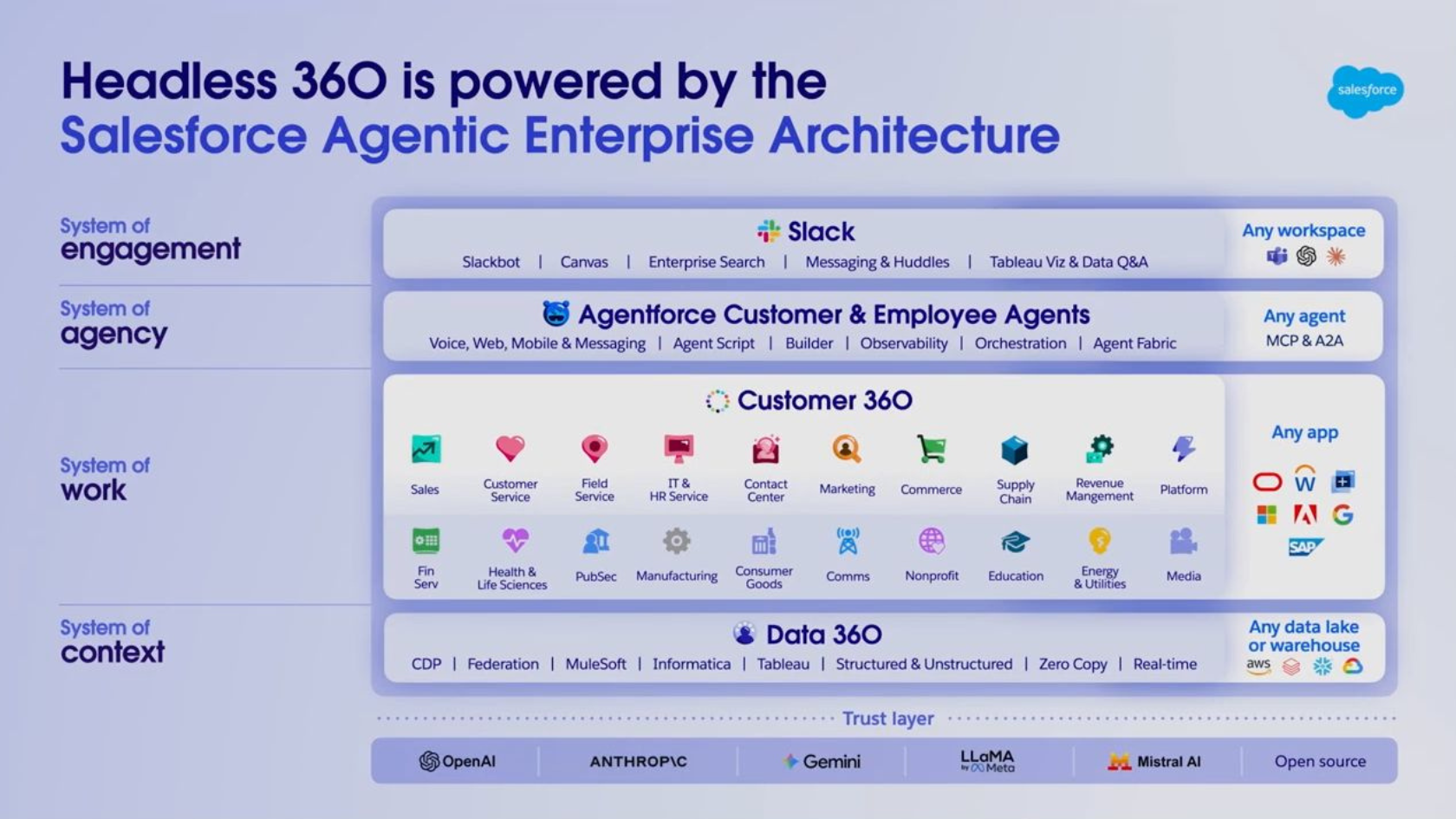
As such, developers may build custom frontends on top of Salesforce data. They can also create coordinated systems of agents that complete tasks across Salesforce and external systems.
Overall, Headless 360 transforms Salesforce into a more flexible and composable platform that teams can integrate into their own applications and processes.
2. Salesforce Introduces an Agentforce Experience Layer
There is a risk with Headless 360 that if Salesforce is made accessible through any interface, organizations end up building 50 different versions of the same experience.
That’s where the Agentforce Experience Layer comes in.
It allows businesses to define an experience once and have it rendered consistently across websites, mobile apps, Slack, AI assistants, and other surfaces.
So, instead of building separate experiences for every surface, developers define the schema, layout, and actions once, and the system generates and adapts it for each environment. This avoids duplication of effort and ensures consistency.
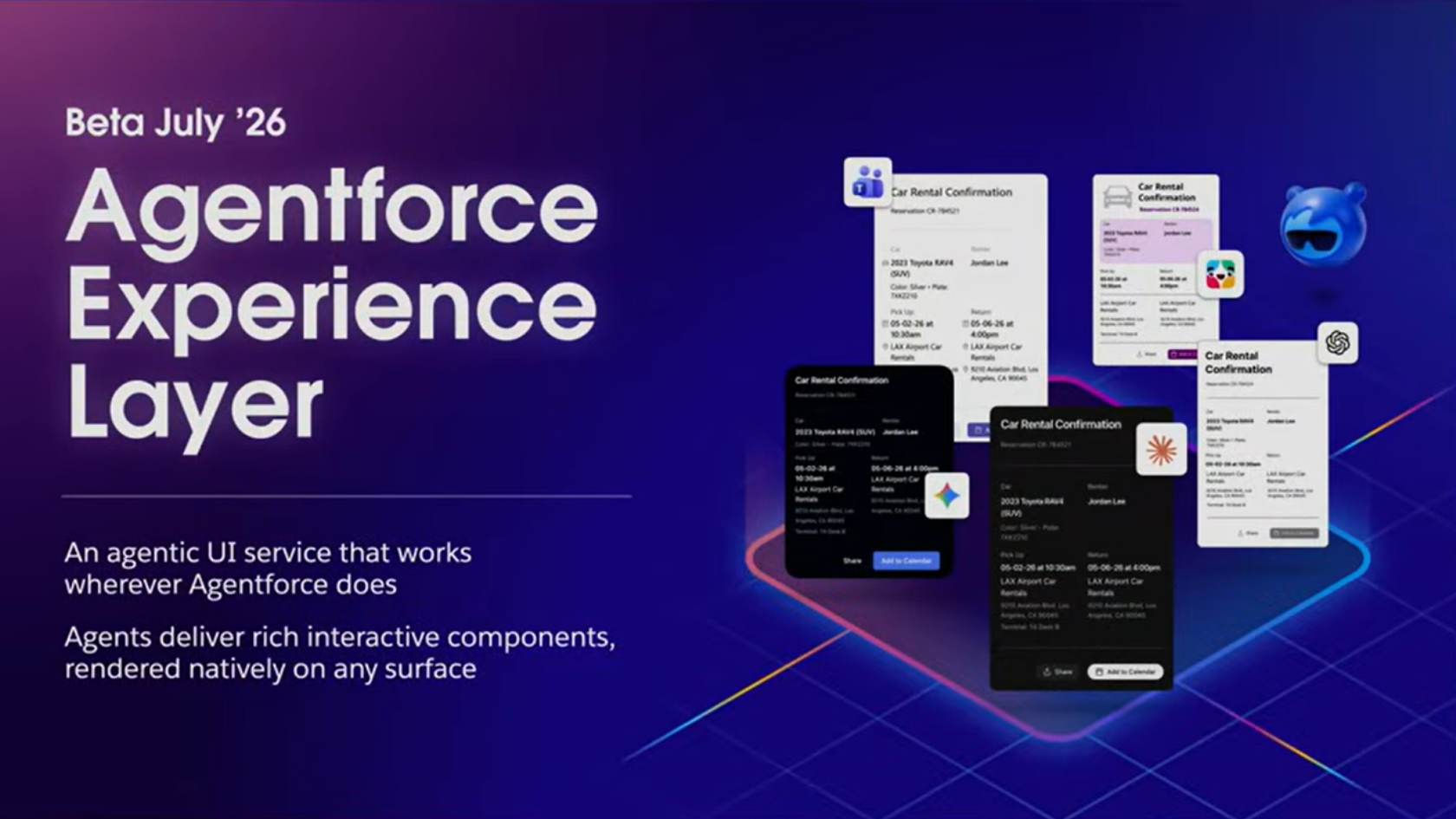
Think of it this way: the Agentforce Experience Layer sits between what the agent decides (logic and response) and what the user sees (UI and interaction). It translates agent output into consistent experiences across all surfaces.
At the event, Salesforce showcased a demo of how Engine delivered a consistent customer self-service experience across its website, mobile app, Slack, and even ChatGPT through the Agentforce Experience Layer.
3. Agent Fabric Gets a Glow Up
Salesforce launched Agent Fabric in September 2025 as an orchestration, observability, and governance layer for managing multi-vendor AI agent deployments.
The platform chiefly addresses ‘agent sprawl’, where AI agents operate across the enterprise without clear oversight or coordination.
At TDX 2026, Salesforce expanded Agent Fabric with several new capabilities.
First, brands may now leverage Agent Scanners to automate agent discovery across MCP servers and platforms such as Amazon Bedrock and Azure AI Foundry, making it easier to identify, register, and secure agents.
A new Visual Authoring Canvas also enables teams to map agent workflows and human checkpoints through a drag-and-drop interface, while an MCP Bridge makes existing APIs ‘agent-ready’ without requiring code changes.
Another key addition is Agent Script for Agent Broker, which allows organizations to define handoff rules between agents, helping balance deterministic and probabilistic workflows.
Finally, new governance capabilities in AI Gateway provide centralized oversight over token usage, permissions, and approval controls.
Together, these updates strengthen Agent Fabric’s role in reducing agent sprawl. Yet, they also reinforce Agentforce as an enterprise’s central platform for AI agent management and, crucially, development.
4. Salesforce Relaunches Its AgentExchange
Alongside Headless 360, Salesforce celebrated the (re)launch of AgentExchange.
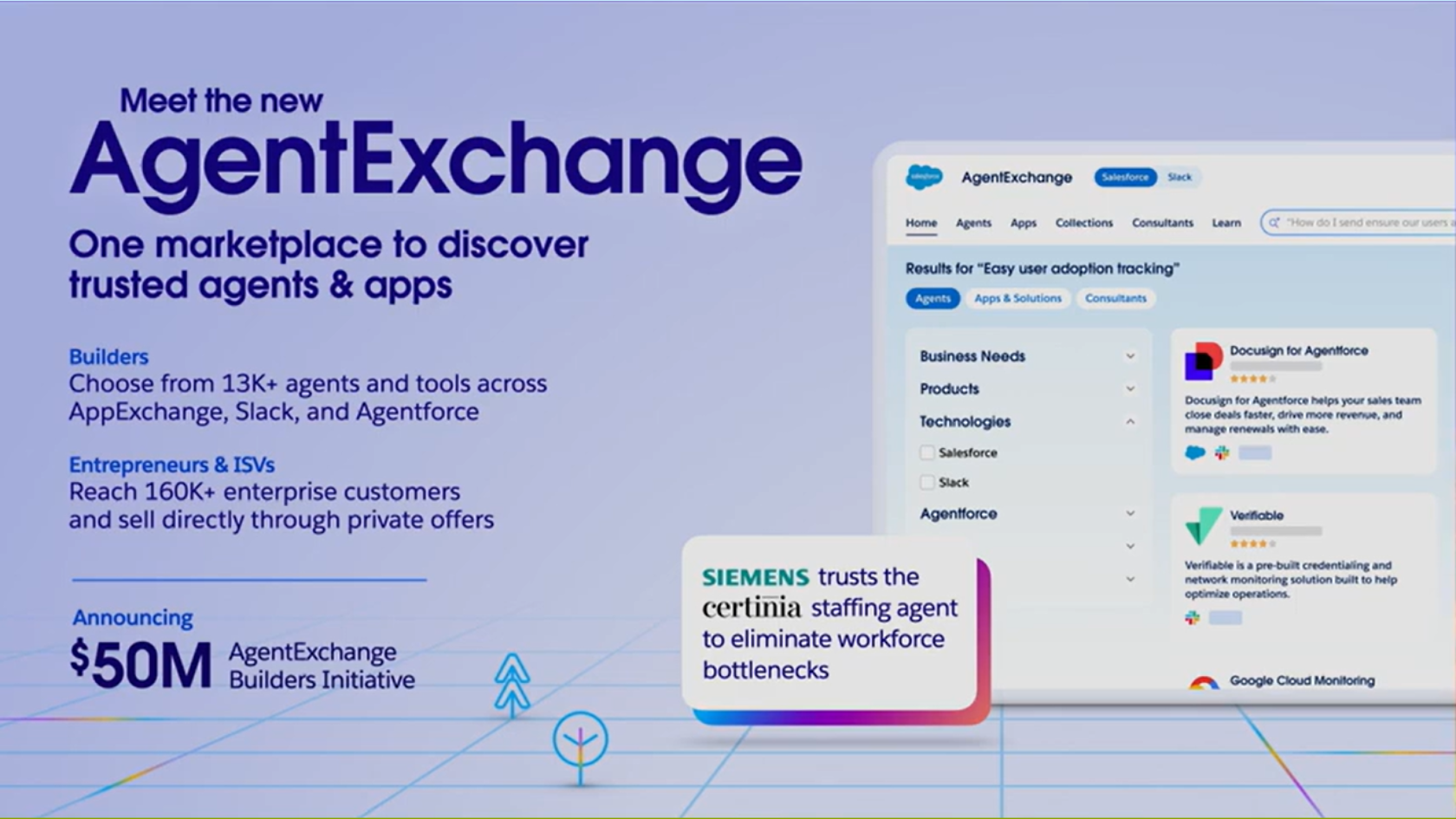
First introduced at TDX 2025, it offers a place for businesses to scout, purchase, and activate AI agents. It also includes skills and modular components to build custom agents and coordinated agent systems.
Yet, it now also comprises Salesforce AppExchange, Slack Marketplace, and the Agentforce ecosystem, establishing one all-encompassing marketplace.
Salesforce is incentivizing builders to contribute to and monetize their work in the new-look marketplace with a new $50 million fund.
5. More New Capabilities Come to Slack...
With Headless 360, Salesforce is making its platform capabilities and data accessible across any interface. However, the company expects many employees to adopt Slackbot as the primary UI for completing tasks across its ecosystem.
Salesforce reinforced this vision with the launch of Slack for Salesforce and Agentforce last month, positioning the collaboration platform as the operational center point for both human and AI work.
At TDX, the company extended this strategy with a new Slackbot MCP Client, enabling organizations to orchestrate workflows beyond Salesforce and trigger them through prompts to Slackbot.
As a result, employees can complete tasks in business applications beyond the Salesforce ecosystem without leaving Slack.
While making MCP work seamlessly and securely across enterprise environments remains challenging, the vision is compelling.
Salesforce also introduced a new developer toolkit to build and deploy agents directly in Slack or import them from platforms like Lovable and Vercel in just a few clicks.
Finally, it has unified its agent browser within Slack, giving users visibility into available agents, and introduced a Block Kit, empowering AI agents to deliver structured responses, such as tables and charts, rather than plain text.
Alongside Slack for Salesforce and Agentforce, Salesforce also announced Slack CRM last month. Catch up on that announcement here.