
November 26, 2026 • 45 min read
16 Conversational AI Solutions for Healthcare & How They Differentiate

Director of Content & Market Research
November 26, 2026
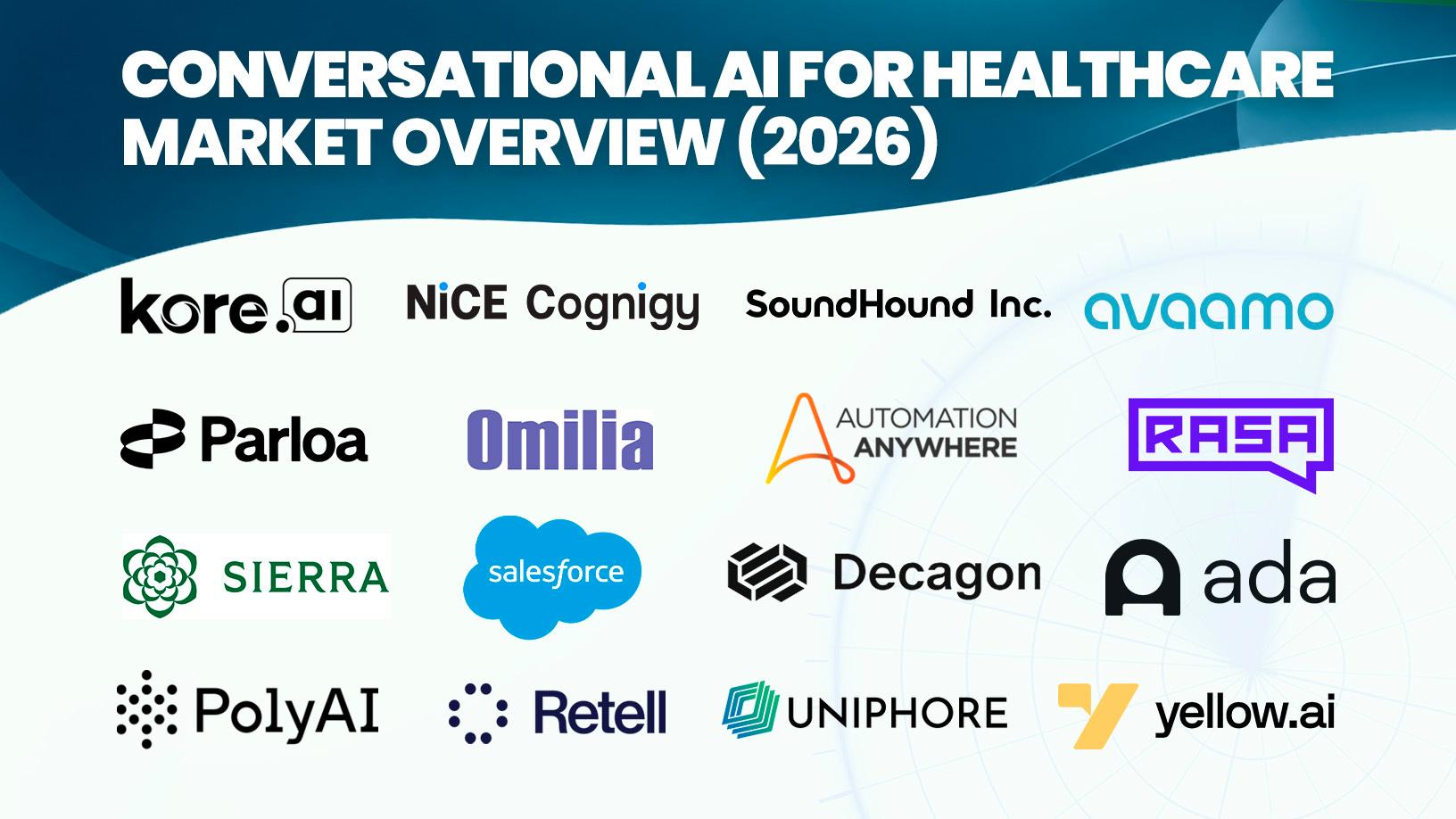
On the surface, many conversational AI solutions appear very similar.
They promise to move beyond answering questions to taking actions, connecting with systems of record, and automating an ever-growing range of employee and customer interactions.
However, look beneath the surface, and a wave of innovation is beginning to reshape the market
For starters, new approaches are emerging to how enterprises build AI agents, how those agents learn and improve over time, and how they collaborate with human employees.
With so much changing so quickly, it can be difficult to separate genuine differentiation from noise.
Given this, the following market overview aims to bring clarity by examining the most significant sources of differentiation through the lens of a healthcare buyer.
The Types of Healthcare Buyers
There are three primary types of healthcare organizations, each leveraging conversational AI solutions to address different challenges.
1. Healthcare Providers
Healthcare providers run hospitals, clinics, and physician groups and deliver care directly to patients.
These healthcare organizations will document care in an Electronic Health Record (EHR), such as Epic, Oracle Cerner, NextGen, and Athenahealth.
Typically, that then becomes their primary technology investment.
The primary objectives for health systems and providers are to get patients in the door and to get paid on time for the services they deliver, with fewer denials.
What Does a Healthcare Provider Typically Look for in a Conversational AI Solution?
Healthcare providers primarily focus on relieving overwhelmed phone lines, supporting many languages, and automating repetitive work like booking appointments, sharing lab results, running eligibility checks, and so forth.
They also want to streamline revenue cycle tasks, like payer communication and balance collection, again with the aim of freeing up staff.
2. Healthcare Payers
Payers include insurance companies and government programs that pay for care and collect premiums.
For example, in the U.S., healthcare is funded through three main types of payers: the federal government (Medicare), state governments (Medicaid), and private commercial health plans, which are often employer-sponsored.
Citizens must choose plan types every year, such as Healthcare Maintenance Organization (HMO) and preferred provider organization (PPO).
What Does a Healthcare Payer Typically Look for in a Conversational AI Solution?
Like healthcare providers, payers want to lower contact volumes and clarify confusing plan choices, in the member’s language, with referencable answers.
However, there is also a greater focus on experience, rather than efficiency. Payers need to raise member satisfaction scores tied to payments, protect retention, and steer members toward cost-efficient care sites.
3. Life Sciences
Life sciences companies develop and sell drugs and therapies to healthcare providers, businesses, and sometimes directly to consumers.
Notably, this includes pharmaceutical manufacturers, biopharmaceutical manufacturers, biopharma companies, and therapeutics firms such as Eli Lilly, Johnson and Johnson, and Pfizer.
Within this segment, needs differ by subtype and who they’re communicating with.
What Does a Life Sciences Company Typically Look for in a Conversational AI Solution?
Life sciences businesses often want conversational AI solutions that give newly diagnosed patients fast guidance on costly therapies and financial assistance, while helping medical affairs teams answer physician questions on side effects and usage.
They also want smoother recruitment and retention processes, plus frictionless event reporting to surface patterns, such as problem batches, quickly.
Key Points of Comparison in Conversational AI Solutions for Healthcare
As noted, there are different types of healthcare companies, each with its own priorities.
Moreover, some organizations will want to build, some will want to buy, and others will go for a hybrid, buy-then-build approach.
Given this, the key points of comparison will vary from one organization to another.
That said, there are seven key points of comparison where vendors can vary significantly, which conversational AI buyers in this sector should watch out for. Here are seven key examples:
- Compatibility with their EHR System. Healthcare buyers want to know how a solution works with their EHR, whether that’s Epic, Oracle, or another prominent provider. These systems typically represent their primary tech investment. As such, providers need strong integrations with these systems.
- Legacy integrations and orchestration. Given the tight security and compliance measures, healthcare systems providers have proven slower to move away from on-premise systems. For example, many still run their contact centers on legacy Avaya, Cisco, and Genesys solutions. Conversational AI providers must be able to connect into the systems and orchestrate experiences across them.
- Deployment flexibility. Healthcare buyers are frequently turning to sovereign cloud deployments, wary of possible geopolitical or operational disruptions and changing regional regulations around data residency and compliance.
- Platform breadth. Healthcare providers often operate on narrow margins, and budgets are tight. Therefore, having one solution that stretches across multiple departments, use cases, and service desks is attractive.
- Inclusive and accessible AI. Language support is critical in healthcare, when timely AI intervention can literally be a matter of life and death. Also, multimodality and AI innovations, such as AI memory to pick up from a previous customer call, are key to ensuring brands meet the needs of vulnerable customers. That’s crucial for healthcare providers, but accessibility can also be a significant revenue generator for healthcare payers.
- Outbound as an efficiency generator. Healthcare providers recognize significant efficiency and revenue they can unlock with outbound automation. For instance, they may maximize the utilization of expensive equipment, such as MRI machines, by having AI manage cancellations and fill schedule gaps.
- Native analytics and reporting. When healthcare goes wrong, the ability to run analytics without porting into third-party tools is critical. It’s also becoming increasingly crucial with new consumption- and outcome-based pricing models to accurately track operational expenses, especially in a sector where margins are so fine.
16 Conversational AI Solutions for Healthcare
The following analysis details what sets 16 leading global providers of conversational AI solutions for healthcare apart. It considers each through the lens of what buyers from the sector typically prioritize.
1. Kore.ai
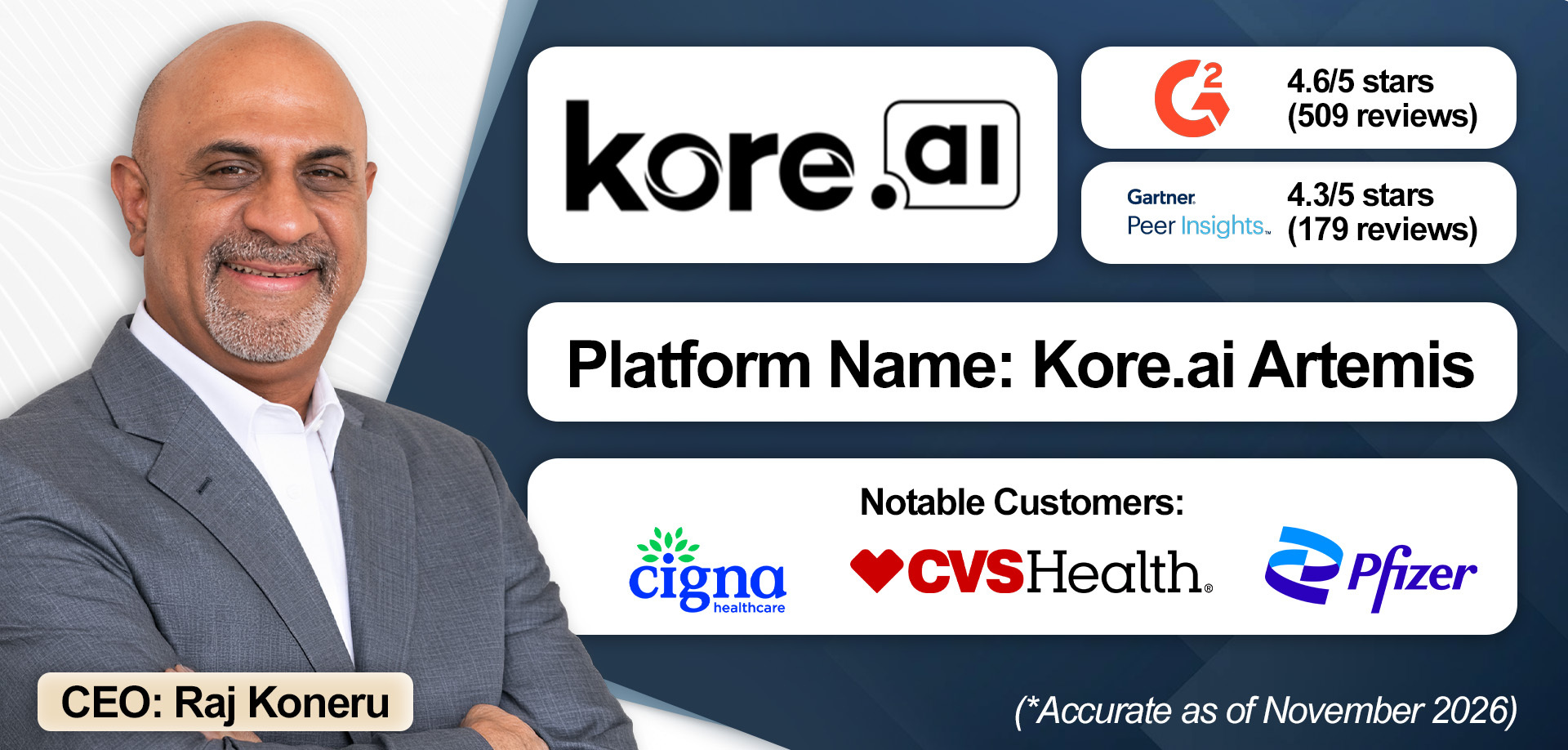
Kore.ai stands out for the breadth of its platform, offering preconfigured agents for each of the three healthcare payer types outlined above. These agents are tailored to different user groups, including patients, caregivers, clinicians, physicians, and employees.
Organizations can then deploy these agents across Kore.ai’s Artemis platform, which features an Autoloop “optimization engine” that pinpoints where a goal was missed across the execution flow and investigates why. It then adjusts the workflow where it broke down, either autonomously or with a human in the loop.
When the issue requires more than a workflow change, it’s flagged and queued for review. The IT team can then scope the issue and address it, whether that requires an API reconfiguration, permissions changes, or something else.
Kore.ai delivers Artemis across several sovereign cloud regions, alongside on-premise, public cloud, and private cloud deployments. The sovereign cloud enables the vendor to offer data residency by region, while it also delivers tenant isolation and real-time PII tokenization.
Meanwhile, Kore.ai is available across AWS, Google Cloud, and Microsoft Azure in cloud and hybrid set-ups, ensuring close fit with the existing enterprise ecosystem.
Its partnership with Microsoft is particularly notable. Indeed, Kore.ai agents are available via Copilot and across Microsoft Teams, which is particularly powerful for internal IT and HR service use cases. Why? Because employees don’t need to log into a separate portal to resolve their problems.
Finally, alongside these deployment options, Kore.ai offers sophisticated legacy system integrations and boasts many referenceable healthcare customers.
“The final thing that we differentiate on among any other vendor in the marketplace is Total Cost of Ownership (TCO). We’re built on this superior platform… It allows you to build an AI agent, monitor an AI agent, scale AI agents, as well as continuously improve.”

Standout Strengths
- Platform Breadth: Kore.ai’s platform comprises many preconfigured healthcare solutions, available on one experience layer across any channel. The solutions cover all three healthcare segments, with agents and skills covering everything from plan selection and caregiver consent to adverse event reporting and employee assistants.
- Optimization Engine: The platform’s Autoloop optimization engine evaluates live breakpoints, tunes automatically, and sends alerts with evidence to address gaps that require human intervention.
- Flexible Deployment Options: Kore.ai is available across all major hyperscaler clouds, with public, private, and sovereign cloud options, alongside on-premise deployments. The vendor also has Forward Deployed Engineers (FDEs) available to handle custom builds for buyers with limited engineering capacity.
How Much Does It Cost?
Kore.ai does not publish official pricing on its website. However, it’s known to offer consumption-based contracts and rely on custom quotes. Contact the Kore.ai team here to learn more.
2. NiCE Cognigy
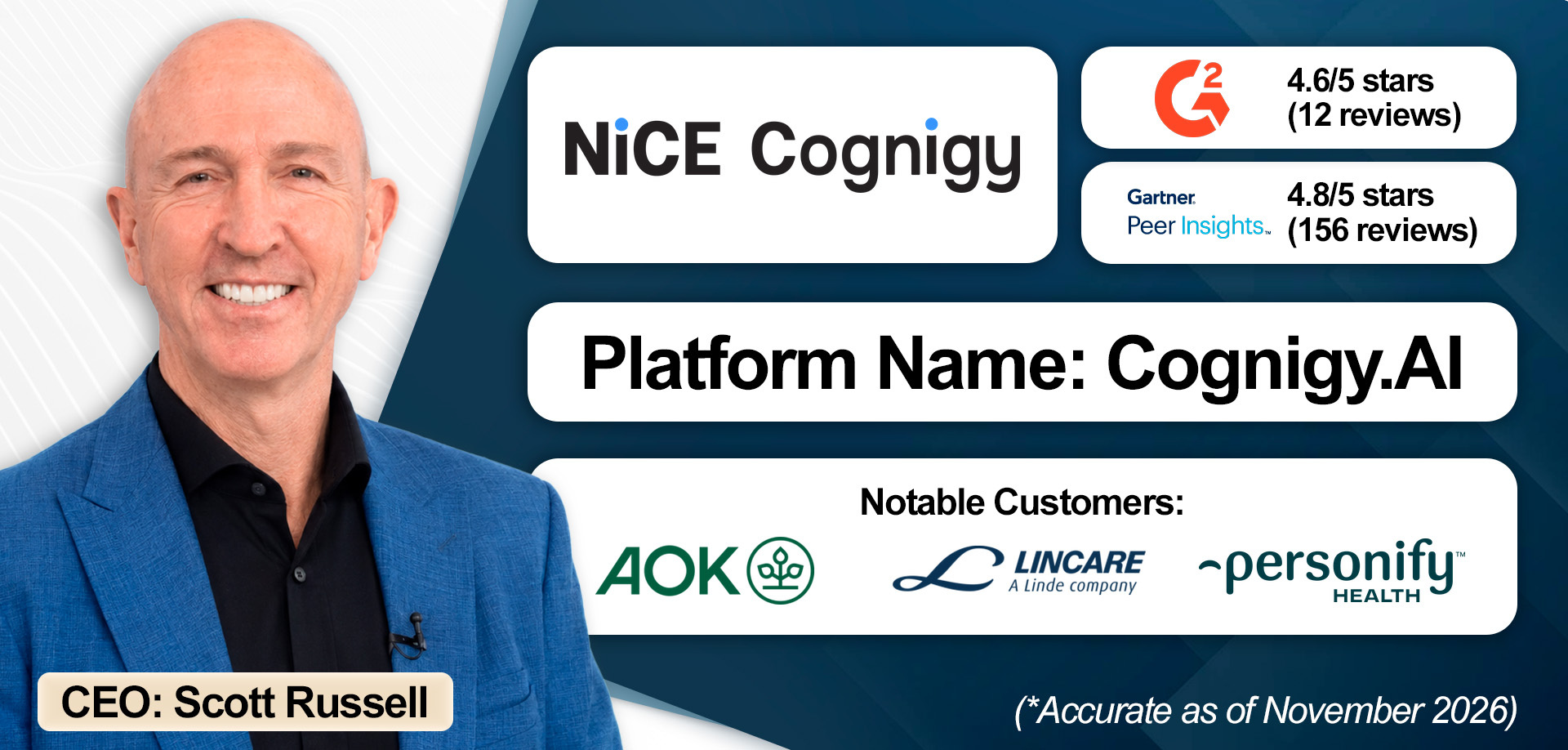
NiCE Cognigy stands out for making AI agents part of how agents get built, not just what customers interact with. Indeed, it has developed a plugin that lets IT teams configure agents by giving natural-language instructions to their coding agents. It also offers an Agent Assist solution lets them build agents in a similar way on-platform.
In effect, AI agents are configuring other AI agents. That puts NiCE Cognigy ahead of the market in embedding AI into the configuration and deployment experience, not only the product experience, accelerating time to value.
The vendor is also a leader in multimodal voice experience. For example, it can connect a digital UI with a voice agent, so that as a customer speaks, the UI adapts in real time, displaying answers, presenting rich media, triggering actions, and so forth. This opens the door to new online self-service experiences that guide patients struggling to complete tasks digitally. With many vulnerable customers in healthcare, that’s a powerful capability.
Language support strengthens this further. NiCE Cognigy supports over 100 languages, including mixed-language speech such as Hinglish (a blend of Hindi and English).
Like Kore.ai, NiCE Cognigy is notable for its relationship with Microsoft. Perhaps most significantly, organizations can use its Microsoft Teams integration to orchestrate resolutions in which the AI agent consults a human colleague in the back office for guidance while staying in conversation with the customer. That flexibility is helpful in healthcare, where a human must keep authority over high-risk decisions.
Also, of all the listed vendors, NiCE Cognigy is also the only one certified on Microsoft’s Teams Unify model for voice agents. This allows providers to embed NiCE Cognigy as an AI receptionist natively into Teams, an offering that may resonate with smaller healthcare providers with limited requirements that are consolidating around Teams.
Finally, NiCE Cognigy is natively available to NiCE CXone contact centers. Mutual customers can access advanced tools such as auto-generated agents, built from contact center analytics and accompanied by ROI projections. A single, unified Workforce Engagement Management (WEM) suite also lets teams manage human and AI agents together.
Standout Strengths
- Multimodal AI: NiCE Cognigy has led on multimodal CX since its 2023 xApps launch. It has since expanded its efforts by synchronizing the digital UI with a voice agent, helping guide patients through digital tasks and making online customer support more accessible.
- Agent-to-Agent Configuration: Organizations can configure AI agents on Congigy through natural-language instructions to their coding agents, like Claude Code, Codex, or Cursor. They can also use an on-platform AI assistant to accelerate deployments.
- Microsoft Teams Integration: NiCE Cognigy agents can consult human expertise by connecting with subject matter experts (SMEs) across the organization on Microsoft Teams, while continuing to lead the customer conversation. This ensures humans maintain authority over high-risk healthcare decisions. At the same time, the organization avoids a full escalation.
How Much Does It Cost?
NiCE Cognigy combines custom quotes with consumption-based billing, charging by voice minutes and digital channel messages. See NiCE Cognigy’s pricing documentation for additional information.
3. SoundHound
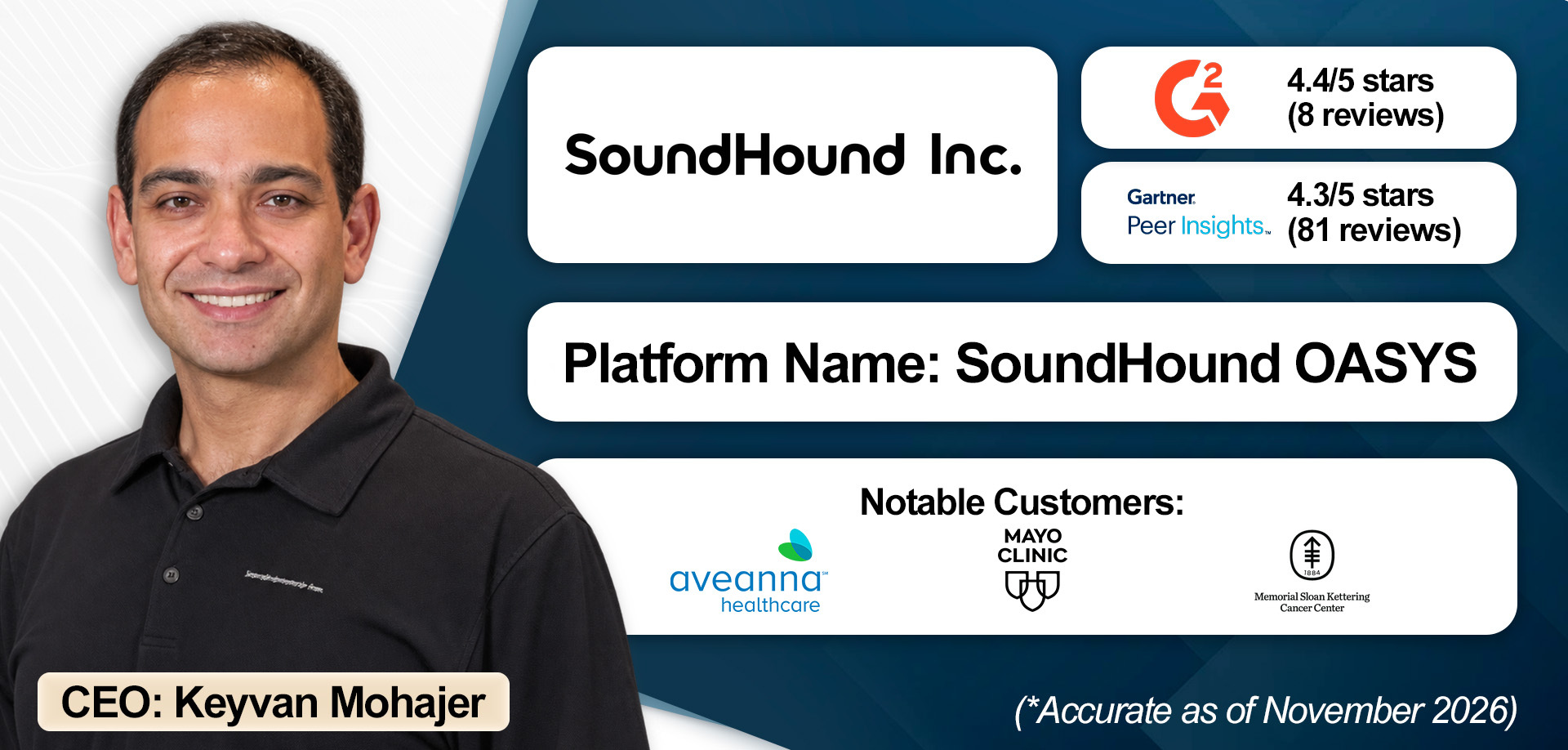
SoundHound is highly regarded for its proprietary voice engine. Rather than relying on hyperscalers, it fine-tunes its voice models in-house for different industries, tailoring them to the specific accents and dialects an organization is likely to encounter.
The platform also supports seamless switching between 100+ languages as patients speak, while delivering noticeably low latency by beginning to process speech before the patient has finished speaking.
Nevertheless, while voice is a key strength, SoundHound is notorious for multimodal AI, with one AI agent working across voice, live chat, and SMS and able to pivot the conversation across channels as part of one workflow. The vendor also provides a voice-native interface for digital AI agents and a Vision AI module that allows agents to interpret visual cues in sync with speech.
These use cases highlight the breadth of SoundHound’s platform, which also extends to preconfigured healthcare agents spanning multiple departments and functions, including patient access, care management, and prescription refills.
Alongside pre-configured agents and integrations, SoundHound provides an Epic starter kit to accelerate time to value for healthcare providers leveraging the EHR.
Finally, SoundHound Human Assisted Resolution (HAR) allows AI agents to hand tasks to humans within a workflow. The human can then complete their task behind the scenes before handing back to the AI to wrap up.
Fundamentally, this helps reimagine human-AI collaboration. It also saves humans time, allows organizations to automate more work, and sidesteps a direct human conversation. That can be particularly beneficial in vulnerable situations where a patient is likely to prefer chatting with an AI agent.
“[Our delivery team] is not just a bunch of generalists that understand technology. These are actual healthcare people that are implementing this and speaking with their peers.”

Standout Strengths
- Proprietary Voice Engine: SoundHound built its voice engine in-house and can tune it directly to meet specific requirements. Its streaming model also starts processing before the speaker finishes for low latency, while still converting speech to text for a full audit trail.
- Platform Breadth: The provider’s portfolio comprises many rare capabilities, from a voice AI interface for digital agents to visual AI. That enables SoundHound to meet a breadth of use cases, while also offering many pre-configured agents designed not just for the front desk but for the most expansive healthcare organization.
- Human Assisted Resolution (HAR): Instead of handing off the whole conversation, the AI agent offloads specific tasks to a human via a digital message while staying with the patient. The human then completes the task and hands back to the AI to conclude the conversation. That’s a uniquely powerful capability.
How Much Does It Cost?
SoundHound doesn’t provide public pricing information. Instead, it requires a sales consultation to scope usage, integrations, optimization, and other specifications before delivering a custom quote. Contact SoundHound to learn more here.
4. Avaamo
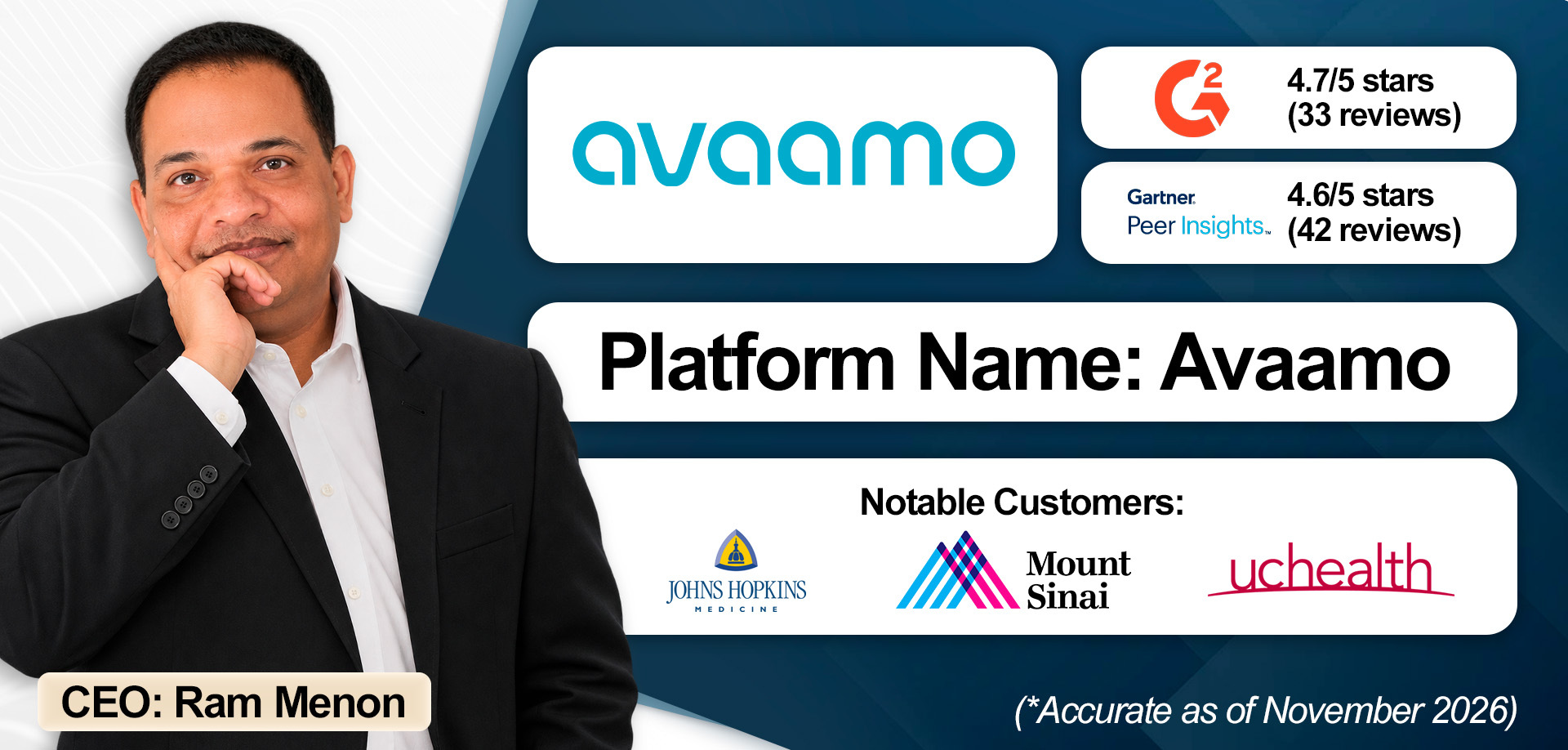
Outside healthcare, Avaamo is one of the lesser-known providers on this list. However, within the vertical, it is one of the biggest, claiming to work with seven of the top ten U.S. healthcare providers and “the top two” payers.
Avaamo credits its voice technology. For starters, it owns its Automatic Speech Recognition (ASR) engine, trained on healthcare terminology and medications.
Based on the query's nature and expected complexity, the request then passes to one of a cohort of fine-tuned Small Language Models (SLMs) and LLMs. This model orchestration is especially valuable in healthcare, where contact reasons are generally more predictable.
From there, the request passes to a TTS model, with regional tuning. Avaamo’s FDE team can, for instance, tweak the model for New York hospitals, as customers in the state typically want a brisk tone and fewer apologies. The team also guides customers through state-level nuance. For example, parental access to a minor’s information differs in California. There, a 13-year-old can restrict what personal information their parents can see. Avaamo walks organizations through this.
Such support reduces the need for professional services add-ons and highlights another key differentiator: sector-specific expertise, with dedicated, specialist FDE guidance continuing beyond the initial implementation. These engineers also help with voice personas, barge-in rules, deliberate pauses, information capture, and more.
Avaamo also has a team of Epic specialists on hand who adapt APIs that weren’t designed for voice agents. They also support organizations still running older versions of the EHR, where even patient authentication alone can require several different APIs.
Ultimately, this reflects Avaamo’s strength in integrations. Another example is how it connects to older telephony systems still prevalent in healthcare, lacking SIP gateways, which many emerging players in the space still struggle to do.
“We have referencibility. Healthcare payers and providers where we have done this successfully and shown real value, not just in terms of containment but in providing value-added experience for patients.”

Standout Strengths
- Industry Specialism: Avaamo has fine-tuned its voice stack for healthcare, built deep Epic integrations backed by a team of EHR specialists, and compiled strong case studies that resonate in the sector’s close-knit community.
- Customer Experience: The provider assigns FDEs who are healthcare specialists, supporting customers with the deployment and ongoing optimization. Avaamo also has a team of Epic specialists and builds a Proof of Concept (PoC) against a company’s Epic staging instance before they commit.
- Legacy Integrations: Avaamo offers over 1,000 prebuilt integrations while specializing in connecting with legacy systems, including on-premise telephony. It can also adapt APIs in older Epic instances, which weren’t originally designed for voice agents.
How Much Does It Cost?
Avaamo charges per conversation, with pricing set per use case. Prospective buyers receive a quote after a consultation, with a POC and volume-based discounts available. Find out more and schedule a demo here.
5. Parloa
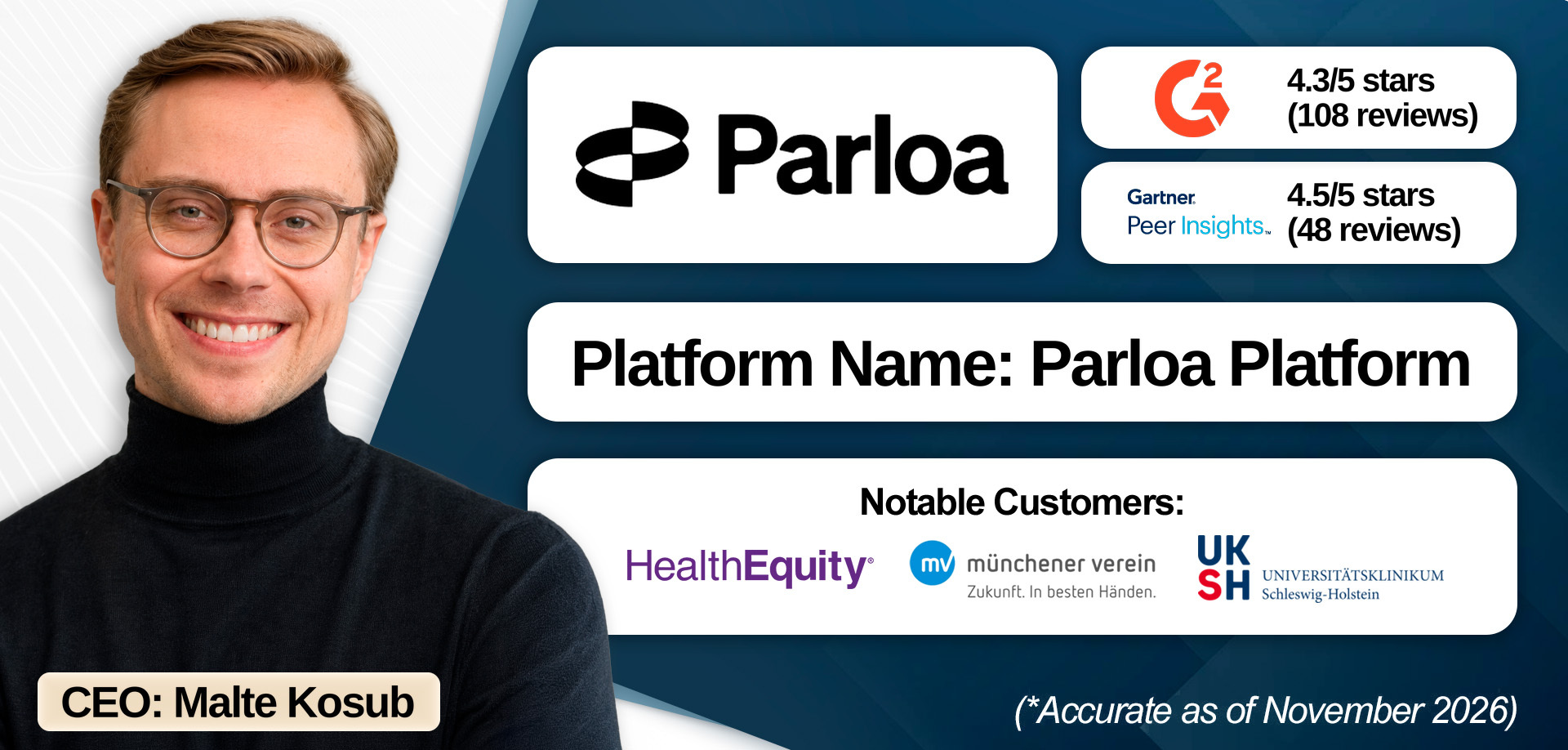
Parloa became a conversational AI stalwart by building its own global voice infrastructure, delivering low-latency voice performance. On that foundation, it established an internal language factory. Now, it can support 147 languages and regional dialect variations. In healthcare, where accessibility is crucial, that breadth matters.
Parloa Zones offers another architectural differentiator. It lets organizations set up dedicated environments where customer data and processing stay put. That helps companies keep data within the regions they operate in, a priority for many healthcare buyers.
Many competitors also make context a critical part of the infrastructure, with coordinated data platforms, as companies realize plugging into an EHR isn’t enough. Parloa’s Context Intelligence capability offers a simpler alternative.
It works with an agent building individual customer profiles by drawing on systems of record, conversational intelligence, and inferred intelligence (conclusions generated by the AI itself), with each data point assigned a confidence score. Parloa then uses that profile to inform later conversations, so its agents can access additional context to solve customer issues.
Another notable new capability is Parloa Lens, an observability and analytics solution. It investigates operational and experience data (including quality scores); tracks new metrics such as sentiment trajectory, frustration severity, and frustration root causes; and explores what drives those numbers.
With Parloa Navigator, the vendor then turns those insights into actions. The tool proposes diagnostic workflows across AI interactions, human interactions, and the handoffs between them. An admin can then run a proposed flow themselves or, for simpler workflow-level changes, accept or reject the proposal and let the system run it on their behalf.
Finally, Parloa’s partner model is a major driver of its success. An excellent example from October 2026 is SAP naming Parloa its exclusive “solution extension” for conversational AI management. That means Europe’s biggest software company now sells Parloa as part of its own solution, moving its agents closer to the operational data underpinning many patient experiences and making it a central part of SAP’s Autonomous Hospital vision.
“We built our multi-agent framework for ultra-low-latency voice conversations that can handle large, complex enterprise use cases, which is important for our customers.”

Standout Strengths
- Conversation Architecture: Parloa built a voice architecture for low-latency voice conversations, with an in-house “language factory” that fine-tunes languages for voice performance. Additionally, from an infrastructure perspective, Parloa Zones includes dedicated regional environments for data residency.
- Parloa Lens & Navigator: Lens investigates what sits behind performance and quality metrics, spotlighting inefficient processes. Using that intelligence, Navigator suggests diagnostic workflows and, in many cases, drafts simulations and evaluations to predict the impact of any workflow changes.
- Partner-Led Growth: From Accenture to Deloitte, Parloa works with some of the world’s biggest Systems Integrators (SIs). That has accelerated its growth alongside close partnerships with Microsoft, OpenAI, and SAP. The latter allows its agents to leverage operational data to transform patient experiences.
How Much Does It Cost?
Parloa charges per minute for voice and per conversation for chat, with rates scaling by use case complexity. These rates aren’t shared publicly. Instead, they’re built based on an audit of the organization’s operations. Discover more about Parloa’s pricing model here.
6. Omilia
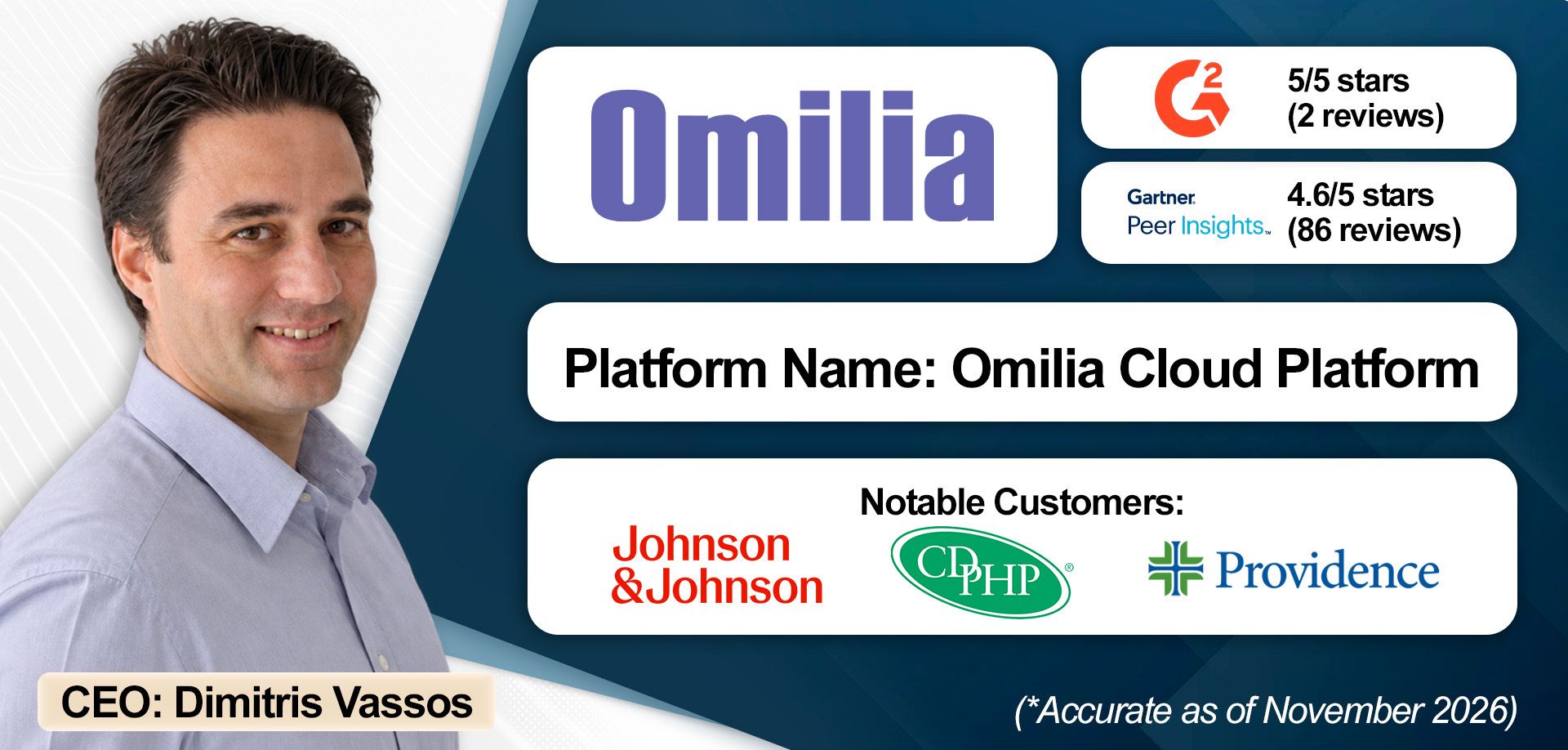
Omilia owns its entire conversational AI stack, from ASR and TTS to synthetic voices. By developing these capabilities in-house, it retains greater control over AI performance, governance, and costs.
On the latter, as it doesn’t pay third-party fees, Omilia can keep unit economics low. The vendor’s blended model architecture then reinforces those savings. Rather than routing everything through an LLM, it combines small, healthcare-specific models and its own larger models. This avoids the costs of LLM calls for every interaction.
Elsewhere, Omilia is developing journey-based agents and applications for healthcare. Take Percy, short for “persistence”, which manages prescriptions. It monitors when patients drop off their prescriptions and triggers a conversation to understand why and how to help.
Like Kore.ai, Omilia also has a mature approach to auto-optimizing agent deployments, spotting breakpoints, testing alternative paths, and proposing those to a human who can adapt the workflow. These small gains can compound across many journeys.
Its traditional strength in conversational intelligence also helps Omilia track emerging contact reasons, highlight automation opportunities, and deliver an ROI projection, so organizations can weigh the benefits of adding new use cases.
Finally, Omilia offers Agent Assist, so its AI doesn’t just escalate but stays with the human it handed over to, sharing additional context and supporting them in finding a resolution. Conversational intelligence can then monitor how the human resolved the query, informing the agent optimization process outlined previously.
“I call us the best-kept conversational AI secret in the world… We continually focus on markets that are highly regulated: healthcare, government, finance, insurance, and utilities. And we let that be our moat.”

Standout Strengths
- Low TCO: Omilia owns its full voice stack and blends small, vertical-specific models with homegrown medium and large ones, avoiding third-party fees and costly LLM calls on every interaction. It passes that cost efficiency to customers, lowering TCO.
- Domain-Specific Agents & Applications: The provider preconfigures journey-based agents and applications for healthcare, using small models tailored to specific processes. Because these models are designed to keep conversations within governance boundaries, Omilia can apply guardrails at the model layer itself.
- Self-Optimizing Agents: Omilia’s platform discovers emerging use cases, proposes improvements, and embeds them with human approval. By also providing Agent Assist, it monitors how humans solve problems to suggest AI improvements.
How Much Does It Cost?
While Omila prices its platform on resolved interactions, it doesn’t publicly list rates. Instead, it asks prospects to reach out and book a demo to learn more. Contact Omilia’s team here.
7. Automation Anywhere
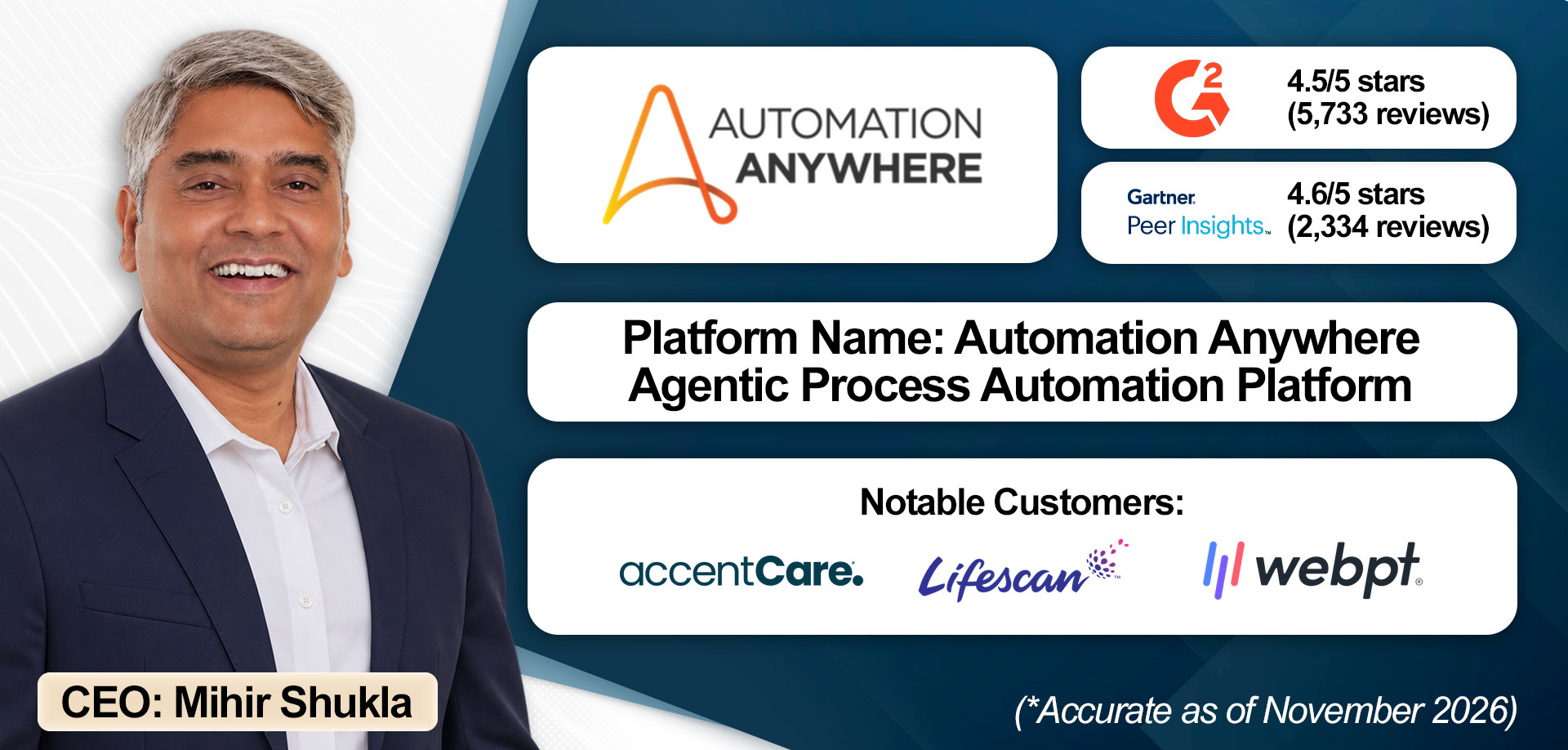
Automation Anywhere has acquired two conversational AI providers in little over a year: Aisera and Boost.ai, with the former focused primarily on employee service and the latter on customer service automation.
By connecting the strengths of both offerings with its existing portfolio, Automation Anywhere can effectively combine employee- and customer-facing AI with back-office process automation. That closes the gap between conversations and the work being done in the background.
That work is far-reaching, as Automation Anywhere can extend resolution workflows across the enterprise, with 40,000+ integrations into back-end systems and computer-interface technology to extend into legacy and homegrown systems that remain common in healthcare.
Focusing on its Aisera solution, specifically, as Boost.ai is only starting to be integrated, AI Lens is a standout capability. It helps IT gauge why an agent performed as it did by exposing LLM prompts, matched flows, knowledge search results, and model reasoning behind any request. It then runs analysis to help expose the failure point.
Additionally, the solution is built around a mature TRAPS (Trust, Responsible AI, Auditability, Privacy, and Security) framework to bolster its governance and safety posture.
Employee support agents are also accessible from numerous UC platforms - including Slack, Teams, and Webex - alongside other channels, so teams can seek support from wherever they work. That’s helpful in healthcare, where teams often utilize several different collaboration tools.
Then, there’s the roadmap, which includes exciting items such as a “plan cache” capability that remembers successful agent paths to cut token costs on reasoning models, alongside a context-engineering layer with short- and long-term memory across channels.
Standout Strengths
- Enterprise Reach: Many enterprises are developing agentic business workflows across finance, HR, supply chain, and beyond with Automation Anywhere. By adding conversational AI, the vendor can close the gap between business operations and the experience.
- AI Observability: Few admin tasks are harder than working out why an AI agent behaved the way that it did. AI Lens gets granular, digging into each component of the AI's performance, pinpointing where the AI underperformed and diagnosing why.
- Legacy Integrations: Automation Anywhere boasts 40,000+ back-end system integrations, and where it can’t easily connect, it uses computer-interface technology to hook into legacy systems, homegrown tools, and old software instances.
How Much Does It Cost?
The vendor prices on completed work and resolutions, providing custom rates. Engage with Automation Anywhere’s sales team and discover more here.
8. Rasa
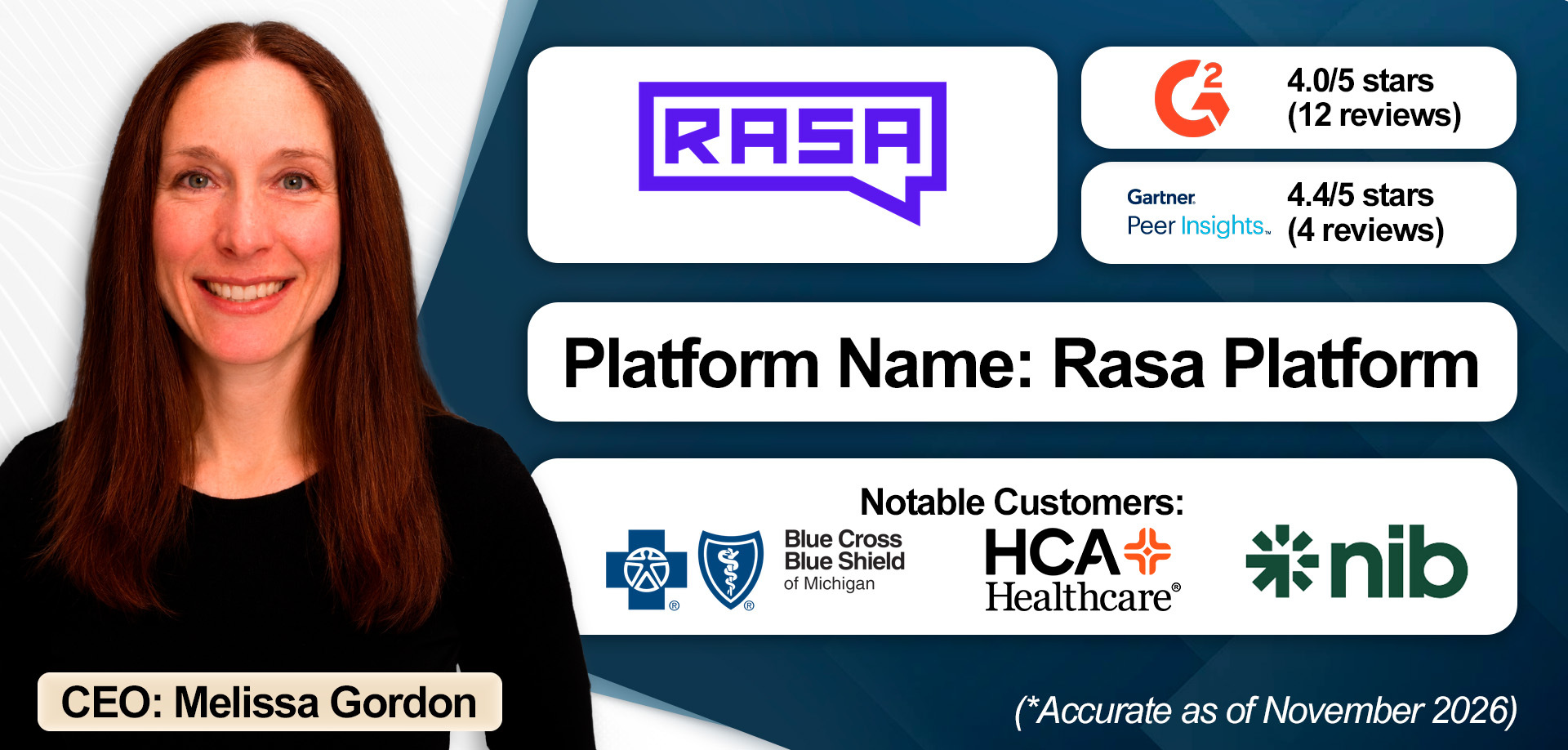
Rasa runs anywhere. Organizations can run its AI agents on a laptop, on their own AWS account, or in their own air-gapped data center. That capability is significant for healthcare providers prioritizing governance and data residency.
After all, an individual on the team, whether that’s a developer or conversation designer, can build, test, evaluate, and optimize agents in a fully controlled local environment. Rasa never sees any data or conversations.
Rasa also has another architectural differentiator in being an open-code platform. That gives organizations full visibility into what happens under the hood, the freedom to switch between models, and - most uniquely - the ability to use its fine-tuning and model distillation tools to train smaller, more cost-efficient models they can run and host themselves.
Ultimately, that lowers TCO, a benefit that extends into Rasa’s unique pricing model.
What makes it unique? It doesn’t charge for LLM usage. Customers pay for their own models separately. As a result, it’s incentivized to reduce overall AI costs on its customers' behalf, rather than increase consumption.
Rasa’s progressive control capability also often appeals to healthcare buyers. This allows organizations to balance AI flexibility with strict control in a single conversational agent.
The capability combines open-ended reasoning for exploratory interactions with deterministic, code-enforced workflows for sensitive or regulated tasks. That means organizations can start with fully controlled conversations and gradually introduce AI autonomy without rebuilding the agent.
“We’re a platform for AI product teams. So teams who are building AI products and they want to bring them to market, and they want to innovate... and they care about the inner workings.”

Standout Strengths
- Data Governance and Residency: Rasa runs anywhere, and customers run it themselves. That means it never sees any data or conversations. As a result, there is no vendor-side data to safeguard, making it a popular choice for buyers in healthcare and other regulated industries.
- Low TCO: Fine-tuning and model distillation let customers start on a Frontier model, then train a smaller model on their own data, and move off per-token payments to something they can host themselves. That can significantly lower TCO.
- Progressive Control: Each skill in an agent can sit anywhere on a spectrum from fully deterministic to fully open-ended, with high-stakes steps locked down, so organizations can start cautiously and gradually loosen control without undertaking a full-scale rebuild.
How Much Does It Cost?
Rasa charges a fixed price per conversation, with lower unit prices at higher volumes. Interestingly, it also has one pricing structure, regardless of modality, and doesn’t charge for LLM use. Learn more about Rasa’s pricing model here.
9. Sierra
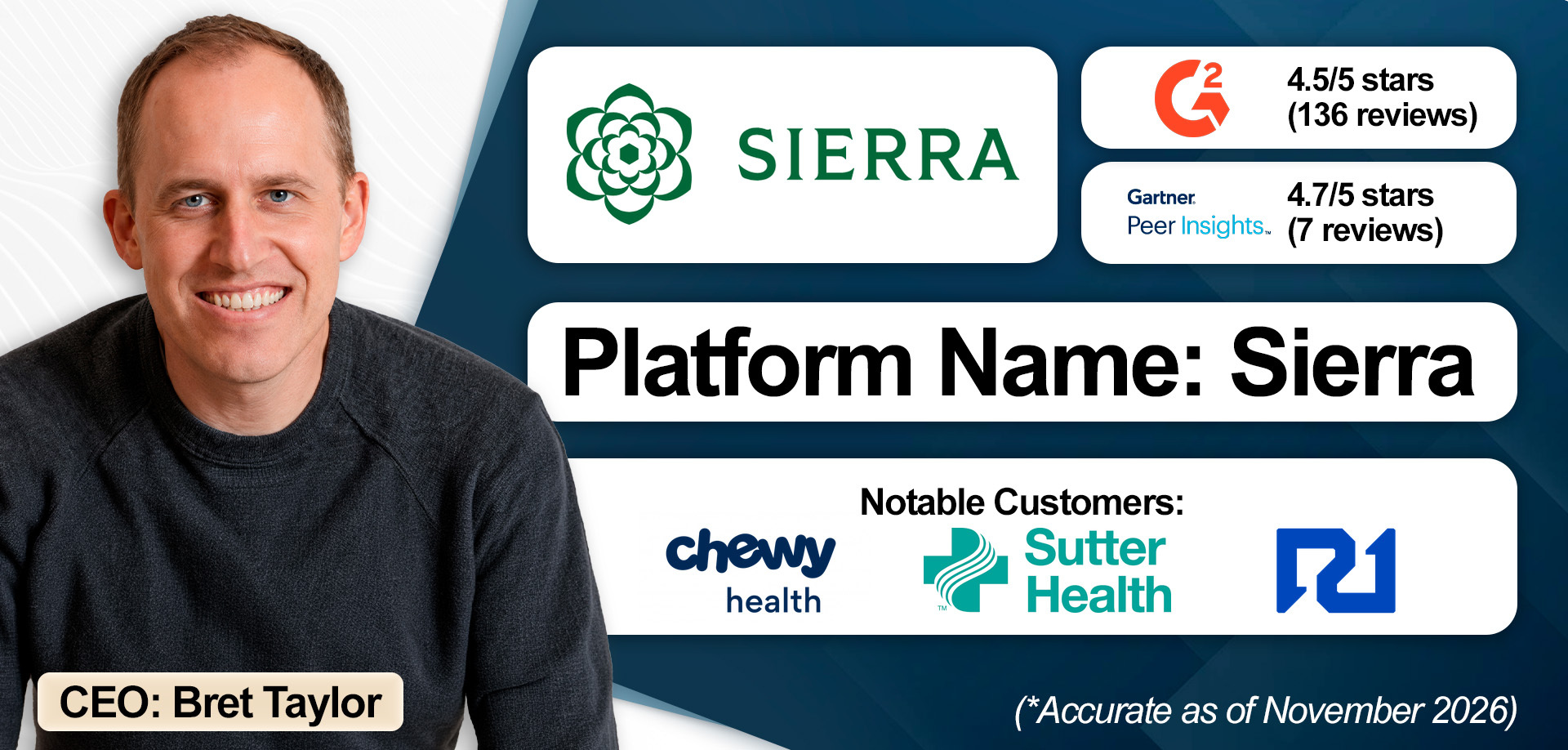
Sierra only launched publicly in February 2024. It’s now valued at $30 billion and claims to work with almost 50% of the Fortune 50, including several of America’s largest healthcare providers.
Rapid innovation is central to its success. That’s sometimes driven through acquisition. Consider its Horizon agents, which fold technology snapped up from Takeoff in July 2026. These agents act across multiple interactions, with multiple people, pursuing a specific outcome.
In healthcare, this capability has several applications. For instance, an agent could manage the referral process from a physician to a specialist. Alternatively, think of something as simple as booking an appointment. When a patient expresses interest in scheduling an appointment with a specific doctor, but leaves without doing so, the Horizon agent remembers. It then retains their preference, searches for cancellations in the doctor’s schedule, and proactively contacts the customer to book something in.
Beyond Horizon, Ghostwriter is an advanced AI assistant that enables developers to configure and adapt agents through natural language instructions. Meanwhile, its Context Engine is a critical piece of the puzzle, connecting each interaction to an individual and picking up where the last conversation left off, no matter the channel.
However, much of Sierra’s differentiation lies in its customer success strategy. Each customer receives a dedicated FDE team to support agent development and back-end integrations, with the team remaining involved throughout the customer relationship.
Before going live, the FDE team simulates traffic across different patient personas. It then ramps up gradually, starting at roughly 5% of traffic and improving the agent along the way. Sierra refers to this internally as “hill climbing,” a process that can last months, with Sierra’s FDE team giving close support.
Lastly, Sierra's outcome-based pricing model has proven disruptive. It ensures organizations only pay when a resolution is successful. Other providers offer this, but measure a resolution on repeat calls. Sierra actively monitors whether the customer calls back with the same issue, only charging when that outcome is delivered successfully without a handoff.
Standout Strengths
- Horizon Agents: These agents pursue outcomes over weeks and across multiple people, not just a single conversation. Across healthcare, that has several applications. Whether it is managing referrals, coordinating care, or ensuring prescription drug adherence.
- Customer Success: Each engagement gets a dedicated FDE team who build the agent, handle back-end system integration, and stay on for the life of the relationship, learning the client’s business in-depth. They also oversee a ramp-up process where AI slowly takes on more responsibility, working alongside internal teams and building their confidence.
- Pricing Model: Sierra only gets paid for completed outcomes, tracking customer intent across repeat calls to ensure fairer measurement. Additionally, a live POC lets organizations measure real production performance before they commit.
How Much Does It Cost?
Sierra offers outcome-based pricing, monitoring repeated contact reasons and handoffs. There is no official per-outcome rate. Instead, it custom negotiates a price with each customer. Explore Sierra’s pricing model here.
10. Salesforce (Inc. Fin AI & Cresta)
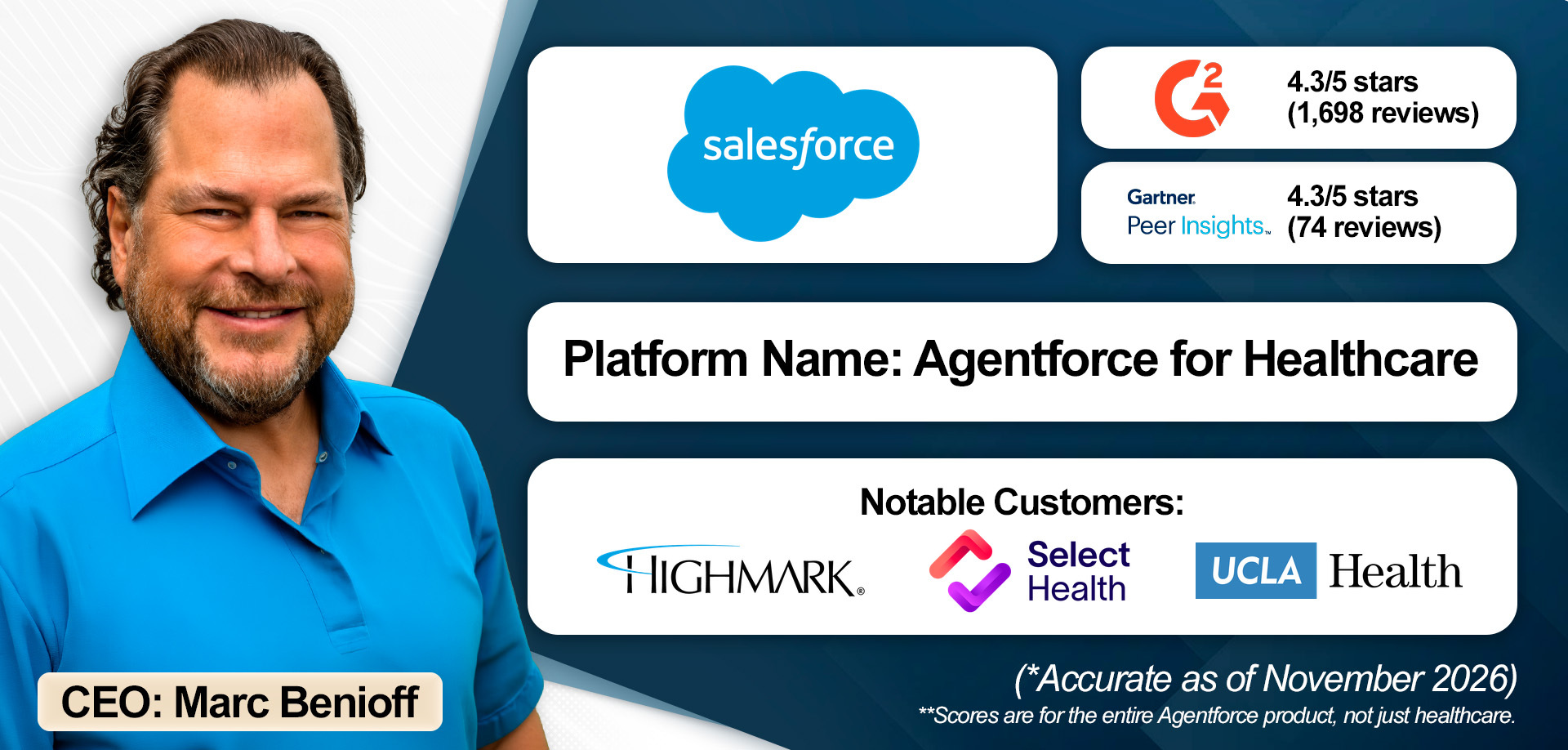
Salesforce differentiates by owning the full stack, not layering over someone else’s. Its context, orchestration, and engagement layers all work together within Health Cloud.
It starts with context. Health Cloud ingests data from the EHR, then adds information about a person’s life circumstances that may affect their health, along with benefits information. That is then grounded in Data 360, the company’s Customer Data Platform (CDP).
From there, Salesforce customers can orchestrate workflows for patients and care teams across the backend, using that context as the trigger and going well beyond the conversation itself.
Consider prior authorization as an example use case. An agent can receive a referral via an API, check benefits, copays, deductibles, score and pre-approve, then communicate the outcome. That replaces four or five applications and multiple humans.
Health Cloud includes approximately 50 of these out-of-the-box agents that organizations can configure to their needs. There are also preconfigured agents designed explicitly for HR and IT support. Thanks to Salesforce's “headless” strategy, employees can tap them from wherever they work, with preconfigured integrations with Slack, Copilot, and Claude (thanks to AIforce).
On the patient side, the Help Agent is fast to deploy because it connects with the knowledge, cases, customer data, channels, workflows, and permissions already in Health Cloud.
Organizations that want to place an engagement layer over a more fragmented environment can deploy Fin, which Salesforce acquired in June 2026. Similar to Sierra (and Decagon), it chases outcomes across conversations while delivering its own proprietary Apex AI models for CX use cases.
Salesforce has also acquired Cresta, which offers conversational AI but is often deployed as a standalone conversational intelligence solution. It combines conversational insights with data on flow complexity, conversation volume, and resolution rates to create a readiness score for contact automation initiatives, among many other innovative capabilities.
“This is the moment to not just add an agent, but to reimagine the process and the work that needs to be done.”

Standout Strengths
- Context Ownership: Thanks to Health Cloud and Data 360, many healthcare organizations already have rich patient data within the Salesforce ecosystem. That context can trigger back-end orchestration, which extend resolution flows further.
- Pre-Built Agents for Healthcare: Health Cloud ships roughly 50 out-of-the-box agents, built on existing data models and workflows. There are also HR and IT support agents, reachable across third-party AI assistants and collaboration platforms, simplifying how employees seek support.
- Fin and Cresta Acquisitions: Fin adds a more sophisticated conversational layer that can sit over a fragmented stack, with agents that pursue outcomes across conversations. Cresta adds conversational intelligence that will better shape the contact automation strategy.
How Much Does It Cost?
Agentforce for Healthcare pricing combines underlying Health Cloud subscriptions with consumption-based usage meters and outcome-based pricing for its customer-facing Help and Fin agents. Learn more about the solution and contact Salesforce for more information here.
11. Decagon
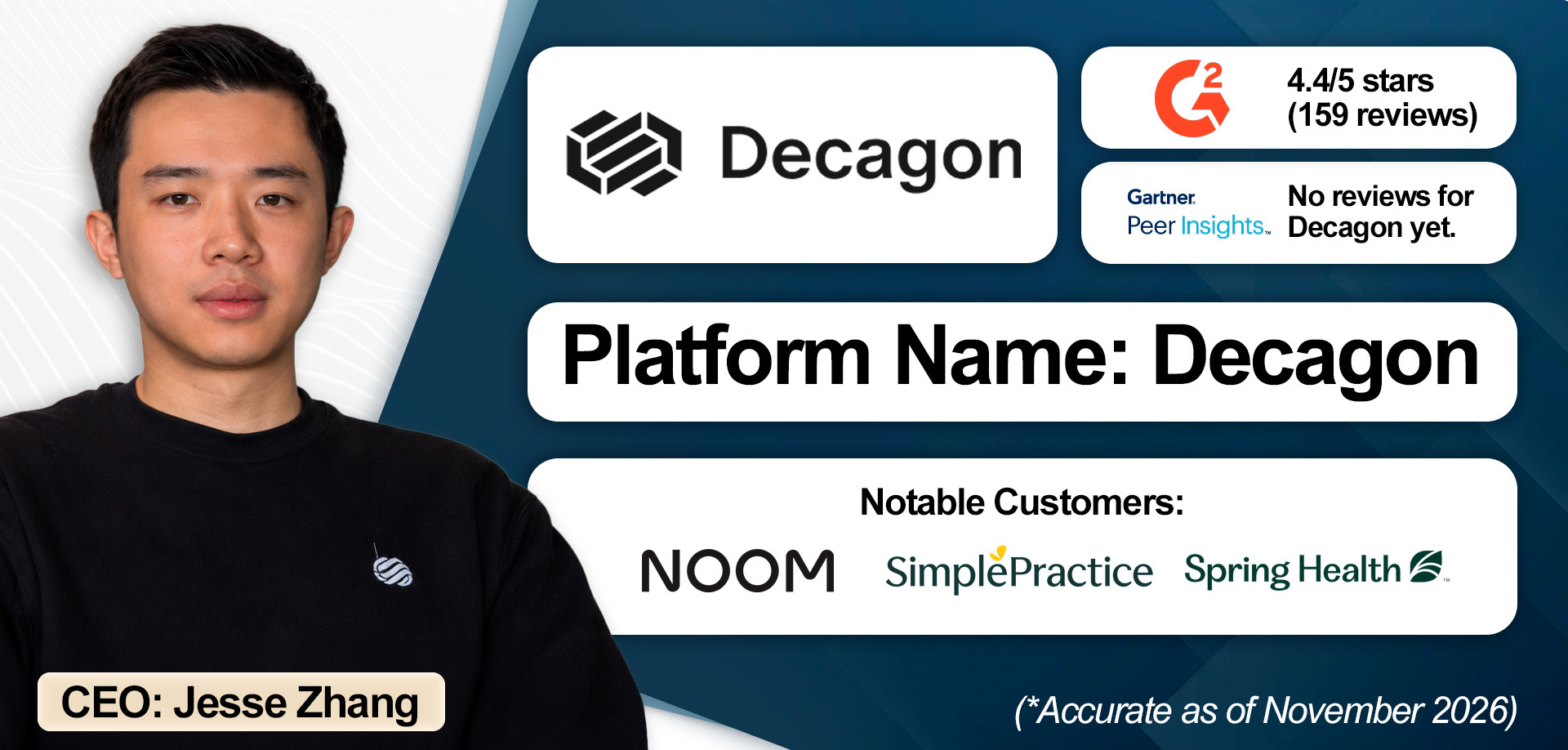
Decagon became a conversational AI stalwart thanks largely to its Agentic Operating Procedures (AOPs), which convert natural-language instructions from CX leaders into code and logic that IT teams control on the back end. That division of roles supports smoother implementations, because departments aren’t stepping on one another’s toes.
Duet, the platform’s native assistant, helps to write the procedures, test and deploy them, and continuously recommend improvements.
Then, Duet Apprentice takes this further by learning from onboarding guides and policy libraries, Slack threads, and escalation analytics. As it does so, Apprentice captures tacit knowledge, including how employees collaborate across UC platforms to solve issues, and builds it into its agents. It can also update knowledge repositories based on its own analytics.
Decagon also has its own research arm, Decagon Labs, which distills frontier models for customer experience tasks. It's now also purpose-building models for industries, including healthcare, so brands don’t just plug a general model into a workflow.
Additionally, Labs developed Chord, Decagon’s first in-house voice model family, trained on real customer conversations. The vendor’s voice agents run on these models, which keep hesitations, breath sounds, and pacing for more natural conversation. They can also switch languages mid-conversation, which is beneficial when interacting with vulnerable patients.
Alongside Sierra, Decagon stands out for delivering AI agents, or “Mission” agents, that pursue a specific outcome across multiple customer interactions, a particularly valuable capability in healthcare. Take a referral from a primary care physician to a specialist, which is often dropped. With Decagon Missions, the agent can call the specialist, navigate their system, and find available times. It can then call the patient, propose times, and reconnect with the specialist to book the appointment. That improves patient outcomes and protects revenue.
Again, like Sierra, Decagon offers an FDE team. However, Decagon’s FDEs are purposefully more hands-off, reflecting its philosophy that the agent should behave like an employee the organization owns, with greater autonomy from the vendor.
Standout Strengths
- Duet Apprentice: The assistant learns unwritten, tacit knowledge by capturing insights from internal interactions around customer conversations on Slack, as well as other sources. As a result, healthcare organizations can base agents around how their best people work and collaborate.
- Decagon Labs: Decagon Labs distills and fine-tunes models for specific tasks, while developing its own family of voice models trained on customer conversations. These models keep pauses, tactfully insert breath sounds, and can switch languages mid-call.
- Decagon Missions: Mission agents pursue outcomes across interactions, working within the guardrails the company sets, across multiple and an undefined amount of time. These help manage healthcare subscriptions, referrals, and appointments, among other use cases.
How Much Does It Cost?
Decagon customers choose between per-conversation and per-resolution pricing, and many can pivot their preferred option mid-contract. Specific rates are shared during the sales process. Learn more about Decagon’s pricing model here.
12. Ada (& Dialpad)
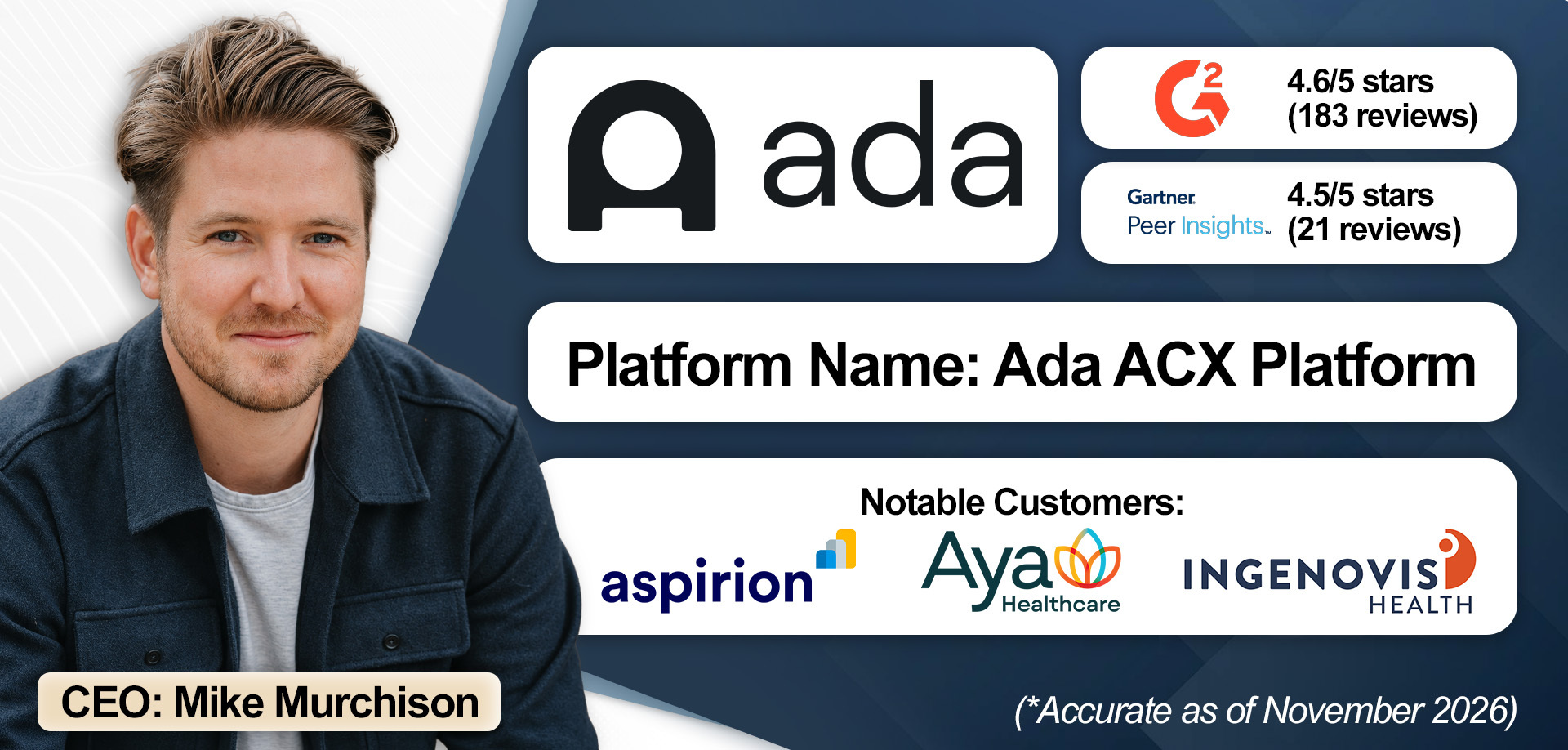
Ada’s core differentiator is where its AI agents sit. Following its merger with Dialpad, Ada’s agents now run on the same platform as Dialpad Connect (a phone system for all staff), Dialpad Support (the contact center), and Dialpad Sell (outbound calling).
Many AI agents can only transfer a caller to the contact center. Within this infrastructure, Ada can route to a pharmacist, care management, or nurse, with the context already attached.
That matters because much of the work that drives healthcare outcomes happens outside of the contact center. Take healthcare payers as an example. They run tasks like formulary exceptions, post-discharge follow-ups, and appeals that can take days and often stall between steps. Ada’s agent keeps the member informed of the status until the task is complete, and sends it to the right person within the relevant deadline.
Dialpad can also capture how employees collaborate around customer issues, follow their internal conversations, and surface that intelligence to generate new knowledge and, further down the road, workflows to simplify complex cases. That’s another architectural advantage.
The vendor’s real-time intelligence is another advantage it aims to exploit with Ada. Indeed, by tracking emerging contact reasons and how human agents solve them on Dialpad Support, the vendor can auto-generate and test new AI agents to address new customer queries and soften peaks in demand.
Finally, Dialpad plans to manage human and AI agents on a unified WEM platform, allowing teams to better assess the hybrid workforce’s performance and better orchestrate resolutions.
"Some calls need a person with clinical authority. The AI agent identifies these calls and sends them to the correct person, wherever they are across the business.”

Standout Strengths
- Platform Architecture: By converging AI with collaboration tools, not just the contact center, Ada can transfer interactions across the business with context from the conversation so far. That broadens the scope for conversational AI deployments.
- Scope for Intelligence: A customer conversation transcript only can outline a resolution, but not how an agent got there. By tracking internal chatter around the customer conversation, Dialpad unlocks new context into how teams solve issues, which can inform smarter AI deployments.
- Roadmap: Dialpad’s roadmap teases Ada agents built from real-time contact center intelligence to help combat emerging contact reasons. It also features a hybrid WEM solution, which will help teams better orchestrate work across the hybrid workforce.
How Much Does It Cost?
Ada offers its agents across two distinct models: resolution- and conversation-based pricing. The vendor doesn’t publish standard rates publicly. Discover more about its pricing strategy and request a demo here.
13. PolyAI
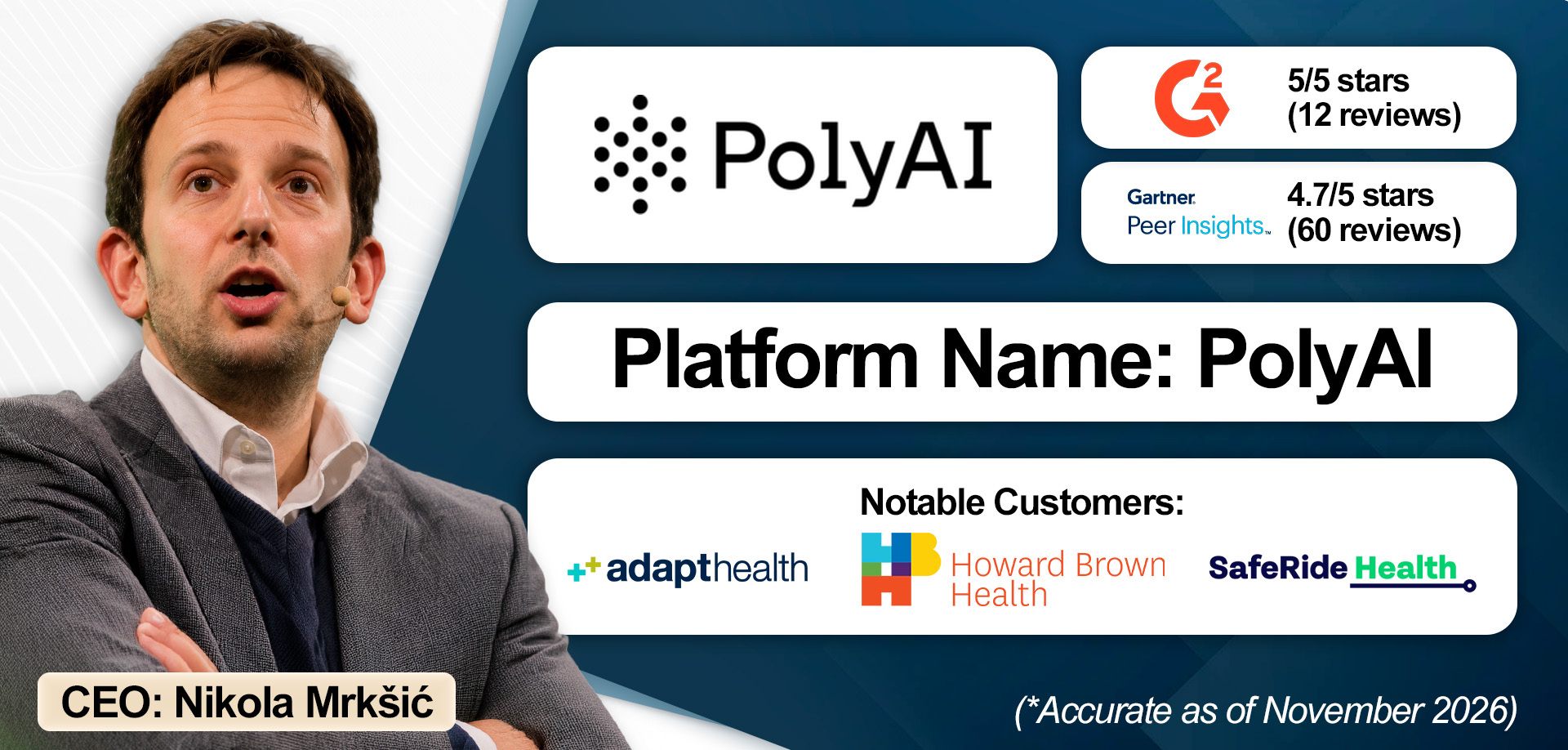
PolyAI has its own conversational model for voice and chat: Raven. This has allowed PolyAI to establish guardrails at the model level, with the highest-risk steps, such as authenticating a patient, enforced in code. That pairing of a predictable model and hard controls around sensitive tasks will appeal to many healthcare buyers.
The vendor is also training Raven to make better operational decisions, with separate reasoning models to evaluate its decision-making in different situations, compare possible approaches to a resolution, and improve the model’s performance over time.
How Raven and PolyAI’s platform interact is another core differentiator. To understand why, it’s first important to stress PolyAI’s belief that training a general model on transcripts alone cannot produce a reliable agent. After all, rules and offers change, and transcripts lack context into how humans reached their decisions.
PolyAI’s answer is to capture business logic in the platform around the model, through its Agent Development Kit (ADK), which also encodes lessons from thousands of deployments, such as confirming ambiguous letters when collecting a postcode. As such, when a rule changes, they can update the one element that changed, instead of redeveloping the entire agent.
In healthcare, where policies, payer rules, and eligibility criteria constantly shift, this matters.
Once an agent goes live, PolyAI’s Wren, the AI assistant for its Dialog Studio, helps teams improve implementations without engineers. It builds changes, reviews calls to propose daily fixes, runs A/B tests, and autonomously merges clear wins.
Lastly, PolyAI is another vendor leveraging FDEs. Yet, innovatively, these engineers cut integration costs with computer-use agents that operate legacy systems the way a human would, then convert what they learn into API-like proxies for faster live performance.
Standout Strengths
- Proprietary Conversational Model: PolyAI built Raven in-house, tuning it on customer support conversations across 200 enterprise clients. The firm also asserts that about 90% of guadrailing is handled at the model layer, with high-risk steps enforced in code.
- Platform Architecture: Business logic lives in the platform and surrounds the model, so teams can update a single rule when a policy changes, and the agent adapts. As such, businesses don’t need to retrain their agents.
- PolyAI Wren: Wren is PolyAI’s Dialog Studio Assistant. CX users can leverage it to configure, review, and improve their own agents. It also autonomously proposes daily fixes, which it tests through autonomous A/B testing and beds in.
How Much Does It Cost?
PolyAI doesn’t publicly disclose pricing information, but is known to follow a consumption-based model, with per-minute pricing for voice. Buyers must contact the vendor directly to learn more. Talk to the PolyAI team here.
14. Retell AI
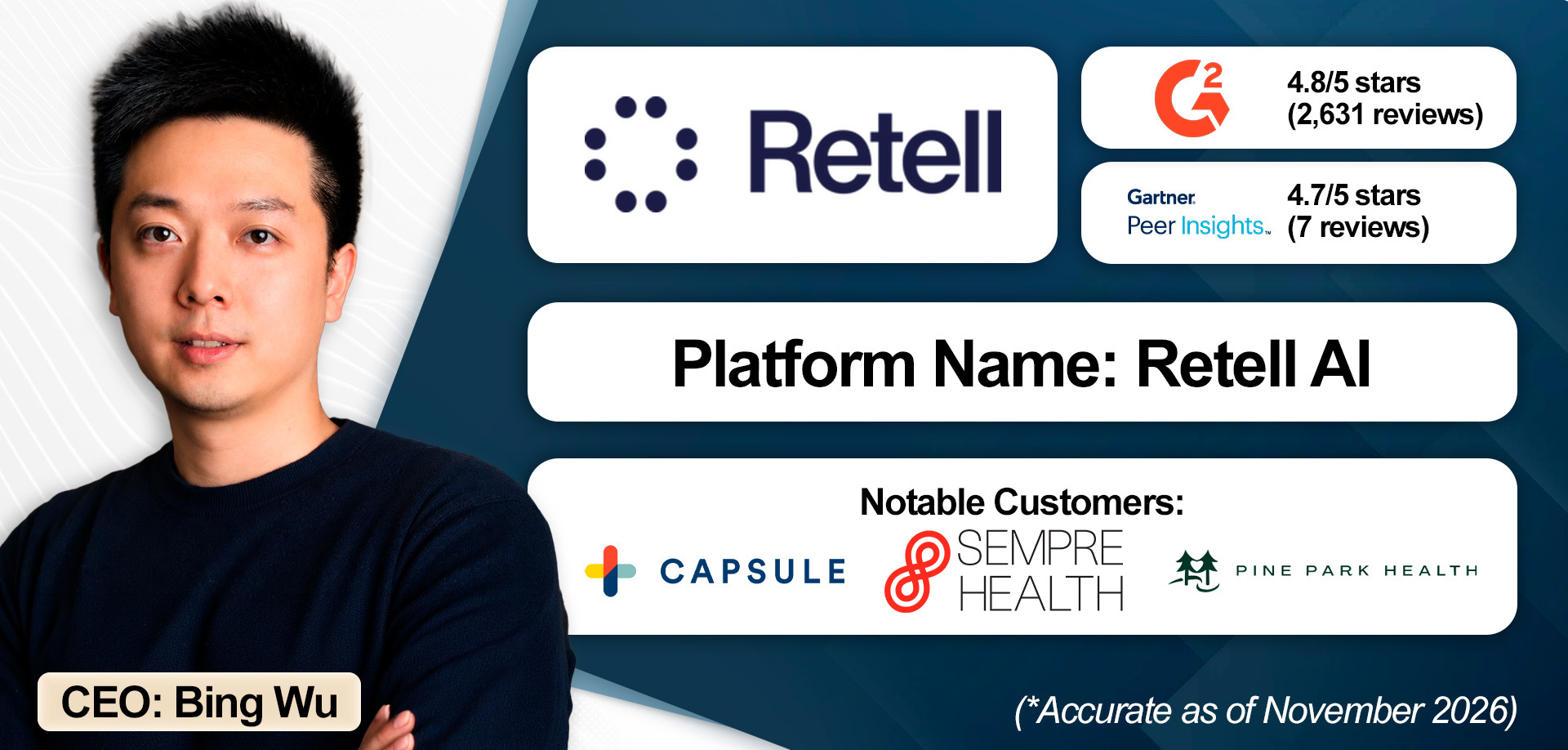
Retell is often deployed in healthcare as an AI receptionist. While it lacks email support, it has several differentiated capabilities and stands out for its ease of use.
That ease of use is evident in its procurement process. Upon request, Retell immediately sends a Business Associate Agreement (BAA), with no strings attached, and healthcare organizations can sign up, try the platform, and confirm HIPAA compliance without a lengthy sales process.
Organizations also get granular control over their data, with simple settings to determine which PII is redacted or never stored on Retell’s server. Meanwhile, the platform syncs with Epic, pulling in contact data and sending updates, such as opt-out requests, back to ensure information never becomes siloed on the vendor’s side. That’s big for data governance.
Retell’s outbound proposition also catches the eye. Its built-in dialer supports appointment reminders, scheduling, treatment campaigns, and more, with TCPA and DNC checks handled within the platform.
The vendor has also developed its own LLM (Tell-1), which it offers alongside Frontier models. This sits alongside frontier models from the likes of Anthropic and OpenAI. Healthcare companies can then simulate customer interactions against their own calls to discover which work best across common scenarios specific to their organization.
Other significant features include Conductor, an AI Copilot that builds agents from natural language prompts; AI memory so returning callers resume where they left off; and a pricing model where voice is billed per second, not rounded up to the nearest minute. That can help businesses save significant sums.
Retell’s approach to handoffs is also innovative. It lets the human employee query the AI about what happened earlier on the call, instead of only passing over a summary. As such, the employee feels more confident heading into the interaction.
“One final cool feature is you can live-listen to the AI conversation as it’s happening, and if you think you need to jump in, you can take over from the AI immediately.”

Standout Strengths
- Simple Deployment: Organizations can sign up on the website, and Retell delivers a no-fee BAA on request, built-in TCPA/DNC checks, two-way EHR sync, HIPAA compliance confirmation, and more, without a heavy implementation and procurement process.
- Proprietary AI: Retell’s own telephony infrastructure and conversation-trained LLM, benchmarked publicly and scored by third-party evaluators (vendor-reported), give customers reliability and model choice with no lock-in.
- AI Copilot & Memory: Conductor builds and tests agents from natural-language prompts using the customer’s EHR and knowledge base, and AI memory lets returning customers resume where they left off.
How Much Does It Cost?
Retell uses a pay-as-you-go pricing model, charging $0.07–$0.31 per minute for AI voice agents (often billed to the exact second) and $0.002+ per message for chat agents. It also offers custom pricing plans for enterprise customers. Discover more about Retell AI’s pricing here.
15. Uniphore
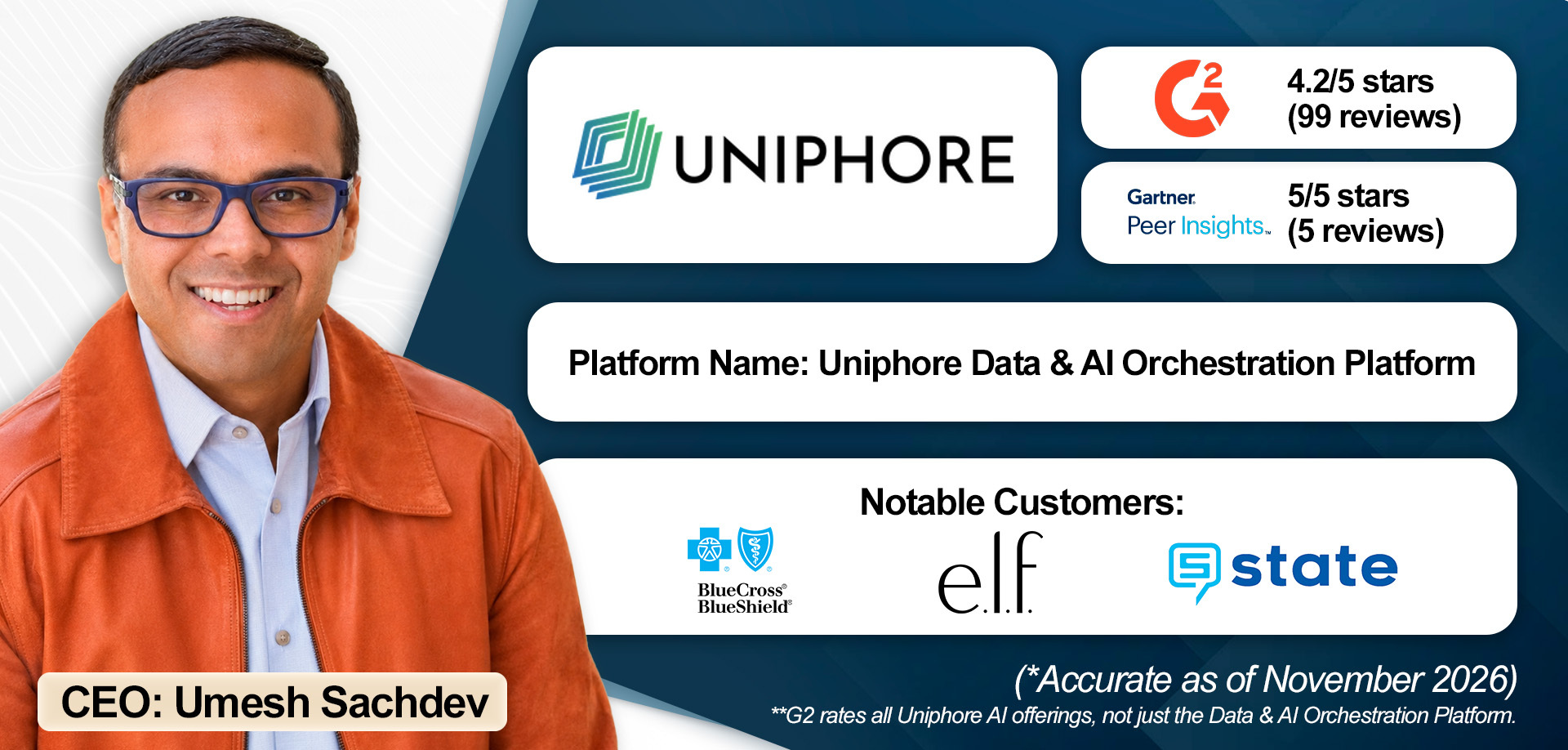
Uniphore’s Business AI Cloud is a platform that manages data and AI together. This combination lets customers more easily fine-tune smaller, industry-specific AI models on their own data, while the platform’s harness retains the fine-tuning history and context. That matters because a model can be swapped out without redoing the work.
Additionally, Uniphore automates much of the work that typically falls on FDE teams. For instance, it builds healthcare ontologies from organizational data, while automating much of the process for fine-tuning models and configuring agents, reducing the organization’s reliance on outside support.
To guide agent implementations, Uniphore offers mature testing and development tools. Teams can use analytics to identify use cases, create an AI agent prototype, test it against patient simulations, and isolate opportunities to optimize the deployment.
The deployment experience is also differentiated. Business AI Cloud can run on any hyperscaler, private cloud, and on-premise, which is significant for organizations prioritizing governance and data residency.
Uniphore also stands out for treating safety and governance as architecture rather than an add-on. Indeed, it runs automated tests before and after every model input and output, pausing the process and calling in a human whenever the model drifts.
As conversational AI evolves from “here’s a workflow, let’s automate it” to agentic workflows that learn about the business and change how they make decisions, these safeguards become crucial, especially in highly regulated industries, like healthcare.
Finally, returning to the initial point, SLMs offer significantly lower token costs than LLMs, and Uniphore passes these cost efficiencies on to customers through consumption-based pricing.
Standout Strengths
- Domain-Specific SLMs: Uniphore provides the platform and tools for healthcare organizations to fine-tune domain-specific LLMs on their own data, with a harness that retains that fine-tuning history and context so models can be swapped out efficiently.
- Safety & Governance: Safety is built into the architecture rather than added on, with automated tests run before and after every model input and output, escalating to a human whenever a model drifts.
- Flexible Deployment Options: Business AI Cloud can run on any hyperscaler, in a private cloud, or fully on-premise, helping healthcare providers prepare for evolving governance and data residency requirements.
How Much Does It Cost?
Uniphore provides custom quotes for its platform, but is known to offer usage and consumption credits, with modular seat- and feature-based add-ons. Contact the Uniphore team for further pricing information here.
16. Yellow.ai
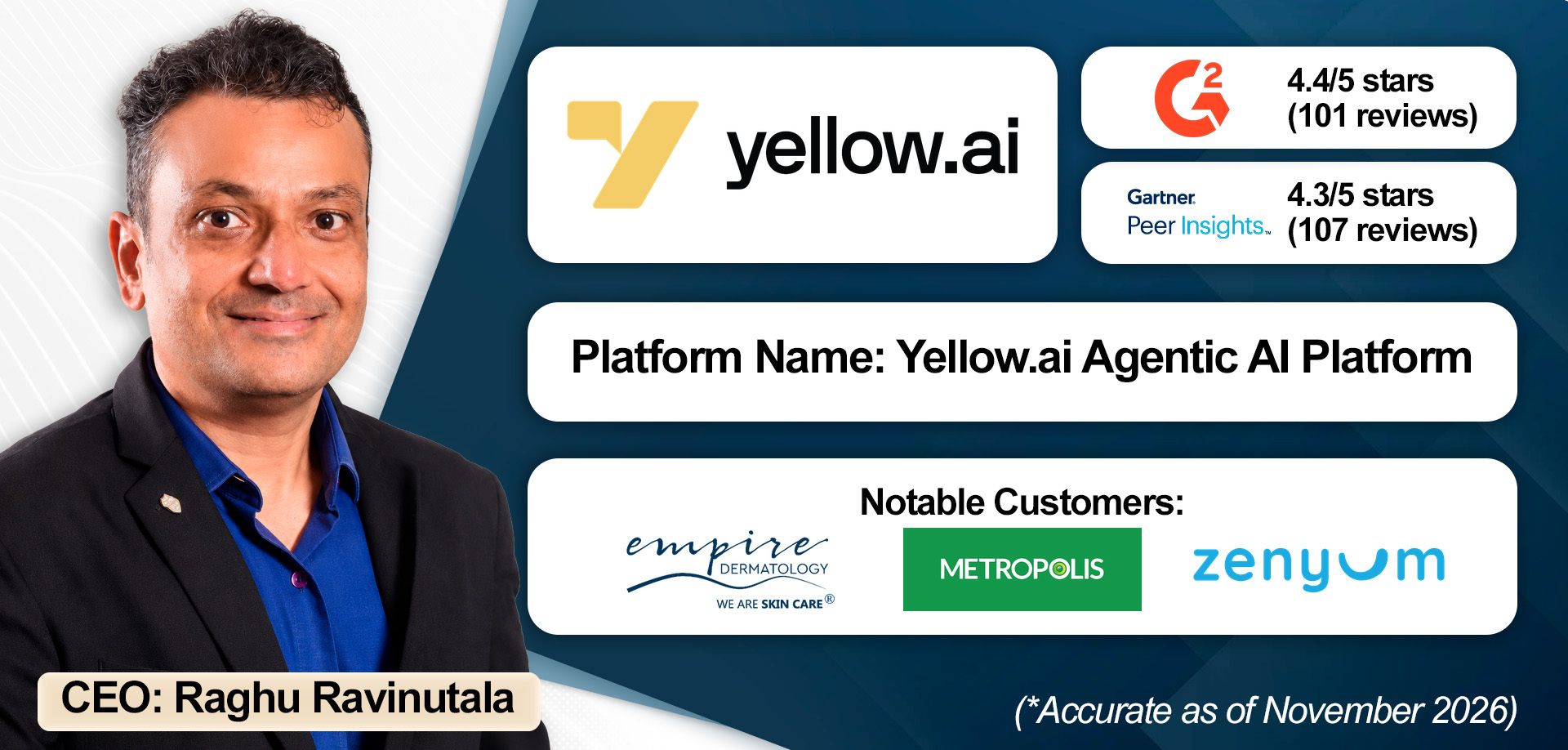
Yellow.ai’s core differentiator is a voice infrastructure where everything runs in one place. Most voice AI chains together speech recognition, voice synthesis, LLMs, and telephony from different providers, and each handoff adds latency and can drop context. However, Yellow.ai runs each component within a single “zero-hop architecture,” so hearing a request, understanding it, and acting on it all happens within the same architecture.
According to the vendor, that means faster, more natural responses, keeping control of each component, something not possible with emerging speech-to-speech models.
Interestingly, that control helps to keep the platform flexible. A model orchestration layer across Nexus routes tasks across models by language, cost, and quality. As such, an AI model pricing change or outage doesn’t require a rebuild.
Language coverage is another strength, and critical in enabling greater accessibility to healthcare services. Yellow.ai’s voice AI, Vox, natively supports 500+ languages and dialects, with the ability to switch languages mid-sentence. Meanwhile, the broader conversational AI platform supports over 135.
Also, Yellow.ai stands out for how it handles internal helpdesks. Take Nexus Edge. It is an AI assistant that lives on an employee’s computer and “sees” problems for itself, so employees don’t have to describe issues perfectly. Edge then navigates knowledge sources, internal procedures, and business systems to decipher and recommend a fix before running it on the user’s screen and working within their permissions.
Finally, for the many healthcare organizations still leveraging legacy systems, Yellow.ai offers an on-premise application that acts as a translator between its platform and legacy systems, simplifying complex integrations. The vendor can also deploy Nexus on-premise, while also supporting public cloud and hybrid implementations.
Standout Strengths
- Zero-Hop Architecture: Yellow.ai’s zero-hop architecture runs speech recognition, voice synthesis, language models, and telephony within one system. It believes this supports faster, more natural responses while allowing organizations to keep control over each AI component, unlike speech-to-speech models.
- Nexus Edge: The Edge AI assistant sits on an employee’s computer, “sees” the problem, finds a fix by checking internal procedures and business systems, and runs it on the user's screen. This can help clinical and administrative staff resolve IT issues without lengthy descriptions and tickets.
- Deployment Experience: Yellow.ai offers on-premise, public cloud, and hybrid deployment, plus an on-premise application that connects its platform to older legacy systems, which suits healthcare organizations with data residency needs and aging infrastructure.
How Much Does It Cost?
Yellow.ai offers a Free plan with 500 chat sessions per month, charging $0.99 per resolution for anything above that. Enterprise plans typically align with conversation volumes and seats, with the vendor providing custom quotes. Discover more about Yellow.ai’s pricing model here.
More Conversational AI Solutions Healthcare Buyers May Consider
The conversational AI solutions for healthcare outlined above are widely deployed worldwide. Yet, there are many options.
For instance, those prioritizing conversational AI for customer support often select the solution native to their contact center or CRM platform.
Some of these providers stand out more than others, like Dialpad. Two significant examples include:
- AWS: AWS acquired conversational AI specialist NLX in April 2026. Since then, it has released an Agentic CX designer that includes a Live Sync feature that synchronizes the customer’s smartphone experience with a voice agent, enabling organizations to layer digital elements over the voice channel.
- Sprinklr: Sprinklr offers a conversational AI solution within a unified framework of contact center, marketing, and Voice of the Customer (VoC) solutions. That framework lends itself to proactive, outbound AI agents that act on various customer signals to strengthen relationships.
Crescendo is another vendor that stands out. Interestingly, it has also built AI agents to replace the CX software stack it usually layers over. Why? Because it believes the platform below limits how successful a conversational AI deployment can be.
Netomi is another standout vendor, with a significant focus on data orchestration and, unusually in this space, using historical and real-time context to better personalize the interaction. While it has many big-name customers, it’s not often deployed in healthcare.
ElevenLabs is also gaining momentum, often as a lightweight AI receptionist. However, by owning the model layer, it can shape how those models fit into the application layer and manage the nuance in between them. That’s a longer-term differentiator.
Finally, there is Tata Communications and its Commotion voice AI offering. One notable strength is in how it leverages the company’s extensive voice networks to add a silent authentication layer, extract new context, and drive cost efficiencies.
A Final Observation
Customer conversations are about to change significantly. Not only will humans be engaging with businesses, but increasingly their personal AI agents will too.
Conversational AI giants like Sierra and Decagon have already released new protocols to prepare organizations for this shift. Yet, there is much more work ahead, as personal agents like Meta Muse sit on the precipice of mainstream adoption.
For instance, solutions providers must now consider how tasks will shift between human customers, AI customers, brand AI agents, and brand human AI agents.
As such, it’s no surprise that vendors like NiCE Cognigy, Retell AI, and SoundHound are also innovating around handoffs, considering fundamentally new ways for humans and AI to collaborate to resolve queries.
Other emerging trends from this market overview include AI memory supporting agents in pursuing outcomes over multiple conversations, voice-agent-guided digital experiences, and a hike in providers touting proprietary AI (and its economic benefits).
That’s just the tip of the iceberg. From a rise in sovereign AI options to self-improving and self-configuring agents, this market is moving fast.
Over the next 12 months, expect plenty more innovation, impacting the healthcare sector and far beyond.