June 8, 2026 • 29 min read
11 Voice of the Customer Solutions & What Differentiates Them in 2026

Director of Content & Market Research
June 8, 2026

Revenue growth in the voice of the customer (VoC) solutions market has averaged between 15% and 25% annually over the past decade.
That's according to 2026 Gartner research, with the firm expecting revenue growth to accelerate for "the larger VoC providers" over the next ten years.
Those larger providers are well known: Qualtrics, Medallia, and Sprinklr. Meanwhile, established rivals like Verint, Alchemer (formerly SurveyGizmo), and SMG continue to hold their ground, still winning major enterprise contracts.
Yet, challenging them is a new wave of disruptors, such as Chattermill, Pisano, and Xebo.ai, with nimble solutions and bold AI strategies.
That's the current competitive picture at a glance. However, the arrival of agentic AI promises to reshape the industry, and it's not the only major trend to watch out for.
Given this, below is a timely overview of the most prominent, enterprise-grade VoC solutions and essential market trends, after a quick recap of the fundamentals.
What Is a Voice of the Customer Solution?
A Voice of the Customer (VoC) solution is a platform that captures, analyzes, and activates customer feedback from direct, indirect, and inferred sources, transforming raw signals into actionable intelligence across the organization.
At its core, a VoC solution still aggregates insights around customer behaviors, goals, sentiment, and motivations. But modern platforms extend beyond traditional survey distribution. Today's solutions span contact center intelligence, digital experience analytics, social media listening, and more, creating a continuous, omnichannel feedback loop.
Additionally, VoC is no longer limited to the customer perspective alone. Leading platforms increasingly incorporate employee experience and business performance data, enabling organizations to correlate operational and workforce signals with customer outcomes. This broader lens helps uncover the root causes behind customer experience gaps, not just the symptoms.
On the action side, many VoC solutions can trigger cross-platform workflows automatically or surface role-specific recommendations and reports that equip teams across the business to make informed, customer-centric decisions.
As scope and sophistication grow, vendors are repositioning VoC platforms as the central system of record for enterprise-wide customer experience transformation. This shift reflects both the strategic importance of CX and the expanding role these solutions often now play.
11 Voice of the Customer Solutions
The following market overview highlights 11 leading VoC solutions, outlining what sets each provider apart and the key features that distinguish them.
1. Qualtrics
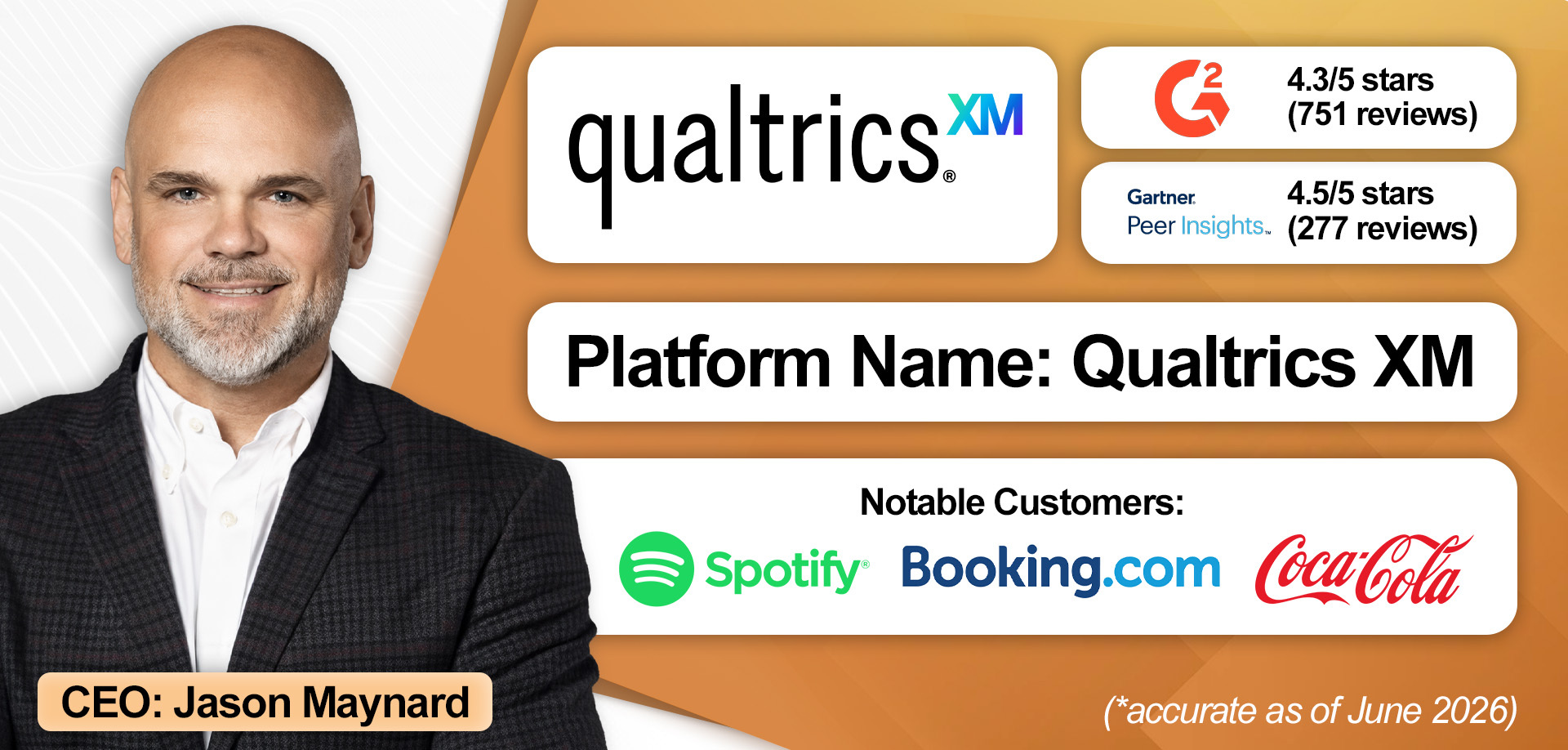
Qualtics combines VoC, Voice of the Employee (VoE), and market research solutions within a single data architecture to surface and act on new insights.
For instance, when a CX team identifies a problem requiring customer compensation, Qualtrics can simultaneously create a Jira ticket and alert the market research team, who can then test, iterate, and release an improved solution to mitigate such issues in the future. The result is a direct feedback loop between customer support and product development.
This architectural design also shines when launching new products. First, Qualtrics’ Synthetic Panels can help validate a proposition upfront. Post-launch, brands can monitor VoC signals to reality-check performance. Does the product meet expectations? Is pricing appropriate? Are service and quality where they should be? Qualtrics pulls together disconnected teams and insights to answer these questions.
Qualtrics has also released AI agents across its platform, including several Experience Agents, prebuilt around specific use cases. For example, if a customer expresses frustration in a transactional survey, an Experience Agent can immediately engage within the survey to help resolve the issue.
To set the scene for AI agents to soon start translating insights from Qualtrics into actions across other systems, the provider has more than 400 native integrations with leading enterprise applications across many industries, ensuring workflows don’t stop within its system.
Ultimately, this reflects the breadth of its portfolio, which includes digital experience analytics for websites and mobile apps, online reputation management, and contact center analytics. It will also expand further following Qualtrics’ acquisition of PG Forsta, which acquired InMoment in 2025. While stitching this all together may prove challenging, it will further bolster Qualtrics’s extensive portfolio.
"We are really experts on experience, which is not just a simple feature, it's something business-critical… What we've observed over 20 years is that the companies delivering the right experiences for customers, employees, and markets are the ones that stay ahead."

Standout Features
- Market Research Capabilities: Qualtrics bridges the historically siloed worlds of market research, CX, and EX, enabling organizations to combine feedback, insights, and operational data and close the loop between customer signals and product development.
- Experience Agents: Prebuilt agents optimized for specific use cases, from resolving customer frustration in real time to autonomously designing and fielding research surveys, enable sophisticated research and action without technical complexity. Cross-platform workflows are also backed by 400+ enterprise integrations.
- Portfolio Breadth: Beyond traditional VoC, Qualtrics spans digital experience analytics, online reputation management, and contact center analytics. This supports its differentiator in fusing CX data with operational metrics and enabling a more comprehensive view of the customer. Its Experience Optimizer solutions also play an essential role here.
How Much Does It Cost?
Pricing for the overarching Qualtrics XM platform and its three core solutions - XM for Customer Experience, Employee Experience, and Strategy & Research - is only available upon request. Reach out to Qualtrics’ sales team here.
2. Sprinklr
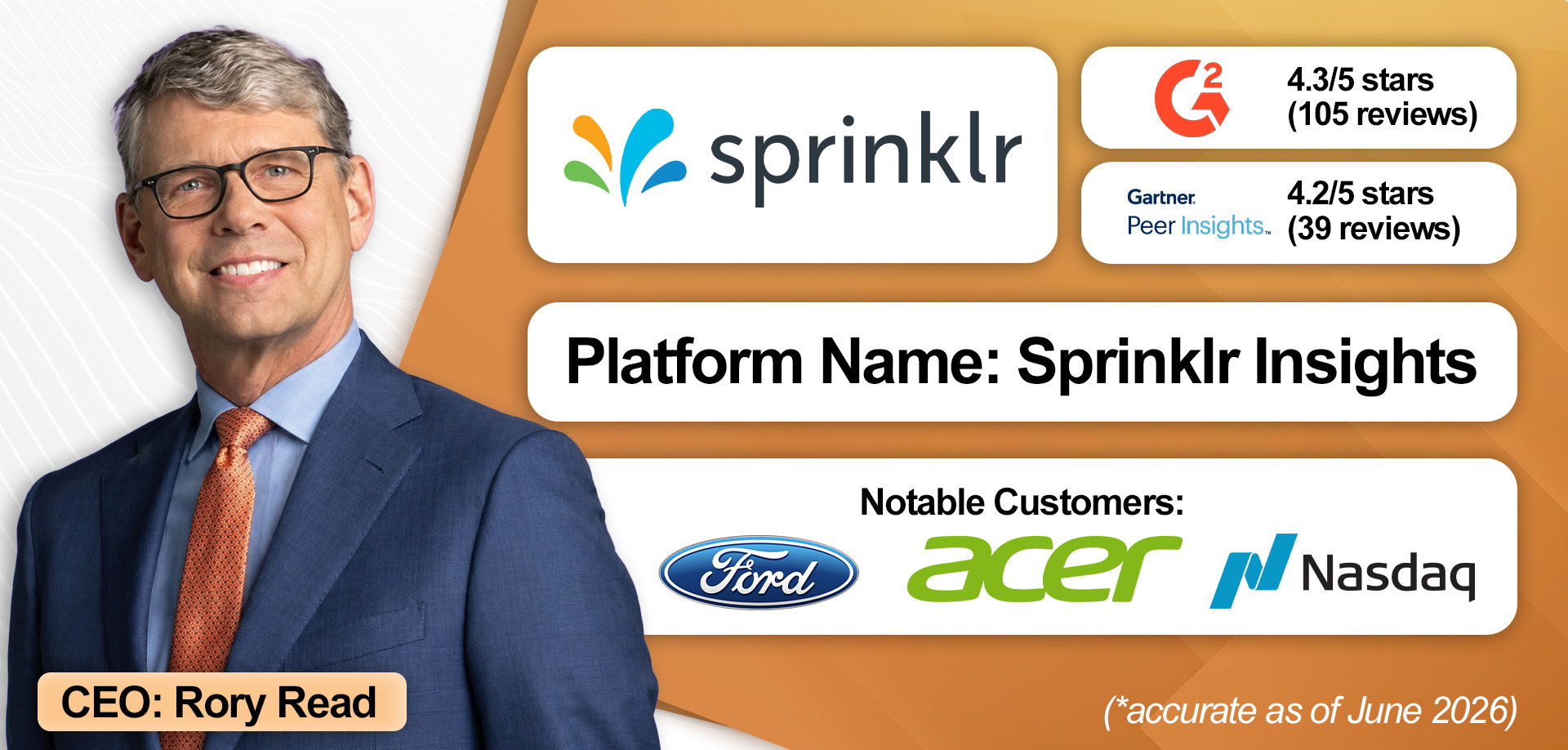
Sprinklr offers unmatched coverage of digital and social channels, covering established and emerging platforms, including Bluesky, Reddit, and TikTok. In doing so, it normalizes all that customer feedback into a 360-degree customer view on one platform, without heavy manual integration work.
With that data foundation, Sprinklr applies advanced AI tools, such as an AI-powered crisis alert feed, to monitor viral trends, spotlight brand risks, and prioritize customer success interventions.
Interestingly, the vendor also recently announced its acquisition of ViralMoment, a social listening tool that specializes in analyzing video content and imagery for deeper insights than tracking text-based posts alone.
Moreover, the company unveiled LLM Insights, which helps track how brands appear across AI platforms like ChatGPT, Gemini, and Perplexity. For example, a financial services company can monitor not only customer complaints and feature requests, but also whether it's being recommended when users ask AI tools for the best credit card.
As AI models increasingly draw from online conversations and cited sources, Sprinklr enables organizations to measure their visibility in those ecosystems and influence how they're represented to customers.
Lastly, Sprinklr Insights is part of a unified “CXM Platform” that also includes campaign management software, a contact center as a service (CCaaS) solution, and an AI Agent Studio. The AI Agent Studio allows customers to translate VoC insight into actions across its platform and, thanks to its MCP support, extend those actions throughout the enterprise ecosystem.
"Our core differentiator is understanding, not just accurately, but turning that into action that can be scaled across our unified ecosystem and beyond."

Standout Features
- Channel Coverage & Data Model: Sprinklr's unified data model consolidates feedback from more than 30 digital and social channels - including Bluesky, Reddit, and TikTok - into a single customer view, reducing manual integration work while enabling real-time, AI-driven crisis detection and brand risk management.
- LLM Analysis Capability: Soon to be released, the provider’s LLM Insights tool lets brands monitor their presence, sentiment, and citations across AI discovery platforms like ChatGPT, Gemini, and Perplexity. In doing so, brands can monitor and act against ‘voice of AI’ insights, much like VoC insights.
- Broader Unified CXM Ecosystem: Via AI Agent Studio, Sprinklr equips organizations to translate customer insights into automated actions across its broader CXM platform. For example, converting a negative social post into a proactive service case to prevent churn. With MCP support, it now extends such actions beyond Sprinklr's own ecosystem.
How Much Does It Cost?
Sprinklr does not publicly disclose pricing for its Insights platform. Instead, the company starts with a personalized demo to assess fit and discuss requirements. Pricing information is available after scheduling a demo. Book a personalized demo with Sprinklr here.
3. Medallia
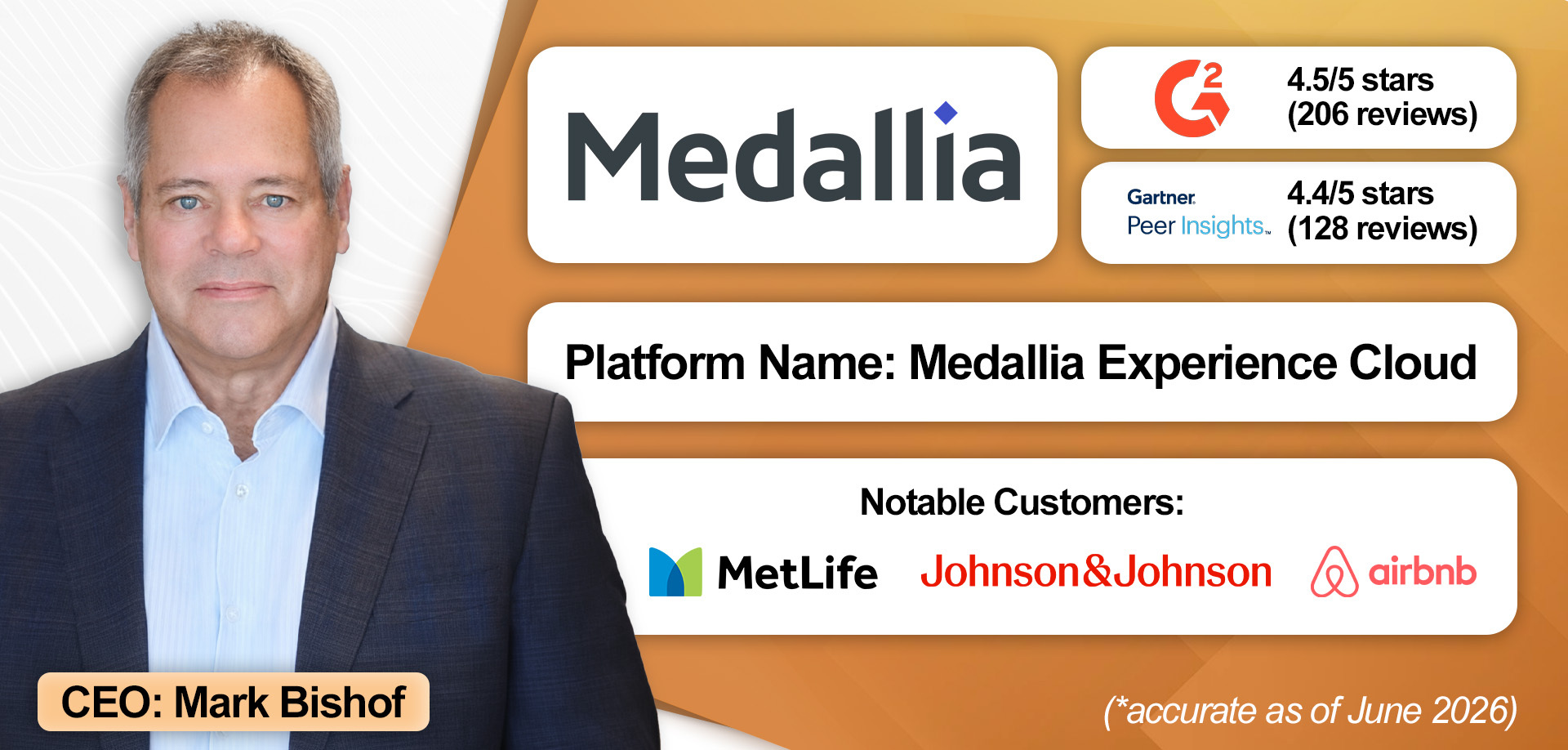
Despite making ten acquisitions over the past decade, Medallia has maintained a unified platform architecture. This lays the foundation for its Org Sync capability, connecting organizational data with customer and employee feedback.
Additionally, it allows organizations to orchestrate pipelines for delivering real-time VoC insights across specified teams, roles, and regions.
That’s a powerful enterprise capability, enabled by its 2022 acquisition of Thunderhead. The same orchestration underpins how Medallia converts data from its Total Experience Profiles, which consolidate VoC insights into comprehensive customer views, into meaningful actions.
Such actions may include sending proactive, personalized customer notifications, coaching suggestions to frontline agents, and product complaints to market research teams, with Medallia’s comprehensive workflow automation tools also shining here.
Elsewhere, like Qualtrics, Medallia offers hundreds of out-of-the-box integrations with enterprise systems, enabling it to connect workflows across complex customer experience ecosystems.
Lastly, Medallia introduced Smart Topic Builder in February 2026, which detects topics, sets keyword and linguistic rules for tracking them, and verifies their precision through auditing. That has turned text analytics from just another feature into a competitive advantage.
Standout Features
- Insight Democratization: Medallia excels at getting the right data to the right people at scale. Its Org Sync technology automatically manages complex organizational hierarchies and personnel changes, ensuring customer insights and recommended actions reach the relevant personnel without manual overhead.
- Workflow Automation: Having invested in insight-to-action capabilities well before the agentic AI wave, Medallia offers mature workflow tooling that triggers tailored responses across the organization, from following up with dissatisfied customers and coaching frontline staff to routing product defects to the correct department. With MCP support, it also extends actions beyond its native ecosystem.
- Advanced Text Analytics: Medallia's Smart Topic Builder stands out by combining analytical speed with human oversight, allowing teams to define topics, set linguistic rules, and audit their accuracy, while ensuring insights remain explainable, rather than relying on opaque outputs from a black-box model.
How Much Does It Cost?
The Medallia Experience Cloud has a unique Experience Data Record pricing model in which organizations pay for the volume of VoC data they process. Learn more about Medallia’s pricing model here.
4. Verint
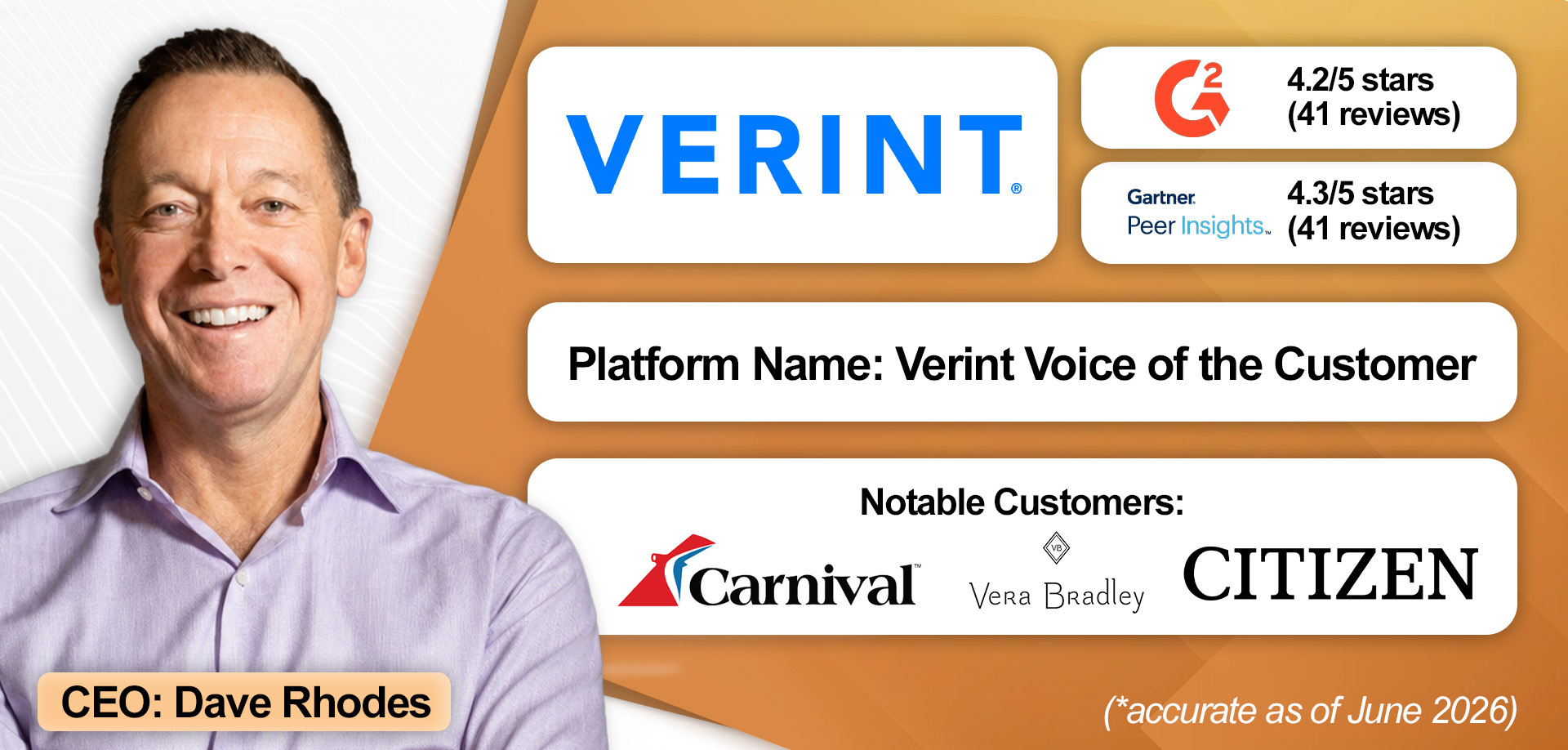
Many VoC vendors started in customer feedback management before expanding into the contact center to surface additional insights from customer conversations. Verint moved in the opposite direction, which is an important distinction, because analyzing unstructured interaction data at scale is notoriously difficult. Yet, it's Verint's core expertise.
Alongside that, Verint can leverage its broad portfolio, including contact center quality management (QM), workforce management (WFM), and conversational AI. Together, these capabilities allow Verint to unlock more operational data, in addition to VoC data, and reveal how business decisions affect customer outcomes.
It does this by ensuring each of its product teams makes data available in the Verint Engagement Data Hub, where it can be correlated with other datasets. This enables brands to combine VoC, interaction, and workforce performance data to extract richer insights.
For example, if a company adapts its service level, what effect does that have on customer satisfaction? These are insights Verint can surface in-house without significant integration work.
Verint also stands out for predictive analytics tools. Consider its Predictive Engagement Surveys, which capture contextual experience data to infer how a customer would respond to a survey, which is useful when direct feedback is absent. Yet, this predictive capability extends to online experiences, with Verint able to estimate how changes to the online experience will impact key metrics, including customer satisfaction, effort, and purchase likelihood.
Lastly, while Verint is best known as a contact center provider, it also captures rich website and digital feedback data, enabling it to analyze what happened before the interaction, during it, and how customers felt afterward.
"Fifty percent of the platform provides customer experience information. Fifty percent provides operational information. We can uniquely correlate the impact of operational improvements on the customer experience."

Standout Features
- Broader Portfolio: Verint's extensive product portfolio allows it to connect operational and customer experience data in-house. This gives organizations a clearer view of how business decisions affect customer outcomes, something competitors focused primarily on survey data struggle to replicate.
- Predictive Analytics: The provider enables organizations to model the likely impact of experience improvements before or as they happen. If a company enhances its website, for instance, Verint can predict the downstream effect on key metrics such as NPS, CSAT, customer effort, and purchase likelihood.
- Enterprise Scale: A published case study with Aetna shows how Verint processes around 120 million customer interactions annually, approximately 30% of which generate survey responses, equating to roughly 40 million surveys per year. Verint has the infrastructure to manage that scale reliably.
How Much Does It Cost?
Verint doesn’t publicly disclose pricing for its VoC solution. Organizations interested in the solution must instead contact the company for a customized quote. Contact the Verint sales team here.
5. QuestionPro
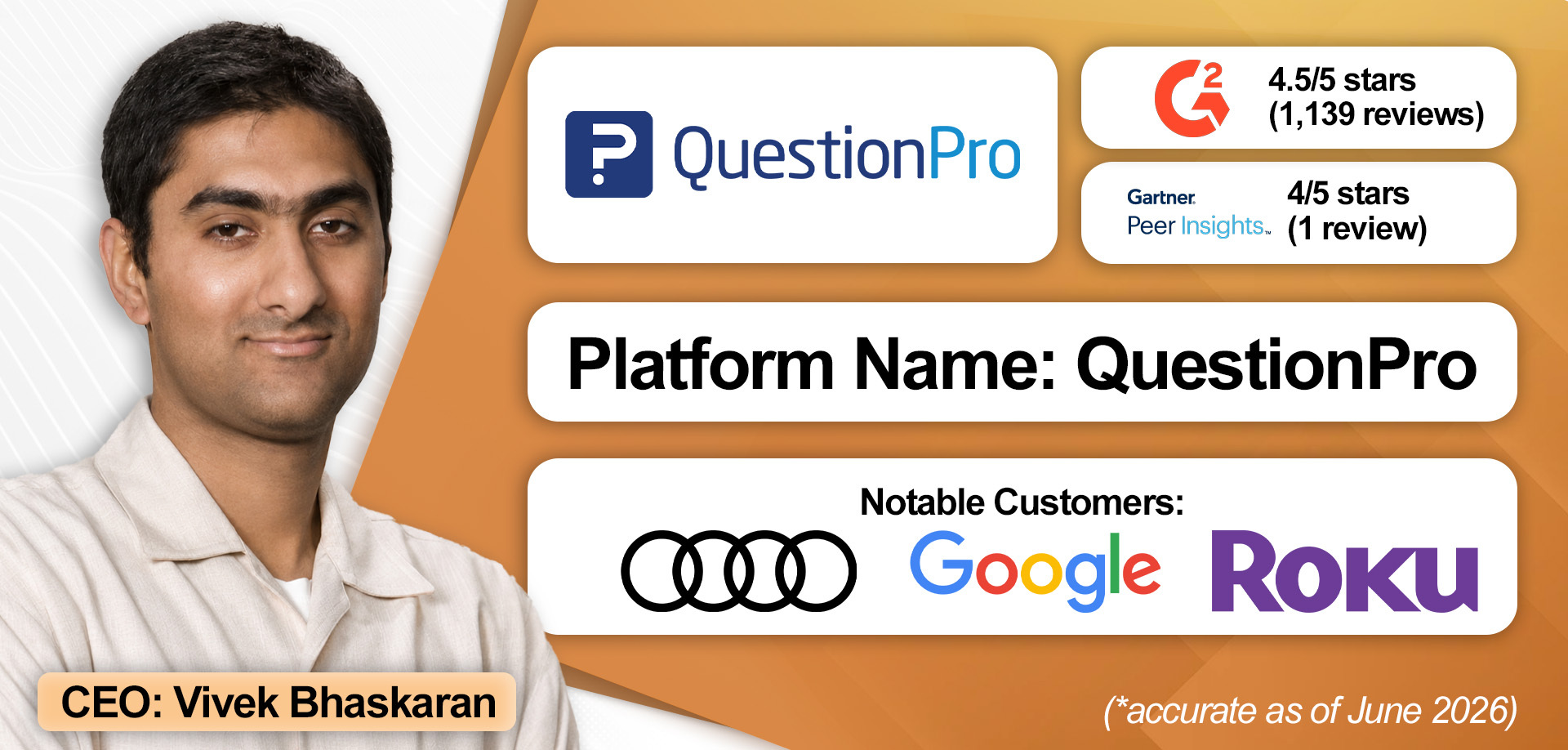
QuestionPro excels at blending VoC with customer journey management, connecting touchpoints and rapidly adding data connectors, allowing organizations to monitor customer experience signals across multiple engagements.
As a result, its platform surfaces insights and generates recommended action plans grounded in each customer’s journey.
These recommendations operate within company-defined guardrails. For example, if a customer is unhappy at a particular touchpoint, the system can recommend an approved remedy, such as a discount, replacement product, or another best-practice resolution. This approach empowers frontline managers to act quickly and save relationships without requiring deep analytical expertise.
QuestionPro doesn't stop at the recommendation stage, however. It tracks the success of follow-up actions, escalates unresolved issues, flags overdue cases, and reassigns ownership when necessary. Accountability is built into the workflow.
The vendor also distinguishes itself through support. Every customer receives a named Customer Success Manager, alongside 24/7 voice and chat support. Critically, no additional hourly fees or support tiers apply, and its pricing transparency extends further…
Indeed, QuestionPro doesn't charge extra for dashboard users, so whether an organization needs 10, 1,000, or 10,000, they're included. Meanwhile, its text analytics capabilities also come at no additional cost.
"We want to be able to look across the entire ecosystem and say: here's the step the customer has to take, here's the touchpoint, and here's what's going right and wrong."

Standout Features
- Customer Journey Management: QuestionPro links touchpoint measurement to strategic action plans. This enables organizations to monitor improvement opportunities in the broader context of the customer journey.
- Closed-Loop Feedback: While many vendors stop at email notifications, QuestionPro takes a more comprehensive approach by tracking follow-up actions, escalating unresolved issues, flagging overdue cases, and reassigning ownership when needed, driving accountability and enabling a more customer-centric organization.
- Support Services: Every QuestionPro customer receives a named Customer Success Manager and access to 24/7 support. Unlike many competitors, this support is included with no additional hourly fees or support tiers to purchase.
How Much Does It Cost?
QuestionPro’s core survey and research tools are available in four plans: Essentials (free), Team Edition ($83 per user, per month), Advanced ($99 per user, per month), and Research Suite (custom pricing). Pricing for its full platform, including customer experience and employee experience suites, is available only after a consultation to assess the organization’s needs. See QuestionPro’s complete pricing model here.
6. Chattermill
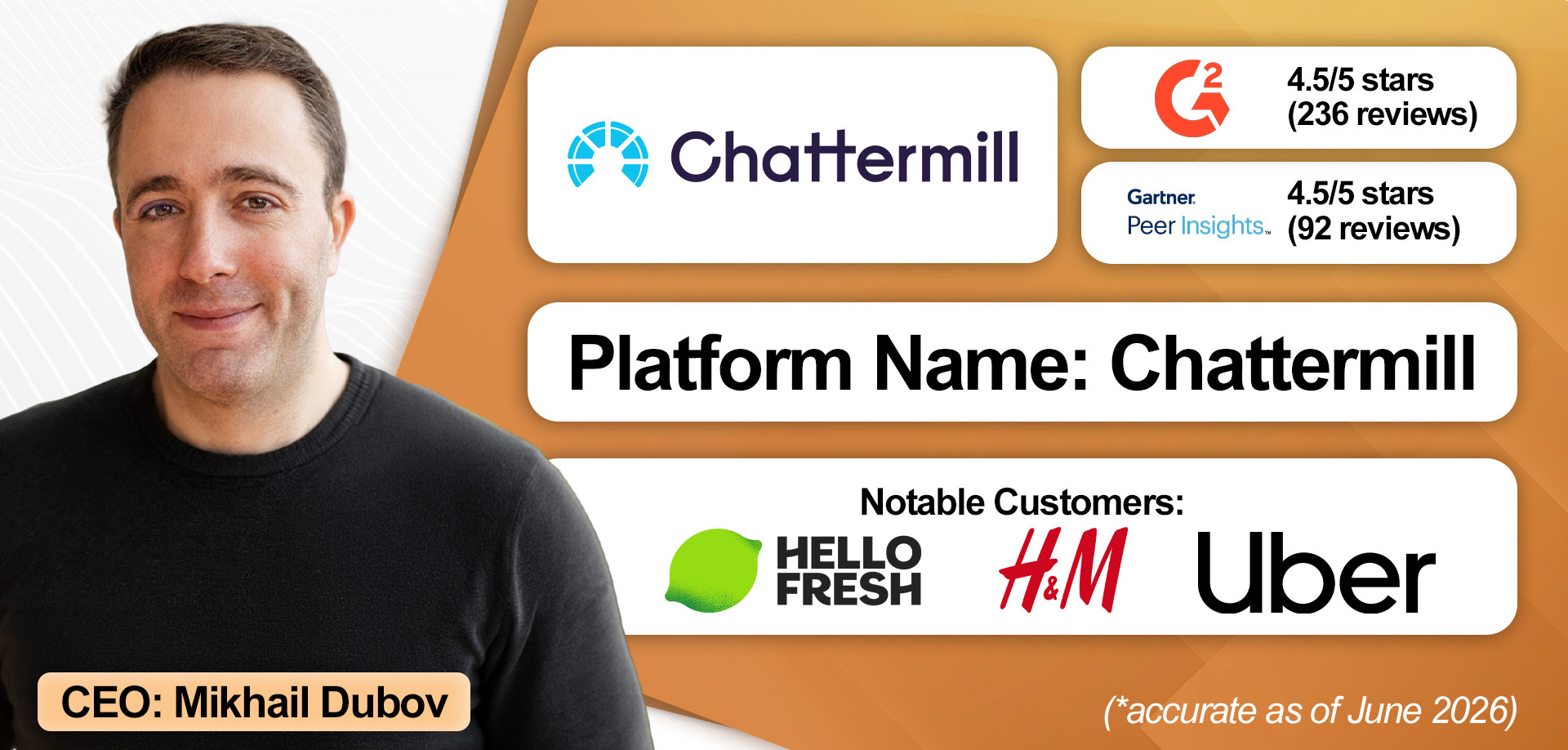
Beyond traditional VoC capabilities, Chattermill helps customers unlock business data, such as average order value and revenue metrics, and uses it to model the relationship between customer experience and business performance.
This enables organizations to understand the impact of specific issues on key outcomes. For example, if hotel guests consistently complain about bedding, what effect does that have on repeat bookings, recommendations, or retention? Chattermill works with an online travel agency on exactly this type of analysis.
Customers also gain access to a Chattermill Experience Growth Strategist, who helps them maximize these capabilities. Yet, their role also extends beyond the platform, evaluating the broader customer experience ecosystem - including survey programs, feedback collection methods, and metrics - to drive organizational alignment around what matters most.
Chattermill is also ahead of the industry in adopting MCP, making its insights accessible through AI assistants such as ChatGPT, Claude, and Gemini.
Crucially, Chattermill performs the analysis, structures the data, and eliminates the risk of AI hallucinations. External AI tools can access this trusted insight layer rather than attempting to interpret raw customer feedback themselves, ensuring trustworthy insights.
"We've really focused everything we do on making that link between customer feedback and the business metrics that matter to you."

Standout Features
- Impact Analysis: Chattermill connects experience metrics directly to business outcomes by modelling the relationship between signals like CSAT or NPS and financial performance indicators such as revenue, making complex analytical relationships accessible and actionable for CX teams.
- Experience Growth Strategists: The provider embeds strategic human expertise into its customer engagements, with dedicated strategists who evaluate the broader CX ecosystem to align on outcomes and ensure organizations can capture the right data before analysis begins.
- MCP Support: Chattermill enables customers to surface trusted insights through AI tools such as Claude and ChatGPT, serving as a validated analytical layer that structures data, reduces hallucinations, and applies deterministic validation to ensure conclusions are grounded in real customer feedback.
How Much Does It Cost?
Chattermill is available in three plans: Pro, Team, and Enterprise, providing custom quotes for each. Learn more about each plan and book a call with its sales team here.
7. Alchemer
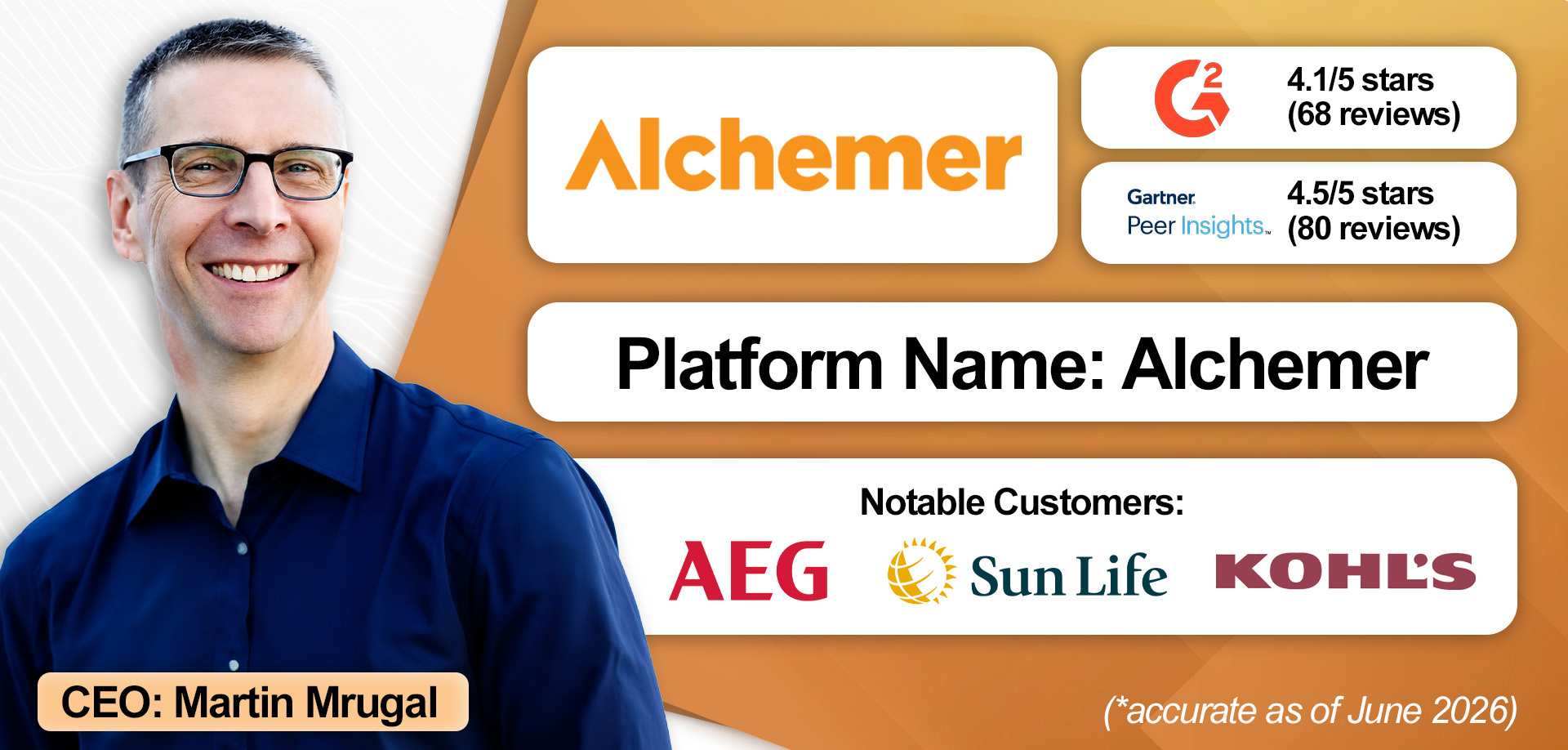
There’s a gulf between enterprise VoC solutions such as Qualtrics or Medallia and customer feedback tools like SurveyMonkey or SurveySparrow. Alchemer aims to fill it.
It achieves this through an intuitive interface for users of all skill levels and a white-glove onboarding experience, with Alchemer ranked #1 on G2 for fastest implementation in the VoC category.
To support clients post-deployment, Alchemer assigns each a success manager and runs customer workshops via its Business Labs program, which aligns customer-facing teams around outcomes, systematically introduces new capabilities, and offers integration guidance.
The vendor also offers several nifty AI tools. For example, its AI Smart Question feature takes real-time customer survey responses to generate contextual follow-up questions. As a result, brands gain more qualitative insights without increasing survey complexity.
Additionally, Alchemer has started embedding AI agents across its platform. Consider its AI Auto-Responder, which is part of its Reputation Management offering. It allows brands to automatically generate and publish responses to customer reviews across various platforms.
Finally, the provider has expanded into market research, allowing product teams to run complex analytical methodologies, such as Conjoint and MaxDiff, on VoC data at scale.
Standout Features
- Customer Onboarding: Alchemer believes that the success of a VoC program hinges on changing how organizations operate to support the implementation. Its onboarding process, led by a dedicated success manager from day one, aims to support both adoption and workforce transformation.
- Speed & Simplicity: Ranked first on G2 for fastest implementation and praised by Gartner for its intuitive interface, Alchemer also leads customers through custom workshops to ensure they are equipped to leverage the platform, integrate systems, and improve outcomes.
- Integrated Market Research: Alongside Alchemer Surveys, Alchemer Research Solutions enables brands to analyze market size, wallet share, and positioning, correlate those insights with VoC data, and run advanced methodologies such as MaxDiff and Conjoint—all within a single Alchemer account.
How Much Does It Cost?
Alchemer offers plans for individuals and small teams, ranging from $55 to $275 per user, per month. Yet, its business platform requires a custom quote. Everyone can access a 14-day free trial to try out the platform. Learn more about Alchemer’s pricing plans here.
8. Concentrix
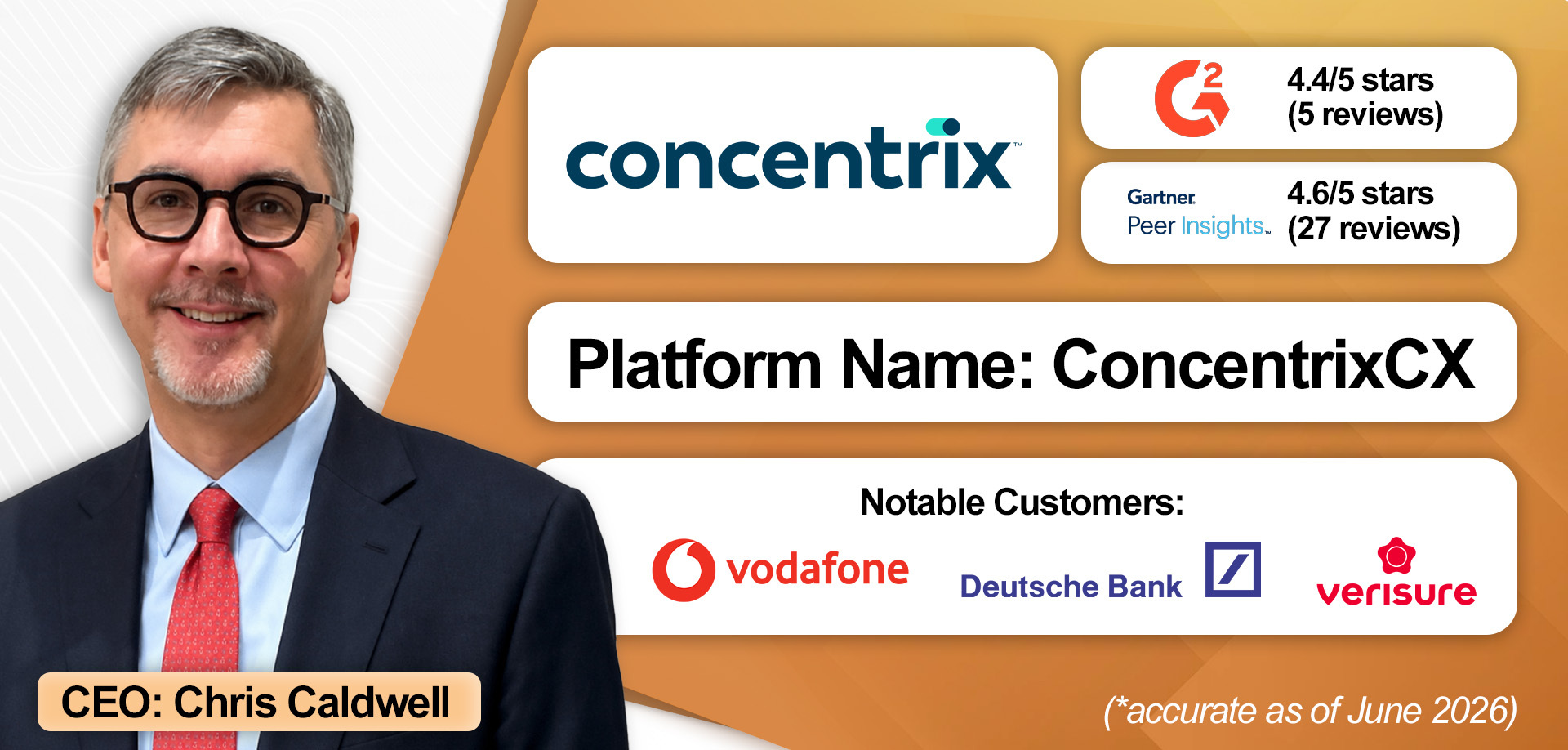
Concentrix aspires to sell partnerships, not just technology, targeting companies that want a broad-scale customer experience transformation but don’t have the in-house capacity.
In doing so, it acts as a full-service partner, helping organizations design enterprise-wide VoC strategies, implement solutions, and manage them thereafter.
Such an approach is underpinned by a “proven adoption strategy” tailored to each industry, aligning VoC data with metadata such as customer spend, demographics, and product usage to uncover the signals most closely tied to targeted business outcomes.
From there, it translates insights into action plans for improving customer experience.
In terms of its industry focus, Gartner highlights how Concetrix offers “out-of-the-box taxonomies and category models” for specific sectors, with financial services a key example.
Finally, Concentrix connects its VoC platform with other in-house solutions to maximize the value of the insights it generates.
Consider its ix Hero solution, which offers a unified, AI workspace for contact center agents, integrated into their desktops. Through this desktop, Concentrix can surface customer feedback, inspiring positive performance recognition and informing coaching actions.
Standout Features
- Partnership-Led Approach: Concentrix positions itself as a transformation partner rather than a technology vendor. Recognizing that CX teams are often weighed down by administrative tasks instead of higher-value work - such as insight generation, action planning, and cross-functional alignment - it provides a proven adoption strategy and services designed to drive meaningful, enterprise-wide VoC engagement.
- Industry-Specific Expertise: Concentrix tailors its adoption methodology to sector-specific needs, offering out-of-the-box taxonomies and category models for industries like financial services, while still giving customers the flexibility to build custom models where needed.
- Broader Transformation Portfolio: For brands seeking an end-to-end partner, Concentrix's broader portfolio may add further value. Consider ix Hero, which embeds customer feedback directly into the flow of contact center agents' work, bridging insight and frontline action.
How Much Does It Cost?
Concentrix offers the predictability of fixed pricing. Yet, doesn’t publicly reveal the costs of its solution or services, with the latter driving much of the cost. Request a custom quote from Concentrix here.
9. SMG
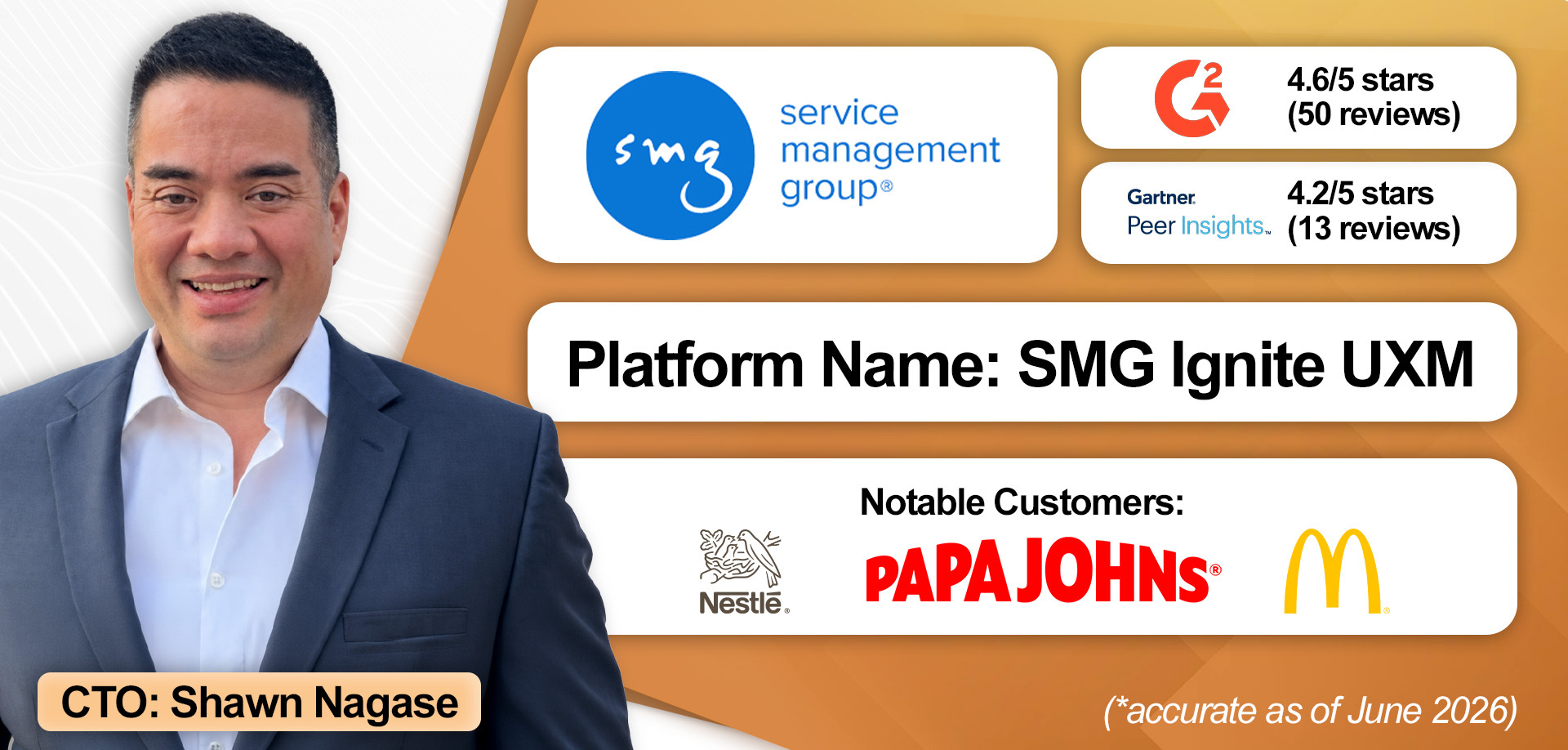
Founded in 1991, SMG is a pioneer in VoC. However, in 2025, the provider made the significant decision to modernize its offering, launching Ignite, a platform built from the ground up.
It has already started embedding AI agents and assistants. Consider its Knowledge Agent, which allows users to interrogate conversational data, unpack insights, and - ultimately - unlock answers much faster.
Yet, more distinctively, its Ignite UXM platform combines customer, employee, and brand data. That combination allows it to surface insights that few others can. For instance, it can track how an employee experience change impacts revenue, a capability particularly valuable in consumer services, healthcare, and retail, where SMG is often deployed.
Another key strength across these industries is SMG’s ability to segment VoC data by brand and location, surfacing tailored insights for each specific segment.
Its Areas for Focus tool strengthens this capability by correlating data across brands and locations to pinpoint the greatest opportunities for improving the CX metrics that matter most to the business.
Lastly, SMG offers Ignite Communities, enabling organizations to build dedicated customer communities to collaborate with customers on product enhancements, loyalty programs, process improvements, and more. The platform also facilitates richer, more contextual feedback through photos, videos, and in-the-moment surveys.
Standout Features
- Employee Experience Monitoring: SMG brings customer, employee, and financial data together on a single platform, enabling brands to trace how changes in employee experience ripple through to customer outcomes and, ultimately, revenue.
- Cross-Brand / Cross-Location Insights: The provider is well-suited to organizations managing multiple brands or distributed locations, offering robust segmentation capabilities and an Areas for Focus tool that pinpoints location-level improvement opportunities before generating targeted action plans.
- Ignite Communities: SMG connects brands directly with digital customer communities, enabling ongoing collaboration around idea generation, product refinement, campaign validation and more, ensuring the customer voice shapes enterprise decision-making.
How Much Does It Cost?
SMG Ignite UXM is available in two plans: Standard and Pro UXM, with additional service packages available. Pricing information is made available after a product demonstration and consultation. Request a demo of SMG Ignite here.
10. Pisano
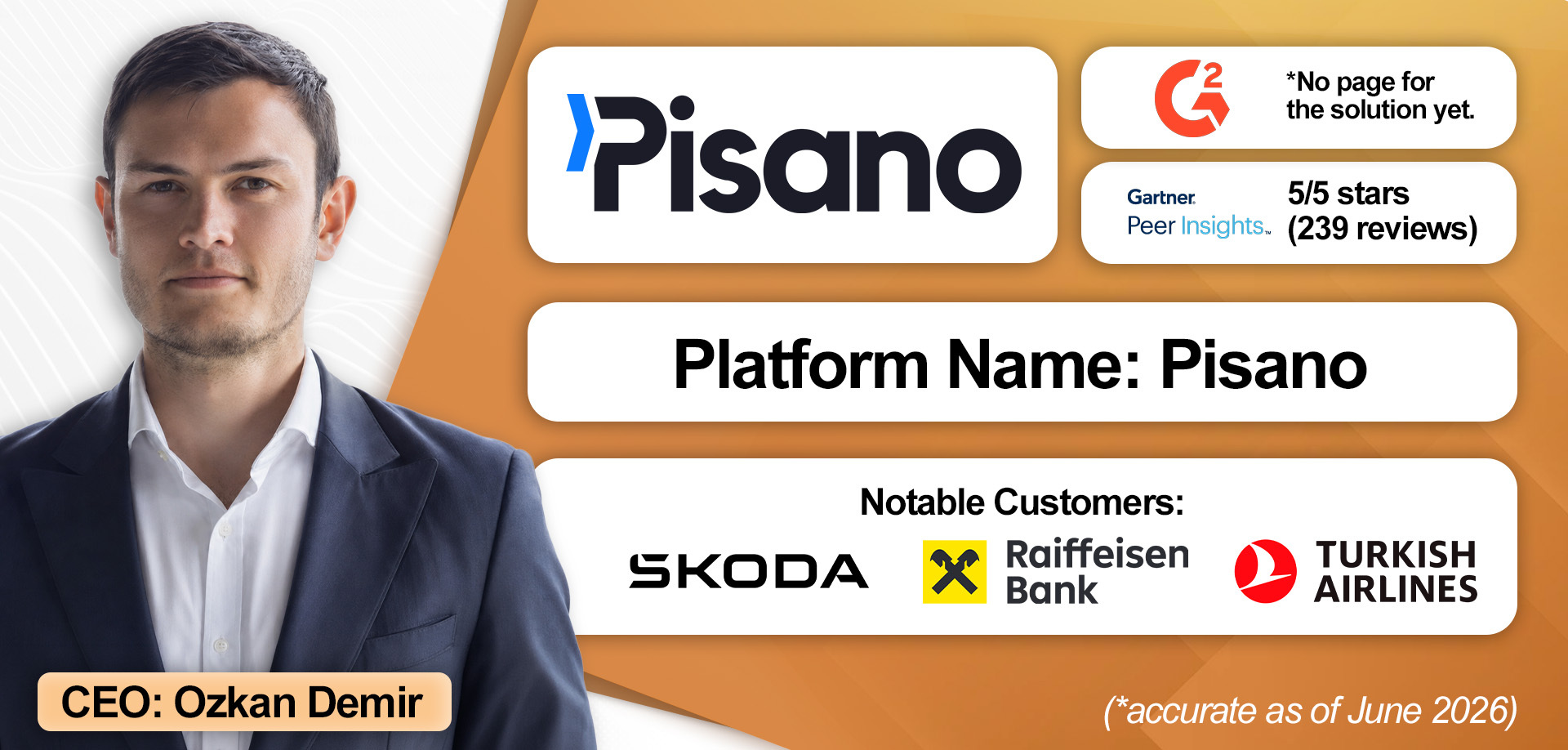
Pisano's ultimate goal is to ensure that every VoC stakeholder, from analysts to executives, has the tools needed to make informed decisions.
Real-time data access and hierarchy-based permissions aim to ensure the right information is available to the right people, while the platform’s AI assistant, Leo, delivers role-based insights and action recommendations.
Leo also helps optimize surveys and interrogate VoC data, reinforcing Pisano’s ease-of-use differentiation, also evident in the platform’s intuitive interface and low learning curve.
Yet, perhaps it’s most evident in Pisano’s approach to integrations. It offers a team dedicated to tailoring integration solutions that align with a brand’s existing workflows and systems, so they don’t have to realign their infrastructure. As such, organizations in highly regulated industries can host their software locally while integrating Pisano into their existing systems.
Interestingly, Pisano also works closely with prospects to build business cases by defining key customer, employee, and business outcomes, setting benchmarks, and delivering highly customized proof of concepts (PoCs) to secure buy-in.
Finally, the vendor offers user experience testing and market research capabilities to surface deeper VoC insights and connect them to broader trends, informing strategic decision-making.
Standout Features
- Ease of Use: Pisano’s platform is designed for simplicity and ease of adoption, delivering a low-effort user experience. Its AI-powered assistant, Leo, provides role-based insights and recommended actions, also guiding users through survey creation and Voice of Customer (VoC) data analysis, helping teams spotlight key VoC insights faster.
- Integration Support: The provider’s integration team works closely with customers to tailor integration solutions that align with existing workflows and technology ecosystems, while offering flexible deployment options across on-premise, cloud, and hybrid environments.
- Sales Experience: Pisano partners with customers to build a compelling business case for investing in its VoC platform. That involves aligning on outcomes, benchmarking data, and value-discovery workshops that enable a tailored POC, helping CX leaders justify their investments while accelerating time to value.
How Much Does It Cost?
Pisano agrees on a flat rate with its customers after the POC, allowing them to leverage as many features and integrations, send as many surveys, and process as much data as they require. Discover more about Pisano’s differentiated pricing model here.
11. Xebo.ai
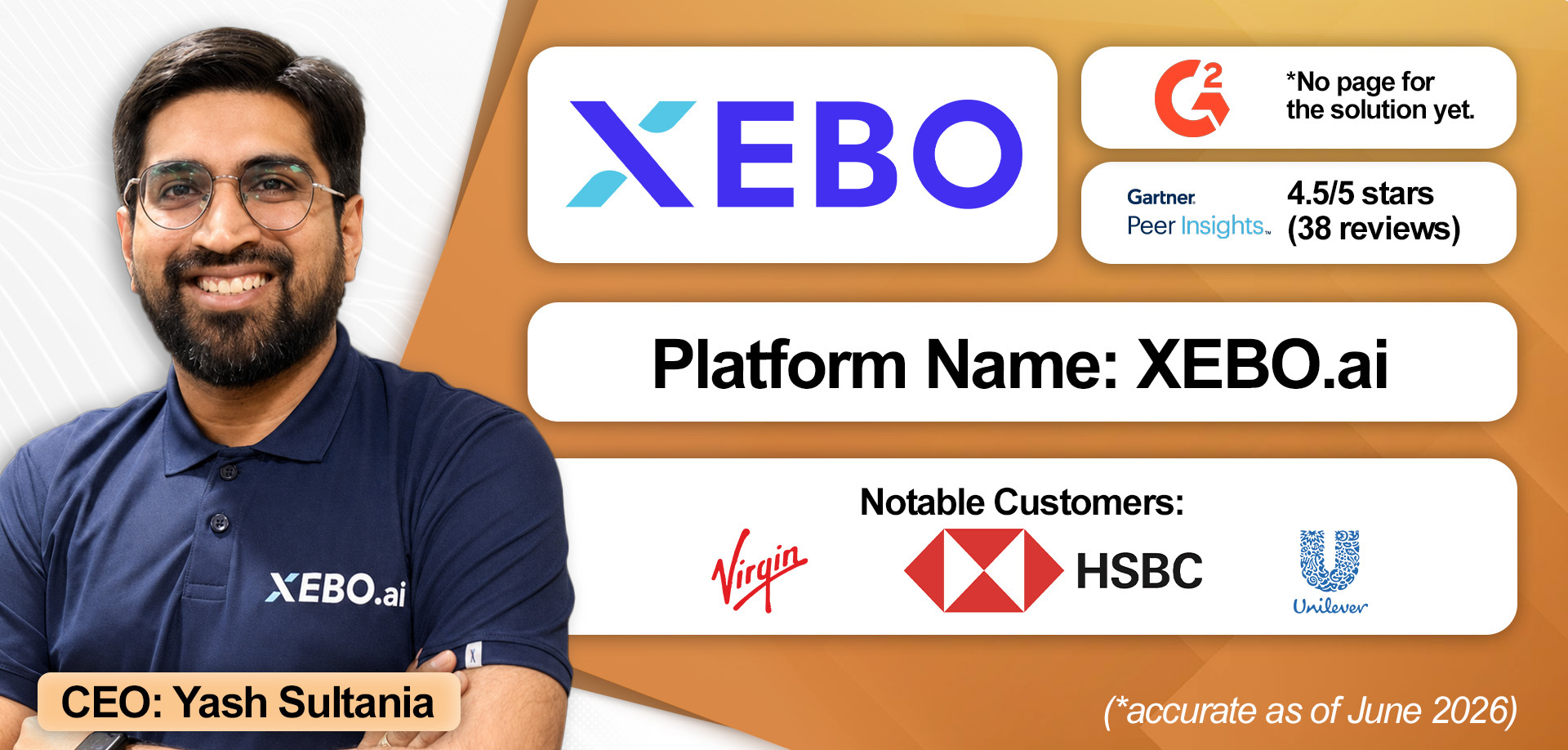
Xebo.ai offers several differentiative AI tools. Its Copilot, which assists users in mapping out end-to-end customer journeys, is an excellent example, as is its Text Genie, which spotlights irregular feedback patterns across those touchpoints.
The provider’s digital research capabilities also stand out. For instance, it analyzes how particular online customer behaviors influence purchase decisions. Meanwhile, its ad testing helps test resonance across the online experience.
Another novel, but powerful offering within Xebo.ai is Xebo Audiences. This is a consumer network of over 335 million engaged respondents across 130 countries. The vendor’s customers can tap into their network for localized research without exhausting their own customer contact lists.
However, Xebo.ai’s key differentiator is its flexible deployment options, offering both cloud and on-premise hosting to meet strict compliance requirements, with local servers across India, Saudi Arabia, Singapore, the UAE, and the US.
As that list of countries may suggest, Xebo.ai is most often deployed across the Asia Pacific (APAC) region, where it has a deep partner base and often wins due to its native support for Arabic.
On the support side, Xebo.ai provides resident engineers for on-site implementation and ongoing assistance, backed by 24/7 global technical support. This aligns with the needs of enterprises operating complex, legacy infrastructures.
Standout Features
- Digital Research Tools: Xebo.ai provides advanced capabilities to analyze how customers interact with brands online, including monitoring behavior, testing ad performance, and benchmarking competitors.
- On-Premise and Cloud Hosting: The provider offers both deployment options, making it well-suited for organizations with complex compliance requirements. This is particularly relevant in APAC, where Xebo.ai is widely used due to Arabic support and localized, first-party services.
- Xebo Audiences: Xebo.ai claims to operate one of the world’s largest consumer networks for digital research, with over 335 million respondents. It enables targeted audience selection through proprietary sampling logic, reducing the need to overuse customer contact lists.
How Much Does It Cost?
Xebo.ai offers a basic Survey Software plan for free. However, pricing for its enterprise-grade CX Suite and Research Suite is only available upon request. Learn more about these plans and request a demo from Xebo.ai here.
Trends Reshaping the Voice of the Customer Market
While analyzing the 11 VoC solutions above, several trends emerged in how providers are advancing their offerings. Here are the most notable examples.
VoC Solutions Shift from Insights to Action
For years, organizations focused heavily on dashboards, scores, and trend reports. Increasingly, they're realizing that reporting isn't enough. They need systems that recommend and facilitate action.
For example, imagine a customer attempting to redeem a coupon online. The coupon generates an error.
Instead of simply identifying the problem, an intelligent, connected system could:
- Understand what the customer is trying to purchase
- Determine eligibility
- Apply a replacement discount automatically
- Complete the transaction
Many VoC vendors, including Qualtrics, Sprinklr, and Medallia, already identify issues and trigger automated workflows. The next step is enabling systems to autonomously execute tasks, as in the example above.
MCP Wrappers Become All the Rage
More enterprise providers are embedding AI agents into their software. The ability of these agents to communicate with agents in third-party systems enables brands to automate cross-functional processes.
Agent-to-agent protocols, like MCP, enable this communication, taking insights and translating them into actions across the enterprise.
Recognizing the value in their insights, VoC providers are laying MCP wrappers across their solutions. Medallia, Sprinklr, and Chattermill are prime examples.
While this is the case, there is still value in simpler workflow automation solutions VoC vendors offer, especially as enterprises overcome the complexities of safely and securely coordinating agents across systems.
Synthetic Data Plugs Gaps In VoC Coverage
Customers are becoming increasingly reluctant to share data and fill in surveys, making traditional CX metrics, such as customer satisfaction, customer effort, and net promoter scores, more difficult to monitor.
As a result, more VoC providers are analyzing the drivers of these KPIs, along with other data sources such as contact center conversations, to generate synthetic metric scores.
Yet some are taking synthetic data use cases further. For example, Qualtrics offers Synthetic Panels to help brands evaluate new product or service concepts.
Rather than recruiting participants and waiting weeks for feedback, these Synthetic Panels use AI models trained on hundreds of millions of data points to simulate responses and generate directional insights immediately.
Expect more use cases like this to emerge as brands consider the possibilities for synthetic data and predictive analytics more deeply.
Omnichannel VoC Is Still the Future for Many
Most organizations have only activated one or two customer feedback channels, typically surveys and perhaps support interactions.
Very few have implemented true omnichannel listening.
To address this, VoC providers continue to launch new omnichannel capabilities and native integrations with platforms such as CCaaS, CRM, helpdesk, social media management, and various other solutions.
These integrations are more often preconfigured to accelerate time to value. That said, implementation projects still often take between six and twelve months to produce omnichannel visibility and enable meaningful outcomes.
Surveys Go on the Back Burner
Organizations are reducing their reliance on customer surveys, realizing that the more questions they ask, the lower the response rates become.
As a result, more companies are emphasizing other sources of customer insight, including social media, operational data, support interactions, and behavioral data.
Verint is an example of a vendor that excels here, normalizing and pooling data inside its Engagement Data Hub to correlate insights. Yet others are also expanding their portfolios and customer data platform (CDP) integrations accordingly.
VoC Providers Expand Into Market Research
More VoC providers are moving into market research, not only to gauge customer reactions before product launches but also to create continuous feedback loops that inform ongoing product improvements.
Qualtrics is a strong example, automatically creating tickets when customers raise product issues or concerns around pricing, terms and conditions, or something else.
However, it’s not the only provider. For example, Alchemer, Medallia, and Pisano are all adding similar capabilities to their platforms.
Compliance, Security, and Compliance Requirements Rise
As AI advances, new regulations emerge, and an emphasis shifts onto vendors’ compliance, security, and governance practices. This is especially the case in Europe.
On the compliance side, brands should maintain certifications such as European Data Protection Seals for GDPR, ISO 27001, AICPA SOC 2, FedRAMP for the public sector, and HITRUST.
While not all of these certifications are European, many buyers in Europe view them as proof of a vendor’s ability to meet their requirements.
Meanwhile, some providers will collect additional certifications to go above and beyond, projecting these as a key differentiator.
For instance, Medallia, Qualtrics, and QuestionPro have moved to become ISO 42001 certified, which means they have committed to ethical AI governance and practices. These include not training AI models using customer data.
Vendors Start to Reframe Themselves as Transformation Partners
In recent years, VoC vendors have rebranded themselves as experience management providers, with Qualtrics and Medallia leading this trend.
Yet, now, some are going further, reframing themselves as strategic partners, not just technology providers, and offering much deeper support services.
Concentrix is the best example of this. Its entire proposition is: work with us, not just on VoC, but to lead your entire customer experience transformation.
That’s potentially an excellent option for brands stuck in the day-to-day routine of firefighting and, therefore, struggling with longer-term planning. However, brands may have reservations that a large-scale service provider may not provide a fitting, bespoke strategy.
For these companies, Chattermill’s approach may be a better fit. It pairs its technology with an Experience Growth Strategist to drive organizational alignment, ensuring teams not only receive VoC insights but also know how to act on them.
The Future of the Voice of the Customer Space
VoC providers are capturing more customer, employee, and business insights, positioning themselves as the primary system of reference for customer experience transformation.
However, they face stiff competition from CRM giants, CDP vendors, and even CCaaS vendors, all striving to earn that mantle.
As this trend takes hold, the lines between VoC and its adjacent categories are fading fast, with vendors like Qualtrics even owning solutions such as contact center agent assist.
Expect more VoC vendors to make similar moves, bidding to bolster their worth within the enterprise and become that system of reference.
Their reputation as “survey companies” remains a blocker. Nevertheless, VoC vendors will continue to collect richer data and showcase how they’re helping customers turn that data into effective, cross-departmental action to challenge such perceptions.