Across many of these vendors, feature parity is high. As such, it can be tricky for buyers to see through the weeds.
As they attempt to do so, it becomes easy to get lost, and brands often over-index on platform selection and under-index on experience design. That’s a mistake. After all, implementation primarily determines success.
Given this, here are the most crucial areas for differentiation in the conversational AI market to help cut through the noise:
Support with experience design
Implementation quality
Pre-built integrations
Industry-specific models
Speed to launch
Governance and compliance
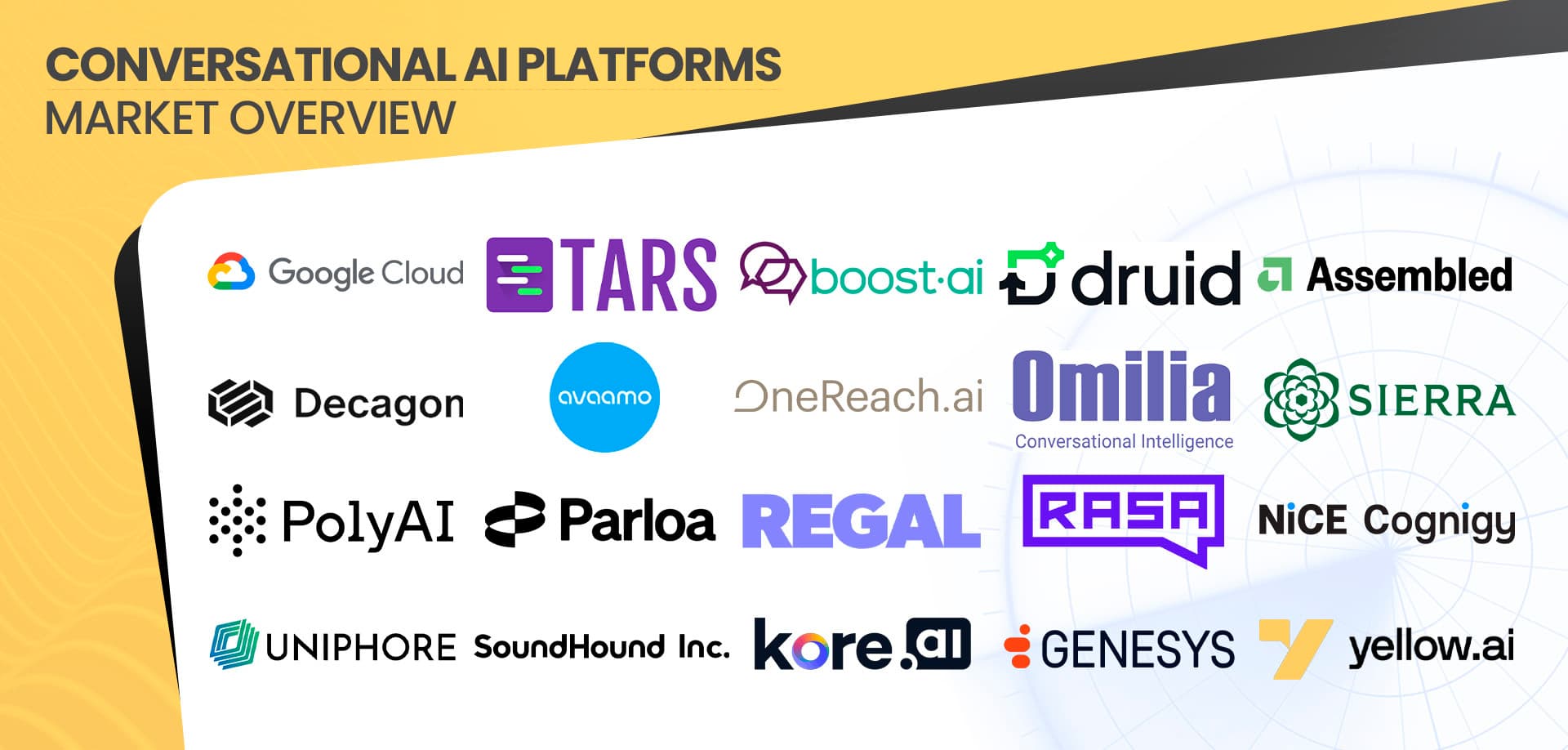
There are also some more distinct differentiators between the leading brands. So, here’s a closer look at 20 of the big-name players and some of their platforms' standout features.
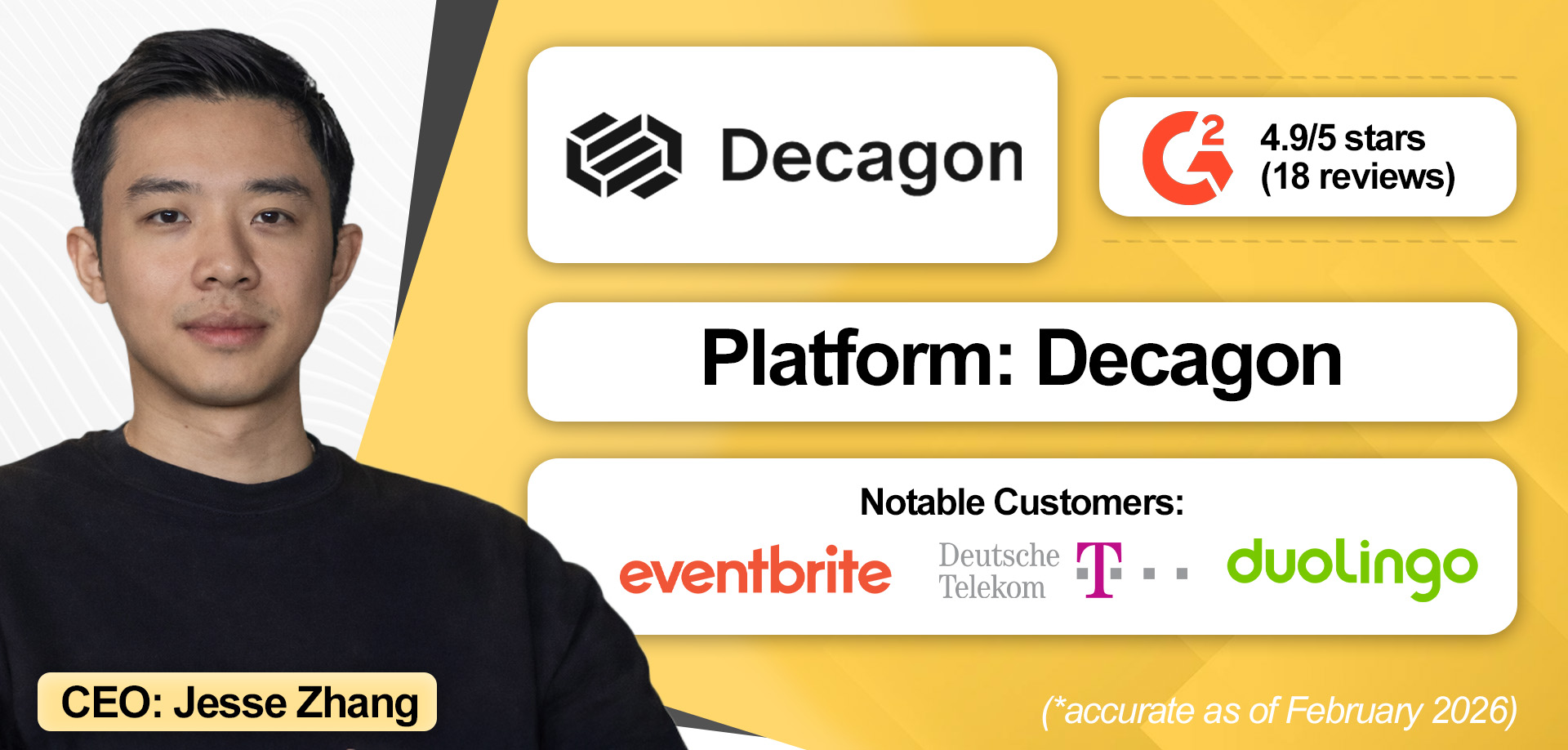
1. Decagon
Founded in August 2023, Decagon raised $250 million in January 2026, tripling its valuation to $4.5 billion in less than six months.
Investor confidence comes after Decagon picked up over 100 new global enterprise customers in 2025, including Deutsche Telekom, Avis Budget Group, and Block.
In doing so, Decagon told a story of building a system where customer experience leaders shape the experience while IT teams maintain full control under the hood. That vision is realized through its Agent Operating Procedures (AOP).
With AOPs, service experts write natural-language instructions for handling cases and overcoming common objections, which the technology then translates into code.
As a result, the service team can mold the AI’s logic around what’s best for the customer while the engineer hooks into the underlying code to enforce rules, establish guardrails, and connect it with internal systems to pull data and take actions.
Essentially, this helps establish clear roles, CX leaders become CX architects, and technical teams retain control over the core code.
Standout Features
Agent Operating Procedures (AOP): AOPs enable brands to build AI agents using natural-language instructions combined with the precision of code, allowing CX teams to shape how agents handle complex, multi-step situations while engineers retain control over logic, guardrails, and system integrations.
Decagon University: In a crowded conversational AI space, execution is a key differentiator. With Decagon University, the vendor provides a curriculum designed to upskill teams, especially non-technical ones, to be AI-native and highly productive. It’s designed to teach teams how to use AOPs, prompt AI agents effectively, and build AI systems confidently.
Conversational AI & Analytics: Decagon utilizes language models to read every conversation and extract meaningful insights automatically. This allows organizations to flag rare but critical issues, identify opportunities for improvement, and even suggest changes to the agent to improve over time, so its AI agents become self-learning.
How Much Does It Cost?
Decagon supports two pricing models: per-conversation and per-resolution pricing. Typically, customers opt for the former option as it's more predictable. However, the latter ensures brands only pay when their conversational AI starts delivering results. The vendor doesn't publicly disclose exact costs across both models, and prospects should request a demo for more information. Discover more about Decagon’s pricing model here.
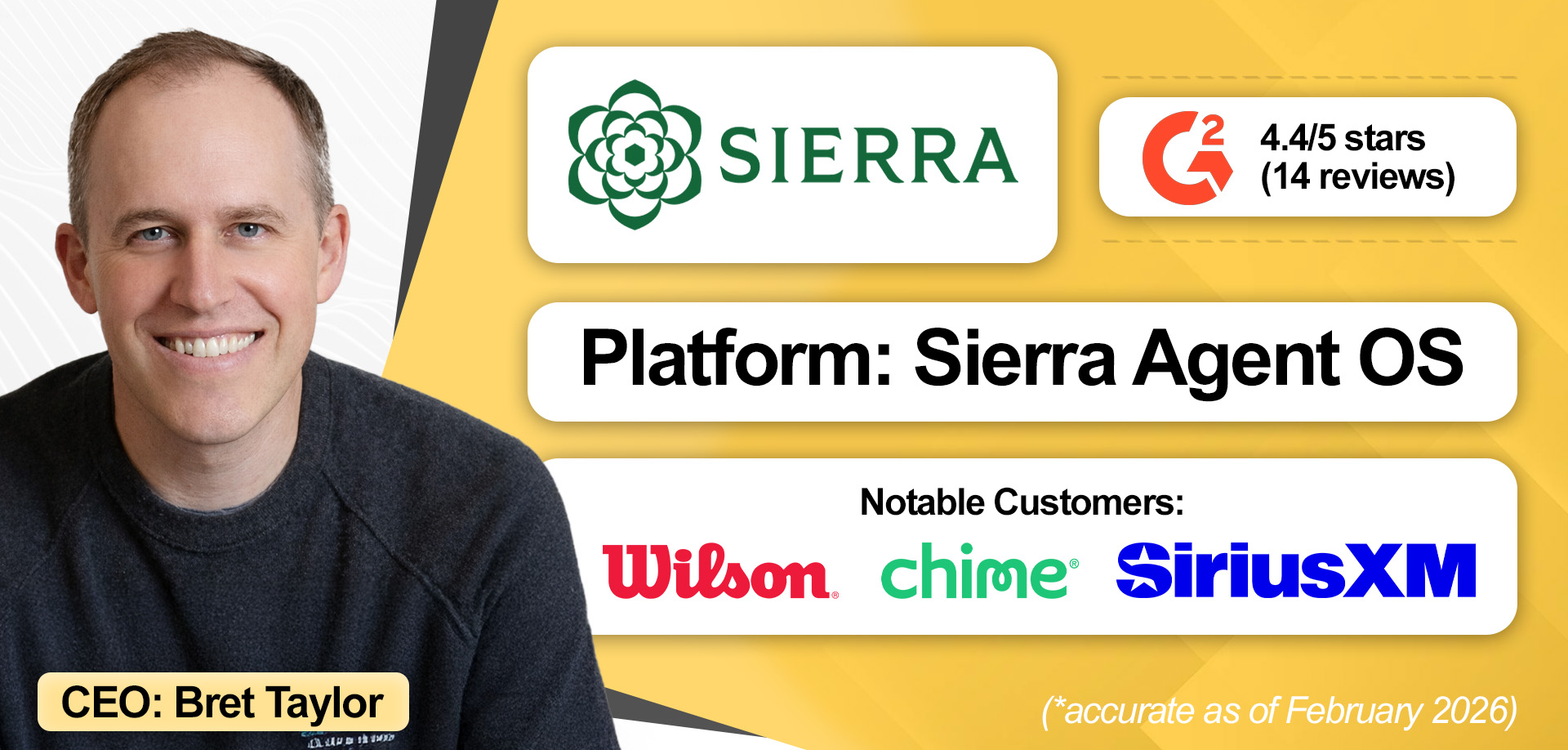
2. Sierra
Founded by former Salesforce co-CEO Bret Taylor, Sierra positions itself as a conversational interface with a deep focus on customer context and interaction value.
One example of this philosophy in action is its investment in context engineering. Sierra has an engineer dedicated to improving the context served to Cursor through an MCP (Model Context Protocol) server. The guiding principle is simple: if Cursor generates something incorrect, don’t just patch the output, diagnose the cause. What context was missing? What information would have led to the right result?
The belief is that when a strong model makes a poor decision, the issue is usually insufficient context. That means carefully examining the intersection between the codebase and the model’s available inputs, then fixing the problem at its root. This systematic approach to context is central to how Sierra improves performance over time.
The company also adds robustness through layered supervision. It deploys AI agents to monitor and catch mistakes made by its customer-facing agents, introducing an additional layer of reasoning and quality control to strengthen overall reliability.
Finally, Sierra champions outcome-based pricing. Rather than charging purely for usage, it ties its fees to measurable business results, such as successful resolutions or even sales conversations.
By structuring pricing around outcomes, Sierra aligns its incentives directly with those of its customers, only getting paid when its technology delivers tangible results.
“If enterprises want to jump straight to AI-first architectures rather than evolve legacy stacks, vendors like Sierra become attractive… If they succeed at scale, that puts real pressure on established vendors.”
Derek Top
Principal Analyst and Research Director for Opus Research
Standout Features
Context Engineering: Sierra goes beyond surface-level conversational AI by systematically improving model performance through context engineering. It diagnoses errors at the root, analyzing what context was missing and refining the intersection between the codebase and model inputs to drive improvement.
Layered AI Supervision: The company deploys supervisory AI agents that monitor and catch mistakes made by customer-facing agents. This added reasoning layer enhances quality control and system reliability over time.
Outcome-Based Pricing: Instead of charging for usage alone, Sierra ties its fees to measurable business outcomes, such as resolutions and sales conversations, ensuring tight alignment between its incentives and customer success.
How Much Does It Cost?
Sierra works with its prospects to define the specific outcomes they want to achieve with conversational AI and how those outcomes will be measured. It then creates a custom quote, ensuring Sierra only gets paid when it hits the agreed targets. Deep dive on Sierra’s pricing model here.
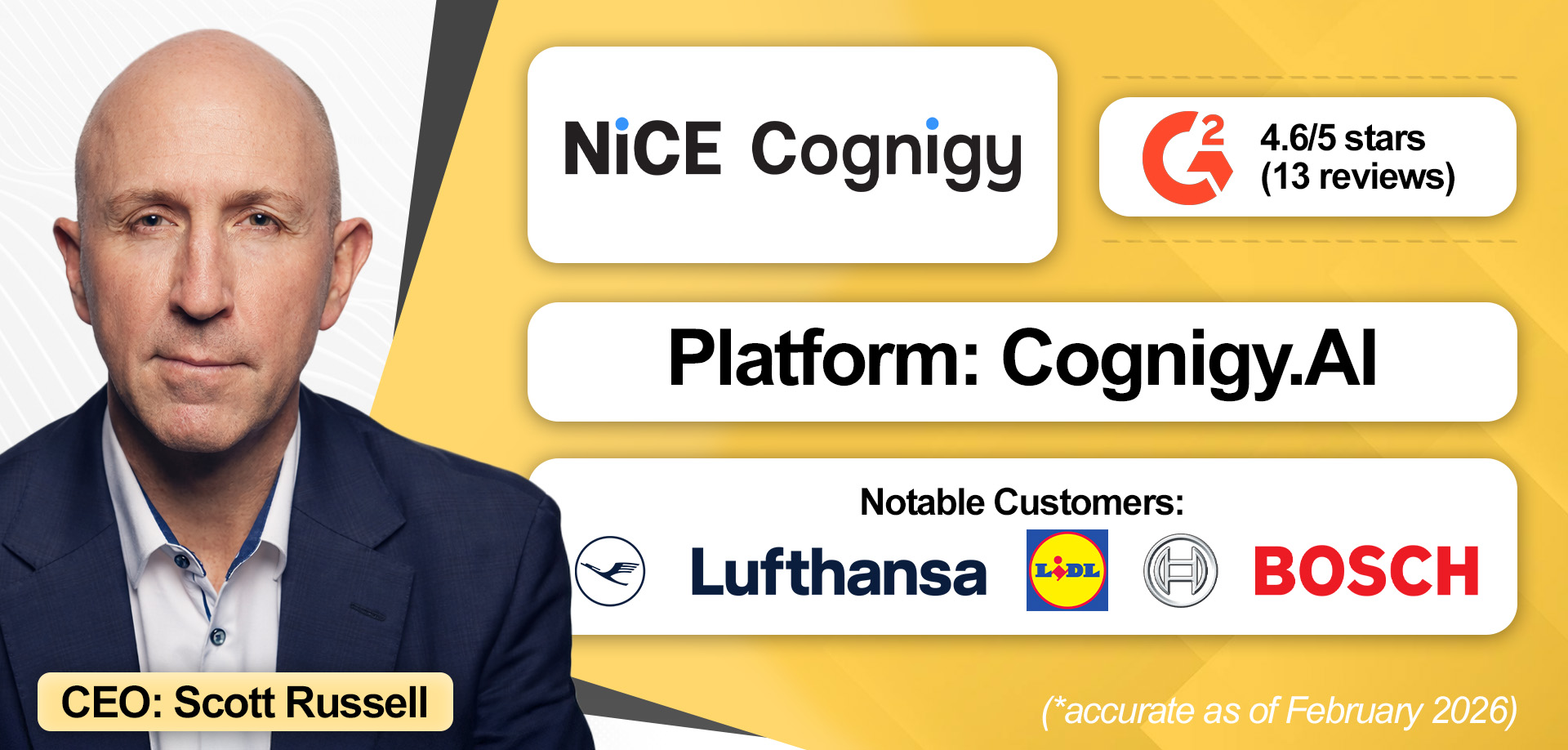
3. NiCE Cognigy
NiCE is the historic frontrunner in contact center workforce optimization (WFO). Cognigy is a longstanding leader in conversational AI. When the former acquired the latter in September 2025, this fusion became fascinating.
By merging advanced WFO capabilities with AI agents, brands may soon evaluate AI performance much like they would human agents, analyzing conversations in real-time and post-interaction to ensure accuracy, adherence to guidelines, and trustworthiness.
NiCE also brings advanced orchestration software and integrations with platforms such as AWS, Snowflake, Salesforce, and other key data hubs. These tools guide Cognigy’s AI agents as they begin to automate complex, long-tail resolution workflows across systems.
This orchestration layer also enables a proactive approach to customer service. AI agents can monitor signals across connected systems to detect potential issues and either resolve them automatically or proactively reach out to customers before problems escalate.
Additionally, NiCE’s conversational intelligence allows brands to analyze customer interactions across departments, not just within customer service. This comprehensive data view helps train AI agents to support broader customer experience initiatives, leveraging insights to improve engagement across more touchpoints.
Unlike competitors such as Decagon and Sierra, Cognigy is not a “rip-and-replace” solution. Instead, it supports brands that want to make incremental, strategic upgrades to their existing infrastructure, often supporting on-premise contact centers.
“We need specialized tools and different scorecards for AI conversations, AI agent governance, and continual learning. Look at NiCE’s performance management tooling and Cognigy’s AI, there’s definitely an opportunity there.”
Wayne Butterfield
Founder of STX
Standout Features
AI Performance Monitoring: The NiCE-Cognigy acquisition combines advanced WFO capabilities with AI agents to track and evaluate conversations in real time and after interactions, ensuring accuracy and consistency while boosting governance.
Workflow Orchestration: Thanks to NiCE’s close relationships with key data players, like AWS, Snowflake, and Salesforce, Cognigy’s agents appear well-placed to automate complex resolution processes that cross systems, once agent-to-agent communication improves. They may also advance proactive support strategies.
Conversational Intelligence: NiCE provides conversational intelligence solutions that break down customer interactions across teams to train AI agents for broader customer experience support, not just customer service.
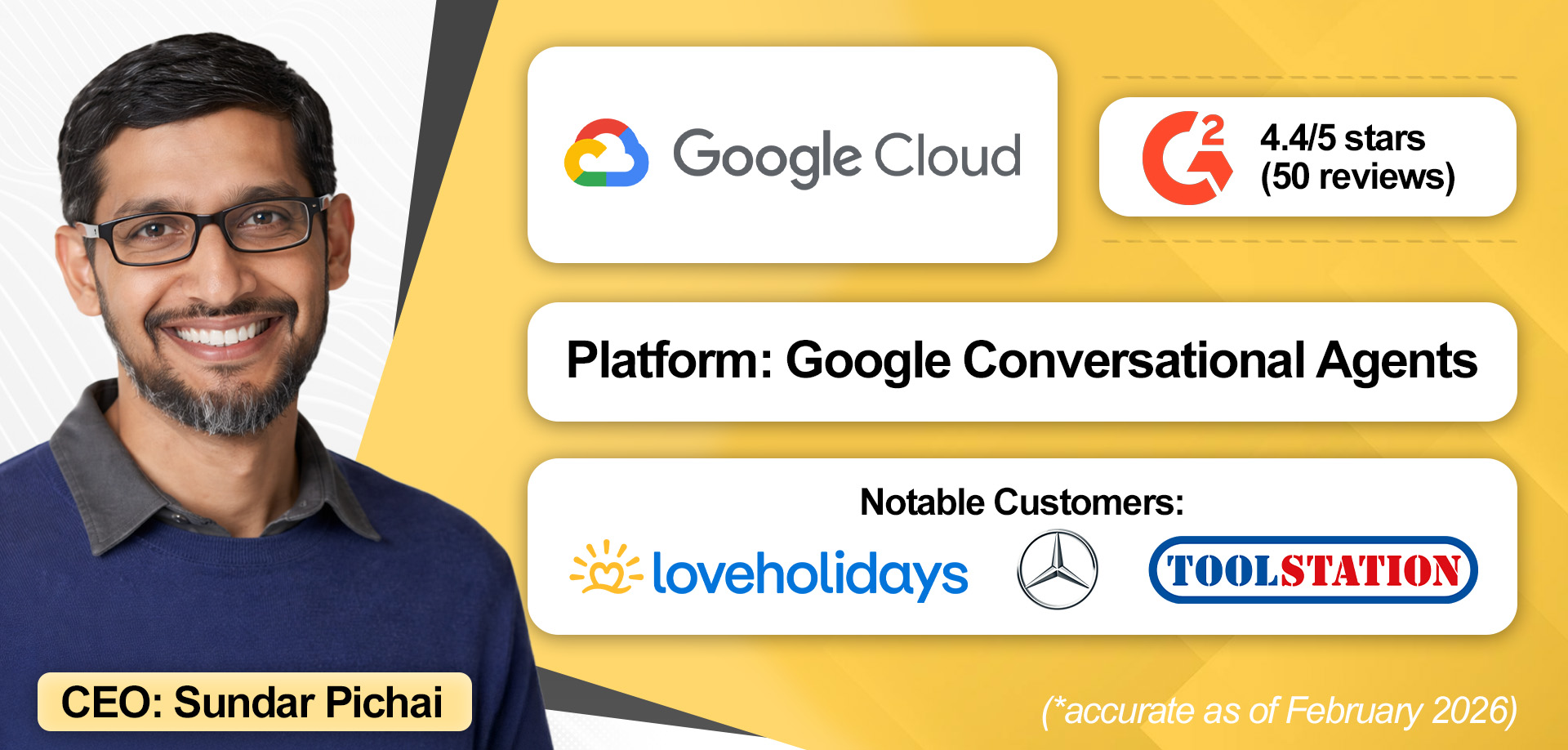
The Google Conversational Agents offering is a rebrand of Dialogflow CX, with a new user interface.
Google develops its AI in-house and hosts Conversational Agents within its own cloud infrastructure. As a result, the tech giant can lower the cost of conversational AI and has much greater control over its roadmap.
Additionally, thanks to Google DeepMind, it has an array of AI models, not just large language models (LLMs), which customers can blend to deliver innovative experiences.
It also has 12,000+ AI-related patents. One example, which Google filed in 2025, is for on-device AI agents that pick up contacts on behalf of customers. As such, Google is seemingly beckoning the future of AI-to-AI customer service.
Google’s customer mix is deep. Its new console experience and playbooks offer a simple developer experience, which especially appeals to smaller businesses.
Finally, Google packages its Conversational Agents within a Customer Engagement Suite, which includes CCaaS, WFO, conversational analytics, and more solutions that it can bundle as part of a cohesive contact center suite. However, it has received little marketing at this point.
Standout Features
AI Ecosystem & Innovation: Google develops its AI in-house, leveraging DeepMind models, which go beyond just LLMs. It also holds 12,000+ AI-related patents, enabling it to be first to market with many advanced capabilities.
Cloud-Native Infrastructure: Hosting Conversational Agents on its own cloud gives Google control over development, performance, and pricing, allowing for cost-efficient, scalable deployments.
Comprehensive Contact Center Offering: Google packages Conversational Agents within a broader Customer Engagement Suite that includes various contact center solutions, offering a unified platform with significant opportunities for innovation through interoperability.
How Much Does It Cost?
Google offers a transparent consumption model where chat agents cost either $0.007 per request (standard) or $0.012 per request (advanced). Its voice agents cost $0.001 per second (standard) to $0.002 per second (advanced). Learn more about Google’s Conversational Agents’ pricing model here.
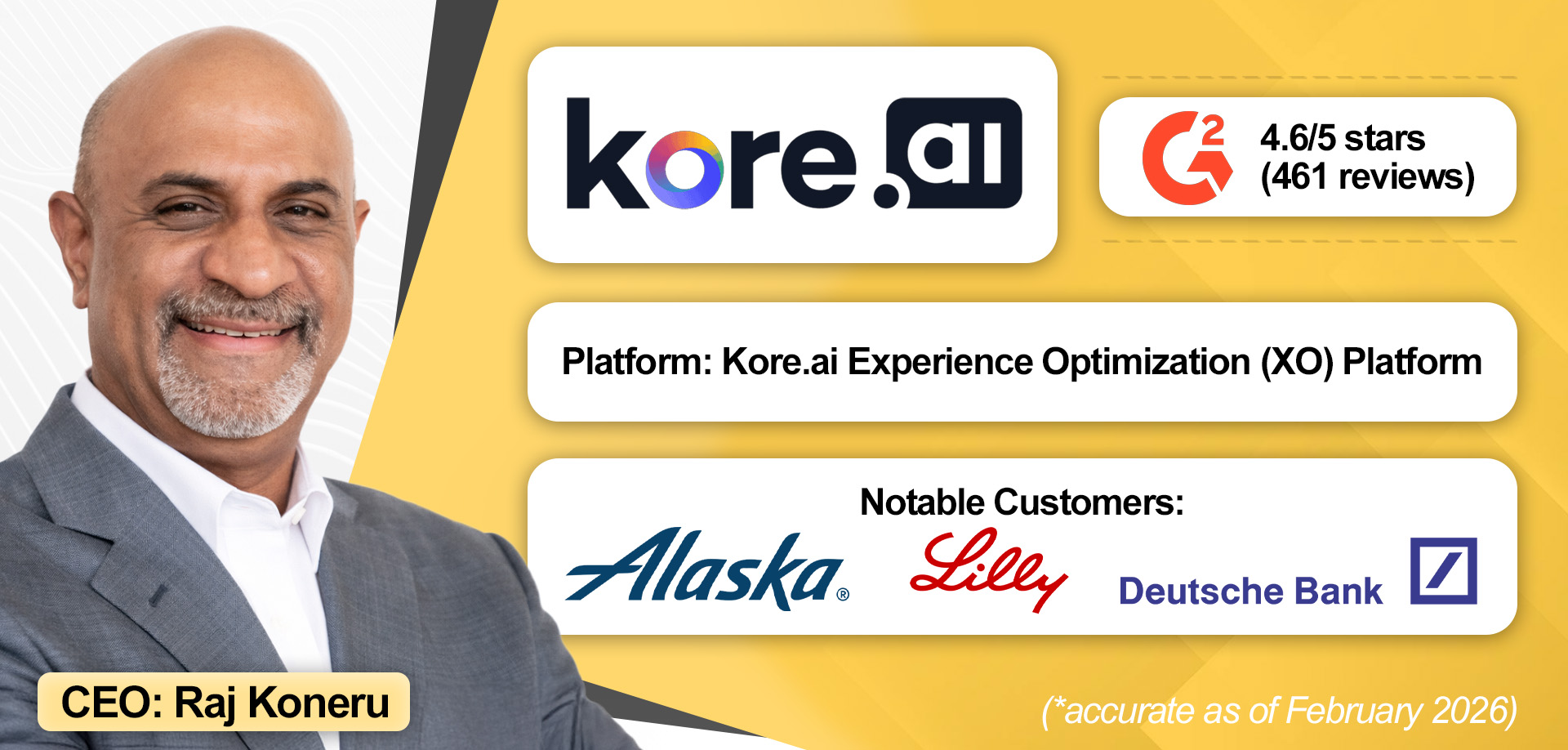
5. Kore.ai
Alongside Cognigy, Kore.ai frequently appears on CCaaS marketplaces. With NiCE’s acquisition of Cognigy, that shift could create an opportunity for Kore.ai to deepen existing relationships and expand its market presence.
Kore.ai has also developed conversational AI offerings directly on contact center platforms such as Genesys and Zoom, enabling more coordinated deployments than traditional integrations.
However, its integration strategy extends well beyond CCaaS. In 2025, Kore.ai announced deeper partnerships with Microsoft (Azure AI Foundry, Copilot, and Power Automate) and AWS (Bedrock, Q Index, and Q Workflows), and it is reportedly in discussions to expand its relationship with Google. This two-way interoperability allows developers to build AI agents on Kore.ai while consuming hyperscaler services or to build within hyperscaler environments and leverage Kore.ai components.
Beyond integrations, governance is a central pillar of Kore.ai’s strategy. The company aims to provide an enterprise-wide control layer that manages identity, permissions, observability, and oversight across all agents, regardless of model or deployment environment. While ambitious, this approach may resonate with organizations looking to deploy Kore.ai beyond customer experience, automating enterprise processes and employee work.
Finally, Kore.ai recognizes that vendors and businesses often speak at different levels of understanding. Its Kore.ai Academy, which comprises 250+ courses, helps close the gap.
“Kore.ai has had strong enterprise customers historically, especially in financial services. But the market is quickly shifting toward AI-first positioning. If they don’t move aggressively, they’ll face pressure from vendors born in the GenAI era.”
Derek Top
Principal Analyst and Research Director for Opus Research
Standout Features
CCaaS Integrations: Kore.ai maintains a visible presence across major CCaaS marketplaces and offers native builds on platforms like Genesys and Zoom, supporting tight operational alignment. NiCE’s acquisition of Cognigy could create additional room for Kore.ai to grow within contact center ecosystems.
Hyperscaler Relationships: The vendor has expanded strategic alliances with Microsoft and AWS in 2025, while it’s exploring closer ties with Google. Its architecture supports flexible deployment models, enabling organizations to combine hyperscaler capabilities with Kore.ai’s agent framework in either direction.
Broader AI Vision: Kore.ai positions governance as a foundational capability, seeking to unify oversight, access control, and monitoring across diverse AI agents and environments. The strategy looks beyond customer experience, connecting deployments with broader enterprise-wide automation efforts.
How Much Does It Cost?
Kore.ai pricing structures around three usage plans: Essential, Advanced, and Enterprise. Each tier offers progressively higher usage limits and more advanced features. However, Kore.ai doesn’t publicly disclose the cost of each plan. Find out more about Kore.ai’s pricing here.
6. SoundHound
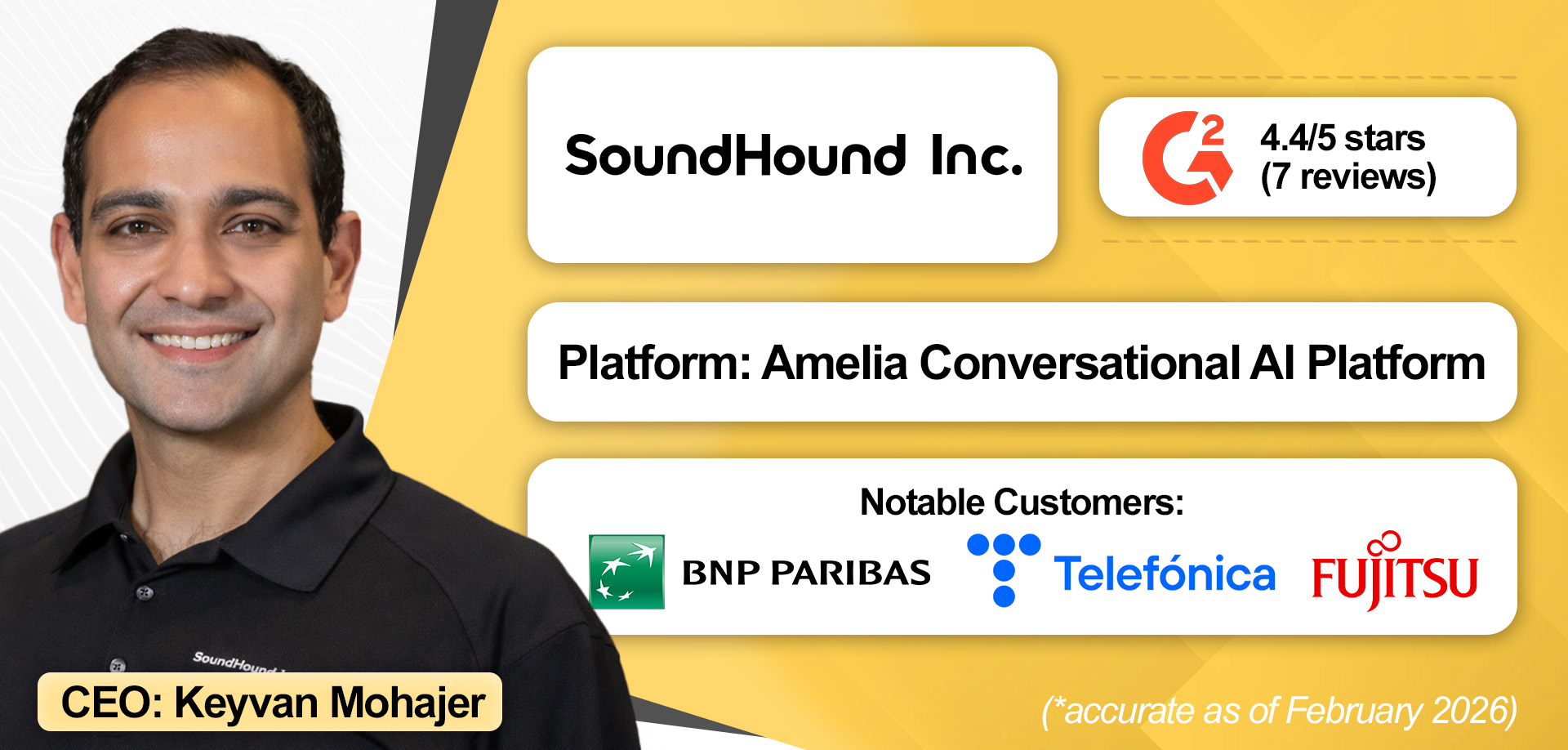
SoundHound is a voice-first conversational AI provider, partnering with brands to integrate white-labeled voice assistants into a wide range of products, from cars and televisions to drive-thrus and beyond.
Ultimately, this enables differentiated AI-led service experiences that operate independently of smartphones, extending the potential of voice AI to any product equipped with an IoT device.
In 2024, SoundHound expanded its capabilities by acquiring Amelia, a more traditional conversational AI provider, allowing it to extend its AI experiences into the contact center.
Amelia brought a strong focus on banking, which has now become a core strength of SoundHound. Today, the company partners with seven of the ten largest global financial institutions to automate customer service, while increasingly developing vertical-specific solutions to further differentiate.
Yet, voice AI remains SoundHound’s key differentiator. By owning its complete voice stack, the company maintains greater control over its roadmap, performance, and pricing.
Amelia’s expertise in layering digital elements, such as carousels and interactive buttons, onto smartphone-based voice interactions further enhances this advantage, helping users navigate complex decisions more easily.
“The hundreds of conversational AI vendors are being squeezed from multiple directions. So, many are becoming layers within larger stacks rather than standalone offerings for differentiation, like Amelia and SoundHound.”
Mark Smith
Chief AI & Software Analyst at ISG
Standout Features
Voice AI: SoundHound owns a complete voice stack, enabling greater control over performance, roadmap, and pricing. Thanks to its Amelia acquisition, it can also add digital overlays over smartphone-led voice interactions, taking multimodal experiences to the next level.
Extended Customer Service: The vendor powering differentiated AI-led experiences across a range of devices, not just the smartphone. Think of cars, televisions, or anything with an IoT device. As such, it can increase the scope for service and extend interactions into the contact center.
Financial Services: SoundHound leverages Amelia’s banking expertise, working with seven of the ten largest global financial institutions. It’s now building out additional vertical-specific solutions, recognizing this as a key opportunity for differentiation.
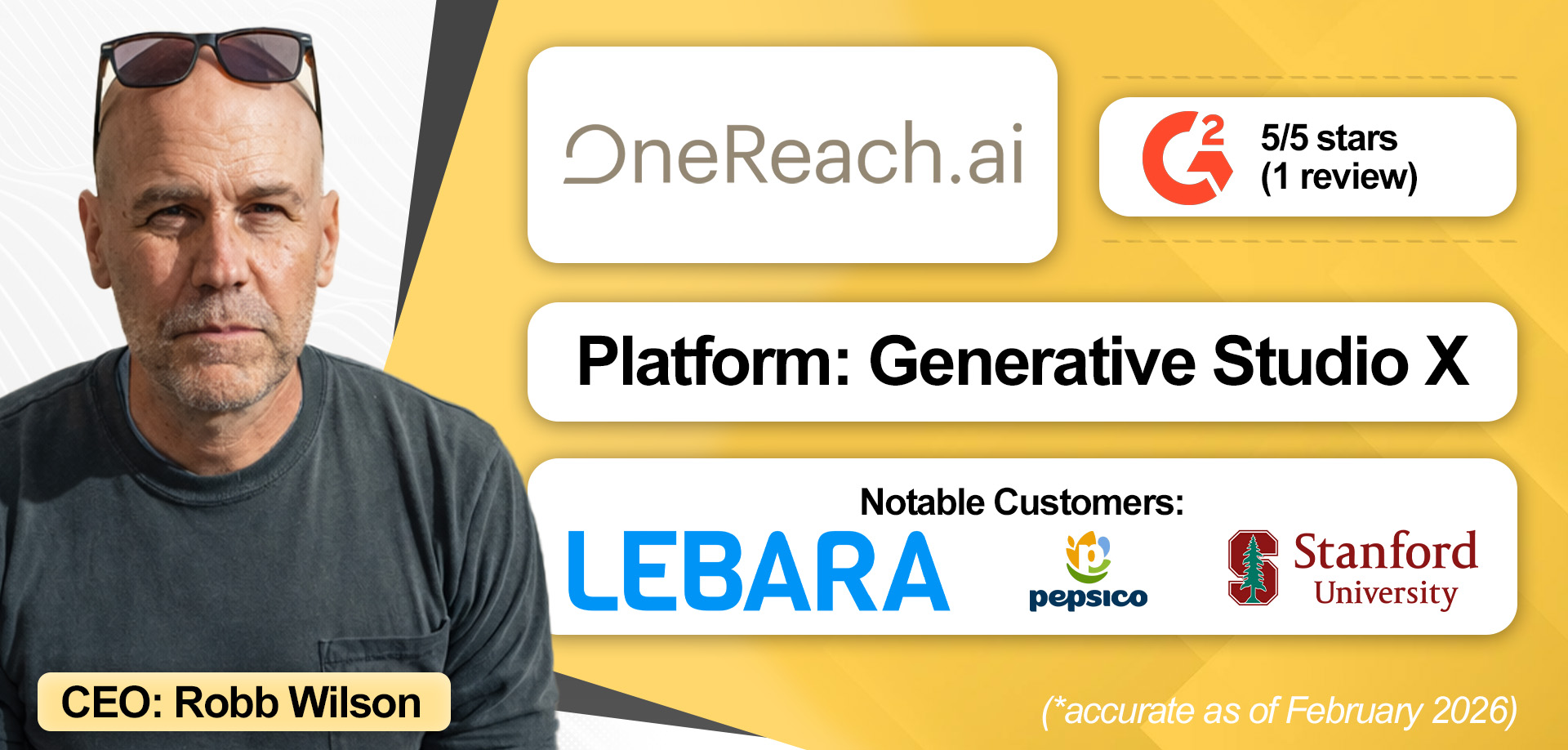
OneReach.ai has built a reputation as a hands-on vendor, guiding clients in developing AI design strategies that prioritize performance, which is a critical differentiator in a space often focused heavily on containment and deflection.
The vendor pairs this emphasis on education with a forward-looking vision that encompasses AI customers and digital twins. True to its reputation as a visionary, OneReach.ai was among the first enterprise-wide conversational AI vendors to embrace the concept of AI agent operating systems.
CEO Robb Wilson describes such a system as an agent runtime infrastructure, explaining that just as humans need a workspace and tools to perform their jobs, AI agents require a dedicated environment, access to knowledge, and the right tools to operate effectively. OneReach.ai aims to provide a secure and responsible environment where agents can function safely.
The company’s focus on safety aligns closely with its install base. By deploying exclusively in a private cloud, OneReach.ai attracts customers prioritizing data protection, uptime, and operational reliability.
While vendors with this model typically target large enterprises, OneReach.ai has historically offered advanced no-code tools, enabling organizations without extensive IT resources to leverage its platform, expanding its reach across the market.
Standout Features
Design-First Emphasis: OneReach.ai emphasizes design over technology. In doing so, it takes a collaborative, hands-on approach, helping clients design AI strategies that maximize performance and build internal expertise.
Agent Runtime Infrastructure: Embracing the concept of an AI agent operating system, OneReach.ai helps its customers establish a "runtime environment", which ensures AI agents can access the appropriate tools, knowledge, and workspace needed to function efficiently and effectively.
AI Safety: With deployments limited to private clouds, OneReach.ai prioritizes secure and responsible agent operation, appealing to organizations that value data protection, uptime, and operational reliability.
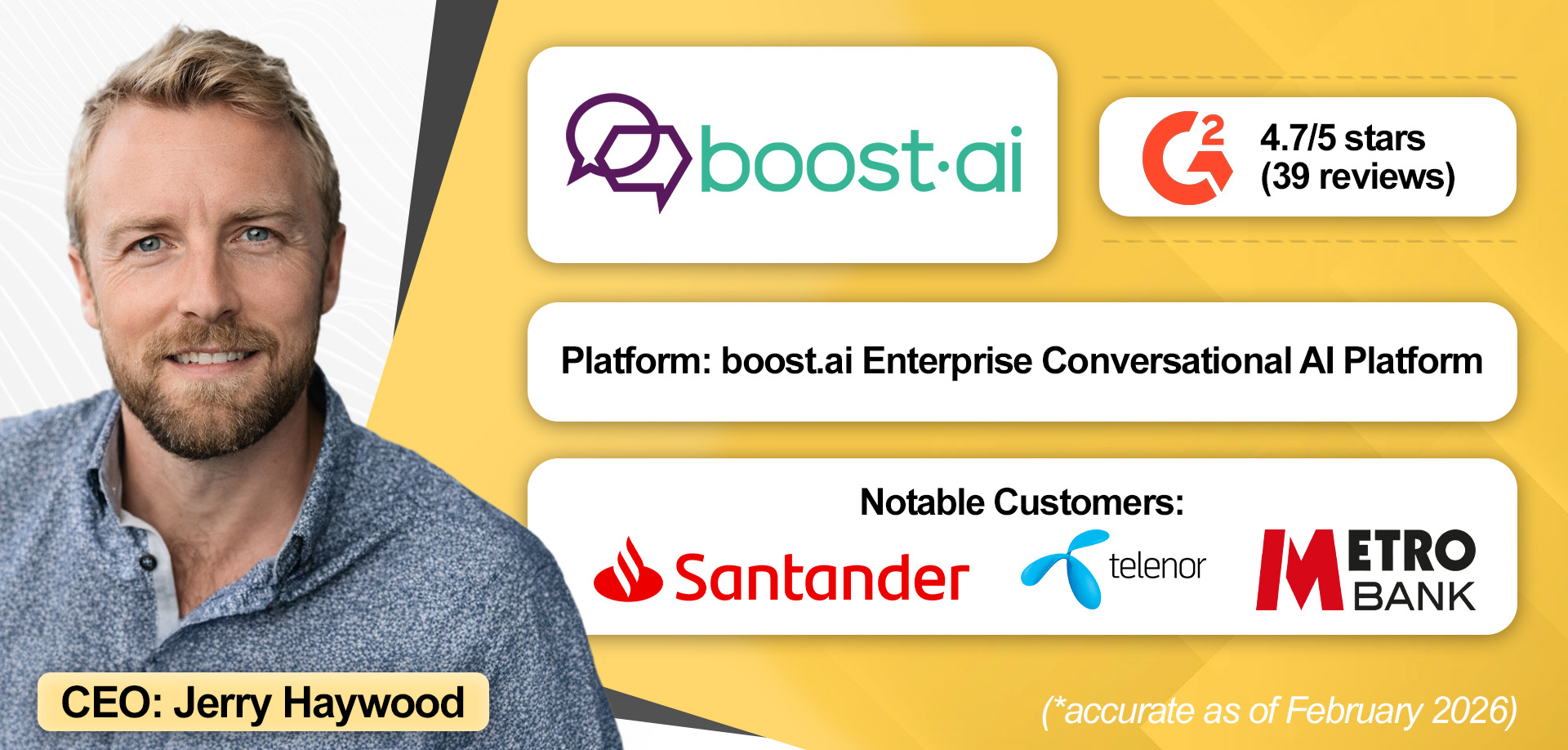
Boost.ai has intensified its focus on highly regulated industries, providing tailored, pre-configured integrations and workflows for finance, insurance, and the public sector.
Across these verticals, the vendor also leverages its broader strengths in pricing, speed to launch, and time to value, enabling clients in these sectors to go from zero to live quickly.
Supporting this rapid deployment are its pre-built integrations and workflows, alongside its Get Started Wizard, which streamlines the creation of intents and utterances.
Diverse deployment options and a significant presence across third-party tech provider marketplaces further highlight Boost.ai’s concerted effort to help connect the enterprise across industries where that is notoriously tricky.
Boost.ai is particularly well-positioned in Europe, where it has helped customers prepare for significant regulatory changes, including those introduced by the EU AI Act. Its educational materials surrounding the act and beyond reinforce its focus on customer experience, which is also reflected in its flexible implementation options across public cloud (Azure and AWS), hybrid cloud, and on-premise environments.
Standout Features
Speed to Launch: With rapid deployment options, pre-built integrations, and the Get Started Wizard, clients can configure functional AI agents in hours rather than weeks, maximizing time to value.
Customer Education: Boost.ai emphasizes customer education and guidance, helping clients understand best practices, navigate regulatory changes like the EU AI Act, and optimize their AI deployments for improved customer experience.
Understanding of its ICP: Boost.ai targets highly-regulated enterprises, delivering AI solutions that are accessible, intuitive, and scalable, without the complexity or cost of enterprise platforms.
How Much Does It Cost?
Boost.ai offers a subscription + consumption model. However, exact prices aren't publicly listed. Prospects can request a quote from Boost.ai here.
Unlike LLMs, LAMs are smaller, specialized models designed to predict next-best actions and execute tasks. They’re built to complete cross-system workflows autonomously, not just generate answers. According to Salesforce research, they’re already outperforming many mainstream LLMs in action-based scenarios.
Others may follow Genesys’s lead as agent-to-agent communication matures and cross-platform resolution becomes standard. But for now, the move reinforces Genesys’s reputation for innovation.
Yet, perhaps the real story may be in governance.
Alongside the launch, Genesys highlighted how its agent explains every action it takes, creating clear decision paths and auditable trails. That level of traceability, with built-in compliance artefacts, will be critical to scaling AI responsibly. Over time, that will prove more differentiating than model choice alone.
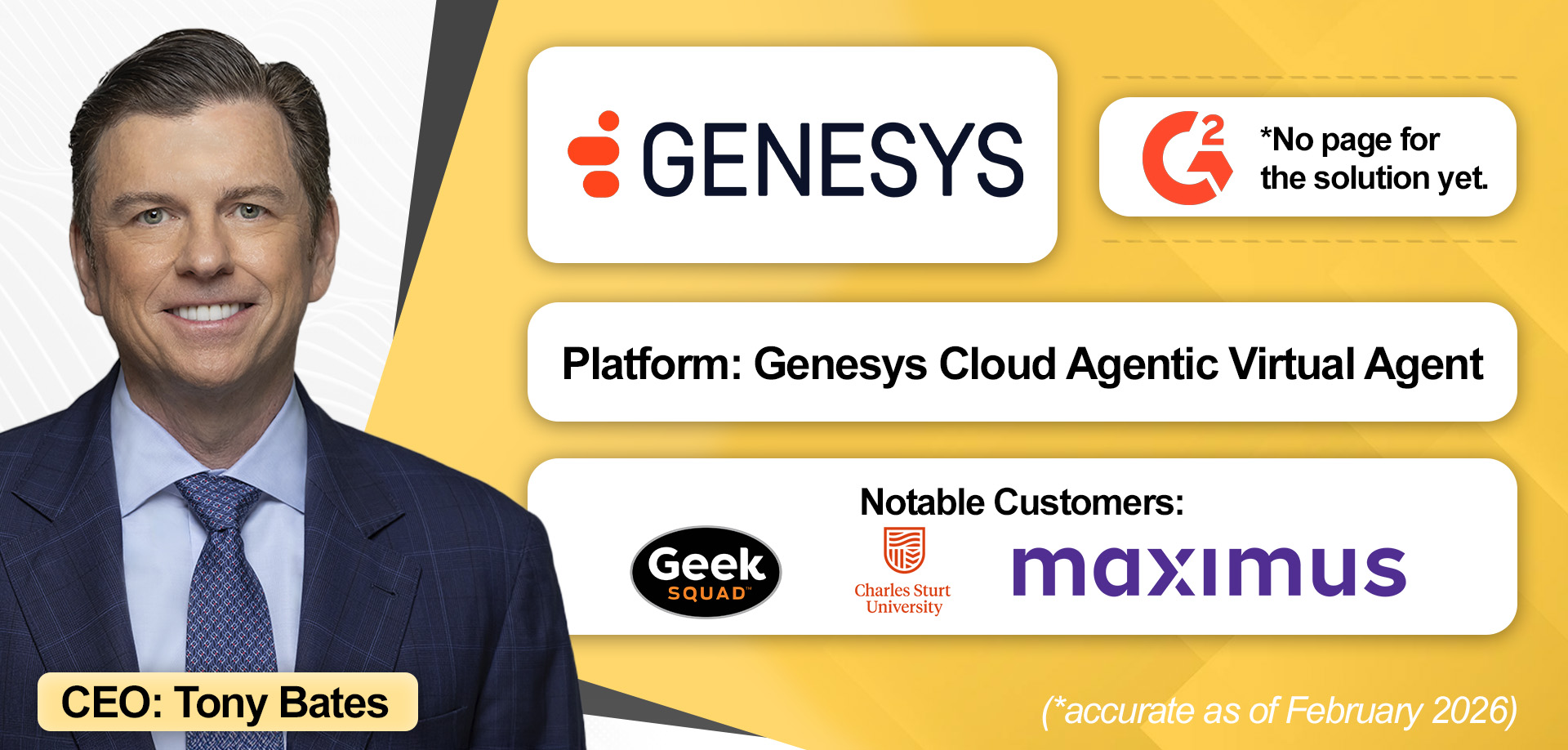
Genesys also enters this race from a position of strength as the CCaaS revenue leader. By pairing its Virtual Agent with its broader contact center portfolio, it can deliver tightly integrated, AI-led experiences end to end.
Take social listening. Genesys can detect negative sentiment online, automatically open a proactive support case, and deploy an AI agent to resolve the issue, all within its own ecosystem. That’s where things get interesting….
“Larger players, like Genesys, often benefit from scale, trial deployments, and enterprise reach, though differentiation increasingly depends on interoperability and go-to-market strategy.”
Mark Smith
Chief AI & Software Analyst at ISG
Standout Features
Governance and Compliance: Most governance systems focus on text-generation safety, i.e., hallucination management and bias control. Yet, Genesys’s virtual agent explains why it takes particular action and leaves audit trails. That’s next-level accountability and massive from a compliance standpoint.
Adjacent CCaaS Portfolio: Genesys has a vast contact center customer base, many of whom are likely to adopt the Genesys Cloud Agentic Virtual Agent. As they do, customers may blend conversational AI with its other customer service solutions to expand its scope. For instance, by combining it with social listening and case management, companies can spin up support cases based on negative customer feedback to proactively and autonomously resolve customer issues.
Innovation Streak: By being the first vendor to incorporate LAMs, Genesys presents itself as a thought leader, with a distinguished vision and roadmap. As such, customers may worry less about playing catch-up in the future of AI-led experiences.
How Much Does It Cost?
Genesys offers a tokenization model for its virtual agent, which generally consumes two tokens per customer interaction session. Tokens cost $1 each. However, Genesys also includes an allocation of tokens for companies already on one of its CCaaS packages. Unpack more information about Genesys's pricing model here.
10. Assembled
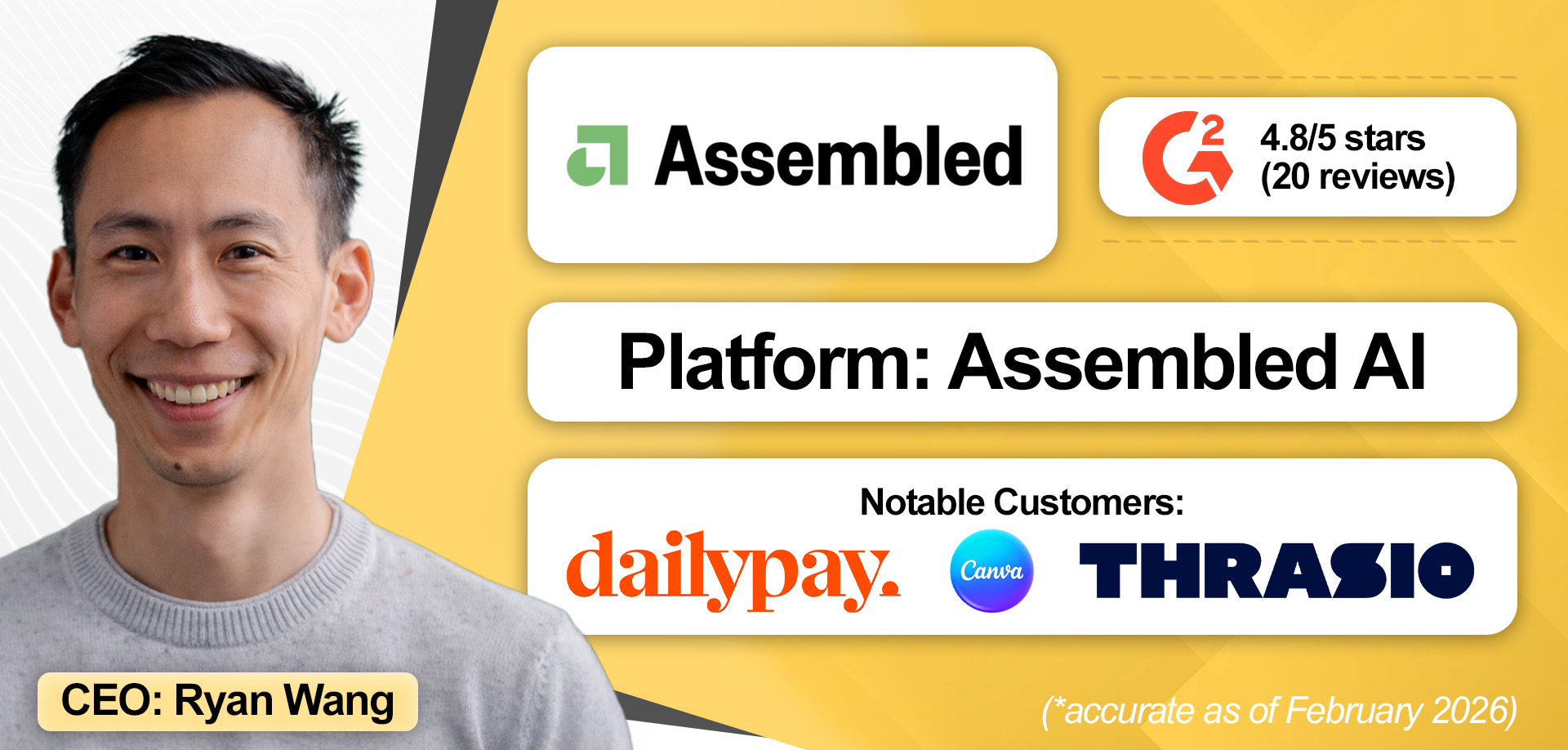
Assembled didn’t begin as an AI vendor. It started as a spreadsheet replacement for contact center workforce planners, built to solve forecasting and scheduling complexity. That operational foundation still shapes its approach to conversational AI.
Instead of pushing full automation, Assembled begins with a Copilot that drafts responses for human review. It measures how much editing agents do across intents, using real performance data to determine where AI is ready to take on more.
Automation then scales gradually. 10%, 20%, then 40% of responses auto-sent—through controlled A/B testing. Assembled calls this its 'baby bear approach': intentionally deciding where humans stay in the loop to protect quality without slowing progress.
Its WFM solution helps manage this process. It places humans and AI agents on the same dashboards, giving leaders a unified view of demand, cost, and performance. AI is treated as a new source of labor, one that must be planned, measured, and optimized.
For global brands already using Assembled WFM across numerous locations, that visibility extends across entire service networks. Leaders can see how automation affects staffing models and service levels across regions and partners.
With its upcoming Command Center, Assembled will orchestrate capacity planning across humans and multiple AI agents in one view, positioning it not just as an AI provider but as the system of control for hybrid support teams.
Standout Features
WFM Heritage: Workforce management data improves escalation decisions. AI adds operational complexity that must be managed. Given this, Assembled’s unique combination of conversational AI and WFM makes a lot of sense.
Contact Center Vision: As AI reshapes the industry, teams must think carefully about what comes next: What new roles will exist? What skills should people develop? How can we pivot staff into customer success and other roles as automation takes hold? Assembled is uniquely placed to answer these questions.
“Baby Bear” Approach: Assembled gradually increases AI autonomy in customer replies, starting with drafts for human review, then auto-sending 10%, 20%, 40%, etc., while allowing contact centers to A/B test and carefully control where humans stay in the loop, preventing oversight from becoming a bottleneck.
How Much Does It Cost?
Assembled AI agents cost approximately $0.65 per interaction. It defines an interaction as a full back-and-forth session within a 24-hour window. However, the vendor also offers its solution on a per-resolution basis. Learn more about Assembled’s pricing here.
11. Druid AI
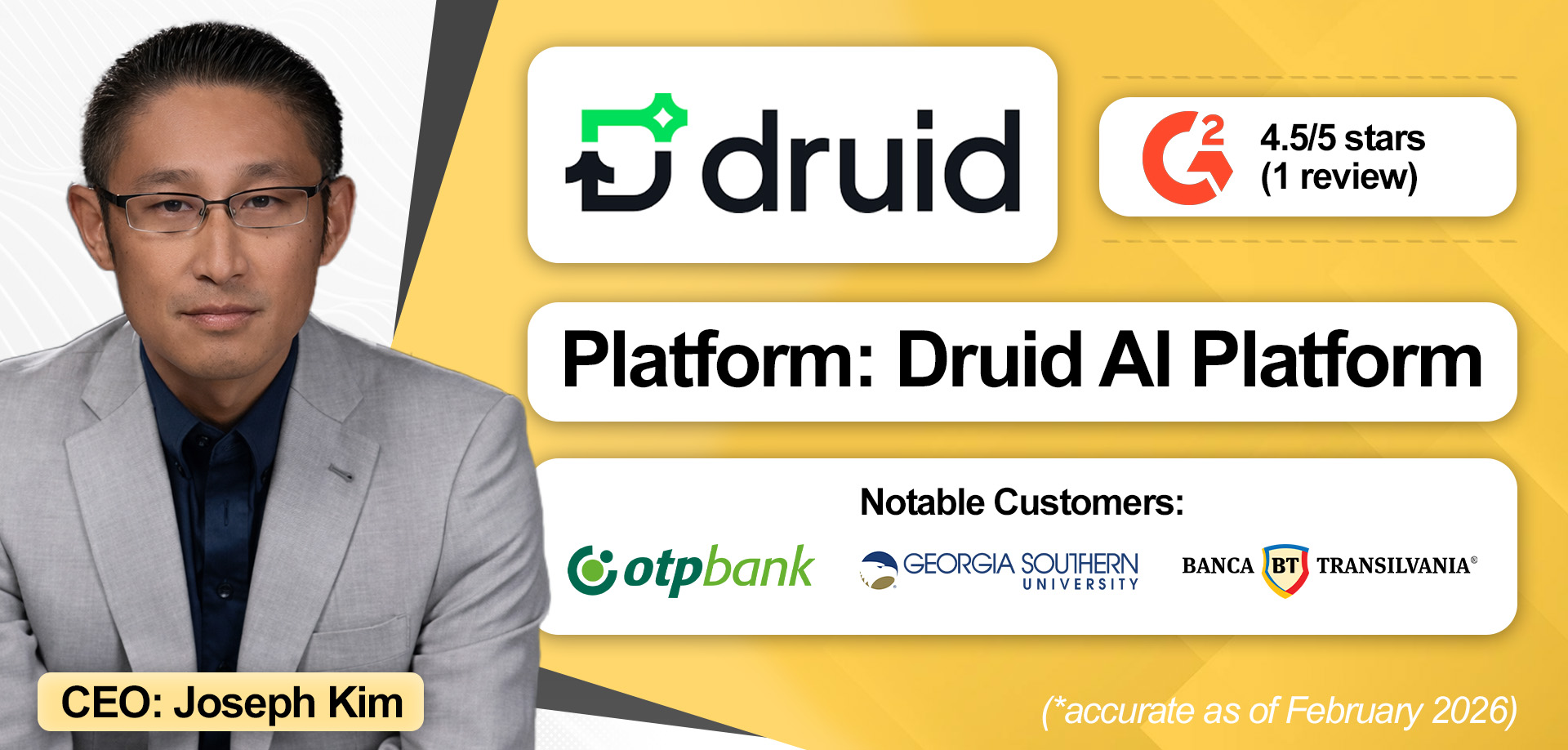
Druid AI has long prioritized workflow automation over simple question-and-answer functionality. This heritage naturally supports its pivot toward agentic AI, where it helps automate long-tail customer resolution flows with “micro-agents”.
Orchestrated by the Druid Conductor, the micro-agents handle discrete tasks across the service environment, collaborating with the customer-facing agent to solve queries.
Meanwhile, Conductor can coordinate both Druid agents and external agents, blending traditional integrations with AI-driven decision-making to extend resolution flows across enterprise systems.
In doing so, Druid forms what it calls a “second layer” of orchestration, emphasizing determinism, compliance, and control.
Additionally, Druid’s micro-agents have helped extend the library of pre-built use cases Druid AI offers, accelerating time to value. Its Authoring Agent also enables a faster ramp time, supporting non-technical teams in building new agents and expanding deployments.
Finally, Druid has strengthened its customer success function to support AI adoption more effectively. A prime example is its “AI laundry” approach, where the company helps customers navigate and evaluate different AI tools, clarifying capabilities and identifying which solutions will deliver real business value.
Standout Features
Micro-Agents: Druid’s micro-agents handle discrete tasks within customer workflows, orchestrated by Druid Conductor. In doing so, they extend resolution flows, expand the scope of automation, and bolster Druid’s library of pre-built use cases.
Speed to Deployment: Micro-agents have expanded the pre-configured use cases that Druid offers. Additionally, its Authoring Agent enables non-technical teams to build and extend agents. These are two examples of how Druid reduces implementation time and accelerates value delivery.
Customer Success: Druid accelerates AI adoption through hands-on guidance, including its unique 'AI laundry' approach, helping customers evaluate AI tools and determine which models best deliver on their specific business use cases and outcomes.
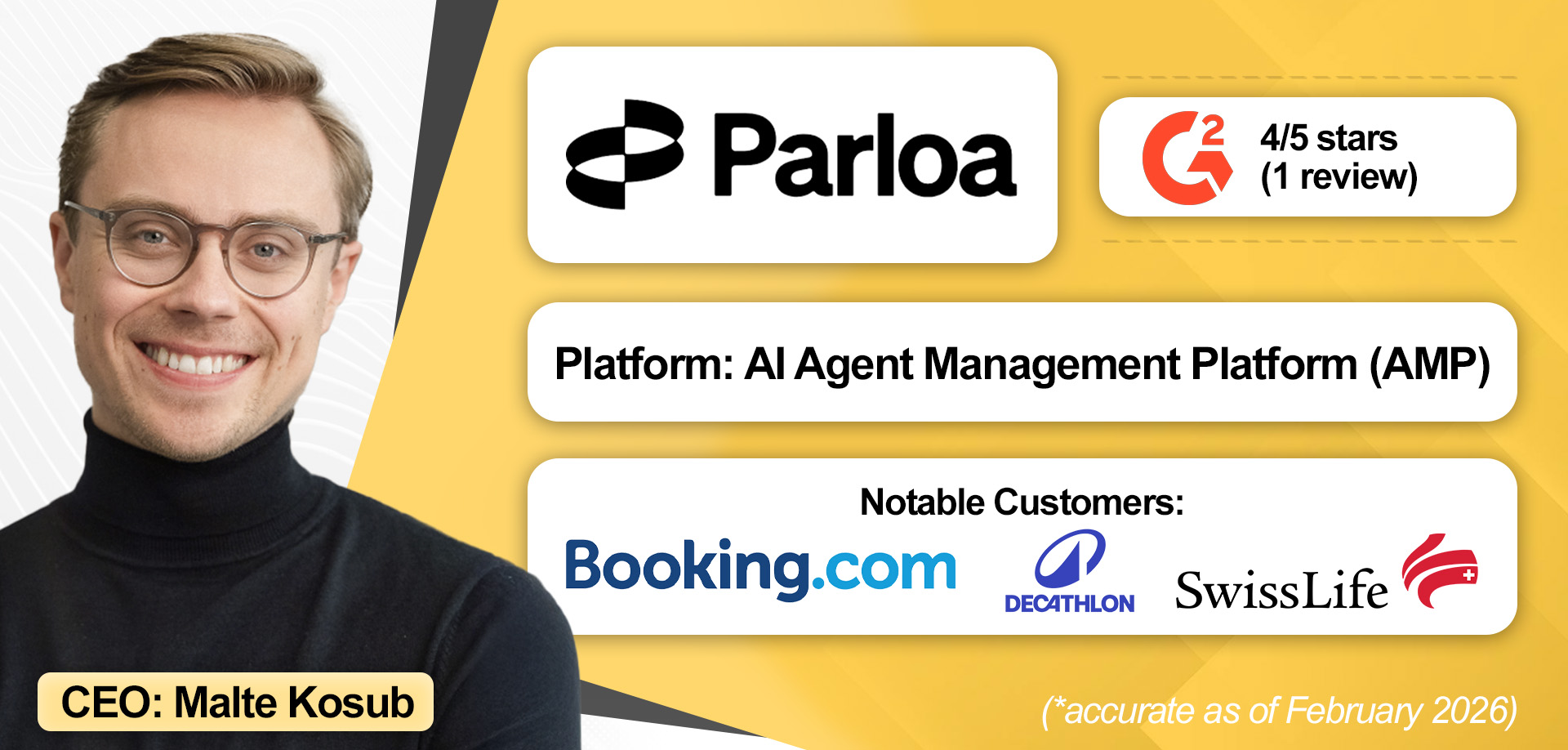
Parloa’s traditional strength has been voice AI. While that remains a differentiator, competitors are increasingly relying on partners like Deepgram and ElevenLabs for speech-to-text, latency, and accuracy—and those providers continue to improve rapidly.
Yet despite this shift, Parloa quadrupled its revenue in 2025. Why? Several factors stand out.
Its focus on delivering multimodal experiences that blend voice, video, chat, images, and interactive widgets within an experience is significant. Essentially, that allows brands to route customers to a carefully curated experience instead of trying to replicate the same AI-led journey across channels, cutting through the strengths of each.
Moreover, its focus on creating a composable AI infrastructure also catches the eye, allowing brands to only leverage the capabilities they need as they grow. For instance, if they want to use their own models but leverage Parloa’s testing and evaluation tools, that’s fine.
Lastly, its Europe-first strategy is different. English-speaking markets are highly competitive with lower labor costs. However, when it comes to languages like German, Norwegian, Swedish, Dutch, etc., the talent pool is much smaller and labor costs are significantly higher.
Given this, many large public companies start with Parloa in Europe because those regions are the hardest and most expensive to serve, with tricky regulations to fulfill.
“You can build a DIY voice agent today, but deploying at enterprise scale with proper guardrails is another story. Vendors like Parloa position their enterprise readiness as a major advantage.”
Derek Top
Principal Analyst and Research Director for Opus Research
Standout Features
Multimodal, Curated Customer Experiences: Parloa blends voice, video, chat, images, and interactive widgets into a single journey, allowing brands to design channel-specific experiences instead of forcing the same AI workflow across every touchpoint.
Composable AI Infrastructure: Brands can adopt only the capabilities they need, pull in third-party models and tools, and expand over time within a controlled, well-governed environment.
Europe-First Focus: By focusing on complex, high-cost, multilingual European markets (e.g., German, Norwegian, Swedish, Dutch), where labor is expensive, and regulations are stricter, Parloa wins in regions that are hardest for enterprises.
How Much Does It Cost?
Parloa adopts a custom, quote-based enterprise pricing model, with costs varying based on interaction volume, required integration work, and level of support. Request a tailored quote from Parloa here.
13. PolyAI
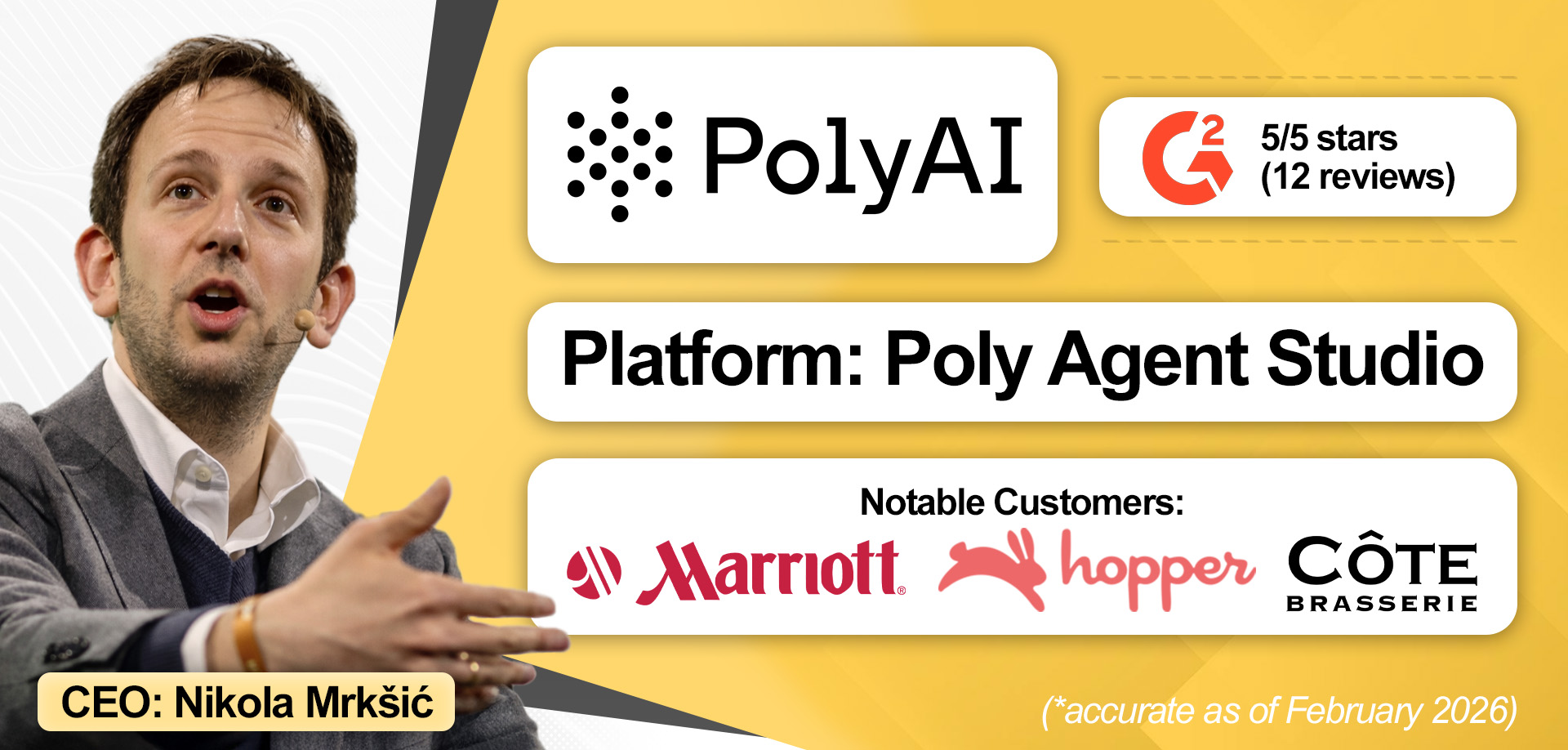
In 2025, PolyAI surpassed a $500 million valuation and ranked eighth on The Sunday Times 100 fastest-growing tech companies list, milestones that underscored its breakout year.
That momentum has been driven by deep expertise in complex, voice-first enterprises. Many of these organizations still rely on mainframes, on-prem systems, and device-level intelligence, environments that demand careful integration rather than clean-slate replacement.
For these customers, the goal isn’t disruption, it’s augmentation. The challenge is adopting AI without breaking critical workflows that have evolved over decades.
Healthcare has been a standout example. In a sector known for fragmented and highly complex implementations, PolyAI’s revenue grew nearly 10x in the past year alone.
Rather than rushing deployment, PolyAI starts by zooming out. It works with customers to define the ideal outcome, clarifying resources, success metrics, and workflow design before iterating toward scale.
That meta-level management is a differentiator. For PolyAI, success depends on clearly defined outcomes, strong human–AI collaboration, continuous monitoring, and diagnosing issues at the right system layer, so when something goes wrong, teams know exactly where and why.
Standout Features
Integrations with Legacy Systems: PolyAI excels in working with complex, voice-first enterprises where on-premise infrastructure still plays a critical role, enabling AI adoption without disrupting the existing setup.
Augmentation over Disruption: Rather than replacing workflows, PolyAI helps organizations layer AI into existing operations, making it particularly effective in fragmented sectors such as healthcare, hospitality, and logistics.
Meta-Level Management: PolyAI differentiates itself by working closely with clients to define ideal outcomes upfront, align on what success looks like, and diagnose issues at specific system layers. So, if something goes wrong, companies can more quickly understand where and why.
How Much Does It Cost?
PolyAI typically prices its conversations per minute. However, over 40% of its customers now pay per resolution instead. Buyers receive custom quotes for their preferred model. Book a pricing consultation with PolyAI here.
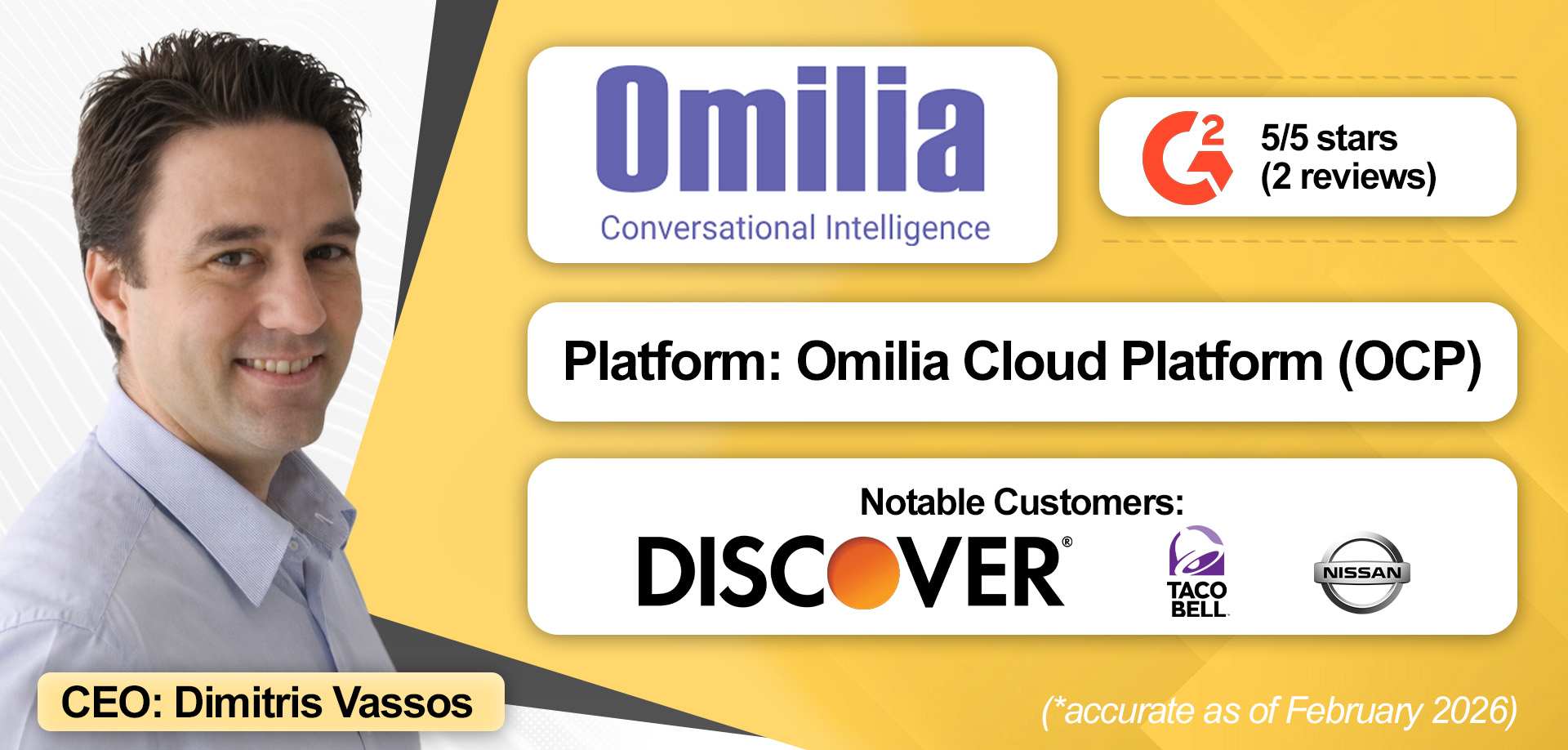
14. Omilia
Conversational intelligence solutions are layering across all sales and service interactions, spotlighting opportunities to enhance customer engagements.
Omilia is at the forefront of a trend to combine these solutions with conversational AI to develop self-learning CX agents, blending orchestration and intelligence layers.
It pairs its self-learning agents with strong customization capabilities. Indeed, Omilia is less of a low-touch, no-code platform and more of an offering in which customers can assert direct control, guided by advanced analytics.
Customers also closely inform Omilia’s innovation curve, with open channels to submit new feature requests as part of the company’s support model.
That support model encourages continuous dialogue, enhancing the post-deployment experience with ongoing guidance on technical aspects of the OCP platform, troubleshooting, and the delivery of detailed root cause analysis reports.
Critically, that lowers the burden on professional services. As many of its customers are midsize or large enterprises in regulated industries, that can be a significant money-saver. These enterprises often value Omilia’s voice heritage and advanced authentication tooling.
Standout Features
Conversational AI & Analytics Harmony: Omilia develops conversational AI that continuously learns from interactions, combining orchestration and analytics to improve customer experiences over time.
Customization and User-Driven Control: The platform allows clients to actively shape and configure their solutions, going beyond typical low-code/no-code approaches to provide tailored performance.
Proactive Support and Co-Innovation: Through ongoing guidance, technical troubleshooting, and open channels for feature requests, Omilia minimizes dependence on professional services and streamlines deployments for large or regulated organizations.
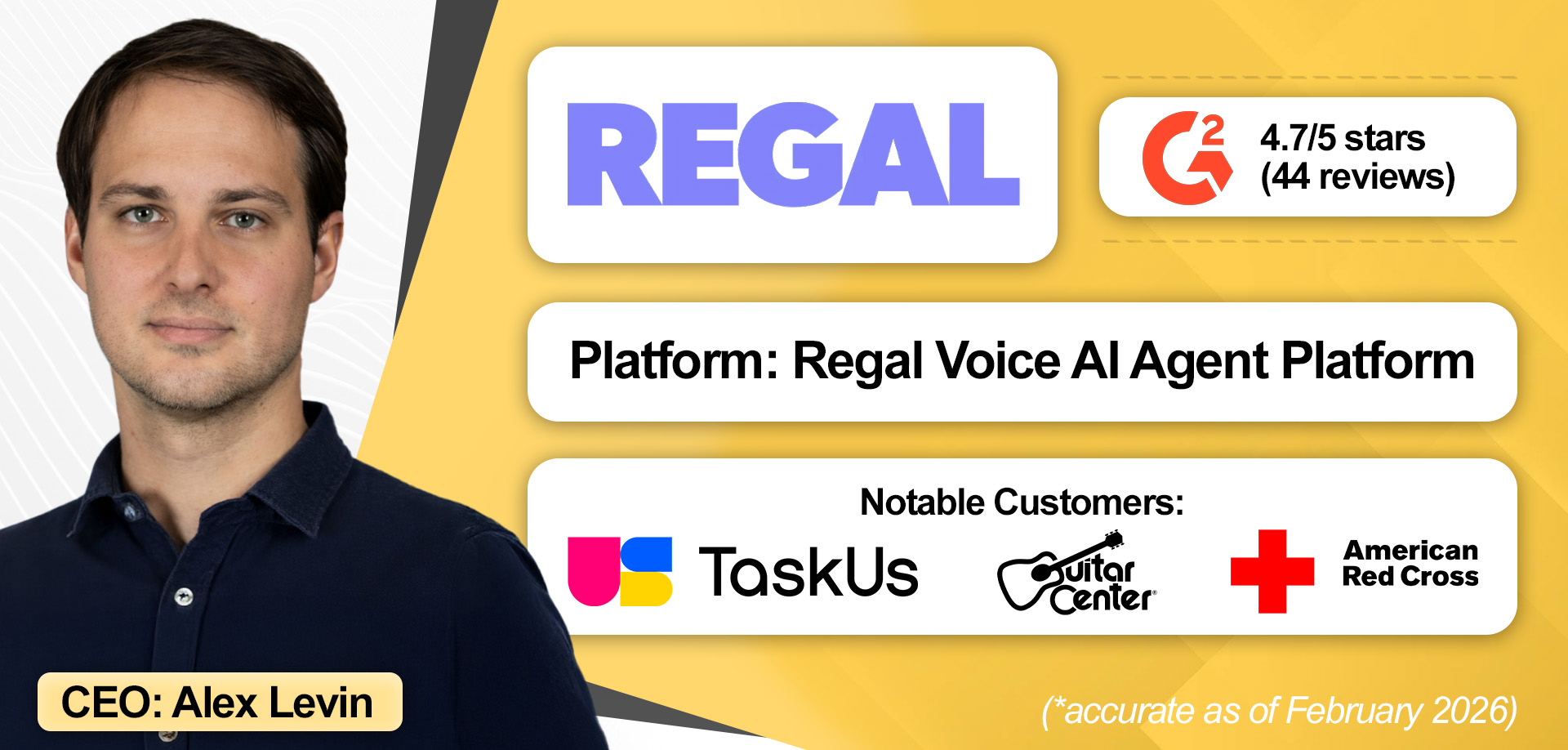
Most conversational AI vendors hook into the CRM for context. However, Regal combines the merits of an in-house customer data platform (CDP) with conversational AI to boost outcomes.
In doing so, it creates a Unified Customer Profile for each customer, offering a real-time view of the customer that updates continuously and is usable inside a live conversation.
The view comprises website behavior (pages viewed, time spent, cart actions), app activity, email opens and clicks, past support tickets and transcripts, purchase history, payment status, loyalty information, marketing attribution data, prior AI and human conversations, and real-time signals during the call itself (sentiment shifts, hesitation, intent changes).
So, instead of pulling one static snapshot, the AI agent can reason over a timeline of events.
That’s the headline differentiator. However, its approach to persona-based agents is also fascinating. Now, every vendor on this list will allow their customers to tweak the persona of their agent. It’s nothing new. Yet, for Regal, it’s underappreciated.
So it created a 'dog campaign', where people could call and talk to different breeds, each with a distinct personality:
Golden Retriever: Warm, upbeat, reassuring, a little chatty
German Shepherd: Confident, direct, authoritative
Border Collie: Efficient, focused, task-oriented
Poodle: Polished, articulate, slightly formal
French Bulldog: Casual, playful, relaxed
The point was that customization isn’t cosmetic; it’s critical to performance, and Regal helps its customers to match personas to specific intents to boost outcomes.
Lastly, Regal also uses AI to model a contact center’s top performers, isolate best practices across intents, and feed that knowledge into its AI agents
Standout Features
Real-Time Unified Customer Profiles: Regal combines an in-house CDP with conversational AI to provide continuously updating, timeline-based views of each customer, enabling personalized, context-aware interactions.
Personality-Driven AI Agents: The provider maps intuitive personalities to AI agents, underscoring how customized conversational styles directly improve performance, underscoring how brands can tweak the personas of their agents.
Agent Modeling: Regal models its top-performing human agents and iteratively optimizes AI behavior to maximize metrics like CSAT, resolution, and speed, achieving high containment and satisfaction rates.
How Much Does It Cost?
Regal uses a per-minute pricing model, suggesting a guideline cost of $0.20 per minute of AI agent talk time. However, the vendor notes that implementation costs can vary. Learn more about Regal’s AI pricing model here.
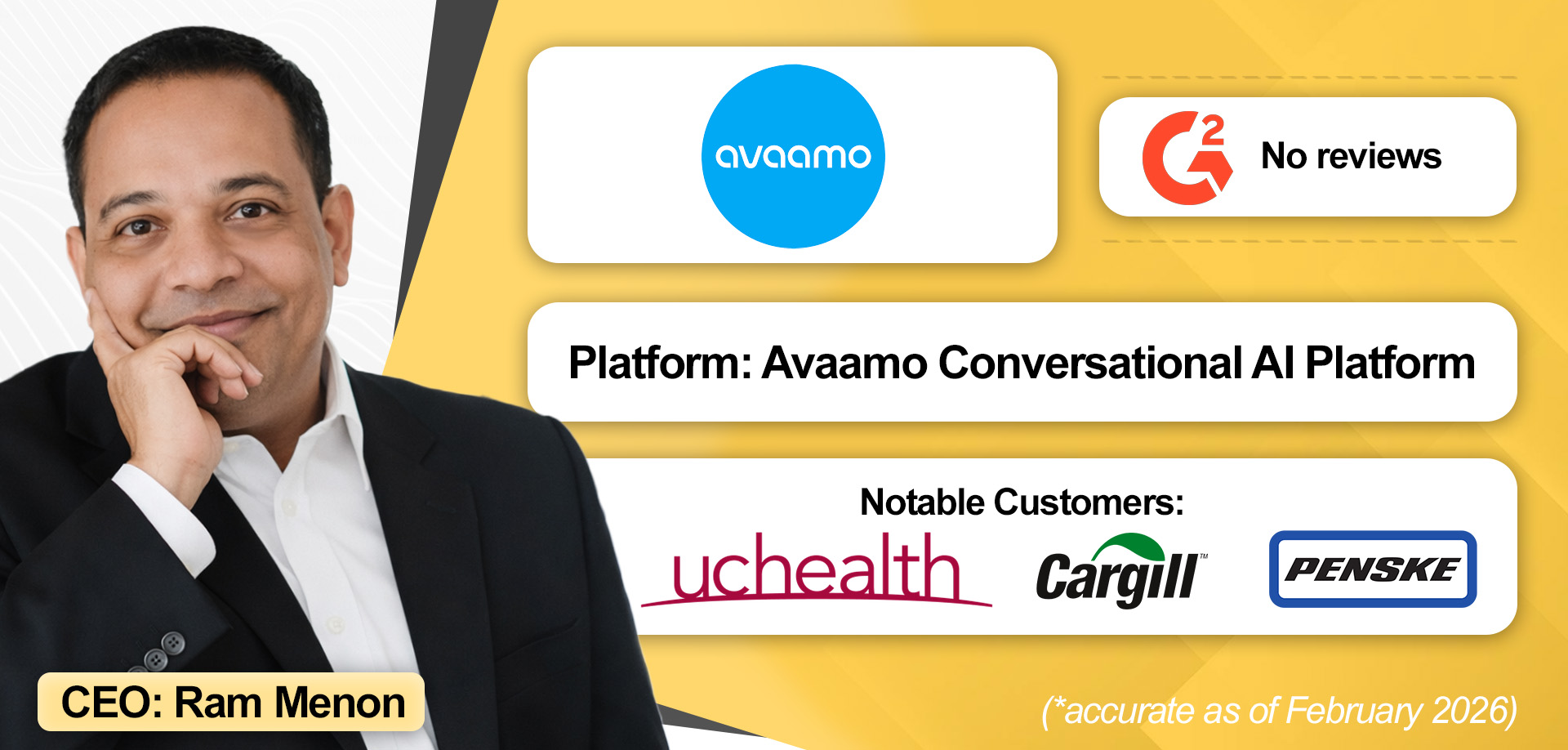
16. Avaamo
Avaamo believes industry-specific innovation is key to differentiation in the crowded conversational AI space, making a big play in healthcare.
Working with five of the top ten healthcare providers in the US, Avaamo pre-configures specialist agents for this sector, providing customizable workflows that span commonly deployed solutions.
For instance, consider a patient who asks for a dermatologist near their home at the earliest possible time. Avaamo offers its Ava agent to check availability, confirm appointments, handle conflicts, email location details, and provide parking info, all in accordance with HIPAA and similar privacy regulations.
Such agents benefit from the company’s deep, sector-specific integration portfolio. In the use case above, Ava leverages seven APIs to work across the company’s existing infrastructure and complete tasks, rather than ripping up and replacing existing systems and processes.
Alongside its agents is Avaamo Ambient, the medical scribe, which turns clinician conversations into structured clinical notes in real time.
The vision for this is exciting, as the scribe may convert medical notes into follow-up actions, which its agents can perform to automate more of the healthcare operation.
Standout Features
Healthcare Innovation: Avaamo’s primary focus is healthcare, offering pre-packaged agents that can handle patient interactions, from appointment management to medical refills across systems, while staying fully compliant with privacy regulations.
Vertical-Specific Integrations: Instead of overhauling existing infrastructure, Avaamo’s agents plug into a provider’s current systems, coordinating across many APIs to deliver end-to-end workflows that bridge disparate tools and streamline operations.
Note-Taking Vision: Avaamo Ambient captures clinician conversations in real time, transforming them into structured notes and actionable follow-ups, which may unlock a new level of automation across healthcare processes.
How Much Does It Cost?
Avaamo offers a free trial for businesses to run proof of concepts, with full platform access. After that, it charges $1.50 per voice session and $1 per digital session, per its AWS marketplace listing. However, prospects can request a consultation and custom quote here.
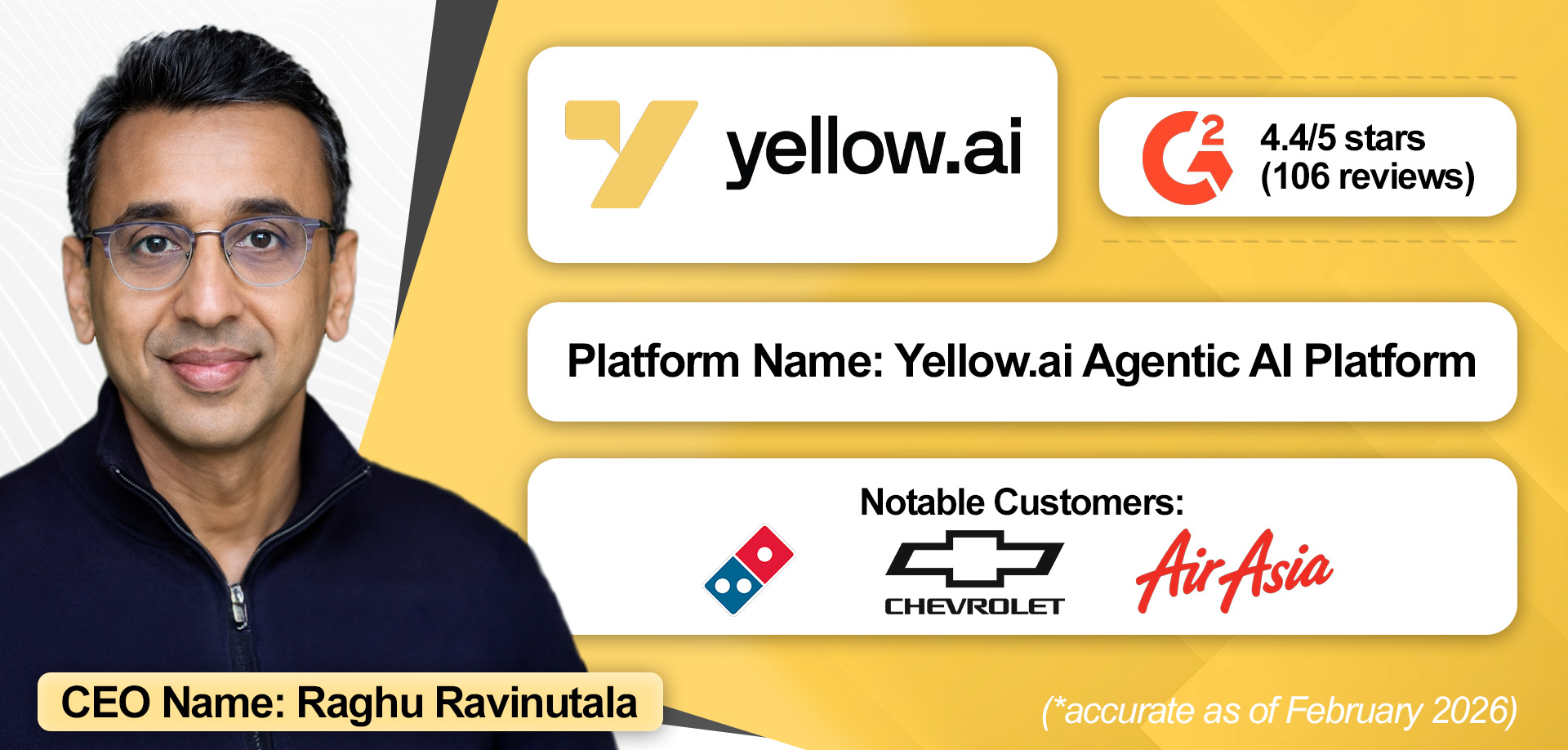
17. Yellow.ai
Yellow.ai has grown by 30x over the past four years, with deployments spanning 85 countries.
Much of that is perhaps due to its slower approach to conversational AI than many competitors. It aims to meet customers where they are and build, rather than race to AI agent deployments.
In doing so, Yellow.ai hand-holds its customers toward a future of invisible agents. These orchestrate asynchronous workflows across departments and systems, supporting the delivery of AI- and human-led service.
Looking ahead, Yellow.ai anticipates a world where humans manage AI agents, and over time, interactions will blur the line between human and machine. The company sees this evolution as central to the future of work and customer experience.
To make that vision tangible, Yellow.ai introduced its Nexus solution. This “universal agentic interface” proactively recommends automation opportunities, autonomously builds prototypes, and stress-tests AI agents before customers encounter issues.
Nexus achieves this by deploying synthetic AI customers that simulate real user journeys. These virtual testers identify vulnerabilities and self-correct, ensuring that problems are fixed silently, before anyone notices.
Standout Features
Measured Adoption: Yellow.ai takes a slower, deliberate approach, meeting customers where they are with previous-generation chatbots and gradually building towards AI agents, rather than rushing deployments.
Workflow Orchestration: The vendor’s solutions guide organizations toward AI-human collaboration, auto-suggesting new opportunities to orchestrate asynchronous workflows across departments and systems.
Self-Healing AI: Yellow.ai uses synthetic AI customers to simulate journeys, identify vulnerabilities, and autonomously fix issues before they impact real users.
How Much Does It Cost?
Yellow.ai offers a limited free trial of its platform. The provider also offers an ROI calculator on its website, helping customers quantify possible savings. However, brands must contact Yellow.ai for a custom pricing plan.
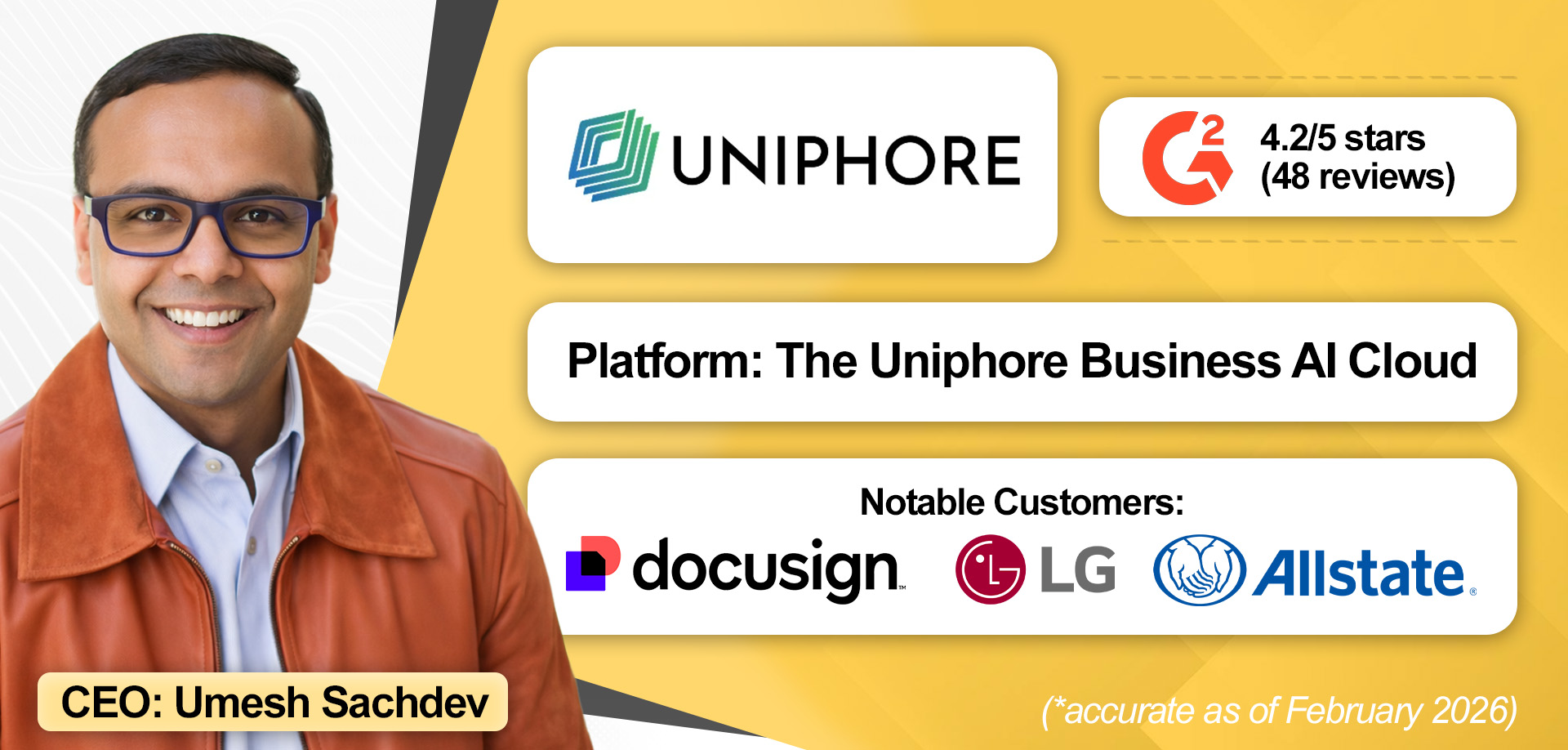
18. Uniphore
Over the past financial year, Uniphore doubled its revenue and reached a $2.5BN valuation.
It has achieved this growth with a significant focus on data and AI privacy, creating an architecture that is both sovereign (runs on-premise or in the cloud) and open (supports multiple GPUs, LLMs, and data platforms).
With its platform, it has also lowered the dependency on general-purpose models, creating smaller, domain-focused AI models. For instance, it offers a billing model for telecom, a claims model for insurance, and a churn model for banking.
It powers these with synthetic data to improve organizational AI readiness. So, rather than wait months for a full data lake overhaul, Uniphore begins with synthetic data and subject-matter expertise to train domain-specific models quickly.
In doing so, the vendor claims it can deliver time-to-value in six to eight weeks for a real production use case, accelerating adoption.
Lastly, Uniphore’s historic advantage is in its ability to blend channels with a single interaction, supporting more advanced experience design.
“Multimodal has shifted from: 'We support voice and text,' to: 'We intelligently combine voice, text, and visual elements to simplify decisions.’ Uniphore has historically championed this blending of channels within a single interaction.”
Wayne Butterfield
Founder of STX
Standout Features
Sovereign Deployments: Uniphore has built its platform around data and AI sovereignty, recognizing that large enterprises view data as core intellectual property. Its architecture supports on-premises and cloud deployments while remaining open across GPUs, LLMs, and data platforms, allowing organizations to retain control without sacrificing flexibility.
Synthetic Data: Acknowledging that enterprise data is often unprepared for AI, Uniphore leverages synthetic data and subject-matter expertise to rapidly train models for specific businesses. This approach enables production-grade use cases to go live in as little as six to eight weeks, significantly shortening time to value.
Multimodal Experience Delivery: Uniphore blends channels within a single interaction, such as augmenting voice calls with mobile document delivery, visual product comparisons, or interactive digital overlays, supporting richer customer experiences.
How Much Does It Cost?
Level AI, a competitor, lists Uniphore’s conversational AI pricing at $35 per agent, approximately $1,500 per integration, plus additional platform fees. However, Uniphore does not publicly confirm this pricing on its website and instead invites prospective customers to request a tailored quote.
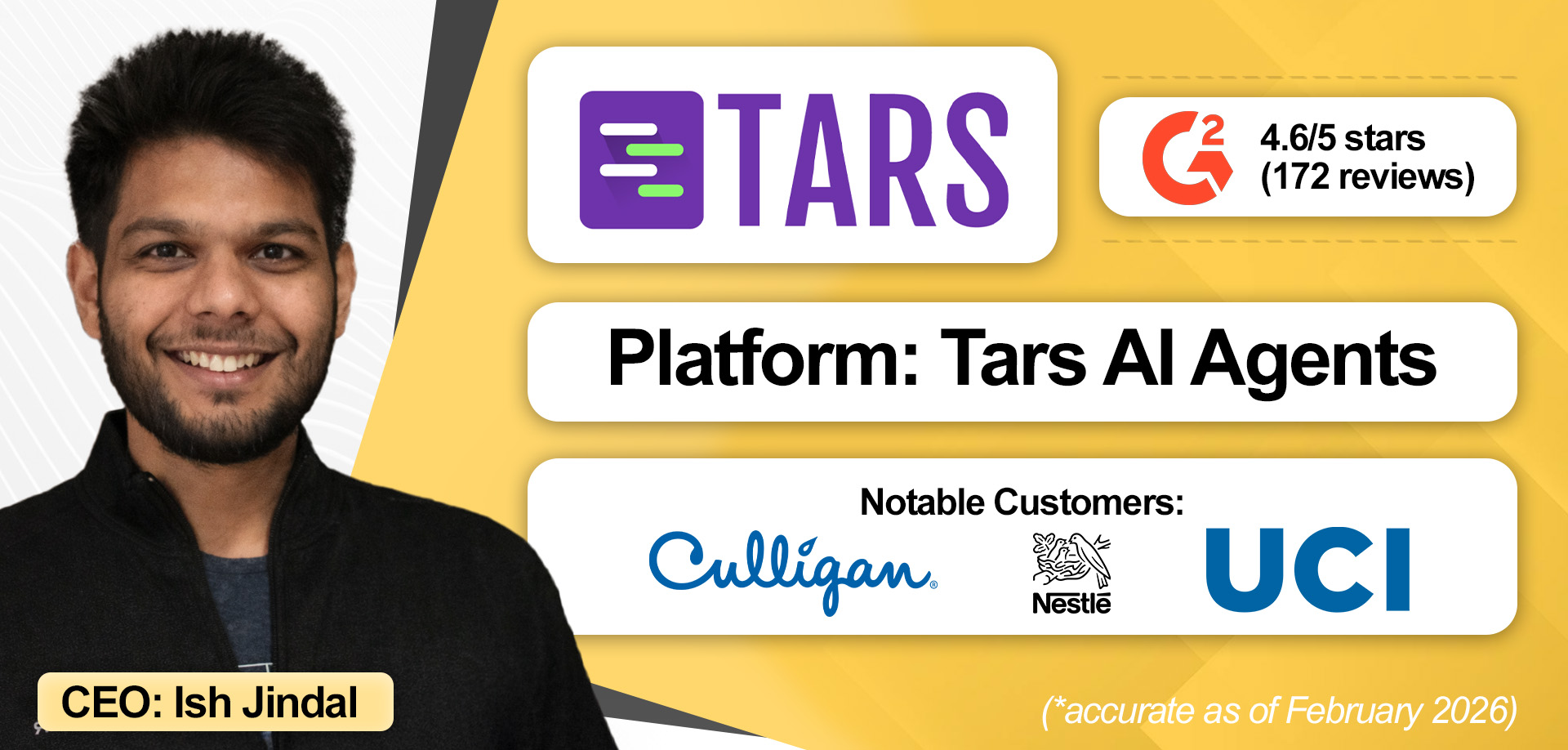
19. Tars
Tars prides itself on simplicity. With a drag-and-drop interface, it claims non-technical teams can build “production-ready” agents in under an hour.
That ease of use is reinforced by a library of over 950 pre-built templates, helping teams accelerate deployment and reduce ramp time. This approach has helped Tars build a global customer base spanning over 700 brands.
Among them are household names such as Netflix, Bosch, and Adobe. However, while Tars counts large enterprises among its customers, its emphasis on simplifying the developer experience and improving platform accessibility resonates most strongly with SMB and midmarket organizations.
Its pricing model further aligns with this segment. Tars offers a free tier for testing, followed by Premium and Enterprise plans at predictable monthly rates.
Notably, the company avoids consumption- or resolution-based pricing. Customers are not charged based on usage spikes or the number of agents deployed, ensuring costs remain stable even as demand grows. That pricing predictability lowers risk and accelerates adoption.
Crucially, Tars also provides comprehensive compliance guarantees, which are often reserved for enterprise-grade platforms. For brands operating in highly regulated industries but managing midmarket budgets, this is particularly compelling.
Standout Features
SMB–Midmarket Alignment: Tars prioritizes ease of use with a no-code builder and extensive template library, enabling lean teams to launch quickly without an over-reliance on developers, making it particularly well-suited for SMB and midmarket organizations.
Differentiative Pricing Model: With a free tier and fixed monthly plans, rather than usage-based fees, Tars offers predictable costs that scale without fluctuating expenses.
Compliance Guarantees: Tars provides enterprise-grade compliance assurances, giving regulated organizations access to robust governance without enterprise-level complexity or cost.
How Much Does It Cost?
Tars comes with three partnership models: Freemium, Premium, and Enterprise. Premium is available from $499 per month, allowing between 500 and 10,000 conversations. Enterprise tailors a per-month quote, offering a dedicated account manager and various other perks. Learn more about the Tars pricing model here.
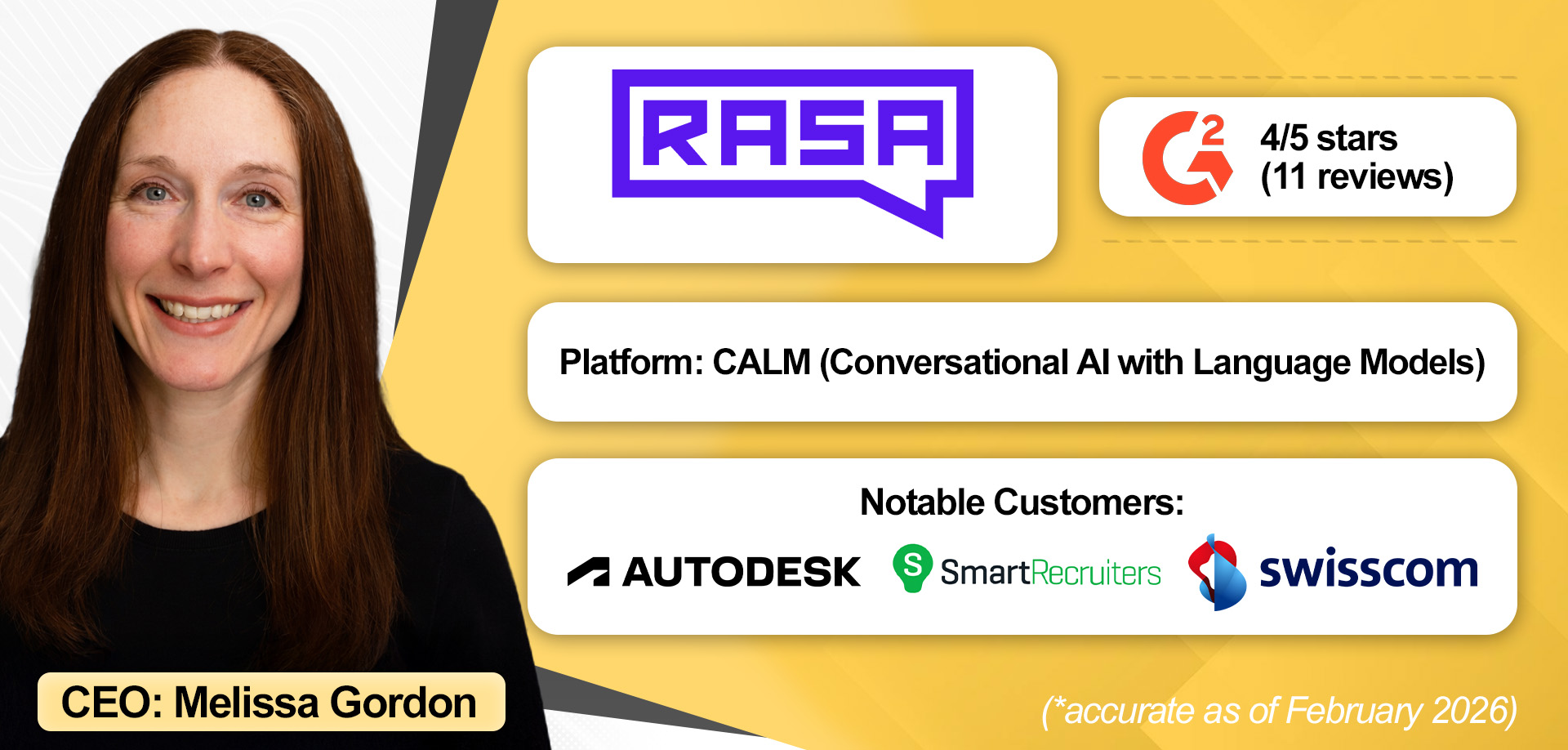
20. Rasa
Founded in 2016, Rasa has built deep expertise in structured dialogue management, deterministic flows, and fine-grained orchestration.
That expertise is embedded in its CALM (Conversational AI with Language Models) architecture, which explicitly separates language understanding from execution.
In doing so, Rasa gives teams greater control over conversational behavior, making it easier to manage reliability, fallback logic, and performance in real customer environments.
The architectural transparency also supports governance-heavy deployments, particularly in regulated industries where explainability, auditability, and oversight are critical. Rasa’s open architecture and explicit control layers make these enterprise requirements achievable.
Beyond transparency and control, Rasa has cultivated a vibrant community of contributors who actively shape its roadmap, including some who contribute directly to the codebase.
Additionally, via its Rasa Forum, customers can collaborate with peers and support teams alike, blurring the lines between “inside” and “outside” and reinforcing a shared culture of innovation.
Standout Features
CALM Architecture: Rasa separates conversation and flows, giving teams precise control over conversational behavior, reliability, fallback logic, and performance.
Governance: The vendor presents explicit control layers, supporting auditability, explainability, and compliance. Across complex, regulated enterprise deployments, these controls can be highly beneficial.
Rasa Community: A vibrant network of contributors influences innovation and the roadmap, while the Rasa Forum enables customers to collaborate, share best practices, and drive collective improvements.
How Much Does It Cost?
Rasa offers a Free Developer Edition of its platform for brands managing less than 1,000 conversations a month. However, its Enterprise offering is available as part of a custom monthly subscription. Dive deeper into Rasa’s pricing here.
Trends Shaping the Conversational AI Platforms of Tomorrow
As this overview of the conversational AI market came together, several key industry trends emerged, many of which are likely to accelerate in 2026.
Conversational AI Platform Providers Split Into Two Camps
Many vendors split into two broad categories:
Those trying to bring enterprises quickly into agentic AI (i.e., Sierra and Decagon).
Those meeting customers where they are and evolving more gradually (i.e., Cognigy, Boost.ai, and Kore.ai).
The best fit will depend on the enterprise’s readiness, personnel, legacy investments, budget, and risk appetite.
Amid this backdrop, some slower enterprises are trying to accelerate by focusing on:
Deterministic dialogue for tight control and clear boundaries.
Agentic workflows in the backend for reasoning, automation, and data access.
Seamless human handoffs with context preserved.
That balanced, controlled front-end experience with more intelligent backend orchestration is becoming common.
Multimodal Has Evolved
Initially, multimodal meant vendors offering both voice and text capabilities. That’s now table stakes. Most organizations previously had either voice-only or text-only automation. Today, nearly everyone supports both.
The real evolution is in blending channels within a single interaction. For example:
While on a voice call, sending terms and conditions to a mobile device for acceptance.
Sending visual comparisons during product selection.
Using digital overlays to simplify complex decisions.
“Take something like comparing service plans from a company such as HomeServe. Explaining multiple plans verbally is inefficient. A visual comparison sent to a customer’s device allows them to review options instantly rather than listening to a long explanation.”
Wayne Butterfield
Founder of STX
The same applies to buying a mobile phone; comparing dimensions, battery life, and features is far easier visually than through spoken explanation. Yet, there are many possible use cases across industries.
Technology is becoming less of a blocker here, with SoundHound, Parloa, and Uniphore exceling here. The bigger challenge is that most organizations are still trying to replicate existing processes rather than redesigning experiences around these capabilities. Overall, there’s a lack of imagination in experience design.
New Data Strategies Enable Individualized Experiences
Developers often hook into a static database like a CRM system for context. Yet, the use of synthetic data and the development of coordinated CDPs - by vendors like Regal and Uniphore - are enabling brands to develop more dynamic, individualized experiences.
Such experiences not only consider the customer’s past interactions, but also billing history, demographics, and real-time behavioral patterns.
For example:
If a bill is unusually high, the AI agent should anticipate that inquiry.
If a customer is older, the AI agent might speak more slowly.
If the customer is speaking quickly, the AI agent may match their pace.
Most voice agents speak at the same speed and use similar verbosity. But individual users value efficiency differently.
As such, designing for user time efficiency is underappreciated. After all, if an AI interaction takes longer than speaking to a human, the business is effectively stealing the customer’s time under the banner of 24/7 service. That’s why frustration with AI persists.
Industry-Specific AI Gains Momentum
Rather than building general-purpose conversational AI, newer vendors are focusing on specific industries, with emphasis on financial services and healthcare.
There are even platforms focusing exclusively on niche markets, such as property management, handling rental renegotiations and maintenance scheduling. Hundreds of customers within that niche.
This vertical specialization allows:
Faster deployment
Pre-built integrations with industry CRMs
Pre-trained domain models
Shorter time-to-value
The Emphasis on Speed to Value Grows
Time to launch is shrinking. Organizations can no longer tolerate 6–12 month implementation cycles. Vendors like Boost.ai and Druid AI now emphasize:
Pre-built integrations
Pre-trained intents
Faster utterance generation
For simple use cases, training and deployment should take days, not months.
AI Starts to Analyze AI
Another emerging theme is AI analytics tools evaluating AI voice conversations and automatically guiding improvements.
As AI handles more volume, organizations will increasingly utilize:
AI-specific scorecards
AI escalation analysis
Cross-intent evaluation frameworks
The fusion of AI and human performance management reporting is also advancing, helping brands to spot the best places to deploy both types of intelligence. Assembled's approach to this is particularly fascinating.
Yet, even before the deployment, AI customer journey simulations will help brands test and optimize their agents.
Over time, these simulations will enable:
Agents testing their own code
Organizations modeling outcomes
AI systems stress-testing decisions
Big Platforms Disrupt the Space
The likes of Salesforce and ServiceNow are gaining momentum by enabling brands to deliver AI-led experiences where their data already resides.
At the same time, CPaaS providers such as Sinch and Infobip are moving up the stack into conversational AI, further reshaping the competitive landscape.
“Historically, players like Twilio focused on APIs and infrastructure, but now the differentiation is in adding customer context and intelligence on top of communications infrastructure.”
Mark Smith
Chief AI & Software Analyst at ISG
Despite this shift, larger enterprises still typically select specialist vendors that offer deeper industry-specific models, broader integration ecosystems, and stronger design expertise.
That said, orchestration platforms remain a critical layer of the stack, with vendors like UiPath and Boomi playing foundational roles beneath customer-facing AI experiences.
A Final Observation
As conversational AI platforms advance, a major concern is implementation quality.
Large service providers and many BPOs (sorry!) often build experiences focused on cost savings rather than customer experience.
The result is poor journeys, even when the underlying platform is strong.
A more mature strategy optimizes for experience first, designs efficient journeys, and allows cost savings to follow naturally.
Ultimately, experience and cost savings are not opposites. Good design improves both.
Stay updated with cx news
Subscribe to our newsletter for the latest insights and updates in the CX industry.



 Alongside Cognigy, Kore.ai frequently appears on CCaaS marketplaces. With NiCE’s acquisition of Cognigy, that shift could create an opportunity for Kore.ai to deepen existing relationships and expand its market presence.