
April 29, 2026 • 29 min read
11 Contact Center Quality Management Software Providers & Their Differentiators in 2026

Director of Content & Market Research
April 29, 2026
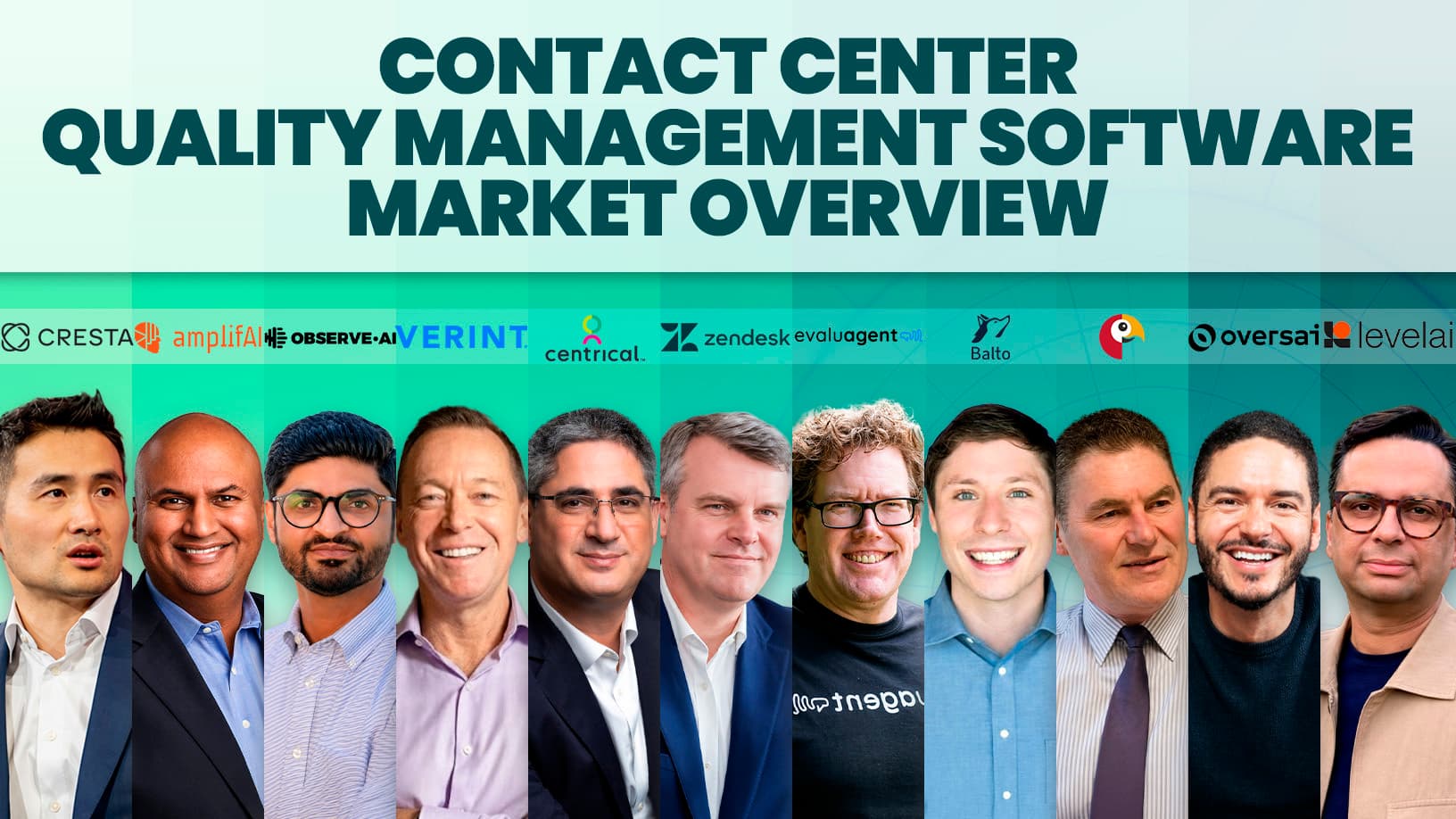
Ten years ago, contact center quality management (QM) centered on scorecards, with analysts manually reviewing a small sample of interactions to verify compliance and monitor performance.
Five years ago, auto-QM tools emerged, using AI to apply those scorecards across 100% of contact center conversations.
Some platforms remain at this stage, layering on features like sentiment analysis, conversation flagging, and agent feedback mechanisms.
However, market leaders are moving the needle.
Below is an outline of this next wave of contact center quality management software providers, after a quick recap of the fundamentals.
What Is Contact Center Quality Management Software?
In 2026, contact center quality management software goes beyond scoring agent performance. While it still leverages AI to analyze 100% of customer interactions, it also identifies what drives successful outcomes and highlights targeted improvement opportunities.
From there, modern QM solutions take this insight and translate it into action. Rather than producing static reports, they feed recommendations into learning, coaching, and - in many cases - gamification workflows, helping agents and supervisors continuously improve.
These insights can also extend beyond these workflows, informing customer and employee retention, workforce management (WFM), routing, and various other business strategies.
Yet, while QM software is increasingly action-oriented, it must also support a new type of agent: AI agents. As a result, many platforms now test, monitor, and optimize AI agent performance just as they do for human representatives.
The 11 Contact Center Quality Management Software Providers
The contact center quality management software space is increasingly crowded, driven by a surge of new technology providers.
Many are conversational intelligence and contact center as a service (CCaaS) vendors bundling QM into their platforms. However, more broadly, any company working with interaction data is now looking to generate insights and, in many cases, extend into QM.
Still, these new solutions typically fall short of leading QM offerings, which go beyond surfacing insight, turning it into action across the contact center and beyond.
Here are 11 leading quality management software providers, and what sets them apart.
1. Level AI
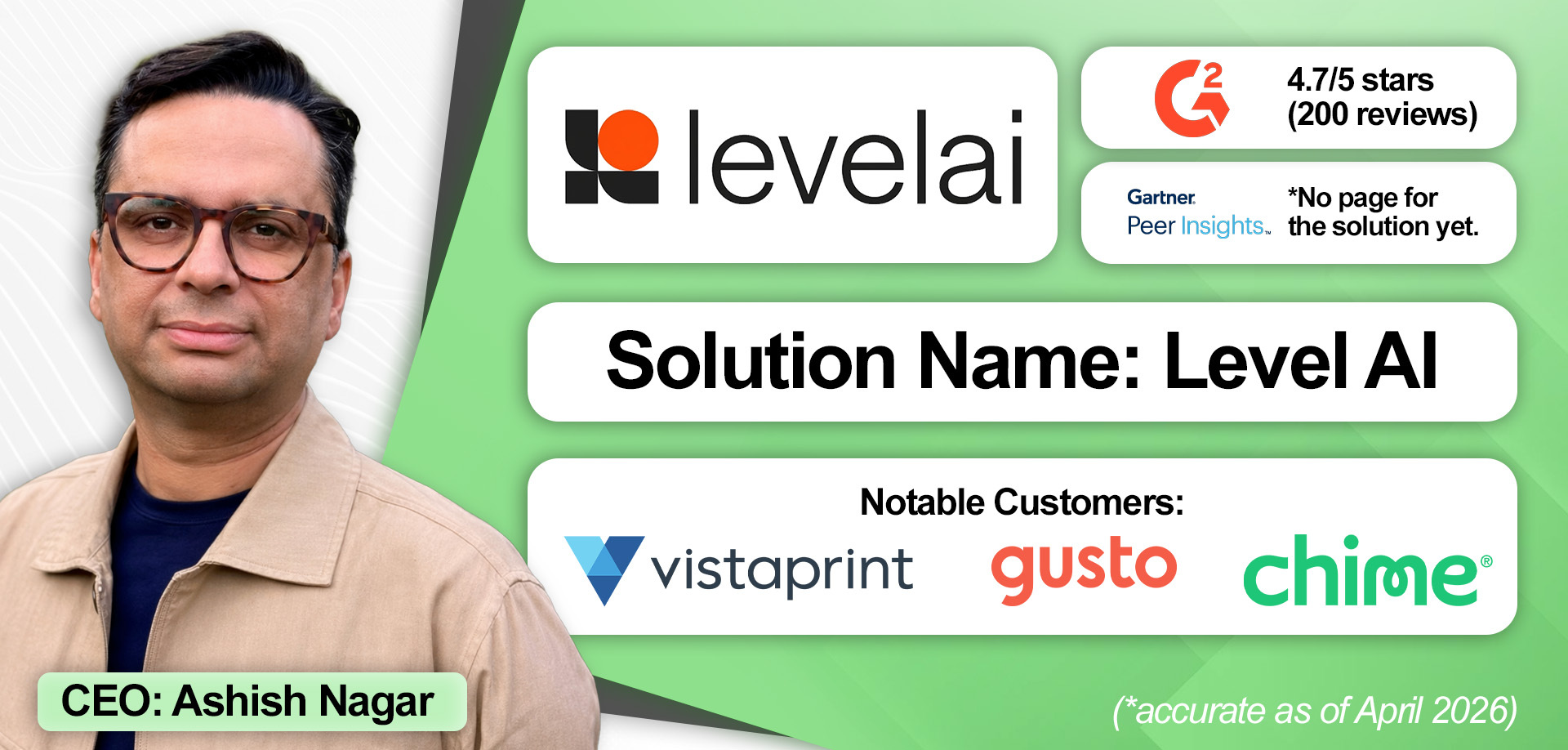
Level AI embeds AI “workers” directly into its quality management software. These include a Voice of the Customer (VoC) Worker that enriches evaluations with deeper customer insight, an Executive Research Worker that generates reports and presentations, and a Coaching Plan Worker that builds tailored coaching programs for individual agents.
The Coaching Plan Worker is especially noteworthy. It monitors what the agent did well, what they might wish to improve (sharing specific examples), and suggests coaching activities and language that may resonate with that particular person.
Level AI also boasts several other standout capabilities. Like others, it can automatically categorize conversations at both topic and subtopic levels. Yet, it then goes further into what it calls “concern themes.” These isolate what drives volume, what’s impacting negative customer satisfaction, and what’s emerging as new issues. Users can then drill down into the conversations behind those insights.
In addition to QM software, Level AI offers customer-facing AI. In doing so, it models AI agents on the best practices live reps follow. It can also monitor human and AI agents as part of a unified QM framework, informing the customer service triage strategy.
Despite this breadth, the company owns its entire tech stack, including seven domain-specific AI models, down to the GPU layer. That allows it to optimize performance for specific use cases, control costs, and improve reliability as it’s not exposed to external disruptions.
Lastly, the provider exhibits an exciting roadmap. This includes screen-aware QA, which evaluates whether agents follow processes correctly, input data properly, and navigate systems efficiently. It also features policy-aware QA, determining whether issues were resolved correctly according to company policies, not just whether the conversation sounds good.
“We offer a broad set of solutions across the CX space, not just quality management, and own our entire tech stack... We’re not wrapping someone else’s tech.”

Standout Features
- AI Workers: The provider’s embedded AI agents query conversational and QM data to isolate VoC trends, generate executive reports, and generate tailored agent coaching plans.
- AI Ownership: Level AI doesn’t depend on third-party providers or external APIs to deliver AI. It builds and controls everything in-house. The provider also uses multiple smaller, specialized language models instead of relying solely on large general-purpose ones. All this enables greater cost efficiency, reliability, and roadmap control.
- Roadmap & Partnerships: Screen-aware QA exemplifies Level AI’s exciting roadmap, monitoring how human agents work with AI and isolating if they’re using workarounds that limit productivity. Its partner strategy, especially with contact center workforce management (WFM) providers, also stands out. The strategy ensures QM insight influences agent schedules, as exemplified by its Assembled collaboration.
How Much Does It Cost?
Level AI doesn’t publicly disclose its pricing. Instead, it asks prospects to schedule a demo to learn more about its product. Book a demo with Level AI here.
2. Observe.AI
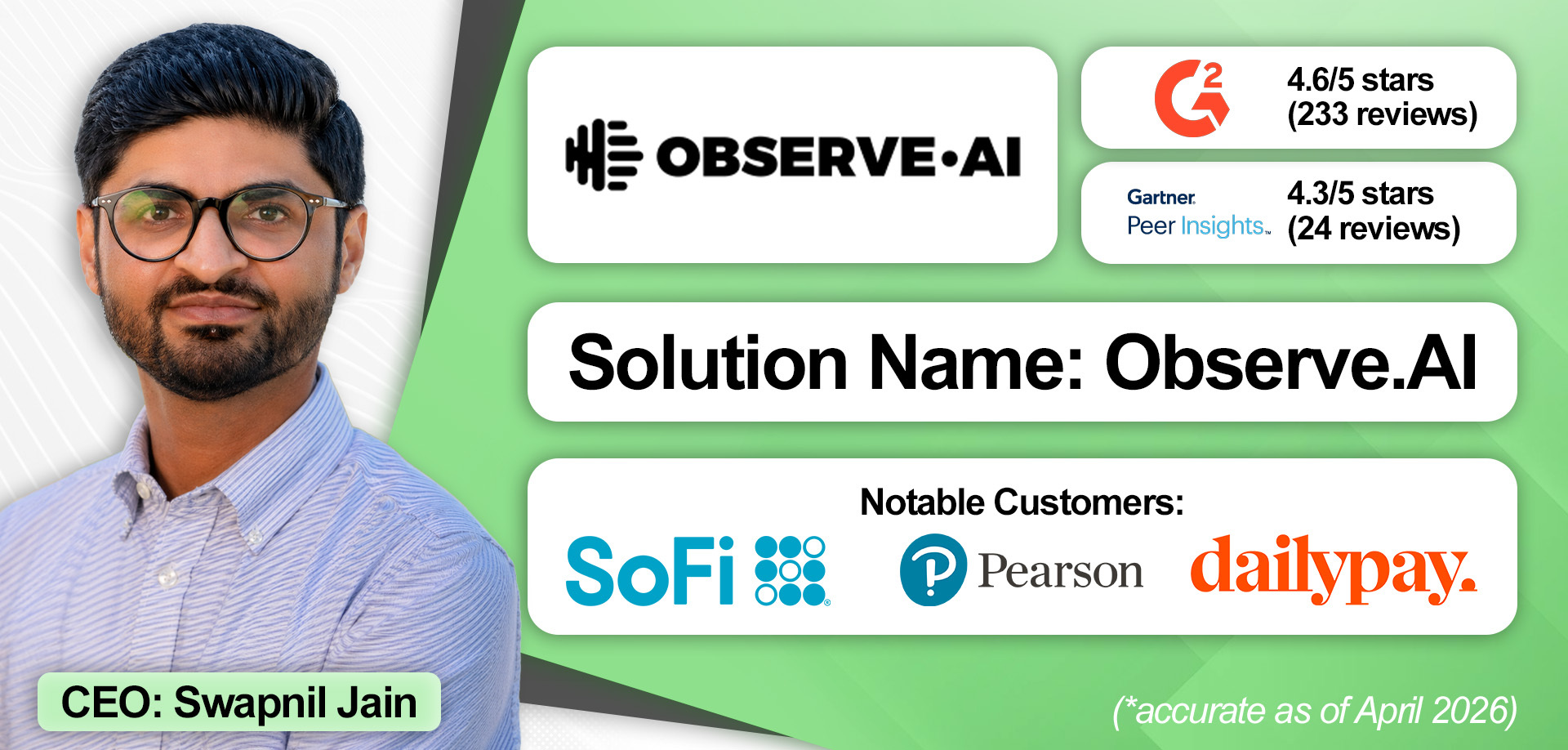 Like Level AI, Observe.AI has AI agents that augment the QM process in production, and its Agent Trainer is a standout example, creating personalized coaching plans.
The plans highlight strengths and areas for improvement, inform daily auto-generated quizzes, and include AI-driven simulations based on real customer scenarios, enabling targeted, continuous performance improvement.
Yet, perhaps most interestingly, Agent Trainer insights feed into Observe.AI’s Companion Agent, personalizing the guidance human agents receive. So, if a human agent consistently misses something, the system can intervene at the relevant moment and offer timely support. It may also detect if an agent understands a process to avoid unnecessary pop-ups.
Observe.AI also offers customer-facing AI and is building case management into its QM software to provide a unified view of a service experience across AI interactions, human conversations, and channels. This enables organizations to understand how an issue originated, developed, and was resolved.
The goal here is to expand the remit of contact center QM, helping spotlight issues within the broader environment that negatively influence the customer’s experience.
Lastly, Observe.AI has a deep portfolio of pre-configured integrations across the customer service ecosystem and significant operational experience. Meanwhile, it’s investing in headless AI to integrate QM tools into heavily customized contact center environments and workflows.
“There’s an arms race for AI agents to automate conversations… but we took a step back and said there’s a lot more under the hood that can be automated and turned into action. That’s precisely what we’re doing.”

Standout Features
- Personalized Agent-Assist: Observe.AI owns a contact center copilot, its ‘Companion Agent’, that guides human reps in real time. It takes QM data to understand which guidance cards the rep might need and which they don’t, personalizing agent-assist solutions so they’re helpful and not an irritating distraction.
- Built-In Case Management: The provider will soon track specific queries across channels, AI escalations, and human interactions to extend the QM process beyond a one-to-one conversation for a broader understanding of where customer service journeys break down.
- Customer Support: Another notable advantage for Observe.AI is how it sends engineers into contact centers to observe workflows, understand real-world challenges, and build solutions with customers. It follows a high-touch, practical approach, ensuring operational maturity matches technological capability.
How Much Does It Cost?
Observe.AI provides custom quotes based on a contact center’s requirements. Learn more about Observe.AI’s pricing strategy here.
3. AmplifAI
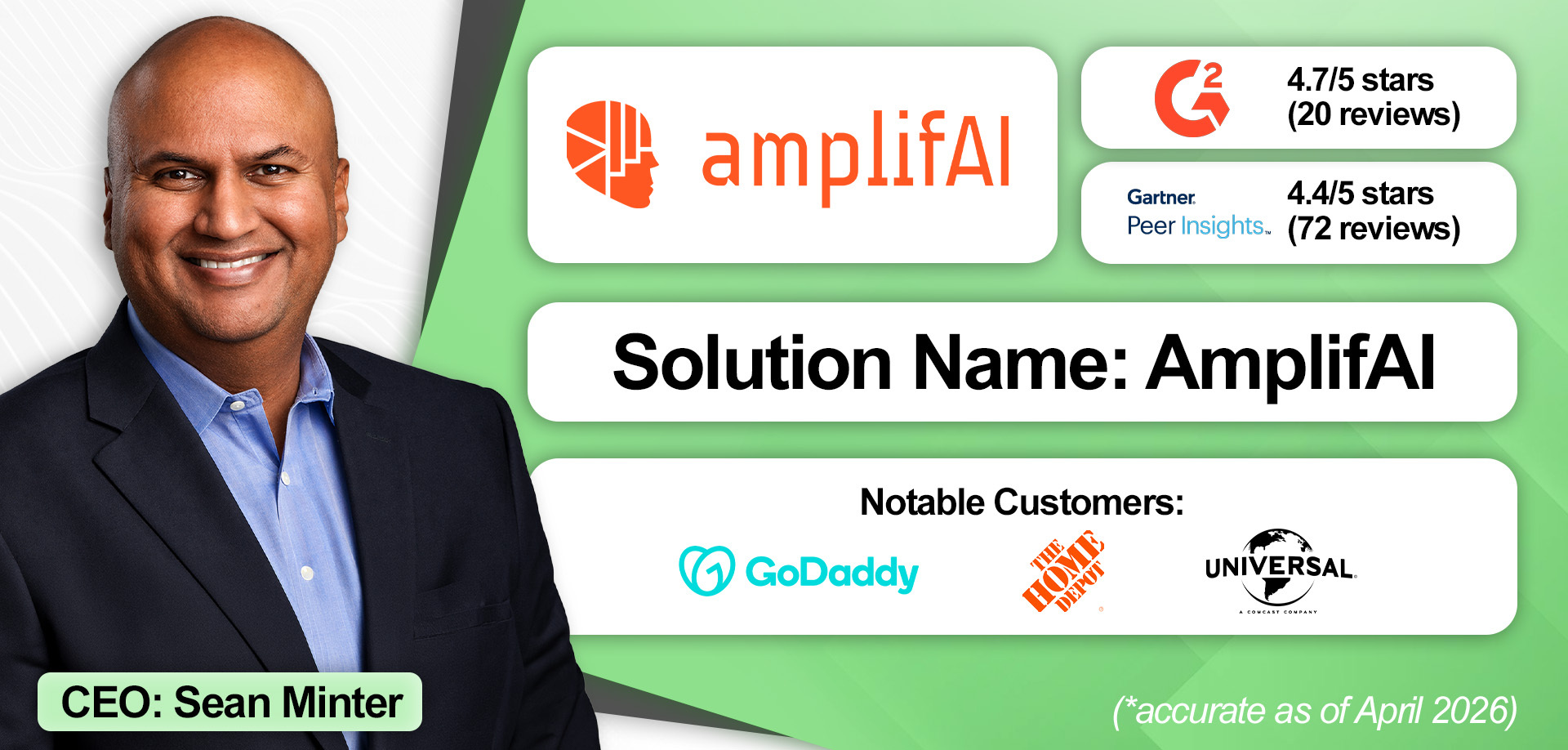 Like many quality management solutions, AmplifAI utilizes evaluation data to identify improvement opportunities and recommend coaching actions. It then goes further by factoring in broader behavioral patterns to add depth to these recommendations, which are delivered directly to supervisors.
However, where it truly differentiates is with its Coaching Effectiveness Score, which allows supervisors to measure how their interventions impact performance. This enables them to refine their approach for each agent based on what demonstrably works.
Another key capability is AmplifAI’s role-specific dashboards and segmented views. These give each user - whether an agent, QA analyst, supervisor, or executive - a view of the KPIs, benchmarks, and trends most relevant to their role.
Additionally, these personalized dashboards are customizable and interactive, enabling users to query data in natural language and explore insights that are contextual and aligned to their specific responsibilities.
Lastly, AmplifAI sits at the center of the customer service tech stack, pooling data from contact center, CRM, CDP, ERP, WFM, and various other solutions. That allows QA teams to add context to each customer evaluation.
Critically, this strength also enables the provider to pump data back out, so, for example, quality management insights can filter into a customer’s CRM profile. That ensures a more rounded view of the customer journey.
Standout Features
- Coaching Capabilities: AmplifAI translates QM insights and broader behavioral patterns into personalized coaching actions, measuring their impact through a unique Customer Effectiveness Score (CES), which helps coaches improve by tracking which interventions work best for particular agents.
- Role-Based Dashboards: The vendor provides personalized, role-specific dashboards for agents, analysts, supervisors, and executives, surfacing relevant performance metrics, benchmarks, performance trends, and contextual insights in real time.
- Integration Ecosystem: AmplifAI provides a robust data layer that unifies insights from multiple sources into a single performance view, enabling more seamless deployment for contact centers with complex, legacy architectures.
How Much Does It Cost?
AmpliAI doesn’t share pricing information publicly, but is known to follow a customized, quote-based model. Book a call with AmplifAI to find out more here.
4. Centrical
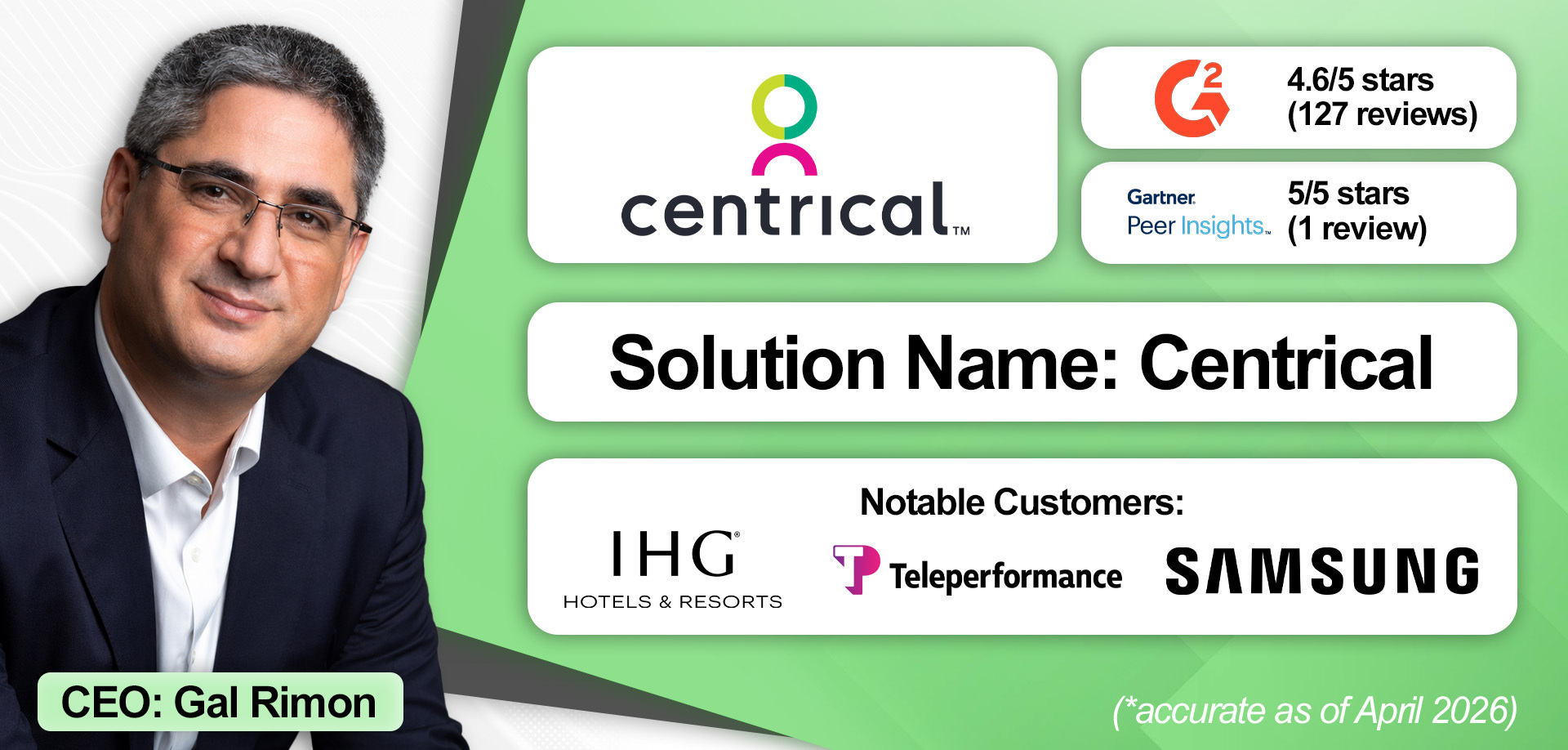 Still, many contact center QM providers stop at insight or a coaching recommendation, leaving the work of changing agent behavior to disconnected learning, training, and engagement systems.
Yet, Centrical delivers a unified employee ecosystem where QM identifies the root causes of performance gaps and addresses them through targeted coaching, microlearning, role-play simulations, and gamification to drive lasting behavior change.
While other solutions rely on analysts to interpret dashboards and coordinate action, Centrical surfaces root causes automatically and uses AI to drive next steps, reducing admin work, expanding supervisor capacity, and enabling more meaningful team interactions.
Its connected approach also enhances onboarding, with personalized learning paths that move away from the traditional “design for the bottom third” model, accelerating time to proficiency and improving engagement.
As agents move through the onboarding process, QM insights isolate individual strengths and gaps (e.g., upselling vs. product knowledge). Centrical then automatically adjusts each agent’s learning path, adapting their microlearning, simulations, and skill-building.
Interestingly, the same connected logic also shapes how managers act on QA in production. Indeed, Centrical's AI Coaching Assistant helps the team leader prepare for each 1:1 with key insights from the agent’s learning journey. It then auto-documents the session and generates follow-ups from the recording. The vendor claims managers can save 4–10 hours a week, which they can reapply to coaching conversations that move the needle.
“Our goal is simple: when contact center agents only have five minutes to spare, we ensure those five minutes deliver the greatest possible impact on their performance.”

Standout Features
- Connected Employee Ecosystem: Centrical has developed a connected learning ecosystem that translates quality management insights into coaching actions, learning experiences, and gamified journeys to uplevel agent performance systematically, with less manual intervention.
- Onboarding Experiences: Before onboarding even begins, Centrical engages new hires to maintain momentum and reduce drop-off. Once they start, it delivers a personalized learning journey. Rather than front-loading information, this approach enables agents to learn in context through targeted interventions, accelerating time to proficiency while helping them build confidence in real-world environments.
- Upcoming Support for Hybrid Human-AI Experiences: Centrical will soon certify AI agents by running them through simulations based on real customer conversations, and seeing if they meet performance thresholds. This aims to prevent new deployments from negatively impacting key customer and business outcomes.
How Much Does It Cost?
Centrical uses a per-user pricing model across multiple license tiers. However, pricing is not publicly disclosed, and prospective buyers must contact the provider for details. Request additional pricing information from Centrical here.
5. Oversai
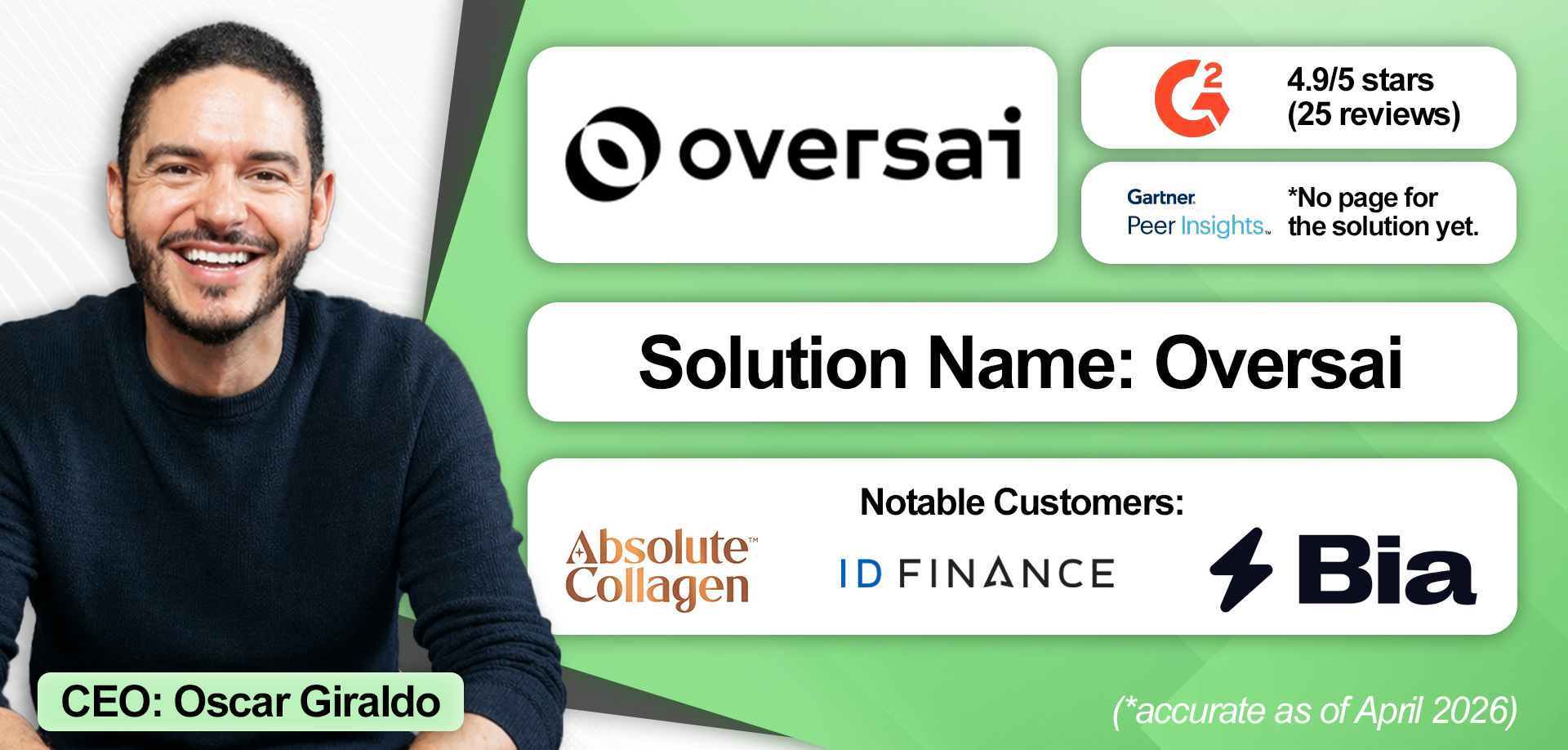 Playvox founder and former CEO Oscar Giraldo launched Oversai in 2024 with a vision to move quality management beyond simply monitoring and assessing customer conversations.
By combining QM and VoC analysis with signals from back-office systems and broader operational data, Oversai expands performance management from a narrow focus on individual agents to a comprehensive view of the entire contact center ecosystem.
Consider a simple example: a customer requests a refund, and the agent, human or AI, confirms it will be processed. However, due to a system failure or human error, the refund never happens. From the customer’s perspective, that’s a failed experience, but conventional QM doesn’t register that; Oversai does.
By blending QM with observability in this way, the platform can alert supervisors to intervene. Yet, over time, AI can begin to act on these signals directly, automatically retrying failed actions, such as refunds, and working within predefined guardrails. The result is a contact center that not only identifies issues but also increasingly resolves them autonomously.
Beyond this vision, Oversai differentiates by democratizing access to QM data. Insights aren’t confined to CX teams; instead, the provider distributes them across the organization via collaboration tools such as Slack. As a result, product, engineering, legal, and operations teams can respond to and address issues in real time.
In effect, this transforms contact center insights into enterprise-wide intelligence, as Oversai bids to help CX leaders become internal champions who use those insights to influence the broader organization.
“We’re not just a QM or VoC tool; we’re part of a new category: observability for CX, and more businesses are seeing value in that… Last quarter alone, we added as much revenue as we did in all of 2025.”

Standout Features
- Blending of QM & Observability: Oversai tracks the expected resolution workflow across systems, verifies whether the action actually occurred in the system of record, and flags failures immediately for supervisors, human or AI, to resolve. In doing so, it considers QM at a contact center level, not just the agent level.
- QM Insight Democratization: QM initiatives often spotlight issues outside the contact center’s control. Oversai helps customers build pipelines to take these insights outside of the contact center, alert the relevant department, and inspire action.
- Long-Term Focus: Oversai is a platform built to support a contact center where AI agents work across the front, middle, and back office to collaboratively solve tasks. This longer-term thinking will be an advantage moving forward, with Giraldo building Oversai as a bootstrapped company, which doesn’t face investor pressure to chase short-term trends or outcomes.
How Much Does It Cost?
Oversai follows a pay-as-you-go pricing model, with monthly billing, no long-term contract, and the ability to cancel anytime. Its base platform costs $625 per month, plus usage-based charges per interaction and feature (e.g., AI processing, transcription, observability, etc.). Discover more about Oversai’s pricing model here.
6. evaluagent
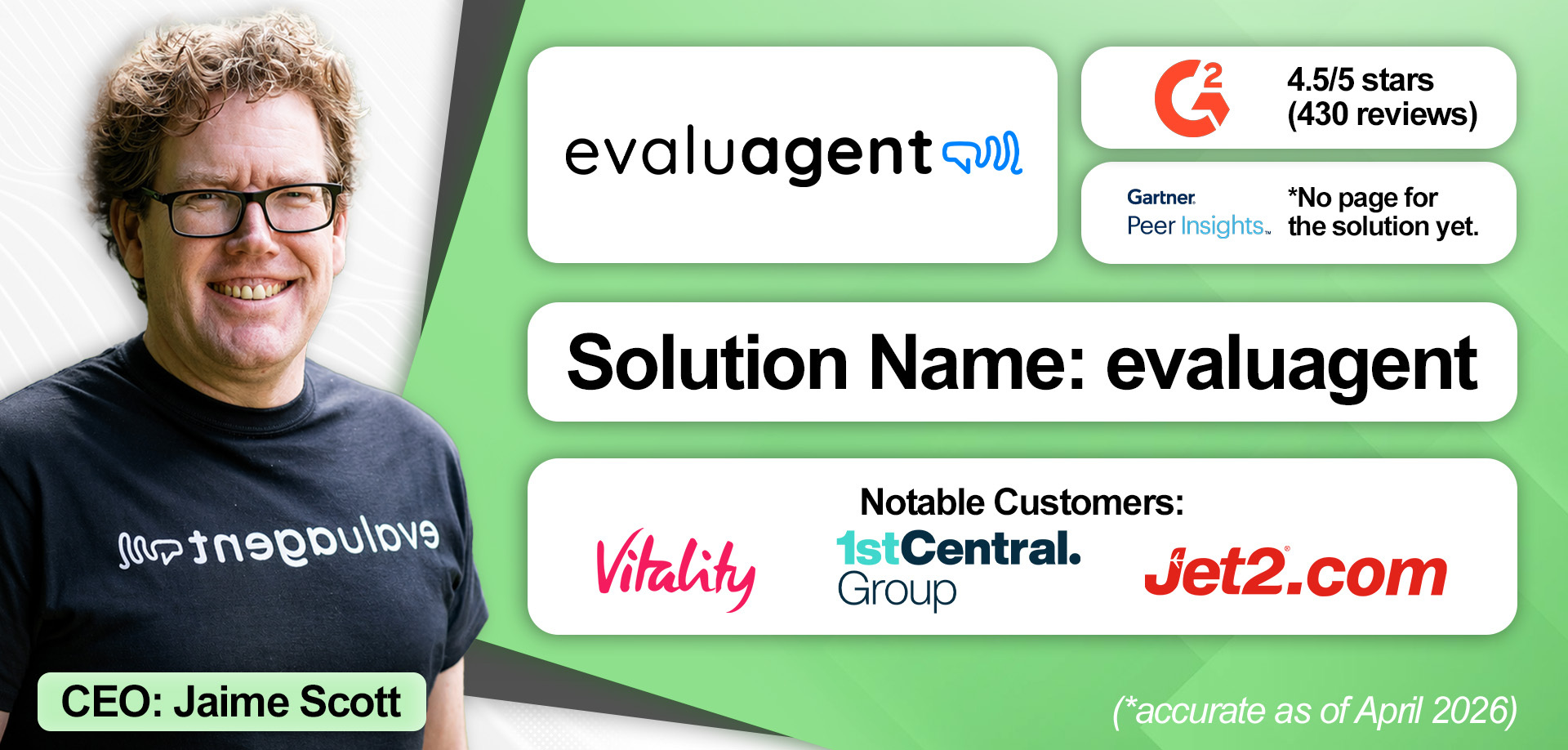 Most QM software providers rely on generic LLMs to evaluate conversations, but empathy and quality are inherently subjective and vary by organization. What “good” looks like in a bank, for example, is very different from what it looks like in an airline.
Recognizing this, evaluagent has developed a Context Engine that allows organizations to define their business (i.e., regions, industries, and goals) and uses that context to tailor evaluation models, improving the accuracy and relevance of insights.
Alongside this and its advanced insight discovery capabilities, evaluagent differentiates through its use of predictive metrics. These go beyond predicted CSAT to include expected net promoter score (xNPS), vulnerability, repeat contact likelihood, and resolution likelihood.
evaluagent has also built its API so that everything generated on its platform can be extracted, including these metric scores. This enables enterprises to apply that data in new ways, for example, using xNPS to inform marketing-led retention campaigns.
The vendor also integrates with many knowledge bases. Here’s an example of why that matters: if an agent gives incorrect baggage information in an airline scenario, the system can detect that against the actual policy, not just whether they answered confidently. That level of precision is important for regulated industries.
Finally, evaluagent brings 14 years of experience in quality management, with dedicated product training and enablement, customer success, and transformation specialists. This ensures organizations feel supported in moving toward a more action-oriented approach to quality management.
“While getting started with the tech is easy, the real work is in organizational readiness, and that’s a key differentiator for us: helping businesses actually become ready for auto-QM.”

Standout Features
- Context Engine: evaluagent uses a Context Engine to tailor evaluations to each organization’s reality (regions, industries, goals), ensuring scoring reflects what “good” actually means for that specific business rather than relying on generic LLM outputs.
- Predictive Metrics: The provider generates predictive metrics such as expected NPS, vulnerability, repeat contact likelihood, resolution likelihood, and predicted CSAT to anticipate future customer outcomes, democratizing that insight across the enterprise.
- Customer Support & Education: evaluagent’s dedicated training, customer success, and transformation specialists ensure organizational readiness. The vendor also provides structured educational resources, including tailored training programmes, to support successful deployments.
How Much Does It Cost?
evaluagent Auto-QA & Improvement is available from $33 per user, per month. Additional Conversational Intelligence costs $54 per user, per month. However, both can be bundled together for $67 per user, per month. Dive deeper into evaluagent’s transparent pricing model here.
7. Verint
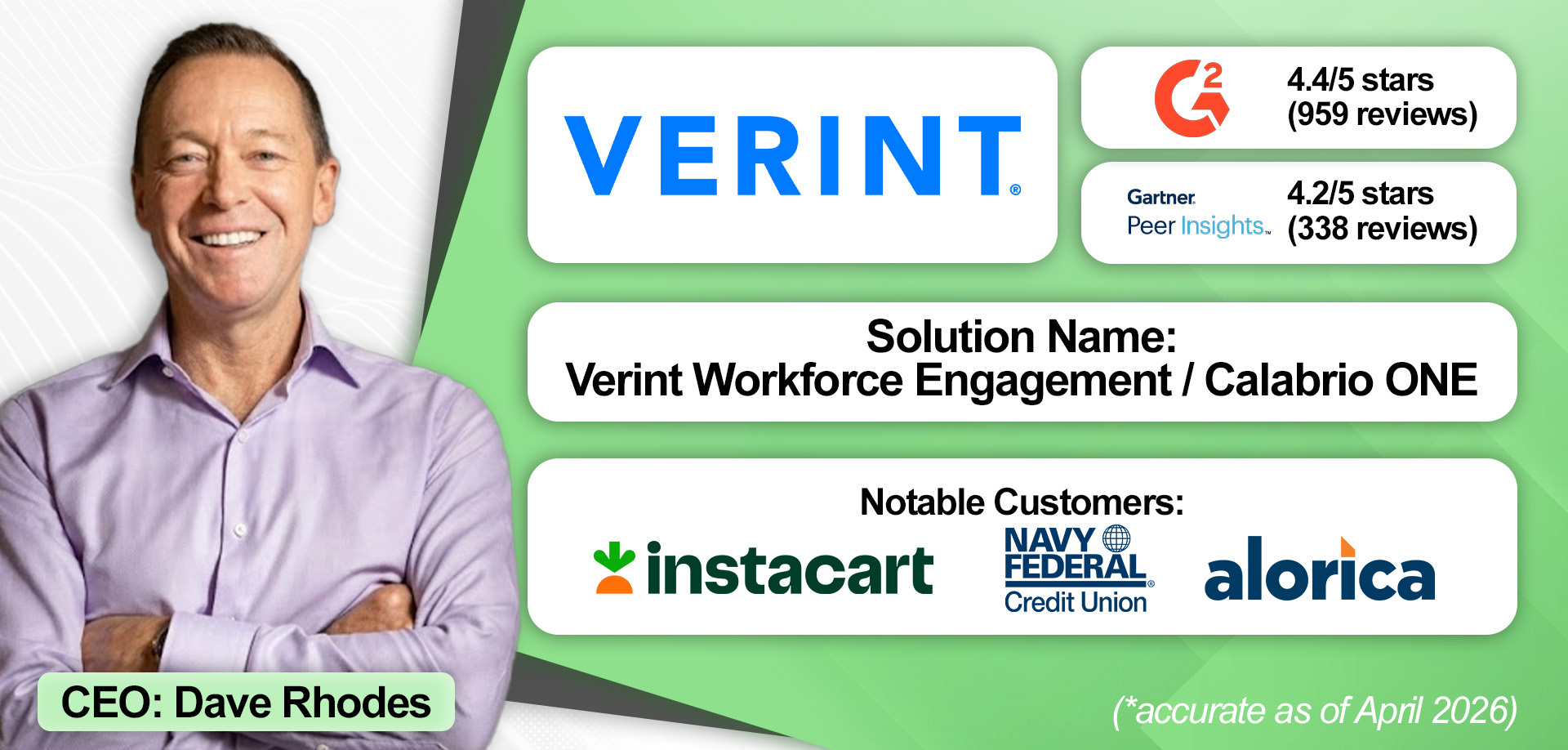 Verint merged with Calabrio in late 2025 under the former’s name, bringing together two of the most prominent contact center quality management software providers.
The vendor will still offer two solutions, positioning Calabrio for the mid-market and Verint for the enterprise, while selectively cross-pollinating capabilities between them to accelerate innovation.
Already, it has made Verint’s bots available to Calabrio customers. These augment specific roles, automate a particular function, and collaborate to complete workflows. Verint has several for Quality Management, yet one fascinating example is its CX Scoring Bot. This predicts customer behaviors during and after contacts, suggesting in-call and post-call actions.
While many solutions now support in-call guidance, Verint’s post-call intelligence stands out, enabling teams to shape follow-up actions that support retention and upsell strategies, which is particularly valuable as contact centers shift toward more proactive service models.
Verint also offers complementary compliance solutions, including desktop and process analytics, to ensure adherence with company practices. Meanwhile, Calabrio has advanced business intelligence (BI) capabilities to send QM insights across the enterprise, inspiring actions that reduce failure demand.
Yet, perhaps what’s most striking about both Verint and Calabrio is that they also own workforce management (WFM) software, enabling them to funnel QM insights through to planning teams. For instance, if there’s a sudden call spike, both solutions can monitor intent to underscore what is driving that, enabling more effective intraday decision-making.
"Everything is connected: QM identifies issues, WFM adjusts staffing, performance management drives coaching, agents see their own progress and can request development... Verint becomes a single operational brain for the contact center."

Standout Features
- WFM Ownership: Both Verint and Calabrio own QM and WFM, enabling quality teams and planners to share insights, informing schedules so they align with agent strengths and informing intraday interventions. Trends in QM data can also inform shift planning, highlighting how performance varies across shift types.
- Verint Bots: Verint delivers bots for creating scorecards based on prompts as to what ‘good’ looks like across channels and interaction types, scoring performance, and ensuring compliance. Yet, it also has bots to monitor employee experiences in real time and recommend follow-up actions, complementing its QM suite.
- Calabrio Embedded Intelligence: Calabrio allows users to create custom QM dashboards and share them across the enterprise, ensuring other departments have accountability for how their actions impact customers.
How Much Does It Cost?
Verint does not publicly disclose pricing for either Verint or Calabrio QM. Buyers should therefore contact the company directly for further information. Request a quote for Verint WFM here.
8. Cresta
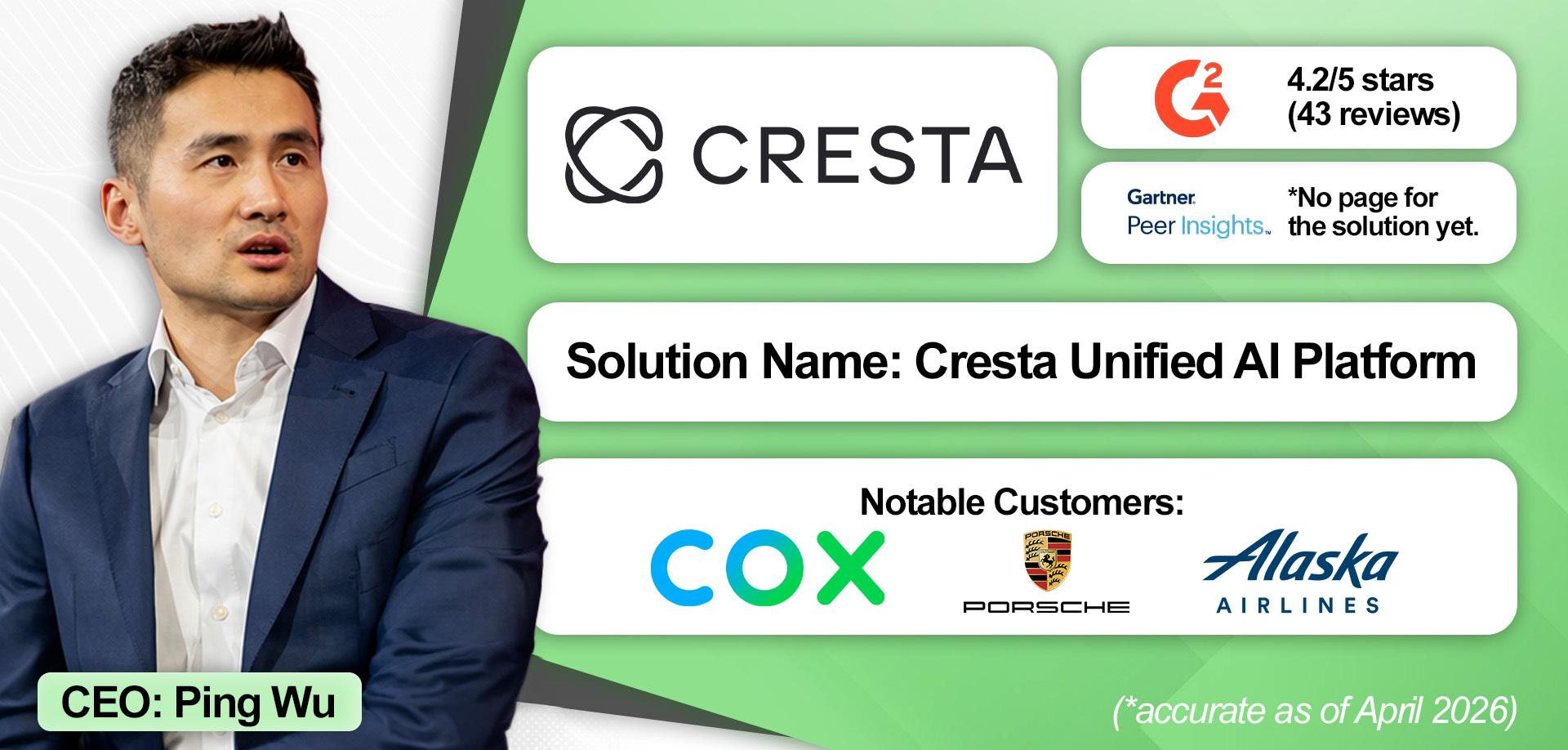 With Cresta Quality Management, users can define the outcomes they want to drive, such as improving customer satisfaction. The platform then analyzes customer interactions and uses AI to recommend which agents to coach and what specific behaviors to focus on in order to better achieve those goals.
Cresta also generates a predictive customer satisfaction (CSAT) score for every interaction. This removes the reliance on post-call surveys while uncovering patterns in topics, processes, and agent behaviors that influence satisfaction and dissatisfaction, which are insights that can directly inform QM scorecards.
In addition, Cresta offers an AI analyst that acts as a natural language interface for quality management and conversational data. This allows quality teams to ask questions and extract insights directly, rather than relying on manual reporting and analysis.
A final notable differentiator for Cresta is its broad, interoperable portfolio, which includes customer-facing AI agents and agent assist.
Data from Cresta’s QM and conversational intelligence solutions not only help to guide customer-facing AI agent deployments, but the solutions also provide a unified view of how they perform in comparison to human agents. That information helps brands continually optimize their service strategies.
Meanwhile, Cresta analyzes how agents engage with AI guidance, highlighting coaching opportunities and revealing where the assisted service strategy can be improved.
“Our key differentiation is the unified platform approach. Rather than treating AI agents, agent assist, and conversation intelligence and quality management as separate tools, we connect them across the full customer journey.”

Standout Features
- AI Agents & Agent Assist: Cresta offers contact center quality management software alongside customer-facing AI agents, building workflows so that QM data informs the contact center’s ongoing conversation automation strategy. That data also helps shape deployments of its Agent Assist solution.
- Outcome AI: Cresta correlates agent behaviors and customer feedback to specific outcomes. In doing so, it can offer prescriptive advice to quality analysts on how to drive those outcomes through not only coaching but process adjustments and policy changes.
- AI Analyst: Cresta also offers an AI Analyst that allows users to ask natural language questions, such as: “What are customers complaining about most this week?” The system provides direct, natural-language answers, removing the need for manual analysis.
How Much Does It Cost?
Cresta doesn’t publicly disclose its prices. Instead, buyers should contact Cresta directly for a custom quote. Book a demo to learn more about Cresta Quality Management here.
9. Scorebuddy
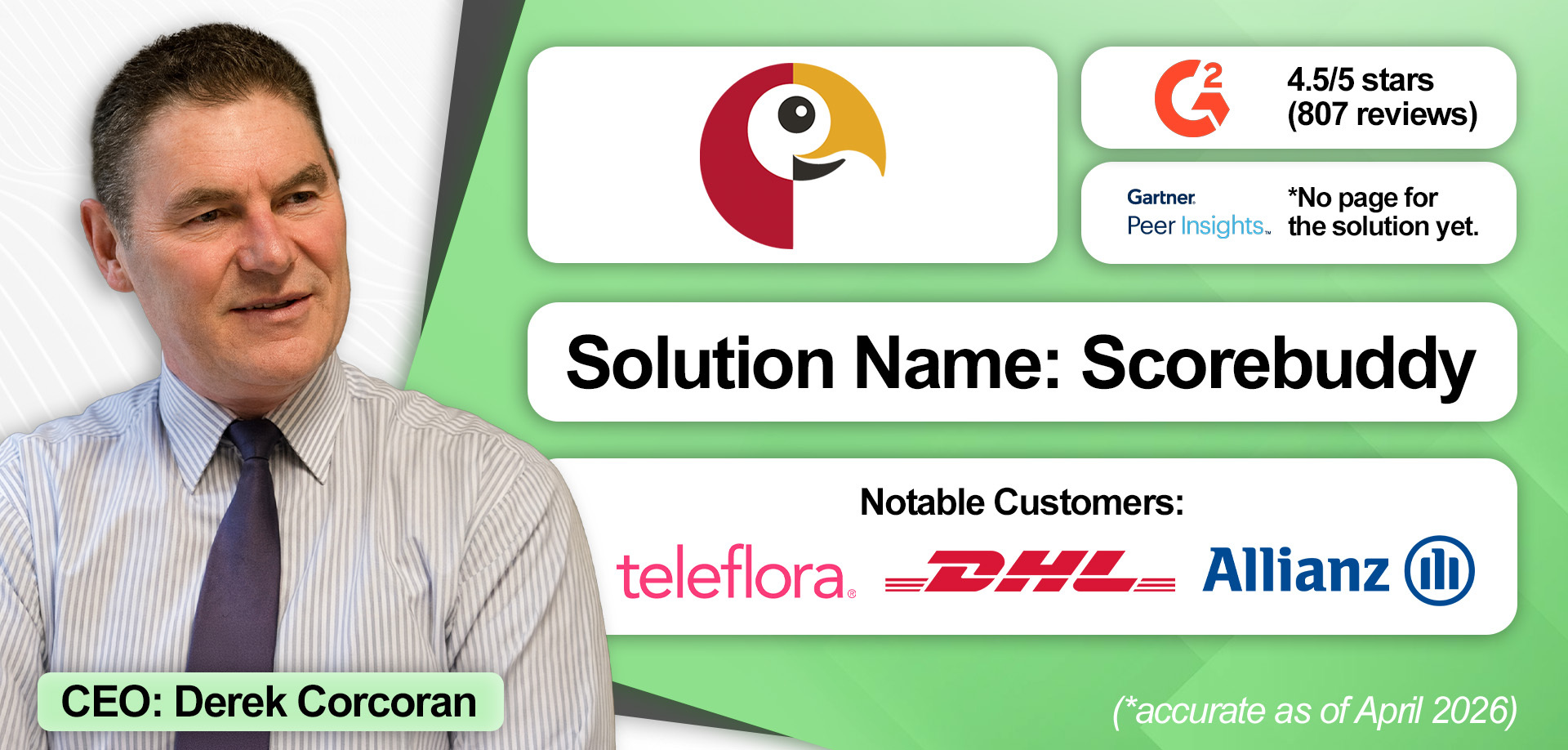 Scorebuddy provides a business intelligence (BI) solution alongside contact center QM software. This enables it to pull in additional context to better inform quality scores.
The provider filters these scores into customizable drag-and-drop dashboards, where users can track trends over time and compare performance across teams and individuals. While this is common, the platform also highlights recurring failure patterns and presents visual cues such as color gradients to prioritize areas for intervention.
Alongside pulling data into dashboards, Scorebuddy pushes it back out for action, with open API access for sharing QM data with CCaaS, CRM, WFM, HR, and various other enterprise applications.
Customer support is another key differentiator, with tailored onboarding, onsite training, and ongoing e-learning via the Scorebuddy Academy.
Additionally, for large-scale deployments, the provider offers weekly check-ins and formal 30/60/90-day reviews to enable the pivot to action-orientated quality management.
Lastly, Scorebuddy has 14 years of experience delivering quality management software, scaling across mid-market and enterprise deployments, and enabling a centralized view of agent performance across locations and outsourcers. That heritage is a strength as the space becomes increasingly crowded with new-look providers.
Standout Features
- Business Intelligence: Scorebuddy offers an embedded BI capability that unifies QA scores, conversation analytics, CCaaS metadata, and other data sources to deliver actionable insights directly within the platform (and send them back out).
- Customer Support & Education: The provider offers structured onboarding and ongoing enablement through training, its Scorebuddy Academy, and regular success check-ins to ensure customers are delivering on the technology’s promise.
- In-House Experience: The platform was developed by a team with deep contact center expertise, and their long-standing experience across midmarket and enterprise environments shapes both its flexibility and product roadmap.
How Much Does It Cost?
Scorebuddy is available in three packages (Foundation, Accelerate, and Elite), with each becoming more feature-rich. Pricing is not publicly disclosed, so customers must contact the company directly for a quote. Learn more about Scorebuddy’s pricing here.
10. Zendesk
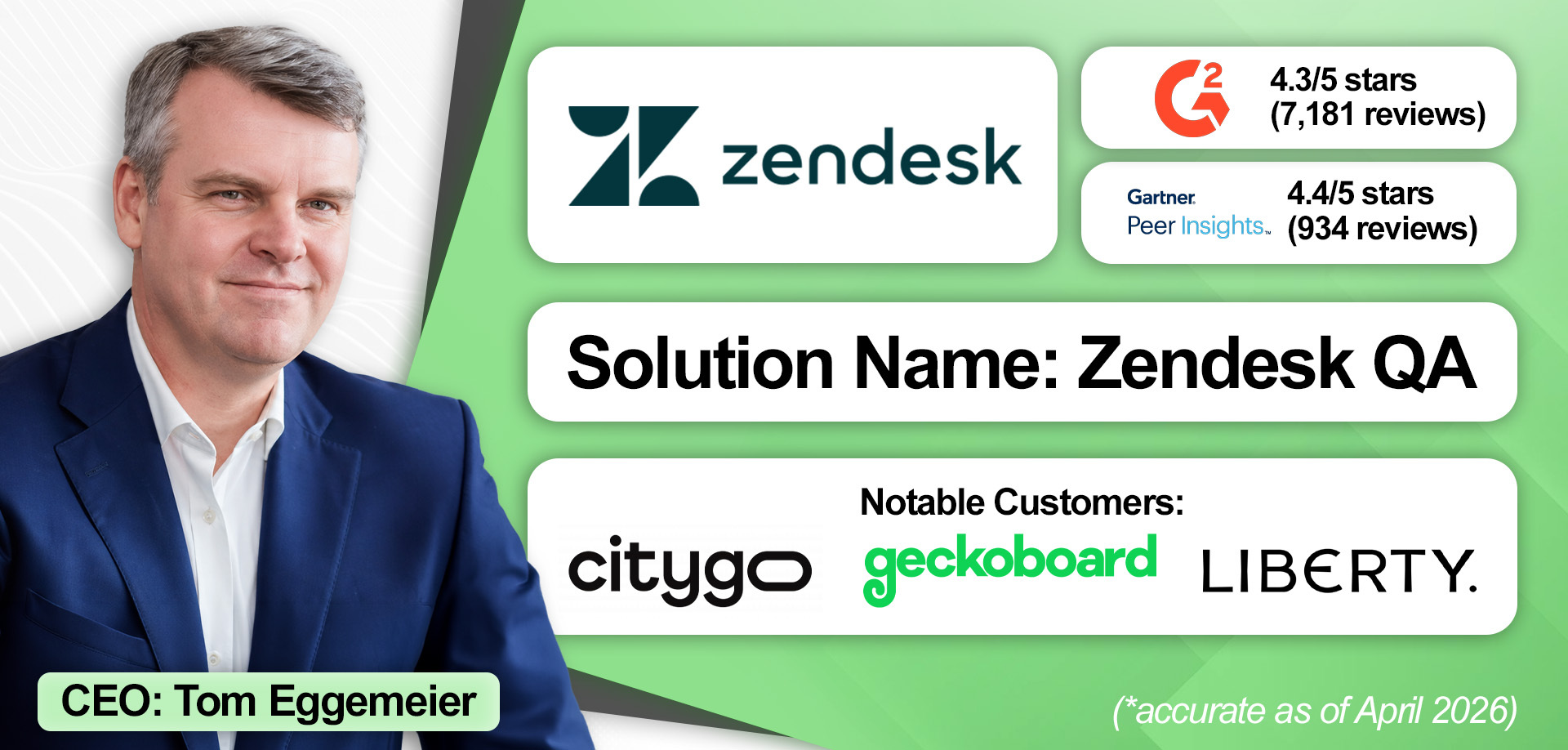 Zendesk entered the quality management software space via its 2024 acquisition of Klaus. Now known as ‘Zendesk Quality Assurance’, the solution is available as part of a workforce engagement management (WEM) bundle, alongside Zendesk WFM.
In pulling this together, Zendesk opens up the possibility to share agent performance insights with WFM teams to inform their scheduling and intraday strategies.
Moreover, by combining CRM and QM, Zendesk enriches customer support tickets with added context, such as churn risk and vulnerability signals, helping shape how the business engages specific customers going forward.
Additional opportunities for greater interoperability include having QM insights influence the actions Zendesk’s AI agents take in real time and informing the pop-ups live agents receive via the Zendesk Copilot.
Already, in regard to the former, Zendesk has launched ‘Voice QA and QA for AI agents’, extending the reach of its QM solution while unifying human and AI agent monitoring.
Other strengths of Zendesk QA include its workspace-based architecture, which lets teams segment QA environments by team, brand, outsourcer, or product; an AI trust metric that helps validate the reliability of automated scoring and scale it with confidence; and an assignment engine that streamlines manual review workflows.
Standout Features
- Broader Portfolio: Zendesk already packages its QM with WFM, adds quality insights to CRM tickets, and monitors its AI agents like human agents. This interoperability is an advantage, and there are many more opportunities, such as utilizing QM data to personalize Zendesk Copilot interventions
- AI Trust Score: Zendesk presents a built-in acceptance metric that tracks how often human reviewers agree with AI scoring. This allows teams to validate the reliability of automated QA and confidently scale its use once alignment reaches strong thresholds (e.g., ~80%+).
- Workspace-Based Architecture: Organizations can divide workspaces by team, brand, outsourcer, and product, with role-based access for agents, reviewers, and admins. As they access the solution, they have a customized workspace with the data signals and AI settings that are most relevant to them.
How Much Does It Cost?
Zendesk Quality Assurance is available for $35 per agent, per month, billed annually. The complete Zendesk WEM bundle costs $60 per agent, per month. Get Zendesk’s full pricing breakdown here.
11. Balto
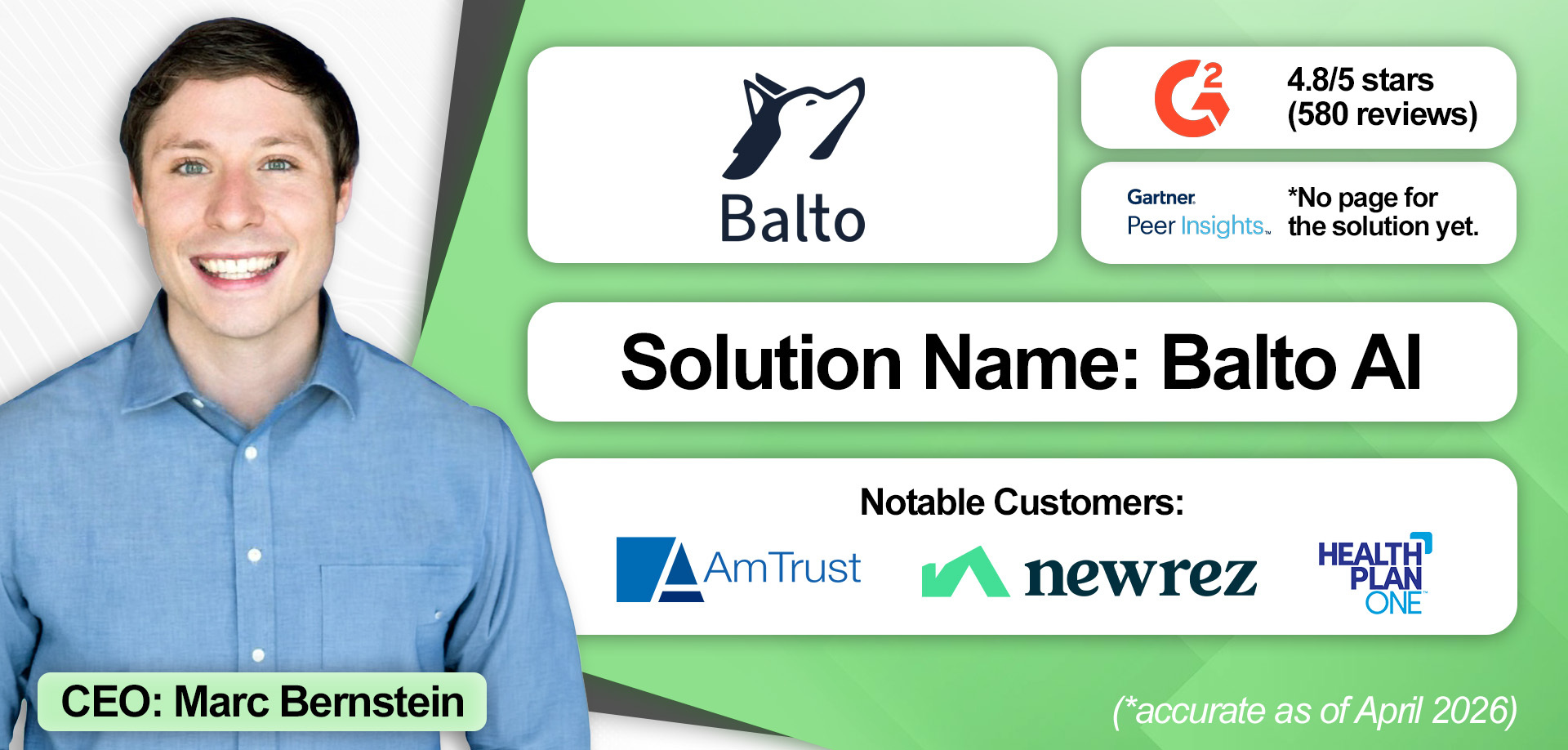 Balto looks to meet contact center quality teams where they are, create an auto-QA system that mirrors its existing scorecards, and refine the system over time. Its elevator pitch is a low-friction experience with steady improvement.
To support ongoing improvement, Balto runs experiments within its QM software to identify which phrases improve conversion rates, approaches reduce success, and behaviors correlate with positive outcomes. That not only informs scorecards but translates into coaching recommendations.
Similarly, the vendor analyzes top-performing agents to model what they do differently, then systematically surfaces those behaviors so they can be shared across teams. This helps spread best practices throughout the organization while informing the development of AI agents.
Interestingly, Balto has introduced its own voice agents, which can be monitored within the same unified quality framework used for human agents.
Alongside voice agents, Balto also offers an agent-assist solution, which presents real-time guidance messages to agents during a live call when specific conditions are met. Using QM data, Balto customers can pinpoint common issues and utilize dynamic prompts to ensure guidance cards pop up at critical moments when agents are likely to struggle.
Finally, Balto integrates with more than 50 CRM and contact center systems, enabling organizations to monitor how agent–customer conversations affect positive and negative outcomes over time, such as renewals and churn.
Standout Features
- AI Agent & Agent Assist Ownership: Balto has released voice AI agents. Its QM solutions help spot opportunities to deploy these agents and monitor their performance. The provider also offers agent assistance to surface contextual prompts during live calls, using QM data to intervene at moments when agents are most likely to struggle.
- Outcome-Focused AI: Balto connects quality management directly to business outcomes, continuously testing and analyzing behaviors and language patterns to identify what drives the outcomes that matter most to a particular business. Its broad integration portfolio helps track these outcomes beyond the one-to-one conversation.
- Low-Friction Approach: Automated QM programs often stutter as contact centers either rewrite the playbook completely, causing confusion, or just automate existing processes. Balto differentiates through with an emphasis on evolution, not revolution.
How Much Does It Cost?
Balto follows a per-seat, subscription pricing model. Yet, to uncover the price of that subscription, brands must book a meeting with the company. Contact Balto’s sales team here.
5 Trends Transforming Contact Center QM Software
The contact center QM market analysis above highlights several key trends shaping the future of the space. Here are five notable examples.
1. QM Leaders Focus on Turning Insight Into Action
The next frontier for quality management lies in actionability, specifically how insights drive coaching, training, and operational change.
Yet, in many organizations, QM insights, coaching workflows, learning management, and knowledge systems remain disconnected. So, even when QM software identifies a clear issue, such as a behavior that consistently reduces performance, it doesn’t reliably flow into coaching actions or structured improvement loops.
As such, the burden often falls back on teams to manually interpret, prioritize, and act on the data, which weakens impact.
Centrical is notably one provider that strives to change this by owning the employee experience stack, so quality insights inform AI role-play simulations, microlearning interventions, and gamification targets. That ownership is a significant advantage.
Yet, others are also moving the needle. For instance, AmplifAI makes coaching recommendations based on QM and then monitors the impact of that coaching via a bespoke metric to enhance future interventions.
2. QM Insights Bleed Into the Broader Enterprise
While still early in maturity, organizations are beginning to explore how quality insights can inform marketing, product development, HR, and broader operational decisions.
Oversai supports organizations by enabling QM insights to flow across collaboration platforms. Meanwhile, Verint (through Calabrio) provides customizable dashboards that allow enterprise users to see how their actions influence critical customer outcomes and contact center demand.
However, this shift is constrained by the contact center’s limited reach into the enterprise, alongside a broader misalignment between technical capability and operational maturity.
After all, in practice, many QM programs remain underdeveloped, with inconsistent measurement frameworks and overly simplistic scorecards that fail to capture nuanced performance.
As a result, Observe.ai’s approach of assigning engineers to align deployments with the customer reality is valuable, helping organizations extend more mature QM practices beyond the contact center. evaluagent and Scorebuddy’s approach to ongoing customer success also stands out.
3. QM Data Is Increasingly Informing Agent Assist
Too often, agent-assist solutions surface guidance that agents don’t actually need, turning pop-ups into a distraction rather than a support tool.
However, QM data can address this by pinpointing where agents consistently struggle - whether that’s in regard to a process, product knowledge, or policy adherence - and ensuring guidance is delivered only where it genuinely adds value.
Cresta and Balto already support customers in this endeavor, while Observe.AI’s approach is particularly advanced, isolating performance gaps at the individual level.
In doing so, the provider uses quality insights to deliver targeted assistance and evolve agent assist into a truly personalized application.
4. Hybrid Human-AI QM Starts with Unified Performance Dashboards
Level AI, Zendesk, Cresta, Verint, Balto, and others have expanded beyond quality management into customer-facing conversational AI.
In doing so, they are bringing all contact center interactions, whether human- or AI-led, into a single framework that informs customer service automation and triage strategies.
Some providers, like evaluagent, are also becoming AI-agent-agnostic to present a similar framework across numerous conversational AI platforms.
Nevertheless, those that own first-party agents may look to differentiate by modeling those agents on QM data that relates to a contact center’s best-performing agents.
Meanwhile, QM software may also help steer AI agents, so they participate in simulations, receive targeted coaching, and continuously improve over time, like human agents. Notably, applying this approach to AI agent training is already on Centrical's roadmap.
5. QM and WFM Interoperability Is In Its Early Stages
Verint Systems and Zendesk bundle quality management (QM) and workforce management (WFM) capabilities together in their platforms. At the same time, companies like Level AI and evaluagent are forming close go-to-market partnerships with the WFM specialists Assembled and Peopleware, respectively.
In doing so, these quality management software providers recognize the potential in equipping planners with the insights they generate.
For example, shifting intent signals captured in QM systems can enable real-time schedule adjustments, while insights into agent performance can help optimize queue assignments to improve both efficiency and morale.
The next step, however, is deeper interoperability between QM and WFM systems.
In a connected ecosystem, QM data may indicate that agents are struggling with a new promotion. An interoperable system could then automatically schedule training and update staffing requirements. That’s just one example of how this interoperability may benefit contact centers.
Understanding the Broader Contact Center QM Market
The traditional lines between contact center technologies are blurring. As this happens, CCaaS, conversational intelligence, and even VoC providers are moving into the QM market.
Recognizing this, leading quality management software providers are doubling down on execution and connecting insight generation to operational execution to differentiate.
Some are successfully making that transition, utilizing QM data to drive actions across CRM systems, the WFM function, agent-assist tooling, routing engine, and beyond.
However, others have proven slow to react or shifted their focus in the changing market.
For instance, MaestroQA now operates under the name “Rippit”, with the founder stating, "We are saying goodbye to being a QA company." Instead, it’s now an insight generation company that sits at the broader enterprise level.
Meanwhile, Playvox - another industry stalwart - has seen little investment since its 2024 acquisition by NiCE. Now, it appears to be taking a back seat as NiCE focuses on building a unified workforce engagement management (WEM) platform for both human and AI agents within CXone (its CCaaS platform), which is, in fairness, a compelling vision.
As former category stalwarts create gaps in the market, each vendor in this landscape aims to position itself as a potential successor, shaping the next generation of quality management software.