
July 9, 2026 • 17 min read
Supporting Vulnerable Customers in 2026: Types of Vulnerability, Frameworks, & Best Practices

Director of Content & Market Research
July 9, 2026
In 2025, Monzo Bank noticed a friction in its identity verification journey.
It realized that customers with visual impairments couldn't follow the on-screen prompts for positioning their face for a biometric scan.
The fix was minimal, add audio guidance. The impact in supporting vulnerable customers wasn’t.
Ultimately, that story exemplifies what good vulnerable customer support looks like: small, deliberate choices that remove barriers most people never notice.
Get it right, and the rewards follow in fewer complaints, stronger loyalty, and a real commercial upside. That’s on top of the ethical and regulatory case for doing it at all.
Yet, given the many ‘types’ of customer vulnerabilities, supporting vulnerable customers can feel like an uphill battle.
Thankfully, there are plenty of frameworks, acronyms, and best practices to help, as explored below, after a quick recap of the fundamentals.
What Is a Vulnerable Customer?
The UK Financial Conduct Authority (FCA) defines a vulnerable customer as “someone who, due to their personal circumstances, is especially susceptible to harm, particularly when a firm is not acting with appropriate levels of care.”
That’s a definition that many organizations follow, and Helen Pettifer, Director of Helen Pettifer Training, recommends breaking down that definition into three parts:
- Personal circumstances: What's actually going on in a customer's life, whether that's a health condition, a significant life event, a financial squeeze, or a communication or cognitive barrier.
- Susceptibility to harm: Whether those circumstances mean an ordinary interaction, a premium increase, a missed payment reminder, etc., could cause serious detriment.
- The firm's own conduct: Whether the organization identifies the vulnerability and acts on it appropriately. (Remember, some customers aren't vulnerable at all until they try to interact with an organization that has no phone line, no accessible app, and no fallback for people who can't use its digital channels. In those cases, the company itself is the thing creating the vulnerability).
By considering the definition in this way, companies can better manage the distinct ‘types’ of vulnerable customers.
The Four 'Types' of Vulnerable Customers (& Two More!)
Vulnerable customers don’t fit neatly into categories. Indeed, the Vulnerability Registration Service (VRS) found that customers who disclose vulnerability typically report six different circumstances affecting them at once.
As such, customers may experience multiple ‘types’ vulnerability.
With that warning, consider the FCA’s four types of vulnerability below, alongside two additional suggestions from Pettifer.
1. Health
Physical and mental health conditions, hearing or sight loss, speech impairments, and learning disabilities all fall under this umbrella, with conditions either permanent or temporary.
2. Resilience
This covers both financial and emotional resilience. Think of it as, essentially, someone's capacity to cope. As the sustained cost-of-living pressure leaves growing numbers of customers running on empty, this is a rising issue. What frontline teams sometimes read as impatience or aggression is often just people in survival mode.
3. Capability
A customer's ability to read, understand, process information, or communicate effectively. For example, that might include customers whose first language isn't English, or who rely on a carer to manage some interactions on their behalf.
4. Life Events
Bereavement, divorce, redundancy are extreme events, but also consider more mundane disruptions like a car breaking down. These can tip someone into a vulnerable position, especially if they have no financial buffer to absorb the shock.
Added - 5. Economic Vulnerability
Petifer recommends separating out the wider economic barriers people face from financial resilience alone. Consider the goals, like buying a first home or changing careers, that become out of reach without financial means, shaped by the broader economic climate.
Added - 6. Environmental Vulnerability
Petifer also suggests considering what's happening around a customer, whether that’s in their home, community, or wider society. That includes domestic or economic abuse, poor housing, inability to heat a home, feeling unsafe locally, or the effects of flooding and climate change.
How to Identify a Vulnerable Customer
Research from the FCA suggests around 60% of vulnerable customers never disclose their circumstances.
The answer, according to much online literature, focuses on teaching agents to show empathy, so customers are comfortable disclosing vulnerabilities.
Yet, the environment around the agent must also make them feel comfortable in having those deeper customer conversations.
Helen Beaumont Manahan, Director of CX at the National Support Network, emphasized this, noting that managers and supervisors must give frontline teams the confidence, permission, and language to explore a possible vulnerability, rather than leaving them to wonder whether it's their place to ask.
"The question is: what stops us from saying, 'Can you tell me a bit more about that?' What stops us from leaning in?"

There are also technological solutions, beyond establishing a foundational environment where agents feel comfortable asking directly: "How can we reduce the overwhelm?"
Here are two excellent examples:
- Use real-time conversational analysis. Conversational intelligence systems can flag signs of anxiety or confusion as a call happens, which agents can utilize to investigate further. These signs include when a customer asks repeated questions, takes accountability for mistakes, or references a family member who provides support.
- Build predictive models from behavioral data. Perhaps a bank notices a sudden spike in gambling transactions or a previously reliable payer who starts missing bills. Building models to isolate such behaviors helps spot vulnerabilities outside of customer conversations alone and opens the door to a broader vulnerable customer strategy.
In using these solutions, organizations can combine vulnerability data with contact volume data to isolate the biggest points of friction for vulnerable customer groups.
Riffat Tufail, former Strategy Lead for Vulnerable Customers at Monzo Bank, recommends doing this before feeding those insights back into product and service design initiatives.
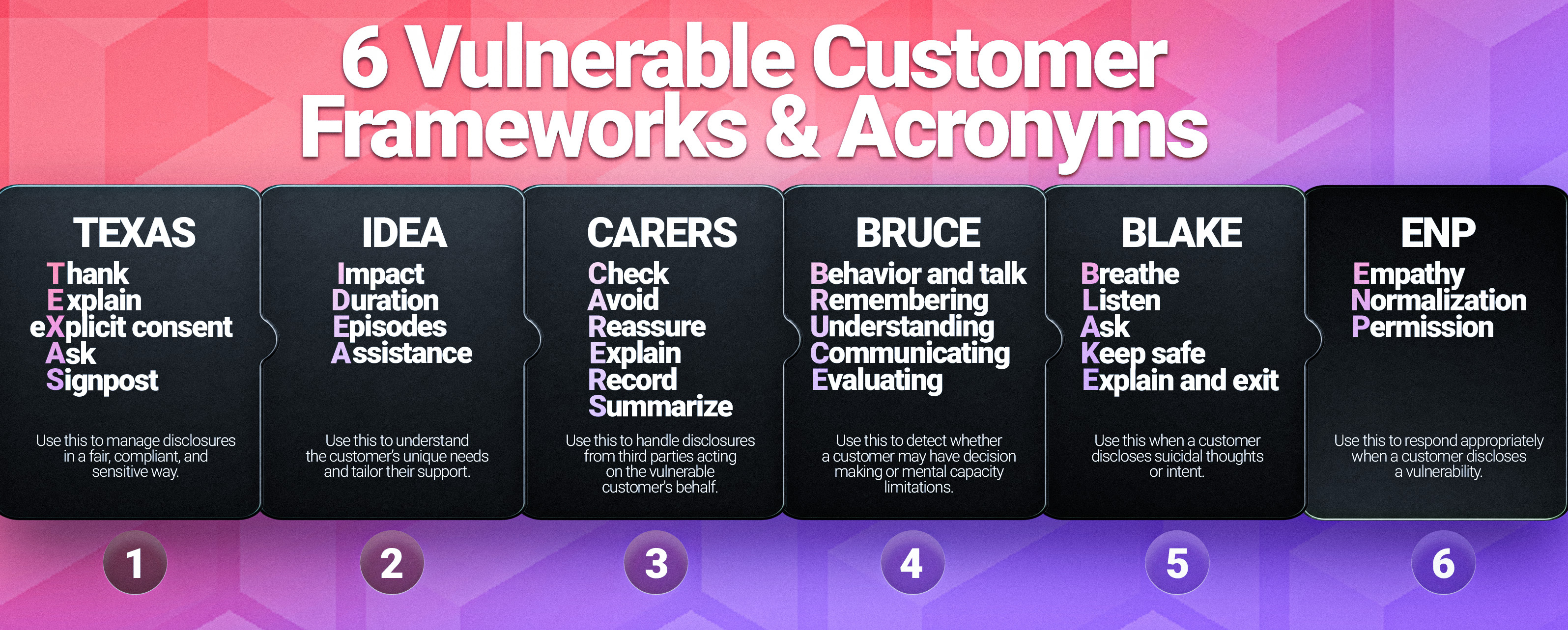
6 Vulnerable Customer Frameworks & Acronyms
Frameworks and acronyms have their place in guiding vulnerable customer programs. But there's a shared warning that comes with them, too.
"You never want to become so scripted that you're simply ticking boxes," cautions Beaumont Manahan.
With that in mind, here are six frameworks to follow cautiously, not blindly.
1. TEXAS
TEXAS stands for Thank, Explain, eXplicit consent, Ask, and Signpost.
The framework aims to help agents manage disclosures in a fair, compliant, and sensitive way.
In this model, every letter refers to a step that an agent should follow, as below:
- Thank the customer
- Explain how the information will be used
- Obtain eXplicit consent
- Ask questions to get key customer information
- Signpost or refer to specialist support
Yet, Petifer recommends not only explaining what will happen to the customer’s data when their vulnerability is recorded, but explaining the benefit to the customer before asking for anything.
“Tell customers why the information is being collected so they don't have to repeat their circumstances to every new adviser they speak to,” noted Petifer.
Once that's clear, explicit consent becomes far easier to obtain.
Learn more about the TEXAS framework here.
2. IDEA
IDEA stands for Impact, Duration, Episodes, and Assistance.
The model aims to help agents in guiding conversations so they understand the customer’s needs and tailor support appropriately.
Here, every letter refers back to a question an agent may consider asking, as below:
- Impact: How has this affected your personal and financial situation?
- Duration: When did this first start to happen?
- Episodes: Have you experienced this before? / How often does this happen?
- Assistance: Is there anything else I should know about the support, treatment, or care you're receiving that would help me support you more effectively?
Interestingly, answers to the last question may help to gain insight into how customer support leaders can tailor experiences for specific ‘types’ of vulnerable customers more broadly, informing customer experience design.
Learn more about the IDEA framework here.
3. CARERS
CARERS stands for Check, Avoid, Reassure, Explain, Record, and Summarize.
The acronym helps agents handle disclosures from carers, family members, and other third parties acting on behalf of a vulnerable customer.
In this model, every letter refers to a step an agent must take to manage that disclosure:
- Check for authority.
- Avoid sharing account details until authority is confirmed, and explain why.
- Reassure the carer that their concerns can be recorded as unverified observations on the customer's account and investigated.
- Explain that the carer's observations will be shared with the customer and relevant colleagues, with their consent.
- Record the carer's observations, ensuring the customer cannot speak directly with the organization, and confirm what has been recorded and how long it will be retained.
- Summarize the next steps. These may include speaking with the customer to verify the carer's observations, discussing a mandate to act on the customer's behalf, or gathering supporting medical evidence.
Learn more about the CARERS framework here.
4. BRUCE
BRUCE stands for Behavior and talk, Remembering, Understanding, Communicating, and Evaluating.
The framework refers to five questions an agent may wish to ask themselves to detect whether a customer may have decision making or mental capacity limitations.
Those five questions are as follows:
- Behavior and talk: Does the customer have any difficulties with their behavior or speech?
- Remembering: Is the customer having trouble remembering information?
- Understanding: Does the customer understand what I’m/we’re telling them?
- Communicating: Can the customer express their wishes and make a decision?
- Evaluating: Is the customer capable of ‘weighing-up’ options and deciding which is best?
After considering these questions, agents should create an environment in which the customer may feel comfortable in disclosing their vulnerability and perhaps follow the TEXAS model.
Learn more about the BRUCE framework here.
5. BLAKE
BLAKE stands for Breathe, Listen, Ask, Keep safe, and Explain and exit.
The model aims to support agents in one of the most difficult situations they face: a customer disclosing suicidal thoughts or intent.
Here, each letter marks a step agents can take to manage the situation:
- Breathe to focus
- Listen to understand
- Ask to discover
- Keep safe from harm
- Explain and exit
Ultimately, the aim is to keep supporting the customer until someone better placed, from the emergency services or an organization like Samaritans or PAPYRUS, can take over managing the risk.
Because these disclosures tend to arrive with no warning, having a simple, memorable structure helps agents respond calmly rather than freeze.
Learn more about the BLAKE framework here.
6. ENP
ENP stands for Empathy, Normalization, and Permission.
The acronym helps agents respond appropriately and with support when a customer discloses a vulnerability.
Each letter refers to a step the agent should take, as outlined below:
- Empathy: Show empathy for the situation.
- Normalization: Normalize seeking support so the customer doesn't feel singled out.
- Permission: Make any next step permission-based.
On the ‘Permission’ step, rather than imposing a solution, ask: "Would that be okay?" Agents can then move into the next-best steps and signposting.
The National Support Network developed ENP internally. Learn more about the organization here.
11 Best Practices to Support Vulnerable Customers
While definitions and frameworks are critical, creating an all-encompassing vulnerable customer program can feel like an almighty task. The following best practices may help lighten the load.
1. Start with the Fundamentals
Vulnerability is often shaped by multiple, changing factors, but that doesn't mean responding to it has to be complicated.
Equip teams to identify the signs, respond with confidence and empathy, tailor support to the individual's needs, document interactions in line with internal and regulatory requirements, and connect customers with additional support when appropriate.
From that point onward, every interaction and iniativative is an opportunity to reduce harm and improve outcomes.
“When we understand the many ways people experience vulnerability, and we all experience it at some point, we can respond more effectively. That's one of the strengths of vulnerability training: everyone has lived experience.”
2. Capture Support Markers
Recording the customer’s ‘type’ of vulnerability only gets an organization so far.
Pettifer argues the real value comes from labelling the type support that's required for that customer as an individual. Consider:
- Should communication be adapted?
- Should extra time be built into calls?
- Has a trusted third party been added to the account?
Support markers like these, not vulnerability labels, are what actually help the next agent who picks up the phone.
3. Unpack Your Existing Customer Vulnerability Data
If an organization is already recording vulnerability, that dataset holds the answer to where a formal program should first focus, when moving beyond the fundamentals.
For instance, if 17% of customers are requesting adapted communications, that's a clear signal to check whether current materials are actually working for them.
Also, it’s a reminder that the true figure is almost certainly higher, since it only reflects the people who've disclosed...
4 Treat Customer Vulnerability as an Ongoing Commitment, Not a One-Off Activity
Running training once a year and considering the job done isn’t enough to support vulnerable customers. After all, approximately 80% of classroom learning is forgotten within a month if it isn't reinforced.
To make matters worse, many contact centers inadvertently undo their own training by telling agents to take as much time as vulnerable customers need, then penalizing them for high average handling times (yes, that still happens!).
The fix, according to Elaine Lee, Managing Director at Reynolds Busby Lee, is embedding the behaviour year-round
Lee asserts that regular coaching, refreshers, and monthly discussions are critical so that every team leader coaches a consistent approach, rather than five different ones.
5. Create Vulnerable Customer Personas to Inform Better Experience Design
Develop personas based on detailed, lived-in scenarios. For example, consider a customer starting a new business, discovering a pregnancy, and going through a relationship breakdown simultaneously, not only a generic marketing-type personna.
To help colleagues genuinely step into such a vulnerable customer's shoes, mystery shop the organization's own journeys from their perspective. That insight opens up several avenues to improve experience design and support that customer, per Tufail.
“At one conference, I challenged the audience to find their own company's vulnerable customer support page and time how long it took. Some couldn't find one at all; others found little useful information once they did.”

6. Use Technology In Training to Better Understand Vulnerabilities
Accessibility aids help frontline teams experience vulnerability first-hand rather than read about it in a slide deck.
Consider VR headsets as one such aid. These allow staff to immerse themselves in real-life scenarios from a vulnerable customer's point of view, free of the usual office distractions.
For example, such headsets can help simulate glaucoma so colleagues can see how hard it becomes to read a customer statement.
Tufail ran this activity while at Head of Customer Vulnerability at Standard Life. Her teams have also used Haptic Gloves that mimic conditions like carpal tunnel syndrome or arthritis, making something as simple as swiping a screen noticeably harder.
Such activities can open the eyes of colleagues, both at the agent level, so they may offer genuine empathy, and at the director level, so they see value in adapting the experience.
7. Establish an Inclusive Customer Panel
Some organizations build panels of around 10 to 12 people with a broad mix of vulnerabilities, who road-test products and communications before they reach customers.
Why is this valuable? Here’s a scenario: a new ATM card design might come back with feedback that the font is too small or that it's indistinguishable from other cards in a wallet.
That insight helps avoid expensive post-launch product modifications and it pre-emptively reduces vulnerable customer contacts.
8. Commission Bespoke Customer Vulnerability Research
Tufail recommends commissioning research on a representative sample of an organization's own customers, rather than relying solely on generic industry data, to better understand vulnerabilities within its own base.
Why? Because vulnerabilities most common among a bank's customers may look very different to those among pension provider's or utility company's, for example.
Bespoke research gives organizations the tailored insight, language, and evidence needed to make the case for change internally.
9. Avoid Making Assumptions About Different Vulnerability ‘Types’
“Don’t make assumptions about a customer's needs based on a condition or label alone,” stresses Pettifer.
After all, vulnerability is highly individual, and the support someone requires will depend on their specific circumstances rather than a diagnosis or characteristic.
As such, agents should feel confident tailoring their responses to the person in front of them, and only identify or record vulnerability when doing so leads to meaningful adjustments or additional support.
10. Collaborate with Charities for Mutual Benefit
Organizations can build purposeful partnerships with charities whose expertise aligns with the needs of their customers.
Rather than engaging multiple charities, it’s best to focus on those that align with the vulnerabilities most relevant to the customer base.
Yet, remember that partnerships should be mutually beneficial. In this sense, organizations should consider how they can support charities through funding, skills sharing or raising awareness, while recognizing the resource pressures many face.
“Sometimes the right partner is a large national charity, but sometimes it's a smaller, independent organization that doesn't receive the same level of funding. Working with corporate partners can be particularly valuable for them, and you can often build very strong partnerships.”
11. Reconsider the Term "Vulnerable Customer"
Lee makes the case for retiring the ‘vulnerable customer’ label in favor of talking about "customers with additional support needs."
Why? Because most people don't want to be classed as vulnerable, and the reframe keeps the focus on what practical support someone needs, rather than fixing them with a category they may not identify with at all.
Why Invest in Vulnerable Customer Support?
Typically, there are three core drivers behind investing in vulnerable customer support:
- The Ethical Case: Everyone will experience vulnerable circumstances at some point in their life and understands the significance of supporting those in similar circumstances.
- The Regulatory Case: Voluntary codes of practice have increasingly given way to mandatory requirements like the FCA's Consumer Duty in the UK and the Unfair Commercial Practices Directive (UCPD) in the EU.
- The Cultural Case: Recognize that contact center staff are people too, and will naturally empathize with vulnerable customers. As such, morale will take a hit if they’re not able to support such customers effectively.
There's also, increasingly, a financial case. Beaumont Manahan notes that companies are now asking direct commercial questions about what effective support delivers for the bottom line.
As such, her organization, the National Support Network, is developing an ROI calculator to attach monetary value to the operational metrics organizations already track, from reduced complaints and lower churn to improved employee retention.
Yet, making any of this stick, Tufail argues, tends to depend on having an executive sponsor in place. That is someone acting as a vulnerable customer champion, with a strategy that runs across the whole organization rather than sitting in isolation within customer operations.
Final Point... Don't Forget About Vulnerable Staff Members
It's easy to focus entirely on the customer side of this equation and forget the people managing these conversations every day.
As Pettifer puts it, frontline agents are increasingly hearing customers share traumatic, deeply personal experiences, and in some cases dealing with strikingly similar circumstances in their own lives.
Measuring their performance purely on call volumes and average handling time (AHT), she argues, works directly against the meaningful conversations organizations are asking them to have, leaving many frontline teams stressed, experiencing compassion fatigue, and under-supported by the organizations they work for.
"You can't claim to care about customers while treating your own staff poorly. We're all human."

Customers aren't the only ones susceptible to vulnerability. Employees are too. Given this, any genuine vulnerable customer strategy has to account for both.