
January 27, 2026 • 11 min read
5 Essential Customer Experience Design Steps for 2026

Director of Content & Market Research
January 27, 2026
Exceptional customer experiences are rarely accidental. Instead, they are anticipated, designed, and carefully executed.
The payoff can be significant. Forrester reports that 41% of customer-experience-focused brands achieved at least 10% year-over-year revenue growth, compared with just 10% of less mature companies.
These numbers highlight the tangible value of intentional customer experience design. But what does the term actually mean, and how should brands approach it in 2026?
What Is Customer Experience Design?
Customer experience design is the intentional practice of planning and shaping every interaction a customer has with a brand, from first touchpoint to long-term relationship.
Rather than letting experiences happen by accident or around internal workflows, customer experience design starts with understanding the customer’s perspective and deliberately designing end-to-end journeys that meet real needs, expectations, and emotions.
In 2026, as businesses increasingly automate internal workflows with AI, the customer perspective is in danger of being lost.
For this reason, the fundamentals of experience design - reducing effort, creating emotional resonance, and delivering consistency – are more crucial than ever before.
The 5 Customer Experience Design Steps
Customer experience design can easily become all-consuming, leading brands to get lost in the minutiae. To stay focused, many follow a framework that loosely follows these five steps.
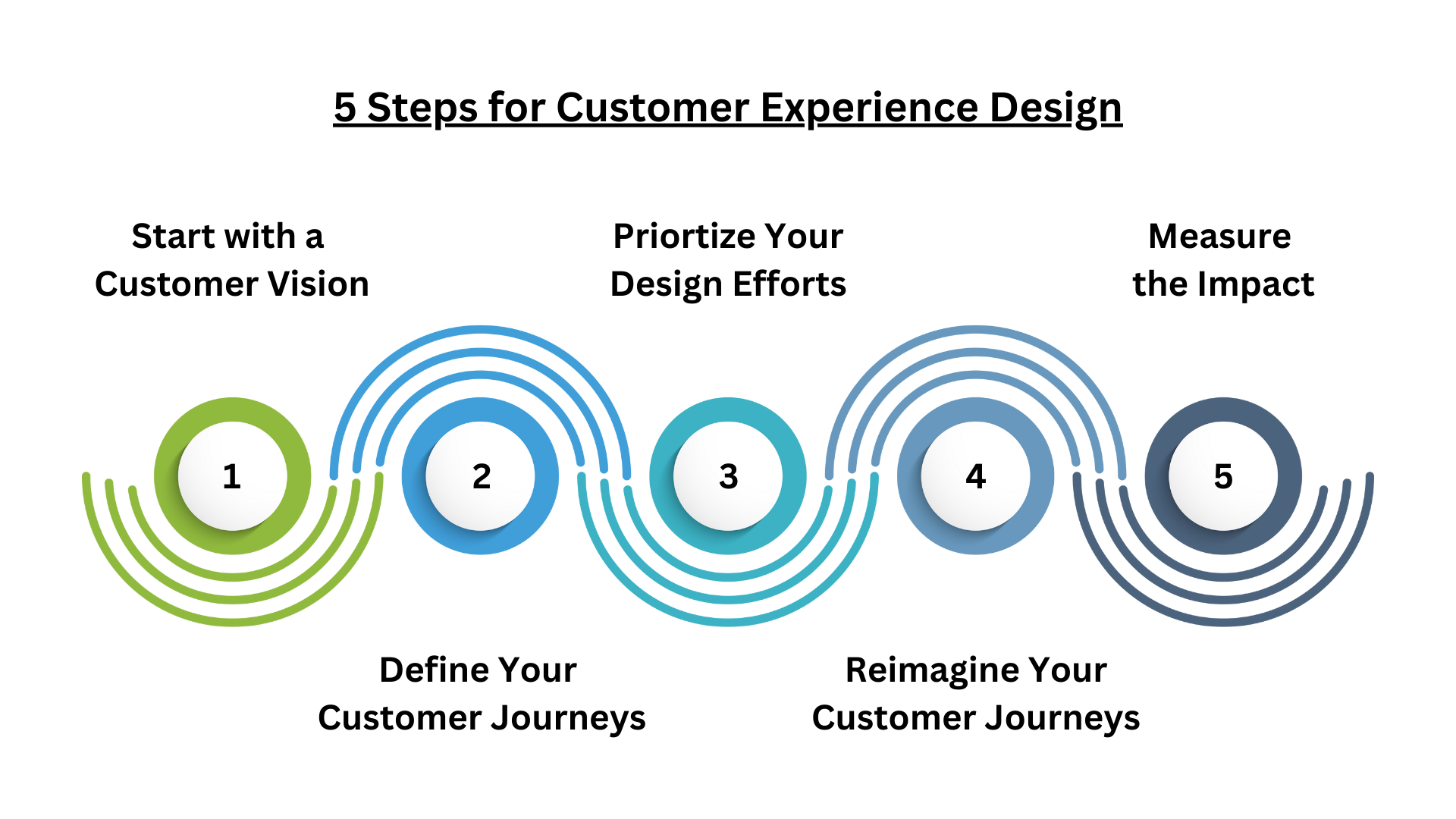
1. Start with a Customer Vision
A customer vision is a clear, aspirational statement that defines the experience a brand intends customers to see, feel, and have across every interaction.
Customer interviews can help inspire this vision. Yet, there are new techniques to find out what most matters to customers.
We’ve started experimenting with synthetic data and AI-generated personas, with underpinning governance in place. For example, with a client in the Italian olive oil industry, we created AI personas based on industry data and real customer insight. Instead of focusing on problems, these personas talked about their lives, family history, and motivations. That storytelling had far more impact than dashboards or soundbites. It helped the client appreciate the context when it came to what mattered to their customers.

With such mechanisms, or a more conventional customer feedback program, translate the vision into concrete customer promises, which are practical and tangible commitments.
For example, a promise might be, "We will contact you within one working day, rather than a broken promise to get back straight away."
These promises form the foundation for experience design principles that guide every journey, whether it’s a contact center, retail, hospitality, or another experience altogether.
2. Define Your Customer Journeys
The Holy Grail is to map every possible journey a customer might go through, designing each one intentionally. However, that can be an exhaustive process.
For instance, one global telecoms provider mapped as many as 750 different journeys, assigning each an owner.
While that doesn’t necessarily mean 750 different people, it does mean every journey is understood, intentionally designed, and accountable.
Some journeys may relate to a single department, such as a customer service experience, while others span multiple departments, like an onboarding experience.
Either way, all customer-facing department leaders should be involved, understanding every journey that touches them, and collaborating on redesign efforts.
3. Prioritize Your Design Efforts
With a comprehensive list of customer journeys, it’s tricky to know where to start. Yet, ultimately, it’s a data exercise, considering which most impact customer sentiment and business value.
Customer feedback is essential. But, also invest in employee insight. After all, frontline teams understand the customer experience better than anyone. Involving them has huge benefits: better insight, stronger engagement, and better delivery of the experience.
Brands must also consider how to unlock data siloed between departments for a deeper understanding their customer journeys, while turning data signals and feedback into usable insights.
Siloed data is an age-old issue. One team looks at user data, another at website data, another at social, another at complaints or revenue. Maybe that data gets shared once a month in a meeting. Yet, typically, everyone will then revert to working in isolation. Very few organizations truly bring all their data together to understand the end-to-end experience.
My advice would be: list every data source you have and ask whether you’re looking at them collectively or individually. If it’s the latter, you’re missing the full picture.

Through analysis, teams can prioritize low-complexity, high-value journeys, demonstrate the impact of customer experience design, and secure support to scale their efforts.
4. Reimagine Those Journeys
The traditional method to reimagine a customer journey is to map it out, touchpoint-by-touchpoint, identifying where processes break down and moments where the brand isn’t meeting its customer promises.
Typically, this involves creating personas, viewing the experience through the customers’ eyes, and adding richness to the feedback and data already collected. Increasingly, however, AI personas or “digital twins” of customers, trained on that same data, are augmenting these processes and generating new insights.
The next step is for the brand to identify and apply fixes across its pain points and, in some cases, try to forge a memorable moment that binds trust.
In doing so, many brands refer to principles like the Peak-End Rule. This dictates that people judge an experience by how they felt at its most intense point, aka its ‘peak’.
Yet, while fixing pain points and creating memorable moments matter, customer experience design should ultimately focus on the outcomes customers want to achieve, not merely the problems brands think need solving.
5. Measure the Impact
Customer experience design is not a one-and-done exercise. Once a brand has designed an experience, it needs to quality assure it continuously.
Someone has to own it, review it regularly, and evolve it. That’s where many organizations fail.
The KPIs should relate back to the vision, covering critical customer, employee, and business outcomes, alongside journey-specific metrics.
For instance, monitoring where customers’ drop out of an AI-led service experience, gives key insight into how brands can improve it.
While it’s tempting to just validate that a problem has been fixed, taking this broad view is critical to gauge true impact
Best Practices for Customer Experience Design
Successful customer experience design programs often follow the best practices set out below to ensure clarity, realism, and purpose.
Establish a Consistent Process Across All Designs
The design of a customer journey will vary depending on context, but there needs to be a consistent vision and process behind it. That process ensures the design is informed by customer needs.
Inclusive design is a good example. It’s easy to say it’s important, but if the organization’s processes don’t help collect insight from minority groups, it won’t know where to start or what to look for.
Even if a brand has skilled designers, people trained to design digital platforms or physical retail experiences, the output they create will depend heavily on the inputs they receive.
The role of customer experience is to make sure those inputs clearly reflect customer outcomes, requirements, and expectations. That’s where CX adds value.
Ground Designs In Reality
Customer experience teams must ground designs in reality, not assumptions.
While that may seem obvious, when a CX leader has seen a problem multiple times, it’s easy to assume the solution will be the same again. But that assumption can be dangerous.
I worked with a B2B client on an order-to-cash process. They’d automated processes many times, with success, and assumed this latest would be no different. But in this case, customers didn’t understand the change in behaviour expected of them. The automation change alone didn’t make the difference. When we went back to the interviews to understand why, the insight was there, but it had been missed. Customers needed training and guidance on certain changes. Once delivered the system worked and usage increased by 300%.
Avoid Hyper-Focusing on Efficiency
Efficient processes matter, but if brands design an experience around what customers need and want, efficiency follows naturally.
“You end up with fewer issues, less friction, fewer complaints, and less employee intervention, all of which reduce costs that we don’t usually measure upfront,” said Stabler.
Involve Frontline Teams in Assessing Customer Feedback
Getting frontline teams into physical insight rooms helps uncover serious issues. Even when such projects are time-consuming and expensive, Brooks believes they can be worth it.
“We tested AI tools like Dovetail and Corral, and they surfaced almost all the same insights we found manually. However, something important was lost. When new employees onboarded, they used to work through the insight themselves in Customer Insight Rooms. They became trained in spotting issues earlier and developed a deep respect for the customers. With AI-generated reports, this connection disappears.”
Don’t Overlook Customer Psychology
Customer experience isn’t complicated in a technical sense, but it is psychology and neuroscience.
With AI especially, there’s a risk of experiences becoming generic and missing the human, psychological elements that really matter.
For instance, a contact center could entirely automate service experiences in highly sensitive scenarios. But, should they? After all, AI may simulate empathy, but it can’t originate it.
Commit to Responsible AI Use
There are many new assistive AI tools that teams may wish to utilize as they redesign customer experiences, like AI-generated customer personas. Yet, they must do their due diligence.
For instance, organizations may get excited, reuse interview data beyond its original purpose and without anonymization. Under the EU AI Act, that can result in fines of up to 30% of turnover.
“I’ve also seen AI generate long lists of “issues to fix”. However, what is not available to the AI is the insight source has been reviewed by leadership who agreed that some challenges were consciously deprioritized for strategic reasons. AI doesn’t understand context or decision history. This leads to at best duplication of work and at worst AI undermining leadership and financial loss.”
To this point, while AI may help rubberstamp what “good” looks like, it doesn’t reflect on the failures brands have learned along the way.
The Challenges of Customer Experience Design
Designing great customer experiences isn’t just a creative exercise, it requires navigating a series of organizational, technological, and cultural challenges, as set out below.
Winning Management Buy-In
Customer experience design is resource intensive, and teams often have to prove the value of CX before they’re allowed to invest properly in it.
In reality, if a brand invested in it from the start, it wouldn’t need to prove the value later.
Nevertheless, prioritization of low-complexity journeys with a clear business benefit can help brands demonstrate the potential of and build confidence in customer experience design.
Building New Experiences on Top of Old Systems
Many organizations build new platforms on top of legacy processes and technology. That creates a very complex environment and makes experience design extremely difficult.
“While recent technology advancements are incredible, especially with new AI solutions, brands mustn’t lose sight of the outcomes they want to deliver and challenges the need to overcome.”
So, don’t start with the technology and work backwards. First, consider: what problem are you trying to solve? What opportunity are you pursuing? Is technology actually the right answer?
Inspiring the People Who Deliver the Experience
It’s easy to put the company vision and commitments on a wall, but when people are under pressure, that’s when what an organization really stands for comes to the fore.
If leadership expects its frontline teams to deliver new experiences, which align with customer commitments, they have to engage them and give them the space to do so.
Even in the difficult moments, leadership teams need to lead by example.
Customer Experience Design Matters More in 2026
At its core, customer experience design is about loyalty: sustainable revenue earned from customers who choose to stay.
While AI promises to unlock new efficiencies, customer experience remains, first and foremost, a relationship, and every relationship begins and ends with trust.
Ultimately, that trust is built in moments that require human judgment.
So, while customer experience will become increasingly AI-led, designing experiences with human very deliberately on top will become increasingly table stakes.
As Martin Hill Wilson, Founder of Brainfood Consulting, told the CX Foundation: “AI makes the foundations of customer experience more important, not less.”