
August 11, 2026 • 14 min read
Multimodal Customer Experience Solutions, Examples, and Design

Director of Content & Market Research
August 11, 2026
For decades, omnichannel customer experience has been the gold standard, promising seamless handoffs between channels, with no dropped context.
But what if customers didn't need to be handed off at all?
Instead of moving them between channels, what if one channel could support multiple media - i.e., text, voice, image, video - at once?
That's the promise of multimodal customer experience, and CX leaders are taking notice. According to Zendesk, 82% acknowledge that ignoring multimodal will leave them behind.
But multimodal isn't a fixed goal. Conversational AI providers are advancing their multimodal capabilities fast, and the possibilities keep expanding.
Here's where things stand today, and where they're headed next.
What Is a Multimodal Customer Experience?
A multimodal customer experience blends modes of communication within a single conversation on one primary channel.
For example, a customer might call a company and interact with digital elements on their smartphone while still speaking to an employee.
Alternatively, they might message a digital agent, exchange voice notes, share video clips, and upload rich media, all within the same chat.
This differs from an omnichannel experience. Indeed, the key distinction lies in the channel itself. A multimodal conversation starts and ends on the same channel. An omnichannel experience, by contrast, is defined by context following the customer as they move from one channel to another.
As AI models become more advanced at blending communication mediums, orchestrated experiences that combine modalities within a single core channel will become increasingly common.
Key Benefits of Multimodal Customer Experiences
Organizations that can blend modalities within a single channel are better positioned to design imaginative customer journeys.
After all, by combining voice and digital elements, or digital channels with voice notes and guidance, brands can simplify complex resolution flows.
There will be more examples of this later, but to illustrate the point: consider an interaction led by an AI voice agent that presents interactive digital overlays, interprets video streams, and verifies images in real time. No longer constrained by the limitations of a single channel, businesses can entirely reimagine how they serve customers.
This shift brings many potential advantages, including:
- Fewer call transfers
- A single conversation record
- Hiked first-touch resolution
- Lower handling times
- Increased customer satisfaction
As more brands design for experience and not cost, multimodal customer experiences are likely to take center stage.
For some, this may still appear futuristic. However, conversational AI providers are already expected to support certain types of multimodal customer experiences. Meanwhile, some vendors are pushing the boat out further…
The Foundational Types of Multimodal Customer Experiences
Typically, organizations leverage AI to deliver multimodal customer experiences in two fundamental ways.
- Voice & Messaging: A voice agent sends text messages or emails with links, forms, and/or payment requests during the conversation. The customer completes the task while staying on the line. The voice agent then processes the additional information and leverages it to solve the query.
- Voice & Rich Media: An agent, voice or digital, sends the customer a link or provides the space to upload videos, photos, documents, and screenshots. The agent scans and reviews the content for accuracy, then uses the information to fulfill the request. A human employee can also manually review the images while on a voice call.
Behind the scenes, there may be other multimodal elements at play. For example, a human service rep could receive written prompts from an AI assistant on what to say or do next, as they engage with the customer over voice. However, the customer is not aware of this and is, therefore, not part of their experience.
Nevertheless, there are new solutions bubbling to the surface, extending the possibilities of multimodal customer experiences further.
4 Solutions Taking Multimodal Customer Experiences to the Next Level
Many credible conversational AI providers already combine multiple modalities within an orchestrated interaction and support rich media sharing.
Now, some have pushed further, introducing capabilities that advance multimodal customer experiences beyond the baseline.
As this trend gains momentum, organizations are delivering innovative experiences, and multimodal innovation is becoming a key differentiator among solution providers.
Gartner highlighted this in its 2026 Magic Quadrant for Conversational AI. It wrote: "Multimodality is becoming increasingly important… However, the reliability and sophistication of these features differ widely among vendors.”
With this in mind, here are four providers taking multimodality to the next level.
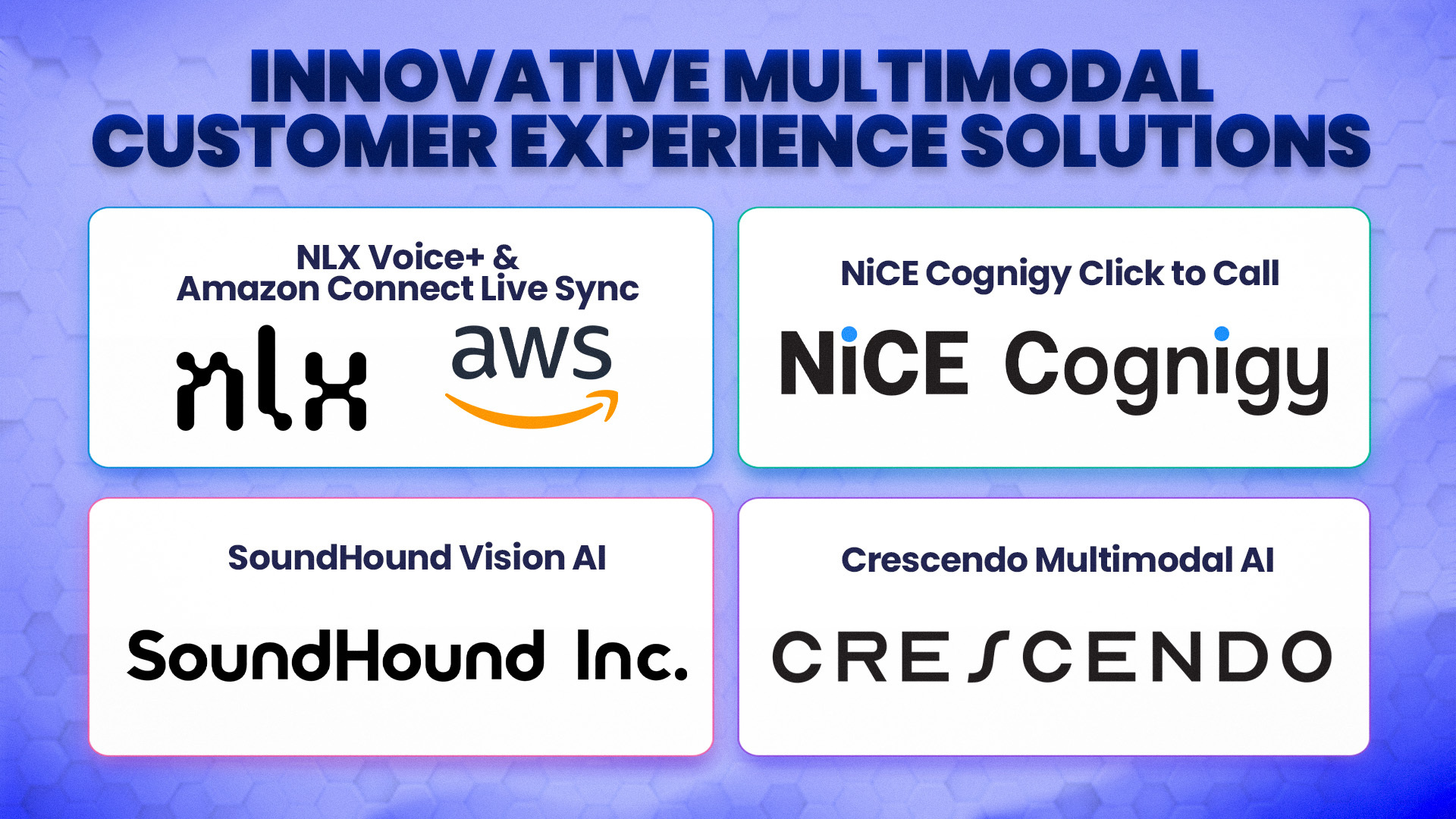
1. NLX Voice+ / Amazon Connect Live Sync
NLX Voice+ is a patented technology that projects a visual interface onto a customer’s smartphone while they converse with an AI voice agent.
During the conversation, the AI guides customers through digital workflows, allowing them to complete tasks on-screen using either touch or voice.
For example, a business could display a product comparison, seat map, or terms and conditions. Customers can then compare options, select a seat, and confirm they’ve read the T&Cs, all within the same voice interaction.
Customer experience teams can design these journeys through a no-code interface, while IT retains control over the underlying systems.
Companies including Red Bull, Saks Fifth Avenue, and United Airlines have already deployed this technology.
In early 2026, AWS acquired NLX and relaunched Voice+ as Live Sync, a capability within the Amazon Connect contact center platform.
2. NiCE Cognigy Click to Call
NiCE Cognigy Click to Call works similarly to NLX Voice+, with one key difference.
Still, it synchronizes voice and digital experiences. Yet, it doesn’t work when customers call. Instead, it builds voice into the digital interface.
So, as the customer speaks, the UI updates in real time, displays relevant information, presents forms, and triggers actions.
That UI could be the company website, a mobile app, or a customer portal. Whatever the case, the experience adapts to what the customer's voice.
Customer service teams could leverage this to improve online self-service experiences. Yet, such technology is also valuable to commerce, marketing, and sales teams.
3. SoundHound Vision AI
SoundHound has a Vision AI module, which brings real-time visual understanding to its voice AI. That allows its system to interpret visual cues in sync with live speech.
In a support setting, that means a customer could turn on their camera, the vision AI could interpret a live stream, and diagnose the issue.
Yet, the possible use cases go further. SoundHound even shared one example of a Drive-Thru, where a camera captures the customers’ driver’s licence plate, infers their identity, and the AI assistant personally greets them.
The AI voice agent can begin by asking whether the customer wants their usual order, creating a personalized experience that combines visual recognition, conversational AI, contextual memory, and - critically - multiple modalities.
4. Crescendo Multimodal AI
Crescendo.ai is a pioneer in multimodal AI and one of the first to add a click-to-start voice button inside a live chat, enabling voice interaction through the chat interface.
The key difference is that it can proactively suggest switching to voice when real-time context indicates another modality would be more effective.
For instance, imagine a customer contacting support for help fixing a router. The conversation might begin in chat, but the AI could recommend switching to voice so the customer can use both hands while following the repair instructions.
Similarly, Crescendo can also leverage digital modes at particular points in a voice interaction.
Here’s another example. Imagine a customer needs to share personal information to authenticate over voice, but the AI detects they’re in a public setting. The voice agent could proactively move the conversation to chat for this step, then switch them back to voice.
Beyond multimodal customer experiences, that ability to adapt experiences based on real-time context is another differentiator in the crowded conversational AI space.
10 Multimodal Customer Experience Examples
The solutions above illustrate how multiple, emerging capabilities are enabling new types of multimodal customer experiences. In summary, these include:
- Laying digital elements over the voice channel
- Giving a digital UI a voice to guide online experiences
- Capturing context from visual feeds to inform the voice or digital conversation
- Blending modalities based on real-time conversational context
In theory, these could help brands redesign any number of experiences. Yet, here are ten examples, many of which are already out there, in the wild.
1. Travel Bookings
Consider a passenger on a delayed flight who realizes they’ll miss their connection. When they call for support, they could be guided through a visual experience on their smartphone.
That experience gives them alternative flights to choose from, takes them through a virtual check-in, and allows them to select a seat on a visual seat map.
United Airlines already provides a similar experience for flight bookings, where an AI voice agent guides customers through entering information digitally and completing their request.
2. Equipment Troubleshooting
Imagine a customer seeing an error code on an electronic device, such as a television, refrigerator, or printer.
They may no longer have the physical manual, so they call up the business. There, they interact with a voice agent that asks to read the code visually through their smartphone camera.
From there, the AI checks the code against a digital catalog, explains what it means, and proactively suggests a solution.
3. Virtual Troubleshooting…
As another example of how multimodal AI can support troubleshooting, picture a customer fixing something more technical.
Whether that’s assembling a piece of furniture from a flatpack or installing an appliance, these jobs sometimes require both hands free.
That’s where an agent, AI or human, could proactively switch from digital to voice, guiding the customer interactively, before pulling the conversation back to their chosen channel to close out the interaction.
4. Return Handling
In retail, one example of a voice-guided digital interaction is returns handling, where the customer is walked through each step on screen.
Why offer this particular example? Because Saks Fifth Avenue is already doing it, claiming the new technology had reduced agent call volumes by 20%.
5. Claims Handling
When handling claims, insurers often have to sift through supporting files, including photos, videos, repair estimates, and medical bills.
A multimodal experience can let customers upload these files, analyze visual evidence, and automate more of the claims process.
An AI agent can also identify missing documents or potential issues in the evidence, helping ensure claims are complete and accurate before a decision is made.
6. Roadside Assistance
Typically, when a driver breaks down, they still have to share an address with their roadside assistance provider’s agent, human or AI. That’s not always easy, especially when the customer is driving through an unfamiliar place.
However, once a multimodal agent understands the customer’s intent, it can present an interactive map, letting the customer drop a pin to share their exact location.
This reassures customers that the information they’ve given is correct, while also preventing confusion on the technician’s end, who can head straight to the exact location without extra calls or searching up and down a street.
7. Subscription Renewals
Many businesses now offer a subscription model, including membership organizations, software providers, media companies, and more.
When a customer calls to change their plan, a voice agent can guide them through a comparison matrix on their smartphone screen, outlining their options in real time.
If they have a question about a specific feature, the agent, human or AI, can respond contextually, explaining it on the spot, before confirming and processing the renewal.
8. Commerce Assistance
Consider a customer whose favorite jacket has shrunk in the wash. With a multimodal experience, they could submit a photo or video of themselves wearing it to a fashion house’s voice or digital agent and ask, “Do you have anything like this?”
The agent could analyze the visuals, search the digital catalog, and return a carousel of similar options to browse and purchase, all within a single channel.
9. In-Car Assistance
Some organizations are embedding voice into their products to improve experiences. Voice assistants within vehicles are an excellent example.
Yet, the next evolution is most exciting. Pairing that voice with vision AI will allow the assistant to take in context from the surrounding environment.
So, a driver could ask: “Did I just miss the exit to XYZ city?” And the assistant could tell them. That’s the next generation of multimodal passenger experiences.
10. Personalized Drive-Thru
As teased earlier, a camera augmented with visual AI could recognize the customer’s license plate and share this information with a Drive-Thru voice agent. The agent may then personalize its greeting.
For instance, the agent may address the customer by saying: “Welcome back! Would you like your usual order of a hamburger, fries, and a bottle of water?” The customer is likely to simply respond: “Yes, please,” streamlining the order.
Alternatively, the customer could input their order via a visual interface, either through voice or touch, as shown in the clip below.
4 Best Practices for Multimodal Customer Experience Design
"Multimodal CX is the next big CX design challenge," said Wayne Butterfield Founder of STX, to CX Foundation.
"Consider how best to communicate a product, present an offer, or explain complex information. These are all strong examples of where voice or text may not be the right medium. Equally, disclosures and T&Cs are unlikely to work as well in an image."
"The opportunity now is to revisit conversational AI and human workflows through the lens of new technology."
"Looking at the end-to-end conversation, across any channel, through a multimodal lens is how organizations can start to differentiate."

"As each wave of technology becomes ubiquitous, what comes next becomes the differentiator," concluded Butterfield.
With that advice in mind, here are four cornerstone best practices for designing multimodal customer experiences.
1. Don’t Assume a Multimodal Experience Is the Answer
In customer experience design, start by identifying the problems to solve and the opportunities to pursue. Then, ask whether a multimodal experience is truly the right solution.
Often, the better customer experience isn't a multimodal one at all. In customer service, it’s often investing in fixing a root-cause issue and removing the query, so the customer doesn’t have to reach out in the first instance.
2. Reframe the Organization’s Approach to Conversational AI
Again in customer service, businesses often investigate how their best human agents solve queries, using those insights to design better experiences.
However, human agents likely have to follow system workarounds and navigate process gaps.
By blending modalities within a single channel, brands can find simpler ways to reach a resolution and reimagine the service experience.
Given this, many organizations may wish to reframe their approach.
3. Focus on Key Customer Wants and Needs, Not Only Efficiency
The temptation is to design an experience that drives the most efficient resolution, whether that's measured in handling time or cost. Yet, brands that start by considering what customers actually want and need will likely find efficiency follows naturally.
One technique for this is to build synthetic AI customer personas based on real customer conversations. Rather than just interpreting dashboards, brands can interact directly with these personas to understand what's actually driving customer behavior.
4. Standardize a Process for All Design Efforts
No matter how skilled the conversation designers or IT team are, the experiences they create will largely hinge on the inputs they receive.
Ultimately, that means there needs to be a consistent, standardized vision and process behind the work. Such a process would ensure an accurate, universal understanding of customer outcomes, requirements, and expectations.
Beyond Multimodal Customer Experiences
The idea of blending modalities isn’t confined to customer experiences.
Contact centers are also deploying AI assistants that empower human employees with relevant written and visual knowledge in real time as they talk with customers on the phone.
Meanwhile, behind the scenes, the rise of “multimodal data” is transforming the intelligence brands can extract from those conversations.
This concept of multimodal data is particularly fascinating.
Traditionally, brands capture transcripts, recordings, and metadata but analyze them separately since each lives in a different format. Multimodal data lets AI reason across all three at once, promising a richer picture of each customer interaction.
Uniphore is one vendor leading the charge, while enterprise communications giants Dialpad and Zoom are advancing their own conversational intelligence solutions in step with the trend.
Given this, organizations shouldn’t limit their thinking to multimodal customer experiences. Also consider the employee experience and the data strategy supporting them.