
July 14, 2026 • 8 min read
Gartner Magic Quadrant for Conversational AI Platforms 2026: Top Takeaways

Director of Content & Market Research
July 14, 2026
Agentic AI, technology convergence, new pricing models… Many trends are reshaping how enterprises buy, deploy, and manage enterprise technologies.
As markets grow more complex, buyers need reliable guidance to make informed decisions.
One resource many turn to is the Gartner Magic Quadrant. While not without its critics, it offers significant insight into the perceived strengths and weaknesses of global software vendors.
In its latest Magic Quadrant for conversational AI, that’s no different.
Below are seven takeaways on the market’s direction, inspired by the report, after a brief reflection on Gartner’s market leaders.
Who Are Gartner’s Conversational AI Market Leaders in 2026?
In its 2026 report, Gartner isolated four market leaders: Google, Salesforce, SoundHound AI, and Kore.ai.
Gartner evaluates Google on its CX Agent Studio, which is part of its Gemini Enterprise for Customer Experience offering. With first-party cloud and AI models, it can deliver cost efficiency, while its broad portfolio supports differentiated innovation.
Salesforce lands in the “top-right” quadrant in its first appearance in the Conversational AI Magic Quadrant. Just last month, seemingly after Gartner’s evaluation, it introduced a new Help Agent and acquired Fin AI, signaling a push to strengthen its position. For brands that have already consolidated knowledge, customer data, permissions, workflows, and channels on Salesforce, partnering with the company could be a strong fit.
SoundHound AI has acquired three prominent conversational AI providers - Amelia, Interactions, and LivePerson - over the past two years, significantly expanding its portfolio. While some may question the integration challenges that come with those acquisitions, Gartner does not. It also glazes over one of SoundHound’s key strengths: its ability to support edge use cases, from drive-thru automation to voice AI order management.
Lastly, there is Kore.ai, a longtime Magic Quadrant leader and the only vendor considered a leader in this report and the latest Forrester Wave study. One advantage Gartner does not mention is the depth of its integrations with cloud and legacy platforms, alongside its partnerships with adjacent technology providers, such as CCaaS vendors.
The study also evaluated ten other vendors across three additional categories, as shown in the image below.
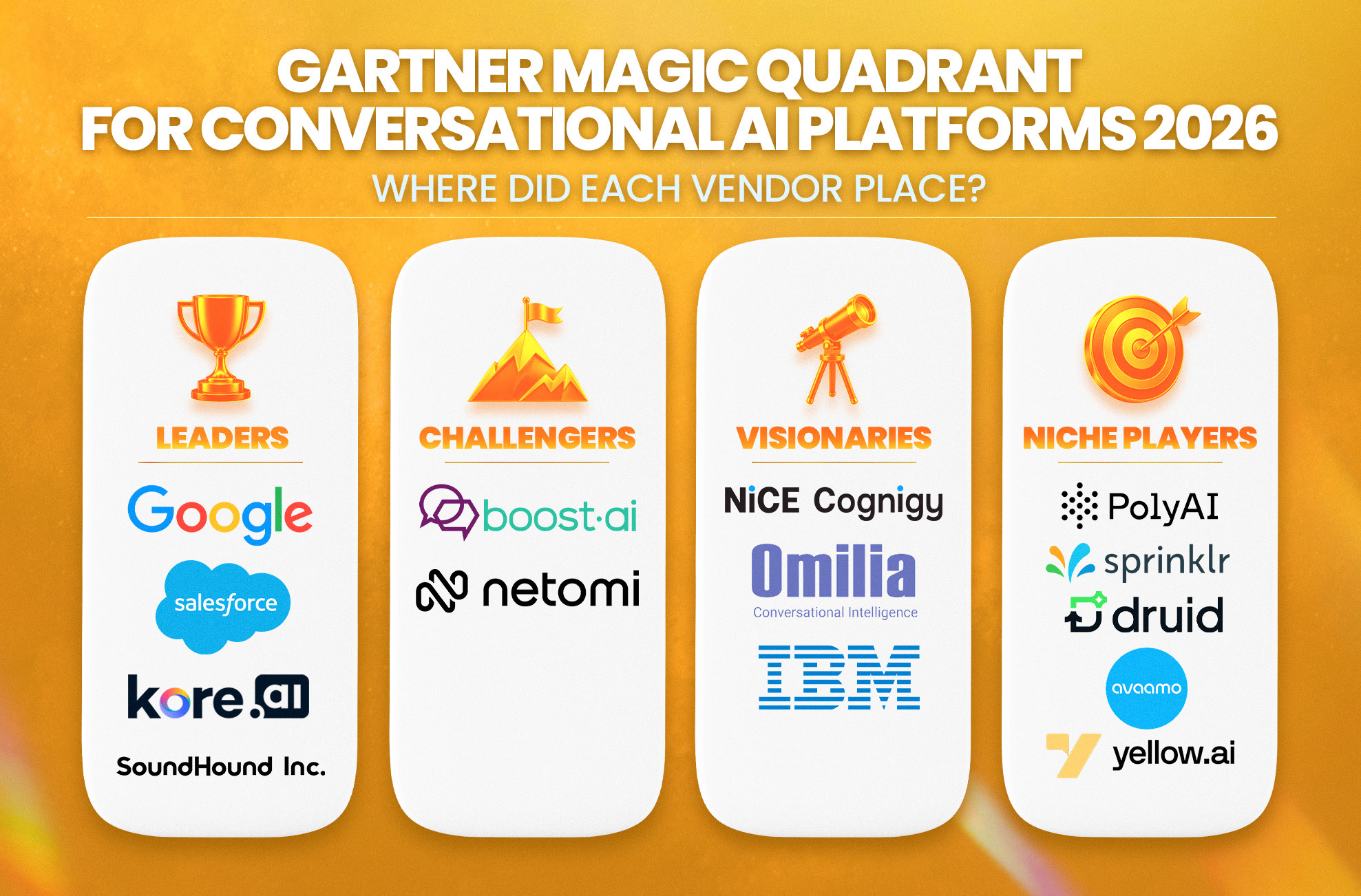
While others receive ‘honorable mentions’, many are perhaps unfortunate not to be included, and that’s just one of the top takeaways.
7 Top Takeaways from the Gartner Magic Quadrant for Conversational AI Platforms Intelligence 2026
From Gartner’s revised definition of a “conversational AI platform” to its vendor analysis, there is much to take away from the report, which is available to download on either the Boost.ai or SoundHound website.
Having extensively covered the space, CX Foundation has identified seven top takeaways below.
1. The Definition of a Conversational AI Platform is Greatly Expanding
MCP is a mandatory capability for a conversational AI platform, according to Gartner. That’s despite it not being mentioned in the 2025 report, underscoring just how quickly AI agent communication protocols are becoming critical for back-end connectivity.
Yet, it’s one of several new features Gartner considered in 2026. Other examples include: “digital human enablement” (i.e., avatars), “knowledge base management”, and “FinOps and cost-optimization tooling” (more on this later!).
Ultimately, these added considerations reflect a rapidly maturing market.
In that market, governance and “guardrails” have shifted from implicit expectations to explicit requirements; vendors are increasingly supporting business and citizen developers alongside technical teams; and, in relation to the previous point, speed-to-value is increasingly positioned as a differentiator. CX Foundation explored these trends - and many others - in its latest market overview.
2. Multi-Modality Becomes Mandatory
A feature referenced but not stressed in 2025 was multimodality. Now, Gartner has made multichannel connectivity a mandatory feature.
In doing so, the research firm appears to recognize that the ability to synchronize channels across interactions is a critical trend and emerging differentiator in a market where product distinction is limited.
SoundHound is a notable example of a brand included in the report that is doing it well. However, many prominent conversational AI providers are excelling here, including those omitted from Gartner’s core analysis.
For instance, Parloa - which works with the likes of Allianz, Booking.com, and IKEA - blends voice, video, chat, images, and interactive widgets within an AI-led interaction. However, it only gains an ‘honorable mention’.
Meanwhile, NLX (recently acquired by AWS) also missed out, despite an advanced ability to overlay voice conversations with digital elements to help brands reimagine experiences.
Finally, there’s Crescendo.ai, which achieved $100 million in annual recurring revenue (ARR) in little more than two years. It can suggest switching channels automatically based on real-time conversational context. The video below explores this further.
3. Self-Building & Self-Learning Agents Come to the Fore
Gartner points to an era of self-building and self-learning agents, highlighting many vendors’ focus on “GenAI-assisted coding and pervasive AI-driven analytics.”
However, it does not explore the significant differences in analytics capabilities, which is a notable omission.
Some vendors use analytics to understand how humans handle queries and leverage generative AI (GenAI) to create and update knowledge content that guides the AI agent.
That’s one thing. However, some are going further. For instance, NiCE has developed an Agentic Analytics layer to identify what should happen next to drive outcomes in live conversations, using that intelligence to auto-adjust the actions and responses of its customer-facing agents.
Ultimately, such advanced analytics provide additional value, particularly for customer-facing conversational AI use cases.
While not covered in Gartner’s report, vendors such as Cresta, Level AI, and Observe.AI are leveraging conversational analytics to similarly benefit their clients.
4. Pricing Model Shifts Haven’t Solved Cost Concerns
In its report, Gartner highlights an overall “lack of standardized tooling [that] complicates scaling and cost control,” which reflects a key buyer concern across the industry.
To improve cost control, many providers have shifted from per-agent or consumption-based pricing to outcome-based pricing, so businesses only pay when AI agents deliver defined results.
However, what vendors define as an “outcome” often differs from how businesses measure one. For example, many contact centers consider an issue resolved if the customer does not make a repeat contact within 30 days.
By contrast, Zendesk, another prominent conversational AI vendor not included in Gartner’s report, defines resolution as no repeat contact within three days.
This is not a criticism of Zendesk; at least it attempts to standardize outcomes. Other vendors are less transparent, offering limited ROI analytics or still relying on third-party business intelligence tools such as Power BI, Tableau, or Looker.
This highlights an opportunity for providers to invest further in cost optimization, which Gartner added to its list of optional features this year. By 2027, such capabilities are likely to become far more common.
5. Gartner Gives the Big Guys Their Plaudits
In its report, Gartner infers that large platform providers such as Google, Salesforce, and IBM hold a structural advantage in a maturing market.
Why? Because differentiation is moving away from pure product/technical innovation and toward “operational sustenance, pricing, and scale.”
In making this observation, the research firm appears to hint that this is why most smaller, independent vendors have either been acquired or drifted away from the leader category.
It does not, however, acknowledge the benefits of choosing an independent vendor.
Indeed, companies that become overly reliant on a single vendor across multiple products risk ‘price shock’ when costs rise and may find it harder to switch providers later.
Zendesk’s and Salesforce’s acquisitions of Forethought and Fin, respectively, suggest they recognize that enterprise buyers value greater flexibility.
After all, enterprises typically work with multiple vendors, often using several solutions of the same type across locations. An independent AI platform that can replicate agents across environments and operate across systems can therefore provide significant added value.
6. The Report Is Notably Skewed Toward North America & Europe
Almost every vendor is described as "mostly" or "primarily" strong in North America and Europe/EMEA, with weaker penetration in APAC and LATAM.
Many providers are even dinged for this specifically, as Gartner cautions buyers to verify support and language coverage.
Yet, this takeaway is also a warning to enterprise buyers reading such market reports, which seem to place a disproportionate emphasis on North American and European markets.
Consider APAC. Prominent conversational AI providers in that market - from AWS to Verint - don’t get a mention. But they’re not the only ones…
7. Major Industry Disruptors Miss Out
Interestingly, Gartner identifies Google, IBM, and Salesforce as market leaders, yet none appear in this year’s Forrester Wave evaluation.
Instead, Forrester included Sierra, Rasa, Fin AI (now acquired by Salesforce), and Ada.
Gartner gave the first two an “honorable mention” and left out the other two, despite acknowledging the acquisition.
One explanation here is that Google and IBM, specifically, did own much of the market during the NLP era. That legacy base gives them a leg up.
Yet, the absence of Sierra and Decagon specifically, valued this year at $10 billion and $4.5 billion, is surprising.
Add to that list Parloa, Uniphore, and prominent CPaaS providers expanding into the space - all absent from the core evaluation - alongside the many vendors already mentioned, and the report captures only a small fraction of a market with more than 650 vendors.
Given this, buyers must refrain from building shortlists primarily from an industry-wide report.
While the weaknesses Gartner highlights offer valuable insights, organizations should build shortlists based on their operational needs, architectural fit, and measurable outcomes, not on vendor positioning in a study that, as noted earlier, is largely geared toward specific markets.