Updated on February 4, 2026 • 41 min read
20 CCaaS Providers & What Differentiates Them in 2026

Director of Content & Market Research
February 2, 2026
In a market where everyone talks about little else than AI, distinguishing between CCaaS providers is challenging.
Yet, last year, vendors started to realize that AI features are no longer differentiators.
Of course, AI is table stakes in the future of customer service, but cute, anthropomorphized AI won’t separate leaders from the rest. Ecosystems, marketplaces, and execution will.
Against that backdrop, here are 20 CCaaS providers, listed in no particular order, worth watching this year, and what really sets them apart.
1. NiCE
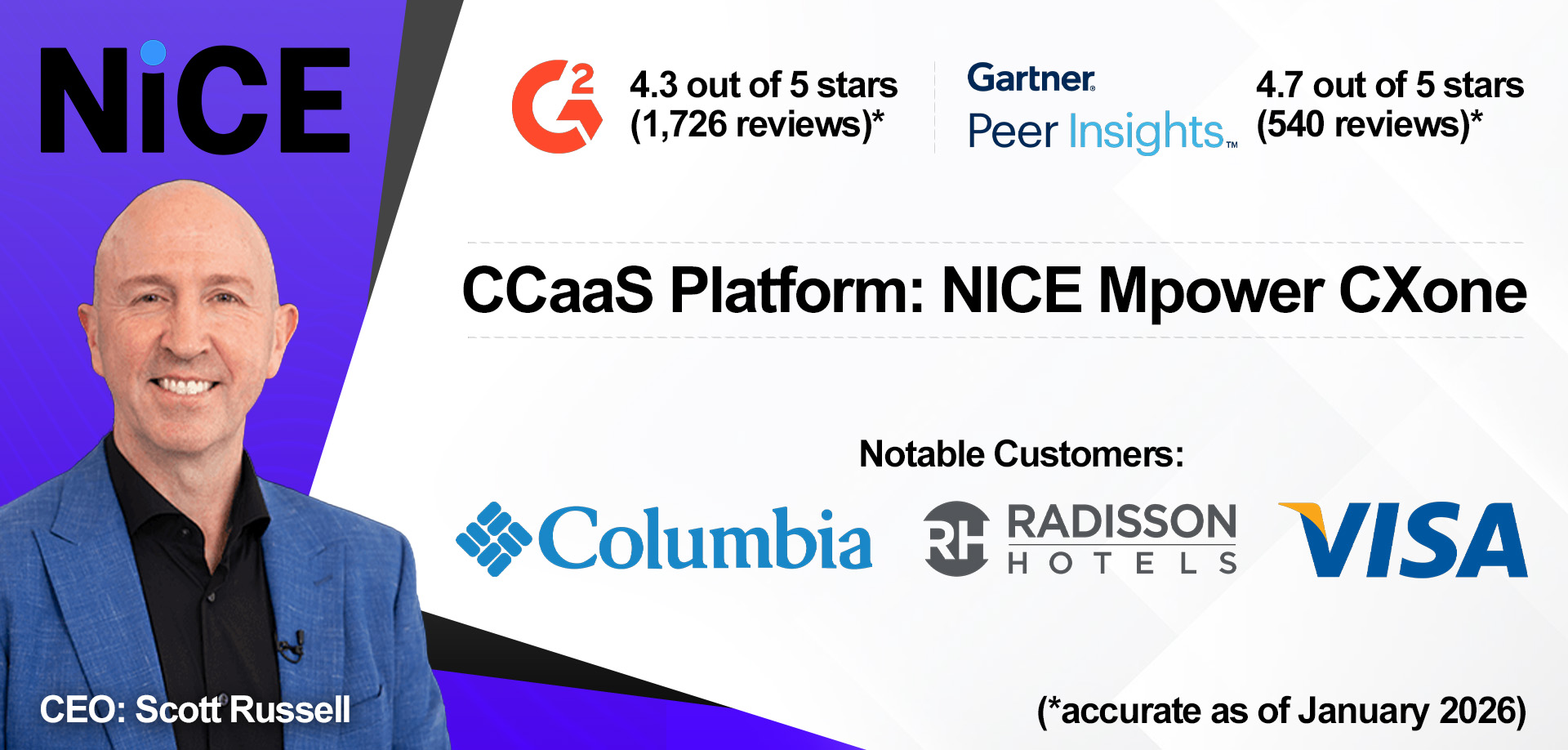
NiCE entered the CCaaS space in May 2016 through its acquisition of inContact and soon raced to the forefront of the market.
In 2025, under a new CEO Scott Russell, its portfolio expanded significantly.
First, it released an orchestration platform that allows brands map out their resolution flows across their most common customer intents. It then proactively recommends opportunities for process optimization and automation.
After, it partnered with AWS, Salesforce, and Snowflake to open up key sources of data and knowledge, so brands could orchestrate service experiences across different systems.
Finally, it swooped Cognigy for $995MN, picking up a revered enterprise AI agent provider, whose agents work across the front, middle, and back office to automate more of those cross-system resolution workflows.
Each move indicates NiCE is a company with a clear vision for the future contact center, while it also maintains its leadership in the adjacent workforce engagement management (WEM) space.
Such WEM nous will prove especially significant in 2026, as NiCE may offer deeper insights into how AI agents are impacting customer and employee experiences.
“What differentiates NICE isn’t features... it’s mindset, posture, and attitude. And (CEO) Scott Russell’s leadership has brought renewed rigor in engaging CIOs and CFOs, not just contact center buyers.”

Standout Features
- Journey Orchestration: The NiCE AI Contact Center Orchestration Platform helps plot out resolution paths, guides AI agents, monitors their performance, and proactively suggests new automation opportunities.
- Cognigy AI & Expertise: By acquiring Cognigy, NiCE picked up a team that has implemented AI agents across the enterprise, not just customer service. That expertise puts NiCE in pole position for a future where AI agents in different systems collaborate to help resolve customer issues.
- Workforce Engagement Management: NiCE started as a contact center workforce optimization (WFO) provider and pivoted into CCaaS. Still, its workforce management (WFM) and quality assurance (QA) solutions are more feature-rich than most industry competitors, with innovative features, such as True to Interval (TTI) forecasting.
How Much Does It Cost?
The price of NiCE Mpower CXone ranges from $110 per user, per month for its “Omnichannel Suite” through to its $249 per user, per month for its “Ultimate Suite” and industry-specific packages. The Ultimate Suite also includes an additional charge of $0.25 per AI session. Find the full pricing breakdown for NiCE Mpower CXone here.
2. Genesys
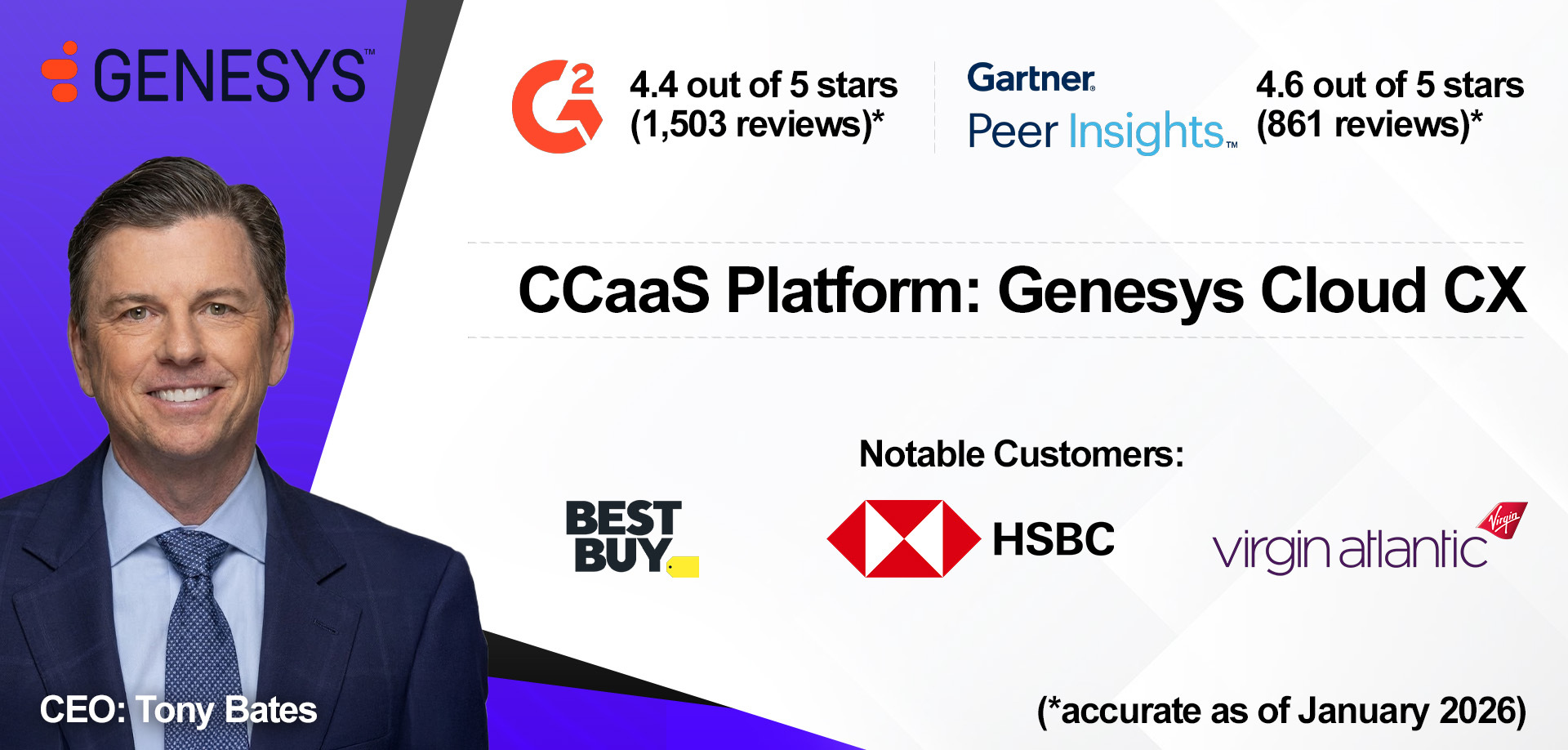
In 2025, Genesys became the first tech provider to achieve $2BN+ in annual recurring CCaaS revenue, underscoring its continued market momentum.
Its large on-premise contact center base supports this, with Genesys hyper-focused on supporting these brands through their migrations with tried-and-tested playbooks and processes.
However, it’s also helping shape market innovation, most notably by being the first provider to announce a new type of CCaaS-CRM integration with Salesforce and ServiceNow.
The new integration embeds its core contact center capabilities – including voice, digital channels, and routing – into Agentforce Service (formerly Service Cloud) and ServiceNow CSM.
A combined investment of $1.5BN in Genesys from these two CRM giants in July 2025 may signify their confidence in its vision for converged CCaaS-CRM environments.
Lastly, its pricing strategy that allows contact centers to purchase AI tokens on top of the traditional seat-based model matches an enterprise preference to cautiously test and scale the technology.
Standout Features
- Enterprise Integrations: Genesys has pioneered new CCaaS-CRM integrations, embedding elements of the former into the latter. It’s also working closely with ServiceNow to converge CCaaS with IT Service Management. Meanwhile, the provider’s preconfigured integration portfolio is vast.
- Trusted Migration Partner: While some of Genesys’s on-premise customers have looked elsewhere for a CCaaS partner, many have come back after stalled transformations, recognizing the value in its in-house contact center knowledge, wide-reaching support services, and migration playbooks.
- Customer Experience Index: Genesys analyzes signals across its platform to assess employee and customer experiences, benchmark performance, and proactively recommend tailored actions to improve service quality and outcomes. The Index moves beyond metrics to deliver practical guidance.
How Much Does It Cost?
Genesys Cloud CX 1 starts at $75 per user, per month. However, there are three other packages, with the most expensive, Genesys Cloud CX 4, costing $240 per user, per month. Customers on any of the four packages may also purchase Genesys Cloud Al Experience tokens to unlock further features. Get the full pricing rundown for Genesys Cloud CX here.
3. Amazon Web Services (AWS)
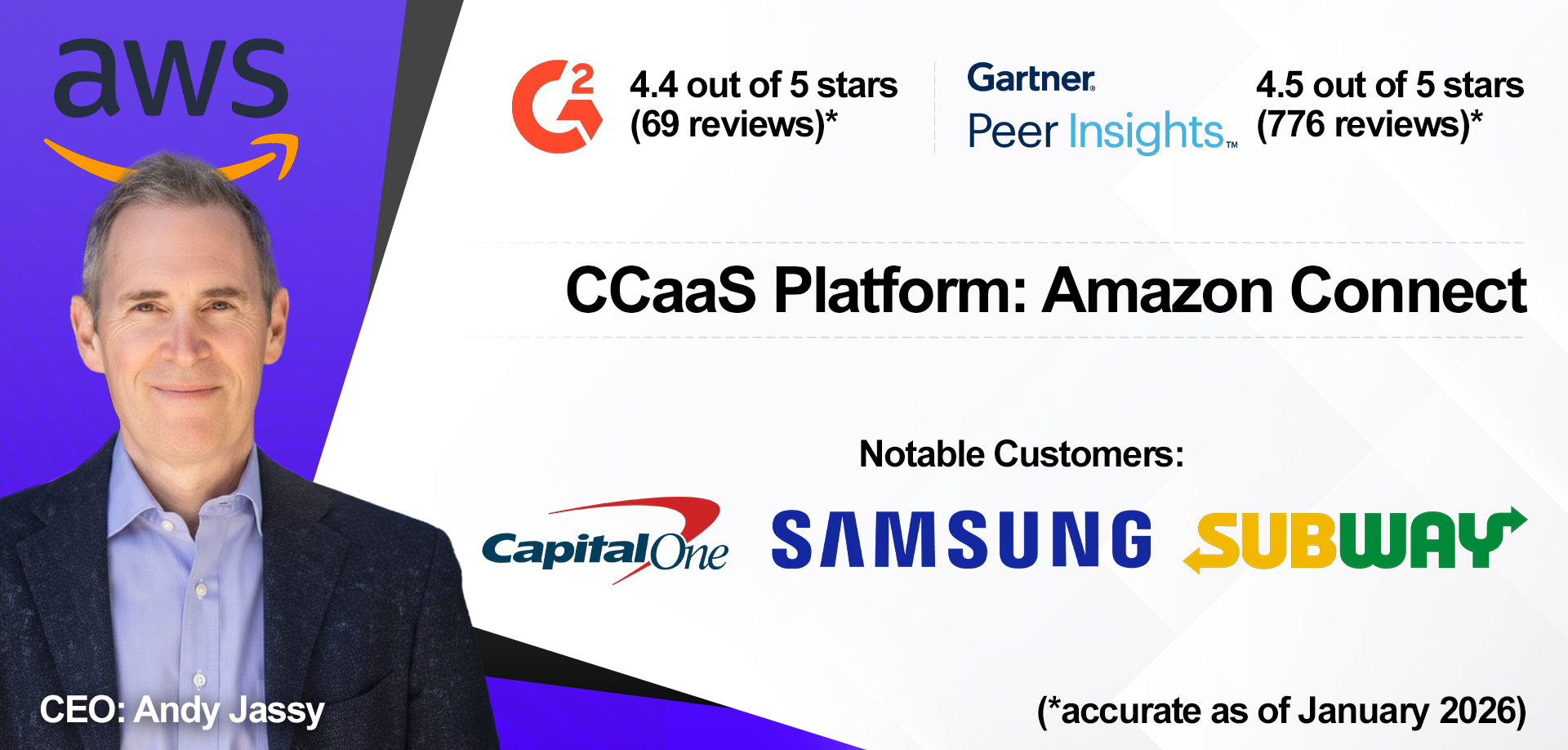
Amazon Connect first came to the market in March 2017 like a set of Legos. The company had built a contact center for its internal use, broke it down into its component parts, and enabled brands to customize those parts to patch together their ideal contact center.
In 2026, the solution appears markedly different. There is still the option to customize every corner of the contact center, but it’s also available out-of-the-box with native AI features that brands can turn on in minutes.
AWS boosts many of those AI tools with Customer Profiles, which sit at the heart of Amazon Connect, pulling customer information spread throughout the enterprise into a single place.
At AWS re:Invent 2025, AWS added an AI-Powered Predictive Insights capability in preview that acts on this data, allowing service teams to see what customers are likely to want next.
It’s not just about predicting cross-sell opportunities; the solution can also identify customers at risk of churn and those likely to need assistance next.
Such insights could fundamentally change the human and AI agent role. Suddenly, they aren’t only reactive service workers. Instead, they can be proactive support reps, sellers, and marketers. That aligns with the vision many business leaders have for the contact center of tomorrow.
Lastly, AWS’s no-add-ons pricing model continues to distinguish it. Buyers pay by the minute, with all Amazon Connect’s AI capabilities – encompassing agent-assist tools, conversational analytics, AI agents, and more – included.
“AWS’s scale, resources, and portfolio allow them to experiment and invest in ways most CCaaS vendors simply can’t.”

Standout Features
- Amazon Connect Customer Profiles: Alongside the ability to pull customer-specific information from across the enterprise, the promise of predictive insights that can help identify customers who are likely to churn, anticipate follow-up needs, or predict the next best action will help customer service operations pivot to customer success.
- AI Observability Tools: New to Amazon Connect are observability features that allow contact centers to track the usage of new generative and agentic AI solutions, measure their impact, and enhance the deployment. That capability will lower the dependency of larger contact centers on bespoke professional services.
- Pay-as-You-Go Pricing: Amazon Connect uses a flexible, usage-based pricing model that allows businesses to scale up or down based on seasonality and operational needs, without capacity constraints or traditional licensing costs. Capabilities are available à la carte, giving teams full control over spend.
How Much Does It Cost?
Everything is pay-as-you-go. Brands can purchase channels with unlimited AI at different prices. For instance, voice costs $0.038 per minute plus telephony, email costs $0.080 per email, and live chat is $0.010 per message. Meanwhile, à la carte AI is also available. For example, AI performance evaluations cost $12 per agent, per month. Unpack the full pricing breakdown for Amazon Connect here.
4. Zoom
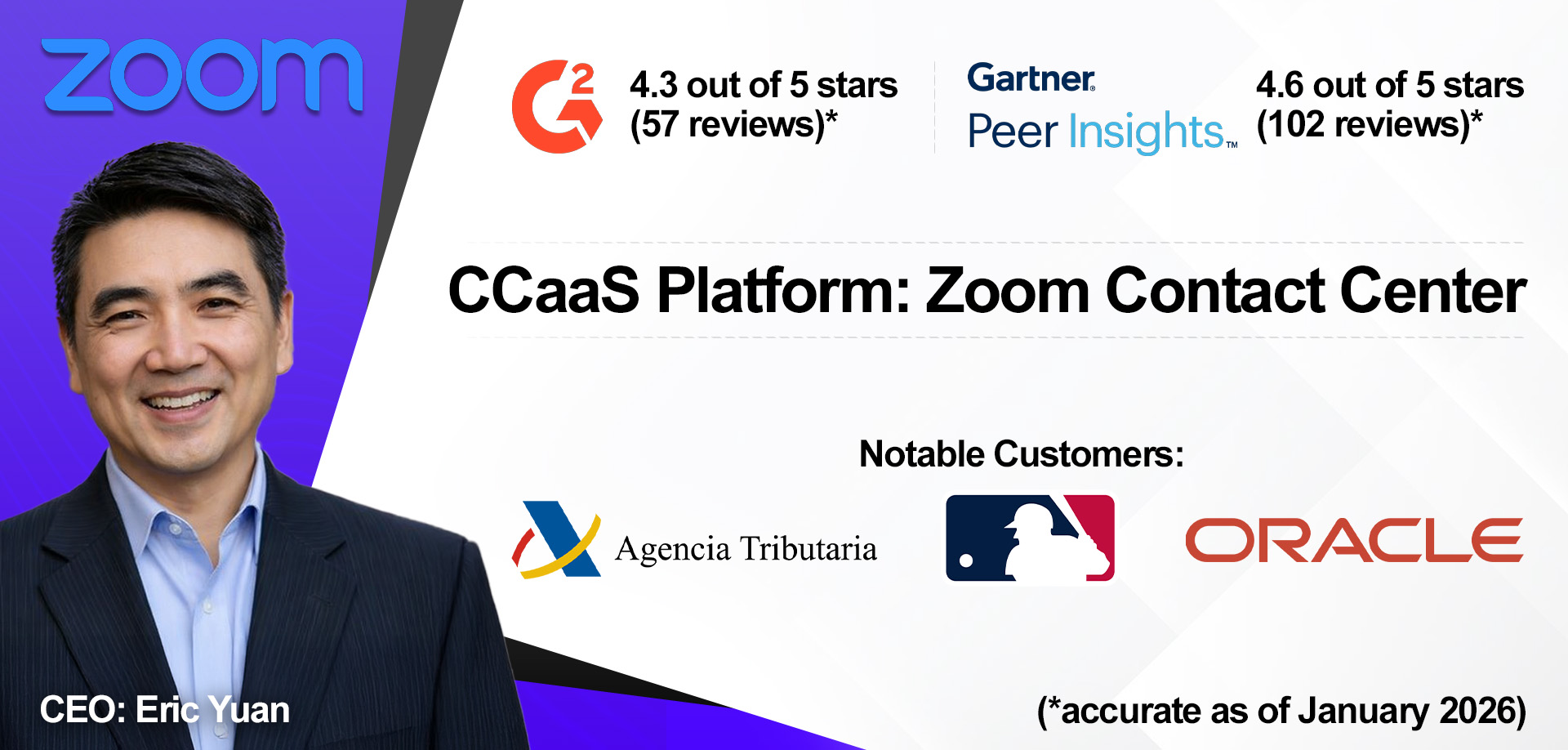
Last year, Zoom demonstrated its ability to compete with the market’s largest players, landing CCaaS deals with Oracle and Spain’s Agencia Tributaria for deployments of more than 10,000 service reps.
Part of its success is in communicating the value of a ‘CCaaS+’ platform.
With a widely-utilized UCaaS solution available on the same platform, Zoom is sending tricky cases across the business for expert support and capturing additional data on how they solve those issues. That data supports the development of new knowledge content for both human and AI agents.
Alongside UCaaS, the Zoom Contact Center sits on the same platform as a virtual agent, WEM software, employee experience solution (WorkVivo), and much more.
The potential to combine these solutions is vast. For instance, in the future, Zoom could take quality assurance (QA) data for new employees and optimize their onboarding experience WorkVivo. Such unique possibilities make Zoom a particularly fascinating player to watch.
Finally, Zoom’s reputation for developing consumer-grade technology is also likely a big pull for midmarket buyers who are often overwhelmed by CCaaS bells and whistles.
“The CCaaS wildcard is Zoom. Zoom has something very rare: genuine user affection. People actually like using Zoom. That’s incredibly uncommon in enterprise software.”

Standout Features
- The Broader Zoom Vision: The future for Zoom is as a “hub” for work, with interconnected solutions that AI agents run across. That interoperability, which already exists between Zoom CCaaS and UCaaS, could help bring new capabilities to contact centers and improve the employee experience, as reps shift between fewer systems.
- A Free AI Companion: Zoom’s AI Companion provides reps with a pre-call overview of customer intent and history, real-time speech metrics, and automated post-contact summaries, as well as assistance in composing customer replies. While these features exist elsewhere, Zoom includes them with every Contact Center license at no extra cost.
- Brand Affinity: CCaaS solutions can be complex. Zoom’s drive to deliver consumer-grade technology for the enterprise has helped to cut through much of that and, as Kerravala suggested, encouraged genuine user affection.
How Much Does It Cost?
The Zoom Contact Center has three pricing tiers. The Essentials package costs $69 per user, per month. Premium, which adds email, social channels, an outbound dialer, and co-browsing, is available at $99 per user, per month. Then, there’s the full-feature Elite package, priced at $149 per user, per month. Brands may also add particular capabilities to the two cheaper packages at specific price points. Get the full pricing breakdown for the Zoom Contact Center here.
5. Nextiva
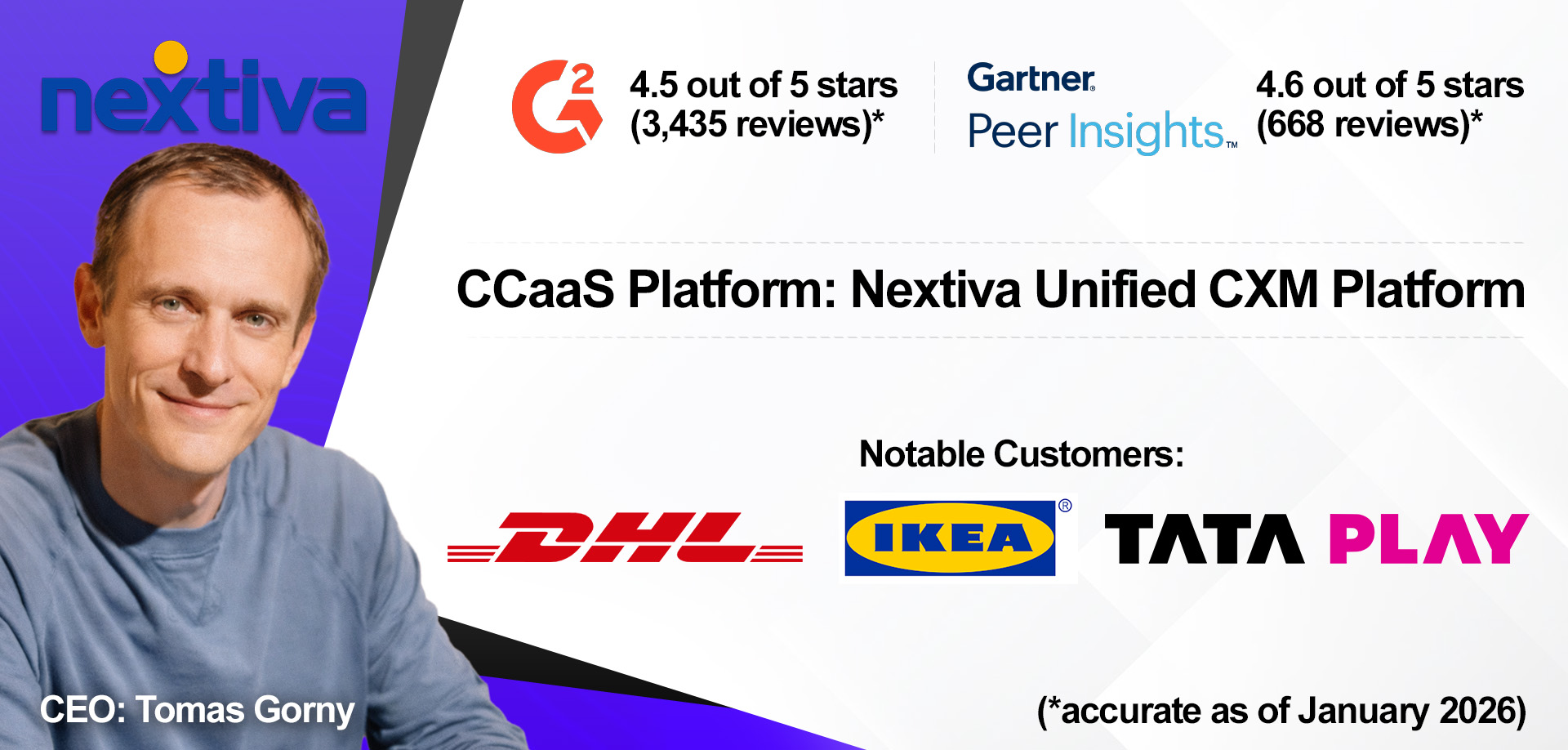
Nextiva has successfully captured market attention, but converting that visibility into consistently successful proof-of-concepts (POCs) will be the true test of its momentum.
The vendor aims to drive that momentum by placing emphasis on social and digital channel capabilities, alongside its traditional voice strength as a UCaaS specialist.
These capabilities go beyond responding to Facebook Messenger or TikTok messages. Critically, they also include reputation listening and real-time brand monitoring, scanning reviews, news sites, and other sources. This helps companies, especially in e-commerce or online retail, react quickly to customer sentiment and avoid negative impacts on engagements.
Additionally, the vendor makes a big point in suggesting that it does not believe in replacing people with software. Instead, it aims to help evolve the role of contact center reps, so they can engage in customer success and sales activities.
Nextiva builds closer relationships with its customers to support that mission. These relationships also help the vendor to understand each organization's unique challenges and continuously add value over time.
Finally, Nextiva refrains from the term “CCaaS”, despite essentially offering a CCaaS platform. Instead, it presents a "Unified Customer Experience", which it believes better reflects its digital-first and outcome-focused approach to customer support.
Standout Features
- Reputation Listening & Brand Monitoring: Nextiva tracks brand signals outside of the contact center, detecting negative customer sentiment online, and generating a service case. That capability attracts brands who view the contact center as a vehicle for growth and retention.
- Emphasis on Not Replacing People with AI: Nextiva states outright: “We don’t believe in AI taking jobs,” working with contact centers to embrace new growth models as technology automates more customer contacts. That stance will appeal to more conventional contact center buyers and many forward-thinking organizations.
- After Care: Nextiva schedules regular follow-ups and offers adjustments to help contact centers avoid stalling innovation, as so often happens across the industry. It recognizes that brands mustn’t move to CCaaS and manage their platform like an on-premise solution, supporting a shift in operational posture and mentality.
How Much Does It Cost?
Nextiva’s basic CCaaS package, including voice and digital channels, starts at $23 per user, per month. Its Engage and Power Suite CX plans begin at $25 and $75 per user, per month, respectively. Learn more about Nextiva Unified CX pricing here.
6. Zendesk
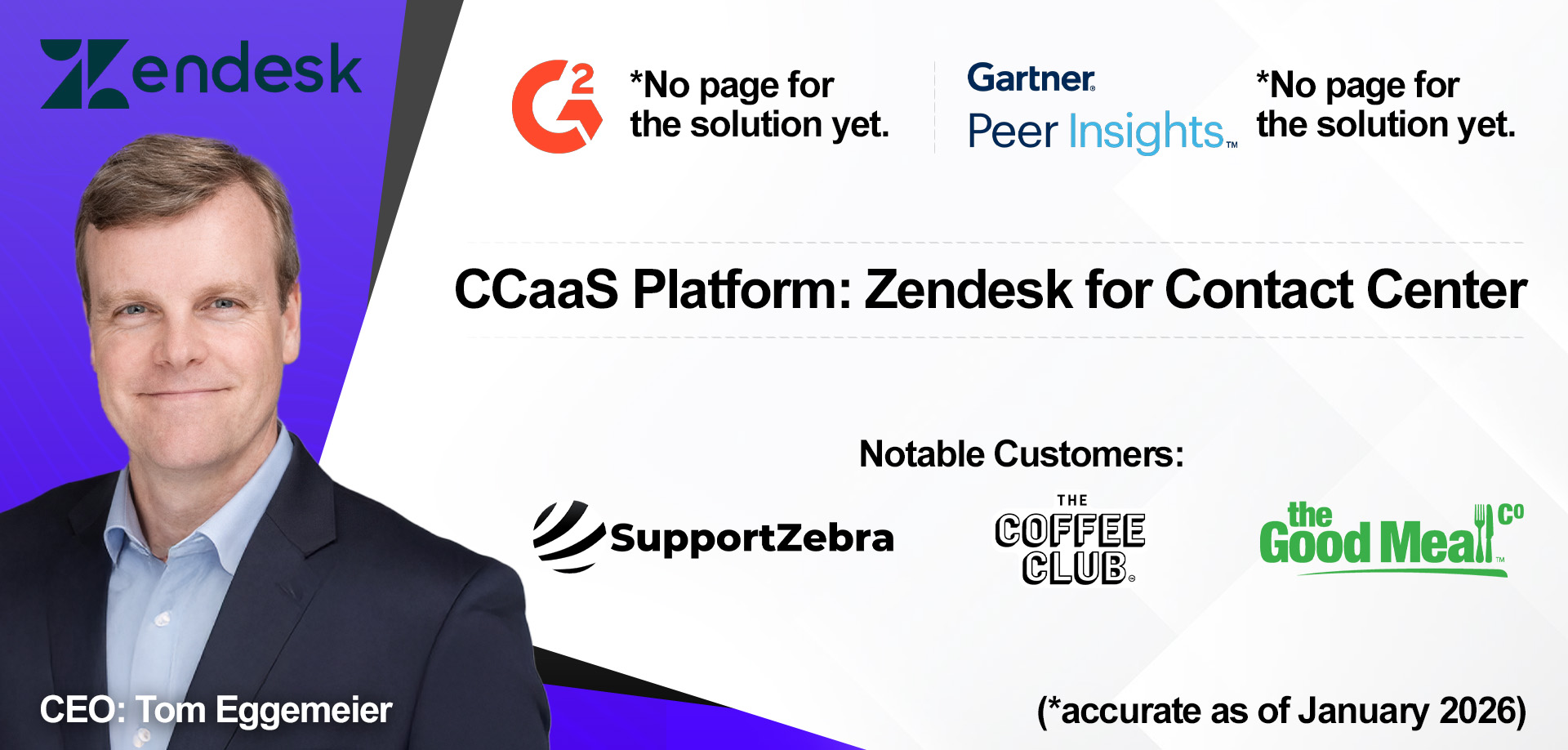
Zendesk acquired Local Measure in May 2025 to enter the CCaaS space. Local Measure had assembled a contact center solution on AWS, leveraging the same foundations as Amazon Connect.
Now, the solution is the Zendesk Contact Center, providing a much deeper offering than Zendesk Voice, which targeted small businesses.
Yet, perhaps most intriguing is how it fits into a broader Zendesk platform, which includes CRM. That architecture allows Zendesk’s 110,000+ customers to buy CCaaS where their data is.
Brands may also utilize workforce management (WFM), quality assurance (QA), and AI agents within that environment, which is attractive for those hoping to converge their service ecosystem.
Zendesk’s outcome-based pricing model for conversation automation, which ensures businesses only pay when their AI agents deliver tangible value, is another differentiator.
However, Zendesk’s success in this market will somewhat depend on its ability to scale the core CCaaS expertise of Local Measure’s team.
Standout Features
- A Converged Customer Service Environment: Zendesk has embedded an enterprise contact center solution inside an ecosystem that includes CRM and WEM. If properly integrated, that will unlock a firehose of data, enabling a deeper view of customer and employee experiences.
- Enterprise Service Management: In 2025, Zendesk launched an employee service solution, bringing its helpdesk capabilities to HR. Thanks to this solution and the Zendesk Contact Center, the vendor can combine employee, customer, and IT support data, unifying enterprise service management and revealing inefficiencies across the organization.
- A Deep CRM Base: With over 110,000 businesses leveraging Zendesk globally, mostly for CRM, its CCaaS solution has massive potential to scale, especially if the vendor can find a compelling way to sell the solutions together.
How Much Does It Cost?
The Zendesk Contact Center is available at $50 per agent, per month. Customers can add a Workforce Engagement Bundle for an additional $50 per agent, per month. Unpack Zendesk’s pricing for CCaaS here.
7. Microsoft
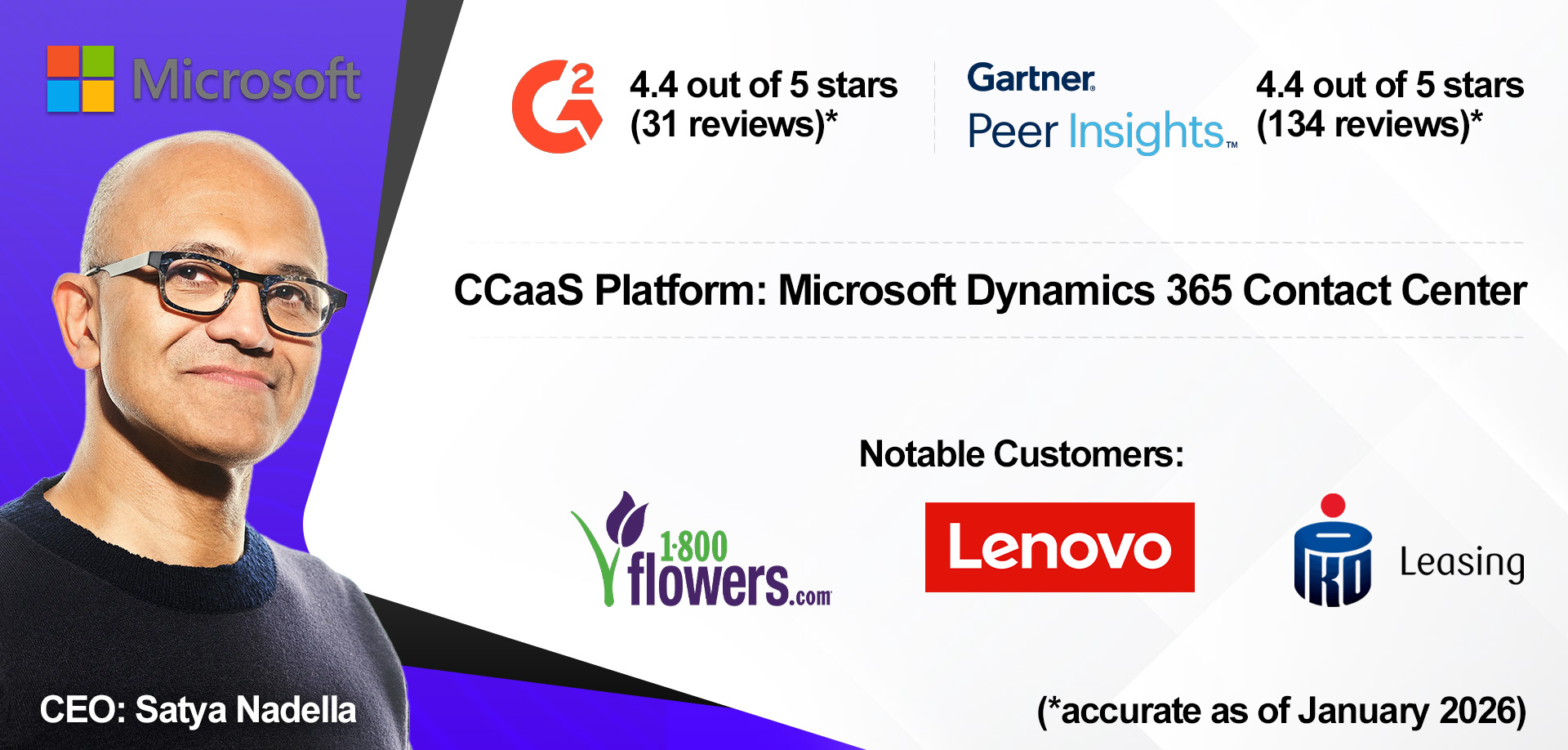
Microsoft often throws new solutions at the wall, sees if they stick, and builds from there. Yet, it recognized that approach wouldn’t work in CCaaS, where every conversation matters.
So, when it entered the market in July 2024 with the Dynamics 365 Contact Center, its offering proved a pleasant surprise, featuring all the core capabilities expected of a CCaaS platform.
Meanwhile, Microsoft made headlines by embedding AI agents into its solution in 2025, including agents that categorize customer contacts by intent, analyze those interactions, and spin up new knowledge content.
The big next step for Microsoft is to leverage the value in its broader portfolio. It has shown signs of recognizing this potential already. Last year it extended Microsoft Teams Phone to its Dynamics 365 Contact Center allowing brands to utilize one voice platform for all enterprise conversations. That streamlines billing but may also ease implementations.
However, there are many more possibilities within its portfolio, such as reimagining contact center reporting with Microsoft Power BI. That’s a particularly exciting example!
Standout Features
- Microsoft Teams Cross-Over: 93% of the top 100 US businesses reportedly use Microsoft Teams. The tech giant looks to exploit this user base by not only allowing CCaaS customers to spread customer cases across the business, via an integration with the collaboration platform, but by establishing a shared voice platform. As such, brands that select Microsoft for CCaaS and UCaaS don’t have to split telephony costs. That streamlines billing and can simplify migrations.
- The Copilot Opportunity: Right now, Copilot does little more than most other AI assistants inside of a CCaaS platform. However, if Microsoft continues to build out its Agent Framework, reps may one day pull data from and trigger actions within other systems via the virtual assistant, streamlining case handling.
- Power BI Reporting: Microsoft Power BI, one of the company’s most popular tools, brings advanced reporting, like drill-downs and quick insights, into its CCaaS solution. Future AI agents, embedded into Power BI, could auto-generate dashboards from written prompts, without preset parameters, to further bolster these capabilities.
How Much Does It Cost?
The Microsoft Dynamics 365 Contact Center is available from $110.00 per user, per month. A premium version, which comes integrated with Microsoft’s customer support CRM, Dynamics 365 for Customer Service, is priced at $195.00 per user, per month. A free trial is also available. Deep dive on Dynamics 365 Contact Center pricing here.
8. Cisco
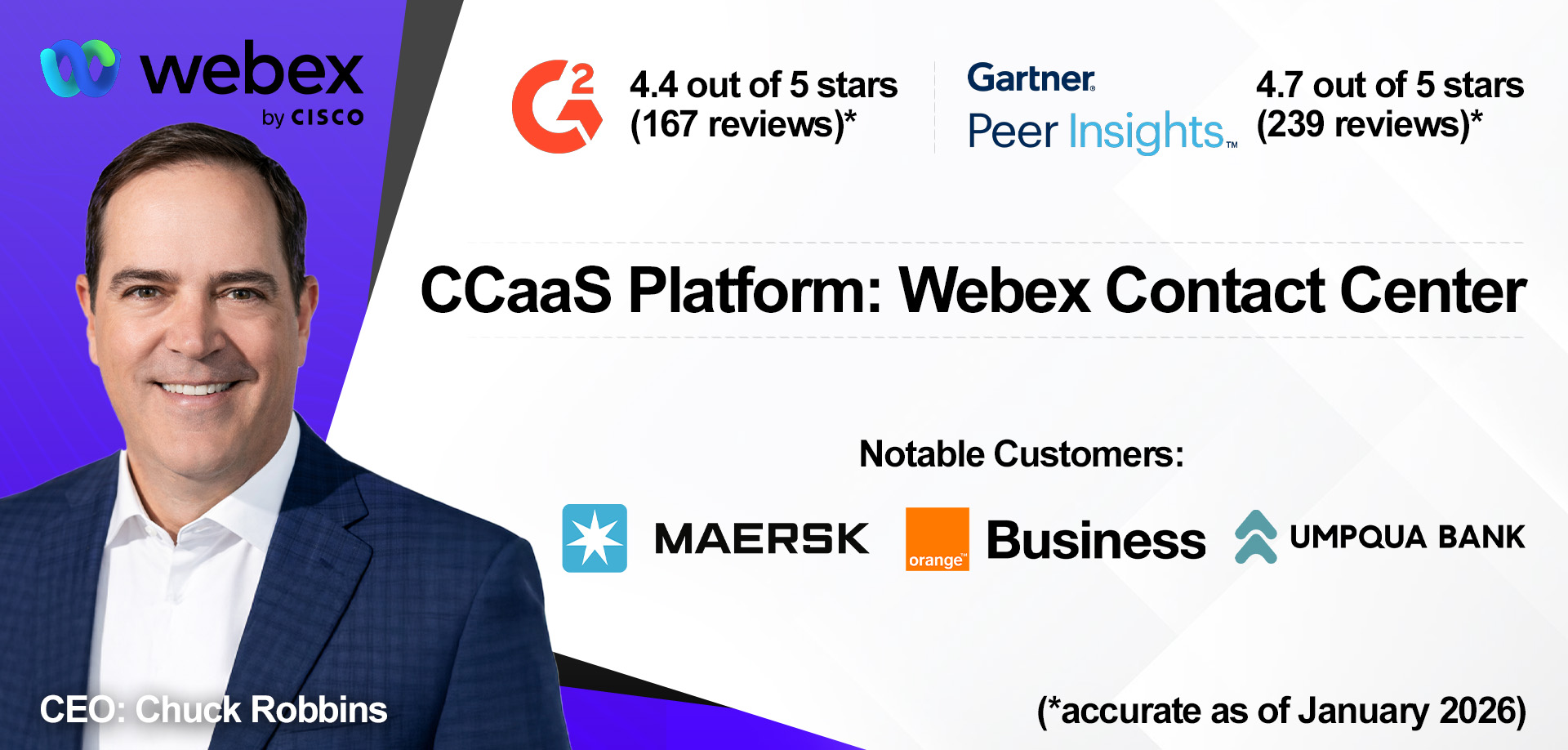
Like Microsoft, Cisco benefits from its broad portfolio that allows it to add differentiative features to its CCaaS platform.
An excellent example of this is how it has embedded ThousandEyes into the Webex Contact Center helping teams isolate the root causes of network connection problems and act quicker. That’s a big efficiency saver for remote operations.
Additionally, it has closely integrated its security, UCaaS, and CPaaS solutions with its CCaaS platform, with the latter supporting companies pivoting to proactive customer service.
Indeed, CPaaS enables Cisco to connect the contact center with middle- and back-end systems, creating an infrastructure for AI agents that isolate signals that indicate customer-facing issues, proactively notify customers, and take action to potentially resolve those issues.
Alongside the broad portfolio, Cisco has a specialist reputation for ‘big’ enterprise implementations and a deep agent experience toolkit, with mature solutions aimed at improving employee wellbeing.
Last year, Gartner ranked Cisco as one of only two ‘Customers’ Choice’ vendors (with Genesys the other), underscoring its recent rise up the CCaaS ranks.
“Over the past two years, and likely the next two to three, CCaaS buying power has shifted toward IT leadership. Cisco has deep, longstanding relationships with IT leaders and understands that audience exceptionally well. That’s an advantage.”
Standout Features
- CCaaS-CPaaS Expertise: Cisco has a widely-deployed CPaaS solution, which comprises APIs, a workflow builder, and communication channels. All this is available within the Webex Contact Center. Effectively, that allows on-premise customers to recreate complex integrations in the cloud. Yet, it also enables users to build a framework across enterprise systems to detect when the customer hits a pain point and trigger a proactive message. Thanks to this, Cisco has become a leader in proactive customer service.
- Advanced Toolset for Contact Center Reps: Cisco is often first-to-market with many new assistive tools for support teams. An excellent example is a solution that detects when a rep has endured multiple negative contacts on the spin and offers them a break to recalibrate. With WEM on its platform, it may, in the future, route reps a simpler contact to help them get their mojo back.
- A Deep Adjacent Portfolio: Cisco has started to augment elements of its broader portfolio - including security, networking, and UCaaS - with the Webex Contact Center to add differentiative features and secure bigger enterprise deals.
How Much Does It Cost?
Cisco does not disclose pricing for its CCaaS solution. Instead it provides quotes that align with customer requirements. Learn more about pricing for the Webex Contact Center here.
9. Content Guru
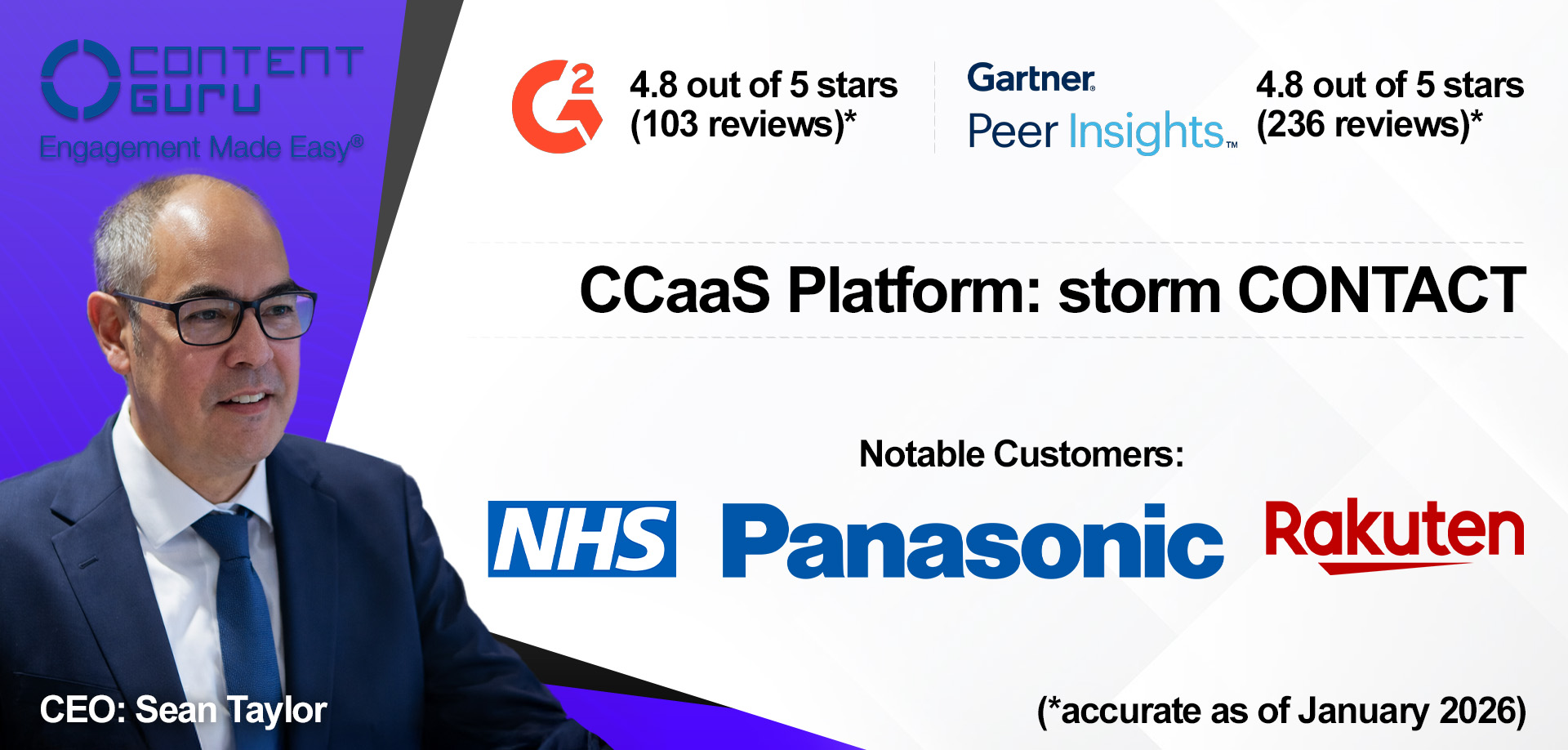
Content Guru is one of the CCaaS market’s more underappreciated brands, distinguished by its ability to deliver highly complex migrations for organizations ranging from the UK’s National Health Service (NHS) to the U.S. Department of Homeland Security.
As these two examples suggest, it has developed a robust reputation in the public sector.
In 2025, Content Guru became only the second CCaaS vendor (after AWS) to achieve FedRAMP High authorization, the highest security standard for handling sensitive U.S. government data.
Supporting its strong data posture is a native customer data platform (CDP), which consolidates information from across the organization, distributes it across systems, and delivers insights to employees and workflows for action.
As AI agents take on a more prominent role in the contact center, this fluid data network, which can ingest signals from enterprise systems and IoT devices, becomes increasingly attractive, enabling a more proactive and intelligent customer service strategy.
Alongside this, Content Guru offers deep knowledge management capabilities to support customer-facing AI and has excellent verified customer feedback on Gartner Peer Insights.
Indeed, a 2025 report by the research firm suggested that 100% of its customers would recommend the vendor. It’s the only CCaaS provider that can boast this.
Standout Features
- Omnidata Strategy: A data fabric stretches across the platform, ingesting data from across the contact center and critical customer signals from across the enterprise. All that data not only fits into customer profiles for agents, but filters into other systems, such as proactive service solutions, enabling a more intelligent contact center.
- Public Sector Expertise: Government agencies across Europe and North America often deploy Content Guru. Its FedRAMP High authorization certificate rubberstamps its ability to safely serve these organizations, with 425 high-level security controls that support data compliance, integrity, and compliance.
- Positive Word of Mouth: Content Guru storm holds the joint highest rating among the 20 CCaaS platforms in this analysis on verified customer review sites G2 and Gartner Peer Insights. Across these platforms, customers frequently praise the people behind the product, highlighting the strength of its support and services teams.
How Much Does It Cost?
Content Guru does not publicly disclose pricing for its full storm platform. However, storm LITE - its CCaaS offering for SMBs - is priced on a per-agent, per-month basis, at $70 for voice agents and $22 for digital agents. Learn more about Content Guru’s CCaaS pricing for SMBs here.
10. Five9
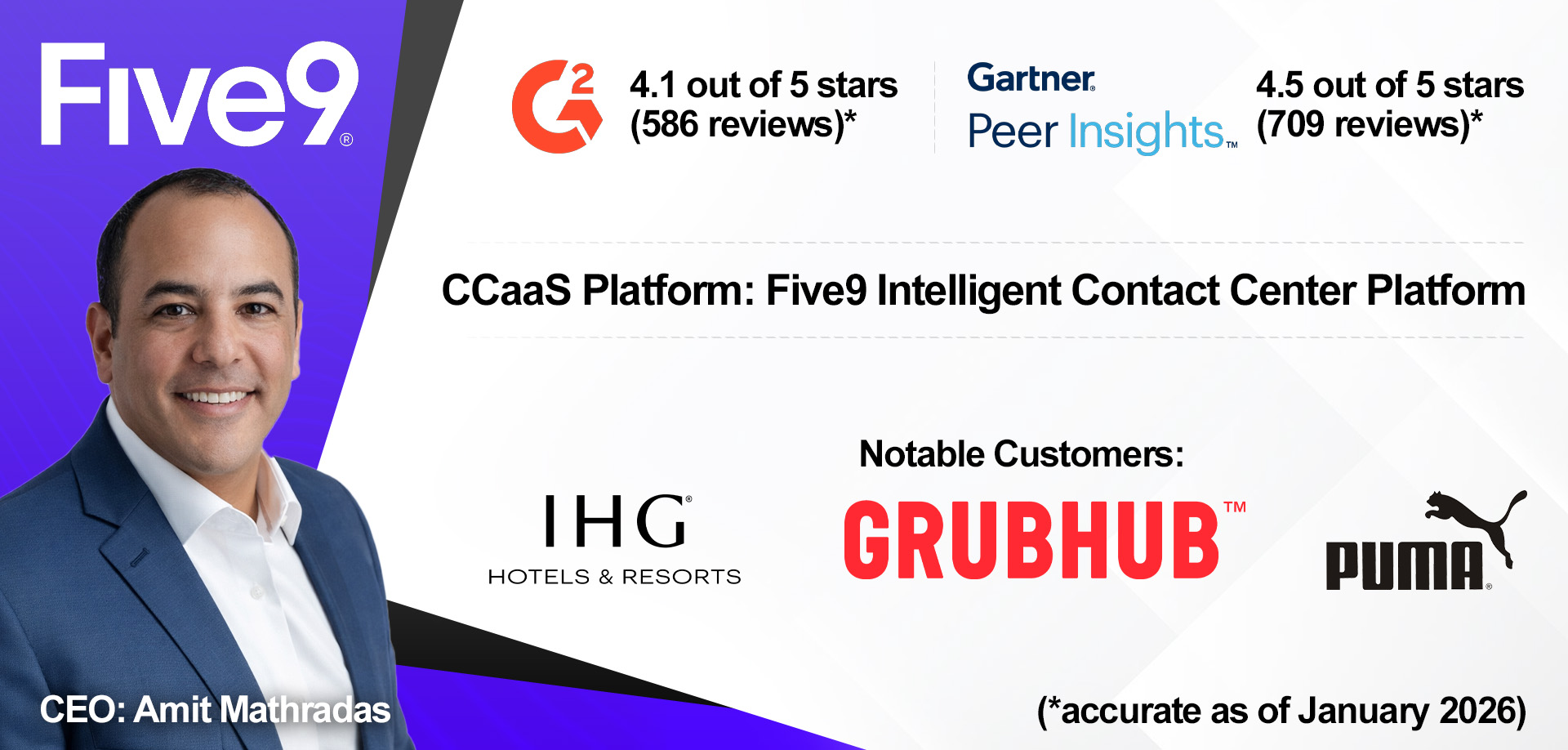
Five9 is in a transition period, with Amit Mathradas appointed CEO effective February 2026.
However, the early signs are positive. For instance, its partnership expansion with Google shows Five9 is not pandering to a narrow ideal customer profile (ICP), instead it’s broadening its appeal to IT leaders, saying: “If you’re a Google shop, here’s an easy button.” That’s differentiation.
As IT leaders show more interest in the contact center, thanks to increasing cloud and AI penetration, and start leading procurement initiatives, these relationships are critical.
Notably, Mathradas does not come from a CCaaS background, having most recently served as CEO of workflow automation vendor Nintex. However, that lack of direct CCaaS experience may prove to be an advantage.
After all, Mathradas will bring fresh perspectives that could reshape how the organization thinks about AI, not just as a tool to embed in every corner of the contact center, but as a way to optimize processes across the enterprise. He’s also sold to finance and IT leaders, which – per a previous point – is a key market expansion opportunity.
While Five9 is one of only four tech providers to have accumulated more than $1BN in annual recurring CCaaS revenue, these relationships are key to unlock its next growth phase.
Standout Features
- Close Partnerships with Adjacent Tech Providers: The new Google Cloud partnership signals a push to deepen its appeal with IT leaders and more tightly integrate CCaaS into the broader enterprise tech stack. It has already built strong partnerships with Epic, Salesforce, and ServiceNow, while its Microsoft Teams integration is especially well adopted.
- Workforce Engagement Management: With the exception of NiCE and possibly Genesys, Five9 has the deepest WEM portfolio within the CCaaS space, with specialist coaching tools, multiple forecasting algorithms, and gamification modules.
- Brand Recognition: Five9 released its first CCaaS solution in 2003, 13 years before NiCE. That heritage offers the vendor strong brand recognition and deep experience in the space, which it has successfully utilized to keep winning market share.
How Much Does It Cost?
The most basic edition of the Five9 Intelligent Contact Center is available from $119 per seat, per month. To add voice, AI summaries, live transcription, conversational analytics, and CRM and UC adapters it costs $159 per seat, per month. Prospects must reach out for a quote to include more advanced AI and WEM. Get the full Five9 CCaaS pricing breakdown here.
11. Talkdesk
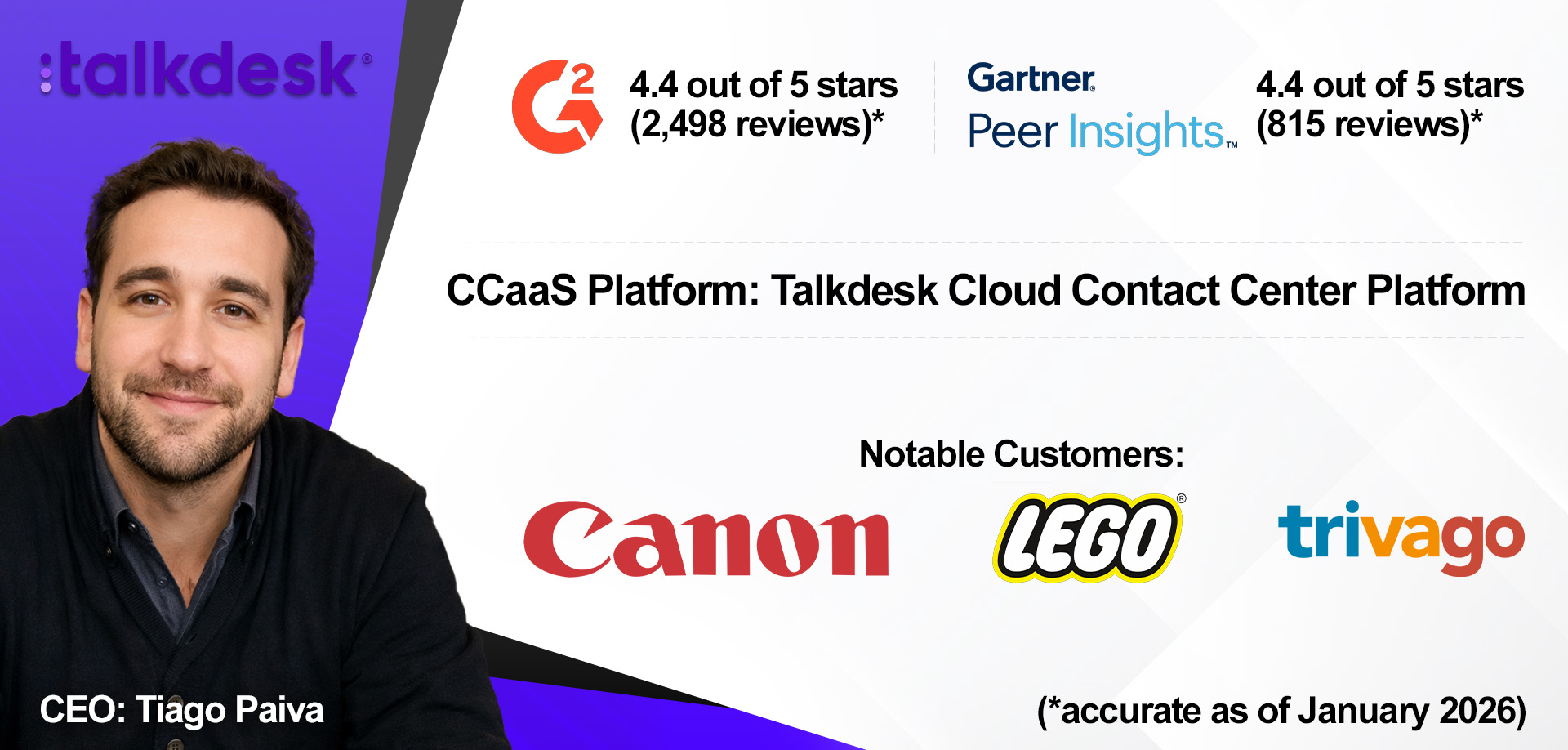
Talkdesk CEO Thiago Paiva declared CCaaS “dead” during an analyst briefing in late 2025.
Paiva’s new vision is to build a customer experience automation platfrom on top of everything: CCaaS, CRM, and various other CX systems. It can also sit above on-premise platforms like Avaya, Genesys, and Mitel, enabling brands to innovate without ripping and replacing their current systems.
Alongside this vision, the vendor announced Talkdesk Embedded in 2025. The solution, targets system integrators (SIs), allowing companies to embed the essential elements of CCaaS into third-party CRM solutions and transforming traditional CCaaS-CRM integrations.
However, despite thinking and innovating beyond the confines of conventional CCaaS, Talkdesk remains one of the industry’s most prominent players.
Its longstanding industry-focus is its key differentiator here, especially across healthcare, financial services, retail, and utilities.
Indeed, the vendor has spent years pre-configuring integrations and developing out-of-the-box workflows tailored to these sectors. As such, they may accelerate automation programs and build bridges from the contact center and into the broader CX ecosystem.
“What I like about Talkdesk is that they’re actively trying not to be a traditional CCaaS provider… Their thesis is that the real value is in automating customer interactions, regardless of the underlying contact center platform. I think that’s the right tactic.”
Standout Features
- Customer Experience Automation Strategy: Many on-premise and hybrid contact centers struggle to innovate on complex architectures. Talkdesk meets them halfway with its Customer Experience Automation portfolio, accelerating service automation while supporting a gradual transition to the cloud.
- Industry-Focused Clouds: Talkdesk has long-focused on industry-specific workflows that run from CCaaS into other enterprise systems. Over the years, it has delivered customized integrations, workflows, and AI to help automate those processes, housing them with Industry Experience Clouds.
- Solutions Tailored to Specific Buyers: In 2025, the vendor launched Talkdesk Express and Talkdesk Embedded, targeting SMBs and SIs, respectively. These releases expand Talkdesk’s reach across the CCaaS market and broaden its overall appeal.
How Much Does It Cost?
Talkdesk offers three “generic” CCaaS packages, ranging from $85 to $165 per user, per month, with each package including customer experience automation. Its Industry Experience Clouds cost more, at $225 per user, per month, covering eight specific verticals. Find a full rundown of Talkdesk’s CCaaS pricing here.
12. Sprinklr
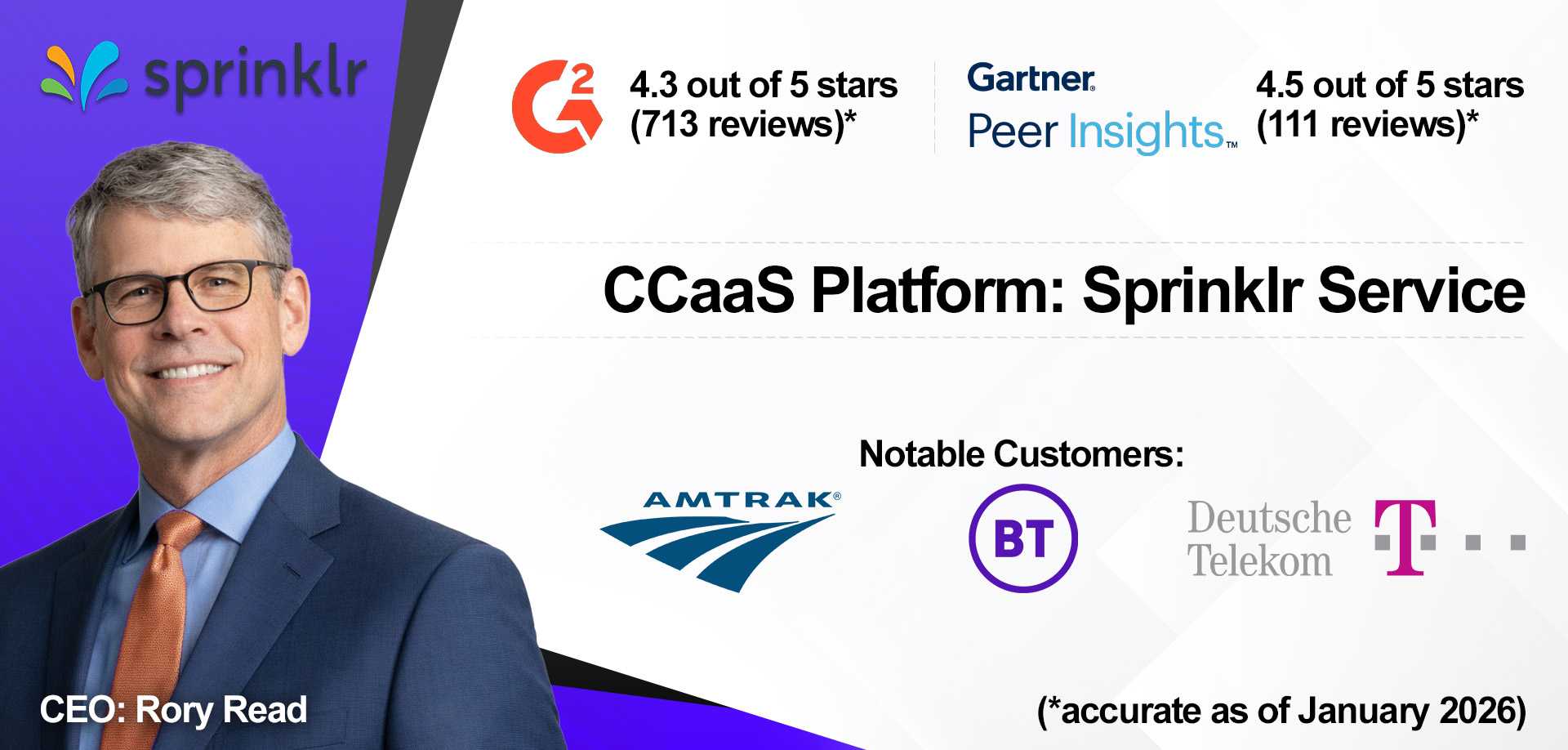
Since entering the CCaaS market in 2022, Sprinklr has emerged as a major player, securing high-profile deals with Amtrak, BT, and Deutsche Telekom.
As it has snapped up those deals, Sprinklr has challenged the traditional use of the term “omnichannel”, considering customer communications through a much broader lens.
In doing so, the vendor considers how people think. They jump, interrupt, and loop back. If and when voice becomes the interface for AI, that complexity only increases.
Thanks to its heritage in marketing and social media, Sprinklr sees the broader context - market conversation, influence, demand, etc. - not just the customer in isolation.
Ultimately, that has spurred Sprinklr to build CCaaS differently, connecting service, marketing, and commerce in a more authentic customer experience ecosystem.
In line with that, Sprinklr drafted in Rory Read as CEO, who once held the same position at Vonage, to advance the deployment experience and aftercare that Sprinklr offers, ensuring greater operational rigor.
“People don’t want to admit it, but Sprinklr is a real player. What they do differently is understand conversation. Not just omnichannel, but multi-threaded conversation.”
Standout Features
- Voice of the Customer Tooling: Sprinklr monitors customer feedback across social platforms, review sites, and contact center channels. This insight helps teams identify pain points and deliver proactive support that protects customer relationships, which is an increasingly impactful capability as service shifts toward customer success.
- Unified Customer Experience Strategy: Most customer-facing function leaders still look at customer data in isolation. Sprinklr CXM aims to connect that insight, and Sprinklr Service lies at the heart of that strategy, enabling teams to better evaluate what drives positive customer experiences.
- Conversation Design: Sprinklr’s ultimate goal is to become an operating system for all customer interaction. With its understanding of the twist and turns of what customers say and do, it aims to piece together more of the customer journey than its CCaaS rivals.
How Much Does It Cost?
Sprinklr Service is priced through a consultative model. A custom quote is scoped to the number of users, channel and message volume, and contract term (typically 12, 24, or 36 months). The vendor asks prospective buyers to reach out directly for a tailored proposal. Contact Sprinklr's sales team and request a demo here.
13. UJET (& Google)
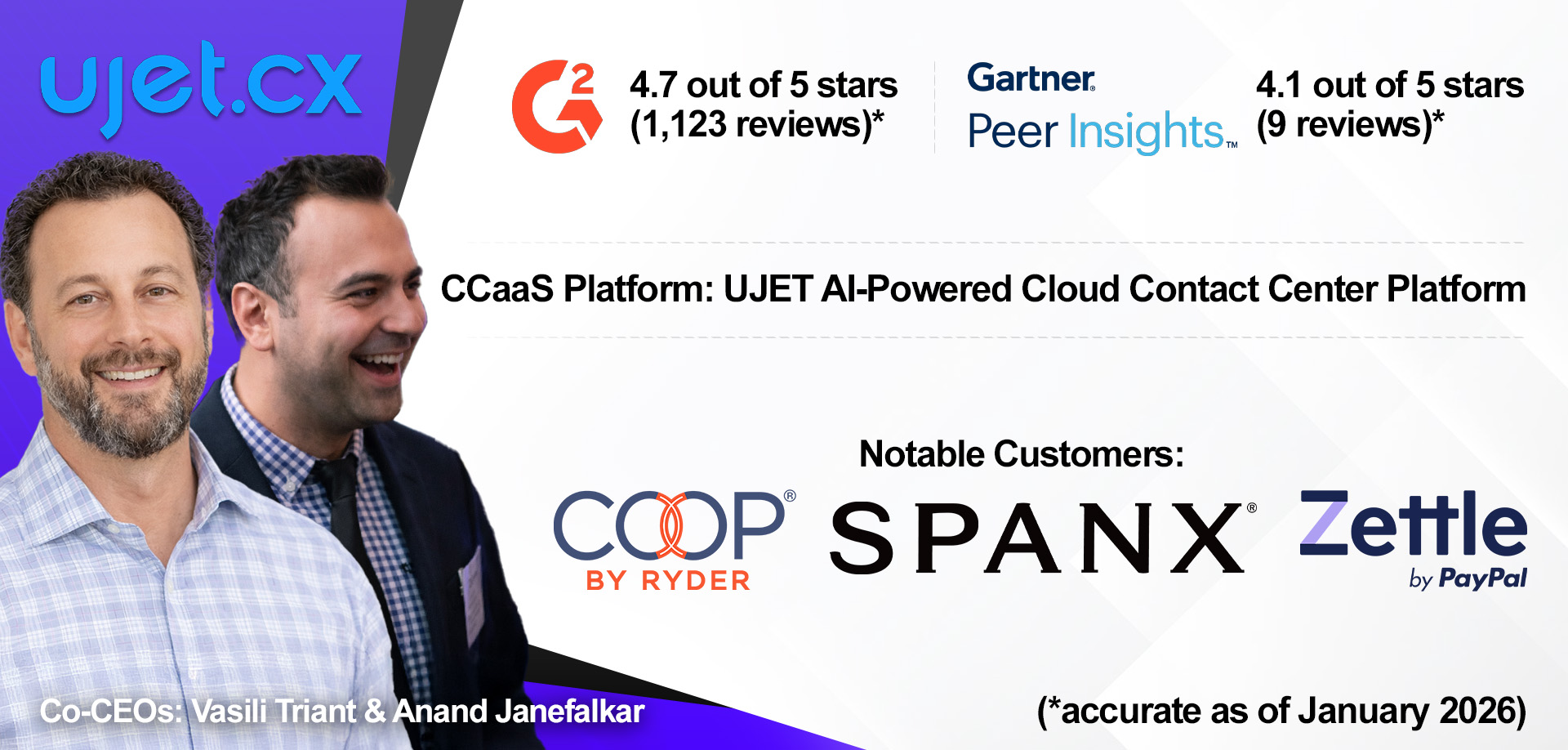
UJET launched over a decade ago, yet its smartphone-centric architecture – based on the premise that a customer should be able to interact with businesses as easily as they talk to a friend or family member – is still differentiative.
Over time, it has built on this to help contact centers orchestrate experiences that blend modalities, humans, and different types of AI.
With more industry experts touting voice to remain the leading channel for service experiences, but augmented by digital elements – i.e., account selection, seat maps, and confirmations that appear on the customer’s smartphone – UJET appears well-positioned.
Another advantage UJET has over most CCaaS providers is its close relationship with Google, allowing it early access to the latest AI models.
That partnership resulted in UJET supporting the development of the Google Contact Center AI Platform, now part of the Google Customer Engagement Suite.
As Google targets the enterprise with its offering, UJET has started to prime its solution for the midmarket, a segment traditionally underserved by feature-dense CCaaS platforms.
Standout Features
- Smartphone-First Architecture: UJET helps contact centers identify the optimal channel for each query and route it accordingly. Once there, customers receive a carefully orchestrated experience that blends AI, multiple modalities, and a human touch.
- CRM-Centric Design: The CCaaS solution sits atop the contact center’s chosen CRM, storing all contact data within it. This approach secures sensitive information, reduces compliance risks, and ensures the full context of customer interactions is captured in one place, minimizing blind spots.
- Close UJET-Google Partnership: UJET supported the development of the Google Contact Center AI Platform, which is now part of its Customer Engagement Suite. In return, it receives early-access to Google’s latest AI models, which allows it to bring advanced tooling to a midmarket traditionally underserved by CCaaS providers.
How Much Does It Cost?
UJET offers four CCaaS packages, ranging from $65 to $120 per user, per month. Across each, buyers may lay over supportive solutions, such as an outbound dialer, co-browse, and WFM, which are available for an additional $15, $20, $40 per user, per month, respectively. Discover the full pricing breakdown for the UJET Contact Center here.
14. 8x8
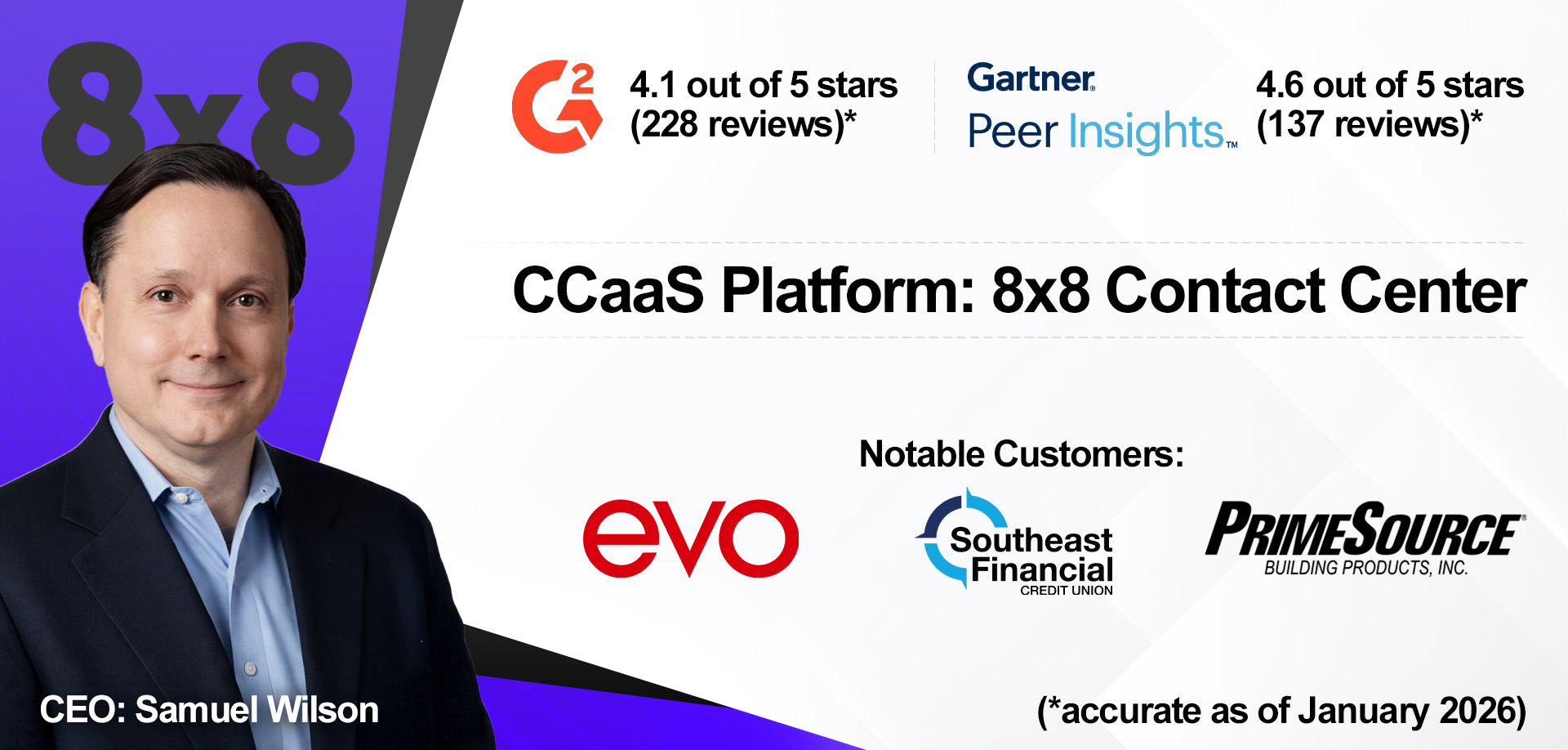
In a space with much bigger tech providers, 8x8 doesn’t attempt to ‘out-market’ them. Instead, it hones in on the midmarket and places emphasis on creating customer intimacy.
To create such intimacy, 8x8 doesn’t lead with a sales pitch, but aspires to first understand the business: the problems, the goals, and what was getting in the way. That approach aligns well with its midmarket focus and guides its innovation.
One such fascinating innovation, released in 2025, is 8x8 JourneyIQ. The solution aims to pinpoint where the customer is on their journey, defines their ideal outcome, and identifies opportunities for self-service and proactive engagement. It’s a significant advancement on conventional contact center intelligence technologies.
Also, since Sam Wilson became CEO in 2024, the company has placed emphasis on flipping the traditional software model.
Historically, this software model prioritized vendor simplicity at the expense of customer complexity. Recognizing that this dynamic has slowed midmarket adoption of new technologies, the CEO and his team reoriented the platform, with an emphasis on outcomes.
As a result, instead of bundling products, 8x8 now leads with clearly defined outcomes, using language customers understand, i.e., orders, field service, reservations, assessments.
“8x8 is worth watching. The CEO is highly engaged and financially savvy, and the company has been pragmatic in its approach… Its strong, integrated UCaaS + CCaaS value proposition is [also] something buyers increasingly value."
Standout Features
- Drive to Create Customer Intimacy: Over the past 12 months, 69% of customers have given 8x8 a five-star review on Gartner Peer Insights for CCaaS. That’s up significantly from its historic average of 56%. The vendor’s renewed vigor in supporting its clients more closely is a significant driving factor here.
- CCaaS-UCaaS-CPaaS: Rather than having reps contact SMEs through disconnected collaboration tools, 8x8 creates a connected experience across its CCaaS and UCaaS solutions, enabling teams to collaborate and resolve complex queries more efficiently. With CPaaS on the back end, 8x8 delivers a comprehensive enterprise communications package centered on critical contact center needs.
- Outcome-Focused Innovation: When 8x8 releases a new tool, it leads with the problems it hopes to solve, helping customers understand the opportunity of new technologies, not just the drone of AI.
How Much Does It Cost?
While 8x8 operates with a seat-based pricing model, it doesn’t disclose its CCaaS pricing. Instead, it asks that prospective buyers reach out for a consultation and quote. Request a quote for the 8x8 Contact Center here.
15. RingCentral
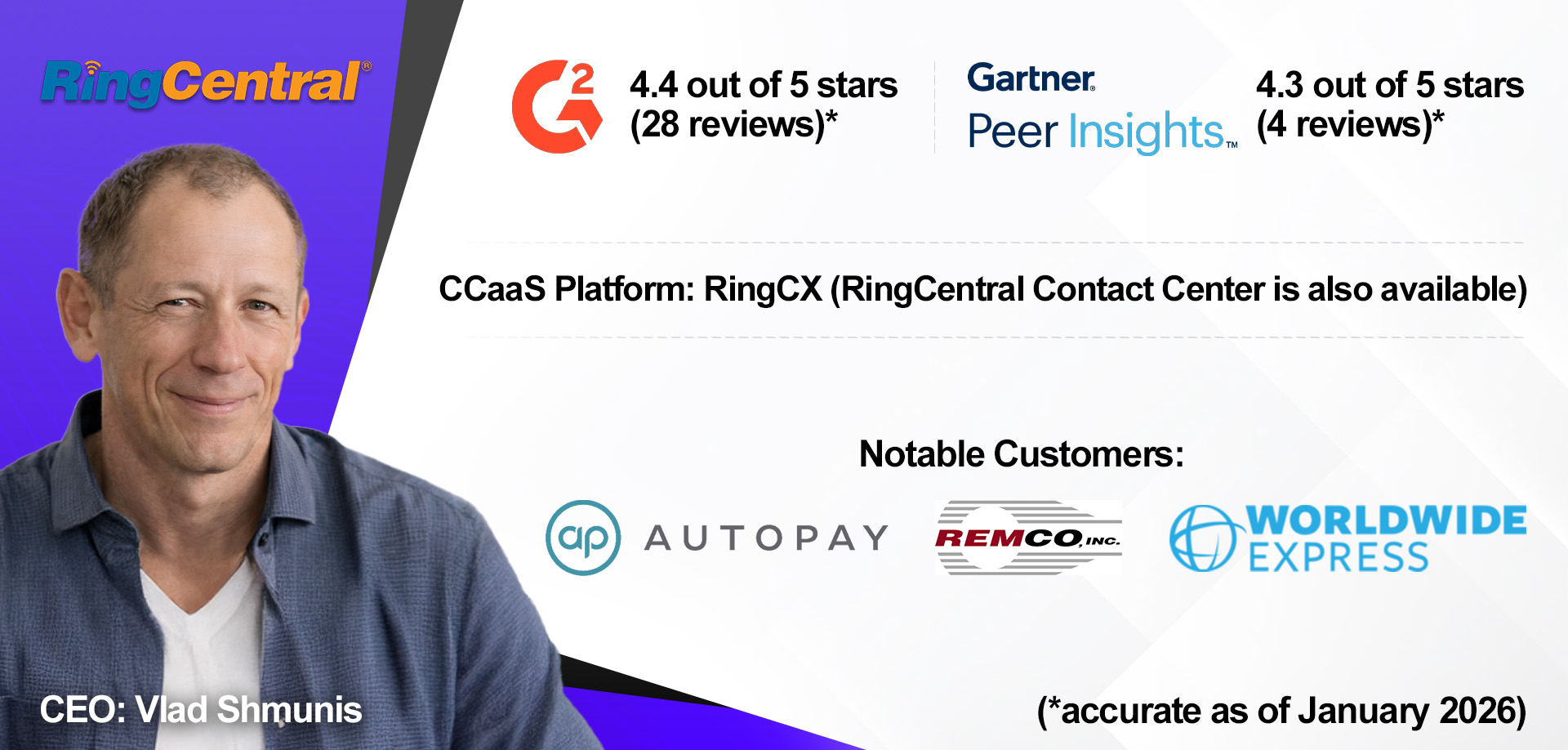
RingCentral has long partnered with NiCE to deliver the RingCentral Contact Center, an enterprise CCaaS platform. Yet, the vendor also offers a ground-up solution: RingCX.
RingCX has fewer bells and whistles, but targets smaller businesses, especially those where frontline teams provide customer service across many disparate locations.
Frontline workers are a large, underserved market. Think about healthcare, field service, store staff, insurance agents… all these employees need access to customer information without a full agent dashboard. RingCentral aims to give it to them.
Consider another example of a school, which may use RingCX to automate communications during emergencies and run basic interaction handling. These are contact center use cases, but not traditional ones.
RingCentral leverages its UCaaS heritage, pulls CCaaS into the frame with RingCX, and provides a unified offering that aligns with these more basic use cases.
So, while RingCX may not align with the needs of 1,000+ seat operations, smaller businesses already leveraging RingEX – RingCentral’s UCaaS platform – may benefit from its contact center lite.
“RingCentral has to be careful with the NICE partnership, but over time I think you’ll see them shift more focus toward RingCX. It’s good, they just need to continue building it out.”
Standout Features
- Distinct Value Propositions for the Enterprise and Midmarket: RingCentral is primarily a UCaaS provider, but many of its customers seek to expand into CCaaS. With RingCX targeting midmarket and smaller companies and the RingCentral Contact Center serving enterprises, it aims to offer a comprehensive communications suite for businesses of all sizes.
- “Beyond CCaaS” Use Cases: Many employees - receptionists, store associates, field workers, and more - need a simple interaction platform with a basic agent desktop, not just contact center staff. RingCX delivers this, connects it to broader service operations, and provides a central interface for IT admins.
- CCaaS-UCaaS-Analytics: By aligning RingCX, RingEX, and RingSense, its conversational analytics solution, RingCentral can analyze customer cases as they travel outside of the contact center for SME support. In doing so, it can expose new insights into how external experts solve tricky issues and bolster contact center knowledge content.
How Much Does It Cost?
RingCentral’s RingCX Standard edition is $65 per user per month, while the fully-featured Elite plan is $145 (down from $165). Pricing for RingCentral Contact Center is available upon request. Learn more about both CCaaS offerings here.
16. Vonage
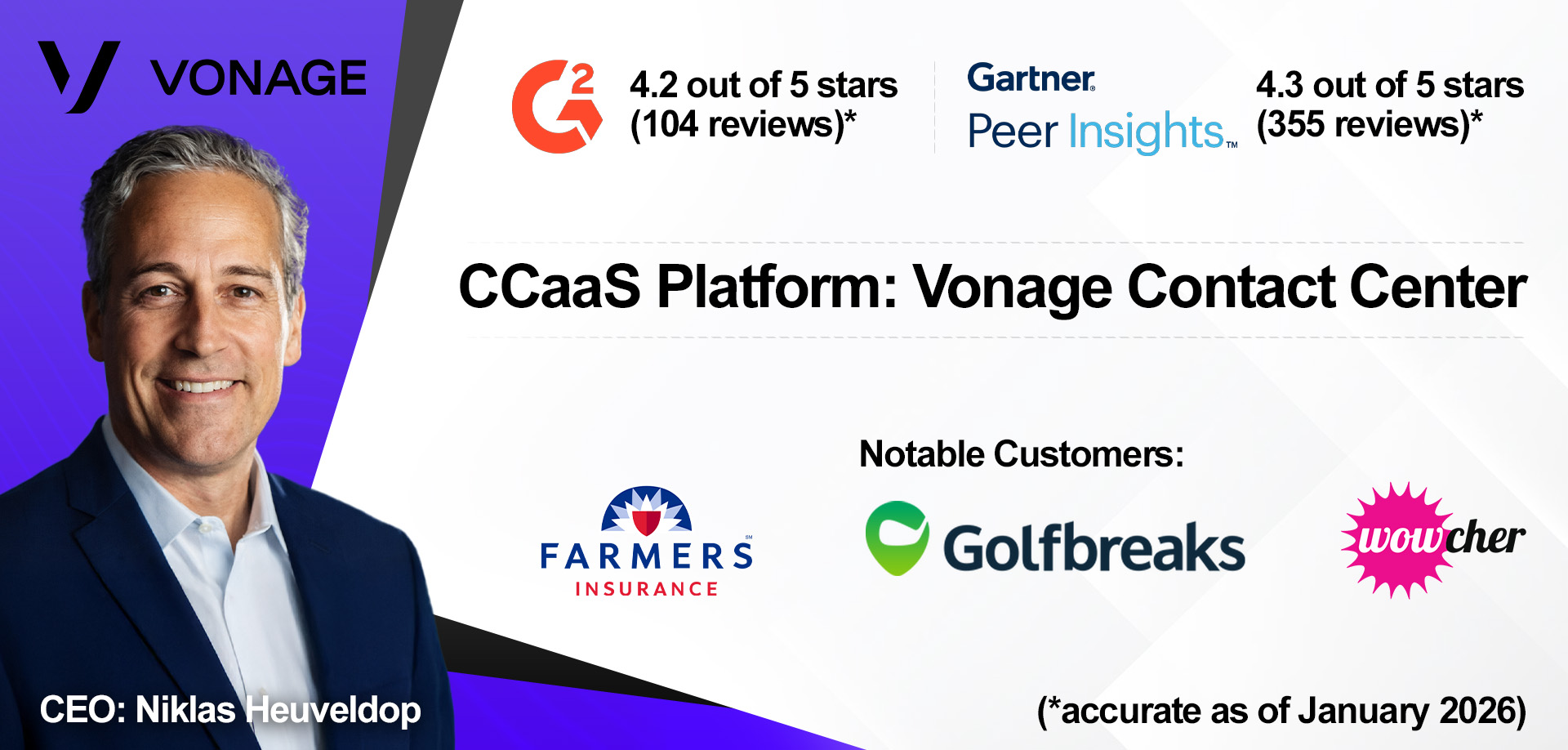
Today, Ericsson-owned Vonage is best known for its CPaaS portfolio, offering communications APIs, including video, voice, authentication, authorization, and messaging APIs such as SMS and RCS.
These APIs lay the foundation for communications across the Vonage Contact Center and leverage Ericsson’s global networks, which strengthen the platform’s voice and video capabilities.
Additionally, data from Ericsson’s networks adds another layer of security to Vonage’s CCaaS platform. For instance, the data can validate if the caller recently changed SIM cards, helping contact centers spot fraudulent account takeover attempts.
Interestingly, Vonage has also leveraged its network APIs to augment Vonage Premier for Service Cloud Voice. This solution embeds Vonage’s voice and digital channels inside of Salesforce’s customer service CRM application, alongside its routing engine. Yet, more uniquely, it also embeds network APIs.
As a result, the vendor can bring its enhanced fraud detection and customer verification capabilities to Service Cloud (now Agentforce Sales) and differentiate from the other CCaaS-CRM solutions that Salesforce has launched with AWS, Genesys, and Five9.
Lastly, while Vonage embraces a Salesforce-centric go to market, it is possible to embed its CCaaS platform directly into other CRM solutions – including ServiceNow CSM and Zendesk – to consolidate all customer information into one interface. That can minimize app hopping and simplify rep experiences.
Standout Features
- Agent Interface: Vonage provides a co-ordinated interface across its CCaaS platform and third-party CRM platforms to minimize channel hopping. It then layers over AI to act on that shared insight, with next-best actions and other common agent assist features. The “VCC Intelligent Workspace” also cleans the audio with built-in noise cancellation.
- Ericsson APIs: These benefit the CCaaS platform in many ways. One excellent example is how a rep can tag an AI agent to verify the caller’s identity, using a silent authentication network API and voice metrics, when the customer makes a request that requires an extra level of security.
- Salesforce Relationship: Like Genesys, AWS, and Five9, Vonage co-innovates with Salesforce for deeper CCaaS-CRM integrations. However, unlike these vendors, it also blends its Network APIs with Agentforce to secure the customer service ecosystem with unique fraud detection and customer verification features.
How Much Does It Cost?
Vonage uses a seat-based pricing model, offering Priority and Premium plans, with features such as speech analytics, WFM, and conversational AI available as add-ons. Prospective buyers must contact Vonage directly for per-seat and add-on pricing. Explore Vonage Contact Center pricing options here.
17. Odigo
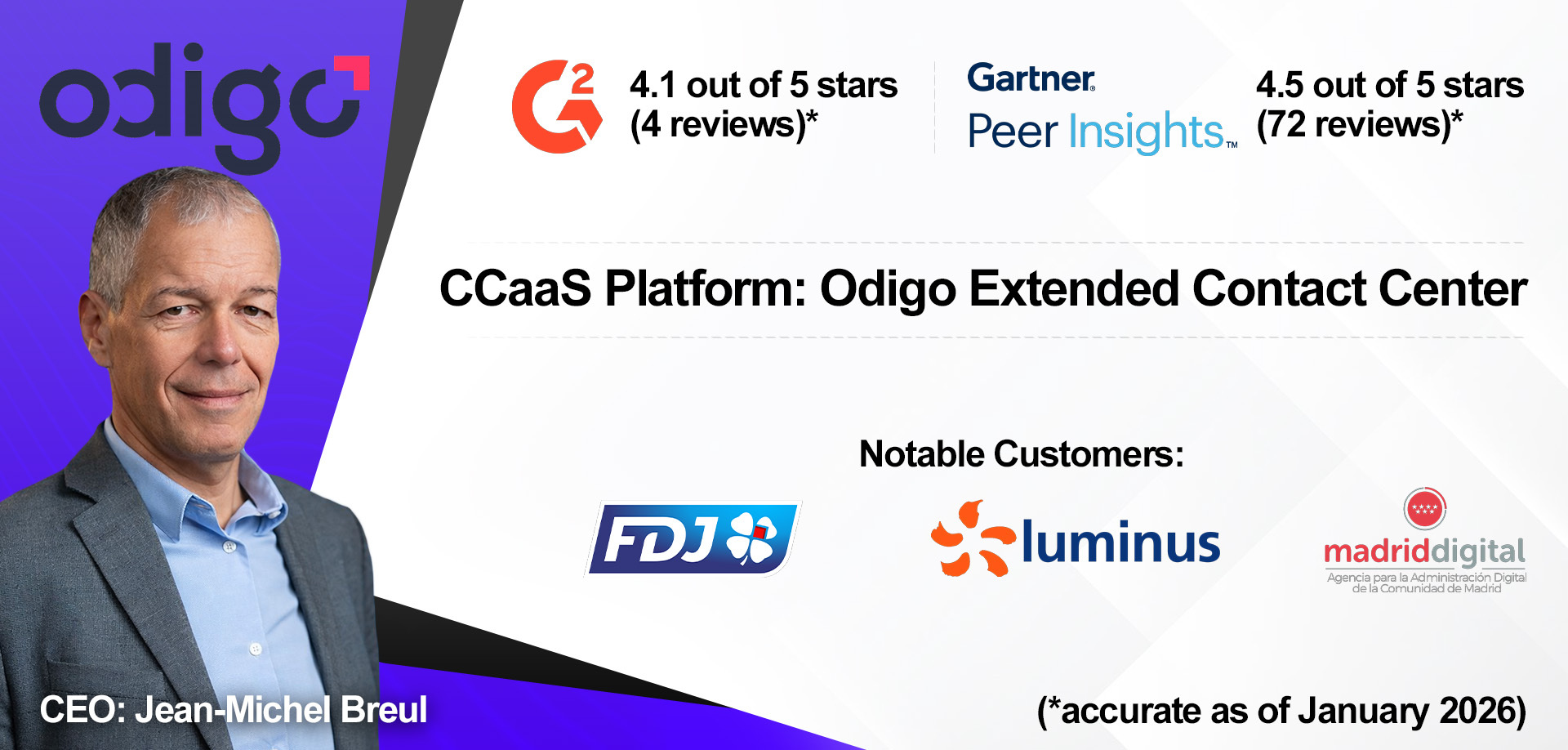
Odigo is one of the most prominent CCaaS players in Europe, spinning out of Capgemini in 2020. Still, it remains close with the IT services and consulting giant. That’s one of its big differentiators.
Indeed, when Odigo sells its technology, it also presents customers with a deep bench of experts ready to step in to support the deployment and ongoing evolution of their CX environments.
That’s not just inside the contact center. With experts in Salesforce, ServiceNow, and various other prominent CX providers, these specialists can help service teams connect to the broader enterprise.
Outside of its close consulting relations, Odigo has shown original innovation with its Extended Contact Center offering that allows businesses to purchase extra seats, at a lower cost, with a limited number of interactions for external SMEs.
By doing so, Odigo allows reps to send difficult calls to these SMEs, who can interact with the customer directly, resolve their issue, and log everything in Odigo. There’s no need for a UCaaS integration that changes the contact center’s architecture.
Lastly, Odigo acquired French CCaaS provider Akio in November 2025. Although Akio is a relatively unknown brand, it provides solutions for voice of the customer (VoC) analysis and reputation management, helping contact centers link inbound contact volumes to broader customer feedback trends. It will be fascinating to see how Odigo embeds these technologies.
Standout Features
- The Extended Contact Center: By extending lower-cost CCaaS seats across the business, Odigo can route selected interactions to external SMEs, centralize customer communications, and surface insights beyond the central contact center. These insights can then inform new knowledge content.
- Capgemini Expertise: Odigo maintains a close partnership with Capgemini, strengthening its support services and giving customers access to specialized expertise. Notably, it collaborates with Capgemini’s extensive Salesforce talent to differentiate its CCaaS offering for brands centering their service strategy on Agentforce Service (formerly Service Cloud).
- European Community: Through Cagemini, Odigo can serve global organizations. However, Europe is its hotspot, with many of the continent’s largest companies choosing to leverage Odigo. As more European tech buyers consider American alternatives, it may continue to grow in the market.
How Much Does It Cost?
Odigo does not publicly disclose its pricing. However, 2024 documentation from partner Sabio lists a rate of £63 per seat, per month (approximately $85) for voice and digital channels, standard AI features, and call recording. Interested buyers can contact Odigo directly for up-to-date pricing here.
18. Glia
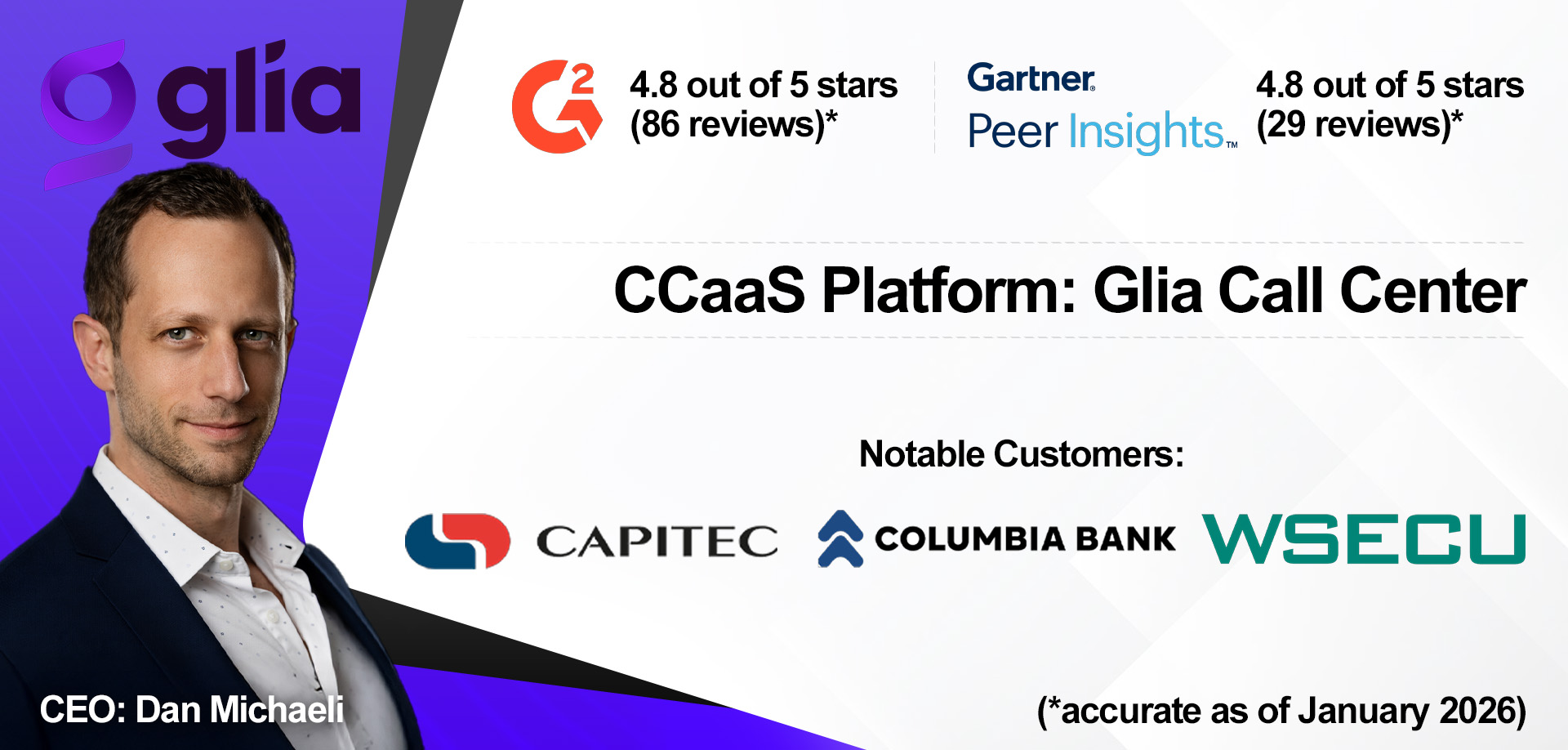
Founded in 2012, Glia first made a name for itself in financial services, working with 700 banks, credit unions, and insurance companies. Now, it’s starting to expand into other sectors.
As it does so, Glia champions its “Priceless Pricing” model, where customers agree to a fixed price at the start of their contract.
Crucially, that price never wavers, as brands can add seats, leverage new solutions, consume more AI, and implement integrations without additional costs.
With this model, Glia aims to present something more future-proof than seat-based pricing and less prone to fluctuation than consumption models, which are becoming more widely-utilized in CCaaS.
Alongside pricing, it tries to be a more consultative vendor, supporting clients as they implement customer-facing AI and pivot to other service models. These models include a vision for pivoting customer support advisors to customer success reps as AI automates more of the contact mix.
Lastly, Glia’s workforce engagement management (WEM) portfolio has several advanced features, like the ability for workforce planners and quality analysts to interact their data via written prompts.
Standout Features
- “Priceless Pricing”: The ability to agree on pricing upfront and access an all-you-can-use suite of tools, integrations, and capabilities appeals to brands confident in their ability to innovate quickly. While less suited to slower-moving contact centers, it allows more agile teams to experiment and deploy new tools without constant CFO scrutiny.
- Finance Specialism: Glia now partners with more than 700 banks, credit unions, and insurance providers worldwide, up from 200 in 2021, establishing it as a major player in the sector. This growth is driven by its focus on virtual branch banking, fintech-grade security, and strong word of mouth.
- Workforce Engagement Management: Although not heavily promoted, Glia offers advanced WFM and QA tools with a GPT-powered component. These tools allow planners and analysts to explore what’s driving current demand, how contact volumes are likely to change during a “what if” scenario, where reps can show more empathy, and so forth.
How Much Does It Cost?
Glia uses a single, fixed-price model with no per-seat or usage-based fees. Essentially, once a price is agreed, contact centers unlock unlimited access to its platform and capabilities. Learn more about Glia’s “Priceless Pricing” model here.
19. 3CLogic
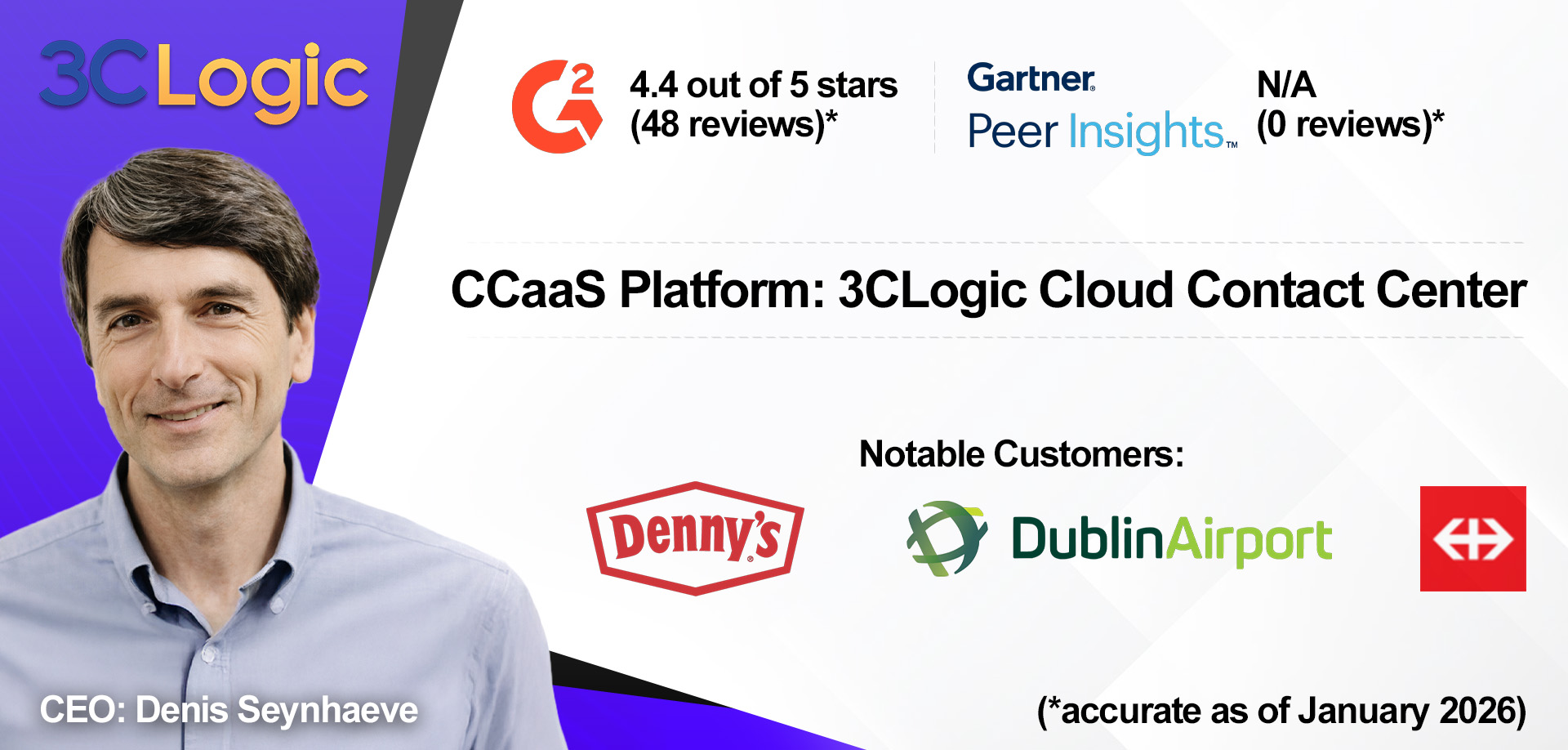
Some smaller CCaaS players champion product change and category convergence as they attempt to differentiate in an increasingly crowded market.
3CLogic is an excellent example. It’s not looking primarily at communications channels, it’s considering workflows, AI, and where service is actually delivered. It’s asking: “What’s the workflow?” Then, it’s building around that.
By doing so, it takes a “beyond CCaaS” view, building on platforms like ServiceNow and Salesforce, to connect the contact center with the broader enterprise and establish autonomous workflows.
In short, 3CLogic sees itself as part of an ecosystem, not “the next big player”, and is betting on that as a winning strategy for CCaaS.
Some may argue that it’s “not CCaaS”. Yet, 3CLogic has inbound, outbound, and omnichannel, alongside deep ServiceNow and Salesforce integrations. So, this legacy assumption, like so many in the contact center market, is a little unfair.
However, recognizing such assumptions, 3CLogic has strengthened its partnerships with the likes of Verint for workforce optimization, Microsoft Teams for collaboration, and Sycurio for payment processing to extend its core contact center capabilities.
Standout Features
- CRM-First Architecture: 3CLogic views the CRM as the primary interface for contact center reps, with CCaaS as an extension. It builds integrated workflows across major CRMs - most notably ServiceNow - and back-end systems, enabling agents, and soon AI agents, to navigate multiple applications seamlessly without constantly switching between screens.
- The Platform-Building Approach: The CCaaS space remains ripe for consolidation, and AI has accelerated the need to integrate into ecosystems. 3CLogic is already there, while many vendors which aren’t building inside of these ecosystems have to acquire to stay relevant.
- CIO Relationships: 3CLogic integrates deeply with back-office systems, tracing customer pain points across products, supply chains, and organizational processes. This visibility allows contact center leaders to collaborate more strategically with the CIO, driving operational improvements while positioning the contact center as a central hub of the customer experience.
How Much Does It Cost?
3CLogic doesn’t publicly share information about its pricing. Instead, it considers its customers’ requirements in a consultation and provides a quote. Book a consultation with 3CLogic here.
20. TCN
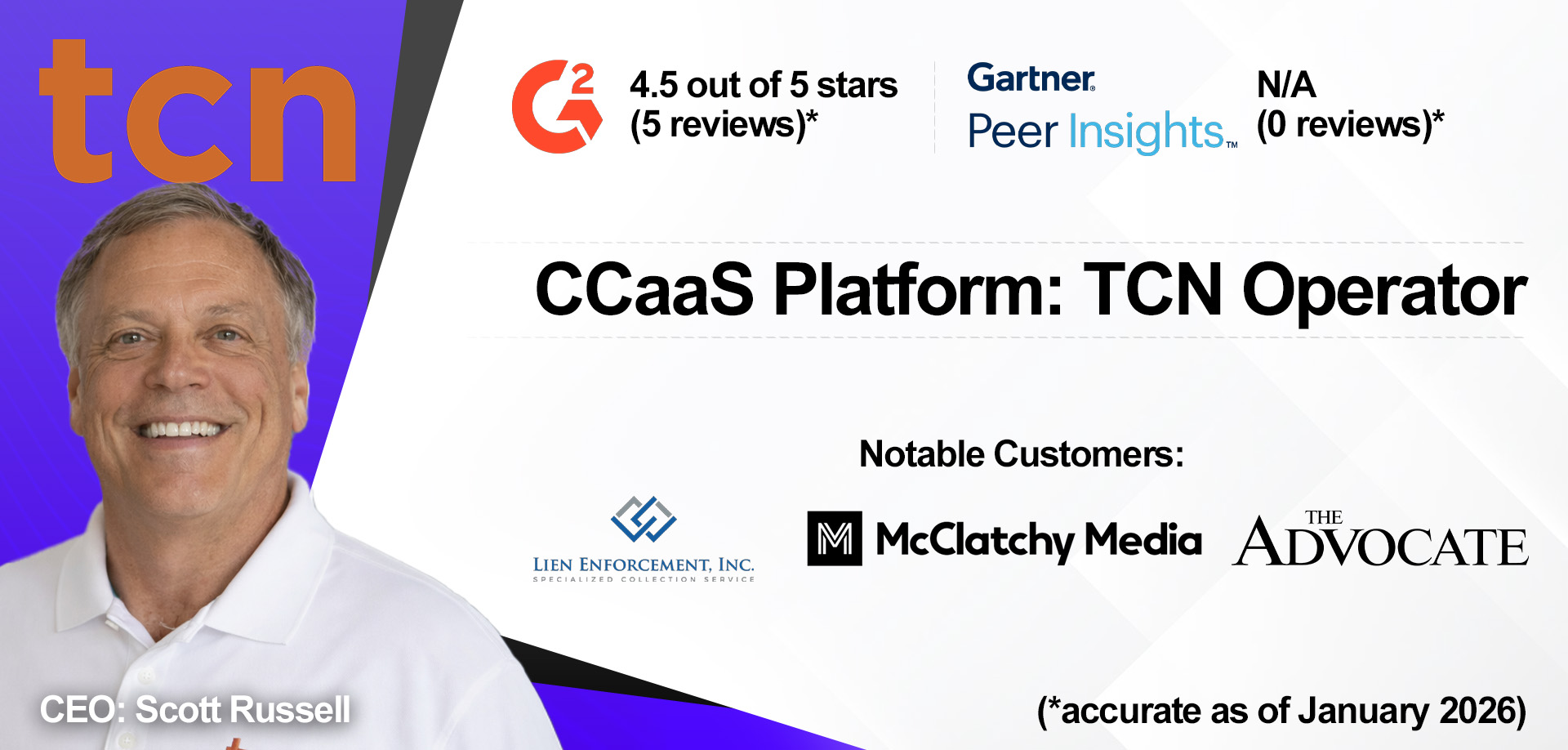
TCN started off supporting contact centers in the collections sector. Thanks to its heritage in this space, it understands how money moves through contact centers better than almost anyone.
As it has evolved, TCN has found a niche for helping businesses with a vision to turn their contact centers into revenue engine. It understands that world inside out.
Additionally, as it has long handled sensitive financial data, TCN offers advanced security and compliance solutions and support. For instance, it proactively informs customers when there is regulation change, explaining how it may impact them.
As more tech giants have entered the CCaaS space – including AWS, Google, and Microsoft – smaller players like TCN have placed significant emphasis on such white-glove service to differentiate.
Another example is TCN offering 24/7 access to customer support from a dedicated account manager at no additional cost, stressing that each manager has an average tenure of 14 years.
TCN further differentiates itself through a flexible pricing model that ensures customers pay only for the capabilities they actually use, never for bundled features they don’t need. It also commits to no monthly minimums, no surprise fees, and no long-term contracts.
“If you want your contact center to be a revenue engine, TCN knows more about that than most vendors. They have the security, the AI, the WEM… it all works.”
Standout Features
- Security and Compliance Expertise: TCN provides solutions, such as consent tracking, that simplify complex compliance procedures. It also monitors regulatory changes, supporting audit readiness and helping contact centers stay ahead of confusing regulations.
- Customer Support Services: TCN offers 24/7 support through experienced account managers, who have an average tenure of 14 years, helping clients manage operations and resolve issues efficiently.
- Flexible Pricing: Clients pay only for the solutions they choose, without hidden fees, monthly minimums, or mandatory contracts, unlike the CCaaS industry norm, where bundled plans and long-term commitments are common.
How Much Does It Cost?
TCN offers a pay-as-you-go pricing model, with customers only billed for the services they use. Learn more about pricing for TCN Operator here.
Weighing Up All These CCaaS Providers
Evaluating the many CCaaS providers is often where organizations start when procuring a new solution, but it shouldn’t be.
Instead of racing to resources like this, which compare vendors to one another, the smarter approach is first understanding the mix of incoming contacts and the causes of failure demand.
By understanding this, contact centers can consider possible fixes and new workflows, and use this understanding to inform procurement decisions.
Doing this homework is critical for brands when isolating the ideal CCaaS platform for their service environment.