
November 9, 2026 • 13 min read
11 Trends Changing Contact Center Work

Director of Content & Market Research
November 9, 2026

AI evangelists like Elon Musk and Sam Altman once claimed contact center jobs would disappear. But that won’t happen any time soon.
In fact, almost three-fifths of contact centers have no plans to reduce headcount, despite 95% running at least one AI or automation capability, according to research firm Valoir.
Many contact centers have even reported that human workloads are increasing.
Zendesk research reveals this trend. It found that after customer-facing AI deployments, the median workload of a human customer support agent rose by an average of 87%.
That’s led to a new hiring push across many organizations.
Why is this happening? The study suggests that it’s because customers now have more confidence in brand AI. As such, they’re asking questions they previously would have let slide.
In turn, that’s driving up escalations to human reps, who are now handling new edge cases.
Given this, human agent workloads are, in many cases, ramping up.
At the same time, the overall interaction complexity is increasing.
Ultimately, that leads to the first of 11 trends that exemplify how contact center work is changing.
1. New Workload & Team Structures
AI is snapping up more routine queries, and doing it well. Impressed, customers are asking follow-ups and escalating to human reps, who then handle the trickier conversation.
As a result, the workload changes. There are fewer predictable customer contacts and more nuance. That adds complexity to the agent role.
Now, many contact center agents face a “barrage of emotionally taxing, charged interactions day in and day out,” according to Alexander Michael, VP of ICT at Frost & Sullivan.
In the face of this challenge, forward-thinking organizations are evolving the support structures around their teams.
Firstsource is an excellent example. It has nudged team leaders closer to the frontline, asking them to spend one day each month handling customer contacts while receiving quality assurance (QA) on their own interactions.
“Team leaders need to understand the customer, the product and the process, and be able to do the agent's job themselves.”

According to Geoghegan, this helps agents and customers recognize problems with products, policies, systems, and processes.
Moreover, it helps shift their focus from administrative workloads to developing helpful capabilities and improving performance.
2. New Handovers
52% of organizations report that the number of interactions that start in an AI channel and are then handed off to a human is increasing, per Frost & Sullivan.
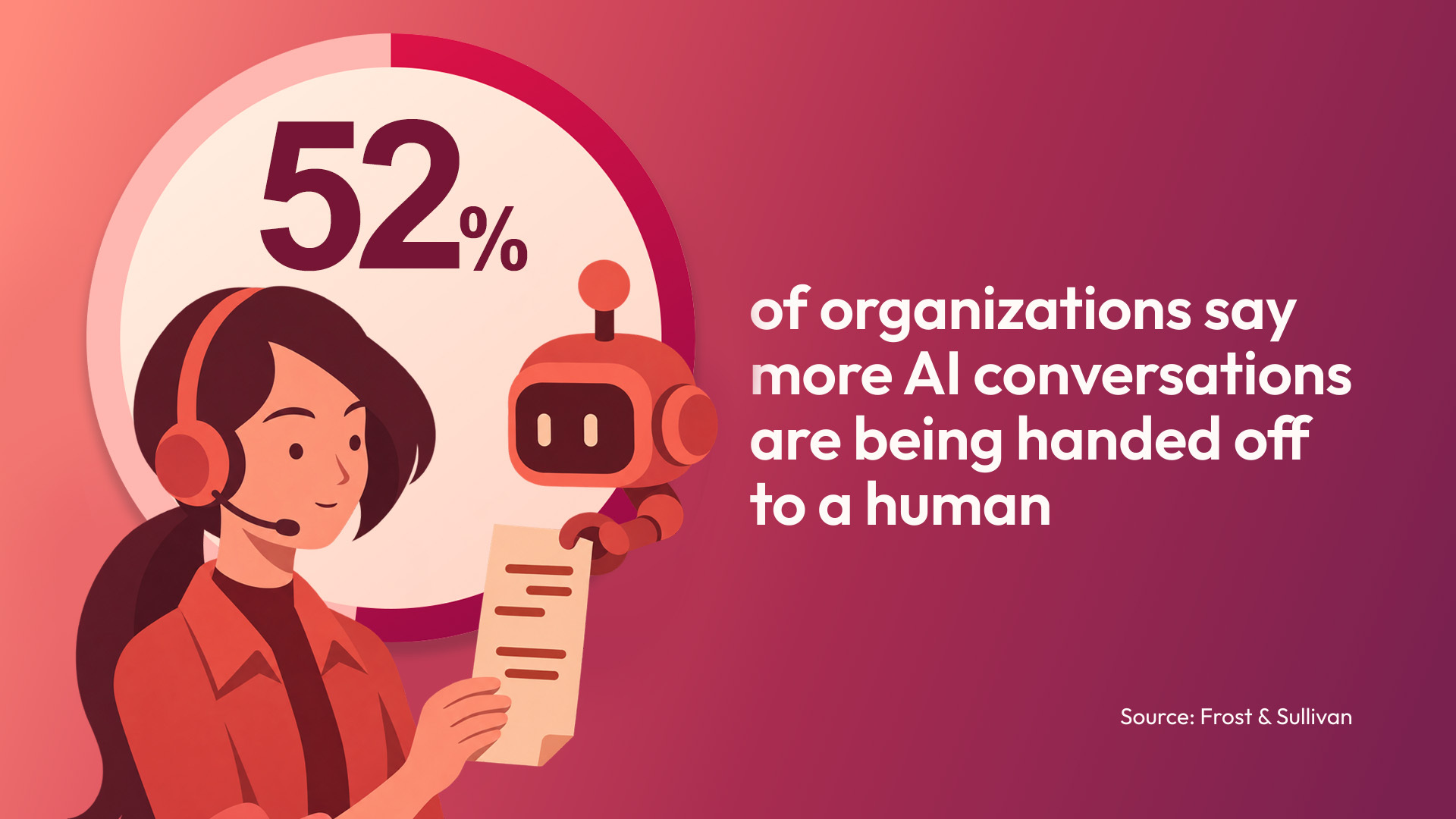
Again, this hints that consumers are interacting with AI differently, asking new and more complex questions that the contact center team has to pick up.
To ease the conversation that follows, more service leaders are considering: what should that escalation process look like?
Most have settled on the AI agent passing key details from the conversation so far. That’s the classic “warm transfer.” However, alternatives are also arising.
For instance, one AI provider lets the human agent interact with the AI agent to gain additional context before accepting the transfer.
Elsewhere, as contact centers orchestrate new AI-led conversations, some are considering how human agents could act as sub-agents within an agentic resolution workflow.
Here, the AI passes a task it’s not authorized to handle to a human to complete. The human then completes it in the background and hands back to the AI agent to run the rest of the conversation.
AI vendors like SoundHound now deliver this capability, which could transform the service rep role if it’s widely adopted.
3. New Customers
It’s not just people talking to service teams anymore. Personal AI agents are too.
These AI agents work on behalf of consumers, scheduling appointments, writing emails, submitting complaints, purchasing products, and running various other tasks.
Currently, use of these personal agents is relatively limited. However, Meta Muse has attracted ten million users just six weeks after launch.
Notably, it also has a voice capability in beta, which will allow it to call customer service.
When this capability goes live, and other tech giants release similar products, contact center teams can expect to communicate more with AI and less with actual humans.
These AI agents will be more persistent, spamming channels until they achieve their preferred outcome, while inflating contact volumes.
All this requires significant consideration, and contact center teams will have to work within specific boundaries when interacting with AI. Leaders may also rethink how they measure team performance when they’re interacting with more persistent, less emotional customers.
4. New Metrics
The previously cited Valoir study found that, because of AI, 30% of contact center teams are changing key performance metrics.
That statistic reflects how many organizations are redefining what they expect from human agents as their workload changes.
Typically, that involves placing less emphasis on efficiency-based measures to monitor agent performance, like average handling time (AHT), and more on customer experience outcomes.
Key measures here include customer sentiment and first contact resolution (FCR).
However, other new contact center metrics are also emerging as contact centers aim to monitor and support agents more fairly. These include:
- Case Complexity: Before a case escalates to a human agent, some contact centers now run predictive analysis to categorize it by expected difficulty. They then route those interactions to ensure that reps don’t receive too many complex calls in a row, lightening their load and spreading it evenly.
- AI License Adoption: Almost half of contact center agents avoid adopting new technologies. By monitoring how agents use these tools, leaders can ensure the team engages effectively, leveraging the measure to seek feedback on how to improve the implementation.
- Coaching Success: More contact centers are monitoring how agent performance changes after running specific coaching initiatives. In doing so, they learn which interventions most resonate with specific agents, informing future coaching efforts. They also track the impact of AI-generated feedback.
At the same time, contact center leaders are taking a broader view of performance, using QA to score cases as a single interaction, rather than monitoring each separately.
In doing so, they can track where customer experiences break down between conversations and uncover new performance improvement opportunities.
While these metrics and evolving analytical techniques are currently underutilized across the contact center industry, they will hopefully help shape its future.
“Most of the metrics we still use are very transactional and don't measure success, just a single transaction. So you can actually have a situation in which every department, every individual meets their target, but the system still fails.”

5. New Coaching
One of the most exciting applications of contact center AI is AI roleplays.
With AI roleplays, coaches can simulate customer conversations in a safe environment, helping reps develop new skills and build confidence.
These simulations can be part of a connected learning strategy, where coaches spot performance gaps, assign a roleplay, and track the impact.
Yet, it’s not just roleplays. Contact centers are also targeting performance improvement opportunities with tailored microlearning, AI-generated feedback, and gamification challenges.
As they do so, contact centers can reinforce coaching while spotlighting good performance to deliver positive recognition.
Prominent contact center workforce engagement management (WEM) provider Centrical has even built a Workforce Orchestration System for delivering such a connected learning program, targeting specific performance outcomes.
“The key part is the combination of both execution and monitoring. If you create this feedback loop, it works perfectly and improves performance.”

6. New Skills (& Salaries)
34% of contact centers are revising agent skill requirements and wage bands because of AI, finds Valoir.
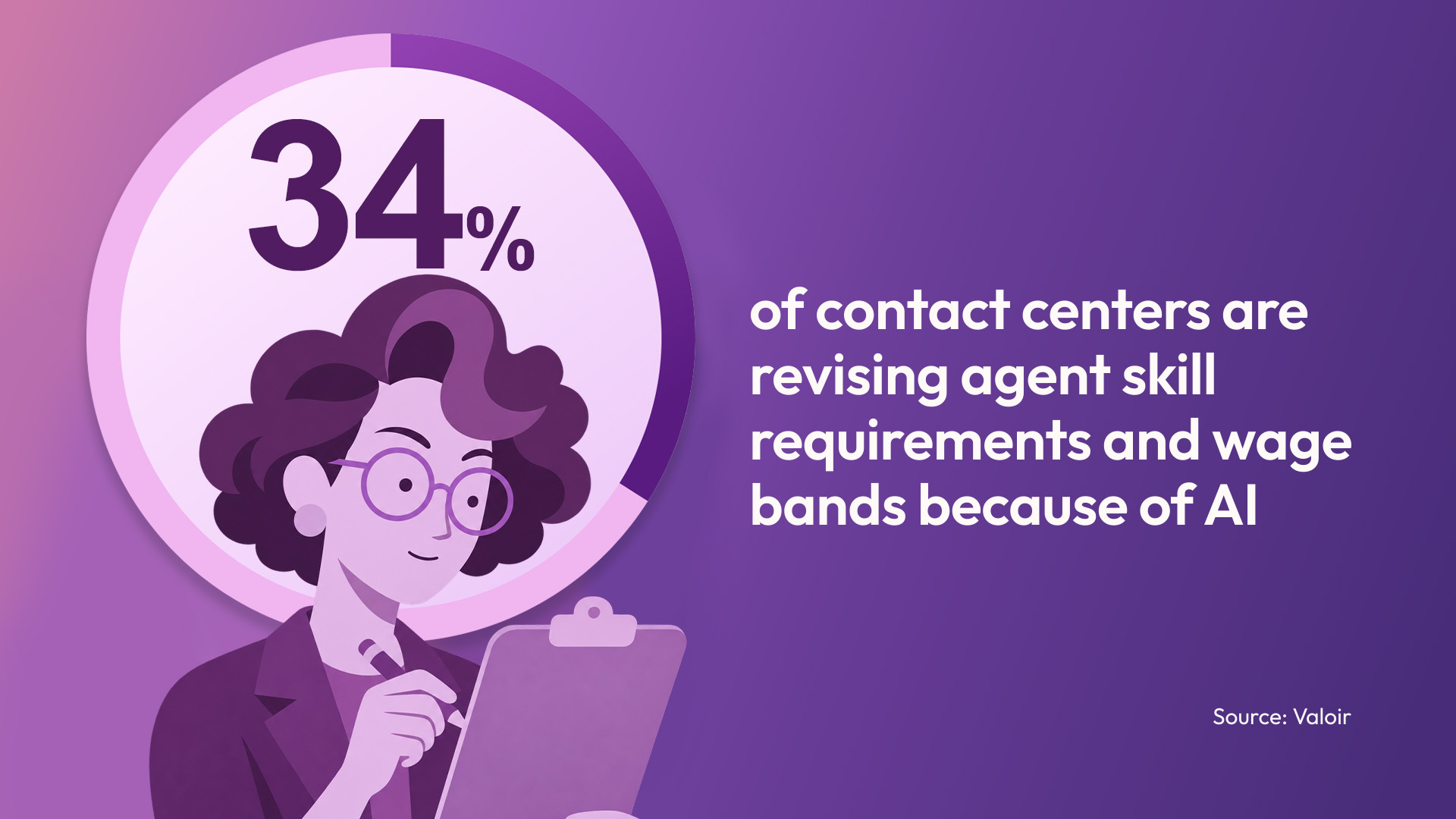
Additional emphasis on soft skills, such as empathy and reassurance, is likely a priority as agents handle increasingly complex, sensitive, and unusual customer needs.
Similarly, coaching agents to take ownership of customer issues also becomes key, so they ease the customer’s burden, develop connections, and deliver the full value of a human touch.
Yet, alongside these skills, others are emerging. For example, AI fluency is critical, as agents must be comfortable working with AI-supported knowledge, information, and performance tools.
At the same time, they must remain cautious, combining technology with human judgement to make the best possible decisions for the customer.
Finally, consider how the broader support strategy is changing.
Many brands are taking a proactive approach to customer engagement. Some are shifting human agents toward outbound interactions, using AI to detect potential issues, and alerting agents to reach out before customers make contact. Others are using AI to identify and flag upsell opportunities during live calls.
Such strategy shifts also require a fundamental rethinking of not only skills, but performance metrics and salaries.
7. New Performance Visibility
Since the advent of automated QA, many contact centers have moved to analyze 100% of customer interactions.
Now, more service teams are strategically sharing that data with human agents, giving a personalized view of strengths, development opportunities, and trends in their work.
“Agents need to see their own performance, understand the feedback, and have the opportunity to respond to it.”
Ultimately, this view is a motivational tool that reconnects agents with critical performance outcomes and inspires better-informed coaching conversations.
However, this is an art form. As Geoghegan warns, agents must trust how the technology evaluates their performance. If AI-generated scores feel inaccurate or unfair, confidence and engagement can suffer. Therefore, agents must be able to push back.
Moreover, too much negative feedback can demotivate agents. Behavioral scientists suggest a ratio of five positive comments for every negative comment is a good mix, and teams can optimize their quality management solution to deliver a similar combination.
8. New Customer Context
Customer context is often scattered across the organization. Indeed, the average service organization only has 58% of customer data available in a single view, despite supporting 20 different integrations.
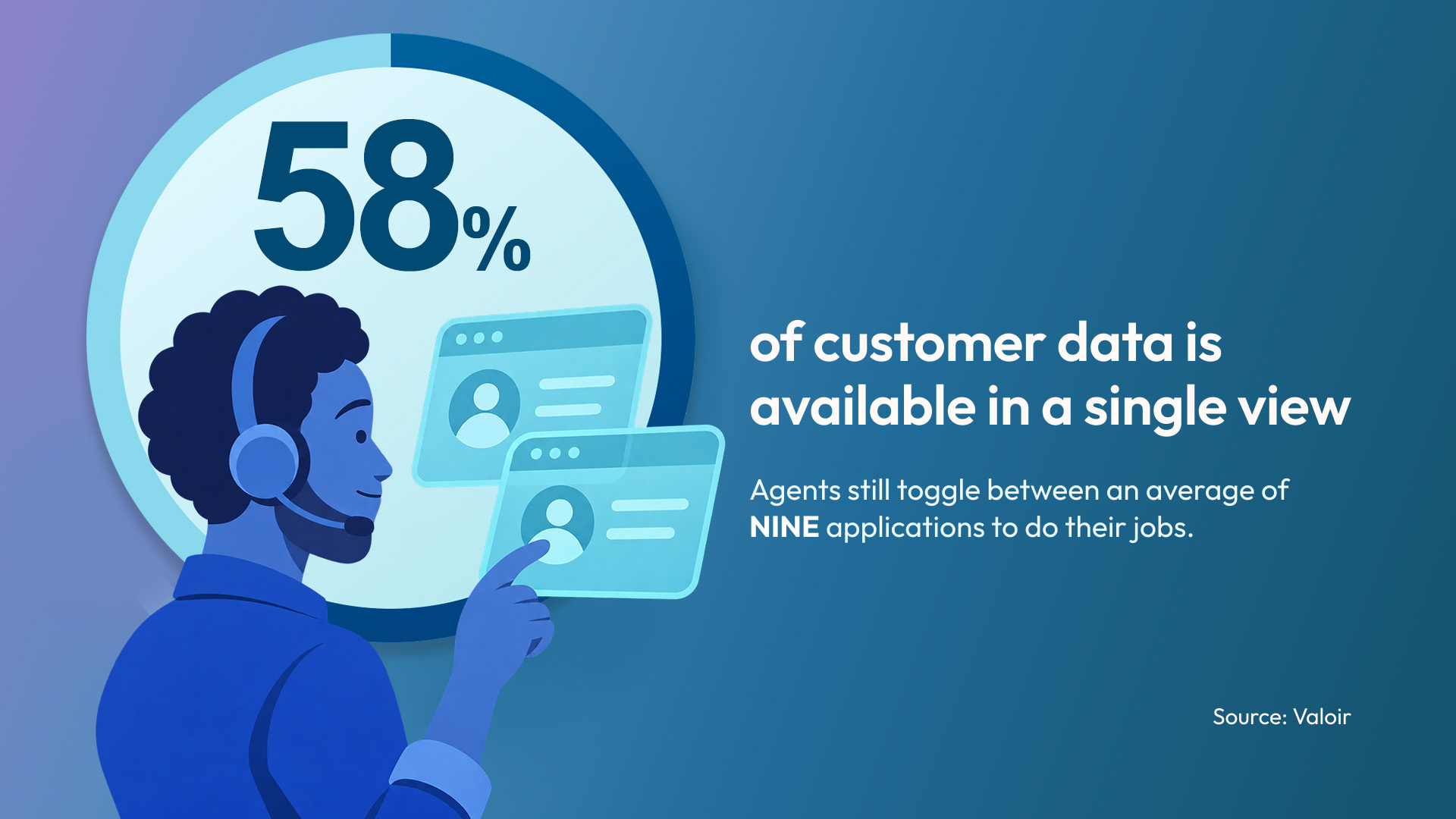
In the past, that has slowed support teams down, and agents still toggle between an average of nine applications to do their jobs.
Thankfully, this may soon start to change, freeing up and surfacing more customer context. There are three trends colliding here:
- System Consolidation: New integrations between Contact Center as a Service (CCaaS) solutions, such as NiCE and Genesys, and CRM platforms, including Salesforce and ServiceNow, see the former embedded into the latter. As a result, contact centers can consolidate around one primary interface for customer service.
- Headless Solutions: Agent Assist solutions will likely evolve so contact center agents can pull data from different systems and perform actions within them using only natural language instructions. That’s the premise of the current “headless” technology chatter.
- Memory: Some contact centers are building a memory layer to capture the reasoning behind decisions, adding more data to the customer’s system of record. Firstsource’s Intelligent Context Framework is an excellent example.
On the latter, Geoghegan summarized: “The context frameworks we’re working on are a way to figure out what the future might look like if you can plug the gaps that exist in systems today.” That supports not only human agents, but AI agents, too.
9. New Partnerships
More contact centers are partnering with other departments to collaborate in new ways and achieve shared objectives.
Perhaps the most common example is teaming up with sales to capture customer expansion opportunities that show up in customer support conversations.
Many contact centers also align with marketing on campaigns, isolating the new conversation types they generate and how the contact center can best convert them.
Yet, some organizations are going further.
For instance, OVO uses a “pod model” to organize cross-functional teams around customer experiences, ensuring people take shared responsibility for the outcome.
“We organize teams around customer experiences rather than our kind of functional design. We know that our customers don’t really care who’s doing the work behind the scenes. They just want to have a seamless, easy experience with us and have their problem solved.”

In establishing this model, OVO recognized how contact centers affect the success of field service visits. For example, if an agent misses that the customer needs specialist equipment, the job fails, and a costly reschedule is required.
To bridge the gap between the field and the contact center, OVO uses Centrical to turn engineer feedback into learning and support modules for the contact center team. This ensures that insights from field operations continuously inform and improve customer conversations.
10. New Support Channels
Historically, contact centers set up channels on Microsoft Teams or Slack so agents could seek subject matter expert (SME) support from across the business.
Now, organizations are integrating these collaboration tools directly with the contact center.
That enables “swarming,” where the contact center agent can either offload the entire customer contact to an SME or just pass over case details, enabling better-informed real-time guidance.
As contact center queries become more complex, these channels become increasingly critical, as does the ability to mine conversations for insight into how SMEs solve queries. After all, that intelligence can inform new knowledge content.
11. New Support Tools
Agent Assist first came to market as a tool that monitored customer conversations and surfaced relevant knowledge content in real time to inform the agent’s next steps.
Now, it’s effectively becoming a Swiss Army Knife, supporting agents in many new ways.
For instance, it’s transferring context from AI agents, drafting responses across digital channels, and auto-generating conversation summaries for the CRM.
However, what comes next is perhaps most exciting.
As noted previously, the enterprise technology ecosystem is becoming increasingly “headless.” That means that employees can pull data from and complete tasks across different tools through one interface.
In the future, Agent Assist is likely to become that interface. Therefore, agents will be able to request data and perform cross-platform actions via natural language commands.
Yet, go back to the technology’s first use case: recommending next best steps.
Now, consider a solution that not only recommends the next step but offers to fulfill it via the natural language interface, with the agent approving the action.
Fundamentally, that could transform the human agent role.
The Bottom Line: The Contact Center Is Changing, and So Is the Agent Experience
Customer service experiences are changing, and the employee experience is an integral part of that transformation.
Organizations making progress recommend involving employees in solution design, giving them visibility into their performance, and empowering them to take ownership of their own development.
For these organizations, the next step may be a formalized workforce orchestration strategy.
In an eBook, CX Foundation recently outlined what such a strategy looks like, including more insights from many of the industry experts featured in this article (and others).
Download it here: The Ultimate Guide to Workforce Orchestration