
April 13, 2026 • 5 min read
Contact Center Agents Still Use an Average of Nine Applications to Do Their Jobs

Director of Content & Market Research
April 13, 2026
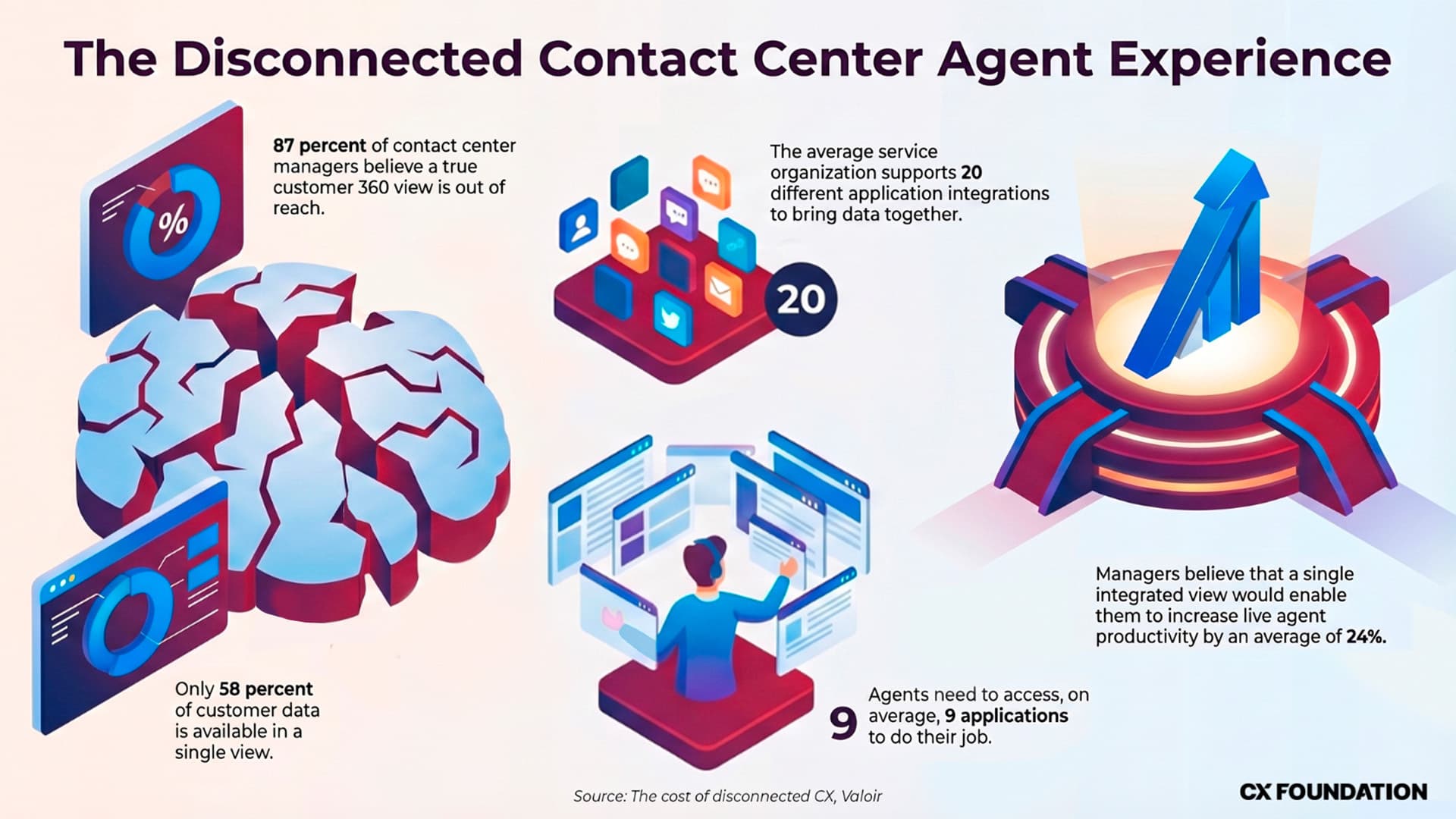
A true 360-degree view of the customer has long been held up as the gold standard in contact centers, but for most, it still feels out of reach.
In fact, 87% of contact center leaders believe it’s unattainable, according to new research from analyst firm Valoir.
Its study also found that the average service organization has only 58% of customer data available in a single view, despite supporting 20 different integrations.
As a result, contact center agents, on average, still switch between nine applications to get their work done.
Ultimately, that adds a “toggle tax”, slows resolutions, and limits the scope for AI & automation.
Over the years, contact centers have learned to live with the burden of disconnected data, relying on human agents to ‘swivel chair’, finding the right systems and piecing together information.
However, AI is now making those gaps impossible to ignore.
“For AI to be effective, it needs data to ground it, and that data can’t be conflicting. It has to be consistent and current,” said Rebecca Wetteman, CEO & Principal Analyst at Valoir.
“What I’ve seen with early AI efforts is that they’re exposing the holes, inconsistencies, and disconnected data across organizations… For AI to work effectively, and for humans to be more productive, we have to start closing those gaps.”

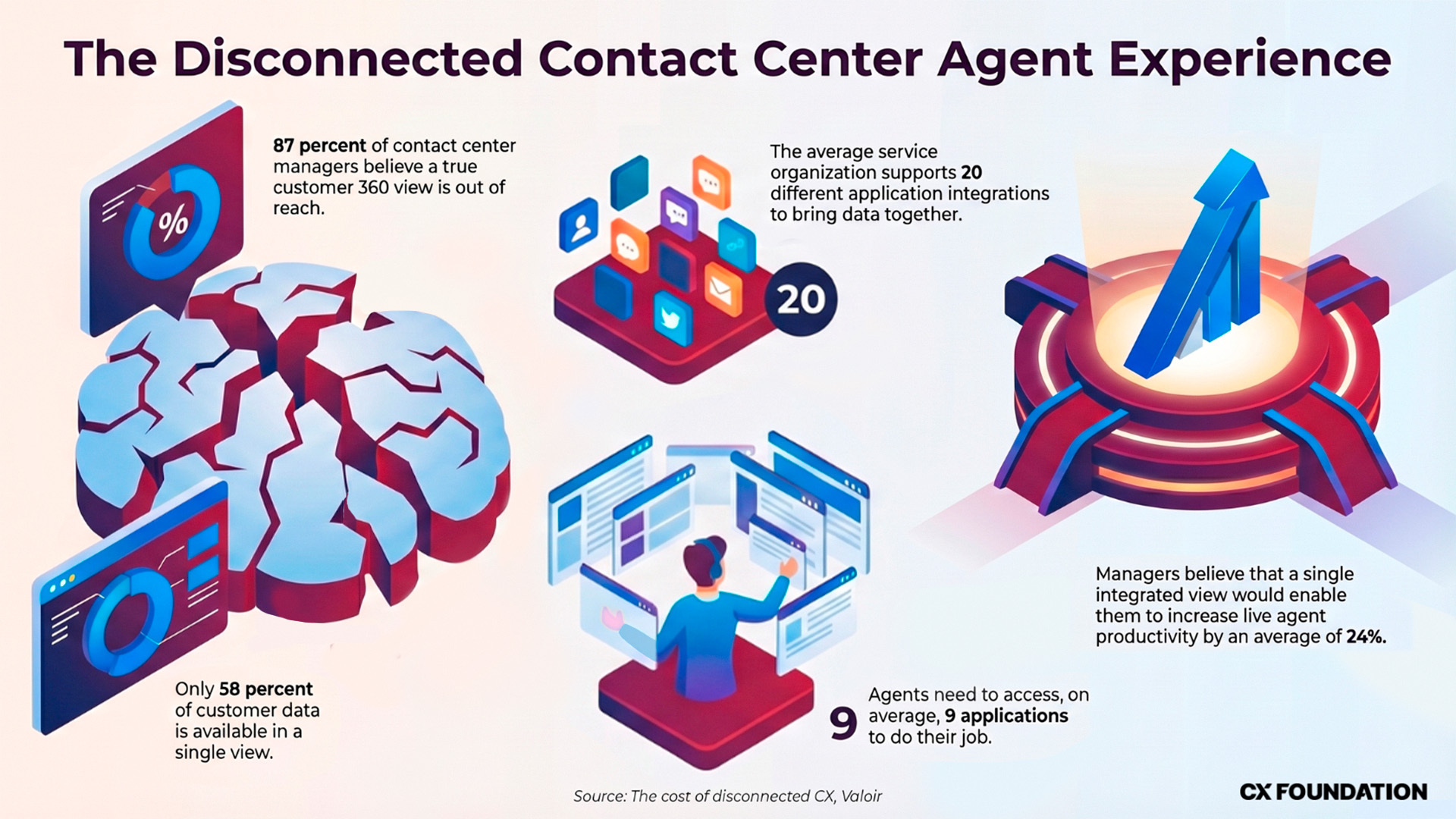
On average, contact center leaders estimate live agent productivity would surge by 24% if they could close those gaps and consolidate a single customer view.
While that may seem like a distant prospect, many leading contact center tech providers are striving to support service leaders in taking steps forward. That starts with unifying their CCaaS and CRM environments.
Addressing the CCaaS-CRM Disconnect
The two primary applications agents toggle between are the contact center and CRM platforms.
These technologies didn’t evolve together, and, over time, as organizations added more channels, data has become increasingly scattered across them.
Some CCaaS providers have started embedding their core telephony, call control, and routing technologies into CRM systems to tackle this issue.
For instance, in February 2026, Cisco announced the Webex Contact Center for ServiceNow.
However, several CRM providers have shifted into CCaaS, bidding to own the interface outright.
For instance, Microsoft released a CCaaS solution within the Dynamics 365 ecosystem in 2024, delivering one shared data model and no middleware.
Zendesk soon followed suit, with its acquisition of CCaaS provider Local Measure, before Salesforce launched the Agenforce Contact Center in March 2026.
Yet, CCaaS providers are making moves of their own. For instance, Genesys has announced native case and journey management inside Genesys Cloud CX.
Elsewhere, AWS has customer profiles inside its Amazon Connect solution, which pull in an individual customer’s data across enterprise systems.
As a result, the lines are becoming increasingly blurred, leaving businesses with a tricky decision as they work toward a single-pane-of-glass customer view: which platform should serve as their primary interface for service? Once that’s defined, they can partner with their chosen provider and build around it.
Pulling More Data Into the Contact Center Agent’s View
Critical data to solve customer queries often sits outside the core contact center or CRM platform. That includes inventory, pricing, finance, and billing data.
Such data enables agents to inform customers about available stock, assess their credit risk, check for upcoming bills, and carry out various other tasks more efficiently.
Yet, while it can significantly improve customer interactions, that data is too often stuck inside supply chain or finance systems, beyond the reach of human and AI agents.
“From the 60–70 companies I’ve spoken with over the past year that use Salesforce and Agentforce, only one was integrating ERP data.”
Ultimately, organizations need more guidance from their vendors on how to start utilizing data from such systems within agent workflows.
“That clarity will have to come, because customers and partners need to understand exactly how these solutions fit together,” said Wetteman.
Innovations to Simplify Live Agent Experiences
Alongside tricky integration work, there are other actions contact centers can take to streamline agent experiences and lower toggle tax.
For example, agent-assist solutions can fetch information from the knowledge base in real time, so the service agent doesn’t search for it themselves.
There are also innovations like the Google ChromeOS Desk Connector, which organizes an agent’s apps and browser tabs into dedicated “desks” for each customer interaction. That makes it easier to manage multiple cases without constantly switching between windows.
The HERE Enterprise Browser is a similar innovation deployed by contact centers.
However, these connectors aren’t widely implemented, and agent assist adoption has proven slower than many vendors anticipated.
A major factor in this is that contact centers tend to have slower innovation cycles than other parts of the enterprise, even those that have shifted to the cloud.
Why? Because contact centers are hesitant to make changes, given that their systems need to run 24/7 with high reliability or risk fracturing customer relationships.
As such, a single customer view still feels a world away for most contact center leaders, and the AI gains that many tech leaders prophesied will likely take longer than first anticipated.
More on Valoir’s Research
Valoir surveyed more than 150 contact center and customer service managers based in North America to generate the statistics shared in this article.
Download its full report here: The cost of disconnected CX