June 17, 2026 • 4 min read
59% of Contact Centers Have No Plans to Reduce Headcount Despite Rising AI Adoption

Director of Content & Market Research
June 17, 2026
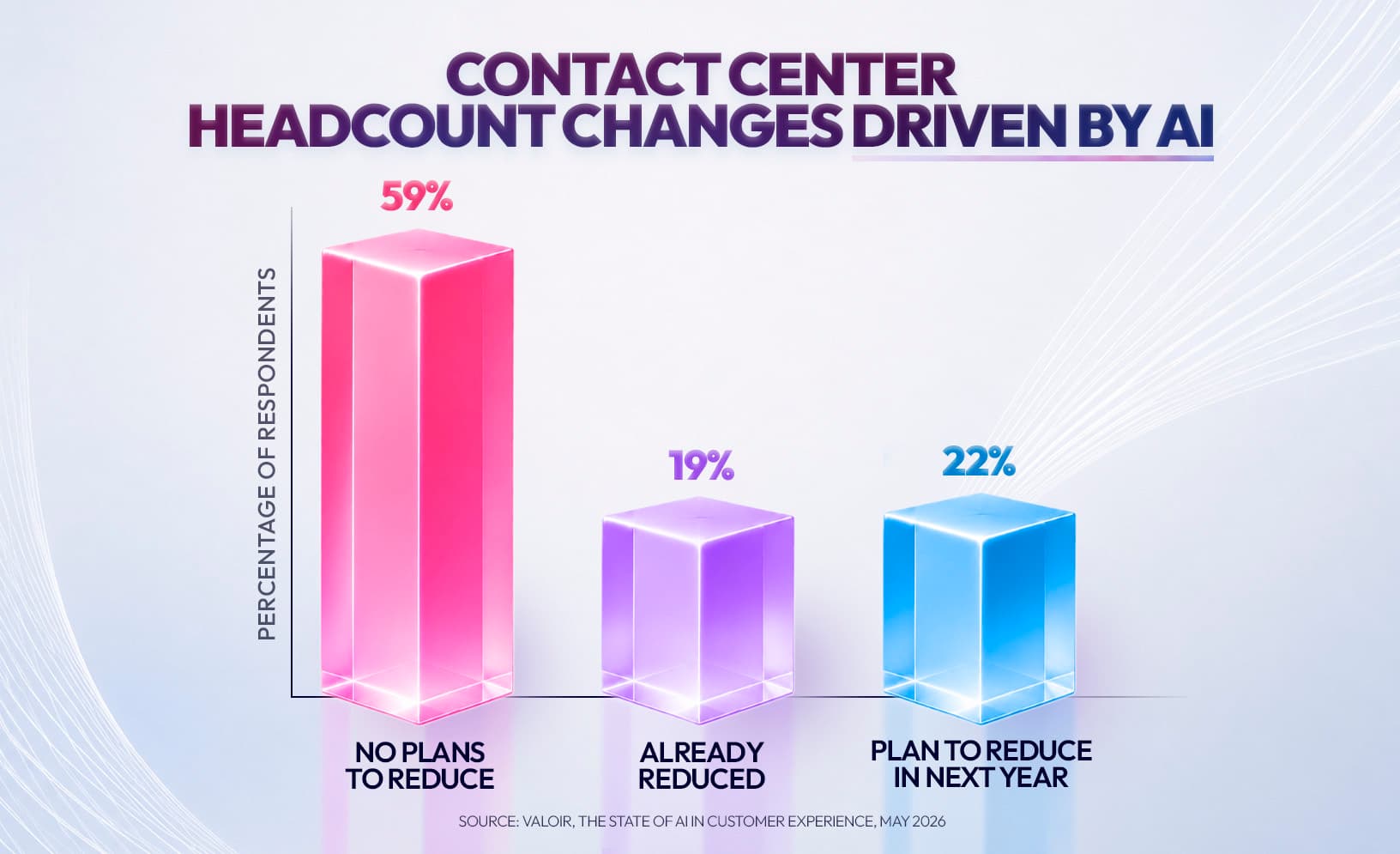
Almost three in five contact centers (59%) have no plans to reduce headcount despite growing AI adoption.
That's according to a new study from research firm Valoir, which found that only 19% of contact centers have reduced staff so far, whether through natural attrition or layoffs.
The findings come even as AI has become almost ubiquitous in the sector.
Indeed, some 95% of contact centers have deployed at least one AI or automation capability, including 61% that now use AI agents for self-service. Meanwhile, many others still utilize more traditional chatbots.
Nevertheless, for most organizations, headcounts remain stable, and they don’t expect that to change anytime soon.
Why Are Contact Center Staff Numbers Staying (Mostly) Steady?
Valoir's study identifies data integration as the biggest obstacle to building AI agents capable of meaningfully reducing contact center demand, ranking ahead of cost, ecosystem limitations, and trust concerns.
As the research firm notes: "The technology may be ready, but many organizations are not."
To this point, many contact centers are still using older AI playbooks, automating legacy processes rather than reimagining service experiences.
Organizations relying on global service providers or legacy BPOs to lead their automation strategies are especially exposed to this risk.
Why? Because these partners often fixate on costs rather than redesigning new, more efficient journeys that blend modalities to unlock AI's full transformative potential.
To put it another way, when costs come before experience, contact centers can end up just making inefficient processes faster.
Nonetheless, while the lack of customer experience redesign is a possible explanation for why so many brands have no plans to reduce their human FTE (Full-Time Equivalent), it is just one of several.
Beyond Valoir's findings, some contact centers, long plagued by understaffing, may use this moment to raise service levels and strengthen the customer experience.
Additionally, customer experience leaders who have successfully implemented AI may redefine customer support roles instead of jumping straight to headcount reductions.
Customer Journey Orchestration & New Support Roles
The most mature contact center teams don’t apply AI everywhere possible; they invest in customer journey orchestration.
In doing so, they first identify failure demand and collaborate with other teams to remove those contacts altogether, not just automate them.
From there, they reconsider the contact center’s demand profile, the customer’s desired outcomes across intents, and where an AI- or human-led experience is best placed before orchestrating that experience.
While this may, over time, reduce staffing requirements, contact centers can also redeploy staff into emerging support and success roles. For instance, they might proactively reach out to at-risk customers to salvage relationships with a human touch.
New CX metrics, such as predicted customer churn, can be powerful in guiding such initiatives.
Additionally, some contact centers are evaluating their demand profile and asking: what conversations are we not currently having with customers that we should be? That question is opening new opportunities for human service reps to contribute and add value.
When this happens, the contact center becomes the revenue engine it was always touted to be.
Preparing Service Teams for New Support Roles
Unfortunately, new roles demand new skills, training programs, and compensation structures. That’s a significant added burden for service leaders already under intense pressure to implement AI.
As such, while the development of new customer support roles is exciting, it is not yet the norm.
That’s evident in Valoir’s data. It shows that just one in five contact centers has updated its compensation structure to reflect the shifting demands on customer support teams.
Meanwhile, only 30% have adapted their performance metrics.
Such statistics underscore how contact centers still have significant strategic work ahead, not only in deploying AI but also in preparing for its broader impact.
“The good news is that the time to onboard and train agents is accelerating, and entry-level agents with AI assistants can manage more complex tasks. The bad news is that few organizations have really repriced those entry-level agent jobs yet or accounted for the fact that handling more complex work means more potential burnout, and more need for managers to focus on agent experience and well-being.”

More on Valoir’s CX Study
The findings from Valoir’s study draw on a survey of more than 150 contact center leaders across North America, spanning a range of industries and company sizes.
To add color to the data, the research firm also interviewed 20 contact center managers across the continent and Europe.