
February 9, 2026 • 26 min read
11 CRM Vendors & What Differentiates Them in 2026

Director of Content & Market Research
February 9, 2026
The CRM market is in a state of flux. Embedded AI agents, changing pricing models, and a reinvigorated customer success function are challenging the status quo.
Meanwhile, providers are still battling the challenges of old, with data quality a particularly thorny issue, across sales and marketing especially.
Some CRM vendors are rising to the occasion and driving market innovation. Others are more cautiously slogging on.
The following analysis highlights the leading CRM vendors and emerging players, examining how their strategies are evolving and spotlighting their key strengths.
The 11 CRM Vendors
Each of the following CRM vendors offers a cohesive platform rather than standalone solutions for sales, service, marketing, or commerce. That excludes major players like Adobe and Zendesk, which primarily focus on marketing and customer support, respectively.
1. Salesforce
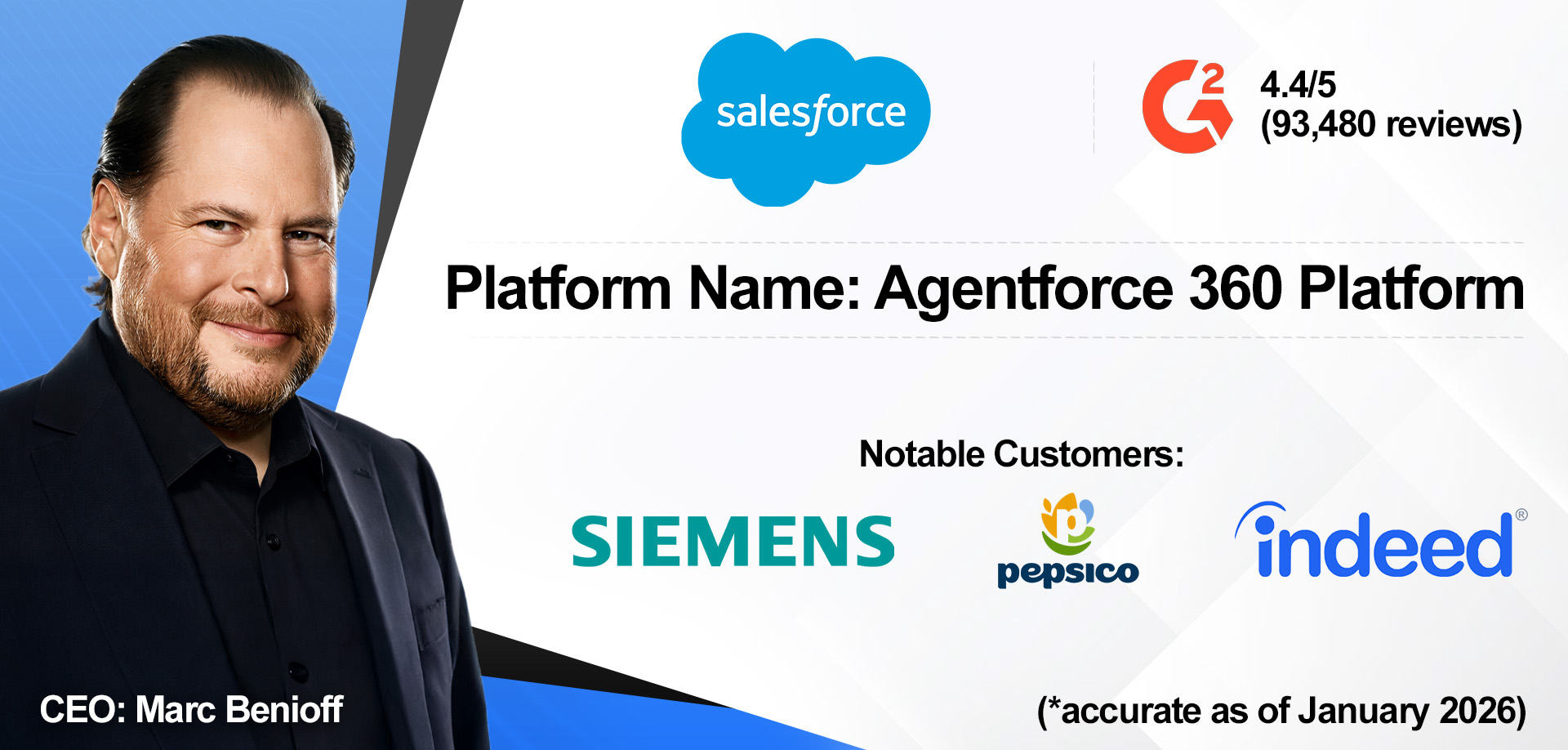
Salesforce has strengthened its CRM proposition by tightly linking it to backend systems through Data Cloud, now Data 360. As a result, customers can more easily combine both internal customer, product, and service data, as well as external data.
The vendor’s zero-copy approach supports this, enabling secure access without data movement, lowering risk and cost, and providing a solid enterprise foundation.
In line with its data strategy, Salesforce is thinking beyond traditional CRM pipelines.
Instead of lead-to-opportunity-to-case, it’s focusing more on the account lifecycle and customer lifetime value (CLV). Essentially, that brings sales, customer success, and support into a shared planning model, looking at revenue projections per account, churn risk, and expansion potential holistically.
While that’s an exciting prospect, Salesforce recognizes that its customers built their environments years ago in ways that aren’t optimized for this transition away from traditional CRM and AI agents.
So, expect more prescriptive guidance into how to architect specific clouds properly, what to fix first, and how to prepare for AI. It’s already starting to do this via its Industry Clouds and tools such as My Service Journey.
“Salesforce is in a position where it has to continue expanding its market and proving value in the AI era. What’s interesting is how they’ve adjusted their messaging. They’ve moved away from a broad “Agentforce can do anything” narrative toward a clearer focus on jobs to be done within its CRM ecosystem and beyond.”

Standout Features
- Data-First CRM Architecture: Salesforce tightly connects its CRM apps to backend systems via Data Cloud (Data 360), enabling secure, zero-copy access to internal and external data, lowering risk, reducing costs, and positioning CRM as a data-driven platform.
- Enhanced Focus on Revenue Optimization: Salesforce is shifting CRM beyond linear pipelines toward a holistic account lifecycle view, bringing sales, customer success, and support into shared planning around customer lifetime value, churn risk, and expansion, creating a stronger foundation for growth-focused AI.
- Advancing Customer Success Efforts: Via its Industry Clouds, Salesforce is delivering more pre-tested workflows, standardized data models, and harmonized architectures, reducing complexity and accelerating AI adoption while leveraging its extensive partner and integration ecosystem.
How Much Does It Cost?
Salesforce Starter, which includes an all-in-one suite of marketing, sales, service, and commerce tools, is priced at $25 per user, per month. Meanwhile, Salesforce Pro costs $100 per user, per month. Additional plans, which include resources, guidance and technical support are available upon request. Find the full Salesforce CRM pricing breakdown here.
2. ServiceNow
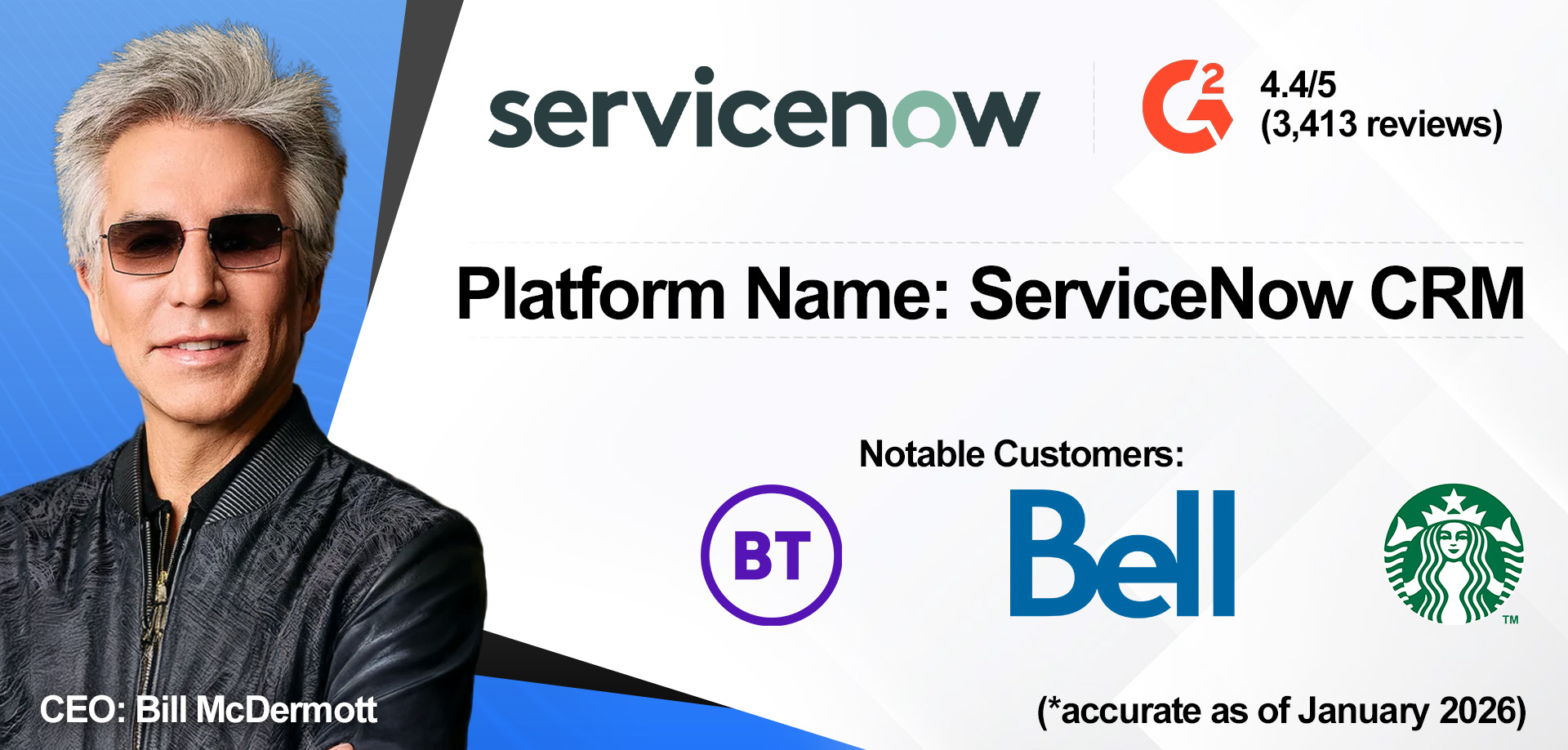
ServiceNow understands how work gets done across an organization, supporting brands as they orchestrate end-to-end processes that flow across CRM and other enterprise applications.
These processes help draw a massive amount of backend data into the CRM solution and power a more data-rich experience.
While some may tag it as a more complex option, ServiceNow pre-packages industry and core workflows to reduce risk and speed up time to value.
Crucially, these industry workflows also help reduce the long-term footprint required to support the platform because there’s less custom code to maintain.
Also notable is how ServiceNow doesn't have an in-house marketing CRM application, instead working closely with Tenon as a third-party provider. However, it does uniquely offer order management alongside customer support and sales within ServiceNow CRM.
While most brands have to integrate to their CRM for this, order management has proven a strong wedge for ServiceNow to expand deeper into CRM.
“ServiceNow’s advantage is the massive amount of backend data and deeply embedded workflows. They understand how work gets done across an organization and how to orchestrate end-to-end processes.”

Standout Features
- Workflow Orchestration: ServiceNow excels at mapping and automating complex, end-to-end enterprise workflows. In doing so, it coordinates work between staff (human and AI), departments, and systems, reducing friction and improving efficiency across both customer-facing and back-end processes.
- Industry-Focused Solutions: Through pre-packaged, tested industry workflows, ServiceNow helps customers go live faster while minimizing custom code and long-term maintenance burdens. Its strong capabilities in order management and other critical functions enable the company to expand beyond traditional CRM and into full customer lifecycle management.
- Platform Extensibility: ServiceNow’s platform is highly extensible, allowing it to coexist with existing CRM, CX, and IT tools while gradually replacing legacy systems. This flexibility enables organizations to adopt ServiceNow incrementally without disrupting existing processes.
How Much Does It Cost?
ServiceNow doesn’t make CRM pricing publicly available. Prospective buyers can request a quote for the ServiceNow CRM platform here.
3. Microsoft
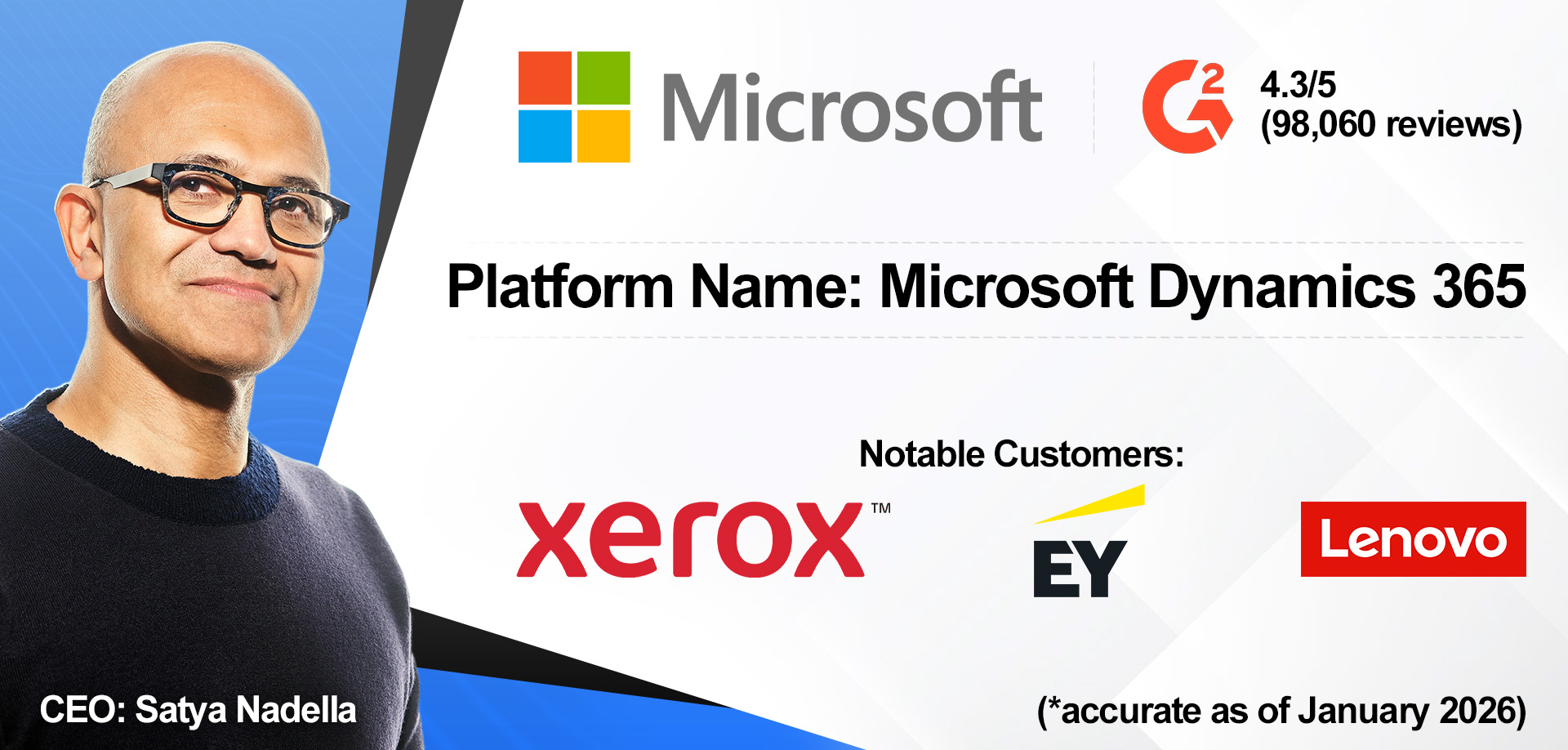
As with all of Microsoft’s enterprise software, Dynamics 365 stands out for its ecosystem. Microsoft Office, Teams, Power BI, and Copilot all work together, allowing organizations to extend capabilities beyond the core system.
Such extensibility also makes adoption easier for employees who are already familiar with Microsoft tools and using them within their daily workflows.
Additionally, Dynamics 365 offers low-code/no-code development tools for semi-technical staff.
Meanwhile, Power Apps, alongside Microsoft’s extensive network of third-party independent software vendors (ISVs), allow organizations to create their own CRM extensions and industry-specific variations. All this adds to the platform's flexibility.
Regarding its partner network, Dynamics 365 benefits from its ecosystem of not just ISVs, but value-added resellers, which enable extra options for customization and deployment.
For businesses with unique operations and processes that require custom extensions, Microsoft can deliver through this ecosystem and flexibility.
As a result, it often appeals to enterprises with the luxury of a technically sophisticated IT team. Yet, businesses that are already “Microsoft shop” may also isolate Dynamics 365 as their preferred CRM software.
“Microsoft positions itself as a platform. Rather than offering fully packaged CRM solutions, they’re enabling internal development teams to build customized solutions.”
Standout Features
- Microsoft Ecosystem: Dynamics 365 works smoothly with Microsoft Office, Teams, Power BI, and Copilot, making it easier for employees already familiar with these tools to adopt the CRM and extend capabilities beyond the core system.
- High Flexibility and Customization: Low-code/no-code tools, Power Apps, and a broad network of third-party ISVs enable organizations to build custom extensions, industry-specific variations, and tailored workflows to fit unique business processes.
- Partner and Support Network: Dynamics 365 benefits from a broad ecosystem of ISVs and value-added resellers, providing multiple options for implementation, customization, and deployment, especially appealing to enterprises with technically sophisticated IT teams.
How Much Does It Cost?
Microsoft offers its Dynamics 365 CRM apps individually, each with a free trial. Pricing for Dynamics 365 Sales ranges from $65 to $150 per user, per month, while Dynamics 365 Customer Service starts at $50 and goes up to $105 per user, per month. Dynamics 365 Customer Insights (formerly Marketing) is priced at $1,700 per tenant, per year. For a detailed breakdown, explore the full Microsoft Dynamics 365 pricing here.
4. Oracle
Oracle wins customers with the message: all your data lives here, so CRM and AI should too.
By owning the full stack, Oracle positions CRM as the front-end of a much broader data and process ecosystem.
As AI agents come to the fore, that positioning pays off as CRM agents have access to a breadth of cross-departmental data that can support them.
Consider a use case where an AI agent informs customers exactly when a product will arrive, based on real-time ERP and supply chain data. That’s high-friction, high-value work today, yet Oracle is uniquely positioned to deliver it out of the box.
Also, Oracle doesn’t charge separately for AI, it’s part of the subscription, which is attractive for enterprises concerned with the costs of scaling.
Lastly, Oracle is getting its customers hooked on outcomes. Consider its embedded, role-based AI agents that hone in on what needs to be done and what value it delivers.
Once those agents become part of the CRM architecture the overall enterprise relationship deepens, customers are less likely to leave, and - ultimately - contracts grow at renewal.
“Oracle’s advantage is Fusion, all applications on OCI (Oracle Cloud Infrastructure), with data already harmonized. That’s powerful.”

Standout Features
- Stack Ownership: Oracle controls the cloud infrastructure and ERP, allowing CRM to integrate closely with broader business processes and data. As a result, the vendor may offer a more data-rich CRM experience.
- Harmonized Data: By enabling pre-harmonized data across its Fusion applications, Oracle can offer pre-packaged, high-value AI agent use cases, like real-time order management with supply chain visibility, directly within CRM.
- AI Without Extra Cost: The role-specific agents in Fusion Cloud come at no additional cost to the subscription, helping brands accelerate their initial AI agent efforts. Custom-built agents are also available on a consumption-basis.
How Much Does It Cost?
Oracle Fusion Sales Enterprise Cloud costs $150 per user per month. Service Cloud is priced at $200–$225 per named user, while Marketing Orchestration runs about $50 per unit per month. The CPQ base application costs around $240 per hosted named user per month. Enterprise deals often include significant discounts. See the full Oracle Fusion Cloud pricing here.
5. SAP
SAP’s core strength is its ERP data footprint. Its CRM benefits from that deep operational data, which is especially valuable for companies dealing with physical goods and complex supply chains.
The company is looking to further leverage its footprint by creating AI Assistants in Joule, which align with the user’s role, the applications they leverage, and the data they tap.
Over time, as the assistants’ learn and their confidence grows, they can begin handling tasks autonomously across the CRM and SAPs many other applications.
With this strategy, SAP can keep its legacy tools relevant and usable, supporting its bid to remain a prominent figure in the CRM market.
Still, these legacy tools are usually part of a fragmented environment, with customers slowly transitioning onto newer SAP instances. While much of the vendor’s effort appears to be on supporting these customers, it’s still figuring out exactly where CRM fits in its long-term vision.
Nevertheless, given how deeply embedded SAP is in enterprise environments, the message can effectively be as simple as: it’s not worth the effort to rip us out.
Standout Features
- Deep Operational Data Integration: SAP’s CRM leverages its extensive ERP footprint, giving companies with complex supply chains and physical goods strong visibility into operational data, which they can blend with experience data for a deeper customer view.
- Enterprise Footprint: As it modernizes legacy enterprise environments, SAP can stitch CRM into a much broader tapestry that pulls together CRM, ERP, and AI, which may expand over time.
- AI Assistants in Joule: SAP is venturing into the world of personalized AI where copilots learn how individuals complete tasks and imitate them to help automate processes. In environments like customer service, having AI copy the company’s best support reps in this way could be powerful.
How Much Does It Cost?
SAP Sales Cloud and Service Cloud are available from $112 per user, per month. However, cheaper, more limited versions are available. Brands must contact SAP directly to get a quote for Marketing Cloud. Request a demo and quote for SAP’s CX and CRM solutions here.
6. Zoho
Zoho has breadth, a common data core, and now Zia AI agents running across the platform. But what’s perhaps most interesting is how it has redefined CRM.
Notably, the company doesn’t see CRM as just for sales, marketing, and service. Instead, it treats it as a system that everyone in the organization interacts with, whether they’re in finance, legal, accounting, operations, etc.
In doing so, Zoho gives each role a tailored view into customer data without charging everyone a full sales license or overwhelming them with irrelevant information. That reframes CRM as a true enterprise application.
Back to Zia, Zoho’s conversational AI assistant. It's helping to connect breakdown siloes between the 45+ apps with Zoho One, which Zoho CRM is a part of, so data and workflows span applications.
This is easier for Zoho than most, since it owns the proprietary cloud infrastructure that runs all its apps, which also helps to keep costs down.
Lastly, Zoho doesn’t need to win the enterprise right now, and that’s a strength. It’s a global CRM vendor, deeply entrenched in emerging markets, and able to serve SMBs and mid-market organizations well.
“Zoho is effectively offering a unified business desktop at a very attractive price. Its approach simplifies deployment, improves collaboration, and makes AI immediately useful across the organization.”
Standout Features
- CRM as an Organization-Wide System: Zoho treats CRM as more than sales, marketing, and service, giving every department a custom view of customer data, making CRM a true enterprise application.
- SMB and Mid-Market Focus with Scalability: The vendor excels in serving small and mid-sized businesses globally, especially in emerging markets, while also demonstrating enterprise-scale capabilities when needed.
- The Broader Zoho One Infrastructure: Zoho unifies its apps within Zoho ONE on a common platform, simplifying data flows and processes across functions. It will also make cross-function agentic AI flows more practical and reduce deployment complexity.
How Much Does It Cost?
Zoho CRM is free for up to three users. From there, brands can choose from four separate offerings: Standard, Professional, Enterprise, and Ultimate. These cost $14, $23, $40, and $52 per user, per month, respectively. Discover more about Zoho's CRM pricing here.
7. HubSpot
Like Zoho, HubSpot’s sweet-spot is the SMB and midmarket space, with a well-aligned pricing strategy that combines “core” and “view-only” seats. That strategy makes its Smart CRM accessible for small teams, with AI layered in through consumption.
Thanks to this approach, HubSpot stops startups from competing on price or ease of use.
Alongside its pricing model is a reputation for delivering rock-solid applications. In 2025, for example, it announced a Data Hub, recognizing the need for a practical place where structured and unstructured data can come together within its CRM ecosystem.
HubSpot’s pragmatic approach is also evident in its AI strategy, considering AI as an assistant, built directly into the platform to support practitioners in their daily work. It’s not blue-sky thinking; it’s focused on eliciting specific outcomes.
Last year, HubSpot also became the first CRM vendor to announce an integration with ChatGPT, allowing its customers to pull data into the large language model (LLM) for analysis.
Like its other innovations, this all comes back to what people expect from HubSpot itself: pricing, structure, affordability, and AI where it fits.
Standout Features
- SMB-Aligned Pricing: HubSpot’s pricing model, which combines core and view-only seats with AI delivered via consumption, helps small and midmarket teams manage costs and act on a unified view of customer profiles.
- Reliable Product Execution: The company has a robust reputation for delivering practical applications, exemplified by launches like the new Data Hub, which addresses real customer needs by unifying structured and unstructured data within its Smart CRM.
- Outcome-Driven, Embedded AI Strategy: HubSpot treats AI as an assistant built directly into day-to-day workflows, focusing on specific practitioner outcomes rather than hype.
How Much Does It Cost?
The professional edition of Smart CRM is available at $45 per core seat, per month. The Enterprise version costs $75 per core seat, per month. Companies can unlock the price of “view-only” seats by talking to HubSpot’s sales team. Discover the full pricing and packaging for HubSpot Smart CRM here.
8. Pegasystems
Many industry observers pigeonhole Pegasystems as a CRM, workflow automation, or low-code platform provider. In reality, it blends all three, and it’s that combination that sets it apart.
Don’t think of it as a conventional CRM provider. Instead, it provides an operational center point to make decisions, with CRM, workflows, and low-code apps to apply those decisions consistently across customer-facing functions and the broader enterprise.
Effectively, that center point becomes the brain, where - instead of having disconnected campaigns flying past each other - it aims to make decisions based on what’s best for the customer and the business.
Another misconception of Pega is that it’s a marketing-orientated CRM. Yet, its service proposition is robust, not just in customer service but enterprise service management (ESM).
Like Salesforce and ServiceNow, it can unify customer, IT, and HR service, draw insights from these interactions, and integrate voice of the customer and voice of the employee feedback, consolidating a single view of shareholder priorities.
Finally, Pega Blueprint is a unique, exciting solution. It helps customer and IT teams accelerate transformation projects by visualizing new processes, like a next-best-action strategy, and articulate their value to stakeholders.
Standout Features
- Center-Out Decisioning: Pega’s center-out approach creates a single “decisioning brain” that applies consistent, real-time decisions across channels and teams. Instead of disconnected marketing, sales, and service CRM campaigns, this allows organizations to align around shared objectives.
- Unified Service & Case Management: Pega’s strength in enterprise service management extends across customer, IT, and HR service. That helps to converge insight, spread a service mindset into the business psyche, and form an experience coalition across customer experience, IT, and HR leadership.
- Pega Blueprint: Pega Blueprint gives CRM teams a practical starting point to visualize next-best-action strategies, align stakeholders, and explore new ways of working, regardless of transformation maturity. It enables “what if” thinking that breaks down silos, enabling more collaborative customer experiences.
How Much Does It Cost?
Pegasystems does not publicly disclose pricing for its CRM applications, but does offer a free trial to prospective buyers. Request more information into Pega CRM pricing here.
9. SugarCRM
SugarCRM benefits from the industry-wide shift in moving beyond analyzing lead-to-opportunity pipelines and instead analyzing the broader customer lifecycle.
In doing so, it shifts the focus in sales and marketing from simply generating revenue to driving growth, emphasizing collaboration between CX teams to expand the business.
While that’s ahead-of-the-curve thinking, it aligns with the company’s install base, which comprises a large contingent of manufacturing brands and related industries.
Critically, brands in these sectors focus less on lead generation and more on extracting additional revenue from their existing base. They’re typically less land, more expand companies. As such, this increased focus on GrowthOps, not RevOps, aligns well with its customers’ needs.
Its 2024 acquisition of sales-i is a big plus here. It helps to determine: what are similar customers buying? What should they buy next? And how can we optimize revenue for this customer? These are ideal capabilities for manufacturing and related industries.
Additionally, SugarCRM has an advantage in its large cohort of on-premise customers, which it can continue to work with closely and migrate cautiously, as opposed to lift-and-shift approaches.
Standout Features
- GrowthOps and Revenue Intelligence: SugarCRM moves beyond traditional RevOps, focusing on the full customer lifecycle to blend “hunter” and “farmer” approaches. This expansion-oriented mindset aligns with customers’ goals of maximizing revenue from existing accounts rather than emphasizing new lead generation.
- Manufacturing and Related Sectors: SugarCRM’s focus on GrowthOps and expansion fits naturally with its core install base of manufacturing and related brands, which prioritize optimizing revenue from established customers over acquiring new ones.
- Legacy Install Base: SugarCRM’s large on-premise customer base not only offers opportunities to expand its SaaS footprint but also enables it to appeal to more cautious enterprises concerned about storing their data in a U.S. public cloud.
How Much Does It Cost?
SugarCRM presents three pricing tiers for Sugar Sell: Standard, Advanced, and Premier. These clock in at $59, $85, and $135 per user, per month, respectively. Meanwhile, Sugar Service costs $80 per user, per month and Sugar Market is available from $1,000 per month for 10k contacts. Lastly, its on-premises CRM ranges from $85 to $120 per user, per month. Find the full Sugar CRM pricing rundown here.
10. Creatio
CRM is moving past basic AI use cases like content ideation or email generation and toward automated, multi-agent workflows where decisions are made and tasks are completed in new and innovative ways, with far less manual effort.
Creatio is well set for this future thanks to its emphasis on building a composable platform that allows organizations to build experiences on the fly, from dynamic applications to analytics and dashboards.
Its vision is for the CRM to assemble the right features, workflows, and capabilities in the moment, based on what the customer or employee needs to get a job done. While that future is not here yet, it’s compelling.
Already, its no-code, workflow architecture is differentiative, with customers able to build end-to-end solutions via pre-made apps, blocks, and components.
For a smaller brand, it has also done an excellent job of building out its partner network, which consists of 700+ organizations, allowing it to compete with the big players on integrations, ecosystem, and ISV relationships.
Lastly, Creatio costs less than many competitors targeting the enterprise, while its emphasis on composibility also helps reduce IT overhead, costs, and maintenance.
“Creatio’s low-code platform has a low learning curve and is flexible beyond traditional CRM use cases. Customers can more easily extend CRM workflows into back-office processes using the same skills and tools.”
Standout Features
- Composable Architecture: Creatio’s composable, no-code foundation allows teams to build and adapt CRM experiences without heavy IT involvement. This flexibility reduces deployment time, lowers maintenance costs, and democratizes advanced CRM capabilities for the midmarket.
- Vision for CRM: Creatio is oriented around a future-state CRM model where the platform assembles the right features, workflows, and capabilities in real time, based on customer or employee objectives. While still evolving, its vision aligns strongly with where adaptive, experience-led CRM is heading.
- Ecosystem & Cost-Efficiency: Despite being a smaller brand, Creatio has built a robust partner ecosystem of 700+ organizations, enabling it to compete effectively on integrations and ISV coverage. Combined with a lower total cost than many enterprise-focused competitors, it offers a compelling value proposition.
How Much Does It Cost?
Creatio offers three bundled CRM plans - Growth, Enterprise, and Unlimited - priced at $25, $55, and $85 per user, per month, respectively. Customers can also purchase individual CRM solutions for sales, service, or marketing separately, each priced at $15 per user, per month. View the full Creatio CRM pricing breakdown here.
11. Spiro
Spiro has the smallest profile among the CRM vendors on this list, yet it differentiates itself with a low-touch design that minimizes the time users spend in the system.
Indeed, the design automatically distinguishes who the rep is talking to, creates new profiles, reads email signatures, and updates information such as titles, phone numbers, and various other details.
Yet, Spiro’s approach goes deeper. Consider how it does forecast management. Its CRM pulls in ERP data to tell salespeople where they should sell. This is just one example of how its system is much more data-driven rather than salesperson-driven.
Additionally, Spiro has clever coaching capabilities built into its app. For instance, instead of nagging sales reps with generic alerts, Spiro delivers data-driven prompts, such as: “You haven’t called this customer in a month,” via a persona. That can come from a grandmother, a video game character, or whatever persona works for the individual user.
It’s a small but telling shift: using personalization and tone to make AI feel less like Big Brother and more like a helpful nudge. That’s the difference between software people tolerate and software they actually use.
Lastly, Spiro has a particular expertise in CRM deployments within the manufacturing sector, where it has accumulated a solid customer base and expertise.
“Spiro is interesting because they take a very “anti-CRM” message, similar to how Salesforce originally positioned itself with the “no software” idea… It has been aggressive in saying that traditional CRM is broken and that what they do is fundamentally different.”
Standout Features
- Low-Touch CRM: Spiro automates much of the busywork that bothers CRM users, creating and updating contacts, organizing emails, capturing meetings, advancing deal stages, and setting follow-ups automatically. Sales reps don’t “feed” the CRM quite as much; it quietly stays up to date on their behalf.
- Data-Driven Selling: Instead of obsessing over forecasts, Spiro pulls in ERP and order management data to tell salespeople where to focus, who hasn’t ordered recently, who needs attention, and which accounts matter right now. It flips CRM from a reporting system into a decision engine.
- Embedded Coaching Tools: Spiro uses timely, contextual coaching prompts, delivered in personalized personas that align with user preferences. The result is guidance that feels helpful, not surveillant, turning CRM nudges into actions rather than ignored alerts.
How Much Does It Cost?
Spiro CRM is priced at $1,500 per user, per year. This includes full access to the core platform - features, apps, AI, and integrations - with optional add-on modules available for capabilities such as marketing insights, quoting, and ticket management. Learn more about Spiro’s all-in-one pricing model here.
Trends Shaping the CRM Market
In this analysis of vendor visions and strategies, the following trends emerged as key to shaping CRM market innovation.
Embedded AI Agents
Salesforce, Microsoft, and Oracle are all pre-packaging AI agents that CRM users can turn on, so brands don’t help to tune, test, and customize their own.
Ultimately, that will help accelerate AI agent adoption, and - over the course of 2026 - brands will become more comfortable with using the technology.
The challenge will come when more start to leverage AI agents that work across first- and third-party applications. While agent communication protocols need to improve for this to happen at scale, that’s the market direction.
As that trend kicks into gear, the role of CRM systems could shift significantly.
“CRM will likely remain the front end, but everything underneath will be about data and how safely, securely, and intelligently it can be accessed and orchestrated.”
CRM Pricing Becomes Commoditized
In the midmarket, core CRM functionality is becoming cheaper and more standardized. The value, and the revenue, will increasingly come from workflows that enhance human work.
At the enterprise level, pricing is more likely to stay the same: SaaS per user per month, with consumption layered on top. There’s too much complexity - covering workflows, security, and compliance - for that to change quickly.
That said, Salesforce is trying to become more flexible, closer to HubSpot or Zoho, by standardizing core CRM and charging for the AI-driven workflows that add value.
By contrast, other traditional CRM vendors, including Microsoft and SugarCRM, haven’t meaningfully reflected AI innovation in their pricing yet. It’s still largely SaaS plus credits.
“We’re seeing consumption- and outcome-based pricing emerge. By next year, SaaS subscription fees may become minimal, with pricing tied to measurable impact, cost savings, revenue lift, efficiency gains. Whoever figures this out for CX will seriously disrupt the market.
Smaller Vendors Fail to Capitalize on AI
Some smaller vendors, with a solid cohort of customers, failed to capitalize on AI as many industry analysts had expected.
These companies could have surged by nailing a core use case. Unfortunately, many have just… stalled.
Instead, it's those vendors on the outskirts of CRM driving innovation. “Consider Magnify,” said Schneider. “They go beyond traditional usage analytics and focus on engagement, customer health, and lifetime value. It’s not just reporting, it’s about identifying at-risk accounts, recommending actions, and even executing campaigns.”
Such a use case is powerful. What used to take weeks can now happen in hours, blending CRM, marketing, and customer success to drive specific outcomes.
Ultimately, that’s where winners will likely emerge: vendors, large or small, that focus on clear outcomes, clean data, and ease of use.
Data Is Still Priority Number One
The dirty secret of CRM is that outside of customer support, vendors don’t actually know customers very well. In sales and marketing especially, the data quality just isn’t great.
Consider Salesforce’s acquisition of Qualified in December 2025. Its first out-of-the-box agent basically did what Qualified does. That shines a light on the efficacy of AI agents, the data behind them, and the limitations of legacy CRM systems when it comes to aggregation, signal extraction, and understanding intent.
As such, data is still priority number one for vendors and for end-users deploying these tools. That’s not changing anytime soon.
Customer Success Gets Reinvented
Since the shift from a transactional economy to subscriptions, customer success functions have received a new lease of life.
Now, it’s becoming something much more collaborative, across sales, product, support, and the customer themselves.
As a result, customer success has become less about quarterly business reviews (QBRs) and renewals and more about engagement, shared account planning, and orchestration across the full journey.
Some smaller vendors are doing interesting work here by building on top of platforms like Salesforce but specializing deeply in professional services and execution.
In doing so, they’re leveraging generative and agentic AI to analyze structured and unstructured data across departments, extract signals instantly, and route critical customer signals to a customer success team that’s ready to act.
Weighing Up All These CRM Vendors
Traditional market reports bucket CRM platforms into their specific applications for service, sales, marketing, and commerce.
However, as these fields converge, customer-facing function leaders are looking right and left to share data, align processes, and utilize one another’s solutions.
Against this backdrop, CRM deployments are becoming smarter, increasingly intertwined, and oriented toward broader customer objectives.
As such, brands should consider the broader platforms these CRM vendors offer and their visions for a unified customer experience team more closely than previously.