
May 26, 2026 • 11 min read
9 Exciting Agentic AI Use Cases for Contact Centers in 2026

Director of Content & Market Research
May 26, 2026
In 2025, Gartner predicted that agentic AI would autonomously resolve 80% of common customer service issues without human involvement by 2029.
It was an eye-catching headline, but statistics like this - unfortunately - tend to create as much confusion as clarity.
For many, "agentic AI" reads as little more than a rebranding of the chatbots organizations have long wedged between customers and their support teams.
That's understandable, but it misses the point.
Agentic AI represents something much different: a disruptive form of AI that extends well beyond self-service.
Some fast-moving contact centers are already leveraging it in ways that go far deeper, reimagining knowledge management, quality assurance, workforce planning, and more.
However, before diving in, one further distinction is critical to make clearly.
What Is the Difference Between Agentic AI and AI Agents?
The terms agentic AI and AI agents are often used interchangeably, and that's not entirely wrong. But, for many academics, a distinction is emerging.
An AI agent combines reasoning and action to accomplish a specified task. This spans a broad spectrum, from an agent solving queries by reasoning on conversational data, customer data, and knowledge content to one that autonomously manages a back-end workflow.
What makes something an agent is the combination of perception, reasoning, and action, not the sophistication of the task.
Agentic AI describes how autonomously and expansively the agent operates. It's less a separate category than a mode of operation: one where the system plans independently, adapts when things go wrong, coordinates tools or other agents, and pursues goals without step-by-step human direction.
What pushes a system toward the agentic end:
- It breaks down goals rather than waiting for instructions
- It invokes tools, APIs, or other agents as needed
- It adapts when conditions change or plans fail
The bottom line is that every agentic system uses agents, but not every agent is agentic. What sets them apart is autonomy, scope, and initiative.
Agentic AI Use Cases for Contact Centers
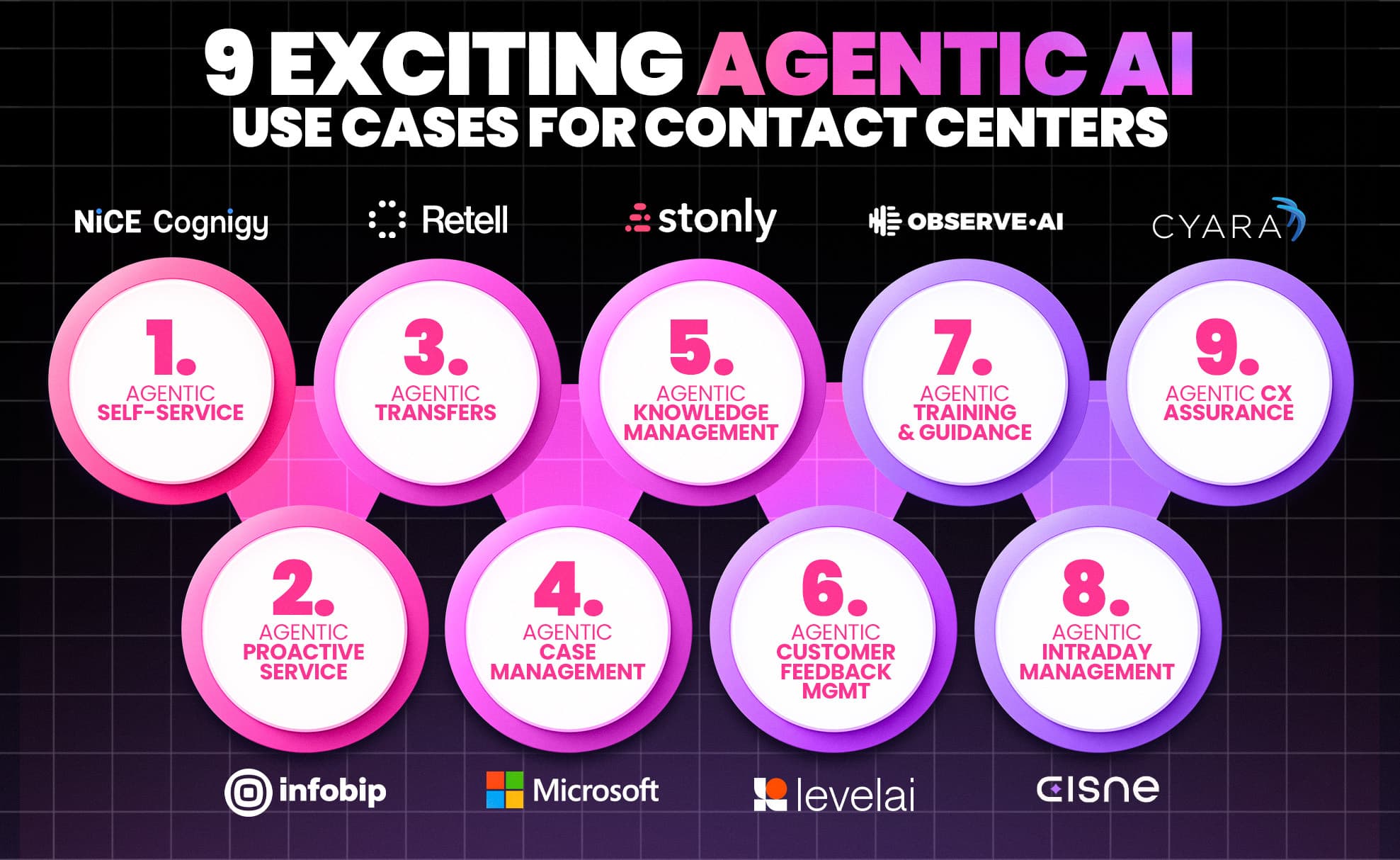
Here are seven examples of contact center agentic AI in practice, where the system invokes AI agents and tools as needed, adapting its approach when conditions change.
1. Agentic Self-Service
Example: NiCE Cognigy
Generative AI greatly advanced self-service by understanding customer intent, scouring knowledge content, and providing answers that weren’t pre-programmed.
However, agentic AI takes this a step further by enabling customer-facing AI agents to collaborate with agents across other systems, pulling data into service workflows and taking action autonomously.
As a result, contact center self-service platforms like NiCE Cognigy are beginning to coordinate AI agents across front-, middle-, and back-office systems to complete tasks and resolve more complex customer issues.
While enabling enterprise-safe agent-to-agent communication protocols, such as MCP, remains a challenge, especially across first- and third-party systems, this is where the industry is headed.
Beyond orchestrating AI agents, emerging agentic self-service platforms can also blend communication modalities within a single interaction, switching between voice and digital channels based on real-time context.
For example, if a customer is speaking in a public setting and needs to complete a secure authorization step, an agentic self-service solution like Crescendo could detect the situation and proactively shift the interaction to text-based chat to maintain security. This transition can happen dynamically, without relying on predefined workflows, as Crescendo CEO Matt Price explains in the short below.
2. Agentic Proactive Service
Example: Infobip AgentOS
Contact centers have long leveraged CPaaS tools to connect systems, build workflows, and deliver proactive customer service notifications.
Now that CPaaS capability can act as infrastructure for AI agents, with those agents detecting signals across different systems that indicate a customer journey issue. They may then pass those signals to AI agents in the CRM, CDP, or CCaaS platform to identify impacted customers and trigger a proactive service experience.
Better still, coordinated teams of agents could attempt to resolve issues immediately after detection and notify customers once the problem is fixed, before they even realize something has gone wrong. That transforms proactive customer service into pre-emptive customer service.
Infobip is one provider offering this capability through its “agentic-first, enterprise-ready AI infrastructure.” However, several of its CPaaS market rivals, such as Twilio, Cisco, and Sinch are also striving to deliver agentic proactive service (in addition to agentic self-service).
3. Agentic Warm Transfers
Example: Retell AI Agentic Transfer
Traditionally, contact centers have relied on two types of escalations when transferring customers from an AI agent or chatbot to a human agent: cold transfers and warm transfers.
A cold transfer passes on a contact without any context of the conversation so far. Meanwhile, a warm transfer shares a concise summary, so the human representative can pick up the contact from where it broke down.
Yet, the Retell AI’s ‘Agentic Warm Transfer’ goes further. Alongside the debrief, it enables the representative to query the customer-facing AI agent for additional insight into the issue.
Moreover, the rep may ask the agent to communicate with agents in back-end systems to provide additional, supportive information.
From there, the human rep can decide that this is something they can handle or, alternatively, reject the transfer.
If they choose the latter, the AI agent can reassess the customer’s query in the context of their interaction with the human rep and then route the customer to another specialist elsewhere in the business.
As part of a podcast with CX Foundation, Bing Wu, CEO of Retell AI, discussed how agentic AI is transforming the contact center transfer process, as teased in the video short below.
4. Agentic Case Management
Example: Microsoft Case Management Agent(s)
Microsoft has a Case Management Agent that coordinates with other agents, both custom and embedded into its Dynamics 365 Customer Service and Contact Center platforms.
First, upon receiving a digital customer contact, it spins up a new support case, extracts information from the customer’s message (i.e., case title, description, and customer details), and updates customer records within the CRM.
From there, it identifies the customer’s intent and either sends a response to resolve the issue or requests additional information from the customer. It then updates the case status to: “Waiting for Details.”
Upon receiving and processing the customer’s follow-up response, the Case Management Agent routes the customer through to either a human agent or another AI agent to support the resolution process.
For instance, if the customer requests a name change, it could invoke a custom passport verification agent to validate the requested name change.
Afterwards, the Case Management Agent can automatically update the customer’s name, case subject, and case description, follow up with the customer, and resolve the case.
Finally, it monitors for customer follow-up after resolution, handing off to the Case Follow-Up and Closure Agent after 48 hours of inactivity to send follow-up communication and confirm customer satisfaction.
Microsoft shares a video demonstration of its agentic case management, going deeper on this example, below.
5. Agentic Knowledge Management
Example: Stonly Knowledge Agents
Stonly is an emerging vendor in the contact center knowledge management space. In April 2026, it introduced several “Knowledge Agents” designed to take on more of the work traditionally handled by human users.
These agents operate in coordination, continuously monitoring support tickets, knowledge articles, product documentation, and internal feedback.
They then identify issues such as duplicated, conflicting, or outdated content, and either update knowledge autonomously or flag it for human-in-the-loop review.
Additionally, the agents detect knowledge gaps and draft new content based on how live agents successfully resolve emerging customer queries.
These new knowledge articles may then inform agentic self-service systems, helping them to answer more customer queries autonomously.
With only 35% of contact center knowledge bases considered ready to support AI, agentic knowledge management can help close the gap between operational readiness and broader customer service AI ambitions.
6. Agentic Customer Feedback Management
Example: Level AI’s AI Workers
Level AI has embedded 11 AI agents, or, as it refers to them, ‘AI Workers’, within its contact center quality assurance (QA) software. Organizations can orchestrate these AI agents and establish their own agentic systems.
As an example of how this works, consider its VoC (Voice of the Customer) Insights Worker, which extracts deeper insights from customer conversations and enriches performance evaluations.
Its Executive Research Worker can use this information to conduct deep, multi-step research, surfacing the most impactful insights tied to key customer, employee, and business outcomes, and turning them into reports and presentations.
The Coaching Plan Worker can then take these reports and create tailored development plans that recommend targeted coaching and microlearning to improve performance.
As a result, contact centers can systematically turn customer insights into concrete actions to drive the outcomes they care about most.
7. Agentic Training & Guidance
Example: Observe.AI Agentic AI for Operations & Frontline Teams
Observe.AI equips operations teams with coordinated AI agents that analyze agent performance, personalize coaching plans, and assign AI simulations of customer roleplays.
Yet, it also offers AI agents for frontline teams, which it calls ‘Companion Agents’. These guide human reps through customer contacts.
Where it gets particularly advanced, however, is when the AI agents for operations teams start to interact with Companion Agents, modifying the guidance individual human reps receive based on their performance history.
So, if a rep routinely misses a critical piece of information in a given scenario, they receive a timely reminder. However, if they rarely make that mistake, they won’t see the prompt, avoiding unnecessary and distracting pop-ups.
Interestingly, Observe.AI’s Companion Agents can also go beyond simply suggesting next-best actions by performing specific tasks across the contact center environment on the rep’s behalf, highlighting an exciting future for contact center agent-assist technologies.
8. Agentic Intraday Management
Example: Cisne's Swan Droids
Cisne is a disruptor in the contact center workforce management (WFM) market, developing a solution with embedded AI agents or, as it calls them, ‘Swan Droids’.
Many of these Swan Droids operate in concert, like those it has built for intraday management.
These Swan Droids work together to detect deviations in contact volumes, reforecast in real time, and dynamically adjust schedules.
If contact volumes suddenly spike, they can also draft in human reps for coverage, open new shifts, and reallocate work across queues.
While Cisne has set this up to be an autonomous, agentic system, planners can still place a human in the loop to approve actions until they establish complete trust in the system.
9. Agentic Customer Experience Assurance
Example: The Cyara Agentic Platform
Customer experience (CX) assurance solutions help contact centers test, validate, and continuously monitor telecom connectivity, IVR and AI systems, system integrations, agent desktops, and more.
Cyara is a leading provider in this space and already uses AI agents to simulate customer interactions with self-service systems, validating their performance.
However, its long-term vision is to build an “agentic platform”, which goes far beyond this.
Indeed, it aims to pull in customer journey intelligence alongside CX assurance data and utilize AI agents to prioritize: what should we test, when should we test it, and how often?
These AI agents may then trigger AI agents to perform those tests and, where possible, apply fixes that align with company best practices.
So rather than only diagnosing issues across the contact center ecosystem after they occur, Cyara - in the future - aims to preemptively address and heal them.
The Many Options for Agentic Self-Service…
Despite its broad range of applications, the term “agentic AI” in contact centers is still largely associated with self-service, and many customer experience technology providers see a clear opportunity to transform the self-service space.
Indeed, traditional conversational AI providers and many well-funded market entrants are championing agentic self-service, with more than 650 vendors competing to automate service and sales contacts.
That makes it difficult for brands to determine which provider best aligns with their needs.
Yet, there are critical points of differentiation to consider between leading providers. For instance, they often vary in their multimodal capabilities (i.e., ability to blend channels within one interaction), which can be powerful for teams tasked with reimagining service experiences.
Other key areas of differentiation include pricing models, integrations with legacy systems, data strategy (beyond simple CRM connectivity), industry-specific AI, reporting and analytics, support services, and speed to value.
With these factors in mind, here are 20 leading providers to consider and how they approach this next era of AI.