
May 14, 2026 • 13 min read
Conversational AI Pricing Models for Customer Service

Director of Content & Market Research
May 14, 2026

With 650 different conversational AI vendors targeting customer service and sales teams, understanding their unique strengths can be tricky.
Yet, vendors often differentiate on data strategy, real-time personalization, industry-specific AI, multimodal capabilities, and, of course, pricing.
The likes of Sierra, Decagon, and Crescendo have surged in championing outcome-based pricing, with the former earning a $15 billion valuation less than three years after its foundation.
Now, many of the more established vendors are pivoting to embrace this model.
In 2026 alone, prominent providers like Fin, Poly AI, and HubSpot shifted to offering outcome-based pricing, alongside other options.
However, those other options still have their place.
Given that, here’s an overview of conversational AI pricing models for customer service, how to isolate the best option, and some of the new, disruptive models coming to market.
The Established Conversational AI Pricing Models
Conversational AI providers for customer service typically offer one or more of the following pricing models.
1. Per-Agent Pricing
A per-agent model allows contact centers to pay a subscription fee for each AI agent they deploy.
The approach extends the traditional per-seat pricing model used in enterprise software, shifting it from human employees to AI-powered workers.
Advantages
- It follows a familiar software subscription model
- It makes costs more predictable than usage-/outcome-based pricing
- It enables a simple, transparent billing process
Disadvantages
- It forces end-users to pay the same price even if the agent underperforms
- It can hike costs dramatically when brands deploy AI agents for edge cases
- It costs the same for a simple agent as it does for a complex design
2. Per-Action Pricing / Per-Workflow Pricing
Per-action and per-workflow pricing models scale costs based on the actions and workflows an AI agent completes, respectively.
Both models closely align pricing with actual AI consumption.
Advantages
- They ensure customers only pay when the agent successfully performs a task
- They enable brands to pilot without an upfront subscription fee and scale cautiously
- They offer transparency, as teams can track expenses across specific workflows
Disadvantages
- They cause significant fluctuations in cost when contact center demand spikes
- They create a misalignment in costs, as not all actions and workflows drive equal value
- They generate high costs for more complex use cases, which sequence several actions and workflows
3. Per-Conversation Pricing
A per-conversation pricing model charges organizations for every conversation the AI agent has with a customer.
Assembled and Salesforce offer this pricing model. They define a conversation or “session” as a back-and-forth interaction within a 24-hour window.
However, that window of time may fluctuate across different vendors.
Sometimes, this model is also tiered, so an organization pays for a maximum number of “conversations” within their subscription.
Advantages
- It scales costs proportionately with customer use of AI
- It allows contact center planners to align costs with forecasted demand
- It avoids tricky conversations around how to define an AI action or resolution
Disadvantages
- It treats every conversation, no matter how complex, as if it has the same value
- It bills successful and unsuccessful interactions at the same price
- It creates unexpected spikes in costs when forecast accuracy is poor
4. Per-Outcome Pricing
A per-outcome pricing model charges a company when its AI agent achieves a predefined “outcome” on a contact-by-contact basis.
Most often, an “outcome" is defined as whether or not a resolution was found, sometimes only validated by whether or not the customer requested an escalation to a human agent.
However, some vendors are now also tying outcomes to customer satisfaction, sales conversions, and other customer experience metrics.
Advantages
- It ensures that organizations only start to pay when they see value
- It incentivizes the vendor to provide ongoing support to optimize their income
- It avoids high upfront costs on disruptive new technologies
Disadvantages
- It adds unpredictability to the cost model as it’s more difficult to predict outcomes than consumption.
- It sometimes causes disputes over whether AI resolved an issue or not.
- It often requires the integration of powerful business intelligence (BI) tools to accurately track outcomes.
5. Per-Minute Pricing (Voice Agents)
This pricing model rounds the average call duration up to the nearest minute and charges contact centers based on the total number of calls multiplied by that average duration.
Most conversational AI providers that offer voice AI utilize per-minute pricing, although some will instead leverage a per-conversation or per-outcome model.
Advantages
- It suits businesses with low call durations, solving routine issues
- It rewards ‘effortless’, customer-focused experience design with lower costs
Disadvantages
- It escalates costs when contact centers automate more complex voice interactions
- It creates cost uncertainty when inbound traffic and call durations fluctuate
Which Pricing Model Is Best?
While outcome-based pricing is a rising force, there’s no ‘one-size-fits-all’ pricing model.
Given this, here are some guiding principles for organizations to identify the best-fit conversational AI pricing model for their contact centers.
Match Pricing to Overall Use Case Complexity
Generally, consumption-based pricing (per-conversation, per-action, or per-minute) works best for simpler, high-certainty use cases, such as basic FAQs, where resolution is almost guaranteed, and value is easy to measure.
Meanwhile, outcome-based pricing is more appropriate for complex, end-to-end workflows where the AI crosses multiple systems to complete long-tail tasks and escalations are more likely.
Plan for Where You're Going, Not Where You Are
Most businesses have a mix of use cases, which may call for a hybrid pricing model. The more important question, however, is a forward-looking one: how much responsibility does the organization want AI to carry over time, and how quickly does it want to get there?
Businesses should let those answers shape their pricing models, not just the current reality.
Pilot Before You Commit
Don't lock into a pricing structure before running a controlled pilot. A good test should generate comparable data across cost, performance, and ROI, providing a grounded basis for model selection and negotiation.
Push Vendors on Measurement
Pilots are only as good as the data behind them. Reporting and analytics remain a weak point across the conversational AI space, with many providers still relying on third-party BI tools like Power BI or Tableau to track outcomes. During procurement, make it a priority to ask vendors:
- How do you measure end-to-end impact?
- What does your native reporting cover?
- Where do you depend on third-party tools?
The answers will help organizations gauge the vendor's maturity and their own ability to validate ROI down the line.
More Innovative Pricing Models
With pricing emerging as a key area of differentiation, some vendors are experimenting with new models designed to improve the return on investment (ROI) for customers.
Below are innovative pricing approaches from vendors striving to stand out from the crowd.
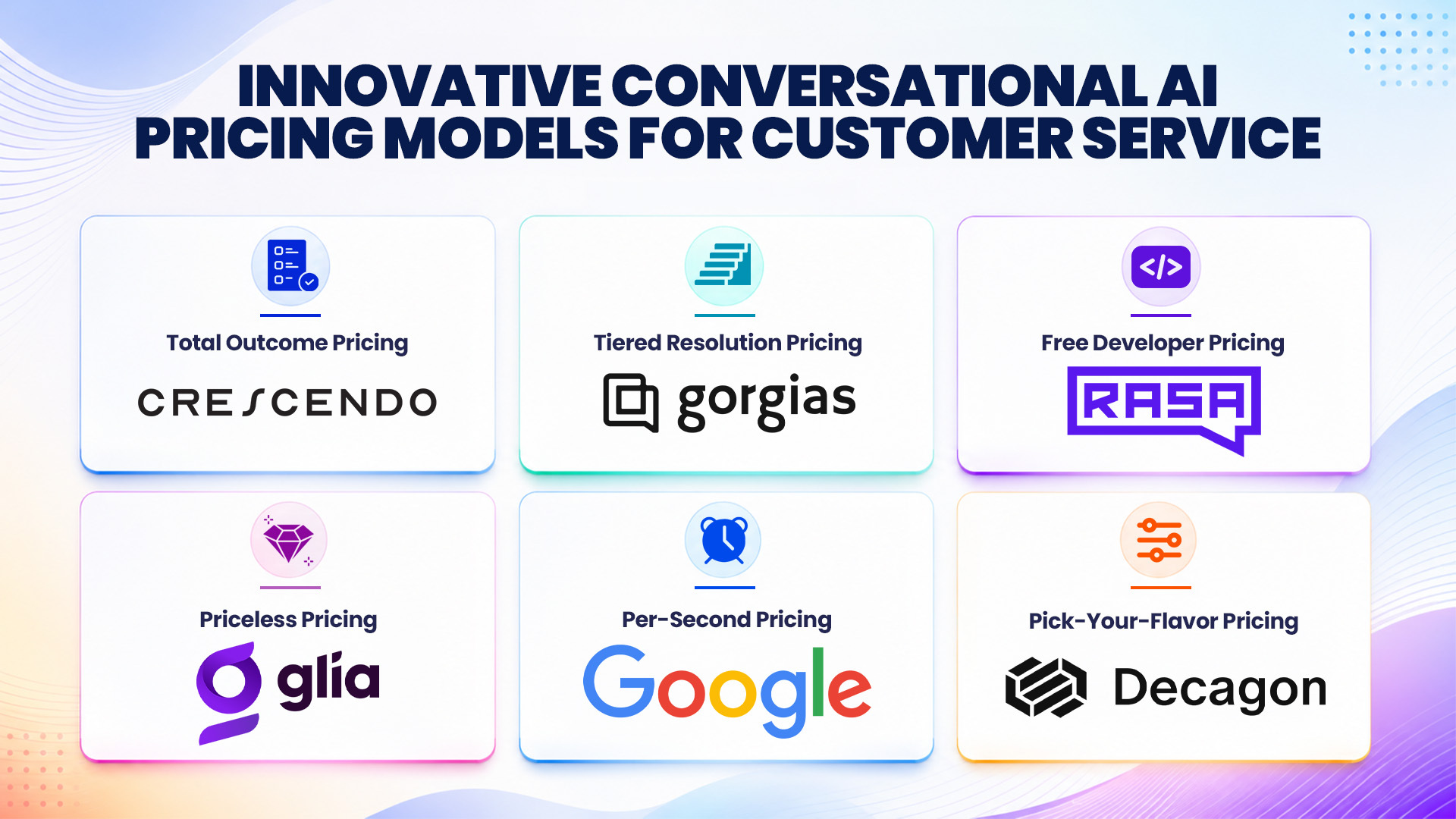
1. Total Outcome Pricing
Champions: Crescendo.ai
Traditional outcome-pricing models measure whether a ticket was closed, not whether the customer left the interaction satisfied. Total outcome pricing changes by tying a chargeable outcome to both resolution and satisfaction.
Crescendo.ai champions this model. It monitors customer sentiment at the end of every interaction, refusing to charge for resolutions that leave customers dissatisfied.
Interestingly, the provider backs this up with a performance guarantee: if its AI agent doesn't outperform the incumbent bot within 30 days, the first month is free.
Crescendo’s approach is similar to Sierra’s, which combines containment metrics with customer satisfaction scores, sales conversions, and other performance indicators. These are mutually agreed upon by the vendor and their customers, ensuring outcomes are not only achieved, but genuinely positive.
Elsewhere, Chargeback applies the same philosophy to a different domain entirely. Rather than charging per interaction, it takes 25% of recovered chargebacks, a revenue-share model that directly aligns its incentives with client results.
The benefit: Vendors are financially motivated to deliver outcomes that are both positive for the business and its customers.
2. Tiered Resolution Pricing
Champion: Gorgias
Gorgias offers both customer support helpdesk and conversational AI solutions, with a unique pricing model that blends the two.
Here’s how it works: Helpdesk plans are built around "billable tickets". These are interactions handled by human agents, with a monthly allowance broken into tiers.
However, if an AI agent fully resolves a conversation before it reaches a human, it's not counted as a billable ticket. Instead, it's billed separately at $0.90 per resolution (annual) or $1.00 (monthly).
So, as AI handles more of the heavy lifting, organizations can reduce their billable ticket count, drop to a cheaper plan tier, and lower overall support costs in the process.
This model suits its target market well: B2C brands in e-commerce typically deal with high volumes of straightforward queries, precisely where AI resolution rates are highest.
The benefit: The more AI resolves, the less the business (ultimately) pays for its helpdesk software.
3. Free-Forever Pricing
Champions: Rasa
In the Forrester Wave for Conversational AI, Customer Service 2026, Rasa was the only provider to score a perfect five out of five for pricing flexibility and transparency. The reason is straightforward: teams handling fewer than 1,000 conversations per month pay nothing.
Unlike competitors whose free tiers last a week or a month, Rasa's Free Developer Edition allows brands to experiment, validate, and iterate at their own pace with no time pressure and no cost (as long as they stay within the 1,000 contact limit).
For SMBs with lower contact center demand, it also functions as a viable long-term solution rather than just a trial.
Similarly, Tars offers a comparable freemium model, with 50 free conversations per month and paid tiers scaling from 500 to 10,000 conversations, a structure designed to grow alongside SMBs and mid-market businesses.
The benefit: Teams can build confidence in the technology before spending a penny, reducing adoption risk.
4. "Priceless" Pricing
Champion: Glia
Glia, which specializes in CCaaS and conversational AI for financial services, takes a contrarian stance: one fixed price, agreed at the start of the contract, that never changes.
It doesn't matter how many edge cases get added, how many tokens are consumed, which features are used, or how many integrations are built; the price stays the same.
For organizations that expect to experiment and scale fast, this removes the anxiety of watching usage meters tick upward.
The benefit: Complete cost predictability, paired with the freedom to push the platform without fear of bill shock.
5. Per-Second Pricing
Champion: Google
Most voice AI platforms bill by the minute, which sounds reasonable… at first.
However, if the average call falls somewhere in the middle of a billing minute, the platform rounds up. As a result, businesses end up consistently paying for time that was never used.
Google eliminates that rounding entirely, billing its advanced voice agents to the exact second. The practical effect is that actual call duration and billed duration are the same thing, and across tens of thousands of calls a month, that adds up to meaningful savings.
Some other providers are also shifting away from the per-minute model. For example, Omilia bills in ten-second increments rather than full minutes, a less precise solution, but still an improvement over blunt per-minute rounding.
The benefit: Organizations pay for exactly what they use for voice AI, and at scale, the savings are substantial.
6. Pick-Your-Potion Pricing
Champion: Decagon
In 2024, Decagon became one of the first conversational AI providers to offer customers a choice between conversation-based and resolution-based pricing.
Crucially, it didn’t and still doesn’t ask clients to decide upfront. Instead, it runs a pilot in the client's own environment first, letting real-world data inform the decision before any commitment is made.
This approach, which combines flexibility and real-world evidence, is likely where the market is heading.
A natural next step would be the option to switch models mid-contract based on whichever proves cheaper in practice. Decagon doesn't currently offer this, but it would be a compelling proposition.
The benefit: No guesswork. Organizations choose the model that works best for the business, not the one that looks best on paper.
Additional Costs of Conversational AI in Customer Service
The pricing model sets the floor, not the ceiling. Here's what sits above it.
Implementation Support Costs
Before a conversational AI deployment becomes operational, organizations typically need to redesign customer journeys, align workflow automation logic, connect data sources, build API connectivity, and complete testing, quality assurance (QA), and compliance validation.
Without incredible in-house technical capability and capacity, professional services costs can become quite the pill to swallow.
Some vendors are responding to this by forward-deploying engineers, with Sierra being a notable example. It aims to reduce deployment friction and accelerate time to value.
However, while this can lower upfront costs, it raises a critical question: are those engineers leaving teams equipped to adapt workflows independently, or are they creating a dependency? If the latter, ongoing support costs may quietly compound long after go-live.
Ongoing Support Costs
The support relationship rarely ends at deployment. Organizations increasingly rely on partners not just for maintenance and optimization, but for something less tangible: helping validate their work internally.
With few conversational AI providers offering intuitive, UI-based reporting, partners often play a critical role in translating AI performance into a narrative that satisfies senior leadership and demonstrates a credible AI posture.
Expansion Support Costs
Scaling deployments across geographies and new channels is one thing. However, taking on trickier use cases and connecting back-end workflows that cut across systems owned by different parts of the business - i.e., sales, marketing, and finance - is no mean feat.
Coordinating such a cross-functional effort often requires significant partner support.
Again, however, vendors are hoping to cut through some of this cost by bundling additional services into enterprise support tiers, making them part of the core pricing proposition rather than a separate line item. That shift is worth scrutinizing closely when evaluating total cost of ownership (TCO).
New Roles & Training Costs
Three-quarters of AI customer service rollouts miss the mark, and the most common culprit isn't the technology; it's the underinvestment in the human infrastructure required to make it work.
Successful deployments increasingly demand dedicated CX designers, customer success managers, AI architects, and data management specialists. These aren't nice-to-haves; they're the difference between an AI deployment that scales and one that stalls.
The data management need in particular is often more acute than leadership realizes. It’s a problem to which service operations professionals only seem to understand the full extent, and when they’re sidelined in AI deployments, the issue can come as a nasty shock.
Indeed, the data challenge tends to reveal itself after go-live, not before, making it a cost that is consistently overlooked in pre-deployment budgeting.
Nevertheless, emerging journey design, customer success, and AI architect positions will carry significant training and salary requirements. That adds further to the total investment required to operate AI effectively at scale.
Understanding Pricing Models Is Critical, But Don’t Design for Cost
In the 2010s, large customer service outsourcing firms saw conversational AI coming and moved early, pivoting from pure outsourcing to become broader CX partners.
Soon, they added experience design and consultancy to their service mix.
Yet, in many cases, their core focus didn’t budge: optimizing for costs.
With several global professional services firms adopting a similar approach, metrics such as containment and deflection rates became commonplace.
Soon, more brands started to focus their efforts on progress toward narrow cost-saving indicators, instead of considering: what’s best for the customer?
Even with the best conversational AI platform and pricing model in the world, that approach will fail.
The organizations that leverage clean data sources, blend multimodal capabilities, and optimize for the experience first will ultimately be those that secure long-term cost savings.
Dive deeper into specific AI offerings and which might best fit your business by reading CX Foundation’s article: 20 Conversational AI Platforms & Their Differentiators in 2026