
August 3, 2026 • 8 min read
Forrester Wave for Conversational AI Platforms, Employee Service 2026: Top Takeaways

Director of Content & Market Research
August 3, 2026
Conversational AI technologies aren’t exclusively reserved for customer service; there are many employee use cases across the enterprise.
Whether someone wants to learn a new process, request a device, or swap a shift, AI is automating more of these requests, easing the burden on IT, HR, and other teams.
Given this, Forrester evaluates both the customer and employee service markets, and recently completed its latest Wave report on the employee side.
The study reveals many trends in how the conversational AI market is developing, which carry over to the customer experience world as well.
Below, after a quick look at who came out on top, is an original analysis of the report’s most relevant takeaways.
Who Are Forrester’s Conversational AI Market Leaders in 2026?
The Forrester Wave identifies four market leaders: Kore.ai, Salesforce, ServiceNow, and Atlassian.
Kore.ai is the only provider to earn leader status in this report and Forrester’s sister study into conversational AI for customer service. Its legacy system integrations, AI model management, and hybrid pricing options are broadly recognized strengths.
Perhaps more debatable is Salesforce’s inclusion, especially in the light of its recent Fin AI acquisition. That said, its ability to blend employee and customer support on a single platform (Agentforce Service) with a common knowledge and data layer is highly differentiated.
Elsewhere, ServiceNow is the largest provider in the employee service management (ESM) space, especially IT service management. Forrester focuses on Moveworks, which is now (post-acquisition) included in particular ServiceNow packages and will increasingly benefit from its broader ESM offering.
Lastly, Atlassian is ServiceNow’s closest competitor in the overall ESM space. Regarding conversational AI specifically, it stands out for capabilities like its Teamwork Graph, which maps work context across applications to inform AI-led experiences.
The image below groups the other nine vendors as Forrester did in its study.
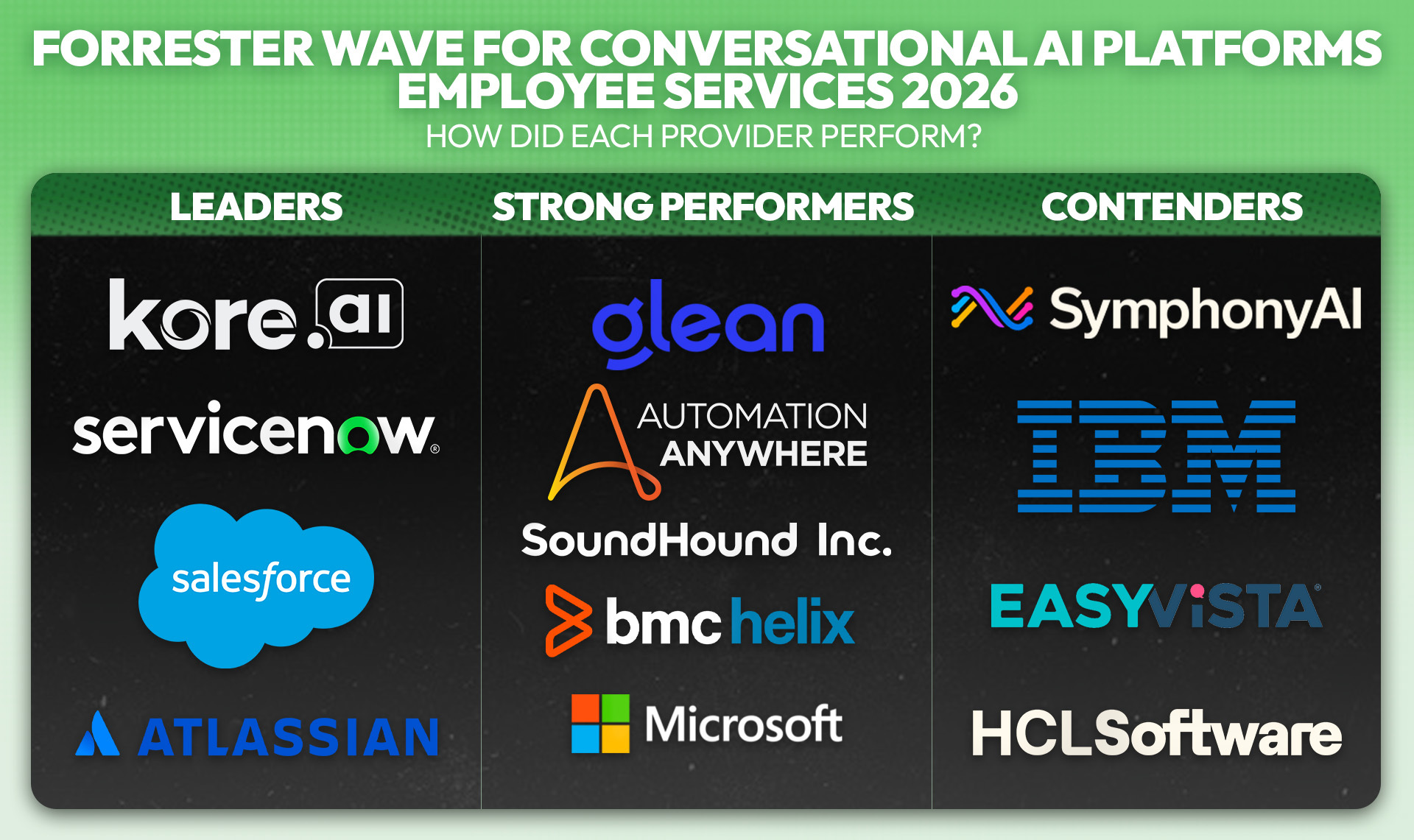
Lastly, BMC Helix is Forrester’s “Customer Favorite” provider. One major reason is its innovation in AI analytics, explored below in one of the seven top takeaways…
7 Top Takeaways from the Forrester Wave for Conversational AI, Employee Service 2026
As noted, Forrester’s study spotlights several trends shaping the conversational AI landscape, beyond its headline-grabbing vendor placements. The following top takeaways expand on some of those, which extend to customer-facing deployments.
1. AI Observability and Administration Lack Maturity
Think back to the end of 2024. Vendor messaging essentially centered on one message: “The next era of AI is here. Build agents now. Go, go, go!”
That swiftly changed, though, as businesses realized that managing dozens of agents can hurt efficiency, drive up costs, and become hard to justify and manage.
Instead, leading organizations are targeting a core set of agents for specific business needs, carefully governed and orchestrated within a broader framework.
That trend is perhaps one of the motivators behind Forrester’s move to include “AI observability and administration” as a yardstick within this year’s vendor evaluation framework.
Only one vendor scored above three out of five on this point: Automation Anywhere.
The vendor has a Control Room, which includes unique features, such as the ability to isolate why an agent called another agent or tool, not just when. That is significant in terms of audibility but also in regard to agent training and sophistication.
P.S. ServiceNow also has a mature Control Tower as part of its broader offering, yet the evaluation considered Moveworks, which it recently acquired.
2. “Agentic Controls” and Agent Builders Also Need Work
Despite rapid year-on-year improvements in key success metrics, like deflection rates, Forrester argues that today's agentic controls and agent builders still need significant refinement.
Regarding agentic controls, Forrester noted that some vendors, including Atlassian and BMC Helix, still lack PII redaction capabilities. Meanwhile, it found that few agent builders proactively recommend existing agents, skills, or knowledge.
As more conversational AI providers market on time-to-value, this is surprising and highlights an opportunity for vendors with builders that include advanced features like knowledge-aware tooling to better communicate this advantage.
3. Market Leaders Don’t Evade Pricing Criticisms
Within Forrester’s vendor analysis, pricing concerns repeatedly crop up, even amongst the research firm’s market leaders.
For instance, Forrester cautions Salesforce on its fluctuating pricing strategy, ServiceNow for its difficult-to-track service consumption model, and Microsoft for its unpredictable mix of platform and consumption-based costs.
These observations underscore how pricing-related issues persist across the industry, despite many framing outcome-based pricing as the silver bullet. Simply put, that is not the case.
Consider a vendor charging $2 per outcome, which covers all queries, including simple requests. Typically, these could be handled much more cheaply via a more conventional conversational AI pricing model.
Also, while only paying when an AI agent resolves a problem sounds appealing, vendors often define "resolution" differently than their customers do. That’s another key caution for buyers.
Given such issues, the future may lie in more providers, as Kore.ai and BMC Helix already do, offering first-party business-impact analytics, including metrics like “dollars saved”. Meanwhile, hybrid pricing models are also emerging, again led by Kore.ai.
4. Providers Are Now Also Expected to Be Knowledge Management Specialists
Knowledge management remains one of the big challenges in conversational AI deployments, with knowledge locked in employees’ heads and scattered across file storage systems. To make matters worse, it’s often conflicting or outdated.
To resolve more complex service cases, brands need to unlock, centralize, and contextualize all that knowledge, and there is a growing onus on providers to support them with knowledge connectors and context layers.
Forrester affirms this, citing Glean Technologies as a provider well-equipped here. Its new Waldo agentic search model is especially compelling, evaluating and refining knowledge for specific queries before passing the enriched context to a frontier model to take action.
While this is particularly innovative, many others are building increasingly sophisticated knowledge and context graphs. Additionally, others are finding and generating new content to systematically close knowledge gaps.
That said, some are still behind. For instance, there are prominent providers that still require manual agent-by-agent designation of specific article content. Others still fail to cite the sources behind their responses. Buyers should be aware of these potential gaps.
5. AI Escalations Are a Surprise Differentiator
Since before the advent of agentic or even generative AI, bots could escalate a service case with context of what happened before.
Nevertheless, Forrester’s scorecard still shows that some are trailing here, with IBM, Microsoft, and Symphony AI scoring one out of five on this metric
At the other end of the spectrum, SoundHound AI and EasyVista are leading the way, moving beyond “warm transfers” and toward something more innovative.
Indeed, both allow humans to step in as the AI agent when it gets stuck, enabling a resolution without a formal escalation.
Another example of a vendor pushing the boundaries in escalations is Retell AI.
While the vendor is not included in Forrester’s report, likely because it’s most often associated with customer service scenarios, it allows humans to ask questions of the AI agent. As a result, the employee taking over begins the conversation without knowledge or content gaps.
6. Analytics Maturity Is Accelerating Quickly
Despite not earning “leader status”, BMC Helix is highlighted as a “customer favorite”. One possible reason behind this is its pioneering blend of AI and analytics.
Like Kore.ai, BMC Helix offers sophisticated ROI analytics. However, it goes a step further by analyzing employee service demand, identifying emerging use cases, and proactively generating solution prototypes. The only other prominent vendor with a comparable capability is NiCE Cognigy, although it is absent from Forrester's report, likely because its primary focus is customer service.
Automation Anywhere also differentiates itself through advanced analytics. As noted previously, it provides insight into why, not just when, an AI agent invoked specific tools or other agents. It also offers robust knowledge gap reporting.
What is perhaps most surprising is that these vendors outperform Microsoft and Salesforce in this area, despite their rivals offering leading business intelligence (BI) platforms.
Ultimately, this may point to an opportunity for Microsoft and Salesforce to better integrate and democratize the capabilities of Power BI and Tableau within their respective AI platforms.
That leads on to the next point…
7. Ecosystem Is a Powerful Advantage for the Big Players
Salesforce converges HR, IT, and customer support on one platform (Agentforce Service), unifying how employees - both human and AI - solve cases.
Critically, this exemplifies how some bigger providers can use their broader solutions, as Salesforce also does with Slack, to enable differentiation.
Forrester highlights how Salesforce already takes context from Slack to deliver better answers to employee queries.
In time, Moveworks will also benefit from ServiceNow’s broader portfolio. Meanwhile, Microsoft is also taking ‘outside’ capabilities to bolster its offering, from omnichannel to emerging AI features like computer use (i.e., the ability for AI to navigate a device).
That said, Forrester warns that Microsoft and IBM lack the depth in pre-configured use cases expected from vendors with such expansive ecosystems.
Go deeper into the conversational AI space by checking out CX Foundation’s own market overview, crossing customer and employee service.