
June 16, 2026 • 17 min read
Genesys vs. NiCE: A Price, Product, & CX Comparison (2026)

Director of Content & Market Research
June 16, 2026
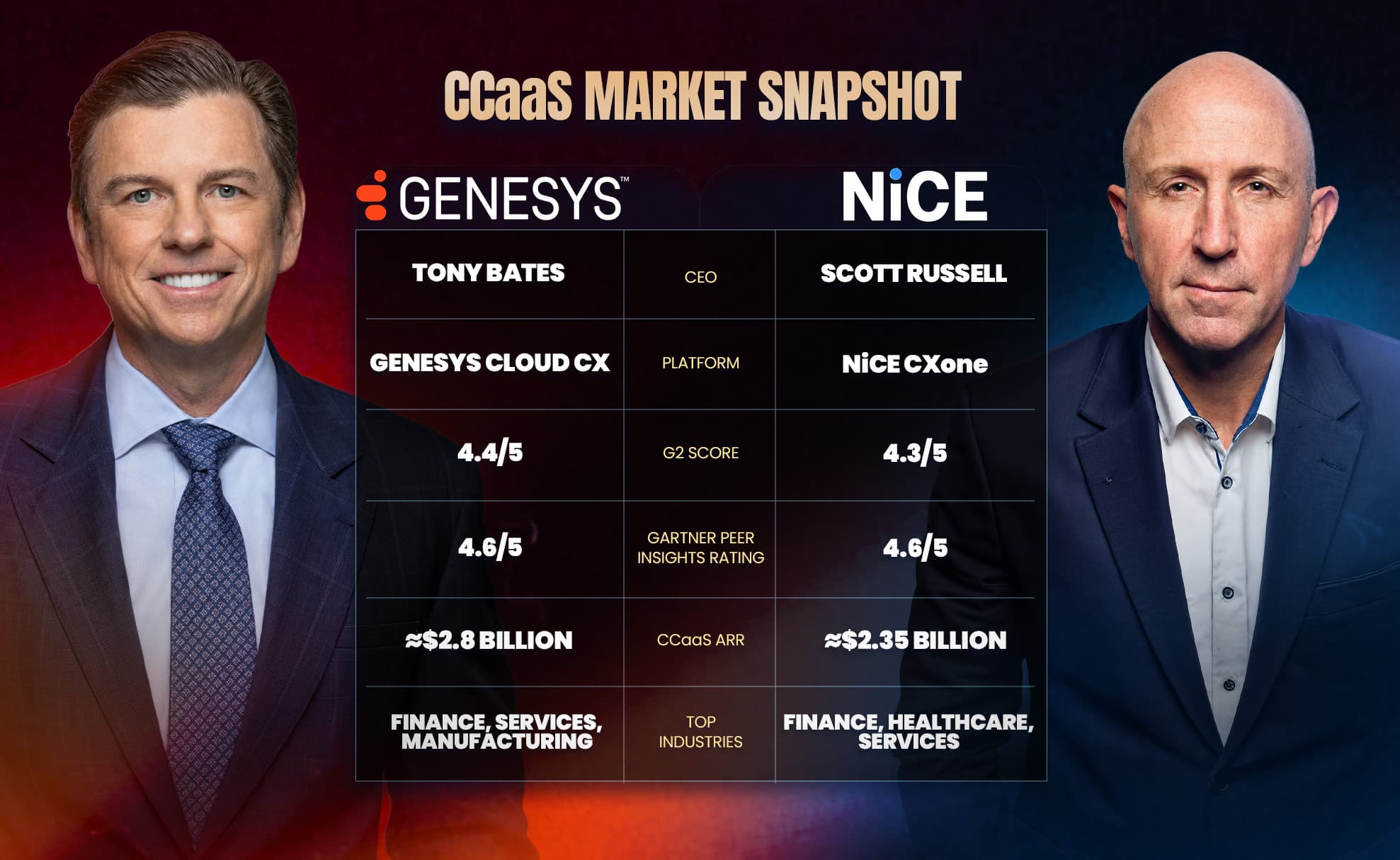
There is no single "best" contact center as a service (CCaaS) solution. The right platform is the one that fits an organization's unique operations, ecosystem, and budget.
That means before a single demo is booked or a shortlist assembled, contact center leaders and IT must do the harder work first: honestly diagnosing the current operation, building specifications grounded in reality rather than aspirational feature wishlists, and convening a diverse buying committee.
The committee should then consider: Where are we now? Where do we need to be in the next year or two? And what needs to change to get there?
Only then does meaningful market research become possible, with organizations engaging vendors with clarity about their needs, pressure-testing the options, and steadily narrowing down the field.
For many enterprises, that process ends with two names on the whiteboard: Genesys and NiCE. And as the following breakdown will show, choosing between them isn’t always straightforward.
Why Genesys vs. NiCE?
The contact center market is becoming increasingly competitive, with companies such as AWS, Cisco, Microsoft, Google, Salesforce, Zendesk, and Zoom now offering CCaaS solutions.
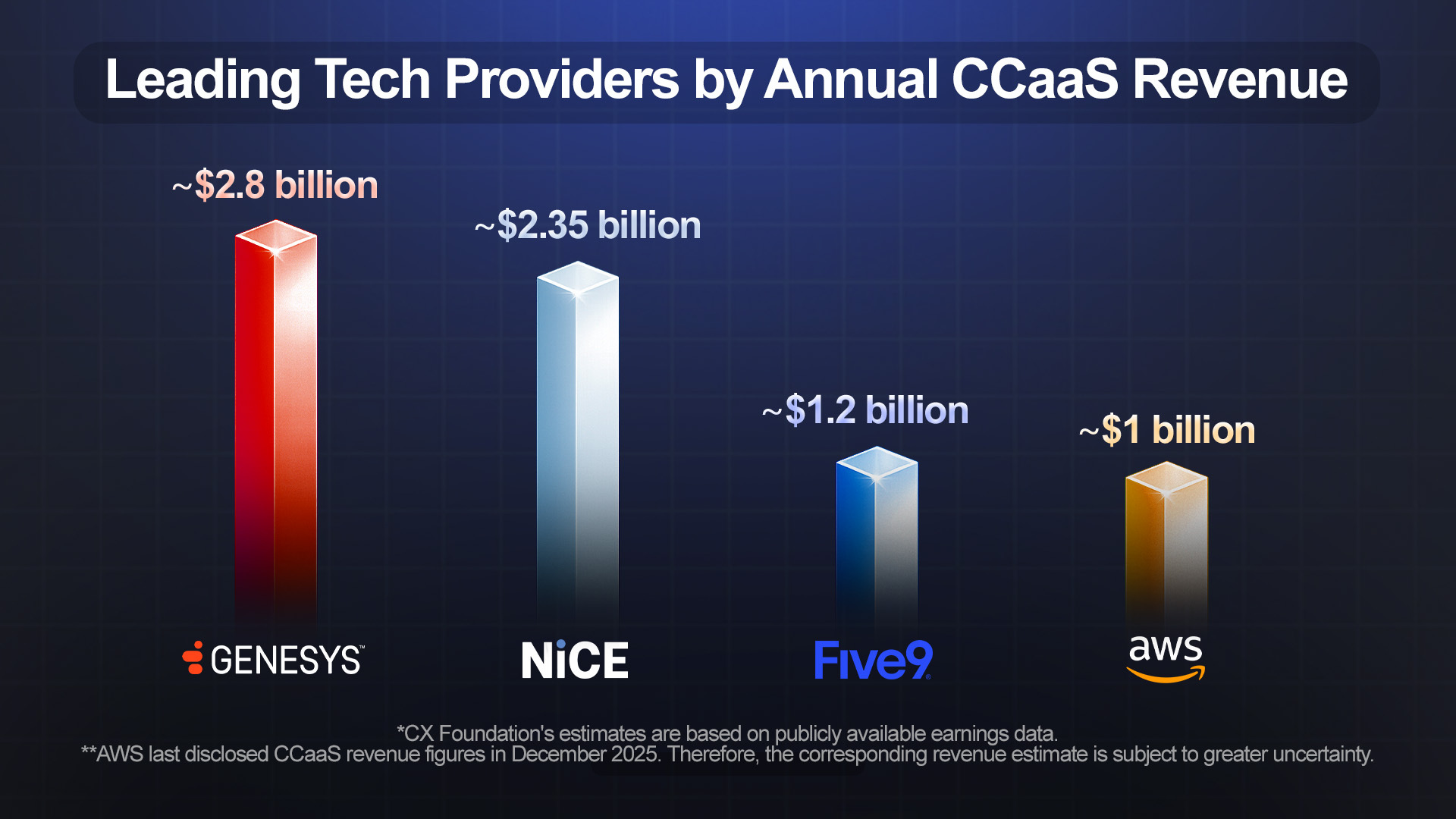
Still, two names consistently appear at the top of enterprise shortlists: Genesys and NiCE. That’s evident in both vendors’ annual recurring CCaaS revenues, which stand at approximately $2.8 billion and $2.35 billion, respectively (as of June 2026).
These numbers far exceed the competition, with Five9 the nearest rival at $1.2 billion.
A major factor behind their market position is that enterprises tend to be risk-averse when adopting CCaaS solutions.
Indeed, most understand that customer relationships are the lifeblood of any business, and taking a risk on an unheralded contact center platform is rare.
As such, enterprises often defer to CCaaS market reports that consistently position Genesys and NiCE as the market’s leaders and, by extension, present them as the safe choices.
While this trend continues, Genesys and NiCE are likely to maintain their stranglehold on the CCaaS space, battling out against one another for major enterprise contracts.
Genesys vs. NiCE: How Do They Compare on Price?
Genesys offers four core pricing plans for its Cloud CX solution; NiCE presents five for CXone.
Although both vendors provide additional features, the table below shows how they package core CCaaS functionality within their plans.
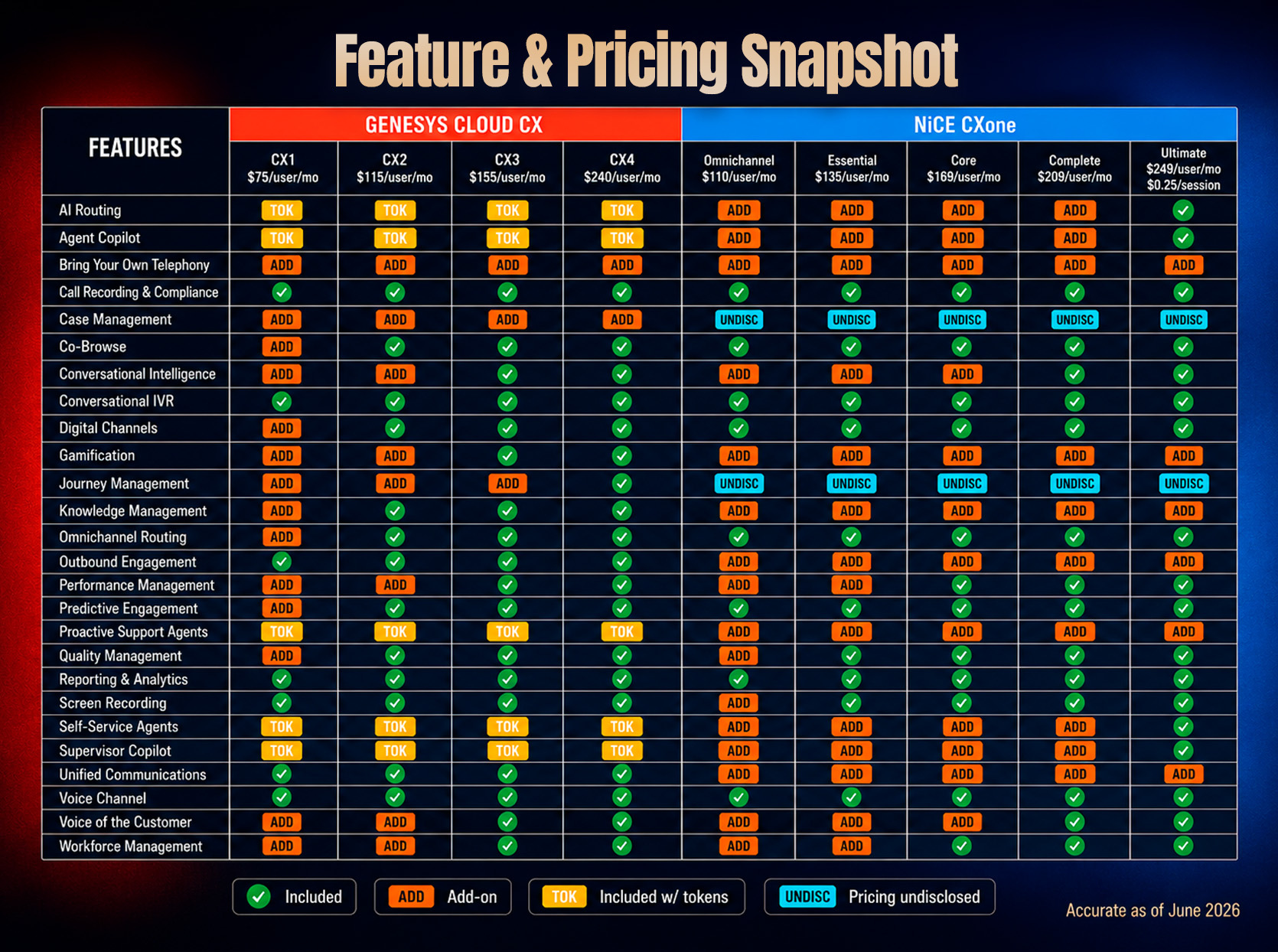
Alongside its standard tiers, NiCE also offers industry-specific bundles of its Ultimate suite for banking, insurance, healthcare, and retail, starting at $249 per user per month (plus $0.25 per session). These include sector-specific capabilities, like Electronic Health Record (EHR) integrations and voice biometrics, baked in.
Also, NiCE serves the public sector with a government-focused package, priced from $2 per consumer per year, which is a fundamentally different commercial model.
While NiCE offers these bundles, Genesys isn't without industry-specific capabilities; it simply doesn't pre-package them.
However, the key distinction is not necessarily how the vendors package their tools, but how both vendors price AI and the impact this has on costs as usage scales.
Important point - Enterprises with significant requirements can typically lower the price point of their chosen plan through negotiation.
Genesys Offers a Token-Based Model
Genesys has built its AI pricing on tokens. Every customer starts with 250 named-user tokens per organization, per month, and from the CX2 plan upward, each licensed agent unlocks an additional 30 tokens per month (or 39 for concurrent-user licenses). Extra tokens can be purchased at $1 each.
The model's appeal is that tokens act as a universal currency across Genesys's AI portfolio, so organizations aren't locked into a single capability.
Also, when Genesys ships new AI products, customers can activate them immediately against their existing token pool, with no contract renegotiation required.
For businesses exploring AI incrementally, that flexibility is valuable.
The risk, however, is that as contact center volumes grow, token consumption rises in tandem, making costs harder to forecast. Organizations with high-volume operations should therefore stress-test their token budgets accordingly.
NiCE Provides Session-Based Pricing
NiCE adopts a different pricing approach at the enterprise level. Its Ultimate package adds a $0.25 per-session charge on top of the base license, creating a variable cost that, like Genesys’s token model, scales with contact volumes.
What softens that exposure is NiCE's internal pricing tiers. So, the more sessions a customer commits to over the contract term, the lower the per-session rate becomes.
Crucially, customers can move between tiers as their usage evolves. This allows contact centers to increase automation over time and switch tiers accordingly, rather than overcommitting upfront or renegotiating mid-contract.
However, like Genesys’s model, it introduces a consumption-based element that adds some unpredictability.
Additional Costs
CCaaS deployments can also involve hidden costs that vary by provider.
One key example is data portability fees, a meaningful consideration for organizations that rely on third-party AI tools for analytics and reporting.
Genesys, for instance, negotiates an API allowance with each customer, with overage fees typically ranging from $0.0001 to $0.001 per request.
NiCE, meanwhile, imposes a fee on recording exports or downloads that exceed 5% of total interactions.
Neither cost is prohibitive, but both reward careful planning. Organizations that anticipate high data egress should factor these charges into their total cost of ownership from the outset.
Genesys vs. NiCE: How Do They Compare on Product?
Genesys and NiCE deliver all the core tools any organization would expect from an enterprise-grade contact center solution.
Where they diverge is in the details, and both vendors have capabilities they'd argue give them a meaningful edge. Here are five worth examining for each.
5 Product Strengths for Genesys
1. Journey Orchestration
Genesys rarely refers to itself as a CCaaS company anymore; it’s now an “AI-Powered Experience Orchestration” provider.
In line with that shift, it aims to systematically take customers through its “five levels of orchestration”, coordinating experiences across systems, channels, and agents.
Much of its innovation aligns with this ambition. Take its Genesys Cloud Associate, which routes contacts to knowledgeable experts across the business, alongside human and AI contact center agents. That’s a powerful capability for coordinating resolutions across the organization.
It is also expanding its unique Genesys Experience Index to incorporate customer effort signals that measure how difficult it is for customers to achieve their objectives across experiences, auto-adjusting resolution paths accordingly.
Sustained innovation around journey orchestration is a key strength for Genesys. Yet, NiCE is also moving the needle here. Indeed, it announced an “orchestration layer for the agentic era” at NiCE World 2026.
Nevertheless, Genesys currently offers more clarity in this area.
2. Native Salesforce & ServiceNow Integrations
Genesys has years of experience delivering native integrations with Salesforce and ServiceNow, embedding voice, digital channels, call controls, and routing technology into their respective Agentforce Service and Customer Service Management solutions.
While NiCE has since released a similar integration with ServiceNow, Genesys’s advantage here isn’t just in its additional experience delivering this unified offering; it’s in its approach to these partnerships.
The vendor actively co-developed these next-generation integrations alongside both CRM providers, earned $750 million in joint investment last year, and continues to align closely on cross-platform solutions.
Now, it’s working on the next phase of CRM-CCaaS integrations, which involves coordinating agents across their systems.
Genesys is already delivering on this with ServiceNow. In one European deployment, a ServiceNow AI agent handles billing disputes while a Genesys Agentic Virtual Agent manages the customer interaction. When a dispute is identified, the two AI agents communicate directly to share context. That type of cross-platform agent-to-agent orchestration is the future.
“What's unique is how we approach those partnerships. We don't walk into meetings as separate vendors. We focus on delivering the best customer experience together.”

3. On-Premise Migration Tooling & Program
Genesys often receives analyst plaudits for its Ignite tooling, which accelerates contact center migration by automating configuration tasks such as importing users, skills, and queues from legacy systems to the cloud.
Complementing this is the Ignite Program, which supports pilots, proofs of concepts, and AI trials, enabling customers to validate value before committing.
For existing on-premise customers, Genesys also offers migration programs that eliminate double-charging during the ramp-up period.
Interestingly, this model also incentivizes the vendor to support customers in accelerating deployments, avoiding the cost of supporting two separate environments simultaneously.
4. Social Customer Service
In 2024, Genesys acquired Radarr Technologies, adding native social listening capabilities that NiCE can only match through partners.
Its technology enables customers to monitor one-to-one social service conversations while aggregating feedback across forums, boards, and social channels.
In doing so, it tracks everything from Facebook posts to Reddit groups, then either auto-generates responses or escalates issues to a live agent.
This capability may become increasingly valuable as contact centers automate more inbound volumes and redeploy staff toward customer success, turning the contact center into the revenue engine it has long promised to be.
5. WhatsApp
Every CCaaS vendor worth its salt offers WhatsApp. Yet, Genesys’s integration is different, thanks to a budding partnership with Meta.
Instead of only allowing text, voice notes, and media sharing across the channel, Genesys offers native inbound calling on WhatsApp, with outbound calling coming soon.
As a result, the multimodal service conversations that Genesys customers have on WhatsApp are much more similar to the everyday interactions they have with friends and family.
5 Product Strengths for NiCE
1. Cognigy AI Agents
As a standalone offering, NiCE Cognigy has led several analyst studies of the conversational AI space, including the latest Forrester Wave and Gartner Magic Quadrant.
NiCE has since embedded Cognigy within CXone to combine the strengths of both platforms and unlock additional value.
For example, it launched an innovative solution that leverages NiCE’s interaction analytics technology to spotlight contact automation opportunities and automatically spin up Cognigy AI agent prototypes for customer self-service.
While Genesys has its Agentic Virtual Agent, which uniquely leverages large action models (LAMs) not large language models (LLMs), this is a powerful capability that differentiates NiCE’s self-service proposition.
Through Cognigy, NiCE can also offer AI agents for sales, marketing, and process automation, which are part of its Ulmitate Suite, something which Genesys doesn’t yet do.
2. Hybrid Workforce Engagement Management
At NiCE World 2026, NiCE announced a unified workforce engagement management (WEM) platform spanning both human and AI agents.
In WFM, this enables a consolidated view of how demand is shifting from humans to AI across different intents, improving long-term forecast accuracy.
Consolidated quality management adds further value, enabling brands to compare outcomes across human- and AI-led interactions and use those insights to shape the broader contact automation strategy.
Beyond this hybrid innovation, NiCE also boasts deeper forecasting and scheduling capabilities than Genesys, stemming from its heritage as a workforce optimization provider.
That pedigree is reflected in the market, with many organizations running alternative CCaaS platforms still opting for NiCE WFM, whether that's NiCE IEX, NiCE CXone Workforce Management, or NiCE Playvox.
"The WEM side... quality management, interaction analytics, that's very accessible, and NiCE has a great reputation in this area.”

3. Sovereign Cloud
In February 2026, Genesys launched an EU Sovereign Cloud on AWS, more than two and a half years after NiCE brought a comparable solution to market.
Over that time, NiCE has extended its sovereign cloud coverage to the UK and Australia, winning significant deals in highly regulated industries.
Its recent £500 million (≈679 million) win with HMRC is a prime example, with the UK tax authority explicitly citing NiCE's sovereign cloud and aligned operational model as key factors in choosing the vendor over Genesys, which just happened to be the only other CCaaS provider to reach the final shortlist.
The depth of NiCE's commitment is evident in its in-country investment across support teams, security operations, network operations, billing, and personnel, a level of localization that Genesys is now building up.
“Many organizations begin evaluating vendors based on sovereignty claims, but when they dig deeper, they discover a major difference between data residency and genuine sovereign cloud operations.”

4. Engagement Hub
The NICE Engagement Hub lets on-premise customers layer NICE AI and CX capabilities onto existing environments, enabling a slower, more cautious CCaaS migration.
For instance, one large UK financial services organization running Cisco used the Engagement Hub to deploy NiCE Cognigy, Agent Assist, Copilot, and analytics, achieving AI transformation without replacing its core contact center infrastructure.
Such an approach helps decouple AI adoption from full CCaaS migration, so customers can realize value immediately rather than waiting on lengthy replacement projects.
5. Supervisor Workspace
NiCE's Supervisor Workspace provides an overview of both human and AI agent performance, with visibility and coordinated controls spanning the complete agent mix. That’s another AI-related differentiator.
Additionally, channel feedback on its overall Supervisor Workspace is strong, with consultants commending the tools available to team leaders through NiCE Quality Management.
There, users can combine recordings, CX metrics, and open-ended customer feedback, which is analyzed by a large language model (LLM) and fed back into their QM environment.
“Supervisors have everything in one place: call recordings, survey results, agent information, and associated metadata… That single source of truth is probably NiCE CXone’s greatest strength.”

Genesys vs. NiCE: How Do They Compare on Experience?
Gartner’s Voice of the Customer for CCaaS 2026 study collated verified reviews across a trailing 18-month period. It cited these reviews and ranked NiCE above Genesys on its sales, deployment, and support experience.
Yet, somewhat counterintuitively, the same report found that 92% of Genesys customers are likely to recommend the vendor, compared to only 86% of NiCE customers.
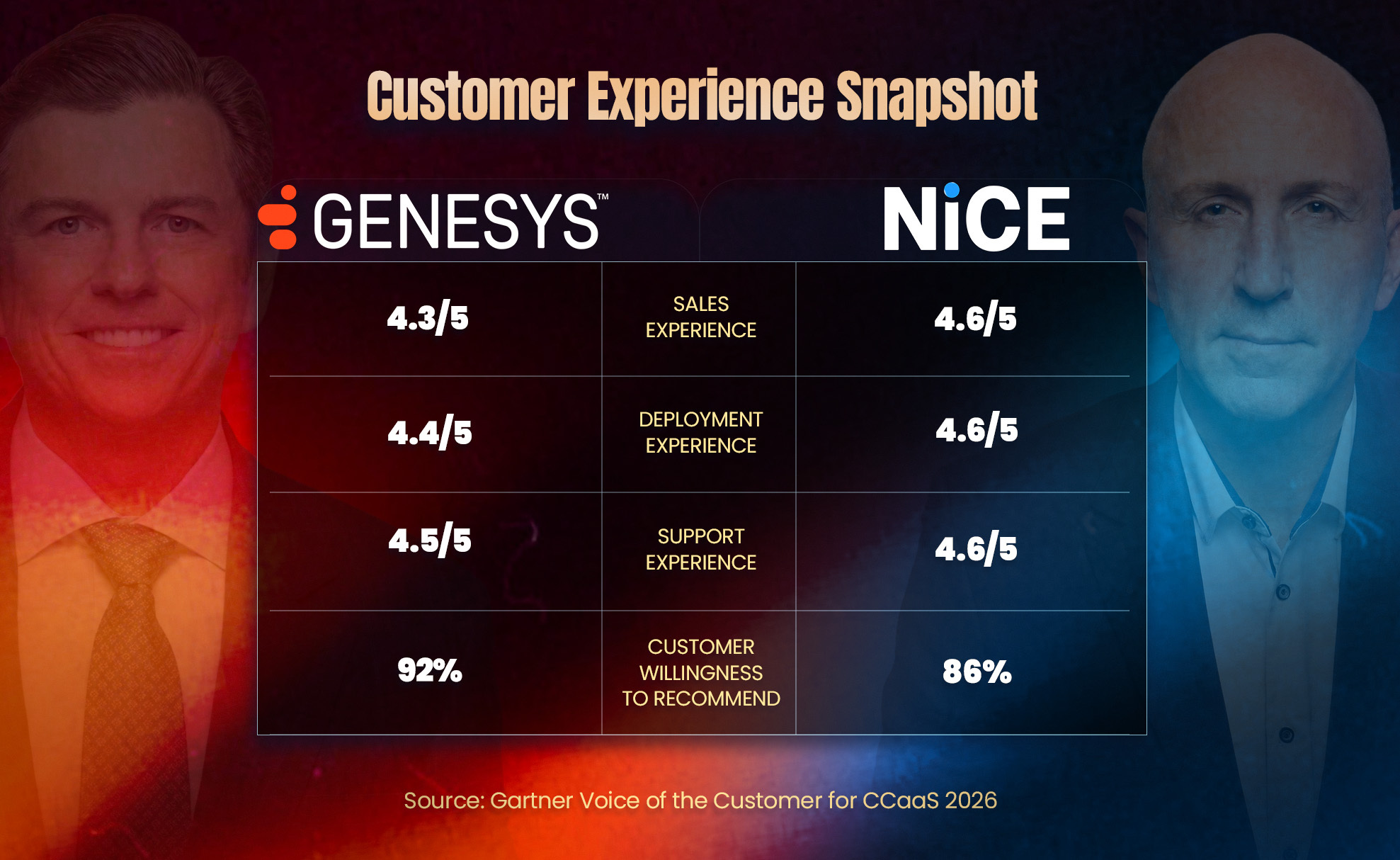
One possible explanation is that NiCE customers tend to hold more polarized views of their CCaaS provider than Genesys customers.
Nevertheless, in its channel conversations and desk research, CX Foundation found emerging strengths and weaknesses in both providers' ability to execute.
Genesys’s Strengths & Weaknesses on Experience
Customers appreciate the transparency of Genesys’s roadmap and capabilities, with all “generally available” (GA) products immediately available to everyone. With NiCE, that’s not always the case. Sometimes a product will launch as GA, but that does not necessarily mean it is available globally, with feature releases often lagging outside of North America.
Alongside that, Genesys’s Ignite program supports smoother CCaaS implementations, with tooling that makes complex on-premise configurations available in the cloud. It also lowers costs for brands migrating from Genesys Engage.
That said, Gartner suggested in its latest CCaaS Magic Quadrant that deployment times for AI projects can “extend beyond initial expectations.”
Meanwhile, the vendor is also still managing the fallout from its 2022 move from multiple CCaaS products to one single offering. As the 2025 Forrester Wave for CCaaS put it: “[That] has been painful for many Genesys customers,” and caused some to switch allegiances. However, in fairness to Genesys, a large cohort has since returned, which is indicative of its continued CCaaS leadership.
NiCE Strengths & Weaknesses on Experience
NiCE has a slick sales operation, supported by extensive customer references that build buyer confidence ahead of deployment, and reinforced by a robust channel strategy. Meanwhile, Genesys has become noticeably quieter through the channel than it once was.
In its latest CCaaS Magic Quadrant, Gartner also commended NiCE’s technical account managers for their “effectiveness in helping clients gain value from the product.”
However, some industry professionals have cautioned that unfavorable product updates have dampened the experience.
For example, in early 2026, NiCE moved Dashboard features into the Performance Management module, which is a paid upgrade, leaving customers who had unified historical and real-time data on the same dashboard with no choice but to purchase the add-on. As one consultant put it: "That did not go down well."
NiCE is also particularly prone to product renaming, with 68 name changes in its 26.2 release alone, risking customer confusion. Its short-lived rebranding of the platform as "CXone MPower” is another example.
Genesys vs. NiCE: Other Points of Comparison
In further research, several other points of differentiation emerged in terms of ecosystem, reporting, proactive AI, and language support, as outlined below.
Integrations & Partner Ecosystem
Genesys offers over 600 prebuilt apps and integrations, approximately 200 more than NiCE. It also provides more than 3,000 public APIs for custom builds.
Industry-first partnerships with Salesforce and Meta on their respective unified CCaaS-CRM and WhatsApp integrations again highlight Genesys’s fledgling ability to partner and innovate with the biggest enterprise technology providers.
However, NiCE is also rapidly expanding its ecosystem, announcing flagship partnerships in 2025 with AWS, Salesforce, ServiceNow, and Snowflake to connect the front office and back office into a unified experience.
Moreover, channel feedback of its CXone Copilot for Agents, in how it can be embedded into many CRM solutions and overlay anything in a Chrome extension, is positive.
In this sense, both Genesys and NiCE are considering how to become more strategic platforms and gain strategic CIO mindshare.
Reporting & Analytics
Analytics is an area where the two vendors diverge meaningfully. Gartner flagged in 2025 that Genesys customers may need to lean on third-party add-ons for comprehensive reporting, a byproduct of its more configurable approach, which offers flexibility but demands greater customization effort.
NiCE, by contrast, was recognized for the opposite strength: a deep foundation of labeled customer intent and behavioral data that underpins its entire analytics suite and enables pre-built, industry-specific AI models for conversational intelligence. Out of the box, it simply does more.
Proactive Customer Service
Through its integration with NiCE Proactive AI, Cognigy agents can analyze CRM, billing, and usage data in real time to identify customer needs, initiate outreach across channels, and dynamically adapt engagement strategies as conversations evolve.
While Genesys matches can match this orchestration capability, NiCE pulls ahead in the outbound and voice AI deliver these proactive service experiences.
For example, Cognigy supports over 100 languages and enables distinct personas across each, compared with 30 for the Genesys Agentic Virtual Agent.
Language Support
While Genesys's customer-facing AI agents may support fewer languages, it leads on broader platform localization, offering 24 languages across its admin and agent UI. That’s compared to NiCE CXone's 11 for its admin workspace and 13 for its agent workspace.
Genesys' additional language support - including Arabic, Hindi, Polish, Thai, and the Scandinavian languages - can be a decisive advantage in large-scale global deployments.
Genesys vs. NiCE: What’s the Vision Moving Forward?
Genesys has built its roadmap around Agentic Experience Orchestration, an approach that determines the best experience path by weighing customer intent, history, context, and business goals in real time.
Think of it as an intelligent front door: a customer arrives with a request, and the platform decides whether to route them to a workflow, virtual agent, human agent, or external expert.
The goal is fewer transfers and better outcomes, achieved by getting the routing decision right from the start.
NiCE's direction is strikingly similar. Its Agentic Engagement Plane distributes and mediates contacts as they flow across human teams, AI agents, and back-end systems, growing more predictive over time and feeding that intelligence back into the system to continuously improve.
Genesys's advantage here is its track record. It has long championed this style of orchestration and has the customer case studies to show for it.
However, NiCE brings Cognigy's agent capabilities and a more sophisticated analytics foundation to the table, both of which could prove decisive as agentic AI matures.
Final Advice for Selecting a CCaaS Solution
Neither Genesys nor NiCE is definitively superior. The right choice comes down to a clear-eyed read of what the organization actually needs.
Ultimately, that means grounding the decision in operational reality: understanding what matters most to key stakeholders and what most urgently needs fixing, whether that's failure demand, service rep pain points, process friction, or something else entirely.
Getting that clarity right sharpens every question, whether of Genesys, NiCE, or any other platform. Beyond visionary slide decks, the system still has to work in the real world.
That also means building accountability into every stage of transformation, not just at contract signing, but through deployment, adoption, and iteration.
After all, a CCaaS platform only becomes a competitive advantage when someone owns the outcome, not just the purchase.
Without that discipline, capabilities stall in pilots, service teams drift back into old habits, and the business eventually surfaces the one question no one wants to answer: why didn't we choose the other provider?
Don't let that be your story.
For more on navigating the contact center procurement process, read CX Foundation’s Contact Center Software Buyer’s Guide for 2026.
This analysis was written with support from the GAIA-CC community of contact center consultants.