
August 31, 2026 • 6 min read
Zoom Reports 250% Surge in Virtual Agent Customers, Signals Changing CX Buying Behaviors

Director of Content & Market Research
August 31, 2026
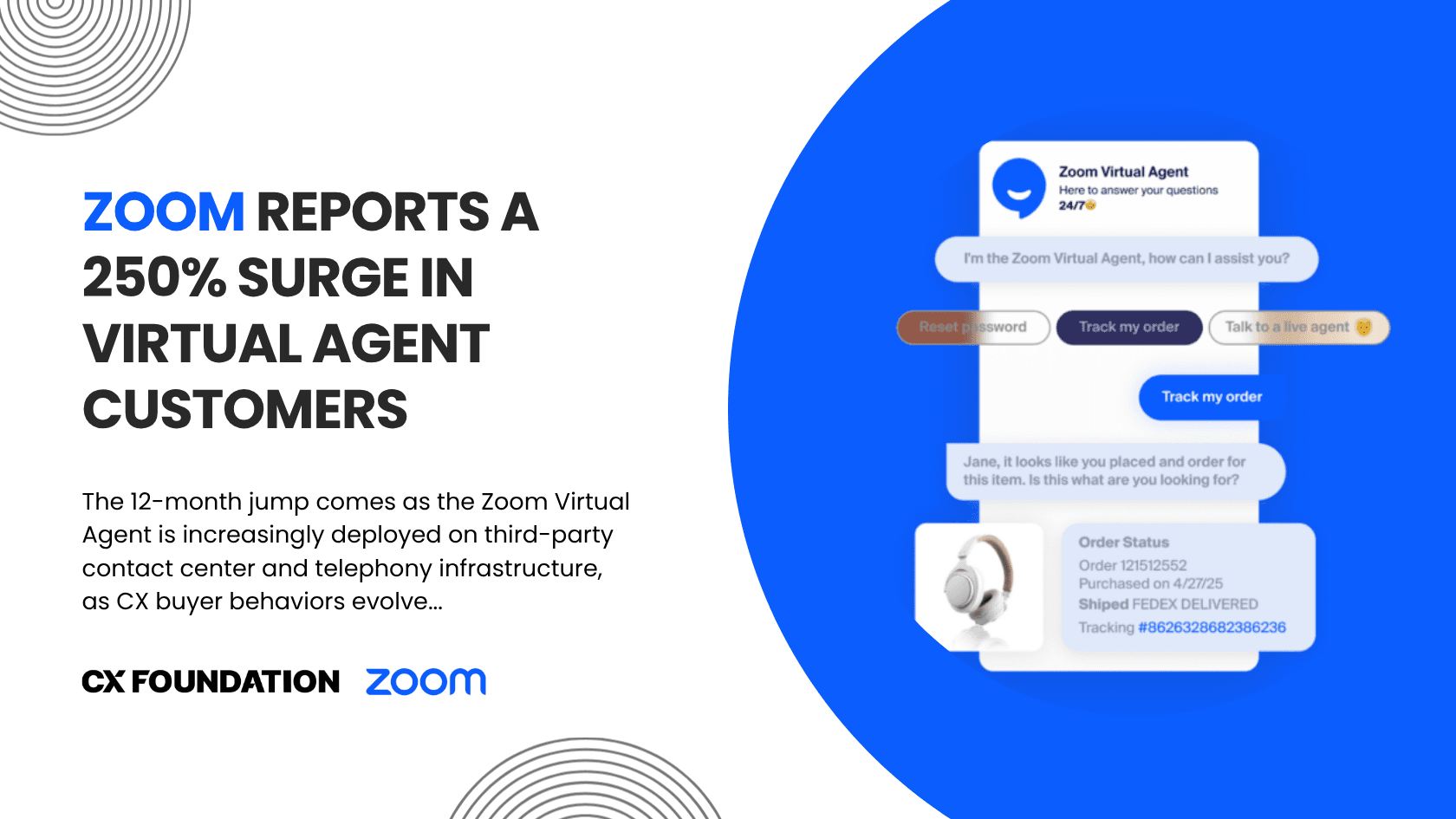
Zoom has reported a more than 250% year-over-year (YoY) hike in customers implementing its Zoom Virtual Agent (ZVA).
The news comes as companies increasingly adopt ZVA as both an extension of Zoom Contact Center and a standalone conversational AI solution.
For example, last quarter, “one of the largest US banks” expanded its Zoom Contact Center deployment by adding ZVA and Zoom AI Expert Assist.
Eric Yuan, Founder and CEO of Zoom, shared this and several other significant customer wins during the company’s Q2 2026 earnings call.
“Increasingly, customers are going all in on Zoom CX, combining our Zoom Virtual Agent and agent-assisted AI solutions to enable seamless transitions from automated self-service to human support.”

However, while Yuan has often touted the possibility of expanding Zoom Contact Center deployments with ZVA, standalone ZVA deployments are also rising.
Last quarter, four of Zoom’s ten largest ZVA deals last quarter were standalone deployments.
Ultimately, that points to a key trend running through the contact center technology market: spinning out standalone AI solutions is quickly becoming a viable go-to-market strategy for platform providers as CX buying behaviors change.
Zoom is taking advantage of this trend…
Zoom Benefits from Changing CX Buying Behaviors
Standalone AI products enable small initial commitments, rapid deployment, and low monthly spend, allowing organizations to test before broader transformation.
At a time when 91% of customer service and support leaders feel under pressure to implement AI, according to Gartner, such solutions are becoming increasingly attractive to CX buyers.
Mark Taylor, Director of Fortay Connect, took note of this market climate during a recent webinar with the GAIA-CC community of contact center consultants.
“The barrier to entry cost and time of deployment would be exponentially higher for a complete CCaaS platform versus a standalone AI solution... [So,] people are looking at the AI facet and looking at that first.”

Yet, these standalone AI solutions typically reach a certain level before plateauing.
Andy Lee, CEO of Crescendo, recently highlighted this trend when his conversational AI company launched its own CCaaS solution.
Indeed, he noted that the underlying CX architecture sets the ceiling for how successful a standalone solution can be.
After deploying ZVA, Zoom can show early success and then make this exact case for taking control of the underlying CX layer and bolstering the existing ZVA deployment.
As a result, it may extend conversational AI implementations into broader customer experience transformations.
Essentially, this represents a land-and-expand strategy, but instead of only landing with the Zoom Contact Center and adding ZVA, Zoom can flip the equation.
In this sense, ZVA is becoming a Trojan horse into the customer experience stack.
Zoom Could Expand Its “Trojan Horse” Strategy
As noted above, a hybrid overlay architecture is the preferred approach to contact center AI transformations for many organizations.
Within such an architecture, AI sits on top of existing infrastructure without requiring replacement of underlying telephony or CCaaS systems.
ZVA provides a conversational AI layer, while leaving the door open for Zoom to deliver the broader platform in the future.
It’s the Trojan horse.
Yet, Zoom could also make other AI solutions available on a standalone basis and take further advantage of this market trend.
It has already made its ZVA Receptionist available across third-party environments, operating independently of the underlying telephony platform, whether Avaya, Cisco, Microsoft, or others.
Now, Taylor expects Zoom to expand this strategy and sell Zoom CX Insights, its contact center conversational intelligence solution, as a standalone offering.
Interestingly, CX Insights also sits on top of Zoom’s Contact Center and Workforce Engagement Management (WEM) products, connecting insights and adding value when customers expand.
Over time, Zoom may also spin out its WEM solution, gradually winning layers of the contact center stack and making it all work together.
Tim Banting, Founder and Principal Analyst at SoWhatNowWhat, believes that could be a winning strategy for the company.
“CX technologies are colliding, getting into a big amorphous block that we’re trying to get our head around. That is leading to a lot of people just sitting still and saying, ‘I really don’t know which way to go.’ Zoom and others can benefit from this.”

How Zoom Competes In Standalone Conversational AI
Zoom is far from the only conversational AI vendor layering its own technology over third-party CX environments. From stalwarts like Google and Kore.ai to disruptors like Sierra and Decagon, competition is fierce.
Nevertheless, if CX architecture sets a ceiling for conversational AI, Zoom could help organizations raise it by taking ownership of the underlying CX layer.
During Zoom’s latest earnings call, Yuan underscored this platform ownership as one of two significant differentiators.
“With the UCaaS, CCaaS, ZVA, plus our AI technology, we have high confidence we can execute very well compared to any other vendor.”
The second differentiator is in its proprietary AI models, with Yuan underscoring the company’s automatic speech recognition (ASR) engine as “one of the best in the world”.
Alongside this, Zoom offers a federated AI approach, where it benchmarks competitive ASR and Text-to-Speech (TTS) models - in addition to third-party large language models (LLMs) - and lets customers pull in the best model for the use case.
One final differentiator Yuan didn’t mention is Zoom’s pricing. It is one of the few vendors offering both consumption- and outcome-based models, allowing organizations to test and implement the model that makes most sense in their environment.
More News from Zoom’s Q2 2026 Earnings
Last quarter, Zoom’s total revenue grew by 4.9%, with enterprise revenue up 7.8%, representing its strongest rate in three years.
On the CX front, the company also set a record for the number of seven-figure Zoom Contact Center deals in annual recurring revenue (ARR).
One of those deals was with a “major” US cybersecurity company, which unified its existing Zoom UCaaS deployment with Zoom’s CCaaS offering, displacing multiple vendors.
Interestingly, this underscores how Zoom can land and expand in multiple directions.
According to Yuan, it also showcases how Zoom can help companies build “a unified AI-first system of action that connects self-service, human support, and internal communications to deliver better customer outcomes at scale.”
Elsewhere, Workvivo crossed the $100 million ARR milestone and the Zoom Revenue Accelerator - bolstered by the recent $250 million Common Room acquisition - grew 41% YoY.
Finally, Zoom remains on track to surpass $5 billion in revenue this year, according to CFO Michelle Chang.
Thanks to the GAIA-CC community for sharing insights on changing contact center AI buying patterns for this article.