
August 21, 2026 • 9 min read
Outcome-Based Pricing Models: Examples, Benefits, Challenges, & Negotiation Advice

Director of Content & Market Research
August 21, 2026
Across the enterprise software landscape, disruptors are championing outcome-based pricing.
Nowhere is this more evident than in conversational AI, where companies like Sierra, Decagon, and Retell AI are selling outcomes and rapidly gaining market share.
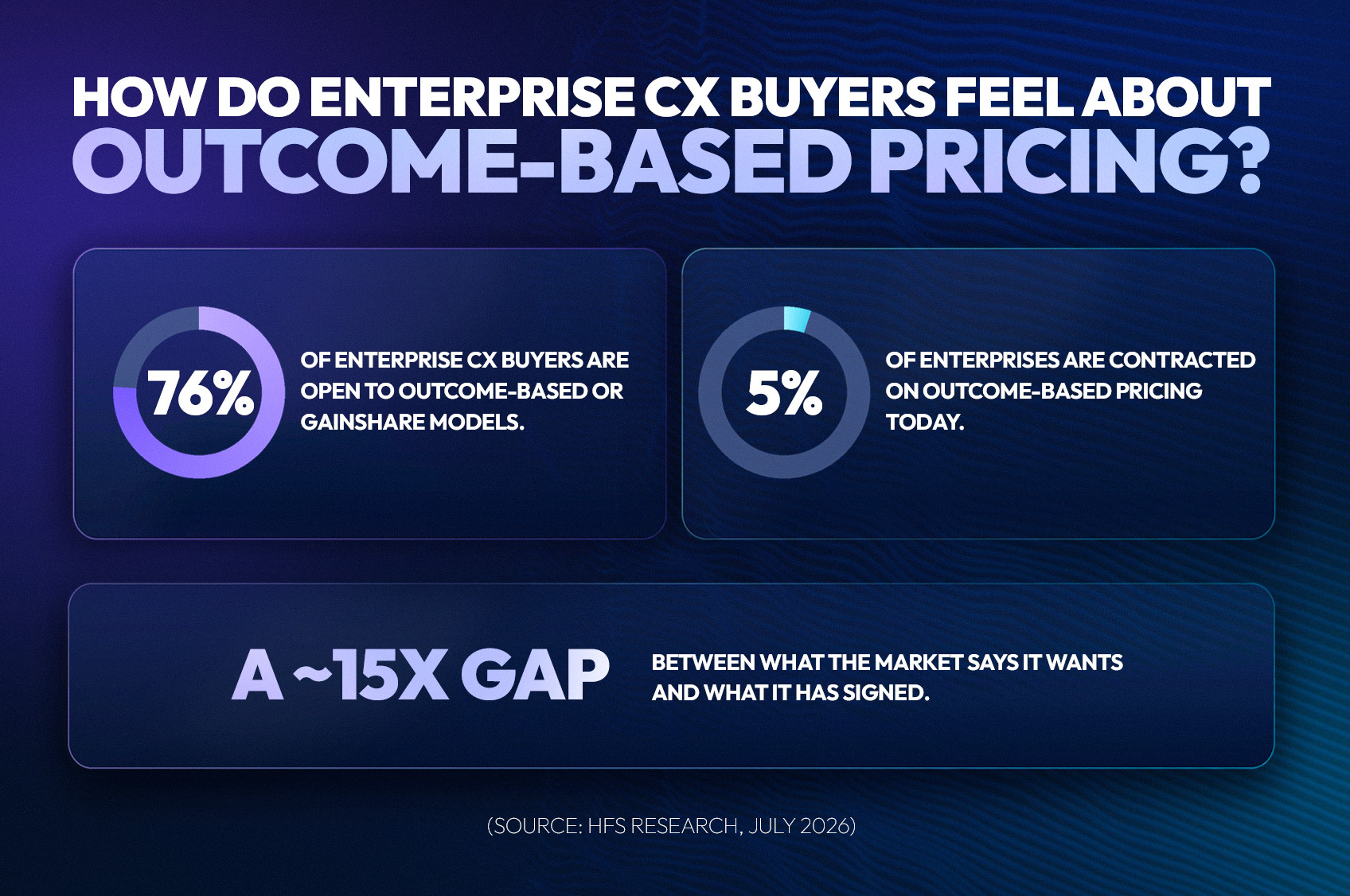
These companies typically sell to enterprise CX buyers, 76% of whom are open to outcome-based pricing models, according to HFS Research.
Still, as of July 2026, only 5% are contracted on outcome-based pricing.
Ultimately, that reveals a 15x gap in what the market says it wants and what it has signed.
While that gap will likely close, it suggests that, despite all the merits of outcome-based pricing, CX buyers have notable concerns about making such a model work in practice.
What Is Outcome-Based Pricing?
Outcome-based pricing is a model in which a seller charges a customer only after a pre-agreed, measurable result has been achieved.
In AI and enterprise software, it offers an alternative to traditional license-, seat-, and consumption-based models, aligning buyer and seller incentives.
After all, the seller only gets paid if it delivers outcomes that the buyer values.
However, the model introduces new challenges for both parties, chiefly in negotiating and measuring those outcomes.
Examples of Outcome-Based Pricing Models
As noted, outcome-based pricing is becoming increasingly common among conversational AI providers selling to customer support teams.
Almost ubiquitously, the outcome they sell is a "resolution", so the organization pays only once an AI agent has resolved a customer contact.
However, vendors define a “resolution” differently, as the table below illustrates.
| Solution | How It Measures an Outcome | Listed Price-Per-Outcome |
| Zendesk AI Agents for Service | If the customer doesn’t make a repeat contact in 72 hours, that’s a resolution. | $1.50 per successful resolution
|
| Salesforce Help Agent | If the customer says: “Yes, the case was resolved,” that’s considered a resolution. | $2.00 per successful resolution |
| Crescendo | If a customer’s ticket is marked as closed and their satisfaction increased during the conversation, that’s a resolution. | $1.50 per successful resolution (typical) |
| Fin AI Agent | If the customer explicitly confirms satisfaction with the conversation or leaves without escalating to a human within 24 hours, that’s a resolution. | $0.99 per successful resolution |
Sierra, Decagon, Omilia, and Retell AI also offer outcome- or “resolution-based” pricing. However, they don’t publish a standard definition and rate card. Instead, they custom-negotiate all enterprise contracts.
Retell AI’s approach is slightly different. It uses an AI Quality Assurance tool to let the organization define a successful outcome and prices accordingly.
While this is an interesting approach, the wide variation in market pricing - around a relatively straightforward use case - is a warning sign: brands must be cautious that their definition of an "outcome" aligns with a seller's.
Many contact centers, for instance, consider a case resolved only if the customer doesn't call back within 30 days. Yet the earlier examples show providers only waiting 72 hours (at most).
This misalignment signals a key challenge of outcome-based pricing models, and there are others. But, before that, here are the benefits…
3 Benefits of Outcome-Based Pricing
When sellers bring outcome-based pricing models to market, they often tout the following three benefits to buyers.
1. Organizations Only Pay When They Realize Value
The premise of an outcome-based model is simple: buyers only pay when they’ve achieved the outcomes they agreed upon with the provider.
This means organizations don’t have to risk high, upfront technology-related costs before they start seeing results.
2. The Seller’s Incentives Align with a Successful Implementation
If buyers only pay when they achieve specified outcomes, providers are more incentivized to help them get there.
Indeed, companies using outcome-based pricing, like Sierra and Fin AI, often take a more consultative approach, forward-deploying engineers to increase the chances of a successful implementation.
3. The Commercial Model Is Often Easier for Employees to Understand
In customer support especially, most leaders are not well-versed in AI terminology, such as tokens and actions, but they understand resolutions.
As such, an outcome-based model can be easier for leaders to understand and - critically - forecast, enabling a broader understanding of the pricing model.
"If a provider says, ‘I’m going to resolve 40,000 queries a month and save your team from handling them,’ the ROI is immediately tangible to everybody within the company."

3 Challenges of Outcome-Based Pricing
When buyers evaluate and then utilize outcome-based pricing models, they typically encounter the following challenges.
1. The Buyer & Seller Might Define an Outcome Differently
Not all “outcomes” are created equal, and what buyers consider an outcome or resolution may differ from what vendors actually count.
Given this, significant negotiation is often involved, and buyers should be wary that the provider may not be able to track outcomes in a way that aligns with their definition.
“Procurement leaders want to know what outcomes they're actually paying for and what they're projected to get over the next 12 months, so they can budget accordingly. But most software products can't yet show a resolution as an outcome in real time or break them down daily/weekly/monthly in a way that ties cleanly back to the agreed terms.”

2. Prices Per Outcome Don’t Flux with Complexity
Sellers typically charge a flat fee per outcome, regardless of how many steps the AI agent takes to achieve it.
Again, take customer support as an example. The seller will charge the same price for a “resolution”, whether it's a simple password reset or a complex, multistep query.
As a result, businesses applying AI to mostly simple queries can end up paying significantly more than they would under a usage-based model.
3. Outcome-Based Pricing Models Are Destined to Become More Complex
If an organization starts with an outcome-based AI agent running reactive customer service, tracking a “resolution” as an outcome is fine.
Yet, what happens when the contact center, or broader organization, wants to deploy other AI agents?
“Consider an AI agent that identifies churn signals on the fly, without any pre-built rules, and then runs an intervention to get the customer not to churn. How can a vendor price that outcome?”

“Ultimately, the business is going to have to bring in another measurement, which adds a layer of complexity to customer billing,” concluded Jacobs.
A Final Challenge (This Time for the Seller)
While conversational AI disruptors embrace outcome-based pricing, notably, many of the stalwarts - including Kore.ai, NiCE Cognigy, Google, and IBM - haven’t.
Why? Likely because they realize the need to separately evaluate AI agents not just on whether they achieved an outcome, but on how efficiently they got there.
After all, as Jacobs stresses, while payment is tied only to outcomes, resource costs will fall on the provider.
How Should Buyers Negotiate Outcome-Based Pricing
As noted, definitions of outcome-based pricing models can vary significantly, making them difficult for organizations to negotiate.
Nevertheless, the following five best practices, put together with input from Adam Mansfield, Commercial Advisory Practice Leader at UpperEdge LLC, may prove helpful.
1. Clearly Define the Outcomes and Measurement Framework
The vendor should clearly define every billable outcome, including which scenarios qualify.
But don’t take that as good enough. Challenge the provider to walk through forecasted outcomes and what it expects to deliver over each period following signature.
Following this process should lay the foundation for an agreement that considers:
- What counts as a successful outcome
- How outcomes are measured and validated
- Which scenarios are included or excluded
2. Establish Full Pricing Transparency
Before starting negotiations, the buyer should request the vendor's standard pricing, including the list price per outcome and the list price for prepaid bundles or packages.
Ultimately, this baseline is what makes discount and volume negotiations meaningful.
3. Negotiate Volume-Based Discounts
A flat discount regardless of volume leaves value on the table.
“Buyers should push for tiered pricing, with predefined discount thresholds so per-outcome costs fall as committed or purchased volumes grow, rewarding adoption with better economics.”

4. Protect Pricing After Committed Volumes Are Exceeded
What happens above the committed volume of outcomes is often the biggest blind spot.
Given this, the buyer must clearly establish the price for outcomes above the committed volume and ensure pricing cannot be changed unilaterally once the contract is signed.
The bottom line: avoid leaving overage pricing to a future negotiation.
5. Negotiate Renewal Price Protections
“Renewal economics should be locked in before the initial agreement is signed, not left for the vendor to reset later,” said Mansfield.
The contract should cap price increases and spell out the conditions for any change, ideally fixing renewal pricing or a clear protection mechanism outright.
When large language model (LLM) providers pivot from subsidized growth to chasing profitability, AI costs are likely to rise. As such, buyers must protect themselves accordingly.
What Is the Future of AI Pricing in Customer Experience?
For many, outcome-based pricing may be the future. Yet, given the challenges above, many will opt for alternative pricing models, at least in the short-term.
Perhaps the most notable alternative is consumption-based pricing, with vendors pricing on actions, workflows, and tokens.
Yet, in areas like conversational AI, a hybrid model might represent the next frontier.
Consider a hybrid outcome- or consumption-based model for reactive customer support. Simple customer conversations could be charged on a consumption-based model and more complex conversations charged on an outcome-based model.
Such an approach would optimize organizational spend.
Yet, reporting must improve. After all, many AI providers still port data to third-party business intelligence (BI) solutions - such as Power BI and Tableau - to report on how their deployments are influencing outcomes, like resolution rates.
Moreover, Smith wants to see operational data more closely tied to commercial data. “Currently, vendors are not able to actually link together the consumption of their products to the contracted terms, so business leaders can monitor that closely.”
That means sometimes leaders can be caught off guard when they exceed contracted limits, and tracking value can be tricky.
Still, some reporting gains are being made. The likes of Kore.ai and SoundHound are actively measuring “dollars saved” alongside their deployments to gauge ROI.
However, expect more innovation along these lines to make outcome-based pricing more enticing in customer experience environments and beyond.