March 16, 2026 • 6 min read
Salesforce Releases AI Agents for ‘Every Step’ of the Sales Cycle

Director of Content & Market Research
March 16, 2026
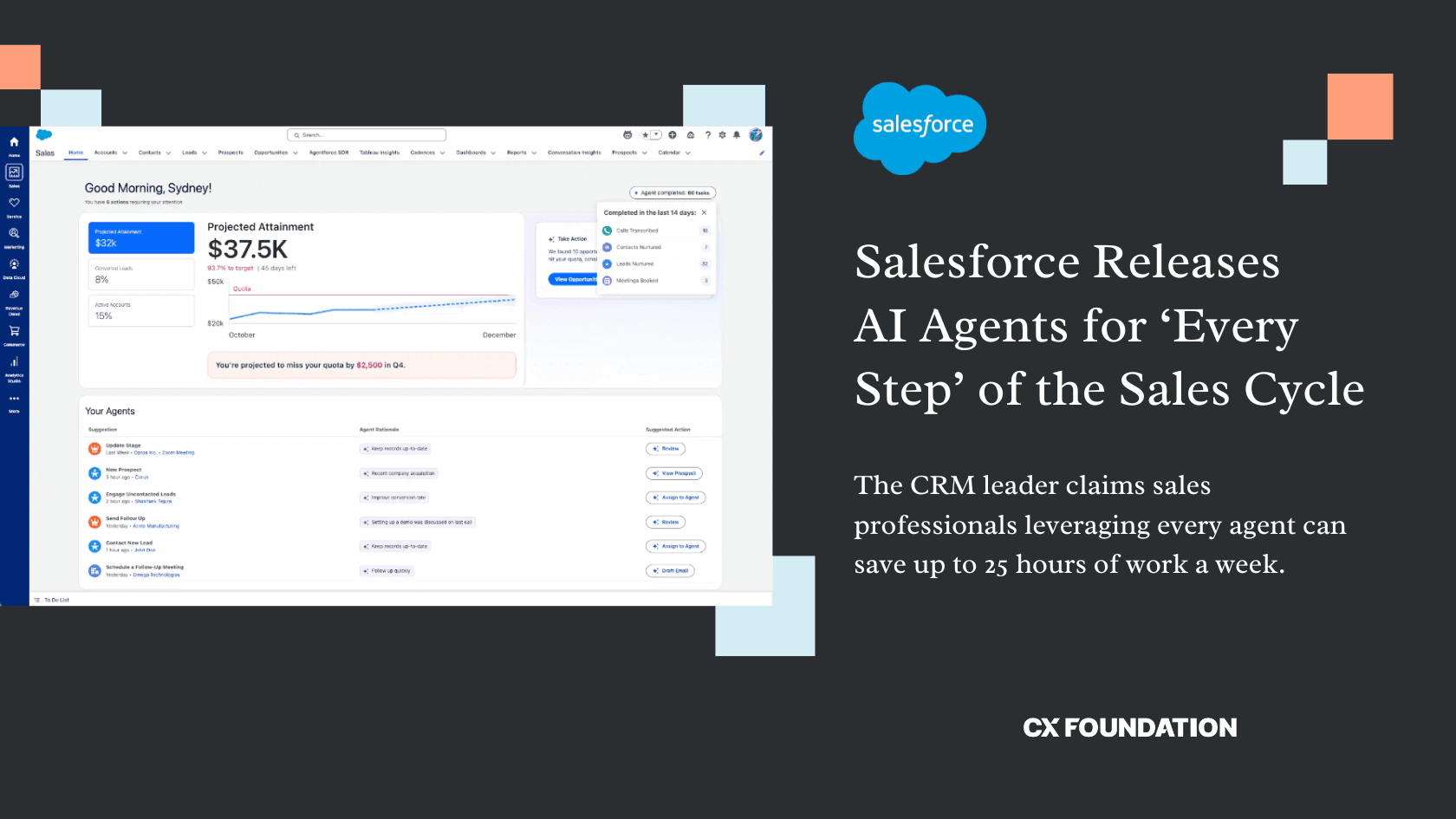
Salesforce has embedded six AI agents across Agentforce Sales (previously Sales Cloud) to streamline ‘every step’ of the sales cycle.
These steps run from prospecting to generating quotes (more on each agent later!).
The CRM leader claims sales professionals leveraging every agent can save up to 25 hours of work a week.
“The 150,000 companies that run on Salesforce already have the data; now, with Agentforce Sales, they have the digital workforce to act on it,” said Kris Billmaier, EVP & GM for Agentforce Sales at Salesforce.
“By providing every rep with a team of agents to manage high-volume tasks, we are eliminating the administrative ‘tax’ on sales teams. This ensures every lead is nurtured and every rep can focus on the high-value relationships that drive revenue.”

Nevertheless, by embedding pre-configured agents, Salesforce doesn’t only aim to lower the ‘tax’ on sales professionals; it also strives to reduce the burden on IT teams.
After all, the new agents, which follow business logic, lower the dependency on custom agent development, tuning, and testing, which has slowed enterprise AI adoption.
Some agents are also designed to reduce integration friction, extending workflows beyond Agentforce Sales into the broader Salesforce ecosystem and third-party apps such as Microsoft Teams (alongside Slack) and ChatGPT.
By building and embedding these agents itself, Salesforce is inheriting complexity from its customers. That underscores a significant shift in its AI agent strategy.
“Salesforce’s initial push involved getting customers to make as many agents as they felt was necessary. The company now has a tighter understanding of what agents are the most effective, including the data and contextual fabric needed to make them perform well in the flow of sales motions,” explained Martin Schneider, VP & Principal Analyst at Constellation Research.
“This shift to a ‘jobs to be done’ versus a ‘just build an agent and find the use case later’ approach will make it easier for revenue organizations to adopt AI agents and show ROI faster in the deployment life cycle.”

Lastly (before getting into the individual agents), Agentforce Sales users can collaborate with embedded agents via the Sales Workspace. From there, users may also gain real-time visibility into the work AI is doing on their behalf.
The Team of Agentforce Sales Agents
Here’s a closer look at the six agents Salesforce is embedding across Agentforce Sales to ‘reinvent’ the sales cycle.
1. The Prospecting Agent (Generally available March 31, 2026)
Salesforce acquired Bluebirds in July 2025, a prospecting platform with a database of seven million company accounts. It tracks buying signals across all of them, including funding announcements, new hires, tech implementations, and more.
The Prospecting Agent takes such signals from companies that match the organization’s ideal customer profile (ICP), building a prioritized list of prospects for sales personnel to contact, with an explanation of why now is the right time to reach out.
Additionally, the agent enriches contact data – i.e., job titles, phone numbers, and email addresses – to ensure the sales team reaches out to the right people. It can also generate personalized introduction messages.
2. The Engagement Agent (Generally available now)
If an initial outreach attempt failed to generate a response, the Engagement Agent gives a polite nudge to pull the prospect in.
Once the customer does respond with questions, the agent sends replies, leveraging connected knowledge and data sources, streamlining the typical back-and-forth of sales interactions.
If interest wanes over those conversations, the Engagement Agent escalates. However, if the prospect shows interest, it can book a call with a sales rep across third-party calendar apps.
3. The Account Research and Meeting Prep Agent (Generally available now)
Before customer meetings, sales teams engage in research and often create briefs to steer the conversation. The Account Research and Meeting Prep Agent automates that process.
Per Salesforce, users may also use the new Slackbot to prepare for meetings, gathering context from across the vendor’s ecosystem and integrated applications.
4. The Pipeline Management Agent (Generally available now)
The Pipeline Management Agent monitors seller activity across Agentforce Sales, emails, and meetings to deliver proactive recommendations on how to move key opportunities forward.
That may involve reminders for follow ups, sending calendar invites, or updating fields in the CRM around deal stages and next steps. With a prompt from the seller, the agent may even fulfil those tasks automatically.
5. The Quoting Agent (Generally available now)
When customers are ready to buy, the Quoting Agent ingests prompts from the sales representative alongside pricing guides, discount rules, and additional customer context to produce a branded, personalized quote. The seller can then review and send.
Salesforce also makes it possible to run the quote creation process in Slack, so long as the organization has implemented the corresponding API.
6. The Partner Success Agent (Generally available now)
The Partner Success Agent provides instant responses to partner queries to speed up issue resolution, while allowing for handoffs to a human agent when needed, similar to a customer-facing AI assistant.
Additionally, the agent can surface key resources for onboarding and enablement. As an example of the latter, it may recommend relevant enablement programs designed to help partners boost engagement and drive growth.
What’s Next for Agentforce Sales?
Sales teams understand the need to adopt AI, but the real challenge is ensuring it produces business value.
Don’t think of that only through the lens of saving hours. Where AI will become more powerful is when it feeds insights back into the broader organization for action and growth.
For instance, customer service interactions might reveal upsell and cross-sell opportunities. If that feedback reaches the sales team, the company can unlock new revenue opportunities and bolster customer satisfaction.
That cross-department AI agent orchestration is a critical next step to add value beyond narrowly-defined agents, embedded to deliver quick success.
Ultimately, reaching that next-level of orchestration will be complex and require organizational change, not just technology.
However, Salesforce has done an excellent job of customer education to help inspire that change, sharing real-world Agentforce use cases and building a cohesive environment across customer-facing departments (with Data 360 the glue).
With embedded agents across Agentforce 360, which companies can turn on, Salesforce will hope to build confidence and an appetite for these latter-stage approaches.