
January 7, 2026 • 24 min read
32 Agentforce Use Cases & Their Real-World Results

Director of Content & Market Research
January 7, 2026
AI agents can do more than automate interactions, summarize meetings, and generate content. The latest Agentforce use cases highlight a range of new possibilities.
Many of these use cases came to the fore at Dreamforce, where some of the 18,500 Agentforce customers (as of December 2025) took to the stage to showcase the AI agents they have built on the platform.
Such customers included Indeed, PepsiCo, and Siemens, each of which – alongside many other global brands – shared Agentforce use cases that crossed customer service, sales, marketing, and beyond.
In doing so, these brands claimed to have achieved significant success in improving productivity, reducing costs, and enhancing customer experiences.
Here are 32 notable Agentforce use cases shared at the event, with perspectives from many of the recognizable brands that have implemented them, as expressed at Dreamforce.
Agentforce Use Cases for Customer Service
Customer service is ground zero for many agentic AI projects, with brands grasping an opportunity quell inbound volumes and orchestrate new support experiences. Nevertheless, the possibilities extend far beyond contact automation, as the following use cases exemplify.
1. Resolving Customer Contacts
Service teams have long utilized chatbots to automate customer queries. However, these bots often failed to properly gauge the customer’s intent, shift between intents, and adapt when the customer says something unexpected.
The Agentforce Service Agent promises to change that, interpreting intent, language, and tone to respond to increasingly complex queries with more empathy, while handling the twists and turns of a natural conversation.
In addition, the agent can understand images and audio, enabling resolution flows that cross channels and blend modalities.
Lastly, as an AI agent, it can communicate with agents working in third-party systems to pull external data and trigger actions inside of adjacent technologies. As a result, it can automate longer-tail resolution flows. Brands must be cautious here, however, as this requires additional guardrails.
“Since we’ve launched, we’ve resolved over 30 percent of our cases autonomously while improving our CSAT (customer satisfaction).”
2. Enabling Pre-Emptive Customer Service
Agentforce agents can track signals in enterprise systems that indicate the customer has or is about to experience an issue. From there, they can trigger a pre-emptive action to resolve that problem and communicate the solution to the customer. Ultimately, that saves them the trouble of contacting the support team and lowers customer effort.
PepsiCo has implemented such Agentforce agents. These predict when inventory is running low and automatically send a text message to the customer. With one click, they can place an order they didn’t know they needed.
“[Others] think of the world of Agentforce as a productivity play. For us, it’s a growth play as well. We’ve seen massive efficiency gains, on the order of 25 to 30 percent, wherever we’ve implemented Agentforce.”
3. Prepping Customers for Conversations with Live Reps
When customers have an issue, service reps must often probe for more information than they have available in the CRM to arrive at a solution.
On digital channels, even if an Agentforce agent is unable to resolve the query, it may recognize the need for more information and request additional details before the case is triaged. It can then escalate the case to a rep, with that new context, so they can begin problem-solving more quickly.
Meanwhile, on voice, an Agentforce agent may gather pertinent information to the caller’s intent in the call queue, again shaving seconds off the interaction.
“A customer sends an email saying they have a new banking account, but the account number is incorrect. [Our] agent automatically sends an email back asking the customer to verify the number. The agent in the [contact] center doesn’t need to handle it at all; it becomes a completely autonomous case.”
4. Drafting Customer Responses for Review
Sometimes the contact center may want a human-in-the-loop, even if an Agentforce agent could resolve the customer’s issue autonomously. These could include cases where reassurance from a live rep could significantly boost customer morale or where there is an upsell opportunity.
Across digital channels like email, live chat, and messaging, Agentforce can still do much of the work by suggesting responses based on knowledge content and business context. The live rep may then review, tweak if necessary, and send the reply to the customer.
While this is trickier on voice, some companies have implemented an agent that takes notes as the customer speaks. This use case allows reps to follow the customer without losing track of key points, aiding their response and accelerating the conversation.
5. Reimagining Call Center Screen Pop
Screen pop is a longstanding contact center solution that checks the caller ID to present the rep with key customer information from the CRM at the start of a customer conversation.
Agentforce promises to transform this technology by gauging customer intent, retrieving customer information stored across the business, and sharing key information at the moment it’s needed by monitoring the live conversation.
Additionally, such an agent could use that information to automate tasks on behalf of the rep, such as form filling, copying and pasting, and updating records. The use case also has potential beyond the boundaries of a contact center...
“We’re scanning all of the systems, bringing up the information, and pre-preparing these nurses to help patients. We have all the information about the member before even the first call, and administrative work like note-taking is also being done. It reduces close to 90 minutes per nurse.”
6. Mitigating Employee Burnout
Many customer service teams can already track employee sentiment and key productivity indicators across the day, thanks to previously implemented conversational intelligence tools. Agentforce offers an opportunity to translate that insight into actions.
For instance, if a rep has endured three difficult calls in a row, the agent may spot that and offer them a quick break or spoon-feed them a contact that is likely to be simple, given the customer’s stated intent.
Moreover, an Agentforce agent could also pinpoint a training need from the tricky interactions and inform the quality assurance (QA) team. Such use cases represent a new opportunity in the world of contact center workforce engagement management (WEM).
“[Our] agents also support staff wellness, preventing burnout and allowing them to impact families differently. It’s a very emotional space for them to be in every day.”
7. Automating Post-Call Processing
After every customer interaction, reps have historically had to complete post-call processing. That involves summarizing the conversation in a CRM, tagging the intent (or “disposition code”), and completing follow-up tasks, like sending a confirmation email.
An Agentforce agent can automate all these tasks, while spotting trends in the summaries and collating product feedback to share with marketing, research, and sales teams.
Sidenote: A Fascinating Case Study from Zota
Agents that piece together rep development plans, add context to QA scores, and configure reporting dashboards based on written prompts are further examples of Agentforce use cases brands can build on Agentforce. Yet, there are many more.
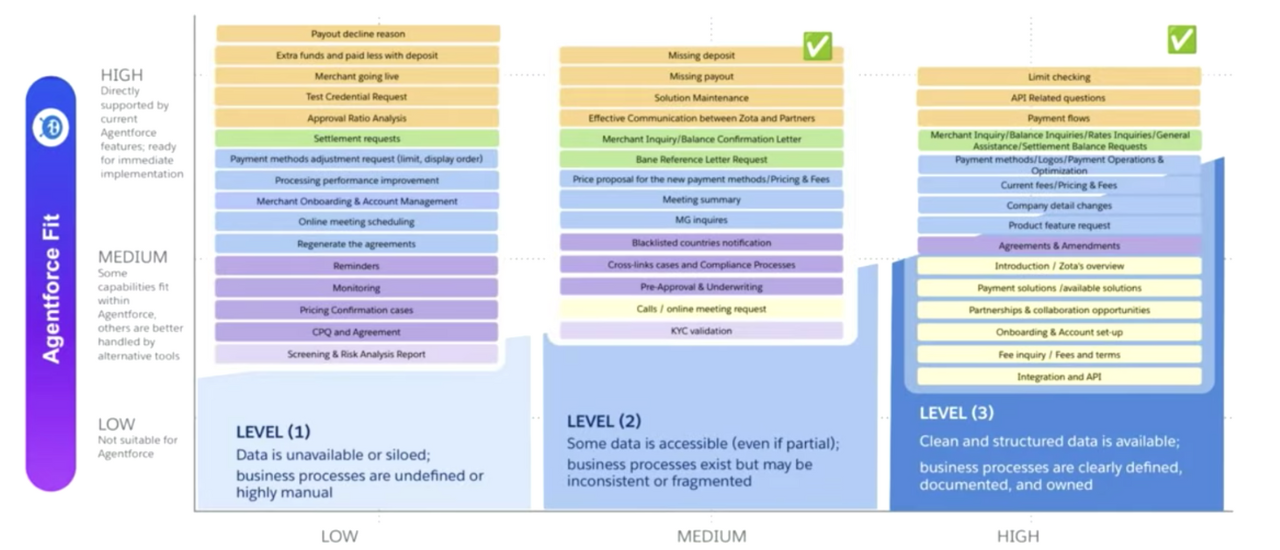
During his presentation at Dreamforce 2025, Abe Ziv, CEO of Zota, shared 50 Agentforce potential use cases for customer service alone. The graphic below articulates each of these and sheds light on how the company prioritized them and prepped for their implementation.
Agentforce Use Cases for Sales
Salesforce has a Sales Development Representative (SDR) Agent available natively on Agentforce Sales (previously Sales Cloud). Nevertheless, the possibilities for AI agents extend further, as sales teams have found success in implementing several other Agentforce use cases.
8. Reimagining Prospecting & Enriching Leads
An Agentforce agent can analyze CRM records, meeting transcripts, and emails to prioritize a list of accounts and contacts for salespeople to engage with. It may also pull in web data to enrich that list.
For instance, the agent may notice a lost prospect who, months previously, asked the salesperson to reach out again ahead of their annual planning cycle. They may also be showing buying intent on a platform like Demandbase. Agentforce can connect the dots, flag the ideal moment to reach out, and draft a personalized email ready for a salesperson to review and send.
“We found that sellers could spend anywhere from 45 minutes to a few hours just assembling a plan. There are many steps that happen before that, too, onboarding data, enriching leads, and integrating partner data from the AppExchange. Even with a solid foundation, it was still time-consuming. Using agents, we’ve compressed that process dramatically. What used to take 45 minutes to two or three hours now takes just minutes. We can quickly onboard a lead, enrich it with data, convert it through qualification, and generate a plan.”
9. Reviving Dead Leads
Sellers often give up on chasing leads after months with little response, considering them ‘dead leads’. Yet, after years of accumulating ‘dead leads’, many of those previously disengaged contacts may be in a better position to buy.
With Agentforce, sellers can reach out to all these leads with a carefully constructed, personalized nurture email to test the water and bolster their pipeline.
“Our first use case we ever tried was to take 100,000 old, dead leads and run them through the nurturing agent and just see what it did. And it found some revenue and opportunities we didn’t know existed.”
10. Evolving Lead Nurturing
Agentforce Lead Nurturing is an agent that sends a polite nudge when prospects haven’t responded to the initial outreach.
If they do reply, it answers their questions using trusted company data and knowledge content, cutting through the endless back-and-forth of many sales conversations.
Once a prospect shows interest, it hands off to the salesperson to schedule the meeting. It also escalates when conversations go off-track or when a prospect opts out.
“Teddy [Asymbol’s agent] has three responsibilities: one, work with prospects to make sure they’re the right customer profile that we can successfully support; two, nurture those prospects, teach them about us, and get them excited about us; and three, introduce that prospect to a human so the human can continue the process from there. We’ve seen tremendous success. Teddy is working with 1,000 to 1,500 leads at any given time.”
11. Bolstering Pipeline Management
Agentforce Pipeline Management tracks a seller’s activity – covering meetings, emails, and notes - and makes suggestions to keep opportunities moving forward.
For example, it may remind the sales rep to send meeting invites, craft follow-up emails, and update fields in the CRM, such as ‘Stage’ and ‘Next Step’. It can also perform these tasks automatically, with a nudge from the seller.
12. Automating Quote Creation
Creating personalized quotes is often an all-consuming process. Yet, Agentforce promises to take written prompts from the sales reps, alongside customer context, product pricing, and discount rules to configure the quote automatically.
From there, the agent generates a branded PDF quote, which the sales rep can review and send.
Per Salesforce, Agentforce Sales (formerly Sales Cloud) customers can deploy such an agent and manage the entire quote creation process in Slack, as long as they have implemented the corresponding API.
13. Generating Performance Feedback
Agentforce Sales Coach allows salespeople to practice product pitches on a recorded video. It then analyzes the video to offer feedback on their skills and product knowledge, before highlighting areas for improvement and recommended next steps.
The personalized feedback is grounded in CRM data, aligns with the company’s stated goals, and aspires to help reps feel confident and ready for their upcoming meetings.
Below is a video that dives deeper into the Agentforce Sales Coach.
14. Pivoting Service Contacts Into Sales Opportunities
When Agentforce handles a service interaction well, customers are often in a good mood. Brands can harness that positivity by leveraging Agentforce to pitch additional products that are relevant to their previous purchases and visitor behavior. It may also book follow-up calls with a sales rep and answer any additional questions the customer may have.
Alternatively, if an existing customer showed buying intent in an online chat but left before purchase, Agentforce can prepare a follow-up email to re-engage them, handing over qualified leads to sellers.
Agentforce Use Cases for Marketing & Commerce
Agentforce use cases for marketing teams go beyond generating content for web copy, social media posts, and campaign assets. With brands like Indeed running end-to-end campaigns on Agentforce, agents are transforming the field. The following use cases underscore how.
15. Creating End-to-End Marketing Campaigns
Marketers can leverage Agentforce to create end-to-end campaigns via natural language prompts, spinning up campaign briefs, audience segments, and content that aligns with brand guidelines.
From there, brands can customize the sequence in which agents complete these tasks.
As the campaign runs, Agentforce may also summarize its performance, delivering daily, actionable insights while generating shareable updates to keep stakeholders informed.
“[Agentforce drafts] entire campaigns, including some framing for the orchestration as well as the content. And a process that might have taken the team days and coordination across other teams has now been consolidated in a matter of moments.”
16. Adapting Online Experiences
With Agentforce, some brands leverage visitor behavior data – including where customers look on the website, return visits, drop-off points in the online commerce journey, etc. – to dynamically alter the user experience.
Additionally, agents may utilize such insights alongside data aligned with the customer’s online profile to personalize product recommendations, tailor copy, and apply discounts.
Lastly, agents may run audits and share recommendations to bolster the overall online experience.
“We are actually co-developing with Salesforce a concept called predictive websites. So what does it really do? It's not only about the agent. Based on the agents, it transforms the way the website works. It dynamically builds a website based on what customers enter as an assistant.”
17. Supporting Content & Asset Generation
Agentforce can ingest prompts, supporting materials, and brand guidelines to create copy for social posts, blogs, newsletters, case studies, reports, and more, alongside content for campaigns.
Yet, some marketing teams are starting to use it in more novel ways.
For instance, Salesforce shared how customers have developed personalized agendas for event attendees. Here, Agentforce scours a customer’s purchase history, past attendance records, and engagement signals to isolate the sessions and resources most likely to benefit them.
18. Managing Loyalty Programs
As with marketing campaigns, Agentforce can automate the creation and configuration of loyalty programs via prompts. It can also adapt programs over time, based on their performance.
In addition, Agentforce can personalize programs, reasoning on customer behavior signals to update loyalty offers, such as discounts, rates, and bonuses.
When a specific customer becomes eligible for the program, Agentforce may send out a personalized invitation to join the loyalty program.
19. Targeting Key Accounts
For many businesses, a small percentage of accounts drives an outsized proportion of their revenue. As such, finding new ways to engage and drive more value from these customers is a marketing prerogative.
Recognizing this, McPherson's has developed a ‘Key Account Agent’ that dives into a customer’s CRM records and suggests promotions that are most relevant to them, inspiring more thoughtful marketing materials and sales conversations.
“Instead of spending hours creating promotions, key account teams can quickly ask the agent for insights on leading promotion tactics for specific customers. The agent surfaces the information, allows us to create and edit promotions - including time bands and parameters - unlocking productivity. Key account teams can now have more strategic conversations with customers about trade spend… It took about a day to set up the Key Account Agent parameters and deploy it for testing.”
20. Enabling More Conversational Commerce Experiences
Virtual online assistants aren’t only for customer service. Commerce teams can develop similar customer-facing agents, which allow web visitors to describe exactly what they’re looking for and generate the most accurate results, based on product descriptions, reviews, and imagery.
These agents may further interact with customers to refine the search results and deliver the best match.
“The old menu-driven filters—like “women's bracelets, gold, under $10,000”—don’t work anymore. Customers want conversational search. For example, someone might say, “Next month, I’m going to a beach wedding. I’m wearing a sleeveless sundress. I want a chunky gold bracelet under $5,000.” The bot curates that experience. They can refine it further: “I want something daintier, show me mixed metal options, and let’s go to $7,500.” This interactive process falls into conversational commerce, where the customer can complete a transaction seamlessly, using their stored payment details.”
21. Tracking Key Metrics Like Customer Lifetime Value with More Granularity
Most customer experience teams rely on dashboards, configured many moons ago, to assess customer experiences. Yet, AI agents promise to change the nature of reporting by scouring various data sources and spinning up new dashboards based on written prompts in minutes, even where parameters weren’t defined in advance.
Critically, this opens up the possibility to track new metrics, as well as delve deeper into the numbers brands already monitor day in, day out.
“The real game-changer for us [with Agentforce] is that we can now track the lifetime value of a client. Instead of thinking account to account, we can follow clients as they move from company to company and understand their lifetime value to Deloitte. I’ll share one more stat… we now know that clients who attend five Deloitte signature experiences generate a pipeline that’s four times larger than any other client we serve today.”
22. Summarizing Customer Sentiment
Seeking customer feedback has become increasingly tricky via surveys. Agentforce agents can combat this issue by gathering qualitative insights from third-party review sites, social media platforms, and customer support interactions before categorizing that feedback.
From there, marketing teams may unlock new insights and analyze how sentiment swings between various customer groups.
In the future, Agentforce agents may begin to make predictions as to how a net promoter score (NPS) may shift between customers on different campaigns. Such predictive measurements are the future of marketing metrics.
Agentforce Use Cases in Field Service
In April 2025, Salesforce launched Agentforce for Field Service, which included a library of preconfigured skills and actions to help businesses build AI agents that serve off-site workers in various new ways. Here are some of the use cases brands have unlocked with the solution.
23. Managing Field Worker Schedules & Creating Briefs
Agentforce can automatically assign jobs to field workers based on their skills, profile, and location, while intelligently filling cancellations.
Moreover, it sends out pre-work briefs, asserting the parts and tools field workers may need for the job, weather conditions to stay alert for, and – critically – life-saving rules that could apply to the work scope.
Agentforce customer Engie also noted that it brings up a safety assessment alongside the brief to ensure employees think through the steps they need to take to stay safe.
“Our agents help [field] workers optimize their schedules, provide pre-work and post-work briefs that they can dictate by voice, which is much simpler.”
24. Ensuring Field Workers Have the Right Tools for the Job
Field workers will often run to the warehouse to grab the tools necessary to complete a job, only to realize they’re missing a vital part. That not only results in a wasted journey but delayed appointments.
With an agent in their system of work, however, field workers can scour the inventory remotely and order parts well ahead of an upcoming job, improving schedule adherence and safeguarding the customer experience.
“We tap into our ERP to look at inventory levels. If a part is missing for this job or an upcoming job later in the week, technicians can procure the part directly within their system of work.”
25. Equipping Field Workers with AI Partners
Technicians often have to call in help when tackling a tricky issue. However, with an agent that trawls internal knowledge content and case summaries, field workers can utilize an AI partner that recommends real-time solutions.
Additionally, the AI partner may equip field service workers to enquire about additional services the customer may need and how the business can support them. In effect, this aims to turn field workers into salespeople…
“We are providing field workers with ways to dictate extra work quotations to clients. In a way, we're transforming all NG employees into potential salespeople. That’s very exciting.”
26. Analyzing Trends in Work Orders
With Agentforce, brands can question their data. That benefit extends into field service, allowing managers to see the broader picture beyond the metrics they look at daily.
In addition, they can compare the performance of teams and individuals, uncover coaching needs, and improve vendor management.
“We track many different KPIs: mean time to repair, acknowledgment time, and the actual cost of a work order versus what was initially planned. There’s a broad set of metrics and KPIs. What’s really exciting about this is Agentforce and the ability to ask questions like, “Which vendor is driving my acknowledgment time?” or “Can you see a trend in repair time by market?” Being able to do this in a simple manner is extremely powerful.”
Agentforce Use Cases in the Broader Enterprise
Salesforce has traditionally served customer service, sales, and marketing departments. Yet, as Agentforce agents can automate processes across the enterprise, the vendor’s technology is falling into the hands of new teams. Here’s how HR, IT, supply chain, and various other teams are utilizing the platform.
27. Automating HR & IT Support Tickets
In 2025, Salesforce expanded into HR and IT service, providing consoles within Agentforce Service (previously Service Cloud) to manage employee support tickets.
The new consoles comprise an Agentforce agent that evaluates the employee request, internal knowledge content, and the user’s case history to provide personalized self-service.
Agents may also autonomously perform tasks such as logging time off, issuing parking tokens, and enabling access to assorted apps by integrating with adjacent systems.
On the user side, conversations were flowing, the right information was being delivered, and the experience was satisfactory. The IT teams were finally happy to be on top of all the different tickets and service support requests.”
28. Reimagining Employee & Customer Onboarding
Agentforce can support new employees and boost their time to proficiency by guiding them through key processes and providing information on request.
Similarly, it can help support customers by guiding them through introductions, answering their questions, and sending over helpful starter materials.
Agentforce may also engage in courtesy calling, with an outbound agent that welcomes the customer, shares helpful advice, and proactively answers common queries.
“[Our agent] engages with prospective learners automatically, helping them select the right course, move through the enrollment process, and even the payment process. The thing we're most proud of is that we launched the DeVry Pro platform in about four to four and a half months from inception to deployment. We haven't had to increase our team size at all. We didn’t have to add advisors or billing people. We were able to operate efficiently, directly because of leveraging Agentforce.”
29. Boosting In-Store Experiences
Brands can equip store associates with an Agentforce agent to better troubleshoot issues, recommend additional products that match a customer’s purchase, and highlight promotions that apply to their order.
In the future, agents may further bolster in-store experiences. For instance, they could augment in-store cameras to analyze foot traffic and help businesses optimize the store layout.
“Imagine improving the store visit experience by five to ten percent, making it more meaningful and impactful. This approach augments frontline employees, allowing them to spend less time on administrative tasks and more time delivering the right storytelling for the customer. It helps guide the customer journey and unlock growth in the process. We have clear learning plans for our pilots, which will serve as stepping stones toward a more agentic future.”
30. Managing Recruitment Processes
Many recruiters already use an AI agent trained on company branding to create job descriptions.
Yet, some Agentforce customers are going further, using agents to scour CVs and build a shortlist of candidates. From there, the agents can coordinate and schedule interviews with promising applicants while offering guidance to prospective employees that prepares them for the interview.
Finally, the agent may analyze interview transcripts and develop summaries that provide an overview of each candidate’s skills, strengths, and weaknesses.
"We built another agent that coordinates and schedules interviews across recruiters, hiring managers, and candidates. This saves a tremendous amount of time. To hire 100 people, we had to conduct 800 interviews. This literally saved us thousands of hours that we fundamentally would not have been able to spend.”
31. Mapping Data Across the Enterprise
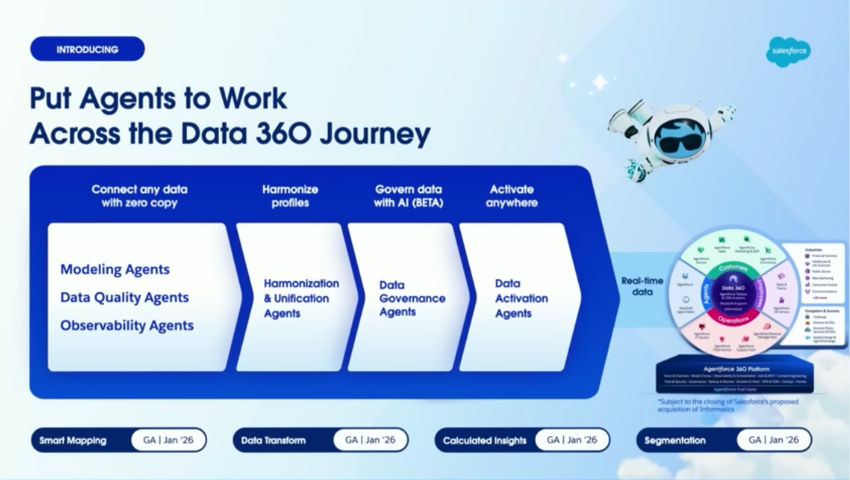
Data 360 (formerly Data Cloud) helps businesses organize, manage, and activate the data behind Agentforce use cases. That includes data from beyond the CRM, such as account registration data, likely stored on a platform like Snowflake. Agentforce agents inside of Data 360 can help map that data.
Traditionally, data mapping included:
- Studying schemas
- Creating spreadsheets
- Manual drag-and-drop mapping
- Iterative trial and error
However, per Salesforce, Agentforce does a lot of this work by:
- Understanding the source data
- Understanding the target Data Cloud schema
- Recommending mappings instantly
Crucially, the agent does not auto-apply changes. The data architect remains accountable, but the agent removes weeks of mechanical work.
Many more AI agents are coming to Data 360 in 2026, as showcased in the graphic below.
32. Creating Process Blueprints (& Making Them Happen)
Agentforce can take documentation that describes a process – including handwritten notes, PDFs, Word documents, diagrams, and so forth – to create a process blueprint, draft forms that the process may necessitate, and structure data and governance models to support its implementation.
This ‘Agentforce Supply Chain’ use case, made possible by Salesforce’s 2025 acquisition of Regrello, also develops the tools to integrate the process into the ERP system.
Dell is using this use case to create and automate a process for supplier onboarding.
“We go through a process of simplifying the process, standardizing it, then reimagining it, and then applying the technology. That’s what we’ve done in supply chain: 19,000 users, incredible automation of workflows and processes, ultimately giving more time back to people so they can focus on the things that are super valuable to us as a company.”
Unpack More Agentforce Use Cases
Over the course of 2025, Salesforce released versions of Agentforce targeting specific industries and departments, like field service, with pre-packaged agent skills and actions.
Essentially, these are libraries for brands to help build ‘beginner’ agents they can deploy within their existing Salesforce environments, familiarizing them with Agentforce and building confidence in what they can achieve with the platform.
Brands getting started with Agentforce may seek out the libraries relevant to their industry or department to gain inspiration for where they can deploy their first agents.
From there, understand the data necessary to support each use case and organize it in Data 360 or an alternative customer data platform (CDP) before prioritizing use cases. Companies can prioritize by considering the business value and ease of implementation of prospective agents.
Over time, Salesforce is also likely to embed more AI agents natively into its software, as it is doing with Data 360, making AI agents deployments less of a burden on IT teams.