June 2, 2026 • 6 min read
Centrical Raises $39 Million to Become the Performance Intelligence OS for Frontline Teams

Director of Content & Market Research
June 2, 2026
Centrical has completed a $39 million Series D funding round to deliver on its vision to become the “Performance Intelligence OS” for frontline teams.
New investors Leeds Illuminate and Kingfisher Investment led the funding round, with support from existing stakeholders, such as JVP.
JVP was one of the most prominent investors in Centrical during its Series C funding round in 2021, when the company secured $32 million in investment.
Since then, the technology provider has become well-established in the competitive contact center quality management (QM) space, partnering with companies such as Deutsche Telekom, IHG Hotels & Resorts, and Samsung.
Centrical has also expanded to serve enterprises across 150 countries, with the new funds earmarked to further its foothold in Europe.
However, the funding will chiefly support Centrical’s bid to transcend the QM market with its Performance Intelligence OS vision.
“Instead of simply optimizing people, we're building an operating system that identifies performance problems, generates improvement programs, measures their impact, and continuously iterates.”

“For example, if the system detects a performance gap around a particular product, it can automatically generate several intervention programs, run A/B testing, deploy them, and measure outcomes,” continued Rimon in conversation with CX Foundation.
“If two of four programs are successful, it scales those and discards the others. The learnings become part of a compounding loop that improves future interventions.”
With this vision, Centrical attacks one of the most significant issues facing contact center quality management programs: the amount of manual work required from analysts, coaches, and supervisors.
Even with automated quality scoring, analysts need to extract insights, coaches need to apply them, and supervisors need to monitor performance improvements.
Teams must also continuously reassess performance criteria to spot new growth opportunities. Otherwise, they’re continuously going over old ground, disengaging more experienced team members.
With its Performance OS vision, Centrical aims to go beyond automation by enabling businesses to run more targeted programs at greater frequency, uncover new and actionable insights, and drive measurable performance outcomes.
Building the Performance OS for Frontline Teams
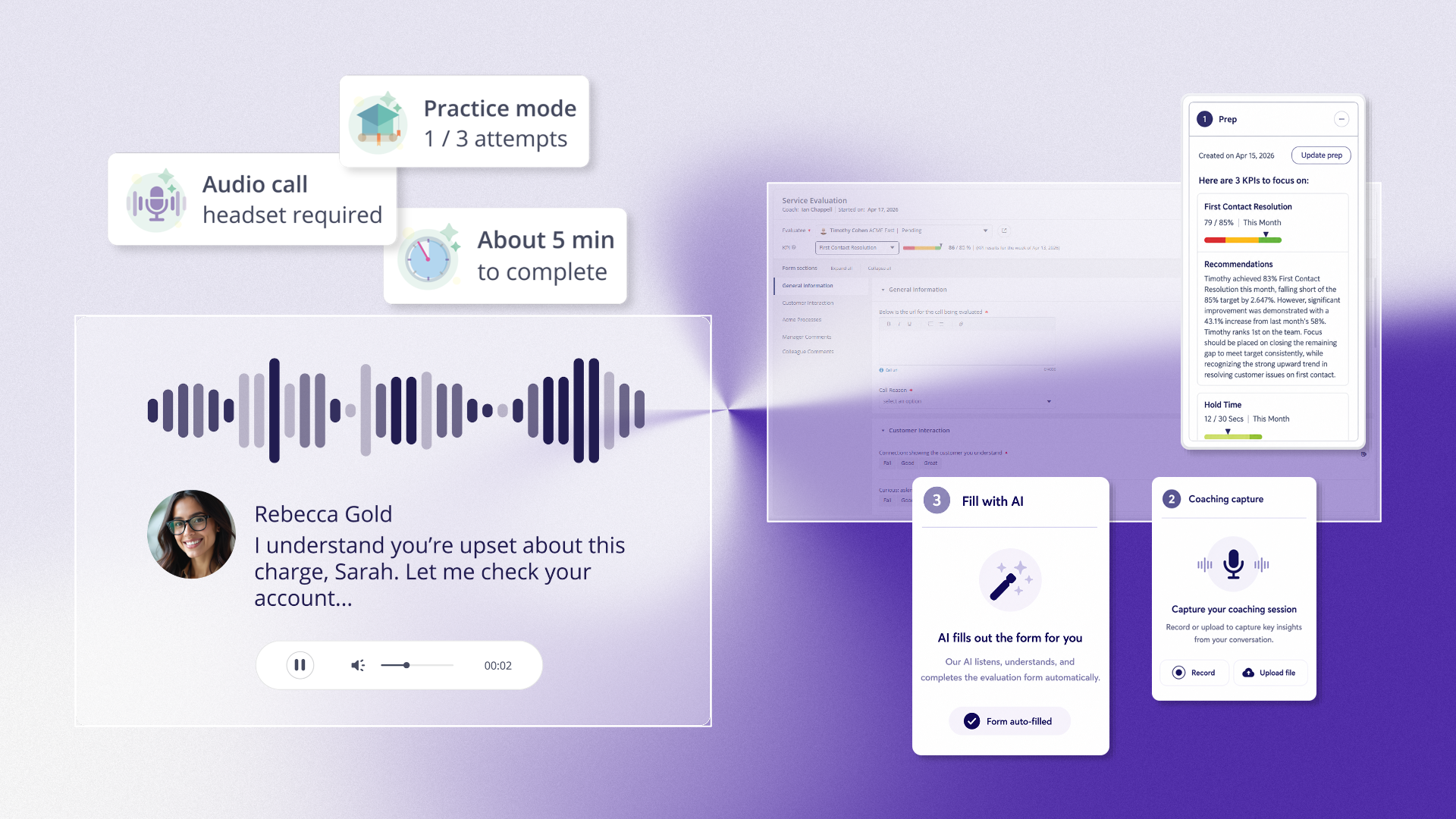
Centrical has already built a unified employee performance ecosystem that uses QM insights to pinpoint the root causes of performance issues, then delivers targeted coaching, microlearning, role-play simulations, and gamified experiences.
These targeted interventions aspire to help build skills, increase engagement, and drive lasting performance improvements.
As such, contact centers can already create a connected learning strategy without coordinating actions across systems or interpreting dashboards.
With its Performance OS vision, this differentiation stays, yet becomes more powerful.
“We'll continue investing in the core AI capabilities that make up the foundation of the platform,” said Rimon. “Our goal is to make these capabilities better, faster, easier to use, and more automated.”
The CEO also highlighted the opportunity to develop not only an operating system for managing the performance of human agents but also AI agents.
In doing so, Centrical enables customers to certify AI agents against performance standards, test them through targeted simulations, and ensure deployments support, not compromise, critical customer and business outcomes.
As a result, contact center teams can find the ideal balance between where to deploy human and AI-led experiences.

Why Are Contact Center Quality Management Solutions Still in High Demand?
With industry discourse increasingly focused on AI replacing frontline workers, some may question the growing investment in QM solutions designed to support contact center employees.
Yet, Rimon isolates three central reasons why Centrical and competitive solutions continue to thrive in the changing market.
1. Humans Must Keep Tabs on How AI Resolves Queries
Conversational AI solutions work, deliver value, and will continue to improve. But people are still what make AI matter.
After all, people who understand what to do and how to do it will implement AI more effectively.
That’s the message behind Centrical’s new People Make It Matter campaign, which celebrates the frontline leaders, managers, and employees who turn AI’s potential into real results.
While discussing this campaign, Rimon also stressed: “There may be fewer people performing certain tasks, but the remaining work will require higher levels of skill, empathy, judgment, and technical understanding because automation handles the simpler tasks.”
Solutions like Centrical help people continuously learn and evolve so they're prepared for that more complex environment.
2. Organizations Will Increasingly Need to Redeploy Talent
Imagine an organization with thousands of employees in a particular role, knowing that over the next few years it will need 10–20% fewer people in that position while demand grows elsewhere.
One option is to lay people off and hire externally, but that's expensive and often not the best outcome for employees or employers.
Internal mobility is often a better approach. Not just vertical promotions, but horizontal career movement as well.
The first step is exposing employees to opportunities across the organization. Many people are hesitant to switch roles because it feels risky. Solutions like Centrical help by introducing those opportunities and encouraging exploration.
So, once someone expresses interest in a role, it can provide training, coaching, and role-play simulations so they can experience the job before committing.
For example, someone in customer service might explore a collections role. After completing simulations and training, they may discover it isn't a good fit, and that's okay. They're still in their current position and haven't taken a career risk.
“As employees continue learning, they can evaluate different opportunities and gradually prepare for a transition. Eventually, they can be onboarded into a new role while continuing to contribute in their existing one.”
Such an approach could save organizations significant hiring and onboarding costs. Meanwhile, employees gain greater career flexibility.
3. Leaders Can Monitor Where It Is Best to Deploy Human and AI Agents
The future frontline workforce will consist of both human and AI agents.
In all likelihood, organizations will have AI agents from multiple providers, built for different purposes.
Without coordination, customer support operations risk becoming fragmented, with each system optimizing for its own objectives.
By monitoring both on a shared platform, Centrical will soon align human workers and AI agents, enabling collaboration, calibration, coaching, and continuous improvement across the board.
Go deeper on what’s next for the space by reading CX Foundation’s analysis: 11 Contact Center Quality Management Software Providers & Their Differentiators in 2026