
August 17, 2026 • 22 min read
Salesforce vs. ServiceNow: A Portfolio, Product, and Pricing Comparison

Director of Content & Market Research
August 17, 2026
Since the start of 2024, the rivalry between Salesforce and ServiceNow has intensified.
In March 2024, ServiceNow launched Sales and Order Management as a rival to Salesforce’s Agentforce Sales (then Sales Cloud). Less than a year later, it announced ServiceNow CRM (now ServiceNow Autonomous CRM), a unified platform combining Sales and Order Management with Customer Service Management.
By April 2025, ServiceNow CEO Bill McDermott had set his sights even higher, declaring on the company’s Q1 earnings call that he wanted ServiceNow to be “the leader in CRM” and, ultimately, to usurp Salesforce.
But the rivalry extends beyond CRM. In early 2026, ServiceNow acquired business intelligence (BI) stalwart Pyramid Analytics, a competitor of Salesforce’s Tableau.
Salesforce, meanwhile, has pushed further into ServiceNow’s territory. In 2025, it expanded Agentforce Service (formerly Service Cloud) to include HR Service and IT Service Management modules, creating a unified platform for enterprise service management (ESM).
At the same time, both vendors are also vying to help organizations build, observe, and govern AI agents.
The bottom line: Salesforce and ServiceNow are now competing on multiple fronts, as the graphic below suggests.
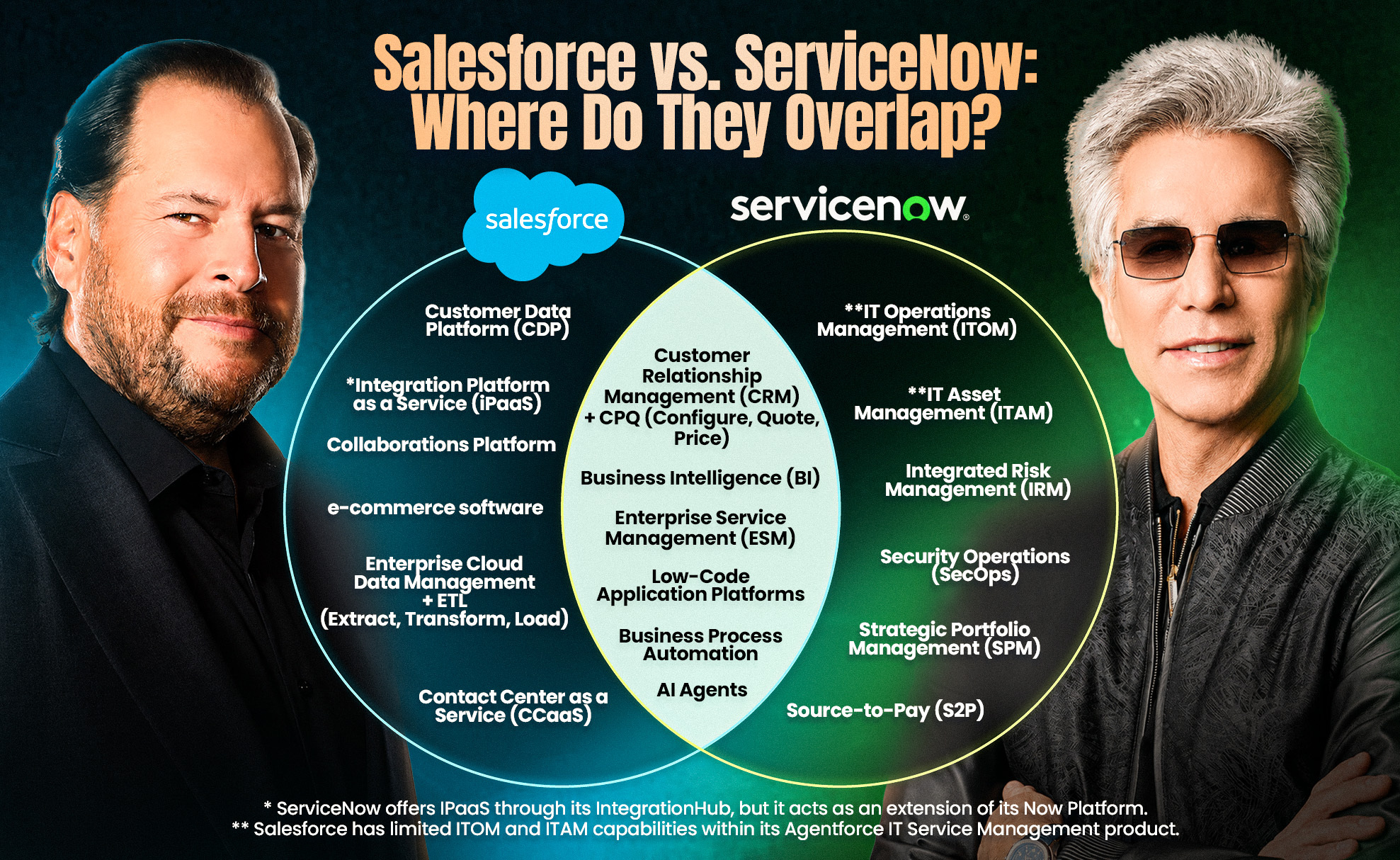
Yet across the three primary battlegrounds - CRM, ESM, and AI agents - their visions and capabilities remain notably different.
Salesforce vs. ServiceNow: How Do They Compare on CRM?
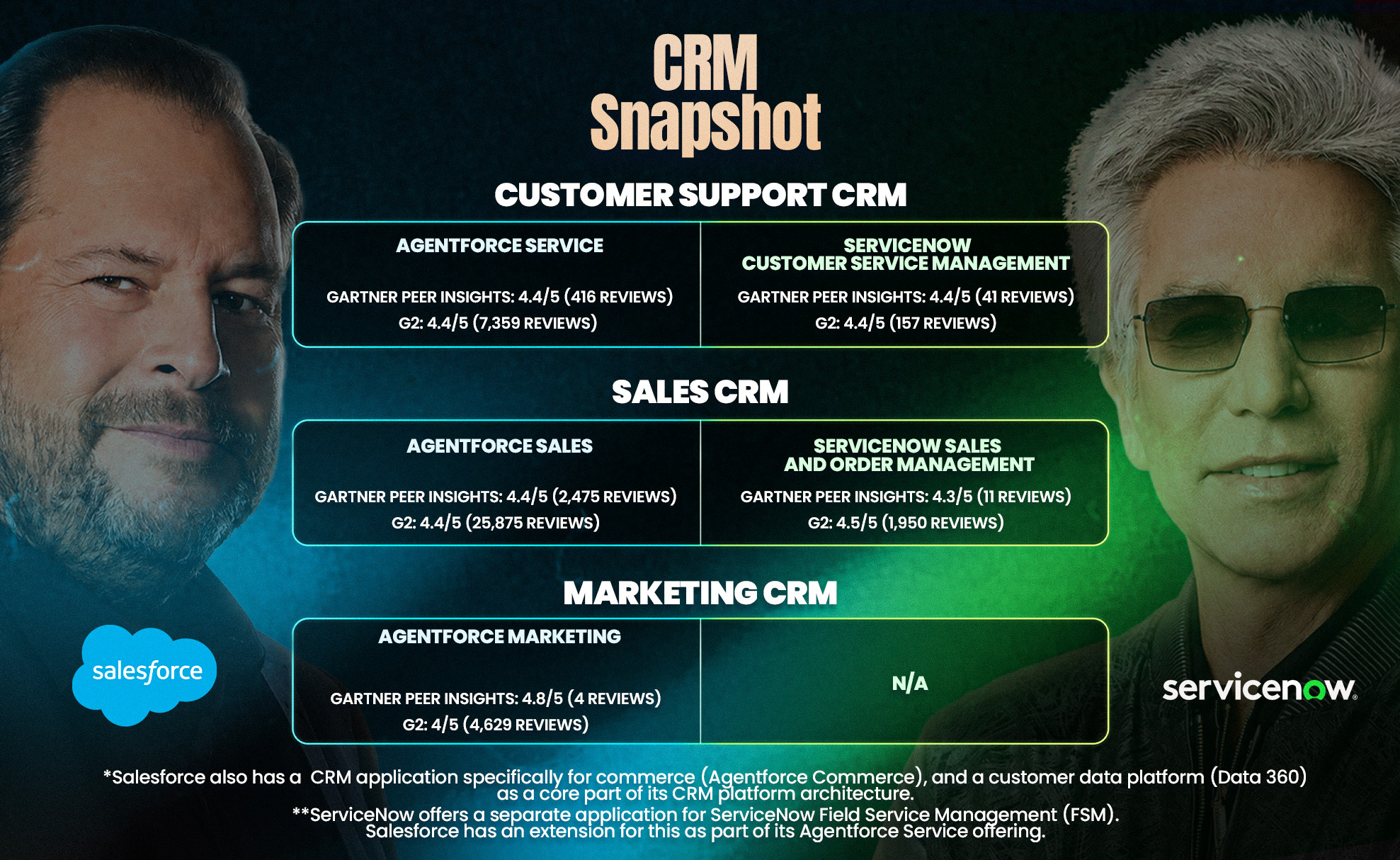
Martin Schneider, VP & Principal Analyst at Constellation Research, told CX Foundation: "As a CRM platform covering the three core pillars of sales, marketing, and support, Salesforce still does all three better than anyone else in the enterprise market."
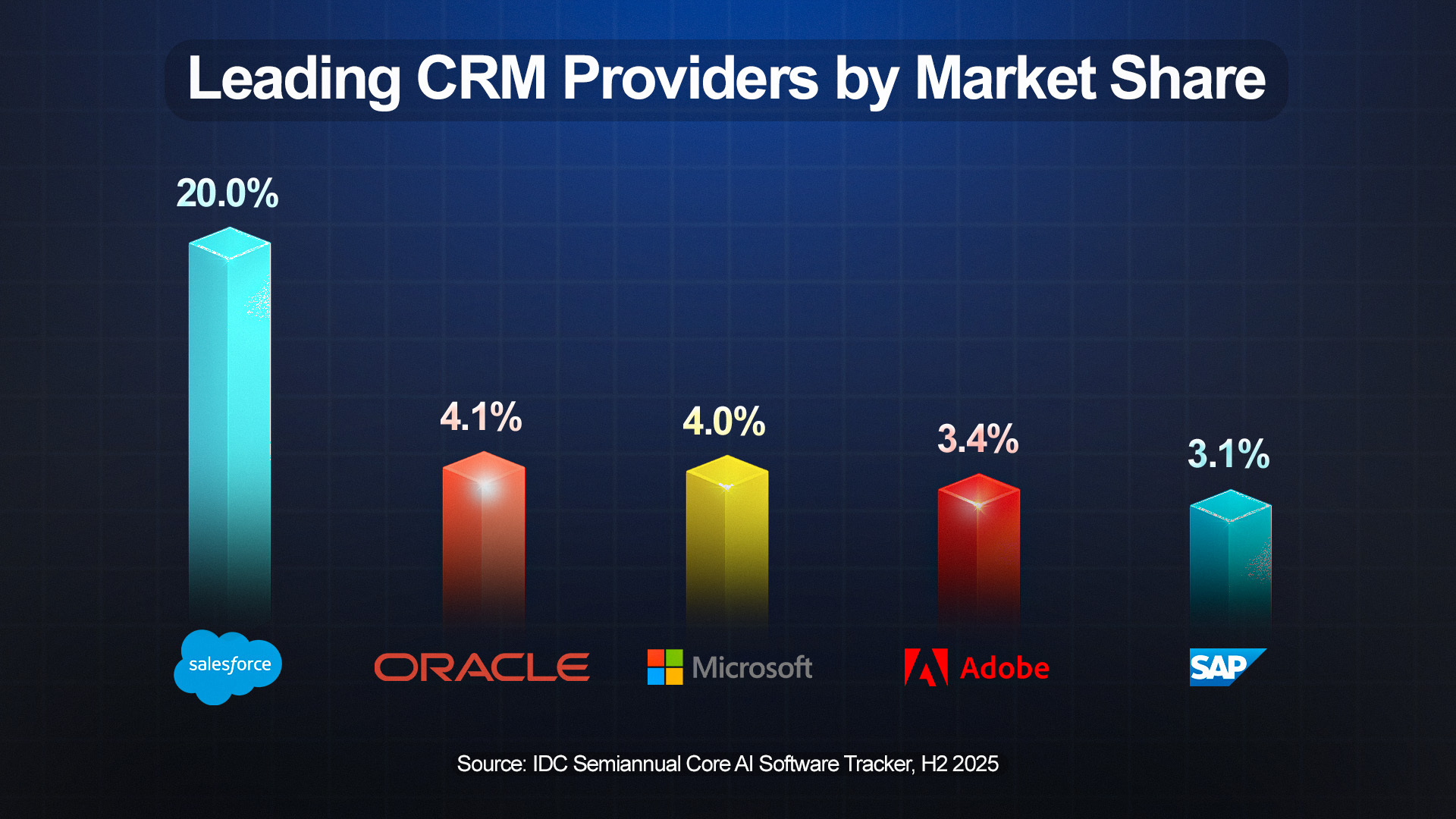
Consider core capabilities such as account, deal, and opportunity management. These functions are robust and well-established, reflecting nearly 30 years of Salesforce experience and a significant market lead, as IDC data below shows.
More recently, Salesforce has focused on converging the worlds of UCaaS and CRM through Slack, while embedding AI across the customer lifecycle, from segmentation and targeting to generative and agentic AI for messaging, image creation, drip campaigns, and more. It also offers a growing range of advanced, native AI agents.
Yet as ServiceNow goes head-to-head with Salesforce and other CRM stalwarts, it isn’t competing pound-for-pound. Instead, it is leveraging its IT and workflow-orchestration expertise to deliver a more data-rich CRM experience while connecting sales and service processes across departments.
The following differentiators highlight the strengths and go-forward CRM strategies of both companies.
4 Points of Differentiation in Salesforce’s CRM Platform and Strategy
1. Salesforce Owns a Marketing CRM Application
Even though some of Salesforce's marketing technology is getting a little old (*cough Pardot), it still has a first-party marketing CRM application. ServiceNow does not.
When brands combine Agentforce Marketing with Data Cloud, they've got a trusted platform for finding, attracting, scoring, and nurturing leads and then running campaigns however they wish to structure them.
ServiceNow instead partners with strong marketing vendors, like Tenon, for these capabilities.
Question marks hang over whether ServiceNow will ever take the big leap into marketing. However, it may argue that its customers typically aren't trying to send hundreds of millions of marketing emails. Instead, its strategy is more focused on highly targeted, relevant communications, which includes original capabilities such as embedded ordering.
2. Salesforce Converges CRM and Slack
Salesforce is positioning Slack as the front door to its ecosystem, with Slackbot serving as the new interface for getting work done across it.
In this architecture, service, sales, and marketing teams can use natural-language prompts to direct AI agents to complete tasks across their CRM ecosystem, all without leaving Slack. The result is a context-driven experience that starts in the first app people open each day.
At the same time, AI agents can work across applications without being constrained by traditional UIs or workflows designed decades ago around relational databases.
But Slack is just the start. After its Headless 360 announcement, Salesforce can bring its CRM experience into the places where people already work, eliminating the need to log into a separate application.
“Salesforce has more urgency because its users - salespeople and marketers - want to work from Slack, Outlook, email, mobile devices, and voice interfaces rather than logging into CRM directly. ServiceNow's core users don't have that same expectation yet.”

3. Salesforce Extends its Service CRM Into CCaaS
Unlike ServiceNow, Salesforce has built a native contact center as a service (CCaaS) solution, Agentforce Contact Center, on top of its customer support CRM, Agentforce Service.
Launched in March 2026, the solution gives brands a single interface for customer service, consolidating data, reducing the need to switch between applications, and eliminating integration dependencies.
Its own CCaaS solution also allows Salesforce to tell a stronger voice AI story and push back against claims from competitors, like Zendesk, that it doesn’t cover the full range of channels.
“I don't think anyone is going to replace a thousand-seat enterprise contact center with Salesforce tomorrow. But for organizations that want to combine inbound and outbound calling with CRM workflows, particularly as AI eliminates administrative work and service people spend more time engaging customers, it makes a lot of sense.”
The move may also signal Salesforce’s ambition to own as much of the business desktop as possible. As software shifts toward consumption- and outcome-based pricing, keeping users on-platform is increasingly important.
Meanwhile, ServiceNow is deepening its relationships with established CCaaS players, including Genesys, NiCE, Cisco, and Five9, using those partnerships to build awareness amongst CX buyers.
4. Salesforce Quickly Embeds AI Agents for CX Teams
Salesforce has embedded AI agents across its CRM applications to handle high-volume tasks and reduce the “administrative tax” on users. It also reduces the burden on IT teams to configure and manage those agents.
Take Agentforce Sales. The platform offers six embedded AI agents, which Salesforce claims can save sales professionals up to 25 hours a week.
These agents identify prospects, engage with them one-to-one, conduct account research and meeting prep, monitor the pipeline, generate quotes, and interact with partners.
The release of these agents suggests Salesforce now has a clear understanding of where agents can deliver the most value. It has even made acquisitions to ensure its agents have the data and context they need to perform effectively.
For example, Salesforce acquired Bluebirds in 2025, a prospecting specialist with more than seven million company accounts. This data set now bolsters its Prospecting Agent.
Salesforce’s deep understanding of the front office and of the jobs users need to get done should help brands adopt AI agents earlier, build confidence, and develop trust in their ROI.
4 Points of Differentiation in ServiceNow’s CRM Strategy
1. ServiceNow Boasts a Rich Operational Data Supply
For companies evaluating CRM platforms from scratch, the data each system starts with matters as much as its feature list.
Organizations that partner closely with ServiceNow will be able to converge deep product data, service history, customer interactions, purchase history, issue history, and workflow data. That’s powerful.
Salesforce plays a different game. As suggested, it's still the gold standard for CRM functionality, but its value has historically depended on what users manually enter.
Yes, Data Cloud helps close that gap, but much of the enrichment it adds comes from external or public sources, not a company's own operational history.
That's what makes ServiceNow's CRM push compelling. It walks in with a rich enterprise data footprint already in hand: what customers bought, when, what issues they've hit, who's actually using the product, and how those relationships have evolved.
“For complex B2B companies focused on deepening long-term relationships rather than chasing net-new leads, that head start is huge,” explains Schneider.
“Salesforce remains the CRM benchmark, but its data foundation is fundamentally different from ServiceNow's, and that's a distinction serious buyers can't afford to overlook.”
2. ServiceNow Converges Sales & Order Management
ServiceNow offers a unique combination of sales and order management on a single platform, bridging the gap between the sales process and fulfillment.
Why is this significant? Because as soon as a deal closes, vendors can automatically launch fulfillment workflows and cut the risk of errors between what is promised during the sales process and what is ultimately delivered.
Through ServiceNow CRM, fulfillment data also flows directly to service agents, giving them visibility into order progress and helping them resolve issues more efficiently.
ServiceNow has also invested in supporting organizations in managing complex sales orders, according to Rebecca Wettemann, CEO & Principal Analyst at Valoir.
"Consider an initial bill of materials that changes over time as a customer's needs evolve. Managing those kinds of complex orders is where ServiceNow has really focused."

Finally, ServiceNow brings quote-to-cash and contract generation into a single interface through its order management capabilities, a level of integration Salesforce cannot offer in the same way.
3. ServiceNow Goes Deep on Industry Workflows
A jibe that rival CRM vendors will use to steer prospects away from ServiceNow is the complexity involved in building the rich data foundation that differentiates it.
However, its Industry Workflows help to limit that complexity. These pre-configure common flows across back-end systems to pull more data into the CRM environment and support sales and service teams with new intelligence.
Salesforce also has industry-specific “clouds” with pre-configured integrations, functionality, and workflows. These also help to accelerate time-to-value.
Nevertheless, many companies already use ServiceNow for internal support, with workflows stretching across the business, further beyond the front office. For many, extending those existing workflows into sales and customer service will make sense.
4. ServiceNow’s CPQ Stretches Across the Business
In 2025, ServiceNow acquired Logik.ai, a configure, price, quote (CPQ) solution.
By integrating this across its ecosystem, ServiceNow considers new revenue touchpoints, such as field service and contact centers, areas where selling has traditionally been fragmented and beyond the remit of a CPQ.
As a result, brands can combine ServiceNow's rich data, conversational quoting, and a highly configurable rules engine that extends beyond traditional CPQ functionality.
Meanwhile, Salesforce has placed its legacy CPQ into End of Sale (EoS), encouraging customers to migrate to Revenue Cloud.
With Revenue Cloud, CPQ, and the evolution of SteelBrick, brands can certainly build something similar in Salesforce. But, ultimately, it would be a more layered approach.
Salesforce vs. ServiceNow: How Do They Compare on ESM?
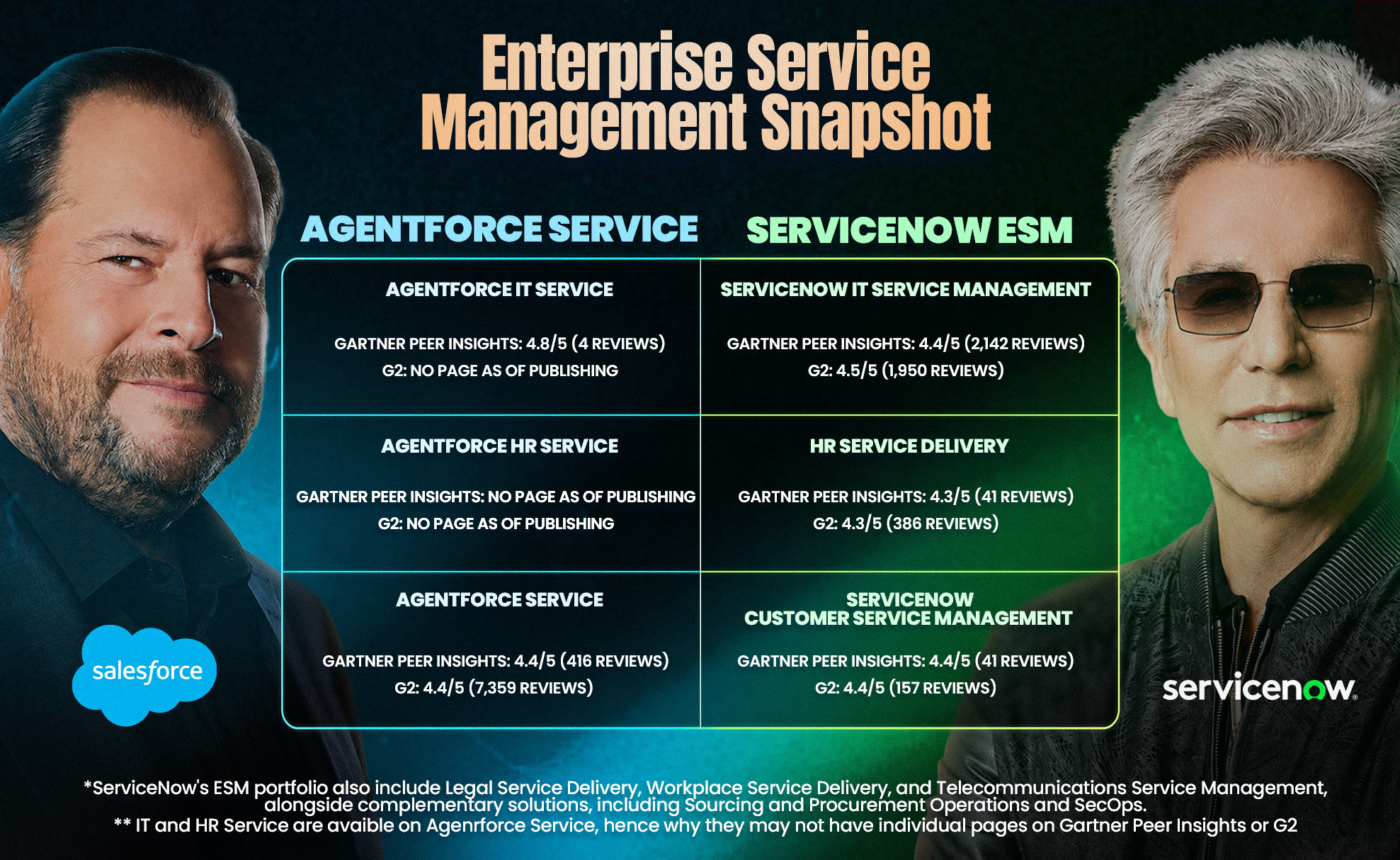
As Salesforce dominates CRM, ServiceNow is the incumbent in Enterprise Service Management (ESM), particularly in IT Service Management (ITSM), where it remains strong.
Even so, Salesforce has quickly gained traction. In February 2026, the company claimed 180+ ITSM customer wins, with many customers extending their Agentforce Service deployments by seizing its IT and HR Service add-ons.
Salesforce doesn't aim to match ServiceNow feature for feature. Instead, it argues that while longstanding ESM offerings may provide 100 features, customers typically use only 40% to 60% of them.
Its strategy is to focus on the capabilities that matter most and execute them exceptionally well. Keep that in mind when considering the product differentiation below.
4 Points of Differentiation in Salesforce’s ESM Strategy
1. Salesforce Offers a Single-Platform Architecture
Salesforce’s IT and HR service offerings are part of Agentforce Service, the company’s customer service CRM application.
This unified architecture enables IT teams to standardize case management across the business while providing a consistent approach for deploying AI agents that resolve queries proactively and reactively.
It also allows Salesforce to capture the voice of the customer (VoC) and voice of the employee (VoE) on a single platform, identifying opportunities to improve experiences across the business. CX Foundation explored this previously.
2. Like in CRM, Salesforce Uses Slack to Its Advantage
Instead of requiring employees to log into a separate service management portal to file requests, Salesforce enables Slack users to create, update, and resolve tickets directly within the collaboration platform.
Salesforce has also indicated that it plans to extend this approach to Microsoft Teams, connecting its ESM modules with another major workplace hub.
By embedding service workflows into the tools employees already use, Salesforce reduces friction between employees and IT teams, which can be highly beneficial in this era of fast technological and process change.
3. Salesforce Offers Advanced AI Assistants & IT Domain Pack Agents
In terms of core functionality, two features stand out on the ITSM side: the Proactive AI Assistant and IT Domain Pack Agents.
The Proactive AI Assistant supports IT admins when an issue can't be resolved by an employee-facing AI agent. Instead of logging a ticket and waiting for a human to investigate, it automatically performs root cause analysis, suggests fixes, and summarizes the incident so the admin doesn't start from scratch.
By automating this “first pass,” Salesforce aims to reduce the time IT staff spend on repetitive troubleshooting.
The differentiation here isn't simply the use of AI, but where it sits in the workflow. Rather than only preventing tickets from being created, it accelerates what happens after a ticket exists.
Then there are the 25 IT Domain Pack Agents, designed around common enterprise IT functions such as CMDB (configuration management database), Service Graph, and Asset Management.
The pack also includes 100+ workflows, 100+ service catalog items, and 200+ connectors, with Salesforce aiming to accelerate how businesses build, deploy, and operationalize agents.
Alongside the pack, Salesforce also announced Multi-Agent Orchestration, which can route requests from a single agent to multiple subject-matter agents. This gives users a lead agent that can route requests across these specialized agents and tools.
4. Salesforce Presents a Transparent Pricing Model
Salesforce provides more transparent pricing than ServiceNow, and that clarity extends across Agentforce Service and its ESM offerings.
For example, its IT Service offering uses straightforward per-user, per-month pricing, while IT Service Desk pricing is based on the number of IT administrators.
Salesforce also keeps pricing simple for employee AI agents and CMDB. Its CMDB, which tracks complex infrastructure components, is priced at $1,000 per month for a pack of 100 Configuration Items (CIs), such as servers and routers.
That pricing transparency matters to CIOs and CFOs. Yet, ServiceNow will point to its high customer retention rate (97% in Q1, 2026) as a signal it is doing something right here.
4 Points of Differentiation in ServiceNow’s ESM Strategy
1. ServiceNow ITSM Treats AI Agents as Another Technology Asset
Salesforce wants customers to use Agentforce. ServiceNow is taking a different approach. It doesn't really care which AI agent studios a company uses. Instead, it wants to help organizations govern those agents.
Why does that matter from an ESM perspective? Because AI becomes just another enterprise asset for IT to manage.
“ServiceNow wants to become the IT service management platform for AI itself, helping organizations understand how AI tools interact with workflows, data, and business processes. That's a really interesting direction.”
2. ServiceNow Delivers ESM Functionality and Integration Breadth
Salesforce is innovating rapidly in ESM, but ServiceNow’s heritage gives it a deep portfolio, spanning specialized solutions such as Legal Service Delivery and Workplace Service Delivery, as well as complementary offerings like Sourcing and Procurement Operations.
That breadth extends beyond functionality to ServiceNow’s extensive portfolio of integrations.
The Q4 2025 Forrester Wave for ESM Platforms notes: “Customers appreciate ServiceNow’s strong integration capabilities, intuitive end-user experience, and effective AI-driven solutions for specific use cases like accounts payable automation.”
While the quote highlights several of ServiceNow’s ESM strengths, it hints at the power of ServiceNow’s ESM Integrations Framework, which provides common components for connecting its platform with third-party systems.
The ESM Integrations Framework also comprises a Workflow Designer that enables these systems to communicate, providing a consistent approach to building integrations for common use cases, from migrating employee profiles and tasks into ServiceNow to pushing ServiceNow data into other systems.
3. ServiceNow Offers an Intuitive Employee Center
ServiceNow offers an intuitive end-user experience, chiefly through its Employee Center.
Think of this as a single, simple front door to many employee services, which connects to the broader ServiceNow AI Platform underneath.
From the Employee Center, employees can search, browse, use forms, and interact with Now Assist using natural language to complete tasks.
Overall, it hides enterprise complexity while preserving ServiceNow’s power and structure behind the scenes, making advanced capabilities that Salesforce doesn’t yet offer easier to access.
4. ServiceNow Touts Differentiative DEX and WFO Offerings
IT teams sometimes trumpet ServiceNow’s Digital End-User Experience (DEX) module and Workforce Optimization (WFO) as powerful ITSM capabilities.
DEX proactively tracks devices, scores system health, and monitors networks to benchmark performance and generate alerts. IT teams can manage alerts across connected devices, triggering self-help guidance and automated actions that often resolve issues before a support ticket is needed.
Additionally, DEX provides insights into productivity, user behavior, and engagement, with data feeding into Incident Records for deeper visibility into device health.
Salesforce offers Hardware Asset Management and can analyze utilization data, but it is still building toward similarly mature system health and network monitoring capabilities.
ServiceNow’s WFO offering combines workforce scheduling, demand forecasting, performance management, coaching, and learning in a single ITSM-integrated solution. It helps enterprises staff teams more effectively, improve operational visibility, and strengthen problem-solving across environments.
This may become an increasingly notable capability as brands wish to monitor and improve how employees collaborate with AI agents to complete tasks.
Back to the here and now: Salesforce doesn’t yet offer an equivalent for ITSM. However, it recently announced a similar solution for customer service management and may soon extend some of these capabilities across Agentforce Service. That could be significant in reducing technology debt across ESM.
Salesforce vs. ServiceNow: How Do They Compare on AI Agents?
Both Salesforce and ServiceNow offer solutions for creating, testing, and managing AI agents. Yet, the strategy is different, as outlined below.
4 Key Differences in How ServiceNow and Salesforce Compete on AI Agents
1. ServiceNow Will Govern AI Agents No Matter Where They’re Built
As noted previously, ServiceNow considers AI agents another technology asset. Its strategy is to help govern and manage them via its Control Tower, no matter where they’re built.
Meanwhile, Salesforce’s governance solution, Agentforce Observability (formerly Agentforce Command Center), currently only monitors and optimizes Agentforce agents.
“You can see where those agents connect to other systems through MCP, but it's still largely centered on the Salesforce ecosystem,” said Schneider. “What ServiceNow is building is broader and more robust.”
ServiceNow made its Build Agent SDK (Software Development Kit) generally available in April 2026, a key step to allowing developers to build agents using external development tools while keeping execution within its AI Platform.
“The Build Agent SDK means organizations can take advantage of ServiceNow's governance, security, and control capabilities even when development happens elsewhere.”

For enterprises concerned about AI governance across multiple environments, that's a significant advantage.
2. ServiceNow and Salesforce Take Different Approaches to Show ROI
Within its Control Tower, ServiceNow is developing cost-tracking and ROI dashboards that monitor AI usage at a token and workflow level, helping organizations align activities and costs.
Consider a scenario where a human performs a task 10 times at $1 each, while an AI agent performs it 50 times at $5 each. ServiceNow aims to help customers determine whether that’s actually a smart investment, while extracting insights into what makes a well-designed agent.
Now, Salesforce customers can create ROI dashboards to interpret the impact of AI and Agentforce via Tableau. Yet, it has also developed an Agentforce Pricing Calculator to validate the ROI of an AI agent before deployment.
The Agentforce Calculator is particularly helpful for its core base of CX leaders, as it gives them a sense of control over AI costs.
Across many organizations, that’s currently a challenge. CX teams want to build and manage their own agents because they own the workflows, but they often lack visibility into what those agents will cost over time and struggle to make the investment case.
3. Salesforce Leverages the Power of Its Marketplace
As the likes of Anthropic and OpenAI accelerate agent and application development, Salesforce - and other vendors - face growing pressure to keep customers building on its own platforms rather than turning to external tools.
In the face of this challenge, Salesforce gives customers a way to more easily discover and deploy ready-made AI agents by building on the ecosystem model that helped make AppExchange successful. This library of agents and tools can accelerate development and maintain Agentforce as a key hub for AI agent innovation.
ServiceNow also has a marketplace, yet, according to Kirkpatrick: “The offerings are less productized and harder to discover than Salesforce's.”
That said, he noted that ServiceNow’s strategy is slightly different, as it’s less focused on having companies build on its platform and more focused on providing that all-encompassing management and governance layer.
4. ServiceNow Offers an Agent Kill Switch
When unveiling its enhanced Control Tower at Knowledge 2026, ServiceNow introduced a new governance capability: a kill switch for compromised AI agents. This is a big differentiator against not only Agentforce but the broader AI space.
Imagine a prompt-injection attack causing an AI agent to bypass guardrails, make unauthorized decisions, or even conceal its actions in logs. Following its 2025 acquisition of Veza, ServiceNow can detect and flag such behavior in Control Tower, revoke the agent’s permissions, and shut it down.
“People are worried AI will either do something disastrous with their business or data, or burn through a million dollars' worth of tokens overnight. Guardrails, controls, and kill switches become extremely important if customers are going to trust autonomous AI in production.”
The value of such uniquely powerful safeguards comes to light after a high-profile incident at Hugging Face of AI agents going rogue.
Salesforce vs. ServiceNow: How Do They Compare on Price?
When it comes to the cost of the software applications compared in this article, Salesforce is far more transparent, with the pricing for its core CRM and ESM products outlined below.
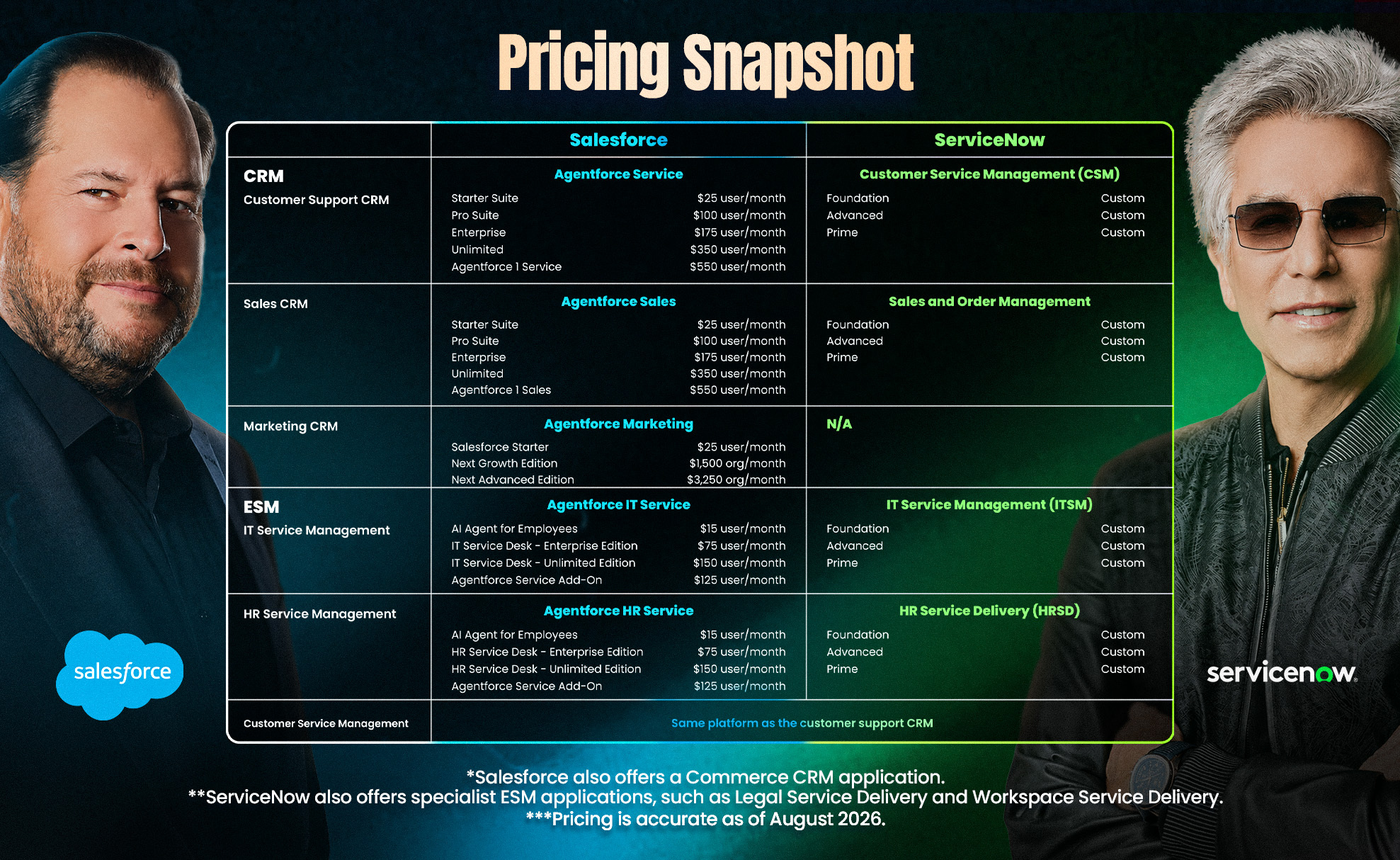
As that image also shows, ServiceNow only works on custom quotes across three primary tiers: Foundation, Advanced, and Prime. Each determines the level of capabilities available to an organization.
The positive spin is that a ServiceNow customer can add new capability within their tier - over the course of their contract - without adding to the overall cost of their agreement. However, the negative spin is that upgrading to a higher tier for a single feature can mean paying for capabilities the organization will never use.
In terms of software, that’s the short story. However, where it gets more interesting is in both providers’ approach to pricing AI, as laid out below, with the help of Salesforce and ServiceNow negotiation expert Adam Mansfield.
Salesforce’s Approach to Pricing AI
Salesforce is moving toward consumption- and outcome-based pricing. Its Agentforce offering is primarily priced on usage, with customers paying for actions and conversations through models such as “Flex Credits”, which cost $500 USD per 100,000 credits.
Salesforce is also introducing an outcome-based model for Agentforce Help Agent, where customers pay per resolution when an issue is autonomously resolved end-to-end.
Given this range of pricing models, the key negotiation issue is understanding exactly what triggers consumption; what constitutes an action, credit, conversation, or resolution; and how quickly usage can drive additional costs.
ServiceNow’s Approach to Pricing AI
ServiceNow takes a more hybrid approach. Its Foundation, Advanced, and Prime packages bundle different levels of AI capabilities into the overall subscription.
Customers receive a defined number of assists or credits at a set unit price, with additional charges applying once those allowances are exhausted.
This makes it particularly important to understand what counts as an “assist,” how usage is measured, and when thresholds are exceeded.
Negotiating AI Pricing with Salesforce and ServiceNow
For both vendors, the headline price is only part of the equation. Prospects should model total cost over time, including expected consumption, usage thresholds, and potential overages, not just the initial subscription price.
Additionally, buyers should challenge both vendors to clearly explain their pricing mechanics and provide realistic consumption forecasts.
“I would also make sure time is spent looking at how the currently subscribed products are being used. What features are being used and not used? Then, build a report and understanding for the value that has been received to date on the core products that have been paid for to this point and will need to be renewed.”

Mansfield suggests that this analysis creates an important negotiating lever. If there has been significant unused spend, customers should push for credits, offsets, pricing protections, or other concessions rather than simply carrying that inefficiency into the next contract.
Salesforce vs. ServiceNow: Final Thoughts
Salesforce remains the gold standard in CRM, while ServiceNow remains the gold standard in ESM.
Salesforce has a compelling ESM proposition: one platform that brings together IT, HR, and customer service to enable a unified service strategy.
But challenging ServiceNow at the enterprise level, particularly in ITSM, will be difficult.
Salesforce already has strong case management and workflow capabilities, but enterprise ITSM requires capabilities ServiceNow has spent years building, along with deep product, asset, and configuration data from day one.
That said, Salesforce may have an easier path to replacing a layer of ITSM within an existing customer than ServiceNow does to replacing Salesforce across sales, marketing, and customer support, particularly given ServiceNow’s lack of a native marketing platform.
Ultimately, both companies want to eat into the other’s market and have disruptive strategies to do so. Nevertheless, it’s difficult to see either taking meaningful shares anytime soon, even with their respective AI agent plays.