
November 25, 2026 • 29 min read
Omnichannel Conversational AI: What It Is and How It Works

CX Analyst & Thought Leader
November 25, 2026
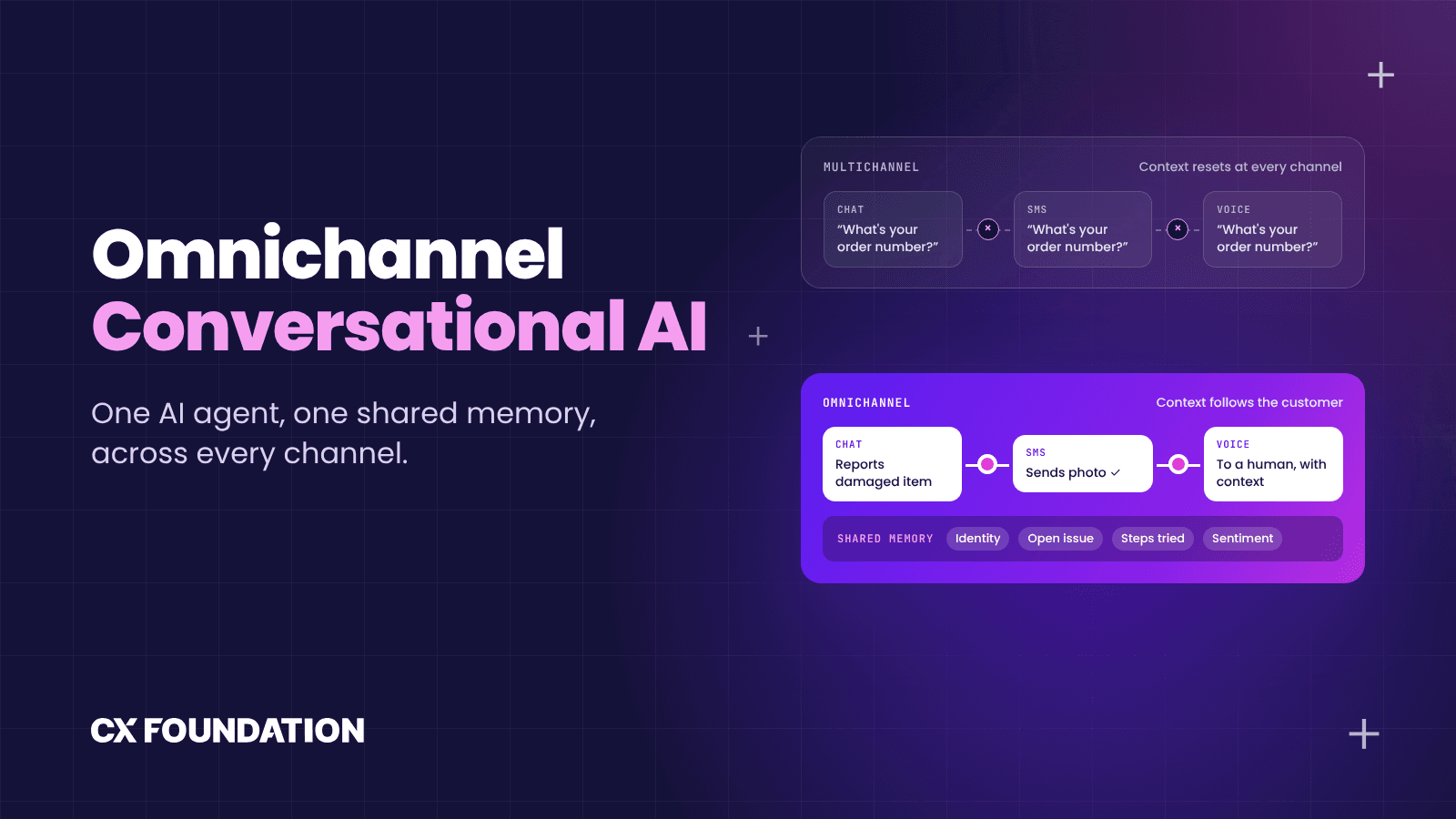
Omnichannel conversational AI understands, responds, and determines the intent behind natural customer conversations, maintaining context across channels and teams.
Human and AI agents share the same knowledge base, integrations, data, workflow rules, and complete conversation history across voice and digital channels. A customer can start a conversation on one channel, then finish it on another without having to repeat themselves or restart the interaction.
Omnichannel Conversational AI means customers don’t have to talk to a chat widget, a voice IVR, then to a human that can’t access the information the customer has already given the AI agent. Instead, when a human takes over the call, they see a complete conversation of the transcript, information the customer gave the AI, next-best action suggestions, and even account history from third-party systems like CRMs. The conversation picks up where it left off.
Done well, omnichannel conversational AI gives businesses 24/7 automated customer support on all channels, while maintaining complete conversation context, in a unified interface. Done badly, it's a disconnected multichannel stack with siloed data that keeps customers and teams frustrated.
What Is Omnichannel Conversational AI?
Strip away the corporate-speak around vendor language, and omnichannel conversational AI rests on two things: software that can hold a natural-sounding conversation while actually moving an interaction forward, and a shared memory that keeps track of all customer conversations and the context behind them
The "conversational AI" part
Conversational AI is an intelligent technology that understands natural human conversations, then responds appropriately based on shared knowledge, workflow data, and governance limits.
Two technologies do most of the work. Natural language processing interprets What the customer is saying (order numbers, a description of a problem), what they want (intent), and how they’re feeling in the moment (sentiment). Large language models (LLMs), the same class of model behind ChatGPT, generate a fluent reply instead of pulling a canned script. On voice channels, speech recognition converts the caller's words into text first, and speech synthesis turns the reply back into audio.
The practical difference for a CX team is flexibility. Responses to questions like “Where’s my refund?” “I want my money back,” and “I returned this and you haven’t paid me back” all land in the same place. Today, conversational AI understands different tones, languages, accents, slang, etc.
The "omnichannel" part
Omnichannel adds a shared layer underneath every channel the AI works in: the same agent logic (what the AI is allowed to do and how), the same knowledge (policies, product information, help content) and the same conversation context (who the customer is, what's open, what's been tried). That shared layer can come from a single vendor, or be stitched together from several: a voice platform, a messaging platform, and a helpdesk, for instance. What matters is that it behaves as one system to the customer.
The channels in scope
The theoretical channel list is long and getting longer:
- Voice: inbound and outbound phone calls, plus in-app or browser-based calling
- Web and in-app chat: the website widget and the messenger inside a mobile app
- Email: still the default for anything with an attachment or a paper trail
- SMS: appointment reminders, delivery updates and two-way text support
- Messaging apps: WhatsApp, LINE, Facebook Messenger and Instagram DMs
The key word here is theoretical. What omnichannel conversational AI can handle and the specific capabilities each software vendor provides are different. Some vendors are voice-first and treat text as an add-on; others are chat-first and still sell voice as a limited or custom-priced product. Ask for the list in writing, and ask which channels run on the same agent logic and knowledge.
How it differs from a standalone chatbot
A standalone chatbot lives in one place (usually a website widget) and forgets everything that happened in a chat once the window closes. It typically can't see what happened on the phone last week, can't handoff the conversation transcript to a human agent, and can't continue a conversation someone started in WhatsApp. It's a channel feature.
Omnichannel conversational AI is closer to a service layer: one AI agent, one memory, one set of rules: deployed wherever customers show up. The chatbot answers questions on a webpage. The omnichannel agent owns the issue until it's resolved, regardless of where the customer goes next.
Omnichannel vs. Multichannel: One Customer, Two Journeys
| Multichannel | Omnichannel | |
|---|---|---|
| Customer context | Lives inside each channel; resets when the customer switches | Follows the customer across channels and sessions |
| Shared data | Each channel keeps its own transcripts and records | One profile, one conversation history, one view of the open issue |
| Agent logic | Separate flows, rules and knowledge per channel, maintained separately | One set of rules, workflows and knowledge applied everywhere |
| Handoff to humans | Agent receives a ticket or a transfer, often with no history | Agent receives the unresolved request, what's been tried and why it escalated |
The distinction has nothing to do with how many channels a company runs. A business can offer chat, voice, SMS, email and WhatsApp and still be purely multichannel if none of them talk to each other and share data. The reverse is also true: separate bots per channel aren't automatically disqualifying, provided they genuinely share context, data. and workflows underneath. Continuity is the test. Channel count is a vanity metric.
The clearest way to see the difference is to follow one customer through both models.
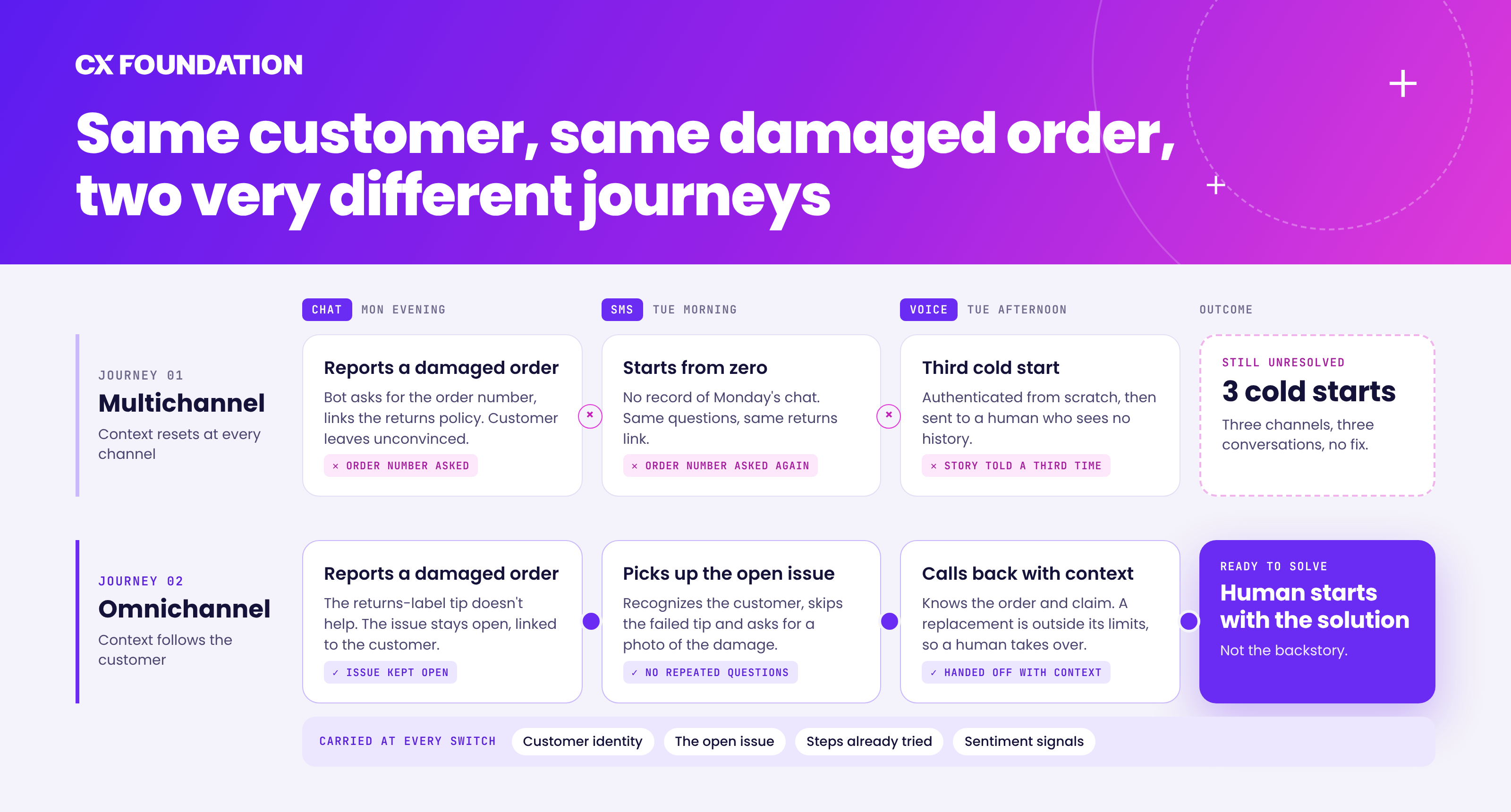
Journey one: the multichannel version
On Monday evening, a customer tells a website chatbot an order arrived damaged. The bot asks for the order number, suggests checking the packaging for a return label and offers a link to the returns policy. The customer closes the window, unconvinced.
On Tuesday morning, they text the support number. The SMS bot has no record of Monday's chat. It asks for the order number again, then for a description of the problem. It suggests the same returns link. Still no solution.
On Tuesday afternoon, the customer calls in. The voice agent authenticates them from scratch, asks what the call is about and, eventually, transfers them to a human. The human agent sees a new call, no chat transcript, no text thread and no indication that this is the third contact about the same box. The customer tells the story a third time, now noticeably less patient than on Monday.
Three channels, three conversations, three cold starts. Each interaction may have been "handled" by its own metrics. The issue still isn't resolved.
Journey two: the omnichannel version
Same customer, same damaged order, same three channels.
On Tuesday morning, the customer texts the support number. Once the platform matches the phone number to the customer's profile, and confirms their identity according to set protocols, the SMS agent picks up the open issue rather than starting a new one. Here's exactly what moves with the customer at each channel or agent switch:
- Customer identity: who this is, matched across the chat session and the phone number on file
- The open issue: a damaged-item claim on a specific order, still unresolved
- Steps already tried: the returns-label suggestion from Monday, which didn't solve the problem
- Available sentiment signals: Monday's chat ended without resolution, and the customer is now on their second contact
Instead of providing the same failed returns link, the conversational AI SMS agent asks for a photo of the damage and tells them they’ll follow up with more information.
The voice agent proactively calls the customer when the photo was accepted, and already knows the order and claim. When the customer asks for a replacement rather than a refund, which falls outside what the AI is authorized to approve, the call goes to a human. That human agent receives the unresolved request, the prior actions, and the conversation transcript from both the SMS and voice AI agents. The customer's first sentence to a person is about the solution, not the backstory.
Why an "omnichannel" label isn't proof
Nearly every vendor in this market describes itself as omnichannel, because the term costs nothing to claim. The way to check it is to run it yourself. Open an issue in one channel, abandon it, return in another channel in a new session, and see whether the open issue and the steps already taken survive the switch. Then escalate and look at what the human agent actually receives.
If context dies at the channel boundary, or at the session boundary, the platform is multichannel regardless of how many channel logos are on the product page.
How Omnichannel Conversational AI Shares Context, Routes Conversations and Takes Action
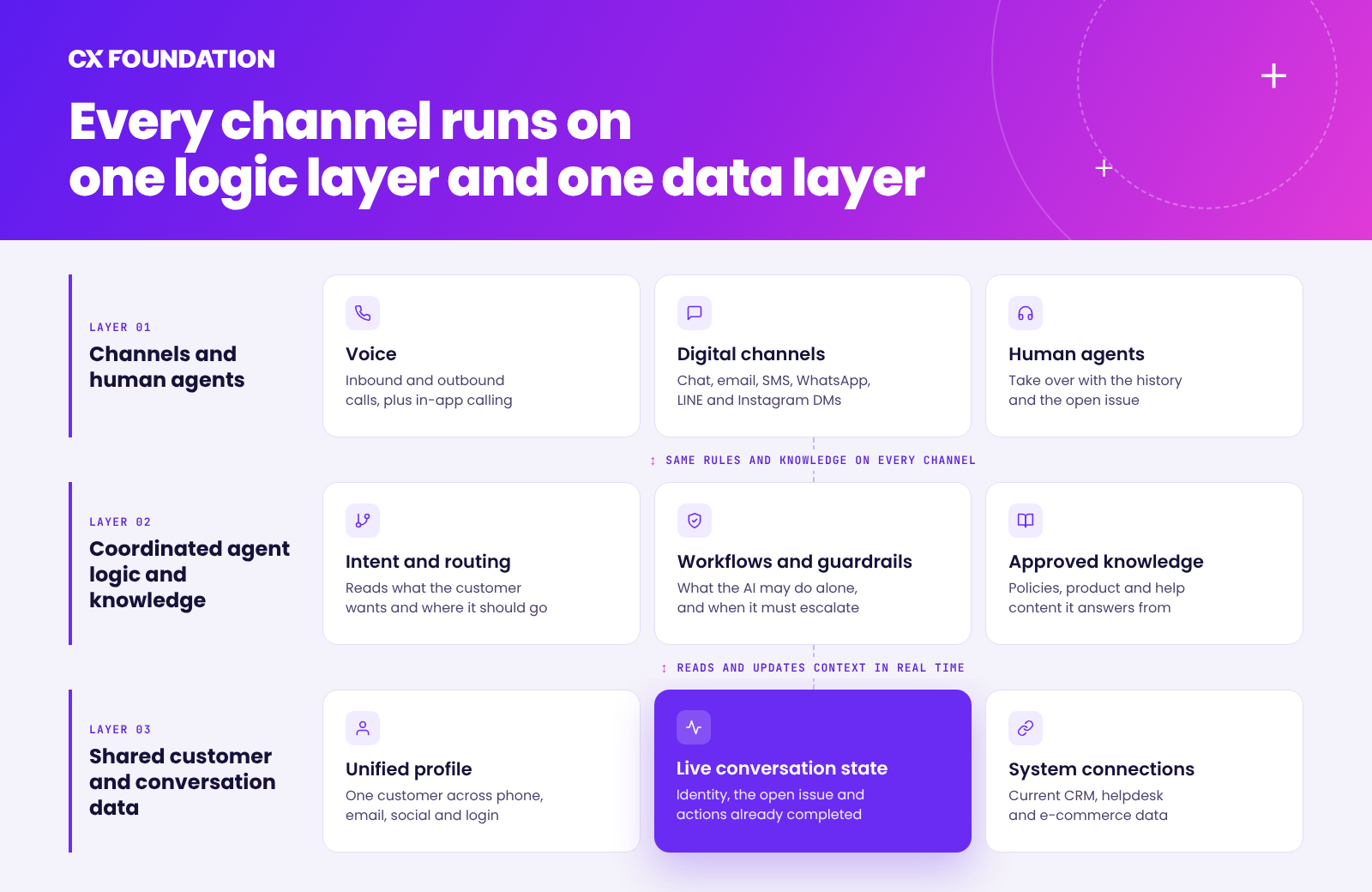
Architecturally, omnichannel conversational AI is three layers. At the bottom sits shared customer and conversation data. In the middle, coordinated agent logic and knowledge decide what the AI says and does. On top are the channels customers use and the human agents who step in. Channels are the interchangeable part. The two layers underneath are what make a platform omnichannel.
When a conversation changes channels in real time, the AI still remembers who the customer is, the active issue, and which actions have already been completed. That live conversation state is different from the background profile updates most CRMs already handle: a new address synced overnight, a loyalty tier recalculated weekly. Background data can lag without much harm. Live state can't. An AI that acts on a stale view will offer a refund that was already issued, re-ask a question that was already answered or cancel an order that was already modified. Every one of those is a worse experience than no AI at all.
Shared Context and Memory
The first job is knowing who the customer is and what already happened, wherever they show up. Four capabilities carry it.
- Unified customer profiles: The platform has to recognize one person across a phone number, an email address, a social handle and a logged-in session. Some of those matches are deterministic (a logged-in user), some are probabilistic (a phone number that's on file but could be shared by a household). The better platforms treat a match as a confidence level, not a fact, and step up verification before revealing account details or taking an action.
- Persistent conversation memory: History, stated preferences and past troubleshooting are stored and linked to the relevant customer and the relevant open issue. The second link is the one most platforms skip. Memory attached only to a customer is a transcript archive. Memory attached to an issue is what lets the next channel pick up where the last one stopped.
- Real-time links to backend systems: The AI agent should read current order, account and case data from the CRM, helpdesk and e-commerce platform at the moment of the conversation, not from a nightly export. If a shipment status changed an hour ago, the voice agent should know it.
- Privacy and consent: Cross-channel memory is, by design, a richer record of each customer than most companies have ever kept. That raises questions buyers should settle before go-live, not after: what exactly is stored, who (and which AI agents) may access it, how long is it retained, and how can customers decline or limit its use where privacy law gives them the right to (GDPR, etc.) Voice adds its own layer, since call recording consent rules vary by jurisdiction. A platform that can't answer these questions precisely has a governance gap, whatever its demo looks like.
Intent Detection, Routing and Human Handoff
The second job is deciding what each conversation needs and who (or what) should handle it.
Intent and sentiment detection: AI classifies what the customer is trying to do from what they type or say, and evaluates how they're feeling about it (frustrated, happy, stressed, etc.) On text channels, sentiment comes from word choice and escalation patterns. On voice, it can also come from tone, pace and interruptions. Rising frustration usually calls for a faster path to a person. A high-value sales opportunity, a customer asking about an upgrade, or a cancellation request that's really a negotiation calls for the right human agent ASAP.
Routing: Once the intent and context are clear, the platform sends the conversation to the right queue, skill group, or individual based on what the customer wants, how valuable the interaction is to the business, and what has already happened. A customer on their third contact about the same issue shouldn't end up in a general queue behind first-time callers.
Handoff on a live call versus a chat thread: On a phone call, the handoff happens in real time with the customer listening. The context (identity, issue, actions taken, reason for escalation) has to reach the human agent's screen before they pick up, because there's no graceful way to say “one moment while I read your file.” In chat, the handoff is asynchronous. The agent can read the transcript, but the customer may have already closed the tab, so the platform needs to keep the issue open and reachable through another channel.
When no human is free: This is where many deployments quietly fail. A well-designed system tells the customer the real wait, offers a callback or a switch to SMS or email without losing the thread, keeps collecting the information the human will need, and creates a case that carries the full context forward. A poorly designed one loops the customer back into the bot.
Autonomous Actions in Back-End Systems
The third job is the one that separates this generation of conversational AI from the last: completing tasks, not just answering questions about them. A bot that explains the refund policy deflects a contact, while a conversational AI agent resolves the issue completely.
What it can do: Multi-step actions like issuing refunds, changing or canceling orders, updating subscriptions, and editing account details. Each involves reading data, applying a policy, writing to a system and confirming the result with the customer.
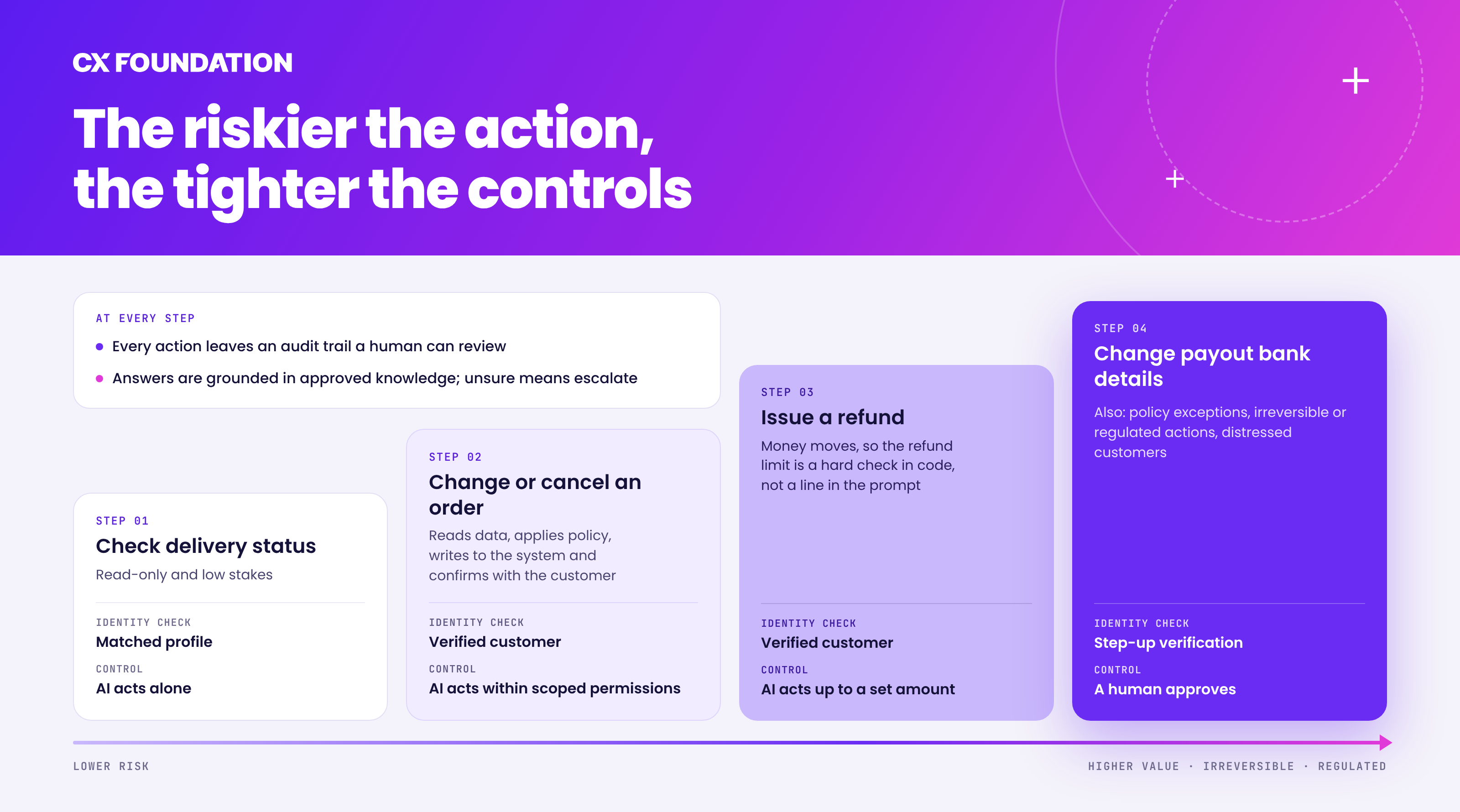
What makes it possible: Integrations, usually through APIs, let the AI agent read from and write to the systems of record. Identity checks scale with the risk of the action (a delivery-status question needs less verification than a change of payout bank account.) Permissions scope exactly which actions the AI agent may take, on which accounts and within which limits, such as refunds up to a set amount. Every action should leave an audit trail a human can review.
Hallucination control. An LLM that's confidently wrong about a return window is an annoyance. One that's confidently wrong while executing a refund is a liability. The controls that matter: ground every answer in approved knowledge rather than the model's general training, have the AI agent say so when it doesn't know and escalate rather than improvise, and enforce business rules in deterministic logic rather than trusting a prompt to remember them. A refund limit should be a hard check in code, not a polite suggestion in the instructions.
Where a human stays in the loop. Over-automation is a real failure mode, and the companies that have pulled back from aggressive AI-first service have generally learned it the hard way. Keep a person in the loop, or at least in an approval step, for actions that are high-value, irreversible or regulated, for exceptions to policy, and for conversations where the customer is distressed or vulnerable. The goal isn't the highest possible automation rate. It's the highest rate of issues actually resolved, at an acceptable level of risk.
How to Evaluate an Omnichannel Conversational AI Platform
Every vendor demo shows a single, clean conversation in a single channel. That's the one scenario omnichannel AI doesn't need to prove. The evaluation should focus on what happens across channels, over time and under your own business rules. Four areas tell you most of what you need to know.
1. Resolution tracking
Ask: How does the platform track one customer issue across multiple channels – and does it count that issue once?
This question sounds like reporting hygiene. It's actually the integrity of every number the vendor will show you. If the damaged-order customer from earlier touches chat, SMS and voice before being resolved, a platform that counts three conversations and one resolution per channel will report a better automation rate than it earned. Ask how a resolution is defined, who or what confirms it, and whether a customer who comes back within a few days about the same issue reopens the original case or creates a new, separately resolved one.
2. Architecture and integration
Ask: How does the AI share customer data, conversation history and task status with the systems you already run?
You want specifics: which CRM, helpdesk, contact center and e-commerce platforms have native integrations, whether those integrations read and write, and whether data moves in real time or on a sync schedule. Ask where the conversation state lives – in the vendor's platform, in your helpdesk or in both – and what happens to it if you leave. The architectural question underneath is whether the AI agent sits on top of your existing helpdesk or expects to replace it. Both can work. They lead to very different implementation timelines and lock-in profiles.
3. Self-management
Ask: Can your CX team update knowledge, workflows and policies without filing a ticket with engineering or the vendor?
Policies change weekly. Return windows shift for the holidays, a product gets recalled, a promotion ends early. If every one of those changes requires a developer or a vendor services team, the AI will be out of date most of the time. Ask the vendor to have someone from your team, not theirs, change a policy and test the result during the evaluation. Also ask how changes are tested before they go live, remembering that simulation and regression testing against past conversations are increasingly table stakes.
4. Pricing model
Ask: How does the platform charge for conversations, resolutions, seats and integrations, including issues that span several channels?
The market has moved well past per-seat licensing, but it hasn't settled on what replaced it. Some vendors charge per resolution or per outcome, some per conversation, some per minute for voice and some through a negotiated mix with a platform fee on top. Each model creates different incentives. Per-conversation pricing charges you for failures. Per-resolution pricing charges you more as the AI improves and depends entirely on how "resolved" is defined. Per-minute voice pricing rewards short calls, whether or not they solved anything. The multichannel question is the sharpest one: if one issue spans three channels, find out whether you pay once or three times.
The decision rule
Prioritize platforms that do three things reliably: maintain context across channels and sessions, complete the tasks your customers actually need done in your back-end systems, and hand off to humans with the full picture. Exclude any platform missing an essential capability or integration for your environment, however strong the rest of the demo looks. A beautiful voice agent that can't write to your order system will still produce a callback queue.
Top Omnichannel Conversational AI Platforms Worth Shortlisting
The five platforms below represent the market's main architectural bets rather than a single ranked list. Fin is the helpdesk-agnostic overlay, now inside Salesforce. Sierra and Decagon are the venture-backed enterprise AI-agent pure plays. Regal comes at the problem voice-first, from the contact center. And Nextiva's XBert is the small-business option – a reminder that omnichannel AI isn't only an enterprise purchase.
The pricing models are just as varied, and that's not a footnote. How each vendor charges tells you what it thinks it's actually selling. Pricing as of November 2026, from each vendor's published materials; please confirm current terms before signing.
| Platform | Channels | Pricing model | Published rate | Best for |
|---|---|---|---|---|
| Fin (from Salesforce) | Live chat, email, WhatsApp, SMS, Instagram, Facebook Messenger, Slack, Telegram, voice, and API | Per outcome, plus optional helpdesk seats | $0.99 per outcome, with a 50-outcome monthly minimum | Support teams that want AI on their current helpdesk, fast |
| Sierra | Voice, website and in-app chat, WhatsApp, Apple Business Chat, SMS, email, and ChatGPT | Outcome-based, with consumption pricing for some interaction types | Not published | Large enterprises automating high-value journeys end to end |
| XBert (Nextiva) | Phone, text, web chat, and messaging apps | Per AI conversation, monthly plan | $99/month for 100 conversations | Small and mid-sized service businesses |
| Decagon | Voice, chat, email, and a dedicated channel for personal AI agents | Per conversation or per resolution, the customer's choice | Not published | Enterprises that want predictable budgets at high volume |
| Regal | Inbound and outbound voice, SMS, chat, email, and browser-based voice | Usage-based, custom quote | Not published; Regal says its AI agents generally come in at about $0.20/min | Voice-heavy B2C contact centers in sales and service |
Fin
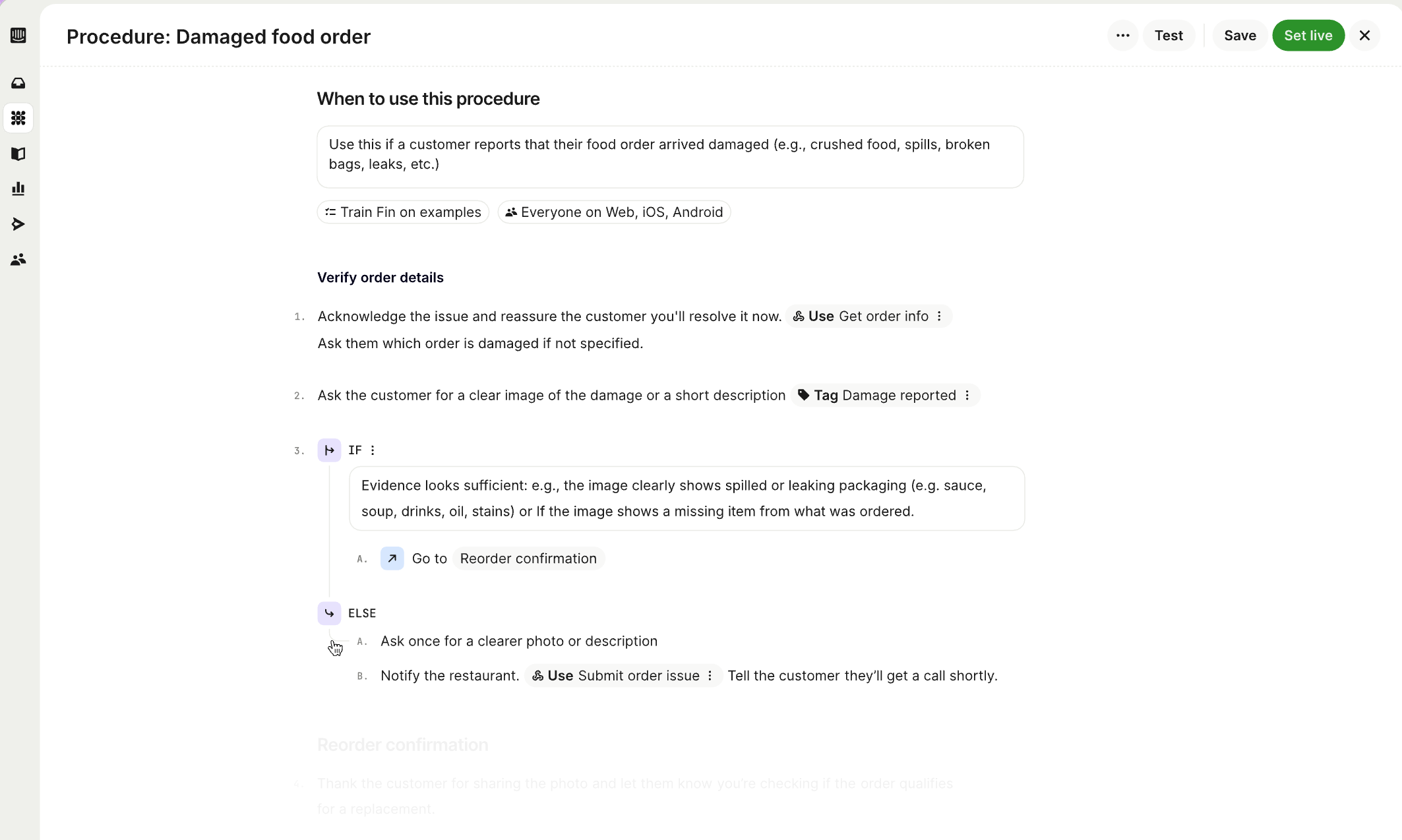
Fin, formerly Intercom, is now part of Salesforce. Salesforce completed its acquisition of Fin on September 10, 2026, bringing in more than 30,000 customer companies and an average resolution rate of 76% across channels, according to the company. Fin works on Intercom's own helpdesk or on top of the helpdesk a team already uses, including Salesforce, Zendesk, and HubSpot, so businesses can add an AI agent without migrating platforms.
The biggest recent news is Fin 4, announced October 7 at Fin's Pioneer 2026 event. Fin 4 moves Fin from answering questions to actively working toward goals: it can now start conversations on its own to onboard, activate, and re-engage customers, and pursue the goals a business sets over any time horizon.
Fin 4 also introduced Skills, which let Fin handle ambiguous problems like troubleshooting without a fixed script, and a Human in the Loop feature that brings in a person to approve, edit, or take over based on a confidence score. Under the hood, Fin's new Apex 2.0 model has 16.5% fewer hallucinations than the previous version.
Standout capabilities
- Fin Memory: Fin remembers past conversations and customer details and carries that context across channels.
- Proactive Procedures: A website click or a signal from your systems can start a multi-step Procedure, so Fin opens the conversation already knowing why the customer is there.
- Fin Voice 2: Runs on Apex Flash, Fin's model built for speed. On calls, Fin can verify identity, process refunds, book appointments, and change subscriptions, confirming details with the caller before submitting. It works with Twilio, Genesys, RingCentral, Five9, 8x8, Aircall, and Mitel. As of October, escalation rules also apply to calls, even in the middle of a Procedure.
- Evals and Releases: New in November, teams can prepare and test changes to content, Procedures, and guidance in a separate space before customers ever see them.
- Operator: Fin's AI agent for the support team itself now runs scheduled routines, connects to Slack and GitHub, remembers each user's preferences, and produces shareable drafts like new Procedures.
Pricing
Fin is the only enterprise-grade platform on this list with a public rate card. The headline price is $0.99 per outcome, charged at most once per conversation. The important detail is what counts as an outcome. A resolution counts when the customer confirms Fin's answer worked, or when the customer leaves for 24 hours after Fin's last answer without asking for more help. A Procedure that ends in a planned handoff to a human also costs $0.99. Fin doesn't charge for escalations that happen because a customer asks for a person or shows frustration, for Procedures that fail, or for conversations that end with an unanswered clarifying question. Sales use cases are priced differently: a qualified lead costs $9.99.
There are two ways to buy Fin. On your current helpdesk, there's a 50-outcome monthly minimum and no seat fees. On Intercom's helpdesk, you pay the same rate per outcome, plus helpdesk seats starting at $19/seat per month across the Essential, Advanced, and Expert plans. Add-ons include Pro (from $100/month) for analytics and Operator, and Copilot (from, $35/month/user) for agent assist. Fin Voice has custom pricing through Fin's sales team.
Paying per outcome aligns Fin's incentives with yours better than paying per conversation. Still, "no further help requested" is a generous definition of resolved, so compare your invoice against your own repeat-contact data.
Best for
Support teams that want a capable AI agent running on their existing helpdesk quickly, with transparent pricing, and that are comfortable keeping an eye on the roadmap after the Salesforce acquisition.
Sierra
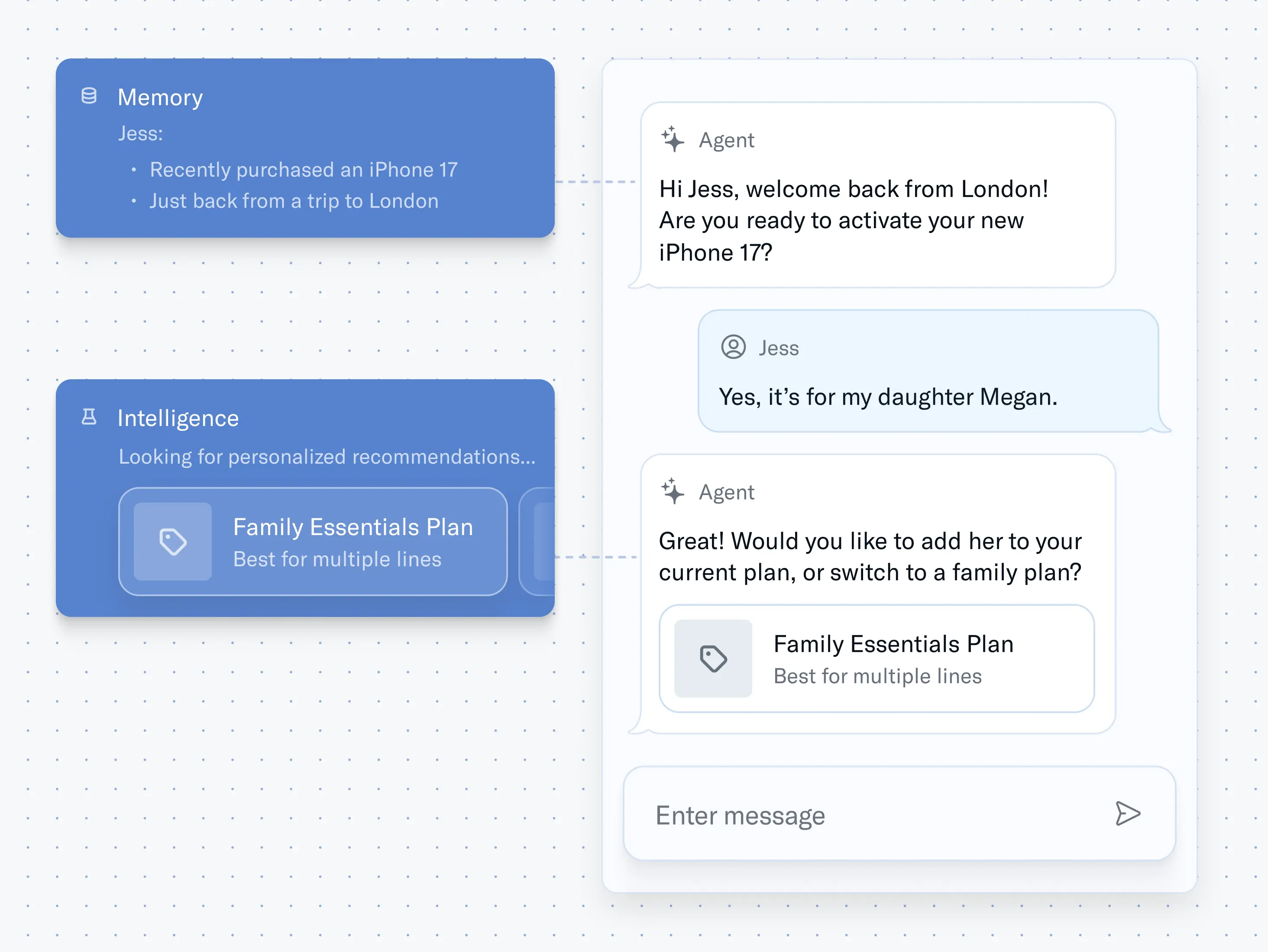
Sierra's Agent OS lets businesses build an agent once and deploy it everywhere: chat, voice, email, SMS, ChatGPT, and the contact center. According to Sierra's Summit 2026 recap, almost half of the Fortune 50, one in three leading banks, and 80% of Fortune 50 healthcare companies are Sierra customers.
Sierra's recent releases are all about memory, long-term goals, and agents that sound and act more like people. Horizon, launched in July, lets agents pursue goals over days, weeks, or months, like originating a loan, getting prior authorization for a healthcare procedure, or scheduling a test drive. At Sierra Summit in October, the company introduced Horizon Advisors, AI decision-makers that choose the next best action for each customer, including the timing and channel, within the goals and guardrails a business sets. Sierra also announced Curie, a new model that orchestrates each conversation, and Fleming, a model that detects when the caller on the phone is another AI agent, helping businesses handle bots, fraud, and customers' personal AI assistants.
Standout capabilities
- Context Engine and Agent Data Platform: Sierra's memory layer unifies what a company knows about each customer across sessions, channels, and systems, connecting calls, chats, and emails with CRM, billing, and transaction data. The Context Engine adds every interaction to that picture to make the next one smarter.
- Tandem Voice: Runs a real-time conversation layer alongside a reasoning layer, so the voice agent can respond quickly while planning its next steps.
- Persona Studio and Voice Personas: Teams can upload voice samples and tune the agent's personality, formality, and style without engineering help. Sierra says one large subscription business improved its resolution rate by more than 50% after deploying Voice Personas, which are tuned across 59 languages.
- Personal Agent Protocol: An open standard Sierra is developing with Meta and other partners that defines how customers' personal AI agents interact with businesses, including authentication.
- Browser automation: Through its acquisition of Anon, Sierra agents can sign in to websites, navigate pages, and fill out forms, even when there's no API.
Pricing
Sierra doesn't publish a rate card. Its model is outcome-based: customers pay when the agent achieves an agreed outcome, like a resolved conversation, a saved cancellation, or a completed purchase. In most cases, unresolved conversations aren't charged. Sierra also notes that some interactions, like routing or greeter-style conversations, may fit better with consumption-based pricing, where businesses pay by conversation count.
In practice, that means the contract is the product. What counts as an outcome, what each outcome is worth, and how blended interactions are billed are all negotiated. Sierra itself acknowledges that outcome-based pricing is more complex than seat or consumption pricing. Expect a sales-led enterprise process.
Best for
Large enterprises automating high-value, multi-step journeys like retention, claims, loan origination, and account changes, that want a strategic partner and are willing to negotiate outcome definitions.
XBert
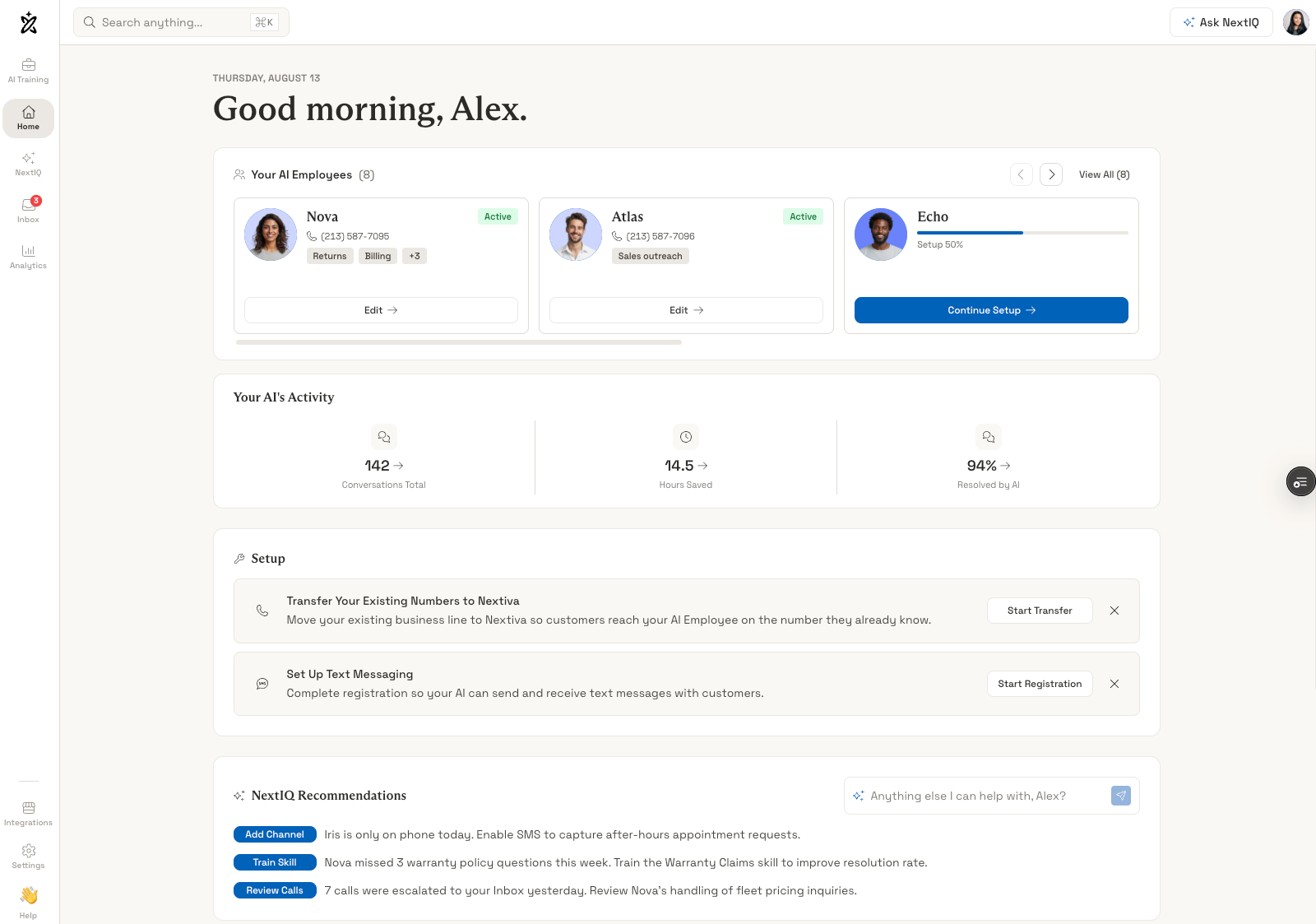
XBert is Nextiva's AI employee for customer conversations, and it's the outlier on this list by design. XBert is a self-serve product built for small businesses that can go live in minutes, not a months-long enterprise deployment. It handles phone calls, text messages, web chat, and messaging apps as one unified experience, and it can be used on its own or as part of Nextiva's NEXT platform.
Setup is about as simple as it gets: XBert learns from a business's website and FAQs, and teams choose a voice, set business hours, and define routing rules, with free assisted onboarding if they want it. XBert comes with pre-built roles for receptionist, sales, and support, and it keeps each customer's conversation history in Nextiva's NextIQ. When a conversation needs a person, XBert transfers it to the right team member with the full conversation attached, and businesses can set sensitive topics like billing disputes, urgent repairs, or medical questions to always go to a human.
Standout capabilities
- Scheduling actions: Books, confirms, and reschedules appointments, sends reminders and booking links, and captures and qualifies leads.
- Integrations: Google Calendar, Calendly, Cal.com, Zoho, Telegram, and Housecall Pro are live at no cost. Salesforce, HubSpot, Pipedrive, ServiceTitan, and about 20 others are available on request within two to four days, also at no cost.
- Reporting: Full call transcripts, call summaries, daily performance reports, and after-hours revenue tracking.
- Language detection: XBert detects the caller's language automatically.
Pricing
XBert is the easiest product here to budget for. It costs $99 per month for 100 AI conversations, with no long-term contract and a 30-day money-back guarantee. Additional conversations cost $1.50 each, or $0.99 each when bought in bulk, according to Nextiva's XBert guide, which also lists a 14-day free trial. XBert can be bought on its own or added to Nextiva's NEXT, Contact Center, or NextivaONE plans.
Nextiva defines a conversation precisely: a call counts once it passes 30 seconds, and a text or chat counts after three AI responses. That filters out hang-ups and one-message chats, but it also means businesses pay for conversations the AI doesn't resolve. That's the standard trade-off of per-conversation pricing, in exchange for predictable costs.
Best for
Small and mid-sized service businesses, like home services, healthcare practices, legal, real estate, salons, and restaurants, that want every call, text, and chat answered without an implementation project.
Decagon
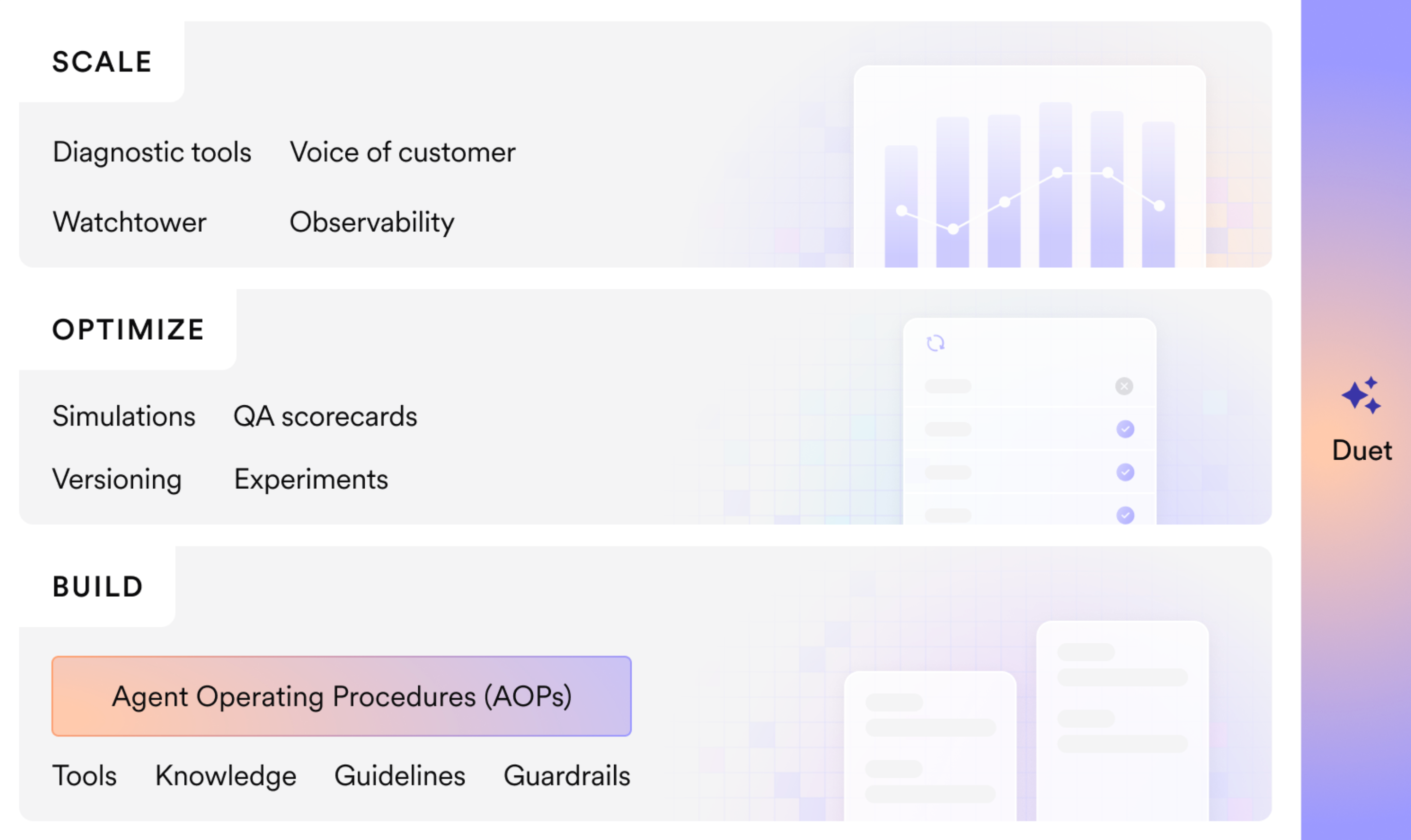
Decagon positions itself as the AI concierge for enterprise customer experience. It raised a $250 million Series D at a $4.5 billion valuation in January 2026, led by Coatue and Index Ventures, and added more than 100 new global enterprise customers in its most recent fiscal year. Customers include Avis Budget Group, Block, Deutsche Telekom, Oura Health, Affirm, and Chime. Decagon agents work across voice, chat, and email, and they run on Agent Operating Procedures (AOPs), the instructions CX teams use to define how the agent handles each workflow.
Decagon's biggest releases of the year came at Decagon Dialogues on October 1. The headliner is Voice 3, which runs on Chord, the first voice model built by Decagon Labs specifically for customer conversations. Voice 3 keeps listening while it talks, so it ignores small cues like "mhm" but stops for real interruptions. It also handles the conversation and the task at the same time, so it can give the caller progress updates during a long task instead of putting them on hold. Chord even adjusts its speech phrase by phrase, slowing down for details like phone numbers and confirmation codes.
Standout capabilities
- Personal Agent Gateway: Detects customers' personal AI agents, including ones that don't identify themselves, and gives them a dedicated channel alongside chat, email, and voice, with permissions customers control.
- Agent Modules: Extend Decagon agents beyond support into journeys like lead qualification, customer onboarding, and collections, with modules for financial services, travel and hospitality, healthcare, retail, and telecommunications. Memory carries across conversations and channels.
- Duet Apprentice: Learns a business from internal resources and from escalated conversations handled by experienced reps, then uses that knowledge to help draft AOPs, run Simulations, and analyze conversations. Teams can update AOPs directly from Slack or Microsoft Teams.
- Cross-channel memory on voice: Chime's COO credits Decagon Voice with combining brand customization and cross-channel memory.
Pricing
Decagon offers two pricing models. Per-conversation pricing charges a fixed rate for every incoming conversation, with lower rates at higher volumes. Per-resolution pricing charges a higher fixed rate only for fully resolved conversations, with no charge for escalations, and the rate drops as resolution commitments grow. Decagon doesn't publish rates.
Decagon says most of its customers choose per-conversation pricing. Why? Because volume-based billing is predictable, avoids disputes over what counts as a success, and removes any incentive to push partial resolutions. That's a direct counterpoint to the outcome-based approach of Fin and Sierra, and a good reminder that "pay for results" isn't automatically the buyer-friendly option if your definition of a result differs from the vendor's.
Best for
Enterprises with high, steady volumes that value budget predictability, and that want a platform pushing hard on voice quality and on new channels like customers' personal AI agents.
Regal
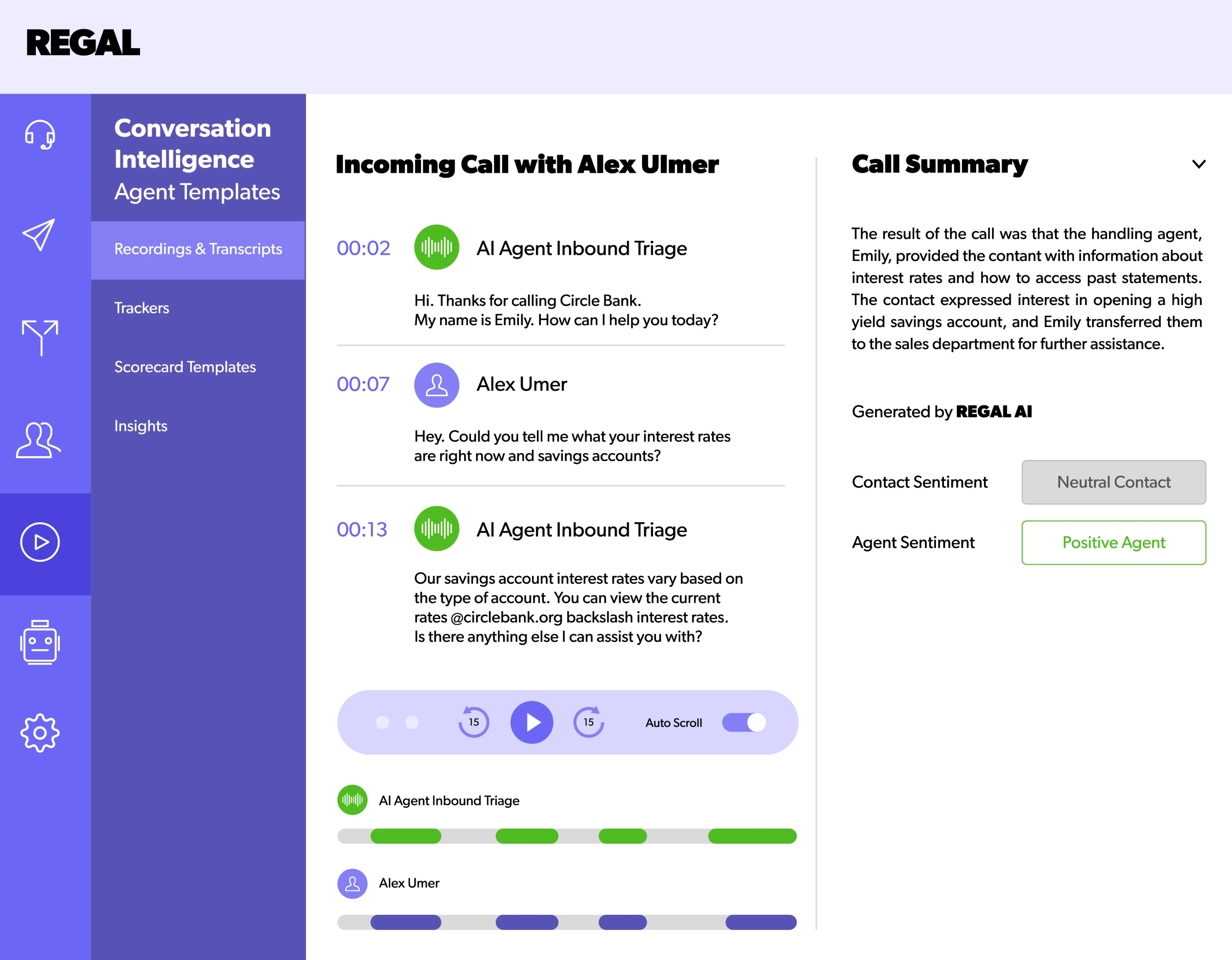
Regal is an enterprise voice AI agent platform for contact centers, founded in 2020, that helps businesses build, deploy, and manage autonomous AI agents across sales, support, and operations. It's voice-first, but its AI agents also run over SMS and chat, and an embeddable web widget supports both chat and browser-based voice calls. Every interaction feeds Regal's Unified Customer Profile, which gives AI and human agents the same view of each customer, and native warm transfers hand calls to humans with full context.
Regal's newest release is Goal Oriented Agents, launched October 27. It's designed to solve a long-standing trade-off in voice AI: single-prompt agents sound natural but loosely follow business processes, while multi-state agents follow the process but feel scripted. Goal Oriented Agents pair a small, fast "actor" model that carries the conversation with a “director” model that checks progress against the goals for each stage after every caller turn. Callers can share information in any order, the agent can capture several details from one answer, and it avoids asking for information the caller already gave.
Standout capabilities
- Goal nodes: Builders define what the agent must accomplish at each stage and what must be true first, from data like a date of birth to plain-language conditions like a caller mentioning a death in the family. Regal highlights use cases like auto insurance claims, Medicare enrollment, roadside assistance, mortgage qualification, and HIPAA-compliant medical intake.
- Copilot and Copilot Canvas: Copilot is Regal's agent for building agents. Copilot Canvas brings building, testing, and monitoring into one interface, with live data on latency, guardrail adherence, and tool reliability.
- Voicemail Detection model: Separates voicemail from iOS and Google call screeners, and has reduced voicemails routed to agents by 45%.
- Regal MCP and Five9 integration: Regal MCP connects the platform to outside AI tools to pull transcripts, inspect configurations, and trigger actions. As a Five9 AI Agent Connect partner, Regal also has a dedicated integration API for its voice AI agents.
Pricing
Regal prices by custom quote, based on each team's setup. Regal says customers pay for usage, and that across millions of calls, its AI agents generally come in at about $0.20 per minute. Regal compares that to roughly $1 per talk-minute for an onshore human agent once idle time is factored in.
Per-minute pricing is the most intuitive model for a voice-first operation, because it matches how contact centers already think about cost. The catch is that it measures time, not results: a short call that fails costs less than a longer call that succeeds. Pair it with your own conversion or resolution data so you're optimizing for what those minutes actually produce.
Best for
Voice-heavy B2C contact centers in industries like insurance, healthcare, and mortgage lending that run large inbound and outbound programs, where AI and human agents need to work from the same customer record.
FAQs
Not for real production use. Free tiers and open-source frameworks exist, but the pieces that make a platform omnichannel all cost money: telephony, access to messaging apps, integrations with your CRM and helpdesk, and the LLM usage itself.
What you can get for free is a serious trial. Fin offers a 14-day free trial with unlimited outcomes and no credit card required, plus an Early Stage program that gives eligible startups a year of Fin for free. Nextiva's XBert has a 14-day free trial and a 30-day money-back guarantee on its $99 monthly plan. Enterprise platforms like Sierra and Decagon are sold through their sales teams, so the closest equivalent is a scoped pilot.
The terms are often used interchangeably, but they describe different generations of technology. An omnichannel chatbot is usually a scripted or intent-based bot deployed across several text channels. It follows decision trees, answers predefined questions, and hands off anything outside its script.
Omnichannel conversational AI uses LLMs to understand open-ended requests, covers voice as well as text, shares memory and context across channels and sessions, and increasingly completes tasks in back-end systems instead of just answering questions. A simple test: if it can't pick up an open issue from another channel and actually do something about it, it's a chatbot, no matter how it's marketed.
Usually not, and most vendors no longer ask you to. Fin works as an AI agent on top of existing helpdesks, including Salesforce, Zendesk, and HubSpot, and Fin Voice connects to telephony providers like Twilio, Genesys, RingCentral, and Five9. Regal is a Five9 AI Agent Connect partner with a dedicated integration API for its voice AI agents. XBert can run on its own or inside Nextiva's platforms. The replacement question tends to come up later, once AI handles enough volume that the cost of your existing seat licenses starts to look different. In the meantime, the real work is integration: the AI is only as omnichannel as the data and actions it can reach.
It depends much more on your systems than on the AI. Self-serve products like XBert are designed to go live in minutes, and a focused deployment on high-volume, repetitive requests with clean integrations can show results quickly. Enterprise deployments that involve voice, back-end actions, and custom outcome definitions take longer, because the integration and testing are the project. Whatever the timeline, measure ROI with the right numbers: issues fully resolved and counted once across channels, repeat-contact rate, cost per resolved issue, and customer satisfaction. If your automation rate is rising along with your repeat-contact rate, that's not ROI. It’s cost moving from one queue to another.