October 2, 2026 • 8 min read
ISG Workforce Engagement Management Buyers Guide 2026: Top Takeaways

Director of Content & Market Research
October 2, 2026
Contact center workforce engagement management (WEM) suites comprise applications that support and optimize a customer service team’s performance.
The suites evolved from the old workforce optimization (WFO) category, which bundled workforce management (WFM) and quality assurance (QA) solutions.
Now, they also include a raft of other applications, like AI routing, Agent Assist, and various performance management solutions for coaching, learning, and gamification.
Many contact center providers claim to cover all of these bases, but the depth of their capabilities can differ significantly.
Recognizing this, ISG spun out a separate WEM evaluation from its Contact Centers Buyers Guide to showcase how providers compare on WEM capabilities, vision, and roadmap.
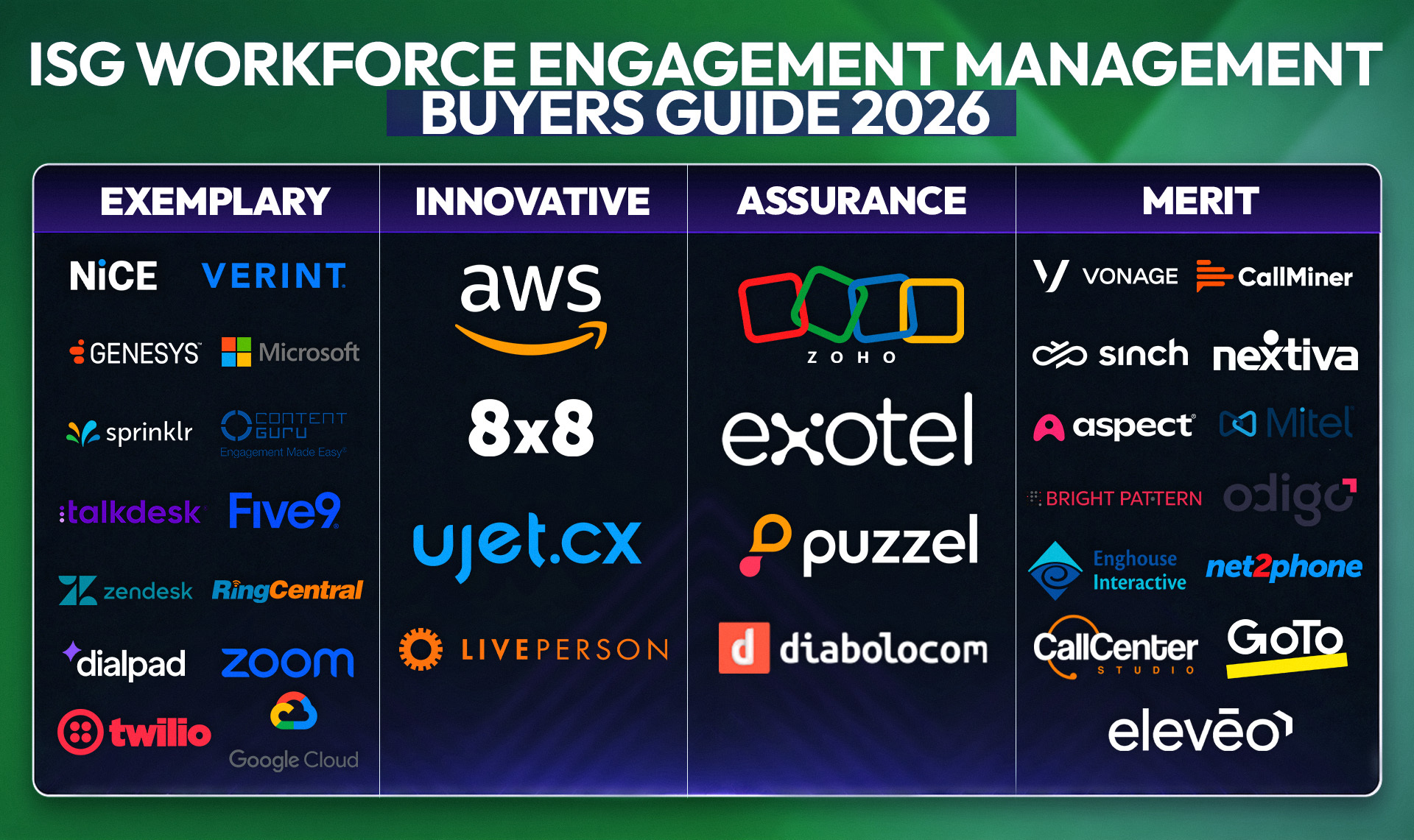
In the process, ISG evaluated 34 contact center providers and named 14 "exemplary."
ISG’s “Exemplary” Workforce Engagement Management Providers in 2026
ISG’s “exemplary” WEM providers are: NiCE, Verint, Genesys, Microsoft, Sprinklr, Content Guru, Talkdesk, Five9, Zendesk, RingCentral, Dialpad, Zoom, Twilio, and Google Cloud.
The research firm assessed each provider’s WEM offerings across three core criteria:
- Customer Experience (20%): ISG investigated the Total Cost of Ownership (TCO) and Return on Investment (ROI) of each provider’s WEM suite, collecting and validating customer feedback. (NiCE, Verint, and Content Guru led here).
- Product Capability (50%): ISG evaluated WEM capabilities across “90 function points”, considering features in isolation and how they come together to add value. (NiCE, Verint, and Genesys led here).
- Product Platform (30%): ISG assessed the “adaptability, manageability, reliability and usability” of WEM offerings. (NiCE, Genesys, and Verint led here).
The following matrix shows how the 20 remaining evaluated providers fared.
7 Top Takeaways from ISG Workforce Engagement Management Buyers Guide 2026
The ISG Buyers Guide offers analysis that goes beyond vendor strengths and weaknesses, spotlighting broader trends shaping WEM innovation and deployments.
With pearls of wisdom from Keith Dawson, Director of Research for Customer Experience at ISG, the following takeaways introduce some of those trends.
1. Hybrid WEM Is Coming
The contact center workforce is changing, with human and AI agents working independently and together to resolve queries. WEM solutions are now evolving to support this hybrid team.
“Vendors are trying to create a parallel system for managing AI performance, using some of the same contexts you use for human performance.”

However, Dawson warns that there is no operational consensus on how to deliver hybrid WEM.
Does gamification have any relevance for AI? No. Coaching? Sure, but in an AI context that’s different to coaching humans. It's adjacent, not equivalent.
As such, hybrid WEM is still in its infancy, with NiCE one of the few vendors to have already launched a solution.
Its solution shows how AI is shifting contact center demand, compares CX outcomes across human- vs. AI-led interactions, and unifies coaching recommendations.
Expect further evolution here. In time, such systems may also evolve to account for new agent roles, like humans completing background tasks within an interaction orchestrated and led by an AI agent.
2. The Economics of a Hybrid Workforce Come Into Question
Hybrid WEM can show a contact center leader whether human or AI agents deliver higher resolution and satisfaction rates across intents. That's powerful data for journey orchestration.
However, it doesn’t yet answer: what’s the cost difference? Is it cheaper to run 1,000 interactions with AI than with a human? There's no industry-wide understanding of cost equivalence.
That gap is troubling in a space with a cost structure that has been honed for decades.
“People who run contact centers know intuitively how to balance volume, schedules and intraday management. It's second nature.” said Dawson. “Now, we're introducing numerous new variables.”
Faced with that uncertainty, contact centers tend to wait and see, or run small pilots, before committing to dramatic change. So while organizations will adapt their structures to facilitate the hybrid workforce, change is likely to be slow and incremental.
3. Workforce Management Starts to Pivot Into Workforce Orchestration
Historically, WFM was a sticking point in the contact center stack. Planners were experts in a specialist solution, like NiCE IEX or Verint, and they either moved to companies using that technology or brought it with them.
That dynamic has changed. WFM is now so finely tuned that some argue it is largely commoditized, with only so much productivity left to squeeze from it.
Whatever the case, it is no longer the decision-maker it once was.
Still, as the contact center ecosystem expands and more organizations consider what tomorrow's workforce looks like, there is an opportunity to move from traditional workforce management to a new vision for workforce orchestration.
In this model, a WFM solution ingests signals from other systems, normalizes the data, uses it adapt staffing plans automatically, and then send out alerts to planners, supervisors, and agents to alert them of the changes.
Here's an example: time-off data might originate in an HR system and sync with the WFM solution. The solution then use that data to automatically adjust schedules and trigger updates to agents through the contact center's collaboration tools, i.e., Teams or Zoom.
For now, such orchestration is beyond the scope of most contact centers. But as WEM vendors explore how their technologies can interact with HR, collaboration, conversational AI, and other solutions, “workforce orchestration” is a term to take note of.
4. AI Adoption in WEM Will Become Inherently More Complex
Three years ago, AI's use cases in WEM were highly practical, and operations leaders could immediately sense the benefit.
Take automated quality assurance (Auto-QA). Previously, a supervisor reviewed 1% to 3% of interactions at month's end, as the deadline loomed, and when the interactions were weeks old. Could they still fix those issues? No. Did anyone remember them? No.
Then came systems that could ingest and score every interaction instantly, letting leaders step in near real time. Although it required some process change, the transformation was clear, and the ROI was easy to calculate from the start.
The next wave of innovation is different. Contact centers are being challenged to connect data sources, apply new forms of AI to new processes, and adopt new governance models.
Ultimately, that necessitates a deeper conversation around the changing contact center operating model, and vendors are now spending more time discussing this than marketing narrowly defined AI use cases.
5. WEM Still Lacks an Integrated Architecture
As Dawson writes in his report: “WEM software should provide an integrated architecture that connects forecasting, scheduling, intraday management, adherence, recording, evaluation, coaching, performance dashboards, and supervisor workflows within a unified operating environment.”
Yet, these elements still operate largely in isolation.
Owning each element gives CCaaS players an inherent advantage over standalone WFM or QA providers. They can build an environment where, for instance, performance data shapes which contacts a rep receives, their schedules, and any ongoing learning management initiatives.
The pieces are in place, but delivering such a WEM operating system seemingly isn’t a core priority of contact center providers, as they consider how their platforms more broadly fit into the enterprise ecosystem.
That said, one area where they are focused is consolidating data across WEM tools and layering natural language interfaces on top.
In some cases, planners can ask: "What types of queries are driving this demand peak?" and supervisors, "Which member of my team needs the most support right now?" and get answers immediately.
The next step is for AI to go beyond answering questions and instead to recommend ways to improve performance, before offering to act on them. That’s the market direction, but building the interconnected ecosystem it requires will take significant work.
6. Agent Assist Adoption Rises, But Deployments Can Be Tricky
Agent Assist adoption has become widespread as the technology has evolved from its origins as a tool that interpreted real-time customer intent and surfaced relevant knowledge content for service reps.
Today, it can also carry over context from a front-end AI agent, recommend next-best actions, auto-draft customer replies, summarize conversations, and more.
Still, ISG finds that Agent Assist maturity varies across the WEM landscape, and many organizations are struggling with deployments.
“It’s complicated to implement and measure the effectiveness of Agent Assist. You need a strong data and knowledge structure behind the scenes. That’s a sticking point in getting that tooling into the field.”
Against this backdrop, some vendors are touting a solution that pulls Agent Assist data into QA to monitor how reps engage with AI recommendations and the technology's impact on customer outcomes. That intelligence can then help to systematically improve Agent Assist implementations.
Over time, QA data on how well a rep handles a given type of customer query could shape the prompts they receive. That is the future of personalized AI assistants.
7. Contact Centers Face Not Just a Tech Shift, But a Mentality Shift
Historically, contact centers have been tasked with handling interactions quickly, cost-effectively, and well. That challenge is big enough that leaders still focus most of their attention on it.
Yet they're now also being asked to bridge with the broader organization, implement new solutions, and manage a hybrid workforce, along with all the challenges that come with that.
In the face of this new reality, leaders have had little time to step back, measure how well their current operation is working, and paint a picture of the future.
Instead, change is being thrust upon them, and they have little time to understand the prerequisites for making tools - like Agent Assist - work in practice.
Given this, vendors should be wary that contact center leaders are navigating a stark mindset shift as well as a technology shift.
For more insights from Dawson, unpack CX Foundation’s earlier coverage of ISG’s Customer Experience Management Buyers Guide 2026