
May 15, 2026 • 8 min read
ISG CRM Buyers Guide 2026: 7 Top Takeaways

Director of Content & Market Research
May 15, 2026
CRM systems are steadily evolving from static systems of record into intelligent platforms that orchestrate workflows around specific outcomes.
In line with this trend, vendors are shifting beyond feature breadth and building cohesive ecosystems that span sales, service, marketing, commerce, and beyond.
These ecosystems will not be defined by standalone applications, but by how they coordinate people, processes, and AI agents seamlessly and securely.
Yet, the pursuit of such platforms is a marathon, not a sprint, and different providers are at different stages of that journey.
The ISG Customer Relationship Management (CRM) Buyers’ Guide lifts the lid on their progress.
How Did ISG Evaluate CRM Providers on Their Offerings?
ISG evaluated CRM providers on their:
- Sales CRM application
- Service CRM application
- Marketing CRM application
- CRM platform approach
- Overall CRM offering
Across each category, qualifying vendors received an overall score based on both product experience and customer experience.
Product experience focused on capability and platform performance, with sub-criteria assessing adaptability, manageability, reliability, and usability.
Meanwhile, customer experience evaluated areas such as customer validation, total cost of ownership (TCO), and return on investment (ROI).
Offerings that scored above average across both dimensions were classified as “Exemplary.”
In the “overall CRM” category, three vendors earned that distinction in 2026.
Which CRM Offerings Lead the Market in 2026?
ISG’s three “Exemplary” CRM offerings for 2026 are Salesforce, Oracle, and HubSpot.
Think of Salesforce’s CRM ecosystem as the filling in a sandwich. The bottom slice is Data 360 (formerly Data Cloud), which establishes a common data foundation. Meanwhile, the top slice is Slack, which is evolving into an intuitive, collaborative interface for interacting with data and orchestrating workflows across the CRM ecosystem. Increasingly, Agentforce agents are running these workflows and extending them across broader business applications.
Oracle, specifically through Fusion rather than NetSuite, takes a similarly integrated approach. Yet, beyond unifying CRM data, Oracle also connects its first-party ERP, HCM, and SCM applications within a single framework. This creates a significant opportunity to enrich front-office workflows with back-office intelligence, enabling more data-rich CRM experiences and stronger end-to-end business value for organizations already invested in Oracle’s enterprise stack.
Meanwhile, HubSpot unifies CRM and other customer data through its Data Hub (released in 2025), which is a crucial addition to its Smart CRM platform. The vendor’s AI strategy is also notable, with AI agents directly embedded into day-to-day workflows rather than positioning it as a standalone capability. HubSpot has also embraced outcome-based pricing to complement this approach and its target customer: the midmarket, which tends not to care about AI for the sake of AI. Instead, this customer cares about measurable growth and returns.
The remaining four providers in the evaluation are Microsoft, SAP, Zoho, and Oracle NetSuite, as highlighted in the image below, which illustrates the overall rankings.
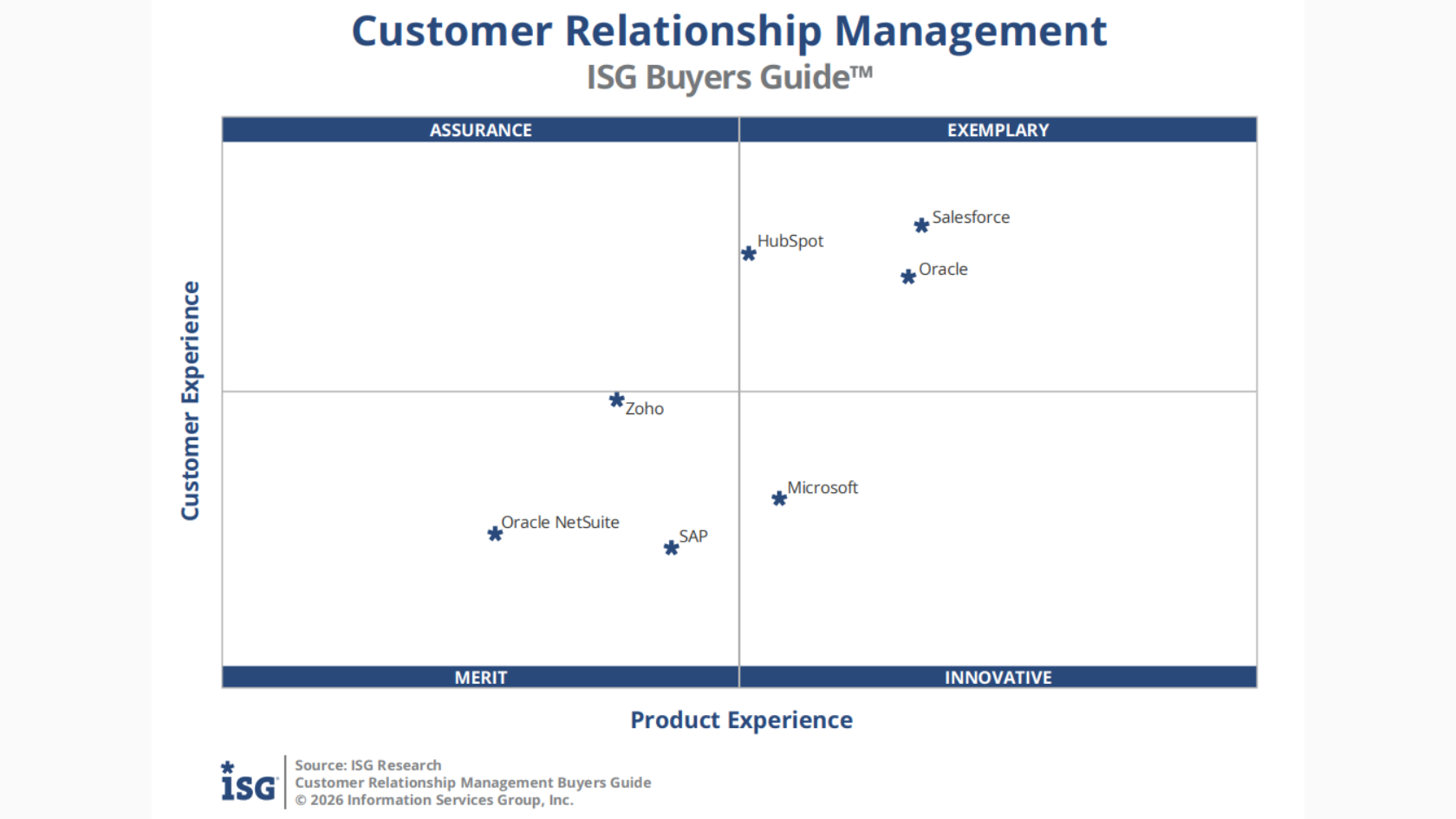
Elsewhere in the report, ISG evaluates additional vendors. However, this particular matrix focuses exclusively on providers that deliver sales, service, and marketing solutions on a single platform.
So, for example, while ServiceNow ranked as an “Exemplary” vendor for its individual service and sales CRM applications, it does not qualify for the “overall CRM” evaluation because it does not offer a first-party marketing solution.
7 Top Takeaways from the ISG CRM Buyers Guide 2026
While ISG’s CRM Buyers Guide delivers a detailed vendor analysis, it also reveals the major forces reshaping the CRM market.
CX Foundation spoke with Barika Pace, Director of CRM & Revenue Technology Research at ISG, to dig deeper into those shifts.
Here are seven of the biggest insights and trends emerging from the analyst’s research.
1. CRM Providers Transition from Bundled Products to True Platforms
For years, "complete platform" claims papered over a fragmented reality, where CRM providers continued to bundle applications. That is beginning to change.
Leading vendors are establishing a context layer that sits above the CRM ecosystem, enabling disparate systems to share a common language, simplifying cross-application workflows, and allowing AI to operate more coherently across the full stack.
Ultimately, this forms the bedrock for what comes next: a persistent customer memory.
Persistent customer memory is a continuous and consistent record of every interaction, touchpoint, and workflow, regardless of which system or agent handles it.
2. AI Agents Tackle the Messy Middle
Handoffs between front, middle, and back office have long generated what the industry calls "the messy middle", a zone of operational friction where deals stall, service breaks down, and revenue leaks. AI agents are beginning to dissolve it.
“With Agentic AI, we're seeing vendors eliminate some of that messy middle, and those hands-offs are becoming more automated, more streamlined.”

That comes as vendors start to configure agents - and chains of agents - on their customers’ behalf, lowering the dependency on organizations to cut through that friction themselves.
Oracle and SAP exemplify this shift, embedding agents that move fluidly across first-party CRM and ERP systems, pulling back-office data into front-office workflows.
SAP leans into this with its Autonomous CX vision, built around its new AI assistants that, according to Jessica Keehn, CMO of SAP CX, connect “customer experience to operational truth in real time.”
3. CRM Solutions Become Increasingly Outcome-Oriented
The problem with legacy CRM was never the software itself; it was organizing everything around applications rather than outcomes.
Application silos bred data silos, which in turn created organizational silos.
The emerging model, with a context layer over the CRM, inverts this logic. It enables end-to-end workflows orchestrated to deliver specific outcomes.
Eventually, CRM systems may monitor the success of these workflows, learn, and self-adapt to bolster outcomes over time. Yet, that's much further down the road.
4. General-Purpose Agents as the New Operating Layer
Rather than proliferating purpose-built agents for every task, leading enterprises are converging on general-purpose agents embedded in everyday environments.
Microsoft's Copilot is perhaps the best example of this trend, bringing CRM functionality directly into Outlook and Teams so users never have to context-switch to do CRM work.
Salesforce's Headless 360 announcement pushes further in this direction, with the vendor making its CRM capabilities available through natural language interfaces across the business.
As AI makes CRM experiences conversational, the traditional notion of a CRM being a discrete application with a UI becomes less relevant.
5. Data Connectivity Becomes the Critical Differentiator
Truly knowing the customer, anticipating their needs, delivering seamless experiences… CRM has promised this for decades.
Yet, while the technology gets better, data quality, not just access, remains a critical issue.
As such, vendors are investing heavily in identity resolution, consent management, governance, observability, and real-time data infrastructure.
“API workframes, middleware partnerships, and ecosystem integrations… That’s where we saw the biggest improvement, pulling signals from ERP, contact center, consumer product usage, finance, and other third-party data sources.”
AI is also helping on this front, auto-curating data and reducing the manual entry burden that service and salespeople have historically resisted.
6. Customer Success Becomes a More Strategic Function
Orchestrating end-to-end customer experiences is as much an organizational challenge as a technological one, and leading CRM platform providers are responding accordingly.
Rather than limiting customer success to technical onboarding or support, they are deploying teams that work across the full executive suite, engaging CFOs, CROs, CMOs, heads of sales, and customer service directors together.
In doing so, they aim to harmonize CRM technology and processes across multiple personas.
“Vendors with a persona-driven approach to customer success are making the most headway."
Now, this is not a consistent trend across the market, but where it exists, it is proving to be a meaningful differentiator, according to Pace.
7. End-Users Struggle to Cut Through ‘AI Washing’
End-users are absorbing a massive amount of AI hype, which creates significant top-down pressure to deliver results.
Yet, amid this hype, it has become tricky to substantiate the use cases beneath the claims.
As a result, enterprises are actively pausing new AI projects because they can't evaluate the sheer volume of options fast enough.
When they do land on use cases, Pace suggests that ROI most often stems from closing deals faster, reducing knowledge transfer friction, creating cleaner team handoffs, and improving workflow coordination.
Notably absent from that list is headcount reduction. Despite being frequently cited by vendors as a primary benefit of AI, Pace is clear that it simply does not reflect what practitioners are seeing on the ground.
In addition to CRM, ISG evaluated the most prominent technology providers across the customer experience management (CXM) market. Unpack that analysis here.