
October 12, 2026 • 7 min read
IDC MarketScape for Worldwide Conversational Intelligence and Analytics Software 2026: Top Takeaways

Director of Content & Market Research
October 12, 2026
Conversational intelligence solutions represent the next evolution of speech analytics software.
For over a decade, contact centers have used the technology to deeply understand customer conversations, track CX metrics, monitor the service team’s performance, and more.
Still, these use cases exist. But conversational intelligence has expanded with the advent of generative AI and, more recently, agentic AI.
Indeed, organizations are putting conversational intelligence in the hands of new users, both human and AI, and using insights to trigger workflows that transform customer experiences.
As a result, a technology once seen as ripe for commoditization is experiencing a renaissance within many organizations.
IDC explores the software providers leading the charge in its Worldwide MarketScape for Conversational Intelligence and Analytics 2026.
How Did IDC Rank Conversational Intelligence and Analytics Software Providers?
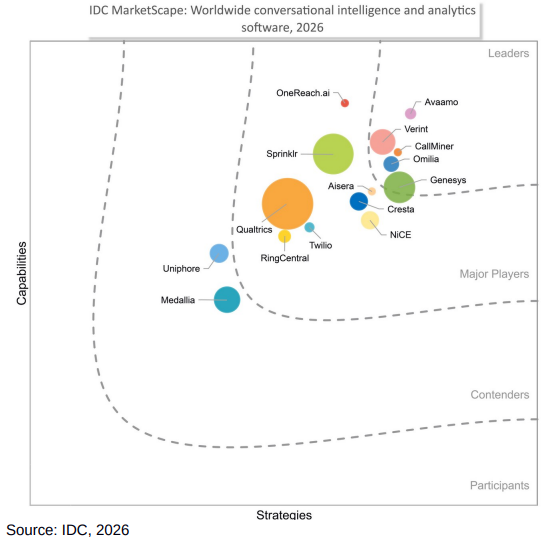
In its evaluation of 15 software providers, IDC named five market leaders: Avaamo, CallMiner, Genesys, Omilia, and Verint.
The research firm evaluated providers on two overarching criteria: capabilities and strategies.
To do so, it conducted structured interviews, ran surveys, and sourced input from vendors, end-users, and “market leaders”, placing the providers on the following matrix.
Of course, the conversational intelligence landscape extends far beyond the vendors included in this matrix. However, many offer modules within broader platforms.
All the providers IDC evaluated offer conversational intelligence as a standalone solution, typically made available via an SKU.
7 Takeaways from the IDC MarketScape for Conversational Intelligence and Analytics Software 2026
In its study, IDC provides in-depth profiles of each software provider, examining their respective strengths and weaknesses.
But between the lines lie several key insights into the state of conversational intelligence and where the market is headed. Here are the seven most striking.
1. The Value Proposition of Conversational Intelligence Software Has Changed
Just two or three years ago, conversational intelligence software providers went to market by flaunting features like automated quality scoring and auto-summarizations. From CCaaS to CRM, such capabilities are now almost ubiquitous across the space.
However, standalone conversational intelligence solutions that work flexibly across systems still have a place. What’s changed is their value proposition.
Indeed, the value of conversational intelligence software is now in connecting insights and orchestrating actions across departments and enterprise applications.
So, while many conversational intelligence capabilities have become commodities, that ability to pull insight and translate it into actions across third-party solutions is where they’ll continue to deliver value.
Unfortunately, many organizations aren’t prepared to take this next step, and the immediate benefits of these AI workflows aren’t as obvious as lightweight generative AI use cases, like an auto-summary, which don’t require organization-wide transformation.
Nevertheless, this is the direction of travel, and IDC advises buyers to consider new criteria, such as API endpoints that support AI readiness, to prepare for multi-agent workflows spanning different vendors’ systems.
2. The Boundaries of Conversational Intelligence Solutions Expand
As buyers follow IDC’s advice and determine both their current and future integration requirements, they may recognize a groundswell in the possibilities for putting conversational insights to work across the enterprise.
In CX Foundation’s conversational intelligence market analysis, cross-department workflows included feeding insights into personalization platforms to tailor customers’ online experiences and into advertising solutions to optimize ad spend.
Such workflows extend well beyond conventional conversational intelligence deployments, but they’re increasingly coming into focus.
Insights are also flowing into broader data and analytics platforms, from Adobe Analytics to Google BigQuery, to unify intelligence and uncover new insights into the customer journey.
For example, marketing may track website abandonments while service teams monitor the reasons users escalate from the website to customer support. These unified insights can help marketing teams improve the website, prevent unnecessary customer contacts, and deliver a more effortless experience.
3. Solution Providers Increasingly Act as Service Providers
The shift from surfacing conversational insights to using them as a trigger for AI-driven workflows is exciting, but daunting.
In many cases, it means adopting new forms of AI, opening up to new systems, and connecting with the broader business from which contact centers have historically been siloed.
Against this backdrop, it’s little surprise that IDC found “AI guidance and partnership” to be the most critical factor when choosing a conversational AI and intelligence provider.
The research firm noted that end users increasingly seek a “true partner” that can deliver rapid ROI while helping future-proof their operations.
That last point is crucial. A conversational intelligence deployment is never a one-and-done exercise. Organizational structures, business priorities, and customer expectations evolve, and analytics strategies must evolve alongside them.
4. Industry Leaders Embed Conversational Intelligence Across Their Broad Platforms
As outlined, the overarching trend in this space is turning conversational insights into action, making MCP servers and APIs increasingly essential.
However, IDC believes “market leaders are taking the onus of putting conversational intelligence to work by connecting their broader platforms.”
Genesys is a prime example. IDC commends the vendor for using conversational intelligence to uncover insights that feed into its workforce engagement management (WEM) solution and copilots, where they’re put to work.
As an example, this intelligence could lift insight into whether reps follow their copilot’s advice. That intelligence can then inform Agent Assist strategies and coaching programs, a process that will likely become more autonomous over time.
Nevertheless, putting insights to work isn’t simply about bolting on solutions like copilots. Market leaders need a clear vision for how their solutions fit into the broader CX stack, and they need to articulate that vision. That will ultimately differentiate them.
5. Conversational Insights Are Still Scattered Across the CX Ecosystem
As CCaaS and CRM platforms offer increasingly sophisticated analytics, many organizations continue to rely on dedicated in-application analytics. While valuable, this can fragment insights, from real-time call data to quality scores.
That fragmentation extends across the organization. Multi-location support teams often use different contact center platforms, while sales and support teams rely on separate conversational intelligence solutions due to longstanding silos.
Third-party Voice of the Customer (VoC), survey, and social listening tools add another layer of fragmentation, as they’re often still excluded from conversational analytics platforms.
These disconnected insights can undermine conversational intelligence initiatives.
IDC notes that organizations recognize the problem and want to consolidate conversational intelligence, provided they can ensure “complete, robust, [and] accurate results.”
6. Natural Language Querying Is Now the Norm (But What’s Next?)
Natural language interfaces that let users query conversational data and build custom reports are now an expectation, not a nice-to-have.
They’re particularly valuable for operations leaders and supervisors, who can ask questions such as “What’s driving this demand peak?” or “Which agents are struggling right now?” and use the answers to take targeted action.
Beyond the contact center, the same interfaces help teams understand what customers are saying about products, pricing, competitors, and more, providing invaluable business insights.
IDC recognizes this value, but the next evolution is even more interesting: AI experiences that understand an employee’s role, tailor responses, recommend actions, and assign agents to carry them out on the user’s behalf.
7. Conversational Intelligence ROI Can Be Significant
The IDC report concludes: “If your organization is not already using conversational intelligence for reporting and analysis purposes, and at least evaluating where advanced AI would increase its value, it should be.”
Beyond these foundational use cases, IDC notes that many organizations are achieving “strong” ROI, particularly by consolidating insights across customer service and internal operations.
The next step is turning those insights into action, making savvy vendor selection essential.
Integrations, MCP servers, and governance models have become key considerations. But to reiterate a central point, perhaps the most important factor is finding a provider that acts as a partner, with referenceable customers whose experiences align with the organization’s requirements and AI maturity.
Earlier this year, IDC conducted a similar study investigating the “agentic CCaaS” space. Get the top takeaways here.