
September 1, 2026 • 9 min read
IDC MarketScape for Worldwide Agentic CCaaS Platforms 2026: Top Takeaways

Director of Content & Market Research
September 1, 2026
Today’s contact center technology market looks very different from five years ago.
First, the solutions tie much more closely with the broader enterprise stack. They’re no longer managed as an IT offshoot; they’re now a core part of a broader, more comprehensive CX strategy.
Second, as that convergence happens, many new names have entered the market. That includes CRM players like Salesforce, UCaaS pioneers like Zoom, and - most recently - conversational AI players like Cresendo.
Third, the conversation has pivoted from either on-premise or public cloud, with hybrid and sovereign cloud deployments increasingly common (particularly in highly-regulated spaces).
These are just three trends that exemplify a changing market.
Yet, one trend is driving change across the space more than any other: agentic AI. It’s even reflected in the name of IDC’s latest market study.
It is no longer the “MarketScape for Worldwide CCaaS Platforms.” Now, it’s the “MarketScape for Worldwide Agentic CCaaS Platforms.”
The report includes a vendor evaluation, but it also offers a window into how vendors’ visions and capabilities are evolving in this fast-moving market.
How Did IDC Rank Agentic CCaaS Platform Providers?
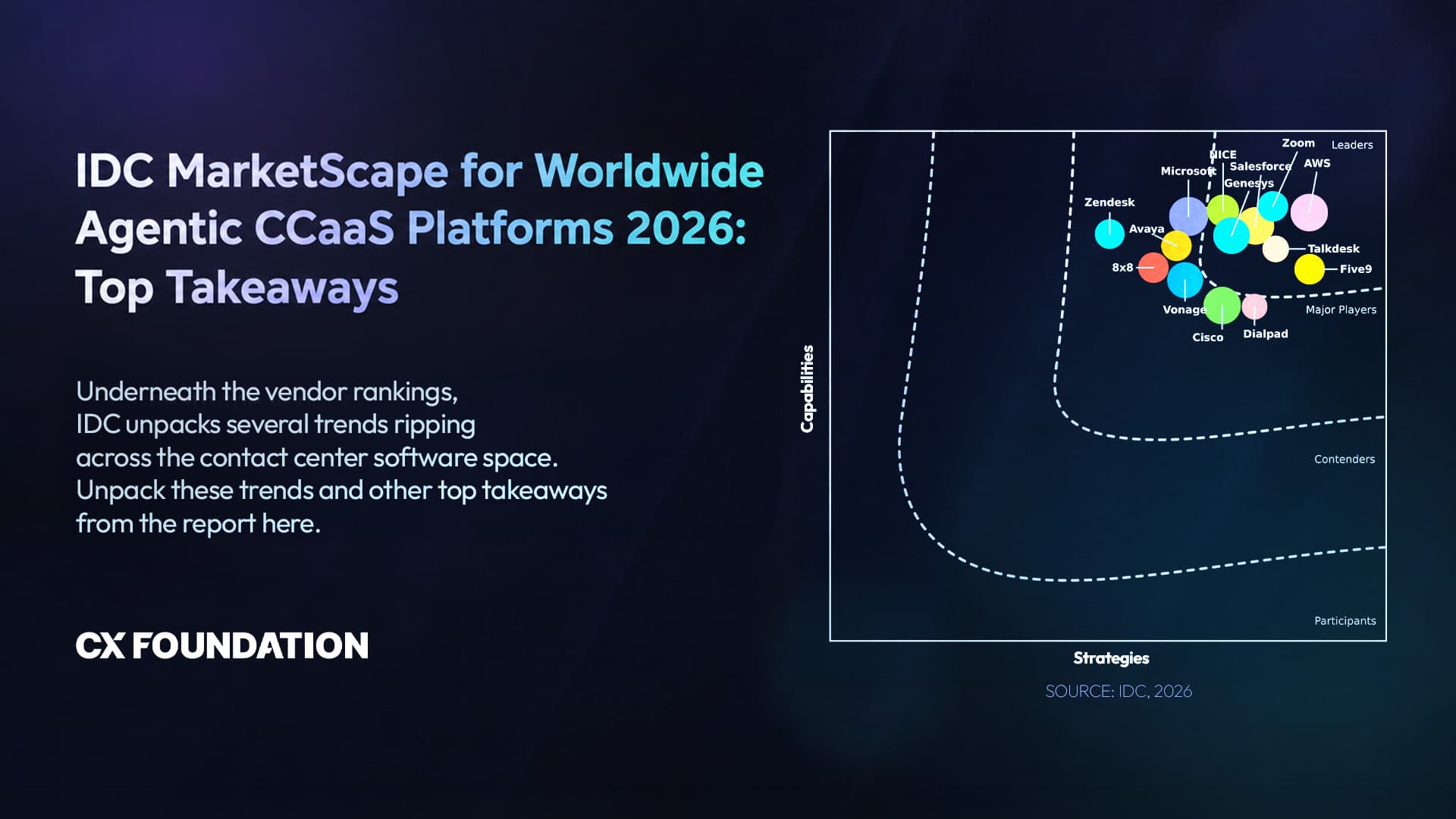
In an evaluation of 14 providers, IDC noted seven market leaders: AWS, Zoom, Five9, Salesforce, Talkdesk, Genesys, and NiCE.
To do so, it assessed all providers’ capabilities and strategies through surveys, discussions, and interviews with providers and end users.
From there, it created a vendor matrix, with leaders - as in other reports - clustered in the top-right corner.
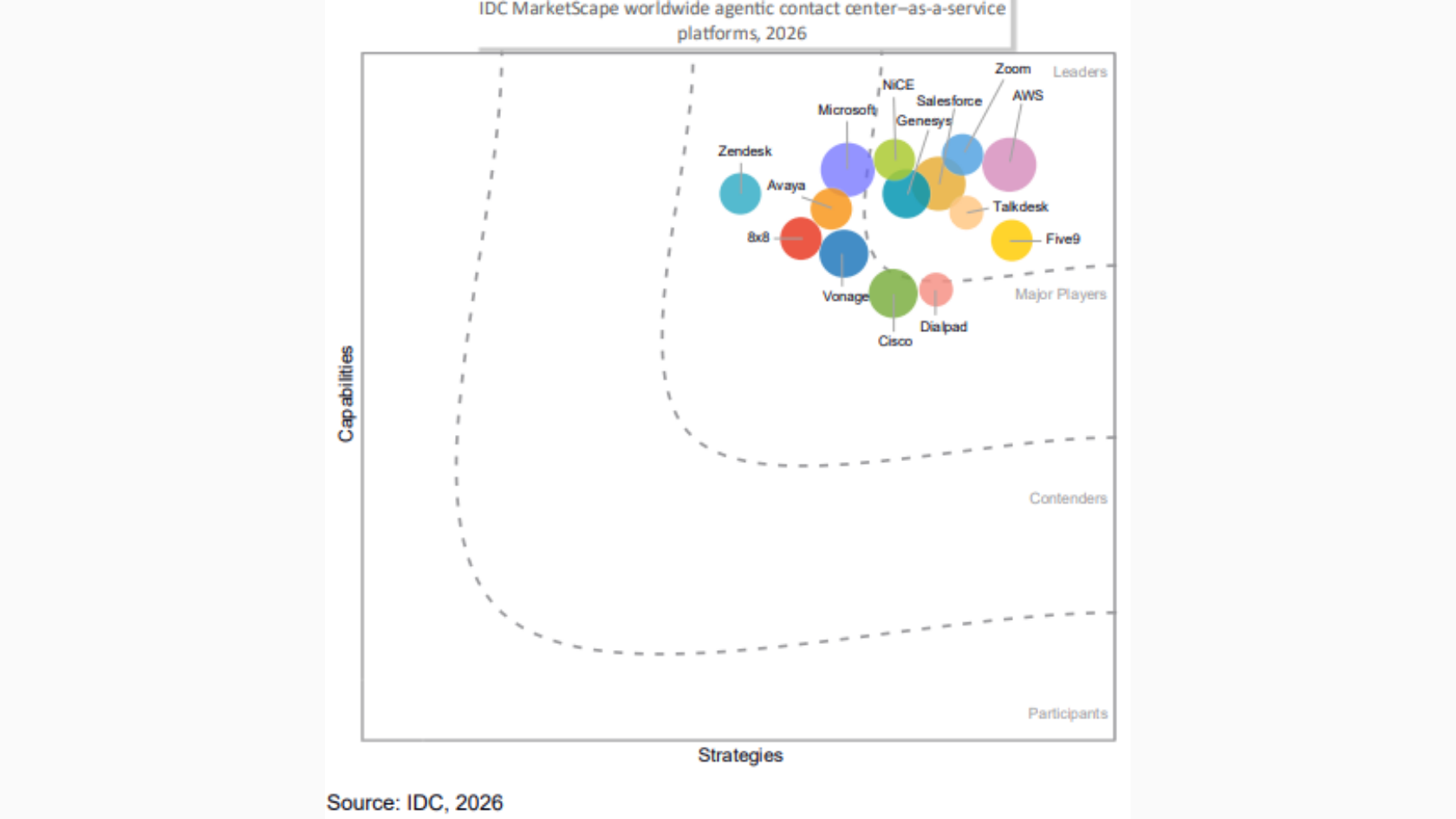
One top takeaway, as dissected later, shows that all vendors are tightly grouped. Yet, AWS, Zoom, and Five9 seem to edge ahead.
For AWS, its Amazon Connect Customer Profiles, fully consumption-based pricing model, and voice AI experiences - bolstered by its recent NLX acquisition - are differentiators.
Meanwhile, Zoom earns plaudits for its support of human-AI back-office collaboration, extensive AI R&D program, and “strong” workforce management (WFM) foundation.
Lastly, IDC commends Five9 for its R&D investment, performance management solutions, and “feedback-driven product development.”
The report explores many other strengths (alongside weaknesses). However, what’s more interesting for industry onlookers is what it reveals about the overall direction of the CCaaS market.
7 Top Takeaways from the IDC MarketScape for Worldwide Agentic CCaaS Platforms 2026
While market evaluations often spark debate, they can provide valuable insight into where the market is headed by highlighting key trends in vendor visions and capabilities.
With that in mind, here are seven key takeaways from IDC’s report, illuminating broader market trends rather than platform rankings.
1. IDC Seems to Give the Term CCaaS an End of Life
While it still uses the term “CCaaS”, IDC suggests that as AI agents become better at pulling account context, reasoning, and resolving queries without a human in the loop, the category will be superseded.
Indeed, the provider believes AI agents will push “the category toward something broader than contact center software, something like a customer experience (CX) platform”.
Such platforms connect with marketing, sales, and commerce workflows, not just pulling in data from new systems, but triggering actions within them.
As this shift takes hold, fewer vendors will refer to themselves as CCaaS providers.
Some already use the term “CCaaS” sparingly. For example, Genesys more often describes itself as an AI orchestration platform, while in summer 2025, Talkdesk’s CEO declared CCaaS “dead”, positioning its platform as an “operating system for customer experience”.
The challenge, according to IDC, is that the industry still needs to catch up.
Today, many requests for proposals (RFPs) reflect traditional CCaaS buying criteria, such as channel coverage and per-agent cost. This indicates that enterprise thinking is falling behind vendor visions.
2. Orchestration Capabilities Become a Pivotal Point of Platform Comparison
While CCaaS providers are repositioning around agentic AI, IDC warns that their underlying architectures aren’t necessarily evolving as quickly as their marketing materials suggest.
The research firm suggests that those best placed to help contact centers embrace the next generation of AI are those with the “orchestration depth” to back it up.
Against that backdrop, it’s perhaps no surprise that AWS and Zoom performed so well.
AWS brought case management into its platform earlier than much of the market, ingesting case and third-party data into Amazon Connect Customer Profiles to enable more adaptive, real-time, and proactive customer service.
Meanwhile, Zoom has built a connected CCaaS-UCaaS platform that orchestrates resolutions across the business. Its agentic intelligence layer, Zoom CX Insights, also lays the groundwork for self-improving contact center workflows.
That said, Genesys and NiCE have long championed journey orchestration, with advanced capabilities such as Genesys Cloud Associate and NiCE Agentic Engagement Plane.
Therefore, they may be disappointed by their overall positioning, particularly as both vendors are accustomed to leading these kinds of market reports.
3. There Are Only “Leaders” and “Major Players” (For Now)
A typical IDC MarketScape divides platforms into four categories: Leaders, Major Players, Contenders, and Participants. Yet in this report, every provider falls into one of the first two groupings.
That seems to reflect how - despite the excitement around new orchestration capabilities - much of the core CCaaS stack has become commoditized, from interaction management to omnichannel capabilities.
WFM is another good example. Five years ago, it was a major sticking point within the contact center stack, as planners moved between businesses advocating for their preferred platform.
Today, that differentiation has diminished. Open-source forecasting, specialist capacity-planning add-ons such as Cinareo and Datanitiv, and increasingly standardized scheduling and reporting solutions have made the WFM stack more malleable.
Some solutions remain more advanced than others, and NiCE and Cisco have innovatively launched platforms designed to manage both human and AI agents. Nevertheless, the broader WFM stack is less of a lock-in point than it once was.
Nowadays, the contact center stack is more flexible and increasingly influenced by other enterprise stakeholders - including IT, marketing, and InfoSec - who are playing a larger role in buying decisions.
Over time, this may open the door to a new wave of contact center technology providers, like Crescendo.
4. The Gap Between Roadmap and Reality Remains Significant
Historically, the contact center market has suffered from stalled migrations, with large enterprises stuck in hybrid mode, where some teams are both in the cloud and on-premises.
There are many reasons for this, including tricky legacy workloads, compliance cautions, and slow change management programs.
Yet, whatever the case, this means many providers’ roadmaps race ahead of customer reality, a trend IDC reinforces, highlighting a lag between companies announcing new features and enterprises deploying them at scale.
Against this backdrop, some vendors are spinning out AI solutions and allowing them to overlay on-premise or competitive CCaaS platforms.
For instance, the NiCE Engagement Hub allows organizations to attach NiCE Cognigy, Agent Assist, and its other AI solutions to their existing environment, enabling fast results without swapping out the core contact center infrastructure.
Similarly, Zoom offers its Virtual Agent on a standalone basis, which is now up 250% year-over-year, as buyers - under pressure to deliver on AI - prioritize AI investments over platform transformations.
5. CCaaS Pricing Comes Under the Microscope
CCaaS pricing is evolving from traditional seat-based models toward hybrid approaches that overlay AI costs based on consumption and outcomes.
There are alternatives. For example, Glia, a major provider in financial services, offers a model where customers agree on a price at the start of their contract and can then access all the features, AI, and integrations they need.
Nevertheless, much of the market is shifting toward AI usage-based models, prompting a warning from IDC to buyers: “AI pricing can look reasonable in isolation and add up badly against a realistic adoption curve.”
Given this, the research firm recommends modeling actual usage rather than relying on vendors’ assumed usage.
Some providers are doing more to help customers forecast and model that usage. AWS, for example, uses consumption-based pricing across its portfolio, allowing customers to turn services on, test them, model usage, and scale accordingly. That may be another factor behind its strong performance in IDC’s evaluation.
Yet, overall, CCaaS and AI vendors must consider developing better tools for forecasting AI usage and linking consumption more clearly to contracted limits. This would give operations and finance leaders greater visibility and control over costs.
6. There Are Questions Over Some Vendor Placements, Inclusions, and Omissions
While the IDC Marketscape shares significant insight into the shape of the CCaaS space, some have raised several questions about its vendor evaluation.
For instance, it places Salesforce as a leader in a worldwide evaluation, yet - as of the report’s release - its Agentforce Contact Center is only available in North America.
As another example, the bubbles on its lead graphic supposedly reflect each provider’s market share, with AWS the largest. However, Genesys and NiCE have a larger CCaaS business.
Indeed, AWS announced in December 2025 that its annual recurring CCaaS revenue exceeded $1 billion. At that point, Genesys and NiCE had long surpassed $2 billion.
The graphic also contains some surprising omissions, including prominent players such as Content Guru, Nextiva, and Sprinklr, all of which seemingly meet its inclusion criteria.
These points reflect a broader caution about placing too much emphasis on such reports when comparing CCaaS platforms. While they shed light on industry trends and vendor weaknesses, the focus should be on finding the best-fit, not “the top” provider.
7. Security & Compliance Innovations May Deserve a Little More Limelight
Cisco and Vonage place in IDC’s bottom three vendors for capabilities. Yet, both are companies moving the needle on contact center security and compliance.
For instance, Cisco’s AI Agent Studio auto-generates custom guardrails from organizational policies and documents, a powerful capability in supporting AI governance and security.
Meanwhile, Vonage is uniquely authenticating customers by pulling network intelligence with its Network APIs, adding a powerful, silent layer of security as contact center threats, including AI deepfakes, evolve.
While IDC does stress the need for “responsible-AI guardrails”, Cisco and Vonage are going above and beyond, attracting many organizations in highly-regulated sectors.
Again, this serves as a warning to buyers against placing too much emphasis on vendor rankings in overarching market reports.
Earlier this year, Gartner also released a CCaaS market report. Unpack the key findings here: Gartner Peer Insights Voice of the Customer for CCaaS 2026: Top Takeaways.