
July 23, 2026 • 8 min read
Gartner Magic Quadrant for Customer Service Knowledge Management Systems 2026: Top Takeaways

Director of Content & Market Research
July 23, 2026
91% of customer service and support professionals feel under pressure to implement AI, according to Gartner. That's up from 77% in 2025.
One of the biggest obstacles standing in the way? Knowledge management.
Knowledge content is often scattered across systems like OneDrive, Google Drive, and Dropbox, and even the largest enterprise contact centers struggle to bring it all together.
Yet, the problem runs deeper. Knowledge isn't just hard to locate; it's often outdated, duplicated, or contradictory.
When AI draws on such a flawed knowledge repository, it risks feeding inaccurate information to both customers and support reps.
That risk, combined with pressure to move faster on AI, is pushing more contact centers to consider specialized knowledge management systems.
Against this backdrop, Gartner has released its inaugural Magic Quadrant for Customer Service Knowledge Management Systems.
Below, after a brief look at the vendors Gartner named as market leaders, is a high-level breakdown of the report's key takeaways.
Who Are Gartner’s Customer Service Knowledge Management Systems Market Leaders?
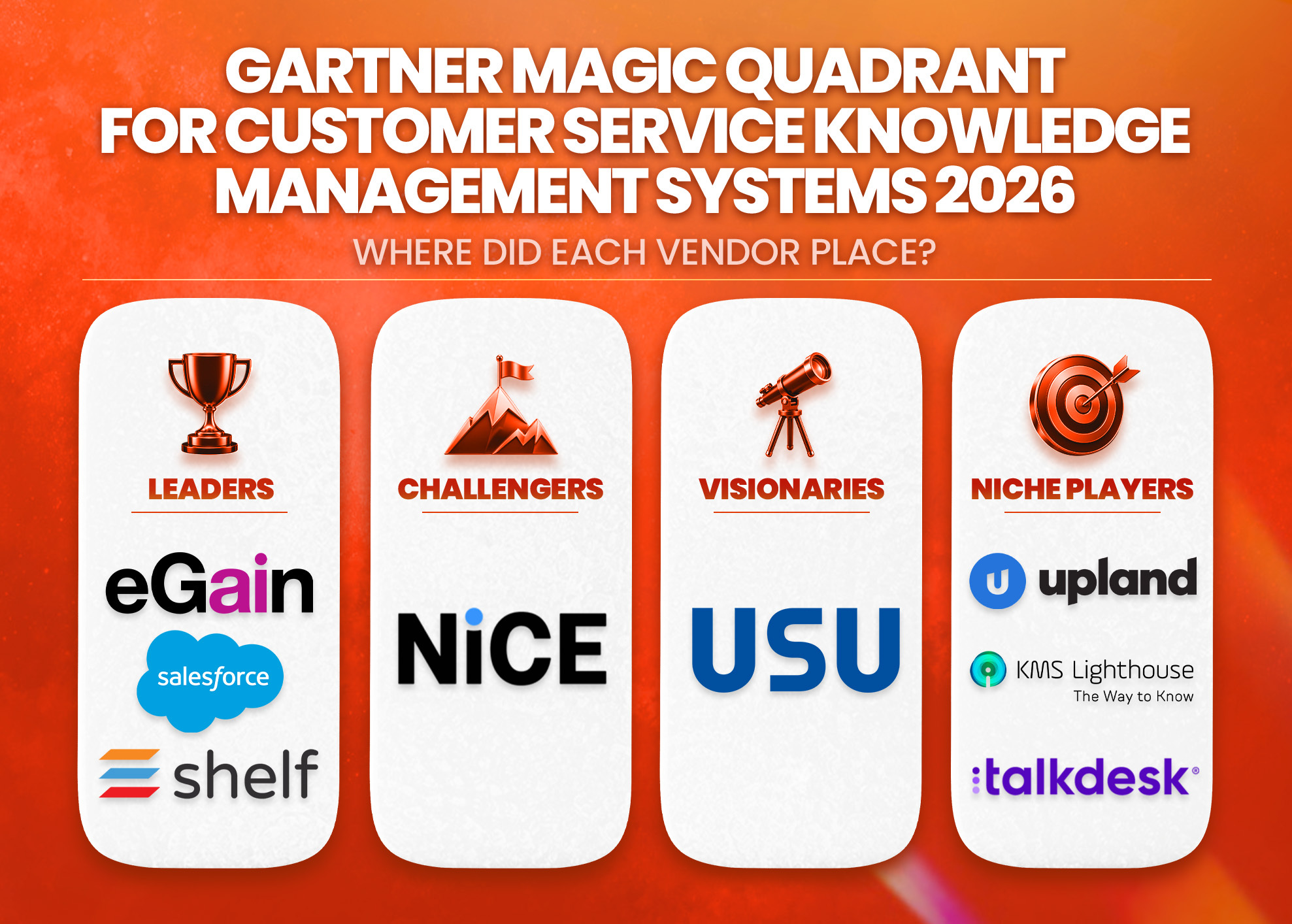
In its first-ever Magic Quadrant study into the market, Gartner isolated three leaders: eGain, Salesforce, and Shelf.
Since its founding in 1997, eGain has pioneered contact center knowledge management. Beyond what's covered in Gartner's report, its key capabilities include the "eGain Knowledge Method" for capturing fragmented knowledge, a closely aligned Agent Assist solution, and governance capabilities that safeguard experiences as new knowledge is added.
Salesforce is more of a surprise, given knowledge management solution is a module within Agentforce Service rather than a standalone offering. Yet its 2024 acquisition of Zoomin, which aggregates content across disparate sources into a unified knowledge layer, has significantly bolstered the Salesforce Knowledge offering. Its alignment with Data360, Salesforce's customer data platform (CDP), to support customer-facing AI agents is also notable.
Lastly, Shelf makes the leader quadrant chiefly due to its "market understanding," "ontology-driven design," and "consultative customer success program." Beyond the study, its other strengths include a proprietary MerlinAI engine that detects knowledge gaps, overlaps, and risks, as well as a Content Copilot that drafts and optimizes knowledge articles.
Alongside these three leaders, Gartner evaluated five additional customer service knowledge management systems providers across three other categories. Their placements are showcased in the image below.
However, beyond these eight solutions are numerous others, with some providers unlucky to miss out, especially given some of Gartner's more surprising inclusions. These are just two of seven high-level takeaways from the study…
7 Top Takeaways from the Customer Service Knowledge Management Systems Magic Quadrant
Many enterprise decision-makers consult a Gartner Magic Quadrant study at some point during the technology procurement process. As such, placements can carry real weight.
While that may be the case, there are often points of contention.
In light of this, here’s an independent perspective on the inaugural Magic Quadrant for Customer Service Knowledge Management Systems, in the form of seven top takeaways.
Alongside the core vendor analysis, these consider market trends, which jump out from the firm’s evaluation.
1. Gartner Includes Solutions Not Sold as Standalone Products
Salesforce is listed as a leader in customer service knowledge management, yet its solution only exists as a module within Agentforce Service (formerly Service Cloud).
As such, it’s only really relevant to Salesforce CRM customers. Moreover, many of those will be large enterprises that use multiple CRM systems from different providers. To centralize knowledge, they’d likely opt for an independent, third-party provider.
Given this, while Salesforce may offer leading-edge capabilities, its inclusion - especially as a leader - is a head-scratcher. The same goes for Talkdesk, which also isn’t available as a standalone product.
While Talkdesk may offer a more robust knowledge solution than many of its CCaaS rivals, it's only available to organizations using the provider’s broader contact center platform.
NiCE does make its solution available as a standalone product. Yet, much of its latest innovations hinge on being part of a broader CX platform (i.e., NiCE CXone).
Gartner acknowledges as much. NiCE's first listed strength is its “contextual delivery, analytics, and AI-assisted workflows” when deployed alongside CXone.
NiCE also declined Gartner's request for supplemental information for the study, perhaps signaling its broader focus on delivering an overarching, interconnected CX offering.
Taken together, the inclusion of these three vendors is surprising, particularly given the large standalone knowledge management providers that were left out…
2. Industry Stalwarts Miss Out
Verint delivers contact center technology to 80 of the Fortune 100, and one of its most widely-utilized products is a standalone customer service knowledge management solution.
The solution comprises several advanced, enterprise-grade capabilities, including external content spidering to tidy up knowledge documents scattered across SharePoint, Confluence, and various storage systems. It also supports flexible deployment across both cloud and on-premise environments, making it a rare option for enterprises in highly regulated industries.
Given this, its exclusion is a surprise. As is the omission of Stonly. It reportedly partners with over 20,000 organizations worldwide, including Siemens, Estée Lauder, and Lenovo. The vendor's platform also offers differentiating functionality, including embedded AI agents that continually update knowledge content.
Other prominent providers of customer service knowledge management solutions not included in Gartner’s report are Knowmax, Procedureflow, and Zingtree.
Instead, the analyst firm chose to spotlight broader CX platform providers like Microsoft, ServiceNow, and Zendesk, alongside the enterprise knowledge management platform Bloomfire.
3. Knowledge Retrieval Evolves Into Knowledge Modelling
The market is moving beyond plain document search and retrieval, adopting advanced techniques to map the logic and context needed for AI agents to best utilize knowledge content in customer conversations.
Gartner points to examples of these techniques, including “knowledge graphs, ontology-driven knowledge modeling, and structured reasoning.”
These techniques let AI agents, and the AI assistants that surface knowledge for human agents, do more than just relay information. They can reason over it, producing more reliable answers.
Shelf's approach stands out here. It transforms unstructured documents into a structured model of business concepts, relationships, and rules.
As a result, rather than simply finding relevant text, AI agents can understand policies, evaluate conditions, apply exceptions, and resolve conflicts. That enables consistent, explainable reasoning and decision-making instead of relying on document search alone.
eGain is pushing in a similar direction with its knowledge graph, helping AI agents grasp meaning and context rather than just matching keywords.
4. Knowledge Management Providers Expand Into Agent Assist
Gartner highlights how several providers are innovating to embed knowledge directly into the agent workflow.
To do this, they're parsing real-time conversational intelligence, CRM context, and knowledge content to deliver tailored next-best actions.
In doing so, many providers are developing their own Agent Assist applications. eGain is one example, and notably, it also feeds insights around how agents interact with knowledge suggestions via Agent Assist into the contact center's quality management (QM) solution. That allows contact centers to monitor whether agents are following policy.
Such innovation points to a fascinating trend not covered in Gartner's report: the convergence of knowledge and performance management in the contact center.
Another example of this is in how some vendors, such as USU, are transforming their knowledge content into microlearning modules that ensure agents understand key policies.
5. Governance Becomes Table Stakes
Gartner stresses that governance has shot from a feature of a knowledge management system to a primary buyer consideration.
Why? Because as AI responses pull directly from these knowledge bases, stale or low-quality content becomes a much higher-stakes liability than in traditional human-facing knowledge management.
Shelf's Merlin AI engine remains a leading innovation here, running continuous quality assurance (QA) analysis across all knowledge content. USU has a similar "AI Knowledge Quality" capability in the pipeline, while NiCE has embedded audit workflows.
One provider that excels in governance, but isn't included in Gartner's report, is Procedureflow. It has a "Knowledge Governance Framework" that establishes accountability for all customer-facing knowledge content, delivered as part of a structured onboarding process.
As knowledge management solutions advance, that onboarding experience will likely see more emphasis going forward.
6. Vertical-Specific Innovation Is Lacking Across the Industry
Gartner dings several providers for their lack of mature sector-specific taxonomies and compliance frameworks, even those with core bases in highly-regulated industries, including eGain, KMS Lighthouse, and USU.
Talkdesk is the example Gartner gives of a vendor that does this well, offering fine-tuned industry models as part of its industry-specific CX clouds.
Interestingly, another provider well-positioned here is Upland Software. However, not for RightAnswers, the product Gartner evaluated. Instead, for one of its two other knowledge management solutions: Panviva.
More of a guidance platform that orchestrates knowledge experiences, Panviva is well-established in highly regulated industries such as healthcare and banking.
Readers should note that Gartner's report evaluates only one of Upland Software's three offerings in this space. That's unfortunate for the provider, since much of its value lies in delivering different solutions to match different operational needs.
7. Integrations Beyond CRM and CCaaS Are Also Important…
Gartner repeatedly stresses that knowledge management solutions now serve a new type of user: not just human support agents, but AI agents as well.
Increasingly, though, the user base extends even further. Store associates, field service teams, product research, and even sales and marketing teams now draw from the customer service knowledge base.
This broader reach demands broader connectivity. While Gartner focused on CCaaS and CRM integrations, modern systems should also connect into UCaaS and collaboration tools to give these enterprise users access to knowledge wherever they work.
Some providers, including USU, are pushing this further still, integrating with employee and IT service management solutions to create a single source of truth for service management and standardize how the business responds to support queries.
Gartner Magic Quadrant studies often provide helpful market insights. However, for a deeper dive on the major players in this space, including some not covered in the firm’s report, check out the following article: 10 Contact Center Knowledge Management Systems & What Differentiates Them