
October 30, 2026 • 7 min read
Gartner Critical Capabilities for CCaaS 2026: 7 Top Takeaways

Director of Content & Market Research
October 30, 2026
With every Magic Quadrant report, Gartner releases a companion “Critical Capabilities” study.
The study identifies key capabilities in that technology segment and assesses vendors against each.
Gartner then weights its scores according to different use cases for that technology.
In its 2026 CCaaS edition, Gartner evaluated ten providers across 14 “critical capabilities” and five primary use cases.
The CCaaS providers are the same ten the firm featured in its 2026 Magic Quadrant.
The critical capabilities for CCaaS include:
- Data Center Design
- Telephony-Centric Offer
- Digital-Centric Offer
- Marketplace
- Developer Environment
- Workforce Engagement Management (WEM)
- Virtual Customer Assistant & Automation
- Customer Administration Portal
- Agent Experience and Virtual Agent Assistants
- Pricing and Contract Elasticity
- SLAs and Trust Center
- Customer Experience
- Channel Partner Program
- Real-Time Continuous Intelligence
And the five use cases are:
- High-volume customer call center: Replacing on-premise contact center technology with a CCaaS platform.
- Digital contact center: Prioritizing customer service across digital channels, such as chat, messaging, and social media.
- Customer engagement center: Integrating CCaaS with business applications to deliver orchestrated customer experiences.
- Agile contact center: Rapidly adapting the contact center setup to changing operational and budgetary requirements.
- Global contact center: Consolidating customer support across regions using a single CCaaS provider.
Here is a snapshot of the vendors that Gartner ranked in the top four for each use case.
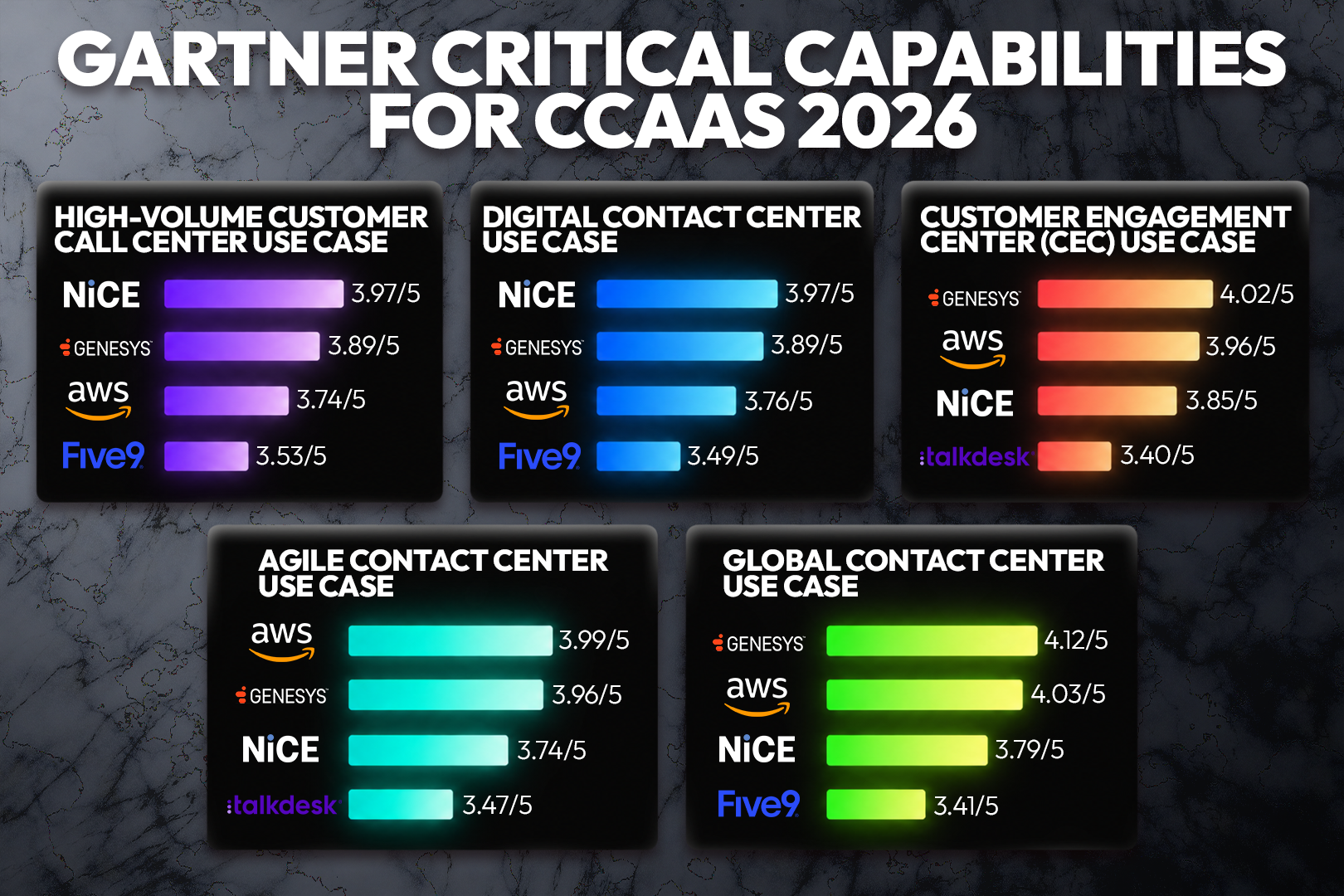
The full report, available on Gartner’s website, includes the complete assessment and rankings.
It also comprises additional commentary on the market’s direction, buyer recommendations, and trends in how specific CCaaS capabilities are evolving.
All in all, it's a deep report. But for those without a spare hour or ten to read it, here are the top takeaways, with additional, independent analysis.
1. CCaaS Procurement Is Changing
Over the past three years, the way organizations procure CCaaS solutions has changed significantly. Buying committees have expanded, with IT increasingly taking the lead.
These IT buyers are taking a more holistic view of customer support, considering how the contact center aligns with and contributes to the broader enterprise AI strategy.
From there, they’re working backward to identify the best-placed solutions and data models, “evaluating platforms based on their ability to operationalize AI across the end-to-end customer journey,” as Gartner notes.
While that’s an important, transformational process, it’s more complex than adding individual, generative AI capabilities. Instead, organizations must rethink the entire operating model.
Given this, many of the individual capabilities Gartner assesses in its report now carry little weight in procurement decisions. Instead, buyers are putting more emphasis on data strategies, ecosystems, and flexible deployment options (more on this later).
2. The New CCaaS Buyer Judges on Proof, Not Promises
As noted, contact centers are rethinking their entire operating model. That lessens the focus on flashy features and roadmap promises.
Instead, Gartner advises closer consideration of production deployments, governance, workflow integration, and measurable business value.
Unfortunately, from the research firm’s perspective, these criteria are inherently trickier to assess objectively, placing greater responsibility on buyer due diligence.
Demanding a POC is just the start. It also means speaking with customers undergoing similar transformations, learning from both their successes and setbacks, and factoring those insights into the decision-making process.
3. CCaaS Providers Are Blending Capabilities In New Ways
Traditionally, customer data, conversational intelligence, and workflow automation sat in separate siloes. Now, providers increasingly combine them on a unified platform, observes Gartner.
Take NiCE, for instance. The company is using insights into how human agents resolve customer interactions to develop AI agent prototypes, complete with ROI projections.
To further combine elements of its CCaaS offering, it’s managing those AI agents on the same WEM platform it uses for human agents, providing a single destination for workforce orchestration.
In doing so, NiCE exemplifies the trend that Gartner has identified.
Outside the report, another related trend sees CCaaS providers taking capabilities from their broader portfolios and making them available within their CCaaS offerings.
Cisco is a case in point. It is integrating its AI Defense and ThousandEyes solutions into Webex Contact Center, bringing security and network visibility capabilities that are difficult for competitors to replicate.
AWS, Microsoft, and Zoom are also jumping on this trend to stand out.
4. Workforce Engagement Management (WEM) Separates Vendors
Across nearly all use cases, WEM was the area where scores varied most significantly.
In its commentary, Gartner applauds NiCE for its strength here, while it’s flagged as a gap for AWS and Vonage, with the latter not offering WEM natively. Instead, it works with partners.
The research firm puts significant emphasis here. In its high-volume customer call center category, for instance, this capability makes up 15% of the overall score.
Some may question this because, for specific WEM elements like workforce management (WFM), large enterprises still typically rely on specialist solutions.
Nevertheless, AI is changing the contact center workforce, and CCaaS providers must support that transition.
NiCE and Cisco recognize this and have announced WEM solutions that unify human and AI agents on one platform. Expect others to soon follow suit.
5. Gartner Addresses the Increasing CCaaS-CRM Overlap
Traditionally, CCaaS managed customer interactions, while CRM handled customer information and service processes. This distinction made sense when communication channels, particularly voice, were complex to deliver. Now, they’re commoditized.
Recognizing this, CCaaS providers have stepped into the realms of CRM, offering native case management alongside adjacent solutions like journey orchestration.
At the same time, CRM players are moving into CCaaS. Microsoft, Salesforce, and Zendesk have all released solutions since 2024.
As a result, a messy middle has emerged, with different organizations choosing different technologies for the same capabilities.
Gartner acknowledges this and notes “increasing demand” for features spanning both markets, transforming the CCaaS model that once centered on interaction management into something much harder to define.
Expanding deployment options will only dial up this difficulty…
6. Emerging Contact Center Deployment Models Are Paved Over
Historically, contact centers bought a variation of the same operating model. That’s no longer the case. They can set up a contact center from virtually anywhere.
For example, organizations might build a contact center on top of their CRM, extend their UCaaS platform, or use an SDK to embed a contact center into practically any other third-party application.
Five9, Talkdesk, Twilio… Several prominent vendors offer solutions for the latter.
However, Gartner’s Critical Capabilities report doesn’t consider alternative architectural approaches. The research firm standardizes one and stretches it across different use cases.
Similarly, Gartner doesn’t mention the word “sovereign” in the study (it does in the Magic Quadrant). For many, especially beyond North America, sovereign CCaaS deployment options are now table stakes.
In fairness to Gartner, it must standardize a set of criteria to analyze the market at large. Yet, as buyers change and consider new architectural options, that criteria becomes increasingly tricky to define.
It’s less apples-to-apples and more apples-to-trampolines.
7. Further Changes to Gartner’s CCaaS Critical Capabilities May Be Required
13 of the 14 critical capabilities for CCaaS are almost identical to those listed in its 2023 report, with “real-time continuous intelligence” the only addition.
At the same time, Gartner still lists “outbound voice” and “customer self-service automation” as “optional capabilities” in its CCaaS definition.
In today’s world, where service models are increasingly AI-led and proactive, many would consider these crucial.
Given this, the new priorities of CCaaS buying committees, and the emerging deployment models, it may be time for Gartner to step back, rethink the category itself, and revise how it scores vendors.
While the report offers valuable insights, and its rankings broadly mirror those of other analyst firms, its increasingly broad-brush approach is becoming harder for buyers to interpret.
Miss the 2026 Magic Quadrant release? Get the lowdown here.