
July 6, 2026 • 9 min read
APAC Contact Center CX Platforms with AI Buyers Guide 2026: Top Takeaways

Director of Content & Market Research
July 6, 2026

Depending on how it’s defined, Asia-Pacific (APAC) comprises approximately 14 markets. That makes serving the region especially complex.
Contact center providers must support a diverse range of languages, partners, and economies to best serve contact centers in countries from the northern tip of Mongolia to New Zealand’s heel.
There are also several other factors at play, such as the density of BPO contact centers and data centers, as well as local compliance laws.
However, widely distributed industry reports such as the Gartner Magic Quadrant can misrepresent the APAC region by placing disproportionate emphasis on North American and European markets.
As a result, some vendors are highly touted despite a low APAC presence. Meanwhile, other providers finding significant success miss out altogether.
Recognizing this gap, CrayonIQ, a leading APAC contact center consultancy and advisory firm, created a buyers’ guide specifically for the region. Here's what it found.
How Did CrayonIQ Evaluate Contact Center Platforms?
CrayonIQ evaluated 20 prominent software providers that provide the primary interface for contact centers to deliver customer support.
These providers don’t necessarily have to be contact center as a service (CCaaS) or contact center infrastructure (CCI) vendors; they may also chiefly offer a CRM solution.
Across its 20 providers, CrayonIQ evaluated each across two core categories: ‘AI vision and capability’ and ‘strategic CX impact’.
To measure AI vision and capability, CrayonIQ assessed areas including:
- Conversational AI and autonomous interaction capability
- AI agents delivering functional outcomes
- Engineering co-innovation
- Asian language NLP and regional AI readiness
- Responsible AI governance and cost transparency
- Voice and text analytics
- Social listening and Voice of the Customer
- Third-party AI integrations
- AI orchestration
Meanwhile, to assess strategic CX impact, the advisory firm considered:
- Platform architecture and deployment flexibility
- Voice and interaction management
- Data analytics
- Security, compliance, and trust
- Platform ecosystem integration and composability
- Workforce engagement and human-AI operations
- Commercial viability and ecosystem strength
In doing so, it interviewed end-users, questioned channel partners, and conducted comprehensive desk research.
From there, CrayonIQ identified six ‘enterprise transformers’.
Who Are CrayonIQ’s Contact Center Enterprise Transformers in 2026?
In alphabetical order, CrayonIQ’s ‘enterprise transformers’ include: AWS, Cisco, Genesys, Microsoft, NiCE, and Verint.
The other vendors evaluated are included in the graphic below, categorized as either a future builder, midmarket innovator, or hybrid stalwart.
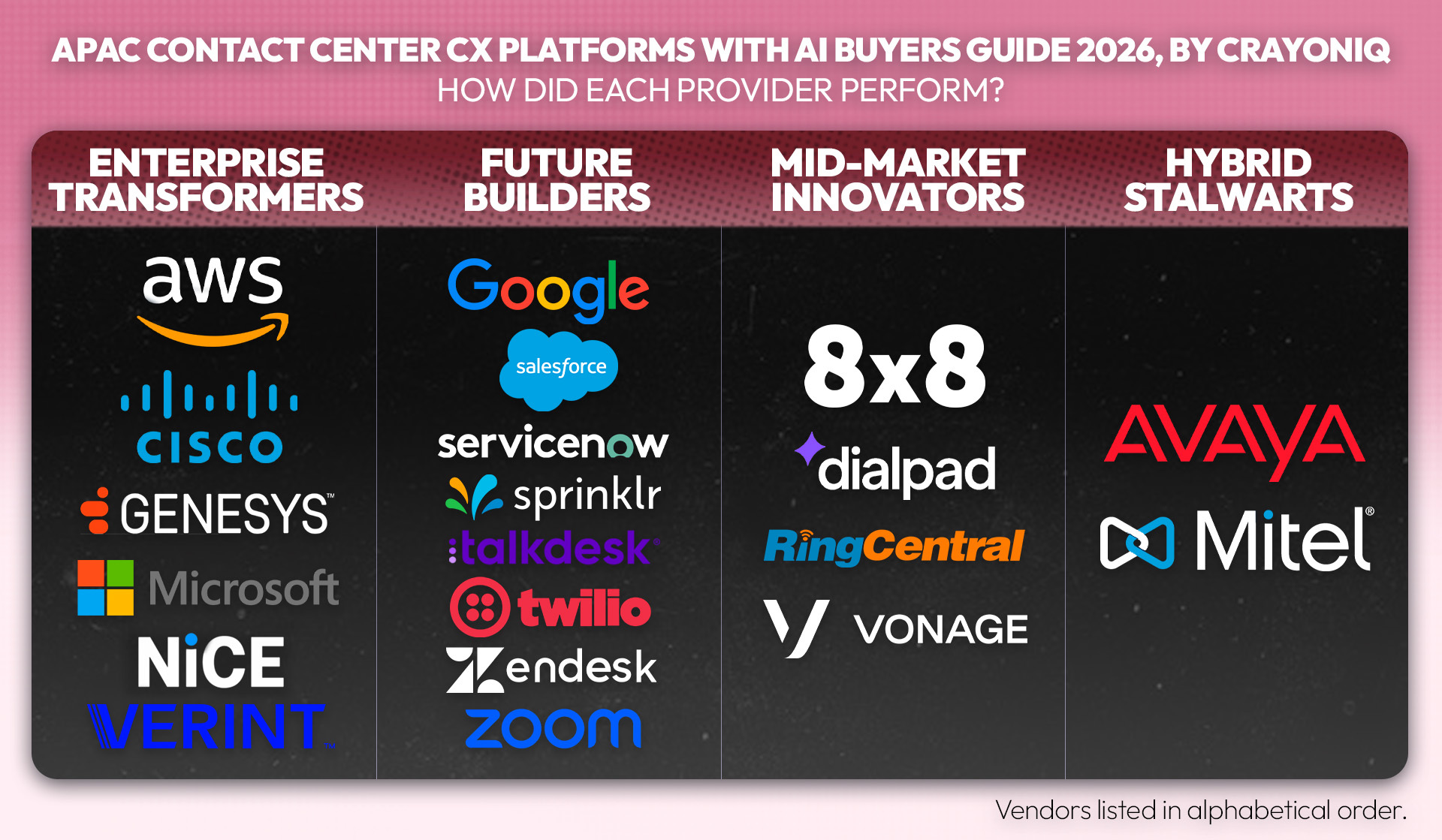
From a North American and European perspective, the guide notably omits vendors such as Five9 and Content Guru. However, CrayonIQ notes that both have seen more limited adoption in APAC, despite the latter maintaining a Tokyo office.
Meanwhile, the firm’s enterprise transformers are particularly well implemented across the region, and here’s what set them apart in the report.
AWS
The analyst singled out AWS for its explosive growth across ANZ, South Korea, Japan and ASEAN, supported by a blossoming partner network of global and prominent regional GSIs and SIs. It also commended the company’s voice AI. Specifically, it called out the combination of its Nova Sonic and Bedrock technologies. Its voice automation is also strengthened by a new Live Sync capability, enabling voice conversations that blend digital elements. Meanwhile, consumption-based pricing is also a differentiator.
Cisco
Per the report’s authors, Cisco’s greatest strength is its hybrid contact center, blending on-premises and cloud environments to accelerate innovation amongst cautious enterprises and meet strict local regulations. This makes it a strong choice amongst highly regulated industries and BPOs. CrayonIQ also credited Cisco’s advanced employee experience technologies, security and observability solutions, and its new Mumbai data center, which is contributing to its “building momentum” across ASEAN.
Genesys
Genesys has 500+ customers across the region, with particularly strong growth across Australia, Japan, and South Korea. It also has a large legacy base, through its Engage platform, which will End of Life (EoL) in 2028. That brings opportunities and challenges. However, that heritage has enabled it to establish robust regional support and partner networks. The report also signals its routing and orchestration tooling (bolstered by its recent Pinkfish acquisition) as a powerful, often-overlooked capability.
Microsoft
Many businesses are "Microsoft shops," deploying the company's technologies wherever possible to simplify their IT ecosystem. CrayonIQ recognizes this advantage, highlighting how Dynamics 365 Contact Center integrates closely with Microsoft's CRM, UCaaS, and BI solutions. The report also points to major wins at Westpac New Zealand, which migrated from Genesys Cloud, and a leading Australian bank as signs of Microsoft's growing market presence.
NiCE
NiCE has a strong presence in ANZ, including Services Australia, which operates the Southern Hemisphere's largest contact center. CrayonIQ highlights this footprint alongside the "strategically important" acquisition of Cognigy, whose AI capabilities can sit on top of legacy contact center platforms, creating opportunities beyond NiCE's existing install base. The research firm also notes that many organizations use NiCE for workforce engagement management (WEM) without adopting its CCaaS platform, presenting further expansion opportunities.
Verint
Verint ranks highly amid rising demand for AI-native WEM and CX automation, with many organizations viewing it as a trusted provider that understands the complexities of contact center operations. CrayonIQ also describes its open CCaaS strategy as "increasingly relevant," enabling it to deliver knowledge management, quality assurance, and CX analytics across platforms. Its established workforce management (WFM) footprint is another key advantage.
7 Top Takeaways from the Buyers’ Guide
While CrayonIQ presents a deep vendor analysis, its report also uncovers several trends shaping the APAC contact center market.
Given this, CX Foundation spoke with Audrey William, Founder & Principal Analyst at CrayonIQ, and Michael Clark, Principal Advisory Strategist at CrayonIQ, to discover more about those key market shifts.
Here are seven key, industry-focused takeaways that have emerged from that conversation and the firm’s research.
1. Journey & Work Orchestration Becomes Priority Number One
CrayonIQ asserts that contact center platforms are entering a new era.
Channels, queues, agent desktops, and IVRs defined the previous generation. The next will be defined by how providers help orchestrate journeys, data, and work across humans, AI, and systems.
Genesys made this shift a few years ago, repositioning itself as an AI-powered orchestration company rather than a contact center provider. In doing so, it expanded support for AI-driven workflows across ecosystems such as Salesforce, ServiceNow, and others.
Yet, other providers also have robust capabilities here. For instance, Cisco and NiCE both offer one WEM platform for human and AI agents to better monitor and manage their performance.
2. Buyers Understand New Ways to Build a Contact Center
Traditionally, organizations turn to CCaaS or CCI solutions to set up a contact center. Yet, CrayonIQ underscores a shift in buying behavior.
As IT teams take on a greater role in buying decisions, they increasingly see opportunities to build contact center capabilities elsewhere in the software stack.
CRM and helpdesk platforms are a natural point of entry, and many leading providers now offer lightweight CCaaS solutions to capitalize on this trend. Those offerings are steadily maturing.
Vendors like Five9, Talkdesk, and Twilio are also leaning into this trend, launching embedded contact center solutions.
Meanwhile, for smaller businesses, there’s an opportunity to use a service like AWS Nova Sonic and establish a voice-enabled, CRM-based contact center without a formal CCaaS offering.
3. Providers Reimagine Voice Experiences
“Voice is becoming increasingly important,” said Clark. “It's not being replaced; it's being redefined.”
Real-time voice translation across languages is a part of that, yet so too is the advancement of voice automation.
One particularly exciting example of this is in how some providers are blending voice with other digital channels.
For instance, AWS can layer digital elements onto a customer's smartphone during voice AI conversations. Meanwhile, others deploy AI to detect scenarios where it may be better to have a voice conversation and suggest switching channels.
Previously, these voice experiences felt like edge cases. Yet, rapid improvement in voice AI across languages, not just English, is democratizing these capabilities.
4. Skills Gaps and Legacy Workloads Slow AI Adoption
The study highlights that despite rising pressure on contact center leaders to implement more AI, many are struggling due to skill gaps and legacy constraints.
Indeed, CrayonIQ identifies conversational design, system integration, and data management as key skill gaps.
Additionally, long-standing challenges persist, including knowledge scattered across hundreds or even thousands of SharePoint or Confluence documents.
While the latest knowledge management solutions can help address this, a clear strategy for reviewing, maintaining, and updating content remains essential.
5. Opaque Pricing Is an Issue for Vendors & Buyers
In 2026, few contact center providers only offer seat-based pricing. As AI joins the service workforce, more are turning to alternative usage-based models, or they’re layering additional AI charges over their user-based model.
For instance, Genesys charges “tokens” for specific AI capabilities, while NiCE applies a session-based surcharge. However, CrayonIQ warns that the opacity of these models, and the way costs can fluctuate with demand, is a significant concern for buyers.
As such, brands that clearly explain their models, offer cost control measures, and present ROI indicators may have a significant advantage moving forward.
6. Security & Compliance Rise Up the Priority List
While the latest voice AI technology is exciting for organizations to leverage, it also presents opportunities for fraudsters to find new ways of infiltrating the contact center.
Voice cloning, deepfakes, and automated social engineering increase the risk profile and may trouble traditional safeguards, such as monitoring known fraud patterns and voice biometrics.
Contact centers are aware of new threats to their operations and wish to implement layered authentication systems without a significant architectural shift.
As such, innovations from the likes of Cisco and Vonage, which monitor fraud at the network level and offer other enterprise-grade security tooling, are becoming increasingly notable.
7. Hyperscalers Encroach Further on the Contact Center Space
To a previous point, the contact center is no longer managed by IT offshoots. It and other customer experience functions fall within an enterprise’s data and AI strategy.
As a result, hyperscalers see a growing opportunity in the space, leveraging first-party cloud platforms and AI models to differentiate on price.
While only AWS currently has the maturity and depth of portfolio to broadly trouble the likes of NiCE and Genesys, expect Microsoft to accelerate its contact center push.
Google, on the other hand, has the foundation through mature conversational AI and a base solution shaped by UJET, a prominent CCaaS disruptor. However, it seems less engaged. If it ever decides to give it a more significant marketing push, though, it could become an ‘enterprise transformer’.
Some of the top takeaways from the CrayonIQ research reflect several key market trends CX Foundation has scoped across the contact center space.
Catch up on these and several others here: 15 Contact Center Trends to Watch Out for in 2026