March 10, 2026 • 5 min read
Zoom Gives Its AI Companion a Major Upgrade, Signals a New Future for Work

Director of Content & Market Research
March 10, 2026
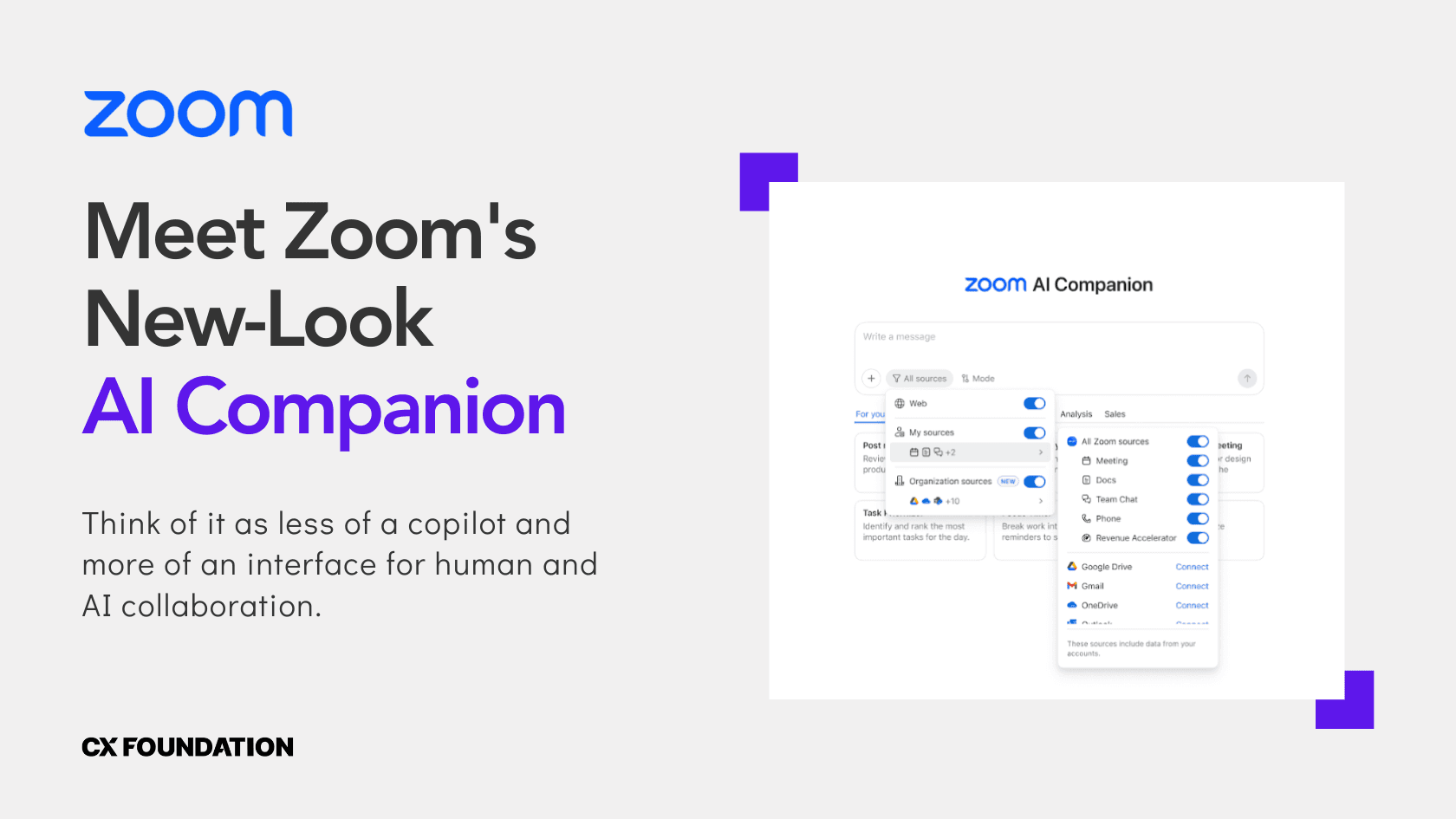
Zoom has debuted the latest evolution of its virtual assistant, the Zoom AI Companion, at Enterprise Connect.
Via a prompt to the AI Companion, employees can now tag AI agents and ask them to perform specific tasks across the Zoom environment and beyond.
As such, think of it as less of a copilot and more of an interface for human and AI collaboration.
Organizations and their employees can activate AI agents by choosing from a library of pre-configured templates. These span sales, marketing, IT, and various other departments, as showcased in the image below.
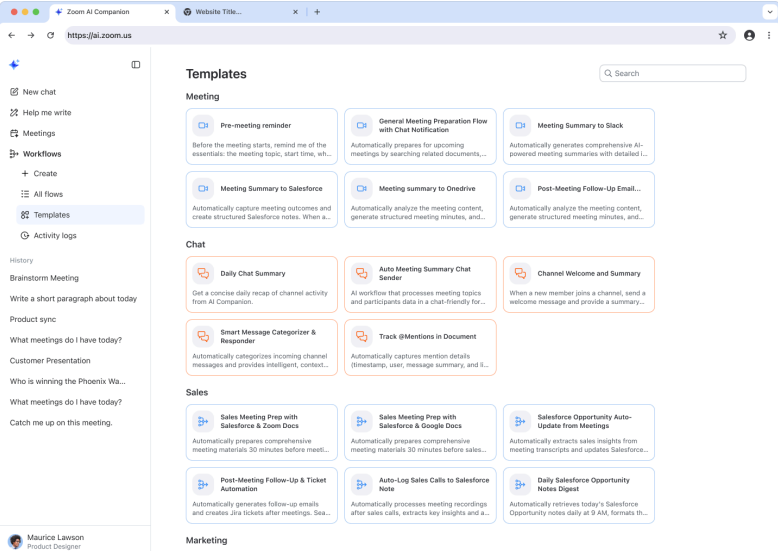
Additionally, brands (and individual employees) may develop their own AI agents and customize those in the library via Zoom’s Workflow Builder.
While these use cases are mostly confined to the vendor’s applications, brands can also leverage and build agents that complete tasks across Zoom and, in some cases, beyond.
For instance, a sales team could employ an agent to update the CRM after a customer conversation on Zoom Meetings. Another agent may automate follow-ups and Jira tickets, with only a prompt from the employee to the AI Companion.
Alternatively, users may tap an agent to retrieve information from a knowledge base or data store, via an enterprise search connector.
Such use cases underscore Zoom’s exciting vision as employees complete more of their work without leaving the vendor’s platform.
Zoom Becomes a HQ for Work
As businesses start to implement these AI agents, employees will spend more time in Zoom. Over time, it may become a HQ for work. That’s an exciting prospect.
Why? Because when agent-to-agent communication models like MCP improve, these agents may automate longtail workflows that span systems, enabling a more autonomous company.
Zoom's vision is to stand at the operational center point of that company.
Of course, it will face competition from Microsoft Teams and Slack. However, its expansive, interconnected first-party ecosystem, which includes Zoom Workplace, Docs, Whiteboard, Phone, Webinars, Contact Center, WorkVivo, and more, will give it a head start.
Additionally, its close partnership with ServiceNow, the company many IT teams are working with to develop inter-departmental workflows, could prove a significant differentiator.
Consider Zoom as the HQ and ServiceNow as the back-stage production. Over time, that could prove a compelling combination.
More on the New-Look AI Companion & Zoom's New Productivity Applications
As suggested, the AI Companion now stretches across Zoom’s ecosystem, and is now available on Zoom Phone, Chat, and Revenue Accelerator, alongside its other apps.
Organizations may also embed Zoom’s AI Companion across third-party applications, enabling a more consistent copilot experience.
Yet, perhaps most excitingly, Zoom has added two new applications to its portfolio, which AI Companion also works across: Zoom AI Sheets and AI Slides. These are spreadsheet and presentation apps, respectively.
Combined with Docs, Zoom now offers a productivity suite, opening up more opportunities for AI agents.
For instance, a company could use an agent to turn raw data and conversations on its platform into branded slide decks and spreadsheets. An example of the latter is shown below.
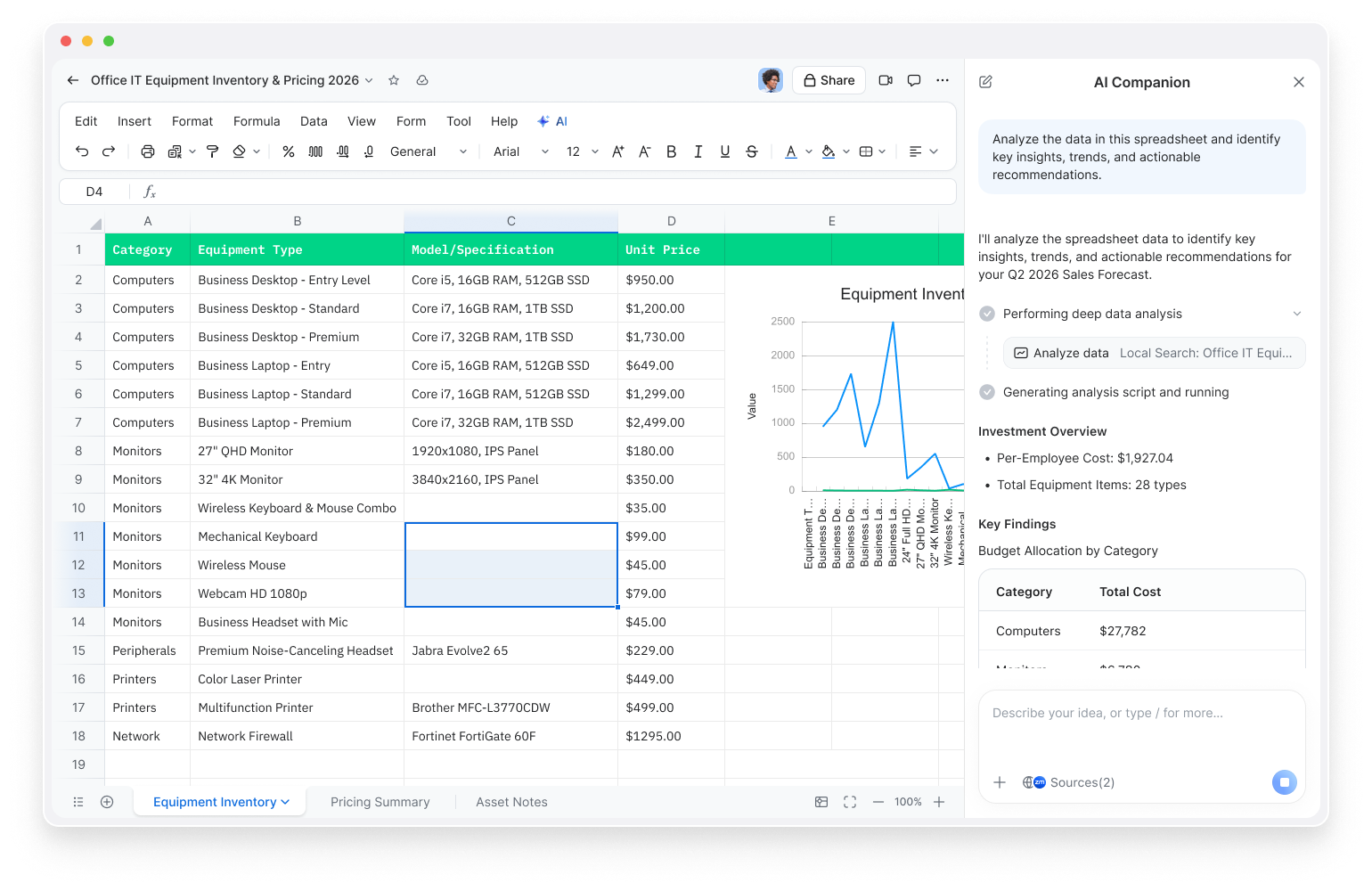
As such, the productivity suite is not just an alternative to Office 365 or Google Workspace; it’s a foundational part of Zoom’s HQ for work, capturing more business context. That’s according to Lijuan Qin, Head of Product & AI at Zoom.
“AI is evolving from being a tool we use to a teammate we rely on,” he said.
“This shift is critical for the future of work, when AI understands your business context and can act on your behalf, teams make decisions faster, stay aligned on priorities, and move from ideas to impact with greater efficiency and confidence.”

As Qin teases, the next evolutions of AI Companion may go beyond business context to understand individual employees.
So, instead of employees building AI agents and sharing prompts to simplify workflows, the system may track how individual employees work to proactively recommend and build agents.
If employees are working within Zoom all day, across its applications, that could prove a significant productivity booster.
Zoom Automates More Customer Work (Alongside Employee Work)
Zoom has momentum in CCaaS, with revenue for the Zoom Contact Center growing at a ‘high double-digit’ rate.
To accelerate this, the enterprise communications giant aims to automate more customer work, alongside employee work.
The recent release of its Virtual Agent 3.0 is key to this. Yet, so is its new CX Insights solution, which is a conversational intelligence tool.
CX Insights analyzes customer conversation transcripts alongside metrics and operational signals to answer manager and supervisor questions like a GPT. These questions could range from: which contact reasons are driving up my contact volumes? To: which manual processes are slowing down resolutions?
Contact centers can leverage this intelligence and redesign service experiences via the new Customer Workflow Orchestration tool.
The tool allows CX leaders to devise resolution journeys across systems, channels, and teams via natural language prompts. These may include proactive experiences, triggered by an event in the ERP, CRM, or another enterprise system.
Elsewhere, Zoom has pulled its Virtual Agent into a new quality management dashboard, allowing brands to monitor the performance of AI and human agents on one dashboard.
Critically, this allows brands to compare performance across contact reasons and isolate where AI or the human touch best meets customer needs.
Yet, perhaps the biggest addition to the Zoom Contact Center is the Zoom AI Expert Assist 3.0 solution.
Already, it provides next-best action recommendations to human agents. Yet, alongside contextual guidance, it can now listen to live conversations and offer to perform tasks proactively.
While the contact center must isolate these tasks, perhaps using CX Insights, and build AI agents that can pop up and fulfil them at the right time, this could accelerate resolutions.
Like the new-look AI Companion, all these Zoom CX updates are expected to drop before the end of the month.