May 20, 2026 • 5 min read
Two in Every Three Customer Service Teams Now Use AI Agents

Director of Content & Market Research
May 20, 2026
AI agent adoption has skyrocketed across customer service organizations, with 66% now leveraging at least one agent. That’s up from 39% in 2025.
Additionally, 70% of the customer support teams leveraging AI agents have observed “measurable value” within 60 days of deployment.
These statistics stem from a new ‘State of Service: AI Agents Edition’ study commissioned by Salesforce, which surveyed 3,075 customer service professionals worldwide.
Many of those professionals have unlocked value quickly by automating low-value, high-frequency work.
Yet, what comes next is something more exciting: coordinating AI agents across systems to handle complex end-to-end resolution workflows.
In doing so, these agents will update records, process claims, book appointments, and more.
As organizations implement these agents, they redesign service experiences, switching their focus toward resolving queries, not “containing” or “deflecting” them.
According to Kishan Chetan, EVP & GM of Agentforce Service, many organizations are now at this point, fundamentally shifting how they operate.
"This next stage of agentic AI focuses on scaling human capacity and transforming potential issues into reliable, consistent experiences across every channel, whether digital or voice.”

Chetan also stressed these experiences require an escalation process that doesn’t just summarize what has happened during an interaction so far, but also passes on key context that increases the chance of a successful resolution.
The next frontier of these escalations is for human representatives to have access to an AI agent themselves that interrogates the customer-facing AI agent, so they kick off the customer interaction with full context. This transforms ‘warm transfers’ into ‘agentic transfers’.
Agentforce customers could build such an agent, and this raises a key point: AI agents are more than a self-service solution. Indeed, there are many other use cases…
How Service Teams Are Using AI Agents Beyond Self-Service
In recent months, Salesforce has released a steady stream of case studies, sharing insights from some of its 29,000+ global Agentforce deals and deployments.
These case studies highlight how many customer support teams now view AI agents as more than just a self-service tool.
Consider the following examples from PepsiCo, CVS Health, and the University of Kentucky.
PepsiCo utilizes Agentforce for proactive support. It predicts when its customers’ inventories are running low, based on previous buying behaviors, and sends them a text message with a ‘one-click’ experience to resupply.
Meanwhile, CVS Health uses AI agents to support its nurses by scanning systems, collating insights, and preparing briefings so they are ready for every patient encounter. The agents also automate note-taking.
Lastly, the University of Kentucky utilizes AI agents to support staff wellness, isolating indicators that they may be struggling during interactions and suggesting interventions to prevent burnout.
However, these are just some examples, and AI agents will continue to proliferate across customer service departments.
Indeed, the survey shows that 89% of service professionals using AI agents believe their organization would benefit from expanding their use.
As this happens, conventional service roles will continue to shift.
AI Agent Adoption Is Changing Customer Service Roles
As AI agents solve customer problems proactively and reactively, each organization’s human rep headcounts should, in theory, decrease.
So, the question becomes: what happens to those reps?
Some contact centers are reducing their workforces, often by allowing headcount to drop with natural attrition.
However, another approach is for AI agents to monitor negative customer feedback, predict churn, and automatically create outbound cases for human agents to intervene and retain at-risk customers. In this model, the contact center evolves into the revenue generator it has long promised to be, while sustaining its headcount.
Alternatively, brands can reskill agents for other roles, such as sales positions or in-store associate roles.
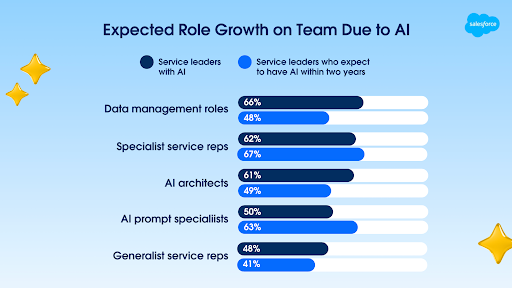
Yet, Salesforce’s research also highlights that the democratization of AI agents will lead to the emergence of new roles, including architect positions focused on overseeing deployment and operations, alongside data management roles responsible for maintaining knowledge bases.
The latter appears particularly critical, with 72% of service operations professionals admitting that data readiness remains a major barrier to AI agent success.
Interestingly, only 59% of customer service leaders shared this concern, suggesting a potential disconnect between how prepared leaders believe their organizations are for transformation and the realities faced by employees who work with the data day-to-day.
More Findings from Salesforce's State of Service Report
As AI agents expand into the contact center, it’s not just jobs that are changing. Customer attitudes and workforce planning strategies are also evolving, as evident in the following statistics, also collected from Salesforce’s State of Service study.
- 65% of customer service professionals say customers fully trust AI.
- Customer satisfaction is the top KPI improved by AI, ahead of productivity, handle time, retention, and response time.
- 97% percent of customer service leaders using AI say it is reshaping their approach to workforce planning.
These statistics were compiled after a double-anonymous survey conducted in March and April 2026, with respondents from across Asia-Pacific, Europe, North America, and Latin America.
For more insights from Salesforce, watch CX Foundation’s recent interview with Kishan Chetan, announcing the Agentforce Contact Center.