June 9, 2026 • 5 min read
Salesforce Extends Its CRM Market Lead, Oracle Now Its Closest Competitor

Director of Content & Market Research
June 9, 2026
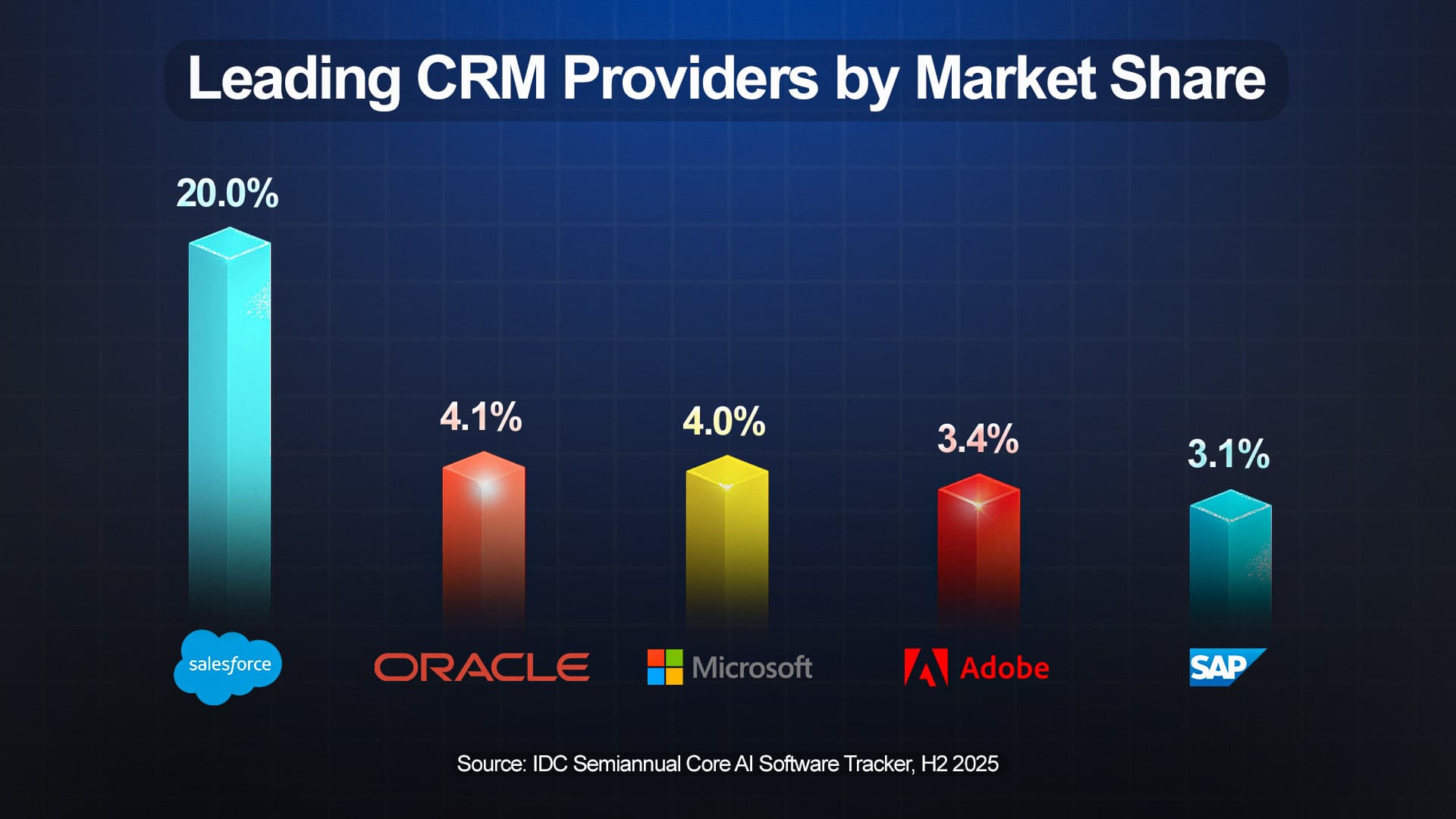
Salesforce continues to lead the CRM space, capturing 20% of the market, according to newly released IDC data.
The data comes from IDC's Semiannual Core AI Software Tracker, H2 2025, which measures each CRM vendor's revenue as a percentage of overall market revenue.
Its latest statistics show that Salesforce’s market share declined from 20.7% in 2024 to 20.0% 12 months later. However, Microsoft dropped more dramatically. It fell from 5.2% to 4.0%.
As a result, Salesforce now earns over four times its nearest rival in CRM revenue. But that’s no longer Microsoft. As of 2025, it’s Oracle, with Big Red standing firm at a 4.1% market share.
Microsoft follows as the third-largest CRM provider, with Adobe and SAP rounding out the top five.
IDC data from 2017 highlights these five vendors as the CRM market share leaders, underscoring the continued dominance of the traditional “big five”.
While each has its own strategy, a key factor is that many enterprises are so entrenched in their existing CRM ecosystems that migration has become extremely complex.
Nevertheless, there are signs that some organizations are beginning to switch to alternative providers.
Consider the table below, which collates IDC data. It shows that the combined market share of “other” providers, outside the top five, has increased each year since 2021.
CRM Market Share | |||||
| CRM Provider | 2021 | 2022 | 2023 | 2024 | 2025 |
| Salesforce | 23.8% | 22.9% | 22.1% | 20.7% | 20.0% |
| Oracle | 5.1% | 5.1% | 4.7% | 4.1% | 4.1% |
| Microsoft | 5.3% | 5.8% | 5.7% | 5.2% | 4.0% |
| Adobe | 3.8% | 3.6% | 3.5% | 3.4% | 3.4% |
| SAP | 5.4% | 4.7% | 3.8% | 3.1% | 3.1% |
| Others | 56.6% | 57.9% | 60.2% | 63.5% | 65.4% |
Many would credit vendors like HubSpot and Zoho for this trend, which initially targeted smaller businesses but are now charging upmarket.
While that is the case, other industry disruptors are also making their mark on the CRM space…
The Vendors Aiming to Disrupt the CRM Market
ServiceNow is perhaps the obvious example of a CRM disruptor. Thanks to its enterprise workflow expertise, the provider promises a more data-rich CRM experience, while also - uniquely - making order management a central part of its CRM proposition.
Nevertheless, there are several other disruptors. Consider Creatio. Its no-code architecture allows it to extend CRM workflows across the back- and middle-office more simply. The vendor was also an early proponent of composable CRM, a key industry trend.
Meanwhile, more traditional CRM vendors are reasserting themselves. Pegasystems, for example, combines strong observability over the customer experience function with robust orchestration tooling, potentially powerful capabilities in the agentic AI era.
As explored in CX Foundation’s CRM market overview, some smaller vendors are also aiming to build market share by specializing in specific sectors. Consider Spiro in manufacturing, which has optimized pre-configured workflows and integrations, AI use cases, and functionality to meet the sector’s needs.
Lastly, there’s the threat of brands building their own CRM systems through vibe coding, as some industry onlookers have touted. The post below shows how Dave Clark, former CEO of Amazon Worldwide Consumer, did precisely that.
However, this trend seems unlikely to make a dent on the broad enterprise market, with major players boasting years of experience in building and updating CRM software, maintaining their environments, and supporting mature data models.
A13th Consecutive Year for Salesforce as the CRM Market Leader
Despite growing competition in the CRM market, Salesforce’s 13-year leadership position shows no signs of facing an immediate threat.
Instead, as many of its customers expand through Agentforce, the CRM leader will undoubtedly hope to become even stickier within enterprise environments.
Its CRM architecture is already central to this, with Data 360 (formerly Data Cloud) connecting insights across CRM apps and backend systems to equip Agentforce agents with the intelligence they need to perform effectively.
Continued progress in Salesforce’s shift from traditional CRM pipelines to revenue intelligence, combined with its focus on customer success and AI education, should drive adoption of its CRM, CDP, and AI agents while strengthening long-term customer relationships.
“Every organization wants to become an Agentic Enterprise, where they automate sales, service, and marketing with humans and AI agents working together on one trusted, agentic CRM platform,” said David Schmaier, President & Chief Strategy Officer at Salesforce.
“By putting Agentforce at the heart of our strategy, we are helping companies of all sizes and in every industry 'agentify' their processes, reduce costs, grow faster, and build enterprises of the future.”

Yet while Salesforce has a plan to stay ahead, its closest competitors are also looking to hold and grow their market share.
Consider its closest competitor: Oracle. It argues that because customers’ back- and middle-office data already resides on its platform, their CRM and AI should too.
The message is compelling, particularly as its CRM sits within its Fusion Cloud suite alongside ERP, HCM and supply chain applications.
As a result, AI agents can access richer cross-functional data and workflows without the need for complex integrations.
While Oracle hasn’t really told this story until recently, it’s a compelling one, which - as IDC’s data may suggest - could be starting to resonate.
More News from Salesforce…
Alongside its continued CRM market leadership, Salesforce announced its acquisition of m3ter, a software company that aims to help brands automate consumption-based billing.
As more software companies move away from fixed subscriptions and charge customers based on consumption, billing becomes far more complex.
m3ter helps businesses track usage, calculate charges, manage credits and commitments, and connect billing data across systems.
By adding these capabilities, Salesforce may better support customers using more AI agents and processing more data, as consumption-based pricing becomes more common. It may also reduce reliance on separate billing platforms.