
May 8, 2026 • 4 min read
RingCentral AIR Tops 11,800 Paying Customers, Debuts Several New Features

Director of Content & Market Research
May 8, 2026
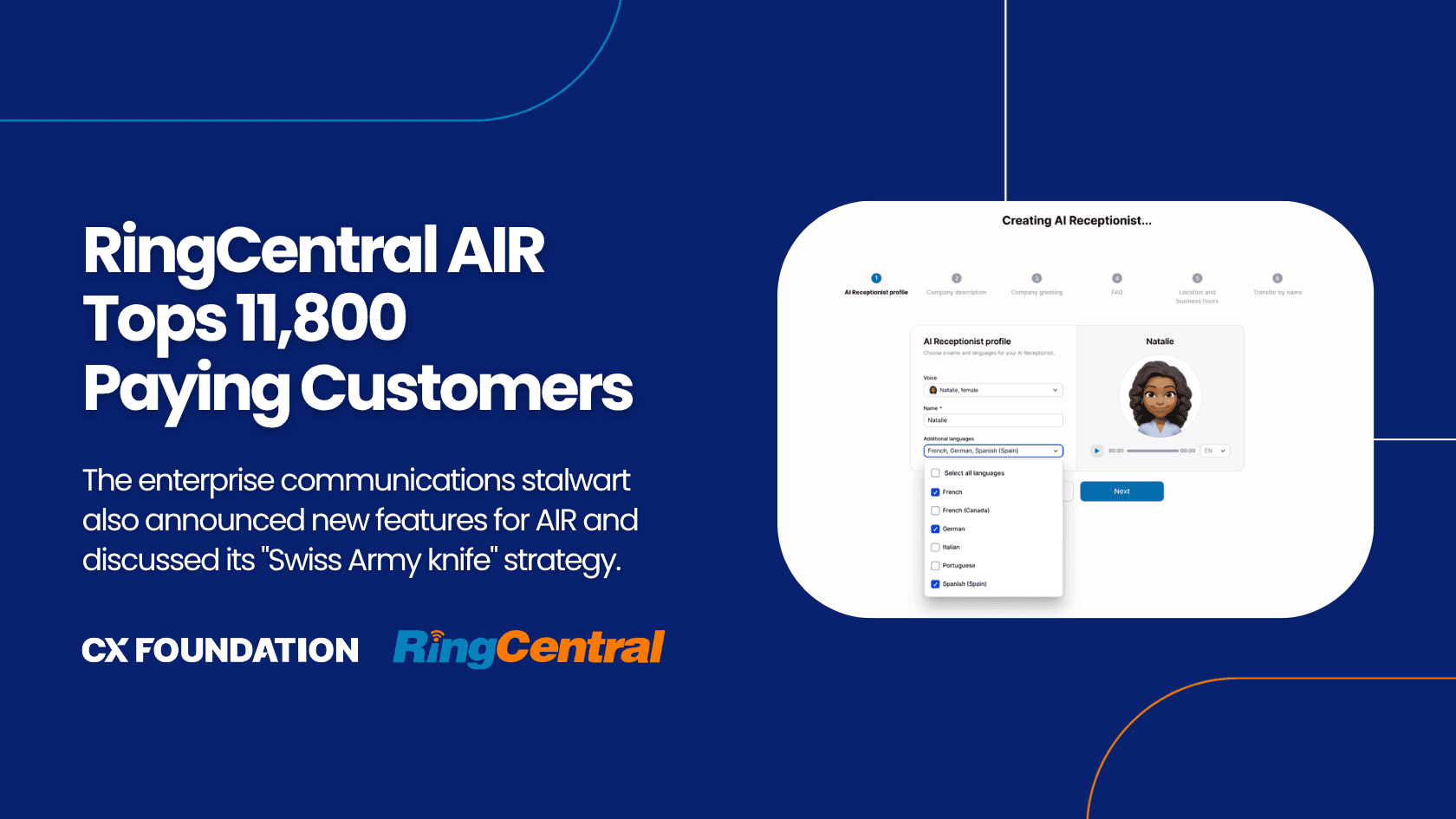
RingCentral has reached 11,800 paying customers for its AI Receptionist (AIR), despite only unveiling the solution in March 2025.
The milestone, shared during an earnings call, comes alongside a 40% quarter-over-quarter jump in the AIR’s install base, underscoring its momentum.
That spike coincided with the recent announcement of AIR Pro, a more advanced version of the solution.
Originally, RingCentral released AIR as a low-touch alternative to the hundreds of voice AI agents that require IT expertise to configure.
The premise: a human receptionist can realistically set up an AI Receptionist on their own, via the RingCentral platform, to help during peak call periods.
That help could involve solving basic queries, booking appointments, and distributing contacts to the best-placed employee across the organization.
Yet, AIR Pro is for organizations that want to push the needle further.
RingCentral AI Pro & the Swiss Army Knife
Like AIR, AIR Pro sits on top of the RingCentral platform. However, it also reaches across 100+ business systems, including HR, CRM, order management, billing, scheduling, and other solutions.
In doing so, it coordinates multi-step workflows from RingCentral into these systems, which admins can configure using natural language prompts.
As a result, brands may resolve more queries autonomously or, upon failure, escalate to employees across the front and back office.
While these capabilities are far from revolutionary, the addition of AIR Pro is a significant step forward in RingCentral’s “Swiss Army Knife” strategy.
This strategy sees RingCentral focus on delivering solutions that specifically meet the needs of SMBs, midmarket companies, and enterprises.
So, while AIR helped to support smaller, disparate businesses, AIR Pro better aligns with midmarket buyers that wish to build a more complex automation strategy.
RingCentral’s Swiss Army knife approach is also evident in its broader contact center portfolio.
Indeed, it offers a Customer Engagement Bundle (CEB) as a contact center extension of its UCaaS platform (RingEX) to SMBs, RingCX to the midmarket, and the RingCentral Contact Center - in partnership with NiCE - for enterprise customers.
Enterprise customers may also utilize NiCE Cognigy as the “agentic front door”.
“We can come in with a turnkey, Swiss Army knife solution and tell the customer, "Look, (here's the) right tool for the right job, and you only have to deal with us."

Alongside CCaaS, UCaaS, and conversational AI, RingCentral also offers conversational analytics (RingCentral ACE), workforce optimization (WFO), and CPaaS.
As these technologies converge, RingCentral's pitch is simple: no one else brings them together under one roof — and that, Shmunis argues, is the company's ultimate differentiator.
RingCentral AIR's Latest Capabilities
While celebrating the growth of AIR, RingCentral announced a series of updates to the solution.
First, it has extended AIR's reach across SMS and WhatsApp, while launching integrations with Shopify and Calendly.
The Shopify integration will help manage product and order queries, while AIR may now book appointments through Calendly, with reminders and confirmations.
Alongside that comes support for ten new languages, while the solution can now also shift between languages fluidly with the customer.
Lastly, when queues grow long or no one is available, AIR may step in automatically to proactively offer support.
See How RingCentral AIR Works
In March 2026, CX Foundation’s Katherine Stone tested the RingCentral AIR. Check out her experience interacting with the solution here.
More Highlights from RingCentral’s Earnings
RingCentral’s total revenue for Q1, 2026, came in at $644 million, up 5.3% year-over-year (YoY).
A major RingEX deal worth “tens of thousands” of seats with a Fortune 500 insurance company helped bolster those numbers.
Another big win saw the New York Mets implement RingEX alongside RingCX and the company’s Call Queues Booster.
Outside of those products, RingCentral CEB now has more than 5,000 customers, up from little over 1,000 last quarter.
Interestingly, CEB can now also be utilized inside Microsoft Teams, with RingCentral embedding voice, call queues, SMS, routing, and analytics into its rival UCaaS solution.
As a result, companies can establish an informal Microsoft Teams contact center solution.
Alongside CEB, RingCentral ACE (formerly RingSense) is growing, with more than 5,200 customers, up 85% YoY.
The enterprise communications stalwart attributes some of this growth to customers wishing to analyze AIR’s conversations alongside human-to-human conversations.
By doing so, RingCentral’s customers can understand where AIR adds value in handling contacts autonomously and where it’s better to pass over to a human.
This convergence of conversational AI and analytics is one of 15 contact center trends CX Foundation spotlighted for 2026, and RingCentral appears to recognize its significance.