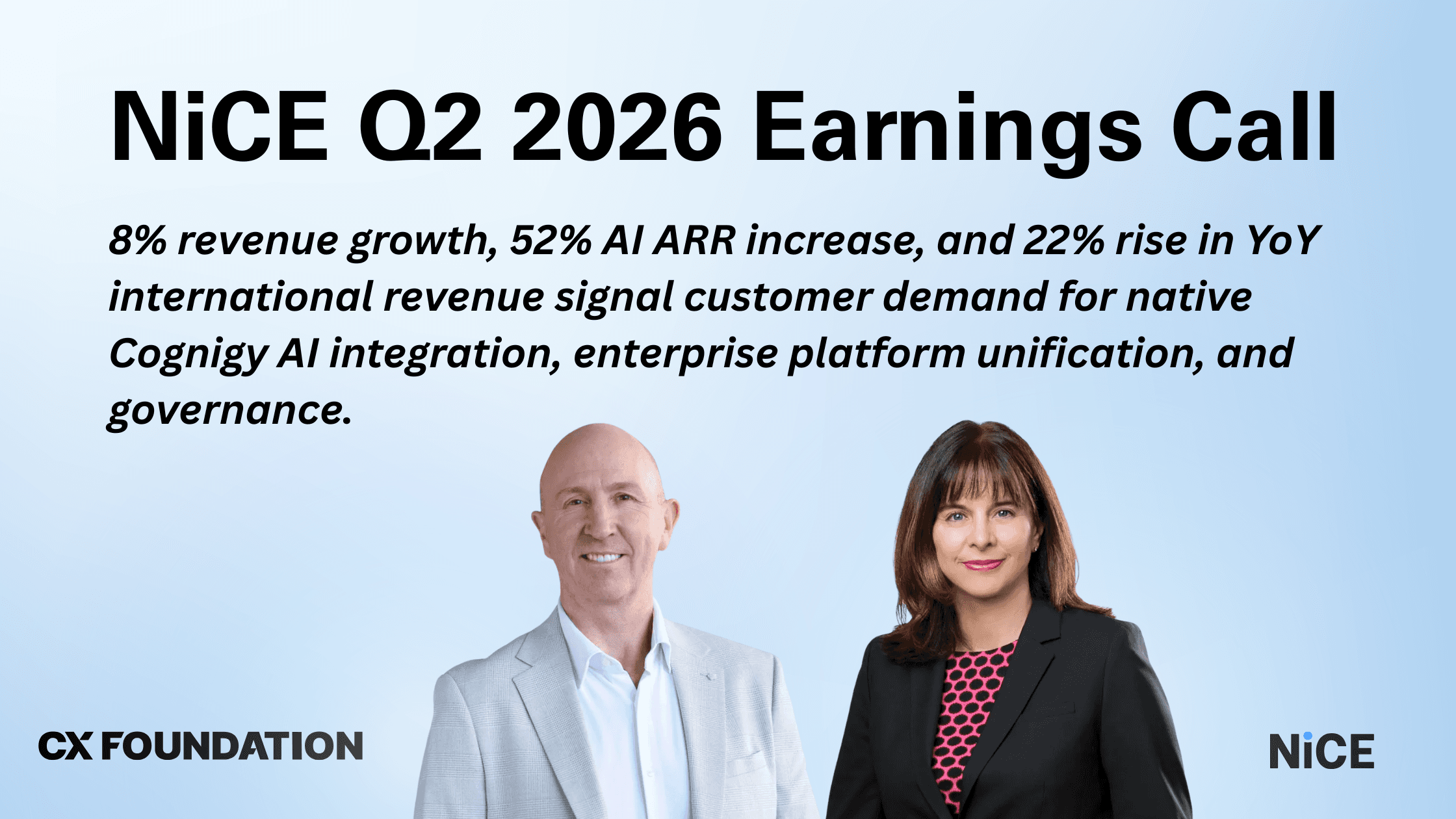
On the August 5 Q2 2026 earnings call for enterprise CX AI platform NiCE, CEO Scott Russell announced a 7.6% YoY revenue increase, bringing total second quarter revenue to $782.3 million in 2026.
NiCE's international revenue increased 22% YoY, led primarily by the EMEA region's 30% YoY growth amidst increased demand for sovereign cloud deployments. Russell also announced that Cognigy AI is now fully native to the CXone platform, delivering NiCE a significant competitive advantage ahead of schedule.
While NiCE's cloud revenue rose to $609.0 million, its growth rate cooled from 14.6% in Q1 to 12.6% in Q2. AI now represents about 15% of NiCE's total cloud revenue, with AI ARR increasing by 52% to reach $362 million in the second quarter.
"Customer engagement is a category in its own right. It connects with broader enterprise workflows, and it remains a distinct system of engagement where every interaction happens in real-time and every customer experience matters. It requires a different level of specialization than enterprise workflow automation or AI-only interaction models -- and that's exactly where NICE has built its leadership. As customer interactions continue to grow with AI interactions growing even faster, customer engagement is becoming a more strategic capability for the enterprise. That shift is driving enterprises to scale customer engagement and AI across their organizations, expanding their investment in NICE."
Scott Russell
CEO, NiCE
Although non-GAAP operating margins fell by 4.9 percentage points, this decline is in line with Russell's strategic decisions to offer competitive renewal discounts to top customers and increase investments in AI innovation.
Russell, who was joined on the call by NiCE CFO Beth Gaspich, called today's results "strong momentum" while highlighting how partnership expansions with RingCentral and Epic will drive continued growth. He also mentioned that NiCE's biggest-ever, eight-digit deal with HMRC was not included in Q2 cloud backlog growth of 19% and AI backlog growth of 72%.
Analyst Perspective: What The Results Indicate
NiCE's second quarter results are predictably solid, and Russell is right to attribute NiCE's gains to native Cognigy AI, enterprise desire for platform unification and consolidation, and ease of scalability.
Many will understandably point out that NiCE's GAAP net income dropped from $187 million a year ago to $83 million, but that kind of shock headline overstates the damage. The reality (in the simplest possible terms) is that NiCE got a one-time $12 million tax benefit that made 2025's profit look even bigger than it already was. The fact that this quarter's tax charge was normal, coupled with NiCE's Cognigy acquisition and intentional choice to increase investment in AI innovation, account for much of the shift here. The roughly 16% non-GAAP profit dip is more tolerable, moving from $190.3 million in Q2 2025 to $160.5 million in Q2 2026.
As we look to the second half, demand across our cloud and AI portfolio remains very strong. At the same time, many customers are still in the early stages of AI adoption, and the pace at which they move into production can influence the timing of monetization. We also continue to see stronger than expected on-premise demand within our non-CX business from several large financial institutions. While we remain confident in the long-term cloud migration opportunity there, the timing of these migrations can affect the mix between product and cloud revenue. These factors may influence the timing of cloud revenue growth and where we land within our guidance range, but they do not change our confidence in the business.
Beth Gaspich
CFO, NiCE
Beth Gaspich
What's especially interesting in Q2 is what Gaspich called the "stronger-than-expected product revenue."
Although cloud revenue still makes up roughly 78% of NiCE's total revenue, product revenue increased 7% year-over-year, representing 6% of total revenue. NiCE still reported record cloud ACV bookings, but cloud growth cooled slightly and AI ARR experienced a 14% deceleration, moving from 66% in Q1 to 52% in Q2.
Gaspich also revealed that NiCE's non-CX customers (especially within the financial sector) continue to invest in on-prem solutions - though it's important to note that the core CX enterprise customers still overwhelmingly prefer cloud platforms.)
Management's explanation is timing. Enterprises are signing large AI commitments but deploying them slowly, creating a lag between bookings and recognized revenue.
None of this is by any means a crisis, but it is a fascinating market signal that will have all eyes fixed squarely on NiCE's future cloud growth.
Stay updated with cx news
Subscribe to our newsletter for the latest insights and updates in the CX industry.


Beth Gaspich